Reuters reports: Offensives by the Syrian army and its allies backed by Russian air strikes are going more slowly than expected due to increased Saudi support to rebels, senior sources close to the Syrian government said, as the insurgents pressed a counter attack on Friday.
Rebels captured the village of Atshan in Hama province, the second setback for the government and its allies in that area in as many days, the Syrian Observatory for Human Rights and rebels said. The nearby town of Morek fell to rebels on Thursday.
Backed by Russian air strikes, the Syrian army and allies including the Iranian Revolutionary Guards Corps and Lebanon’s Hezbollah have launched several offensives in areas vital to President Bashar al-Assad’s control of western Syria.
But analysts say the government gains have been at best modest, one saying earlier this week the only breakthrough thus far was a minimal advance south of Aleppo.
U.S. officials have voiced a similar view, while rebels have said the Russian-backed attacks are failing and they expect more gains for their side.
In a frank assessment of the situation facing the government side, the two senior sources – neither of them Syrian – said the course of battle had been slowed by more military support to the rebels from Saudi Arabia, which is vying for influence with Iran across the Middle East and wants Assad gone from power.
They cited increased supplies of anti-tank TOW missiles to the rebels as a big factor. [Continue reading…]
Category Archives: Syria
Assad regime airstrikes level ‘economic powerhouse’ in Aleppo
Syria Direct reports: A series of regime airstrikes on Saturday destroyed Syria’s largest textile factory, the “largest source of work from the Aleppo countryside to Idlib,” a local reporter told Syria Direct.
“The Dayri factory was an economic powerhouse,” said Bashar al-Halabi, the director of the news website Aleppo and Its Countryside Today, on Sunday. The plant, located near the Aleppo-Damascus international highway in the western Aleppo countryside, manufactured polyester and employed over 600 workers.
Many of the factory’s workers were trapped inside while fires burned the building down around them. Rescue workers from the Civil Defense managed to save the majority of those trapped inside. 13 workers were reported injured and it is not yet known if anyone was killed. [Continue reading…]
Refugees helping refugees: How a Palestinian camp in Lebanon is welcoming Syrians
By Elena Fiddian-Qasmiyeh, UCL
Established in 1955, northern Lebanon’s Baddawi refugee camp is home to between 25,000 and 40,000 “established” Palestinian refugees. Like other Palestinian camps across Lebanon, it has long been violent and lawless. This summer, I conducted fieldwork there.
Such camps are outside Lebanese jurisdiction, and have commonly been referred to as “islands of insecurity”. Nonetheless, the established residents of Baddawi camp have offered protection and assistance to tens of thousands of new arrivals from Syria since 2011.
These recent arrivals include Syrian nationals who have fled violence and persecution in their country, but also displaced Syrian-Palestinians and Iraqis. While they are new to Lebanon and Jordan when compared with “established” refugee communities, refugees from Syria are now officially categorised as “protracted” refugees. And for many hundreds of thousands of Palestinian and Iraqi refugees, this is the second, third or fourth time that they have been displaced by conflict.
Baddawi is a stark reminder of the urgent reality of this crisis. We’ve been saturated with stories and images about the refugee crisis (really a protection crisis) in Europe – and yet the vast majority of refugees from Syria are still hosted by Syria’s neighbouring countries. At the end of August 2015, there were 1,114,000 in Lebanon, 630,000 in Jordan and 1,939,000 in Turkey.
Anti-ISIS airstrikes are killing more civilians than ISIS fighters
Hassan Hassan writes: Last Thursday, Russian fighter jets carried out devastating raids in the ISIL-held Syrian city of Albukamal, near the Iraqi border. At least 30 civilians were killed in the twin attacks in the city centre. Many more were seriously injured. According to activists who document atrocities, not a single ISIL member was killed in the raids.
Leaflets dropped by the regime also warned this was only the start: “The intensity of the attacks is increasing. The worst is coming. Crushing attacks will be directed to this area.”
The leaflets suggest the raids were not intended to attack ISIL specifically but were part of a systematic campaign against the local population. Also, even before the current intensity of the air strikes increases in Deir Ezzor, the government still kills more than three times the number of those killed by ISIL. According to DeirEzzor24, an organisation whose members inside the province risk their lives to document ISIL’s daily atrocities, 77 people were killed by the regime last month, compared with 25 civilians killed by the terrorist group.
The level of devastation committed by the regime in ISIL-held areas often goes unnoticed. No condemnation was issued from the US-led coalition of the massacre of civilians, which reinforces the feeling often expressed by locals that the regime, Russia and the international coalition seem to be taking turns in attacking residential areas, especially as ISIL has adjusted to the air attacks and evacuated its bases.
If the international coalition believes that ISIL does not command the support of the local population living under it, as officials often claim, then silence over such atrocities cannot be justified. Locals living under ISIL are the international coalition’s safety net against the group and its attempts to ensconce itself in areas under its control, especially in border areas where locals still view it with suspicion.
Silence over such atrocities and failure to distance the anti-ISIL coalition from them only bolsters the group’s claims that there is a global war on those communities. The attacks in those areas, in particular, have no apparent tactical purpose other than to punish the local population. [Continue reading…]
Video: The civilian toll from airstrikes against ISIS
U.S.-led air war on ISIS in Syria has little allied support
The New York Times reports: As the United States prepares to intensify airstrikes against the Islamic State in Syria, the Arab allies who with great fanfare sent warplanes on the initial missions there a year ago have largely vanished from the campaign.
The Obama administration heralded the Arab air forces flying side by side with American fighter jets in the campaign’s early days as an important show of solidarity against the Islamic State, also known as ISIS or Daesh. Top commanders like Gen. Lloyd J. Austin III, who oversees operations in Syria and Iraq, still laud the Arab countries’ contributions to the fight. But as the United States enters a critical phase of the war in Syria, ordering Special Operations troops to support rebel forces and sending two dozen attack planes to Turkey, the air campaign has evolved into a largely American effort.
Administration officials had sought to avoid the appearance of another American-dominated war, even as most leaders in the Persian Gulf seem more preoccupied with supporting rebels fighting the government of President Bashar al-Assad of Syria. Now, some of those officials note with resignation, the Arab partners have quietly left the United States to run the bulk of the air war in Syria — not the first time Washington has found allies wanting.
Saudi Arabia and the United Arab Emirates have shifted most of their aircraft to their fight against Iranian-backed Houthi rebels in Yemen. Jordan, reacting to the grisly execution of one of its pilots by the Islamic State, and in a show of solidarity with the Saudis, has also diverted combat flights to Yemen. Jets from Bahrain last struck targets in Syria in February, coalition officials said. Qatar is flying patrols over Syria, but its role has been modest. [Continue reading…]
Why is Russia bombing my town?
Raed Fares writes: On Jan. 29, 2014, I pulled into my driveway after a typical day of work. But after I got out of my car, a masked gunman jumped from his hiding place and fired bullets into my chest. A second gunman then appeared and fired more shots. As I lay bleeding, I felt death embrace me. I did not call for help, for fear the gunmen would return, but as I bled, I wondered what sort of twisted individuals would need to kill others to prove that they were right. No, I thought, only God has the right to remove me from life — and God ultimately saved me from their treachery.
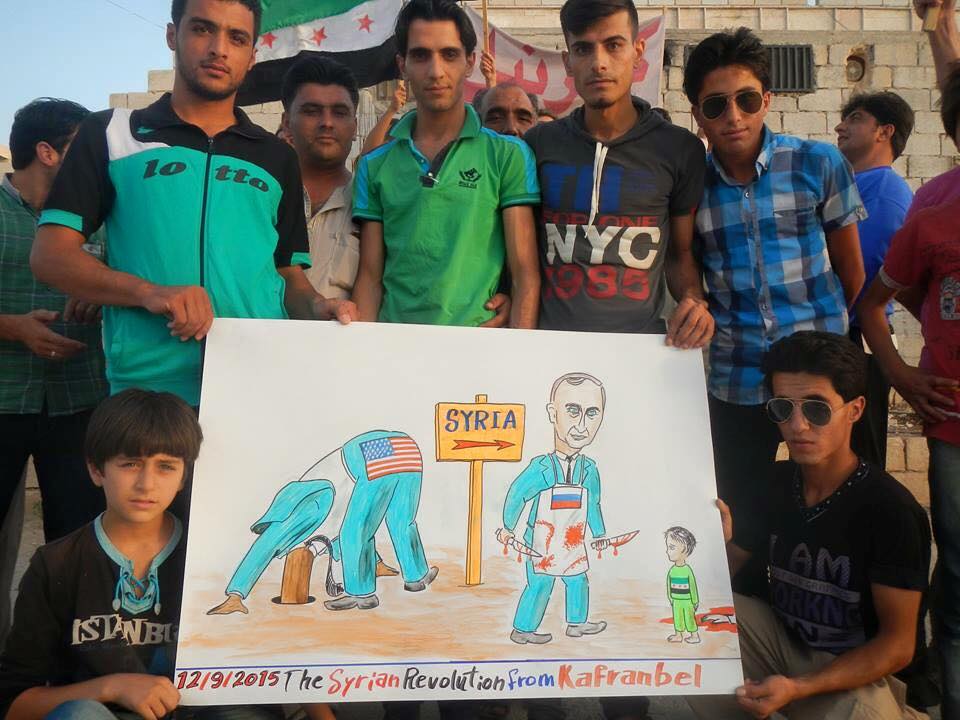
Those gunmen, I am almost certain, were sent from the so-called Islamic State (which we refer to as Daesh because it is neither Islamic nor a state). I am a media and civil society activist from Kafranbel, Syria, a village that has gained global attention for its witty and sarcastic protest banners. We have fought the regime, we have fought extremism and we have maintained our focus on bringing a civil democracy to Syria. The Assad regime has bombed us nonstop since August 2012, killing more than 500 civilians. The Islamic State also used to attack here, raiding our offices and assaulting our activists, but its attempt to kill me was its last gasp in Kafranbel. The people of Kafranbel rose up and kicked the group out. The Islamic State has no presence here today.
Russian warplanes are attacking us anyway. [Continue reading…]
Turkey’s troubling ISIS game
Roger Cohen writes: Above a restaurant specializing in sheep’s head soup, with steaming tureens of broth in the window, two young Syrian journalists took up residence in this ancient town in southeastern Turkey. They had fled Raqqa, the stronghold in Syria of the Islamic State, or ISIS, and devoted their time to denouncing the crimes of the barbarous jihadi group. Today, their second-floor apartment is a crime scene, with a red police seal on the door.
On Oct. 30, the Islamic State beheaded Ibrahim Abdel Qader, age 22, and slit the throat of 20-year-old Fares Hammadi. They later posted a video of their handiwork, saying enemies “will never be safe from the blade of the Islamic State.” The killers have not been found; a new unease inhabits this bustling town about 30 miles from the Syrian border. “It was shocking to have a first beheading in Turkey,” Omer Yilmaz, the owner of the restaurant, told me. “We are used to bullets, but that, no. To slaughter a human like an animal is unthinkable.”
The unthinkable is becoming conceivable in a combustible Turkey. Syrian violence has seeped over the border. The Islamic State is now entangled in the age-old conflict of Turks and Kurds. During several days near the Syrian border, often in areas with Kurdish majorities, I found simmering anger among Kurds and predictions of worsening bloodshed. [Continue reading…]
ISIS’s ‘most potent’ crew is now in Sinai — and says it bombed Russia’s jet
The Daily Beast reports: Soon after Russian planes began dropping bombs on Islamic militants in Syria a month ago, in an effort to prop up the country’s embattled dictator Bashar al-Assad, ISIS vowed that Russia, and by extension its citizens, would be a target. Last Saturday, Russian Metrojet Flight 9268 departed Sharm el-Sheikh, Egypt, and flew directly over the homebase of an ISIS affiliate with the ambition, and perhaps the capability, to make good on that threat.
The growing fears that an explosive device may have brought down the airplane, killing all 224 on board, stems in part from the rise of the ISIS affiliate in the northern part of the Sinai peninsula.
Over the past four years, the self-proclaimed Islamic State’s branch in Egypt’s Sinai peninsula has grown into a formidable threat. It “is one of the group’s most active and potent ISIL affiliates,” a U.S. counterterrorism official told The Daily Beast, using an alternative acronym for the group.
The branch, which calls itself the Islamic State of the Sinai, or Wilayat al Sinai, has twice claimed responsibility for taking down the Russian airliner, most recently on Wednesday. But it hasn’t offered any of ISIS’ trademark evidence, such as martyr statements or videos of the plane crashing. Rather, the group said essentially: “Trust us, we did it.” And that only added to the mystery about how the plane came down.
U.S. officials said this week that some intelligence points to ISIS or its affiliate in Sinai as having detonated bomb on the Russian airliner, though the Obama administration has yet to publicly make that claim, and scant evidence has been put forward.
If Wilayat al Sinai turned its sights on foreign citizens, it would mark a significant evolution in ISIS’ regional strategy, from gobbling up territory to launching attacks on civilians beyond its holdouts in Iraq and Syria. It would also stand as one of the deadliest attack by a terror group since 9/11, and the first successful attack since then against civilian aviation. [Continue reading…]
A Syria-first strategy for defeating ISIS
Fred Hof writes: The four-plus years the United States spent holding Syria at arm’s length, hoping its carnage could be contained while drawing erasable red lines and merely calling on Assad to step aside, have helped to spawn horrific unanticipated consequences and narrowed policy options. Decisions America deferred in 2012 came home to roost in 2015. Everything is harder now, and policy choices run along a spectrum of bad to worse, with “inaction” firmly situated at the “worse” end. And yet hard decisions, if avoided in 2015, can haunt Obama’s successors for decades to come. What should be done right now to defeat ISIS?
In western Syria, the United States and its partners should make civilian protection the near-term centerpiece of their anti-ISIS strategy, before even beginning to seek the political solution [David] Ignatius [in a recent essay] rightly calls the best hope for Syria’s survival. The objective should be twofold: terminate the ability of the Assad regime to kill large numbers of civilians, whether with barrel bombs, artillery shelling, high-performance aircraft bombing and strafing, or missile attacks; and oblige the regime to lift sieges that deny food and medical care to up to 600,000 Syrians. Blunting Assad’s policy of collective punishment ought to be a humanitarian imperative. But it will be good enough if the Obama administration sees civilian protection as an essential anti-ISIS war measure, which it most assuredly is.
How to do it? First, lean hard diplomatically on Russia and Iran. The recent meeting in Vienna among diplomats from world and regional powers means nothing and goes nowhere unless Syrian civilians receive protection from the depredations of their own so-called government. Leaders in Tehran and Moscow have it in their power to compel their client to stop bombing civilians and to lift starvation and disease sieges in accordance with UN Security Council Resolution 2139. After all, without Russia and Iran, Assad is finished. The United States should present them with a straightforward proposition: Get your client to stop committing war crimes and crimes against humanity, or we will take steps to protect Syrians. Russia’s UN ambassador, Vitaly Churkin, announced the day after the Vienna meeting that the Assad regime had stopped barrel bombing—a positive development if true, and an interesting one given Assad’s repeated denials of having used those weapons at all. [Continue reading…]
ISIS suspected of using chemical weapons in Syria and Iraq
Reuters reports: Chemical weapons experts have determined that mustard gas was used in a Syrian town where Islamic State insurgents were battling another group, according to a report by an international watchdog seen by Reuters.
A confidential Oct. 29 report by the Organisation for the Prohibition of Chemical Weapons (OPCW), a summary of which was shown to Reuters, concluded “with the utmost confidence that at least two people were exposed to sulphur mustard” in the town of Marea, north of Aleppo, on Aug. 21.
“It is very likely that the effects of sulphur mustard resulted in the death of a baby,” it said.
The findings provide the first official confirmation of use of sulphur mustard, commonly known as mustard gas, in Syria since it agreed to destroy its chemical weapons stockpile, which included sulphur mustard.
The report did not mention Islamic State, as the fact-finding mission was not mandated to assign blame, but diplomatic sources said the chemical had been used in the clashes between Islamic State and another rebel group taking place in the town at the time.
“It raises the major question of where the sulphur mustard came from,” one source said. “Either they (IS) gained the ability to make it themselves, or it may have come from an undeclared stockpile overtaken by IS. Both are worrying options.”
Syria is supposed to have completely surrendered the toxic chemicals 18 months ago. Their use violates U.N. Security Council resolutions and the 1997 Chemical Weapons Convention.
The findings were part of three reports released to members of the OPCW last week. They add to a growing body of evidence that the Islamic State group has obtained, and is using, chemical weapons in both Iraq and Syria. [Continue reading…]
In last interview, Iranian Revolutionary Guard Corps commander described role in Syria
Pandagulu draws out some of the salient points from the last interview given by Iranian Revolutionary Guard Corps(IRGC) top commander, Hossein Hamadani, before his recent death in Syria:
[T]he Supreme Leader told us that Syria is like a patient that is not aware of his ailment. Therefore, he doesn’t want to go to Doctor, but you need to take him anyway. When he goes to Doctor he will tell you that he doesn’t want any medication. You need to prescribe and get the medication for him. He won’t take the medication, but you need to make him take it, Hamadani asserted. “That was the recipe for us to stay,” he added.
Accoding to Hamadani, the opening for Iran in Syria came when the opponents reached to the close vicinity of Assad’s palace. “Everyone fled, even the Russians,” Hamadani claimed, adding that Iranians were the only one that stayed. They came to believe that we would stay next to them “up to the last moment.” As a result, they started to trust us, the IRGC commander said.
Enforced disappearances: The Syrian government’s organized attack in which more than 58,000 civilians have gone missing
Amnesty International: The vast scale and chillingly orchestrated nature of tens of thousands of enforced disappearances by the Syrian government over the past four years is exposed in a new report by Amnesty International published today.
Between prison and the grave: Enforced disappearances in Syria reveals that the state is profiting from widespread and systematic enforced disappearances amounting to crimes against humanity, through an insidious black market in which family members desperate to find out the fates of their disappeared relatives are ruthlessly exploited for cash.
“This report describes in heart-breaking detail the devastation and trauma of the families of the tens of thousands of people who have vanished without trace in Syria, and their cruel exploitation for financial gain.”
The scale of the disappearances is harrowing. The Syrian Network for Human Rights has documented at least 65,000 disappearances since 2011 – 58,000 of them civilians. Those taken are usually held in overcrowded detention cells in appalling conditions and cut off from the outside world. Many die as a result of rampant disease, torture and extrajudicial execution. [Continue reading…]
Syrian activists, working against insurmountable odds, struggle to build a new society
Robin Yassin-Kassab writes: Samar Yazbek’s shocking, searing, and beautiful new book, The Crossing: My Journey to the Shattered Heart of Syria, describes three visits to Idlib province in northern Syria, an area liberated from the Assad dictatorship “on the ground but betrayed by the sky.”
In the face of regime repression, Syria’s non-violent protests of 2011 had transformed into an armed uprising in 2012. By August of that year, when the author — exiled Syrian novelist and journalist Samar Yazbek — made her first trip, Bashar al-Assad’s forces had been driven from the rural border zones. From a distance, however, via warplanes and long-range artillery, they implemented a policy of scorched earth and collective punishment.
So Yazbek finds her homeland changed to a landscape of burnt fields and cratered marketplaces, with boys picking through collapsed homes in search of things to sell and displaced families sheltering in tombs and caves. Death is ever-present. Gardens and courtyards have become cemeteries. Yazbek never shies away from the horror but builds something worthwhile from it, a record and a reflection, for death is ultimately “the impetus of writing and its source.”
Known today only for war, Syria is heir to an ancient civilization. Idlib province houses the remains of Ebla, a 5,000-year-old city, and is dotted with half-intact Byzantine towns and churches. The war’s “ruthless sabotage of history” has damaged these priceless sites. In Maarat al-Numan the statue of 9th-century poet Abu Alaa al-Maari, a native of the town highly respected in his own time despite his unusual atheism, has been decapitated by armed Islamists. And the wonderful mosaic museum at the same location has been bombed by the regime and looted by various militias.
But amid these ruins Yazbek encounters a people giving voice to their aspirations after half a century of enforced silence. In revolutionary towns the walls are “turned into open books and transient art exhibits.” Activists organize “graffiti workshops, cultural newspapers, magazines for children, training workshops, privately-run community schools.” In the context of state collapse these projects are born of necessity, but they also reflect the kind of society the revolutionaries hoped to build — inclusive, democratic, forward-looking — one which they are in fact trying to build, even as extremists fashion their own, much darker versions.
Through self-organized committees and councils, Yazbek is told, “each region now has its own administration, and every village looks after itself.” This — Syrians’ willed self-determination, Syrian creativity amid destruction — is the positive story so often missed in the news cycle, and it represents a hope for the future, faint though it is. The activists know they are working against insurmountable odds, but continue anyway. They document atrocities and reach out to international media, an endeavor that has so far failed to bear tangible fruit. When they can, they laugh — it’s “as though they inhaled laughter like an antidote to death.” [Continue reading…]
Afghan refugees in Iran being sent to fight and die for Assad in Syria
The Guardian reports: Iran is recruiting Afghan refugees to fight in Syria, promising a monthly salary and residence permits in exchange for what it claims to be a sacred endeavour to save Shia shrines in Damascus.
The Fatemioun military division of Afghan refugees living in Iran and Syria is now the second largest foreign military contingent fighting in support of Bashar al-Assad, the Syrian president, after the Lebanese militia Hezbollah.
Iranian state-affiliated agencies reported in May that at least 200 Fatemioun members had been killed in Syria since the beginning of the war. How many more have died since is not clear.
Iran has always claimed it is participating in an advisory capacity in Syria, dispatching senior commanders to plan and oversee operations, but the Afghan involvement shows it is using other methods.
Recruitment is taking place on a daily basis in Mashhad and Qom, two Iranian cities with the largest population of Afghan refugees. Mashhad, the second most populous city in Iran, is only three hours’ drive from the country’s border with Afghanistan.
Iran is also accepting Afghans below the age of 18 provided they have written permission from their parents, the Guardian has learned. At least one 16-year-old Iran-based Afghan refugee was killed in Syria earlier this autumn. The rising number of funerals in Iran is a tangible sign revealing a greater involvement in the Syrian conflict in the wake of the Russian airstrikes. [Continue reading…]
Refugees: ‘No one puts children in a boat unless the water is safer than the land’
The New York Times reports: The rubber dinghy rolled perilously on the waves and twisted sideways, nearly flipping, as more than three dozen passengers wrapped in orange life vests screamed, wept and cried frantically to God and the volunteers waiting on the rocky beach.
Khalid Ahmed, 35, slipped over the side into the numbing waist-high water, struggled to shore and fell to his knees, bowing toward the eastern horizon and praying while tears poured into his salt-stiff beard.
“I know it is almost winter,” he said. “We knew the seas would be rough. But please, you must believe me, whatever will happen to us, it will be better than what we left behind.”
The great flood of humanity pouring out of Turkey from Syria, Afghanistan, Iraq and other roiling nations shows little sign of stopping, despite the plummeting temperatures, the increasingly turbulent seas and the rising number of drownings along the coast.
If anything, there has been a greater gush of people in recent weeks, driven by increased fighting in their homelands — including the arrival of Russian airstrikes in Syria — and the gnawing fear that the path into the heart of Europe will snap shut as bickering governments tighten their borders.
“Coming in the winter like this is unprecedented,” said Alessandra Morelli, the director of emergency operations in Greece for the United Nations High Commissioner for Refugees. “But it makes sense if you understand the logic of ‘now or never.’ That is the logic that has taken hold among these people. They believe this opportunity will not come again, so they must risk it, despite the dangers.”
The surge means that countries throughout the Balkans and Central Europe already under intense logistical and political strain will not find relief — especially Germany, the destination of choice for many of the refugees.
Hopes that weather and diplomacy would ease the emergency are unfounded so far, putting more pressure on financially strapped and emotionally overwhelmed governments to quickly find more winterized shelter.
The influx also underscores the European Union’s failure to reach a unified solution to the crisis, leaving places like this, on the Greek island of Lesbos in the northern Aegean Sea off the coast of Turkey, struggling to deal with huge numbers of desperate people and raising questions about what will happen not just this winter, but in the spring and beyond. [Continue reading…]
ISIS suspected of bombing Russian jet, but little evidence cited in support of this claim
The Daily Beast reports: Wittingly or unwittingly, British authorities have triggered a sudden blizzard of assertions that the Russian Airbus A321 that crashed in Egypt was brought down by a bomb on board. Until 10 Downing Street, apparently acting on their own initiative, decided to send their own aviation security experts to the airport at Egypt’s Sharm el-Sheikh to “assess” the level of security, British and American intelligence agencies were limiting the chance of a bomb being the cause to a “possibility.”
The Brits have provoked, within hours, a chorus of endorsements that terrorism was involved, but without any single piece of definitive evidence to prove it.
Stopping prudently just short of such evidential confidence, 10 Downing Street said “we cannot say categorically why the Russian jet crashed. But as more information has come to light we have become concerned that the plane may well have been brought down by an explosive device.”
Reports by CNN, NBC News, and the Associated Press originally cited a single, anonymous U.S. intelligence official who said that ISIS was involved.
Multiple U.S. officials told The Daily Beast that it was too soon to say definitively that a bomb aboard the airplane was responsible for the crash. But none of them would rule out that possibility, either, and acknowledged that a bomb is one scenario that intelligence agencies have been considering since the day of the crash.
“Intelligence officials are starting to lean that way,” a U.S. official told The Daily Beast of the bomb scenario.
Notably, the intelligence so far that tends to support the theory of a bomb has been technical in nature, including intercepted communications from within terrorist groups and indications from satellites of some intense heat signature at the time of the crash — possibly from an explosion. [Continue reading…]
US hasn't yet seen traces of explosives on airplane. Bomb speculation is all based on interpretation of sketchy intercepts.
— Matt Apuzzo (@mattapuzzo) November 4, 2015
The Independent reports: An “engine explosion” is thought to be the most likely cause of the Russian plane crash in Sinai on Saturday which killed 224 people, according to Egyptian and Russian media reports.
Investigators have been carrying out preliminary analyses of the Metrojet Airbus 321’s two “black box” flight recorders since Tuesday morning, though damage to the equipment has slowed their progress.
But while an initial assessment of the evidence on the cockpit voice recorder seemed to show noises “uncharacteristic of a standard flights” just before the plane disappeared off radar screens, a first look at the other recorder has thrown up an explosion of the engine as the main lead.
That’s according to a source close to the investigation, the Egyptian Al-Masry al-Youm newspaper reported. The source also said that the possibility of a catastrophic blast on the engine was first thrown up by an analysis of debris at the crash site. [Continue reading…]
Syria: Is Putin preparing to dump Assad?
By Scott Lucas, University of Birmingham
The answer from Russia’s foreign ministry spokeswoman Maria Zakharova was blunt. Asked on November 3 if saving Syria’s president, Bashar al-Assad, was a matter of principle for the Russians, Zakharova replied: “Absolutely not, we never said that.”
Driving home the point, she added: “We are not saying that Assad should leave or stay”, declaring that it was up to the Syrian people to decide his fate.
In October, Russia began bombing rebel positions inside Syria, as well as the Islamic State, to prop up an Assad regime facing military defeat. At the end of the month, Moscow’s efforts for an international conference to confirm Assad’s short-term hold on power produced a meeting in Vienna.
But is it now reconsidering that situation and preparing to ditch the Syrian leader? The question deserves more than a yes or no answer. Russia is having to rethink its approach because its political-military strategy to prop up the Assad regime, if not the president, has not been successful. It has also led Moscow to diverge from Assad’s other main ally, Iran.
Assad supporters, both inside and outside Syria, quickly rallied to say that Zakharova’s statement was merely a reiteration of a long-standing Russian position. They cited declarations from Russian president, Vladimir Putin and his officials, throughout 2012, such as: “We aren’t concerned about Assad’s fate, we understand that the same family has been in power for 40 years and changes are obviously needed.”
The line – similar to yesterday’s statement – was that: “this issue has to be settled by the Syrians themselves”.
But then Russia regularly has changed its Syria policy. After Iran and Hezbollah stepped up political, economic, and military intervention for the Assad regime in early 2013, for example, Russia pulled back from that earlier “he can go” rhetoric and began contributing strategic support themselves.