Micah Zenko writes: If you watch U.S. government press conferences, you will occasionally come across a moment of incidental but illuminating honesty. Yesterday, one such moment occurred during a routine press briefing with Col. Steve Warren, spokesman for Operation Inherent Resolve (OIR), the command element for the war against the self-declared Islamic State. Col Warren was asked about the growing number of disturbing allegations of Russia’s indiscriminate use of airpower in Syria. Just the day before, Secretary of Defense Ashton Carter told the Senate Armed Services Committee that, “it appears the vast majority of [Russian] strikes, by some estimates as high as 85 percent to 90 percent, use dumb bombs.” Warren echoed Carter’s assessment, claiming that, “Russians have chosen to use a majority of really, just dumb bombs, just gravity bombs, push them out the back of an airplane, and let them fall where they will.”
Col. Warren went further to castigate Russia for its use of one particular type of ordinance: “You know, there’s been reporting that the Russians are using cluster munitions in Syria, which we also find to be irresponsible. These munitions have a high dud rate, they can cause damage and they can hurt civilians, and they’re just, you know, not good.”
That cluster munitions are “not good,” except as a reliable method for killing noncombatants outside of an intended target field, is a well-known and established fact. According to one UN estimate, the failure rates for cluster munitions vary from between 2 and 5 percent (according to manufacturers) to between 10 and 30 percent (according to mine clearance personnel). They were subsequently banned by the UN Convention on Cluster Munitions, which entered into force in August 2010 and has been endorsed by ninety-eight states parties. Notable states that have refused to sign and ratify the convention include those that consistently uses airpower to achieve their military objectives, such as Russia, the United States, and Saudi Arabia. [Continue reading…]
Category Archives: Syria
A mass refugee crisis, and it may yet get worse
The New York Times reports: They arrived in an unceasing stream, 10,000 a day at the height, as many as a million migrants heading for Europe this year, pushing infants in strollers and elderly parents in wheelchairs, carrying children on their shoulders and life savings in their socks. They came in search of a new life, but in many ways they were the heralds of a new age.
There are more displaced people and refugees now than at any other time in recorded history — 60 million in all — and they are on the march in numbers not seen since World War II. They are coming not just from Syria, but from an array of countries and regions, including Afghanistan, Iraq, Gaza, even Haiti, as well as any of a dozen or so nations in sub-Saharan and North Africa. They are unofficial ambassadors of failed states, unending wars, intractable conflicts.
The most striking thing about the current migration crisis, however, is how much bigger it could still get.
What if Islamic State militants are not beaten back but continue to extend their brutal writ across Iraq and Syria? What if the Taliban continue to increase their territorial gains in Afghanistan, prompting even more people to flee? A quarter of Afghans told a Gallup Poll that they want to leave, and more than 100,000 are expected to try to flee to Europe this year. [Continue reading…]
ISIS assassinates prominent Syrian activists in Turkey
One of our member called " Ibrahim " and another friend called "Fares" was found slaughtered in their house in Urfa pic.twitter.com/6xkQ9S3Jcr
— الرقة تذبح بصمت (@Raqqa_SL) October 30, 2015
The Daily Beast reports: This month, ISIS perpetrated the worst terrorist attack in modern Turkey’s history. Today, it dispatched an assassin to murder two Syrian activists from the “capital” of the so-called caliphate, and wasted no time boasting of its cross-border reach.
Fares Hammadi and Ibrahim Abd al-Qader were both members of the grassroots anti-ISIS organization known as Raqqa is Being Slaughtered Silently (RBSS). Not long after the jihadist takeover of their hometown of Raqqa City in 2014, they fled to Urfa, southern Turkey, where they set up shop coordinating the group’s media from a putatively safe place. But ISIS found them somehow.
“In the morning, somebody, we don’t know who, exactly, but he was from ISIS—entered their apartment and shot them in the head,” Abu Ibrahim al-Raqqawi, one of the Raqqa-based members of RBSS, told The Daily Beast via Skype. “Then he beheaded them. There was a third friend who was coming to the apartment. He found their bodies. He was shocked.” [Continue reading…]
A surgeon’s struggle to save the victims in a war the West failed to stop
Dr David Nott writes: In 2014, as in 2013, I worked in Aleppo in two hospitals in an opposition neighbourhood. Many of the medics had fled to Turkey and many hospitals had been bombed. The use of barrel bombs dropped by the Assad regime on civilian areas meant the largest proportion of patients admitted to the hospital were women and children. The nature of their injuries was such that often all we could do was try to make their final moments less painful. As a surgeon, I felt close to despair.
I came back to the UK and once again spoke about what was happening in Syria. I called it for what it was – a genocide perpetrated by Assad – but still was met with government apathy. There were efforts made by the US and UK to train some rebel groups and provide assistance to refugees; there was talk of humanitarian corridors and no-fly zones – but ultimately, without a protective military presence, such initiatives would never succeed.
It was vacillation on the part of the US and UK that emboldened not only the Assad regime but Putin too. The first Russian air strikes, against targets in the West of Syria, were an audacious attempt to shore up Assad’s Alawite heartland. They struck far from the Isil zones of control.
That Assad is an effective ally in the battle against Isil is a fiction repeated by many commentators. When the revolution commenced in 2011, Assad emptied Syria’s jails of radical Salafists, who went on to become Isil’s leaders and commanders. It suits Assad to have a villain against which he can defend his regime, and in Isil he has one that he has fed and watered to great effect.
The only way to win this war is to put boots on the ground, and that should have been done two years ago when there was an opportunity to help the Free Syrian Army and actively remove Assad from power and stem the rise of Islamic extremism. Instead there was a lack of insight and leadership from the West.
An oft-repeated line was that all the anti-government protagonists are equally extreme, equally impossible Western allies. I can say that from my experience that they are not. Towards the end of my time there in 2014, I went to visit a Catholic Church in Aleppo. There, having tea with the priest, were a group of Free Syrian Army fighters, their rifles slung across their chests as they chatted amicably. The Church had been protected by the Free Syrian fighters and the priest respected for the kindness he showed to many sick and dying people. In March this year, I was shocked to hear that this kindly priest had been killed. Not by supposed Islamist rebels intent on destroying all those of other religions; but by a barrel bomb dropped by one of Assad’s helicopters.
The West has so far abrogated its moral responsibility to the Syrian people and has paid a price not only in the hundreds of thousands of desperate refugees flocking to Europe’s shores but also in Putin’s audacious power play, so that we find ourselves in a situation where Russia, Iran and Hizbollah are leading this brutal dance. [Continue reading…]
If Assad stays on, then Syria will never be saved
H A Hellyer writes: The regime in Damascus has powerful backers in Russia and Iran who are willing to intervene. Opponents of that regime have no such comparable sponsors. The help they receive is limited.
Now the search is on for a compromise solution to the crisis in Syria. But the motives have little to do with the civilian body count, which is now in excess of 200,000 since the start of the crisis. The impetus also has little to do with the destruction of much of Syria’s civilisational heritage either. Rather, the critical factors are the flow of refugees to Europe and the threat of ISIL spreading. Bearing these factors in mind, it’s entirely possible Mr Al Assad will get something of a free pass.
But the compromise solution is not the extension of Mr Al Assad’s rule in Damascus. A full solution in Syria would be the radical reform of the regime structure in the country – a full reform of the apparatus, so that not only would Mr Al Assad leave, but the Baathist edifice would change. That wouldn’t necessitate the destruction of the edifice in the same way as in Iraq, but it would mean more than the departure of Mr Al Assad. A compromise, therefore, that includes Mr Al Assad, is not a compromise in the slightest.
But judging from the moves that are currently being entertained in Europe and the US, it may be that any solution that sees the reduction of refugee flows, and increased activity against ISIL, will be deemed as acceptable. [Continue reading…]
Vienna talks on Syria with no Syrians
#Saudi FM on left sitting very far from #Iran FM. Vienna table on #Syria with No Syrians. pic.twitter.com/GoNjwuJYtF
— Joyce Karam (@Joyce_Karam) October 30, 2015
U.S. signals Bashar al-Assad can take part in political transition in Syria
The Wall Street Journal reports: On Thursday, Thomas Shannon, President Barack Obama’s nominee to be undersecretary of state, said Mr. Kerry is seeking to ascertain whether Russia and Iran are prepared “to convince Mr. Assad that during a political transition process, he will have to go.”
During his confirmation hearing, Mr. Shannon said Mr. Kerry “thought it was time to bring everybody together and effectively call their bluff.”
The U.S. diplomacy is placing the Arab states and Turkey in a bind, as many of them have provided significant arms and funding to the largely Sunni rebel forces seeking to overthrow Mr. Assad.
Saudi Arabia, in particular, has publicly criticized Russia’s military intervention in Syria, arguing it could strengthen Mr. Assad and Shiite-dominated Iran, his closest Middle East ally.
Still, Saudi Arabia is finding it difficult to oppose the new round of diplomacy because of Russian President Vladimir Putin’s heavy military investment in Syria. Saudi officials have been holding their own direct talks with the Kremlin and have also pressed for a clear time line for when Mr. Assad would be forced to stand down, senior Arab officials said.
Mr. Obama’s position in the early days of Syria’s civil war was that Mr. Assad had to step down immediately as part of any resolution to the conflict, but that position shifted as the regime held together and the spread of Islamic State has become a higher priority.
The administration’s primary aim now is to get warring parties to abide by a cease-fire, so the U.S. can more effectively zero in on Islamic State and give new momentum to the stalled fight.
As a result, the administration’s view is Mr. Assad’s future can be dealt with later.
Current and former U.S. officials say the White House’s acceptance of Russian and Iranian demands on keeping Mr. Assad in power at least temporarily will make it hard — if not impossible — for the administration to get the different rebel factions fighting the regime to sign on to a cease-fire. [Continue reading…]
U.S. to send dozens of special forces to Syria as first boots on ground
Reuters reports: U.S. officials disclosed plans on Friday to station the first American boots on the ground in Syria in the war against Islamic State fighters, saying dozens of special forces troops would be sent as advisers to groups fighting against the jihadists.
The announcement of the small ground force came as diplomats from more than a dozen countries held talks over Syria, which for the first time in the more than four-year-old civil war were attended by President Bashar al-Assad’s ally Iran.
In a rare hint of diplomatic progress, Tehran signaled it would back a six-month political “transition” period in Syria followed by elections to decide Assad’s fate, although his foes rejected the proposal as a trick to keep the president in power.
The Vienna talks ended without a specific conclusion apart from an agreement to reconvene in some form next week, delegates said. In addition to Assad’s fate, key sticking points have long included the question of which rebel groups should be considered terrorists and who should be involved in the political process. [Continue reading…]
Selective anti-imperialism: Why some bombings provoke more outrage than others
Sam Charles Hamad writes: Earlier this month in the Afghan city of Kunduz, the U.S. committed an apparent war crime. At some point in the early hours of Oct. 3, a U.S. gunship fired on a hospital run by Medicins Sans Frontieres, destroying the facility, killing 22 people and injuring over 30. There is no doubt of the criminality of this act — even if, as the U.S. and Afghani governments have suggested, the attack occurred due to Taliban militants having some presence within the hospital compound (a claim vigorously denied by eyewitnesses and victims), it was still a crime.
In the hours following the attack, many people of all political persuasions from around the world rightfully condemned it, but perhaps most vocal were those on the political left. Public outrage over war crimes is of course not just to be welcomed passively, but it can be actively useful in terms of demanding accountability from those who committed the crimes, while giving a voice to its victims. All too often, when it comes to activity against these acts of criminality, it is organizations, political parties, and individuals who identify with the left that lead the charge on these matters — the consequences of this can be impressive.
And the left are no longer marginal. The so-called “alternative media” is catching up with the mainstream media in terms of its reach, while political forces that identify as left-wing are now once again in the mainstream of politics, whether it’s forces like SYRIZA in Greece or Jeremy Corbyn’s new role as the leader of Her Majesty’s Opposition in the U.K. What these people do and say now matters on a global scale. Millions of politically-aware people from around the world hang on every word that prominent leftists write and say, whether it’s a figure such as Glenn Greenwald, whose news site The Intercept has become the go-to place for so-called “anti-imperialists,” or a leading politician such as Corbyn.
For a self-identified leftist like me, you might think I’d be over the moon at the way things were steadily — or exponentially, if you consider the rise of the left in this era relative to its fate in the past two decades — developing for the global left, but you’d be wrong. For there’s a bitter catch to all this. [Continue reading…]
‘No one puts children in a boat unless the water is safer than the land.’
The Guardian reports: The actor Benedict Cumberbatch has shown his growing frustration over the migration crisis during a speech after his Hamlet performance – reportedly saying “fuck the politicians”.
The Sherlock star has been giving nightly speeches after his curtain call at the Barbican in London and asking for donations to help Syrian refugees. So far, audience contributions have raised more than £150,000 for Save the Children.
Cumberbatch has been particularly critical of the British government’s decision to accept only 20,000 refugees over five years.
During the speeches, Cumberbatch has been reading a poem called Home by Somali poet Warsan Shire, the same one he read in the introduction to Help is Coming, Save the Children’s charity single, released in the summer. It includes the line: “No one puts children in a boat unless the water is safer than the land.” [Continue reading…]
Taking stock of ISIS oil
Matthew M. Reed writes: The early estimate for ISIS oil revenues was $2-3 million a day. Media coverage ran with that number and so did U.S. officials for a time. However, the price/volume assumptions built into it were never clear. “It’s not an estimate that the U.S. intelligence community or the Pentagon is endorsing or has come up with,” a Pentagon spokesman said in September 2014.
The first official U.S. government estimate for ISIS oil revenue came in October last year. Then-Treasury Undersecretary David Cohen estimated that ISIS probably earned $1 million a day in June—before the anti-ISIS coalition intervened. That estimate held up until February 2015 when Cohen said ISIS revenues had fallen to just $2 million a week (or ~$300,000 a day). At that point, U.S. officials became convinced oil was not the top money maker for ISIS; instead the group relied more on taxation, tolls, ransom and theft. Official estimates came with big caveats but the U.S. government apparently believed it had cut down ISIS oil revenues by two-thirds.
That estimate lasted until July, when Treasury’s Assistant Secretary for Terrorist Financing Daniel Glaser concluded that oil ranked third among ISIS revenue streams, but it was still significant. “Earlier this year ISIL made about $40 million in one month, off of the sale of oil. So if you want to extrapolate that out, you get to about $500 million in the course of a year,” he said. $500 million a year works out to almost $1.4 million a day, which is almost a five-fold increase from the lowball claim made in February. (FT estimates revenue at $1.5 million a day as well.) [Continue reading…]
See also Part Two of this report.
Reports of the demise of the Free Syrian Army have been greatly exaggerated
Alex Rowell writes: The loose coalition of non-jihadist Syrian rebels often dubbed the Free Syrian Army (FSA) has not had an easy time of the past two years.
Between annihilating defeats at the hands of Al-Qaeda-linked rivals across key provinces in 2014 and longstanding fears of expanding Islamist influence and ideology even within comparatively moderate brigades, a perception has taken root among many observers — particularly in the West — that the FSA is neither a viable nor an especially desirable alternative to the Bashar al-Assad regime. In an August 2014 interview, US President Barack Obama dismissed the fighters as “former doctors, farmers, pharmacists and so forth,” whose chances of victory had “always been a fantasy.” An October 2014 poll found only 35% of Americans favored arming Syrian rebels to fight ISIS, with strong fears cited that the weapons would later be used against the US.
Yet, as the killing last week of a member of Jabhat al-Nusra, Al-Qaeda’s official Syrian subsidiary, by a non-jihadist brigade in Daraa underscored, the notion that the remaining FSA factions today are all happily subservient comrades of the Bin Ladenists is clearly simplistic. Indeed, the FSA’s Southern Front coalition, which controls important territory along Syria’s southern border, including crossings with Jordan (whence it receives military and financial aid from both Gulf and Western nations), officially repudiated Nusra in April 2015, saying “neither [Nusra] [n]or anything else with this ideology represents us […] We can’t go from the rule of Assad to [Al-Qaeda leader Ayman al-]Zawahiri and Nusra.”
Equally, a string of recent FSA accomplishments on the battlefield — most notably the well-publicized destruction of dozens of regime tanks by rebels wielding CIA-supplied anti-tank missiles, leading to territorial gains in Hama and Aleppo — suggests the doctors, farmers, and pharmacists are not as martially feckless as President Obama would have New York Times readers think.
In short, reports of the FSA’s death have been greatly exaggerated. Or, as Brookings Doha Center Visiting Fellow Charles Lister, who has recently completed a book on the Syrian insurgency, put it in a column last week, “Although it is often overlooked, Syria does have a powerful and socially entrenched moderate opposition on the ground.” [Continue reading…]
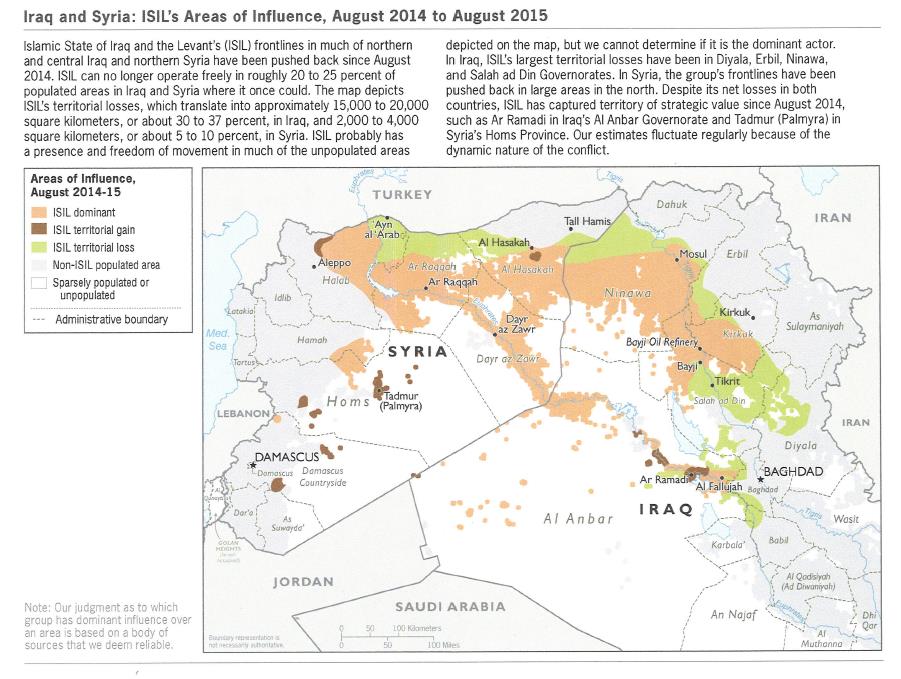
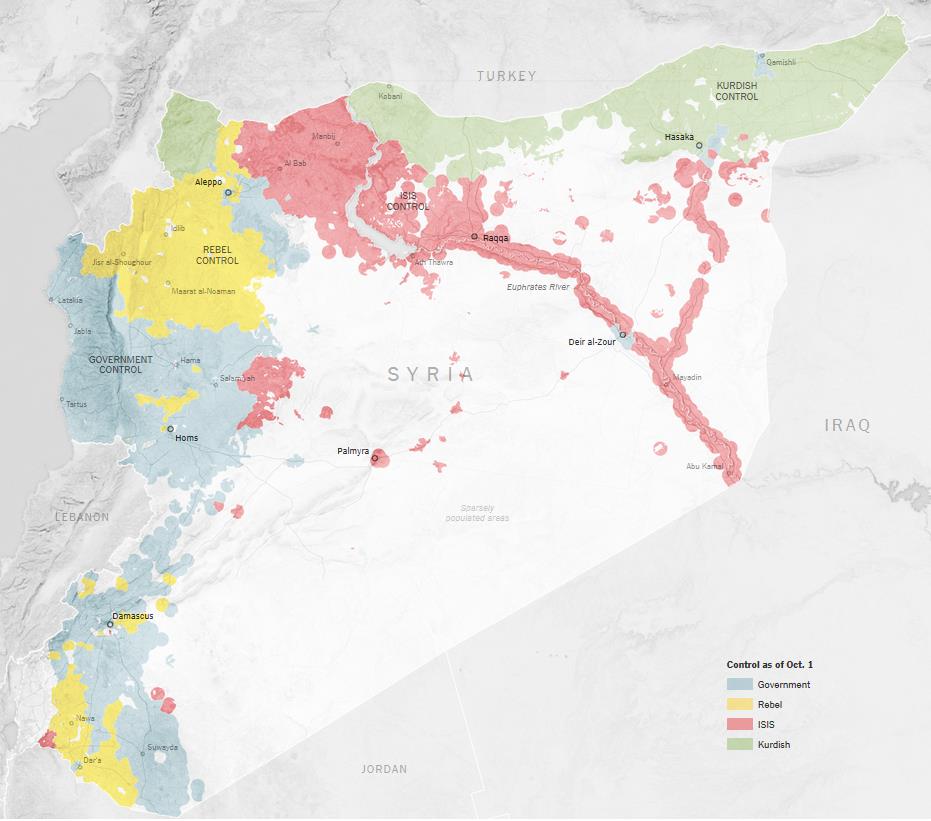
Map: ISIS areas of influence in Syria and Iraq
The following maps come from a recent Congressional Research Service report, “Armed Conflict in Syria: Overview and U.S. Response.”
Iraq and Syria: ISIS’s Areas of Influence, August 2014 to August 2015

Source: Map and text produced by U.S. Department of Defense, September 2015.
Syria Conflict Map: Estimated Areas of Control as of October 1, 2015

Source: Tim Wallace, New York Times. Area of control data source is Carter Center, October 1, 2015.
Notes: All areas approximate. Yellow area of “Rebel Control” includes areas under Jabhat al Nusra (Al Qaeda affiliate) control, and includes
areas controlled by a wide variety of anti-Asad forces. White color denotes sparsely populated or unpopulated areas.
After a U.S. shift, Iran has a seat at talks on war in Syria
The New York Times reports: Just a few weeks ago, Ayatollah Ali Khamenei said any new talks with the United States were forbidden. He described the United States as a persistent enemy of the Islamic revolution, and said that despite the nuclear agreement, it needed to be kept at a distance.
But participating in the multination Syria talks does not contradict Mr. Khamenei’s dictums, some Iranian analysts say.
“Our leader has banned the bilateral relations between Iran and America or any negotiation aimed at resuming relations,” said Hamidreza Taraghi, a political analyst in Tehran considered close to the ayatollah. “Case-by-case negotiations or finding solutions for regional problems on a multilateral basis is all right.”
So, while publicly siding with the hard-liners, the Supreme Leader may well be giving more negotiating room to President Hassan Rouhani, who has advocated more open engagements with the rest of the world. There has already been an unspoken cooperation between Iran and the United States in Iraq, where both are fighting the Islamic State.
“We should thank President Rouhani for his efforts in reaching out to the international community, and the nuclear deal,” said Farshad Ghorbanpour, a political analyst close to the government in Tehran. “Now we are seeing the rewards: We are playing an increasing active role in the international arena.”
That role is something that Iran has desperately sought: Diplomatic weight and respect that bolsters its claim that it, not Saudi Arabia, is the most influential power in the region. “It’s very important because it shows that, following the nuclear agreement, Iran is now ready to cooperate on crisis management in the Middle East,” Seyed Hossein Mousavian, a former Iranian diplomat and nuclear negotiator who now teaches at Princeton, said in a telephone interview. “I’m not surprised, because the leader had said that if the deal were done fairly, with face-saving for all parties, Iran would agree to next steps on other issues. This is a big step forward.”
Cliff Kupchan, an Iran specialist and chairman of the Eurasia Group, a Washington political consultancy, said that given Russia’s recent intervention in Syria to support Mr. Assad, it was clear he would remain in charge for a while, which meant Iran would be attending the Vienna talks from a position of strength.
Still, Mr. Kupchan said in an email, “as U.S.-Iran contacts spread to a broader array of issues, it will be harder and harder for Iranian conservatives to quarantine cooperation.” [Continue reading…]
Syrian refugee children work Beirut streets to support families
The Guardian reports: On a Friday night in Beirut, tiny figures weave in and out of the traffic between moving cars. They stand on tiptoes to peer through vehicle windows in an attempt to charm drivers out of a dollar or two.
The children are Syrian refugees, often the sole breadwinners for their families, working through the night selling flowers and shining shoes. They come from families stuck in limbo in Lebanon, and whose parents desperately want to go back to Syria.
A group of young boys between 11 and 19 seem to have marked their territory along the stretch of bars and restaurants between the Gemmayzeh and Mar Mikhael neighbourhoods in the north-eastern part of the Beirut.
One of them, Abdullah, smokes heavily but still sucks his thumb. He alternates between the two habits while tucking a plastic container of crumpled flowers under his arm. He says he is 13 but looks much younger as he recalls his first night selling flowers in Beirut, after fleeing his home in Aleppo with his family nearly five years ago. [Continue reading…]
The other refugee crisis
Joshua Meservey writes: In 2012, Syrians fleeing their country’s brutal civil war began arriving in significant numbers in Iraqi Kurdistan, a semi-autonomous enclave of ethnic Kurds in the north of the country. Two years later, ISIS vaulted out of northern Syria and swept across swathes of Iraq, scattering millions of Iraqis. Many of them, in addition to fleeing to Europe, made their way to the Kurdistan region and the protection of its military forces, the peshmerga, which have, for now at least, turned back ISIS’s attempts to overrun northern Iraq’s last sanctuary.
In contrast to many countries, the Kurdistan region has not hesitated to accept large flows of displaced people. Part of this is because nearly all of the Syrians who fled to Kurdistan are ethnic Kurds themselves. So too are members of several religious minorities sheltering in Kurdistan, such as the Kaka’i and the Yazidi, who faced annihilation last year at the hands of ISIS before escaping to Kurdistan.
However, the Kurds have also welcomed non-Kurds fleeing ISIS. Arab Sunni and Shiite Muslims, the latter considered heretics by ISIS, have found protection in the territory, as have the Turkmen, Shabaks, and Assyrian Christians, who have been virtually cleansed from their ancestral home in the Nineveh Plains region.
The cost of caring for so many dispossessed people is straining Kurdistan’s modest resources. Its estimated 2013 GDP was $25 billion, compared to Europe’s 2014 GDP that was more than $16 trillion. Its oil-dependent finances were already being squeezed due to plunging global oil prices, and there is the cost of fighting a war along a more than 600-mile front. The regional government also accuses the Iraqi government of withholding for more than a year its federal budget share, which Baghdad had already slashed in February 2014. The Kurdistan region, with a native population of only 5.4 million, now hosts more than a million refugees — many of whom require shelter, food, and medical care. [Continue reading…]
PBS Frontline goes inside Syria and helps boost the Assad regime
“Inside Assad’s Syria,” Martin Smith’s latest documentary on the war in Syria, aired on PBS last night. The complete report can be viewed here.
As usual, Frontline’s signature narration comes in the introduction from Will Lyman, whose every utterance sounds like incontestable truth.
As a leading brand in documentary production and investigative journalism, Frontline presents itself — with varying degrees of success — as factual, unbiased, and free from the influence of the political agendas that distort a lot of news coverage. It caters to an audience that wants to understand the issues behind the headlines — viewers who are skeptical about official statements and partisan interpretations.
This is what makes Frontline influential — the level of trust it has won. But at the same time, Frontline’s credibility can on occasions be the very reason that a story, badly told, can be so harmful.
“Inside Assad’s Syria” is a case in point. The few comments that have already appeared on the Frontline website, demonstrate the film’s effect in shaping perceptions:
Maybe Assad should stay in power. — Helen Hodge Hesketh
It is truly the first program produced by a major American media outlet (that I am aware of) that has tried to present an honest and objective depiction of the ongoing tragedy in today’s Syria. — Brian Victoria
I’m just sick of the entire middle east. And I see -no- good guys. I no longer demonize Assad. — JC Harris
Undoubtedly the Assad government is far from the best, but do its deficiencies justify the destruction of Syrian society and the misery of the Syrian people? — surprisedmike
Shouldn’t US be embracing Assad instead of overthrowing his regime? — Irfan Haqqee
If, before broadcasting his film, Smith had invited the regime to vet his production, I suspect it would have received their unqualified approval. After all, the evidence suggests that PBS is more effective in boosting support for Assad than are many of his own media operatives.
Really, this is worse than Syrian state propaganda precisely because it has a veneer of objectivity. Smith delivers the regime’s message that it is the bulwark of stability and that its enemies are terrorists supported by foreign powers, but he does this by presenting himself as a passive witness — “I went, I saw…”
Having given the opposition no voice whatsoever — it merely looms in the background as a dark uncontrollable force outside the narrowing boundaries of state-sustained stability — towards the end of the film he finally seems to give the rebels a face and a voice in the form of Majd Heimoud, but not quite: This is a man who in 2011 defected from the Syrian army to the opposition, only to later rejoin the army.
“Someone in the president’s office wanted me to hear this story. It shows that there are some Free Syrian Army fighters willing to defect back to the regime side. How many is unclear. The great majority are still fighting Assad,” says the filmmaker.
This is Smith’s MO: His “honesty” derives from calling out those moments when he is transparently being used as an instrument of regime propaganda, as though this transparency means he no longer has that function.
It’s a subtle form of deception that simply makes the propaganda that much more effective. The message is of a rebellion leading to disenchantment, and a regime with the magnanimity to welcome back those it once lost. It hints at the faint promise of Assad, the peacemaker, while gliding over his responsibility in destroying his own country.
This is the core message in Smith’s portrayal of Syria: On one side we are shown images of stability and even prosperity and of a state much healthier than we had been led to imagine, and on the other side — shown mostly in clips from YouTube videos — is carnage, destruction, terrorism, and the influence of malevolent foreign powers. Smith points out that the regime and its supporters conflate all opposition groups by portraying them all as terrorists, but then, who does he call out by name more often than any other group? ISIS.
And in perhaps the most bizarre moment in the film, he even includes scenes from the trailer for a Syrian-made movie about Saudi Arabia which graphically shows a man’s hand being chopped off — an image that is not blurred because it’s a movie special effect — as the movie’s director says: “I believe that the swamp of terrorism and backwardness in the Arab world is Saudi Arabia, and if we want to get rid of ISIS and Nusra, we have to get rid of the Saudi regime.”
The bulk of PBS’s liberal-minded audience might not support yet another call for regime change and yet this portrayal of Saudi Arabia as the well-spring of all strife across the Middle East, is a notion that resonates widely across the West. It serves the Assad regime well, by reinforcing its image as an embattled enclave, defending secularism and pluralism. And it sanctions ruthless violence by positing the alternative as worse.

Why are so many Iranian generals getting killed in Syria?
McClatchy reports: At least six generals from the elite Islamic Revolutionary Guards Corps have been killed in Syria since 2013, according to an official of the U.S. Defense Intelligence Agency, who requested anonymity because of the sensitivity of the issue. Three of those, including Hamadani, who was killed Oct.9 in the embattled northern city of Aleppo, have died since the beginning of the month.
A seventh Revolutionary Guard general was killed by an Islamic State sniper in Iraq last year.
Experts say the deaths of so many senior officers in Syria underscore the Iranian commitment to preserving Assad’s government in a “rump” Syria that includes most of the country’s major cities and the coastal province of Latakia, the traditional center of Assad’s religious sect, the Alawites.
It also is a reflection of the difference between Iran’s fighting tactics and those of Western militaries, whose senior officers usually direct operations from heavily protected command centers far in the rear.
Just one U.S. general has been killed in a conflict zone since the Vietnam War ended more than 40 years ago. That officer, Army Maj. Gen. Harold Greene, was shot by an Afghan soldier during a visit to a Kabul military academy in August 2014.
The need for close battlefield supervision by senior commanders has grown as the pro-Assad force has become a diverse amalgam of fighters from Lebanon, Iraq and Iran as well as Syria, cobbled together to compensate for the Syrian army’s serious manpower shortages. In addition to coordinating with one another, the units must be synchronized with airstrikes from Russian and Syrian jet fighters and helicopter gunships.
“When you need as many bodies on the ground to do the fighting . . . they need better coordination,” said Philip Smyth, a University of Maryland researcher who tracks Iranian-backed Shiite militias. “You need guys who are hard core and can really provide the stiff style of leadership and command, people who are not going to flinch under fire.” [Continue reading…]