The New York Times reports: How did $681 million end up being deposited in the personal bank account of Malaysia’s prime minister, Najib Razak, last year?
Not in any corrupt way, officials insist.
Saudi Arabia’s foreign minister said on Thursday that an unspecified Saudi source had given a large sum of money as a “genuine donation” with no obligations attached. He joined top Malaysian leaders in waving away any suggestion of scandal.
For those who have never had fortunes deposited into their personal bank accounts with no obligations attached, this may sound suspicious. Indeed, Mr. Najib has been subject to fierce international scrutiny, including a United States Justice Department investigation, as he continues to deny any wrongdoing. [Continue reading…]
Category Archives: News
Saudi Arabia threatens economic fallout if Congress passes 9/11 bill
The New York Times reports: Saudi Arabia has told the Obama administration and members of Congress that it will sell off hundreds of billions of dollars’ worth of American assets held by the kingdom if Congress passes a bill that would allow the Saudi government to be held responsible in American courts for any role in the Sept. 11, 2001, attacks.
The Obama administration has lobbied Congress to block the bill’s passage, according to administration officials and congressional aides from both parties, and the Saudi threats have been the subject of intense discussions in recent weeks between lawmakers and officials from the State Department and the Pentagon. The officials have warned senators of diplomatic and economic fallout from the legislation.
Adel al-Jubeir, the Saudi foreign minister, delivered the kingdom’s message personally last month during a trip to Washington, telling lawmakers that Saudi Arabia would be forced to sell up to $750 billion in treasury securities and other assets in the United States before they could be in danger of being frozen by American courts. [Continue reading…]
The hell after ISIS
Anand Gopal writes: Falah sabar heard a knock at the door. It was just before midnight in western Baghdad last April and Falah was already in bed, so he sent his son Wissam to answer. Standing in the doorway was a tall young man in jeans who neither shook Wissam’s hand nor offered a greeting. “We don’t want you here,” he said. “Your family should be gone by noon tomorrow.” For weeks, Wissam, who was 23, had been expecting something like this, as he’d noticed a dark mood taking hold of the neighborhood. He went to get his father, but when they returned, the stranger was gone.
Falah is tall and broad-shouldered, with salt-and-pepper hair. At 48, he was the patriarch of a brood of sons, daughters-in-law, and grandchildren. He sat down with Wissam to talk things through. They had been in Baghdad for just three months, but that was long enough for the abiding principle of refugee life to imprint itself on Falah’s psyche: Avoid trouble. When Wissam had managed to find a job at a construction firm, Falah had told him to be courteous, not to mix with strangers, and not to ask too many questions. If providence had granted them a new life in this unfamiliar city, it could snatch that life away just as easily.
Six months earlier, isis had seized their village, in Anbar province, the Sunni heartland of Iraq, blowing up houses and executing civilians as they fled. A few hundred families had managed to escape and were now scattered across Iraq. Many had wound up in squalid refugee camps near the front lines. The Sabars considered themselves lucky to have landed in Baghdad, a city solidly under the control of anti-ISIS forces.
But they soon realized that their new home offered little shelter from the conflicts erupting on distant battlefields. As the Islamic State spread its brand of Sunni extremism, their new Shiite neighbors seemed to cast blame on all Sunnis, even those who had lost homes or loved ones to ISIS. By March, when ISIS was battling Iraqi forces in Tikrit, 120 miles north, Falah could feel the city changing. In the market, neighbors began to look away from him. At police checkpoints, the family’s IDs were examined more closely. Sometimes, beige pickup trucks with burly Shiite militiamen in the back circled the block. Black banners proclaiming OH HUSSEIN! — the grandson of the Prophet Muhammad, revered by Shias — began appearing on the storefronts of Sunni-owned businesses. Falah wondered whether the flags were taunts, or had been placed there for protection by the shopkeepers themselves. [Continue reading…]
From Israeli jail, Marwan Barghouti initiates ‘nonviolent’ bid to ‘free Palestine’
The Times of Israel reports: A group of people close to leading Fatah activist Marwan Barghouti, jailed in Israel for murder, have reached an understanding with the Hamas and Islamic Jihad leaderships overseas on a comprehensive plan to jointly campaign against the Israeli occupation until it is brought to an end, Palestinian sources told The Times of Israel.
The plan includes unprecedented steps within the framework of what is dubbed “nonviolent resistance” which, the sources predicted, could prove immensely problematic for Israel. The goal is to force Israel out of all areas beyond the pre-1967 lines via a nonviolent intifada coordinated by a unified Palestinian leadership under Barghouti, who has been jailed by Israel since 2002 after being sentenced to five life sentences for involvement in murder.
The contacts were managed secretly in meetings that took place over recent months by four senior Fatah officials: Barghouti, Qadura Fares, Sarhan Davikat, and Mohammed Horani. All of them were considered senior members of the Palestinian Tanzim organization during the 90s and the latter three are known to be personal friends of Barghouti. Bargouti also intends to run for the presidency of the Palestinian Authority in the next elections, and even has Hamas support for the move, the sources said.
The four met with all of the Hamas leadership, including Khaled Mashaal, head of Hamas’s political wing, who is based in Doha, Qatar. Afterwards, they continued with meetings in Istanbul with the participation of Hamas leaders Moussa Abu Marzouk, Salah al-Aruri – considered to be behind many terror attacks against Israeli targets in the West Bank and in Israel – Osama Hamdan, Husam Badran and others. [Continue reading…]
Sisi’s stature melting away
David Hearst writes: President Abdel Fattah el-Sisi has been burning the candle at both ends. Having burned his way through Egypt’s largest political party, the Muslim Brotherhood, Sisi went on to give secular liberals who supported his coup against Mohamed Morsi the same treatment: imprisonment, torture or banishment. A significant part of Egypt’s political and intellectual elite is now in exile. He has one source of legitimacy left – the international community. This week, he’s been burning his way through that.
Sisi’s week should have started on a high – the visit of the Saudi King Salman. After all the tension between the two countries (at the time of Salman’s succession, the pro-Sisi media declared the then crown prince not fit for office) and after all the reports of money from Saudi drying up, this should have been an occasion to silence all doubters: Salman was investing $22bn in Egypt. The Egyptian presidency described Salman’s visit as “crowning the close brotherly ties between the two countries.”
Salman’s visit had been much hyped, as indeed Sisi’s visit to Britain was in November last year. Sisi expected each to be a breakthrough of its kind. And yet during his visit to London, Cameron cancelled all British flights to Egypt as a result of the downing of a Russian airliner over Sinai, sounding the death knell of the Egyptian tourist industry. A similar disaster awaited Sisi in Salman’s visit. [Continue reading…]
Greenland’s ice sheet is melting so fast right now, scientists thought the data was wrong
Meteorologist Eric Holthaus writes: On Monday, Greenland began to melt. Parts of Greenland melt every year and the whole thing freezes again each winter, but lately, thanks to global warming, the melting has come earlier and then peaked in the summer at higher levels than usual.
Even in light of these trends, Monday’s melt was unlike anything the scientists studying Greenland have ever seen — it was so different, in fact, that they thought the data was wrong.
“We had to check that our models were still working properly,” Peter Langen, a climate scientist at the Danish Meteorological Institute, told Polar Portal, a Danish government website which chronicles monitoring of the ice sheet. Sure enough, thermometers on and around the ice showed temperatures as high as 64 degrees Fahrenheit on Monday — more than 35 degrees warmer than normal for this time of year, and more typical of a warm day in July. [Continue reading…]
Fighting surges in Syria amid apparent collapse of truce backed by U.S., Russia
The Washington Post reports: A surge in fighting across Syria on Thursday signaled the apparent collapse of a landmark cease-fire that has been under mounting stress in recent days because of intensifying assaults by government forces and rebels.
The partial truce, which took effect in late February, represented a rare moment of agreement over the Syrian conflict between its most powerful outside players: Russia and the United States.
Although Moscow backs Syrian President Bashar al-Assad and Washington supports his opposition, the powers cajoled their Syrian allies into an agreement to cease hostilities to promote peace talks in Geneva that resumed Wednesday. The burst of fighting will almost certainly complicate those talks — now in their second round — and prolong a civil war that has killed more than 250,000 people and displaced millions.
“The more breaches of the truce we see, the more it shows that Assad does not want a political solution,” said the head of the opposition delegation in Geneva, Mohammed Alloush.
The opposition insists that a political solution requires Assad’s exit from power, but the Syrian leader and his allies have firmly rejected this. [Continue reading…]
Sanders slams Clinton for ignoring Palestinian needs and thinking Netanyahu is ‘right all the time’
Philip Weiss writes: It’s finally happened: the issue of Palestinian human rights came up in the Democratic debate tonight on national television, and Bernie Sanders repeatedly criticized Hillary Clinton–for siding with Israel singlehandedly, for her support of Benjamin Netanyahu and her indifference to the plight of Palestinians.
On the same night that he caved in to rightwing fools and suspended his Jewish outreach director over her criticisms of Benjamin Netanyahu, Senator Sanders stood up for Palestinians and against Netanyahu to cheers from the Brooklyn crowd.
Toward the end of a bruising debate, the two Democratic candidates tangled over Israel and Palestine for more than six minutes, beginning when Wolf Blitzer asked Sanders if he stood by his criticism of Israel for “disproportionate” attacks on Gaza. [Continue reading…]
Microsoft sues Justice Department to challenge electronic gag order statute
The New York Times reports: Big technology companies have usually played a defensive game with government prosecutors in their legal fight over customer information, fighting or bowing to requests for information one case at a time.
But now, in a move that could broaden the debate over the balance between customer privacy and law enforcement needs, Microsoft is going on the offense.
The software giant is suing the Justice Department, challenging its frequent use of secrecy orders that prevent Microsoft from telling people when the government obtains a warrant to read their emails.
In its suit, filed Thursday morning in Federal District Court in Seattle, Microsoft’s home turf, the company asserts that the gag order statute in the Electronic Communications Privacy Act of 1986 — as employed today by federal prosecutors and the courts — is unconstitutional. [Continue reading…]
Angela Merkel, accused of betraying core values, faces a balancing act with Turkey

The New York Times reports: Last September, Chancellor Angela Merkel was widely seen as an idealist, charitably welcoming hundreds of thousands of refugees to Germany in the face of stiff opposition at home and from European allies. But the influx swiftly became too much to handle.
Fast forward, and this year it is a rather different Angela Merkel at the helm, with an approach toughened by experience. This is the pragmatic Angela Merkel, who entered a calculated deal with an increasingly authoritarian President Recep Tayyip Erdogan of Turkey to try to stanch the migrant flow.
Ms. Merkel now stands accused by a new chorus of critics of not only betraying her ideals on immigration but also of jeopardizing core European values, as the costs of doing business with Mr. Erdogan become painfully clearer by the week.
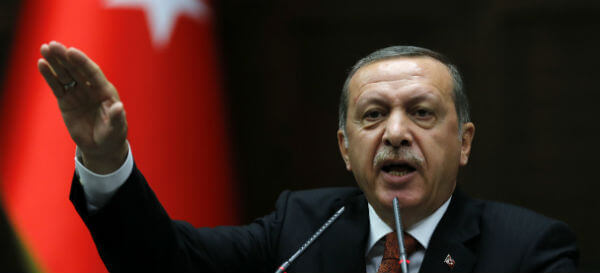
Mr. Erdogan, who has stifled the news media at home and shown little tolerance for criticism, has used his new leverage in Europe to extend his brand of censorship to Germany, employing diplomatic threats, and now a private lawsuit, to try to silence a German comedian who skewered him.
The satirist, Jan Böhmermann, had earned plaudits but also criticism when, on his TV show two weeks ago, he read a crude poem, which he himself labeled “abusive criticism,” and accused Mr. Erdogan of lewd behavior and fierce political repression.
That case has now become Exhibit A in the unpalatable bargains Ms. Merkel has made in pursuit of security and political survival, or what might be known as realpolitik version 2016. [Continue reading…]
The New York Times reports: Chancellor Angela Merkel, caught in a bind by Turkey’s bid to silence a German satirist who lampooned President Recep Tayyip Erdogan, said on Friday that her government would allow the case to go forward, but that the outdated law that permits it would be repealed with effect from 2018.
Announcing the decision to allow the court case against Jan Böhmermann, the comic, to proceed, Ms. Merkel repeatedly insisted that Germany backs the freedom of press, opinion and culture and believes in the rule of law. “Not the government, but the courts and the legal system will have the last word,” she said.
Pointedly referring to Turkey as a partner and a NATO ally, Ms. Merkel said that Germany expects the government in Ankara to heed democratic norms and that Berlin has observed attempts to restrict freedom of media and the justice system in Turkey “with great concern.” [Continue reading…]
Anna Sauerbrey writes: Though it’s a fact often overlooked by the rest of the world, Germany is a funny place — seriously. Long before Jon Stewart and Samantha Bee redefined topical American humor, comedians here perfected the art of sharp political satire.
For the most part, German politicians get the joke. But now politics and comedy are colliding in a new way — a collision that exposes the tragicomedy of modern European politics in a way that no late-night monologue ever could. [Continue reading…]
Britain’s covert war in Yemen
Vice News reports: In a rural valley in southern Yemen lies Wadi Rafad, a collection of farms 50 miles from the provincial capital of Ataq. Amid an arid landscape dotted with lemon orchards and cornfields, villagers were used to the peace being disturbed by the buzzing of US drones flying overhead. But on the afternoon of May 6, 2012, something changed.
Around 4.30pm an aircraft came into view, its white fuselage clearly visible against the stark blue sky. Rather than overfly the valley, the CIA drone fired Hellfire missiles straight at Fahd al-Quso, who was working his land. He was killed instantly — but shrapnel from the blast also engulfed Nasser Salim Lakdim, a 19-year-old student who had just returned home to tend his family’s plantation. Nasser’s father came rushing back to the farm to find his son in pieces. “It was horrifying, I can barely describe it,” he told VICE News.
The strike was among the foremost successes of the US counterterrorism effort in Yemen. Al-Quso, its target, was a senior field commander in al-Qaeda in the Arabian Peninsula (AQAP). He had participated in the bombing of the USS Cole in 2000 and had threatened to attack American embassies.
It was also an example of successful cooperation between British and American intelligence agencies. The US had hunted al-Quso for half a decade, and the intelligence that led to this strike came from a British agent working for the UK’s Secret Intelligence Service (SIS) — commonly known as MI6 — who had infiltrated AQAP.
Far from being a one-off tip, a VICE News investigation can exclusively reveal that this was a high point in systemic collaboration between SIS and the CIA to degrade AQAP through a combination of special forces operations and drone strikes.
A former senior CIA official responsible for operations in Yemen told VICE News that “the most important contribution” to the intelligence for the strike came from “a very important British capability.” The UK agent provided the CIA with al-Quso’s position, allowing a drone to track his car. “That was quite unique,” the former official explained, “it was something we didn’t have.”
The use of drones in Yemen has long been characterized as a unilateral US policy. In response to a 2014 parliamentary question on Britain’s role in the US drone program, UK Minister of State for Foreign Affairs Hugh Robertson said: “Drone strikes against terrorist targets in Yemen are a matter for the Yemeni and US governments.”
However, following interviews with more than two dozen current and former British, American, and Yemeni officials, VICE News can reveal that the UK played a crucial and sustained role with the CIA in finding and fixing targets, assessing the effect of strikes, and training Yemeni intelligence agencies to locate and identify targets for the US drone program. The US-led covert war in Yemen, now in its 15th year, has killed up to 1,651 people, including up to 261 civilians, according to The Bureau of Investigative Journalism. [Continue reading…]

Cash, candy, and ‘collateral damage’: An anatomy of a CIA-MI6 drone assassination
Vice News reports: “I was on my way to play football with my friends when the airstrike hit,” Amin Ali al-Wisabi told VICE News, recounting the day when a CIA drone struck his hometown of Azzan in Yemen. “We had stopped to sit down and plan the match when all of a sudden an explosion hit a passing al-Qaeda car.”
Recovering from his shock, 13-year-old Amin realized he had been hit by shrapnel. “Blood was pouring from my leg.”
Next to Amin, his friend Hamza Khaled Baziyad lay unconscious. In total, five children aged between 10 and 14 were injured as they gathered close to the local mosque.
Though the number of people injured in covert US strikes is not officially recorded, they play a crucial role in the struggle for hearts and minds across Yemen’s southern hinterland. Bystanders and family rushed the children to a local clinic, where Hamza awoke while shrapnel was extracted from his chest. All of the children survived. [Continue reading…]
Thousands of refugees flee for Turkish border after surprise ISIS attack
The Guardian reports: A new wave of refugees has fled northern Syria for the Turkish border after Islamic State opened fire on communities that had sheltered them, killing at least three people and uprooting thousands more.
The killings came as the terror group pushed back Syrian opposition forces who had edged to within five miles of Dabiq, a highly symbolic village that the group’s leaders believe is the pre-ordained epicentre of a clash that will herald an apocalyptic showdown.
The Isis advance appeared to catch the opposition off guard after 12 days of gains in the same area, which had seen it move closer to Dabiq than at any time in the past three years. [Continue reading…]
ISIS and Nusra put Yarmouk civilians in line of fire
Al Jazeera reports: Deadly fighting between the Islamic State of Iraq and the Levant (ISIL) and the al-Nusra Front has put civilians, mostly Palestinian refugees, in danger yet again in the Yarmouk refugee camp in southern Damascus.
Issam, a 54-year-old resident of Yarmouk, said that civilians have called for a temporary humanitarian ceasefire from the armed groups but have yet to receive a response.
“There is not a piece of bread left in this camp,” he told Al Jazeera by telephone while the sound of gunfire rang out behind him. “There isn’t medicine or water for drinking.” [Continue reading…]
Ordinary Syrians are risking their lives to protect their cultural heritage
By Emma Cunliffe, University of Oxford
I have spent years documenting damage to Syria’s amazing cultural heritage. I have recorded sites ploughed away by farming, built over by housing, robbed for stone, dug by looters, shelled in fighting, demolished by extremists … the list goes on. As the conflict grew, I was repeatedly asked how I could worry about stones when people were dying. Perhaps as many as 470,000 people have been killed, and millions have lost their homes and been forced to flee. And besides, I’ve been told, Syrians don’t care about their heritage. They didn’t before the conflict, and now they’ve got more important things to think about.
Given the list of damage to the country’s ancient remains, you might agree. But you’d be wrong.
The depth of Syria’s history is stunning. The country boasts some of the earliest writing and cities, including biblical Christian and Jewish sites that were still in use before the current war. There are also mosques founded at sites visited by the Prophet Mohammed, Crusader castles, and six UNESCO World Heritage Sites (to name just a few).
Is that ‘bump’ a new particle?
U.S. corporations have $1.4tn hidden in tax havens, claims Oxfam report
The Guardian reports: US corporate giants such as Apple, Walmart and General Electric have stashed $1.4tn (£980bn) in tax havens, despite receiving trillions of dollars in taxpayer support, according to a report by anti-poverty charity Oxfam.
The sum, larger than the economic output of Russia, South Korea and Spain, is held in an “opaque and secretive network” of 1,608 subsidiaries based offshore, said Oxfam.
The charity’s analysis of the financial affairs of the 50 biggest US corporations comes amid intense scrutiny of tax havens following the leak of the Panama Papers.
And the charity said its report, entitled Broken at the Top was a further illustration of “massive systematic abuse” of the global tax system.
Technology giant Apple, the world’s second biggest company, topped Oxfam’s league table, with some $181bn held offshore in three subsidiaries. [Continue reading…]
Does it take 8 years to decide whether to declassify 28-pages of 9/11 report?
The Daily Beast reports: By the end of President Obama’s term in office, the administration hopes to decide whether to declassify a controversial portion of Congress’ investigation into the 9/11 attacks, the White House said Tuesday. The so-called “28 pages,” which have never been publicly released, are said to implicate Saudi government officials and civilians in the deadliest act of terrorism on U.S. soil.
The administration had directed a “declassification review” of the material from the Joint Congressional Inquiry into the terrorist attacks in 2014. Former lawmakers who have read the classified pages say they describe a financial and logistical support network for the 19 hijackers, most of them Saudi citizens, while they were in the U.S. The report was released in December 2002.
“That review process remains underway, but every effort is being taken to complete it before the end of the Administration,” Ned Price, the spokesperson for the National Security Council, told The Daily Beast in a statement. [Continue reading…]