The New York Times reports: Mr. Trump has become unacceptable, perhaps irreversibly so, to broad swaths of Americans, including large majorities of women, nonwhites, Hispanics, voters under 30 and those with college degrees — the voters who powered President Obama’s two victories and represent the country’s demographic future. All view him unfavorably by a 2-to-1 margin, according to a recent New York Times/CBS News poll.
In some states, Mr. Trump has surprised establishment-aligned Republicans with his breadth of support beyond the less-educated men who form his base. Even so, his support in the nominating process, in which some 30 million people may ultimately vote, would be swamped in a general election, when turnout is likely to be four times that.
“We’re talking about somebody who has the passionate devotion of a minority and alternately scares, appalls, angers — or all of the above — a majority of the country,” said Henry Olsen, a conservative analyst. “This isn’t anything but a historic election defeat just waiting to happen.” [Continue reading…]
Category Archives: News
Syria cease-fire unravelling as fighting erupts near Aleppo
The Associated Press reports: Syria’s partial cease-fire appeared to be unraveling Saturday as fierce fighting between government forces and opposition fighters, including members of the al-Qaida affiliated Nusra Front, erupted outside the country’s second largest city of Aleppo and other parts in the country’s north.
At least 25 pro-government and 16 opposition fighters died in the clashes south of Aleppo, where the Nusra Front and rebel militias captured a village overlooking a major highway, a Britain-based monitoring group told The Associated Press.
The fighting was the most serious in the area since the cease-fire, engineered by the U.S. and Russia, took effect Feb. 27. The violence in the north, along with heavy government airstrikes that killed more than 30 civilians near Damascus this week, threatened to completely dissolve the truce, which had sharply reduced overall violence across the war-ravaged country.
The rebel advances also risk drawing Russia back into the conflict after it shored up the government’s position through a fierce bombing campaign that wound down nearly three weeks ago. The opposition’s advances threaten to reverse some of the gains made by the government during the Russian campaign. [Continue reading…]
Syrian Alawites distance themselves from Assad
BBC News reports: In a deeply unusual move, leaders of President Bashar al-Assad’s Alawite sect in Syria have released a document, obtained by the BBC, that distances themselves from his regime and outlines what kind of future they wish for the country after five years of civil war.
The community and religious leaders say they hope to “shine a light” on the Alawites after a long period of secrecy, at what they call “an important moment” in their history.
In the eight-page document, termed a “declaration of identity reform”, the Alawites say they represent a third model “of and within Islam”.
Those behind the text say Alawites are not members of a branch of Shia Islam – as they have been described in the past by Shia clerics – and that they are committed to “the fight against sectarian strife”.
They also make clear that they adhere to “the values of equality, liberty and citizenship”, and call for secularism to be the future of Syria, and a system of governance in which Islam, Christianity and all other religions are equal. [Continue reading…]
Mixed reactions from Iraqis as American troops enter the ground war against ISIS
Mustafa Habib writes: Iraqis found out that just about a week ago at dawn, the US military had entered the “war” against the extremist group known as the Islamic State, for real. In the northern province of Ninawa, near the extremist-held city of Mosul, US ground troops – a group of 200 soldiers from the 26th Marine Expeditionary Unit, according to the US Secretary of Defence, Ashton Carter – used their artillery against the Islamic State, or IS, group’s fighters in the area.
Speaking at a press briefing last Friday, Carter told reporters that the US troops had set up base at an outpost to be named Firebase Bell – as the LA Times newspaper reported, “this would be the first American combat base since the US returned to Iraq in 2014”.
So how did Iraqis feel about the apparent return of US boots to their ground?
“The US troops have finally decided to join in properly,” says Qais al-Saadi, a colonel in the Iraqi army. “Previously they were limited to air raids. I think now they have discovered that these air raids did not affect the Islamic State as much as they hoped and they have become convinced that ground troops are also important.”
Al-Saadi was happy about this, noting that the US was paving the way for the Iraqi army, especially with their recent success in eliminating two senior members of the IS group in quick succession.
Social media lit up with debate on the subject. Some welcomed the US troops, believing they were necessary in order to defeat the IS group. Often Iraqi commentators said that this move by the US was too late and that they should have helped from the beginning. Others were not so happy, saying it was a new occupation. [Continue reading…]
Libya’s deep state is back and wants you to know it
Borzou Daragahi reports: A pudgy, graying middle-aged man in a brown sweater vest sat quietly sipping tea in the hotel lobby. If you noticed him at all, you might have thought he was a businessman, or an engineer, maybe a mid-ranking civil servant. He frowned occasionally as he contemplated the messages on his smartphone.
He allowed a smile as two men approached. They greeted each other as old friends, exchanging embraces, asking after relatives. One of the men complained a little about the state of business in the region, and warned he might have to head off at some point: “My daughter has a ballet recital.”
The entourage moved to a darkly lit corner of the hotel, their voices dropping, sometimes to a whisper. They looked up with paranoid glares each time a waiter or hotel guest walked by. The three men knew they could never be too careful.
The newcomers were retired colleagues; the first, a balding man in his sixties, works for a charity that helps African migrants in Libya; the second, in his late forties, is a real estate developer, dividing his time between the Libyan capital, Tripoli, and Europe.
But this was no workaday meeting of middle-aged businessmen. The three men are operatives from one of the most feared institutions in the Middle East: Libya’s mukhabarat, or intelligence agency. Formed shortly after the Second World War, the mukhabarat has worked behind the scenes to monitor and manipulate Libya for decades. And they have now joined the war against ISIS, as well as al-Qaeda and loyalists to the former regime of Muammar al-Qaddafi. They have made many, many enemies over the years.
“Extremists are extremists,” said the man in the sweater vest, a senior ranking official of the agency’s counter-terrorism division. “It doesn’t matter if they’re government militias, ISIS, or Qaddafi loyalists. In my focus, I target them all. Political extremists are all the same. And I want stability.” [Continue reading…]
HSBC and Citibank aided firm at center of international bribery scandal
Huffington Post reports: No business can operate without bankers — not even the bribery business.
British financial giant HSBC and American bailout kingpin Citibank processed transactions, managed money and vouched for Unaoil, a once-obscure firm that is now at the center of a massive international corruption scandal. Police raided Unaoil’s Monaco offices and interviewed its executives on Thursday, a day after The Huffington Post and Fairfax Media first exposed the company’s practices. Law enforcement agencies in at least four nations are involved in a wide-ranging probe of the company and its partners.
Halliburton, KBR and other corporate conglomerates relied on Unaoil to deliver them lucrative contracts with corrupt regimes in oil-rich nations. But without the help of banks like HSBC and Citibank, none of Unaoil’s operations would have been possible. [Continue reading…]
After WikiLeaks revelation, Greece asks IMF to clarify bailout plan
The New York Times reports: Greece called on the International Monetary Fund on Saturday to explain whether it was seeking to usher Athens toward bankruptcy ahead of a pivotal referendum in June on Britain’s membership in Europe. Greece’s comments came after I.M.F. officials raised questions in a private discussion published by WikiLeaks about what it would take to get Greece’s creditors to agree to debt relief.
The transcript, which captures what WikiLeaks said was a teleconference conversation in March between Poul Thomsen, the head of the I.M.F.’s European operations, and the I.M.F.’s Greek bailout monitor, underscored a widening rift between the I.M.F. and Greece’s European creditors that could jeopardize Greece’s new 86 billion euro bailout. It also exposed the fraught behind-the-scenes political machinations that have led to a deadlock on how to deal with a country still regarded as Europe’s weakest link.
The I.M.F. declined to comment on the WikiLeaks transcript, but said in a statement that Greece needed to be put “on a path of sustainable growth” supported by reforms and further debt relief. The document touched off a fresh political frenzy inside Prime Minister Alexis Tsipras’s government, which accused the I.M.F. of trying to “politically destabilize Europe.” [Continue reading…]
A CIA grunt’s tale of the fog of secret war
The New York Times reports: In Douglas Laux’s final days as a C.I.A. officer, the futility of his mission prompted him to quote George Orwell to his boss.
Mr. Laux had spent months in 2012 working with various Middle Eastern nations that were trying to ship arms to Syria to help disparate rebel groups there. But it had become clear to him that the C.I.A had little ability to control the squabbling and backstabbing among the Saudis, Qataris and other Arabs.
He told a senior C.I.A. officer he felt like Winston Smith, the character in “1984” known for his fatalism, because he was carrying out his work without comprehending the politics and competing agendas thwarting progress in aiding the rebellion. “I understand the how,” Mr. Laux said, paraphrasing one of Smith’s famous lines. “I do not understand the why.”
It is a sentiment that might sum up much of Mr. Laux’s career at the C.I.A., an organization he served for eight years as an undercover case officer and soldier in the agency’s shadowy conflicts overseas. His career at the agency began with a tour at a remote firebase in southern Afghanistan and ended with a spot on the agency’s Syria Task Force — a life in war zones that is emblematic of the lives of a large cadre of American spies who joined the C.I.A. after the Sept. 11 terrorist attacks. He left the agency three years ago, but is speaking publicly about his experiences there for the first time in conjunction with the release of a memoir. [Continue reading…]
Turkey is no ‘safe haven’ for refugees – it shoots them at the border
Patrick Kingsley writes: It was beyond sad to read in the Times this week that Turkish border guards have allegedly shot dead Syrians trying to reach safety in Turkey. Sixteen refugees, including three children, have been killed trying to escape the battlegrounds of northern Syria in the past four months, according to the Syrian Observatory for Human Rights, a frequently cited watchdog.
It is shocking to think of people fleeing the combined atrocities of Islamic State and Bashar al-Assad being gunned down just as they make their bid for safety. But what is perhaps most shocking of all is that we observers are still shocked by this.
The shooting of Syrians on the border is not a new phenomenon. Refugees and rights groups have reported shootings of migrants on the Turkish-Syrian border since at least 2013. These abuses are well-documented, and the reports widely circulated. So why, in the months following a shady European deal that forces Turkey to shoulder the biggest burden of the refugee crisis, are we still so appalled when Turkey continues to use deadly violence to stop that burden getting any bigger? [Continue reading…]
Amid clashes, Greece presses on with plan to deport refugees
The New York Times reports: Violent clashes erupted in Greek refugee camps among panicked migrants as Greece and the European Union pressed ahead on Friday with their intention to expel them from Europe and deport thousands back to Turkey, despite strong objections from rights groups and United Nations relief officials who say the plan is illegal and inhumane.
Hundreds of migrants broke out of an overcrowded detention center on the Greek island of Chios and began walking to the port to protest a European Union deal that went into effect in March, authorizing Greece to return them to Turkey if their applications for asylum in Europe were not accepted. The deportations officially begin on Monday.
Video clips in the Greek media showed migrants streaming away from the camp unhindered by the police, hours after a brawl broke out at the camp’s registration center. Several refugees were taken to a hospital after the riot police used stun grenades, and a help center run by Doctors Without Borders was destroyed, forcing the aid group to abandon its work. More than 1,500 migrants were being held at the center, designed for 1,200. Three people were also reported stabbed during a migrant riot on the island of Samos, where another detention facility operates. [Continue reading…]
After Palmyra, where next for Assad?
Aron Lund writes: Forces loyal to Syrian President Bashar al-Assad on March 27 retook the desert city of Palmyra, which had been lost to the self-proclaimed Islamic State in May 2015. Its loss came at a difficult time for Assad, whose exhausted and overstretched army was losing territory on several fronts while the decaying economy in government-controlled areas was threatening to undo his regime from within. Given Palmyra’s location at the center of valuable gas fields and position as a nexus of major transportation routes in Syria’s eastern deserts, its loss compounded Assad’s problems. The government found itself with an expanded eastern frontline, with the Islamic State burrowing into the Qalamoun mountains, north of Damascus, and the Badiya region, where central Syria’s fertile plains around Homs and Hama fade into the desert.
A reversal of fortunes began on September 30, 2015, when Russian President Vladimir Putin ordered his country’s air force into action in Syria. Since the end of 2015, Assad has significantly improved his position in western Syria — where he is fighting other rebel and jihadi forces — and made limited advances against the Islamic State near Aleppo. The current push — which came after a truce with mainstream rebel factions — began on February 27 and marked the first major push east. Shortly after that Putin announced a somewhat disingenuous withdrawal from Syria on March 14.
Not only has Assad’s advance into Palmyra redrawn Syria’s military battlefield, but it also looks likely to accelerate the shift of its politics. [Continue reading…]
Global investigation launched on bribery and corruption in the oil industry
Fairfax Media and the Huffington Post report: he FBI, US Department of Justice and anti-corruption police in Britain and Australia have launched a joint investigation into revelations of a massive global bribery racket in the oil industry.
The news comes as Fairfax Media and The Huffington Post can reveal that US giant Halliburton and its former subsidiary Kellogg, Brown & Root are embroiled in the Unaoil bribes-for-contracts scandal through their operations in former Soviet states.
The biggest leak of confidential files in the history of the oil industry also unveils rampant corruption inside Italian oil giant Eni in many of the countries in which the firm has been contracted by national governments to manage their oilfields.
Texas firm National Oilwell Varco, Singapore conglomerate Keppel, Norway’s Aker Kvaerner and giant Turkish joint venture GATE are also implicated. Information from hundreds of thousands of emails to Unaoil’s chief executive, Cyrus Ahsani, show individual executives and managers from Halliburton and Kellogg Brown & Root (KBR), which split in 2007, knew or suspected that Unaoil was acting corruptly to win contracts in Kazakhstan.
Managers from Eni, Spanish Firm Tecnicas Reunidas, French firm Technip, drilling giant MI-SWACO and Rolls-Royce not only actively supported bribery but were offered, or pocketed, their own kickbacks. And US defence giant Honeywell and Australian firm Leighton Offshore agreed to hide bribes inside fraudulent contracts in Iraq. [Continue reading…]
Moqtada al-Sadr is back, proving that he’s still a force in Iraqi politics
The Washington Post reports: Moqtada al-Sadr, the troublesome cleric whose militia repeatedly battled U.S. troops more than a decade ago, is back in action in Iraq — this time as a champion of political reforms.
And what a comeback it has been, replete with high political drama, bold gestures of choreographed symbolism and moments of nerve-racking tension that have seen Baghdad brace for a potential new war.
Sadr’s return to the limelight began in February, when he emerged from years of self-imposed retirement from politics to lead a mass protest campaign calling for the creation of a new government and an end to the corrupt practices of the country’s despised political elite.
On Thursday, after spending five days holed up in a tent inside Baghdad’s heavily fortified Green Zone to press his demands, he was handed a victory, in the form of a proposed new government presented to parliament by Prime Minister Haider al-Abadi. The new, streamlined cabinet is to be composed not of politicians but technocrats with the skills required to run ministries — meeting one of Sadr’s top demands. [Continue reading…]
Zuma court ruling: South Africans witness a massive day for democracy
By Hugh Corder, University of Cape Town
The accountability of public governance in South Africa has come a long way since 1994. When the transitional constitution was hammered out in negotiations in 1993, the primary consideration was to establish an unshakeable commitment to government under law in terms of a binding constitution.
Founded on the “rule of law”, this means that no one is above the law and that everyone is formally equal before the ordinary courts. No-one, not even the president, may take the law into their own hands. One of the founding values of the constitution is the:
… supremacy of the constitution and the rule of law.
The brand of democracy enshrined in the final constitution of 1996 emphasises participation by the people in a multi-party system of democratic government, to achieve “accountability, responsiveness and openness”.
Recognising the democratic deficit that South Africa faced because of the ravages of apartheid, additional mechanisms were introduced to strengthen participative democracy and popular accountability. One of them was the establishment of the office of the Public Protector.
The Constitutional Court’s judgment in Economic Freedom Fighters and Democratic Alliance v The Speaker of the National Assembly, the President and Others represents the exercise of judicial authority and expertise at the highest level by international standards.
Egypt’s chief corruption investigator alleges widespread government graft. He’s now under house arrest
The Wall Street Journal reports: Egyptian authorities have placed the country’s chief corruption watchdog under house arrest, his lawyer said, days after he was dismissed by the president following his allegations of widespread government graft.
A decree by President Abdel Fattah Al Sisi on Monday removed Hisham Geneina from his post as head of the government’s Central Auditing Authority. It gave no explanation for the move.
Mr. Geneina, a former police officer and judge, now has plainclothes police officers stationed outside his home, his attorney, Ali Taha, said in an interview. The police have confiscated his phone as well as those of his family and are turning away any visitors, the lawyer added. However, no formal order for his house arrest has been issued.
Mr. Taha said all this signals that Mr. Geneina will face prosecution for speaking out against corruption and moving to hold figures from Egypt’s executive, judiciary and police accountable in court for widespread graft ranging from day-to-day bribes to large-scale misappropriation of state land.
“Anyone who tries to visit him will be told by a mob of plainclothes policemen standing outside his house doors that he is not at home,” Mr. Taha said — describing the house arrest as “thuggery.” [Continue reading…]
Former U.K. attorney general linked to Russian mob
Michael Weiss reports: The former attorney general of Great Britain has been representing the lawyer for an alleged Russian crime family, The Daily Beast has learned, based on a tranche of email correspondence leaked online.
Lord Peter Goldsmith, who served for six years under Tony Blair’s premiership and is now a senior partner at the London office of U.S. law firm Debevoise & Plimpton, was retained in March 2014 by Andrey Pavlov to act as “legal advisor.” Pavlov for years acted as legal counsel for Russian crime boss Dmitry Klyuev; he was also directly implicated by whistleblower Sergei Magnitsky as being an accomplice in the theft of public Russian money. Pavlov has denied all these accusations.
Goldsmith — who provided the Blair government with the legal justification for Britain’s participation in the 2003 Iraq War — was tasked with helping Pavlov evade possible sanction by the European Parliament for being complicit in Magnitsky’s death in prison, and for “the subsequent judicial cover-up and for the ongoing and continuing harassment of his mother and widow,” as the text for the European parliamentary resolution stated. [Continue reading…]
Erdogan’s security detail assault reporters and protesters outside Washington, D.C. venue at which Turkish president spoke
The Atlantic reports: Recep Tayyip Erdogan’s security detail manhandled reporters and protesters at an event at which the Turkish president was speaking.
Turkish media and the president’s critics are by now used to such incidents, but they probably didn’t expect them to happen in Washington, D.C., where Erdogan was speaking at the Brookings Institution. [Continue reading…]
Robert Mackey adds: Now that Turkish President Recep Tayyip Erdogan has nearly completed a crackdown on dissent at home — closing down opposition newspapers, prosecuting students for joking on Twitter about officials, and putting journalists on trial — he seems intent on silencing critics in other countries as well.
After the president arrived in Washington on Tuesday night, his security team got right to work, harassing protesters and journalists outside his hotel, as writers for one of the papers recently shuttered by Erdogan’s government noted. [Continue reading…]
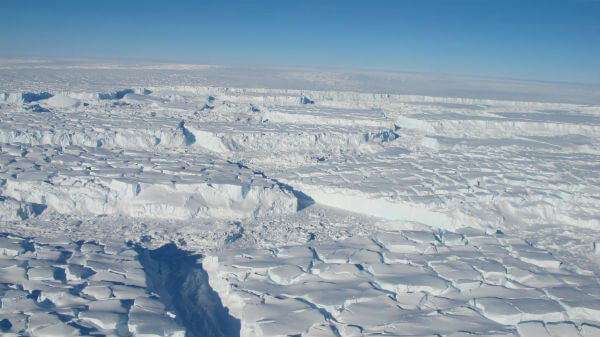
Climate model predicts West Antarctic ice sheet could melt rapidly

The New York Times reports: For half a century, climate scientists have seen the West Antarctic ice sheet, a remnant of the last ice age, as a sword of Damocles hanging over human civilization.
The great ice sheet, larger than Mexico, is thought to be potentially vulnerable to disintegration from a relatively small amount of global warming, and capable of raising the sea level by 12 feet or more should it break up. But researchers long assumed the worst effects would take hundreds — if not thousands — of years to occur.
Now, new research suggests the disaster scenario could play out much sooner.
Continued high emissions of heat-trapping gases could launch a disintegration of the ice sheet within decades, according to a study published Wednesday, heaving enough water into the ocean to raise the sea level as much as three feet by the end of this century.
With ice melting in other regions, too, the total rise of the sea could reach five or six feet by 2100, the researchers found. That is roughly twice the increase reported as a plausible worst-case scenario by a United Nations panel just three years ago, and so high it would likely provoke a profound crisis within the lifetimes of children being born today. [Continue reading…]