Haaretz reports: Some 600 Israeli companies and 850 Israeli shareholders are listed in the leaked documents of Panamanian law firm Mossack Fonseca, a leader in creating shell companies that often serve to conceal ownership of assets.
The leaked files, which were obtained by the German newspaper Süddeutsche Zeitung and shared by the International Consortium of Investigative Journalists with Haaretz and other media organizations, provide a glimpse of the economy that until now had been hidden from the Israeli public.
There is a number of prominent names among the shareholders. It is important to note that as long as holdings in the companies and their revenues — if any — are reported as required to Israeli tax authorities, owning the company is not against the law.
Mossack Fonseca’s branch in Israel is headed by attorney Amir Maor. Callers to the branch are informed by a voicemail message that they have reached the offices of “The Company for Establishing Companies.”
Reached by telephone, Maor stated that Mossack Fonseca informed its Israeli branch last week that files had been stolen after its computer systems were breached. “Any information you use [from these files] is like using stolen data,” he said, refusing to give further comment.
The leaked files mention Sapir Holdings, a company registered in 2002 in the Virgin Islands. The owner and its only director was top-ranking lawyer Jacob Weinroth. He was indicted for money laundering in late 2009 and acquitted two years later of all charges against him. During the trial, it emerged that the company had received 30 million shekels ($7.95 million) for services rendered from Uzbek-Israeli entrepreneur Michael Cherney and Russian-Israeli businessman Arcady Gaydamak.
The fraudulent real estate deal of 2002 with the Greek Orthodox Patriarchate was also brought up in the trail. The failed deal, in which expensive lands in Jerusalem were offered to the State of Israel for a 999-year lease, was intended to be carried out by Christian Lands of Israel, a company created by Mossack Fonseca, which Weinroth represented. Company documents, like those requesting power of attorney for Weinroth, are among those found in the leaked files. [Continue reading…]
Category Archives: News
Islamist rebel groups press offensive in northern Syria
The Wall Street Journal reports: A tenuous cease-fire in Syria unraveled further over the past few days, with rebel groups that signed on joining the al Qaeda-linked Nusra Front in a new offensive against regime forces near the northern city of Aleppo.
Amid the offensive in its fourth day on Monday, Nusra supporters were mourning a top figure in the group and nearly two dozen of his associates killed in airstrikes in northwestern Idlib province on Sunday.
Nusra supporters blamed the airstrike on the U.S., which has previously targeted the group’s fighters in Idlib, its stronghold.
A spokesman for the American-led coalition that is mainly battling Islamic State wouldn’t immediately confirm nor deny the allegation. Russia and the Syrian regime also conduct airstrikes on opponents in the area.
The truce has been imperiled by an escalation of regime airstrikes on rebel-held suburbs of the capital Damascus over the past week. Despite a rapidly rising toll of alleged violations, both sides appear reluctant to call off the agreement which has reduced violence and deaths after all.
“The cessation of hostilities agreement is about to take its last breath and effectively be declared finished,” Riad Hijab, an opposition leader, warned in a letter to United Nations Secretary General Ban Ki-moon on Friday. Mr. Hijab heads the main opposition delegation to the Geneva peace talks.
Continuing regime restrictions on humanitarian assistance to several besieged rebel-held areas around Damascus are further straining the shaky truce. Residents of one such town, Madaya, said a sick teenager died Monday because of lack of medical care.
Regime airstrikes on a rebel-held community near Damascus on Thursday killed 33 people, almost half of them children, according to a tally by local emergency responders. [Continue reading…]
In Nagorno-Karabakh, a bloody new war with Putin on both sides
The Daily Beast reports: Nagorno-Karabakh, an enclave in Azerbaijan that became breakaway republic backed by Armenia in all spheres of life, has been living in a not-quite-frozen state of war since 1994. Every schoolboy in the mountainous little republic has grown up knowing that after graduation he will put on a uniform and join the military to police the unstable cease-fire. The republic’s 150,000 people, mostly ethnic Armenians, remember rockets destroying apartment buildings in the fighting more than 20 years ago, and have long feared that their worst nightmare of full-scale war would return.
Now it looks like it has.
The war woke up on Saturday night with both sides of the front using armored vehicles, battle tanks, and aviation, launching multiple rockets, and shooting artillery at each other. Over 30 people were killed and dozens wounded in the worst combat in the last two decades.
The regional implications are hard to miss. Armenia is one of Russia’s closest allies and Turkey immediately backed up Azerbaijan at a time when relations between Moscow and Ankara are bitter and vindictive. Given the war in Syria, where Russia and Turkey back opposing sides, and Turkey shot down a Russian warplane in November, the current eruption between Armenia and Azerbaijan is even more geopolitically dangerous than two decades ago. [Continue reading…]
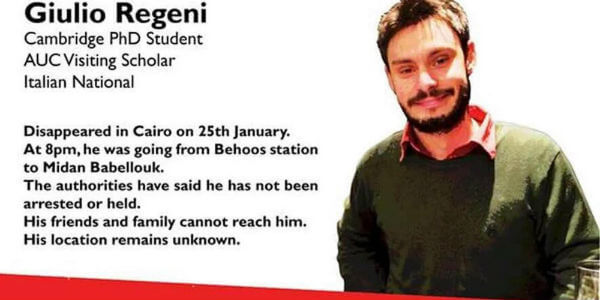
Giulio Regeni murder: Egypt postpones Italy meeting as criticism mounts

The Guardian reports: Egypt has postponed a meeting in Rome at which a Cairo delegation was due to hand over evidence relating to the torture and murder of the Italian researcher Giulio Regeni.
The highly anticipated meeting was scheduled for Tuesday but is now expected later this week. There is a growing perception in Italy that cracks are beginning to emerge in Egypt over how the government of President Abdel Fatah al-Sisi has handled the murder investigation.
Italy’s foreign minister, Paolo Gentiloni, will outline the government’s position on the case in a parliamentary statement on Tuesday, his ministry said.
Regeni’s body was found in a ditch off a desert road on 3 February, more than a week after the 28-year-old – a Cambridge PhD student researching labour unions in Egypt – disappeared. [Continue reading…]
Afghan spy agency arms villagers to hold off ISIS
The Wall Street Journal reports: n Afghan spy agency is recruiting villagers for militias to hold back Islamic State fighters seeking to expand their foothold in this opium heartland in eastern Afghanistan.
The program, which one top official says the government hopes to roll out across the country and may later use against the Taliban, is President Ashraf Ghani ’s riskiest attempt to defend rural villages—and also a part of his much larger counterinsurgency strategy.
The government has closely guarded the program, and news of it essentially hasn’t been reported since its establishment in August 2015. Details of the program came from Afghan government officials, local village leaders and Western officials who have been monitoring its progress.
The militia groups that are part of the pilot project, known as the People’s Uprising Program, are being called on to hold territory the army has recaptured from Islamic State in three districts.
More than a thousand men, mostly village farmers who turned against the extremist group’s harsh rule in areas it seized in the past year, are on the payroll of the spy agency, the National Directorate of Security, which receives funding from the U.S. Central Intelligence Agency. So far, the militias in Kot, with the backing of the army and police, have repelled six Islamic State attacks. [Continue reading…]
Europe begins sending people back across the sea, defying human rights outcry
The Washington Post reports: The European Union began offloading its refugee crisis onto its Turkish neighbors Monday, sending back more than 200 migrants in the first stage of a plan to deport thousands that has drawn condemnation from human rights groups.
The returns — carried out at dawn and under heavy security — were intended to send a powerful message to others considering the journey from Turkey to Greece via a smuggler’s rubber raft: Don’t even bother.
Authorities braced for demonstrations or other forms of resistance from those being sent back only days after crossing the Aegean and arriving on European soil in search of a new life — part of a massive migrant wave that has tested Europe’s resources and highlighted the desperation to the east in war zones such as Syria.
But the expulsions were carried out smoothly and quietly; two ferries packed with migrants and E.U. escorts slipped away from the island of Lesbos and charted an eastbound course toward the rising sun along the blue mountains of the Turkish coast.
A third ferry left the island of Chios, bringing the total sent back to 202 by late Monday — nearly all from Pakistan or Afghanistan. Both islands are popular landing spots for refugee rafts.
Under a deal struck with Turkey last month, all refugees and migrants who arrive on Greek shores aboard smugglers’ rafts from March 20 onward will be sent back.
In return, the European Union has said it will accept one Syrian refugee from Turkey for every Syrian who is returned. Germany said Monday that it had accepted its first several dozen Syrians flown from Turkey under the new program. [Continue reading…]
Endgame for the IMF-EU feud over Greece’s debt
Yanis Varoufakis writes: The feud between the International Monetary Fund (IMF) and the European side of Greece’s troika of creditors is old news. However, Wikileaks’ publication of a dialogue between key IMF players suggests that we are approaching something of a hazardous endgame.
Ever since the first Greek ‘bailout’ program was signed, in May 2010, the IMF has been violating its own “primary directive”: the obligation not to fund insolvent governments. As a result, the IMF’s leadership has been facing a revolt from its staff members who demand an exit strategy arguing that, if the EU continues to obstruct the debt relief necessary to restore the solvency of the Greek government, the IMF should leave the Greek program.
Five years on, this IMF-EU impasse continues, causing a one-third collapse of Greek GDP and fuelling hopelessness to a degree that has made real reform harder than ever.Back in February 2015, when I first met Poul Thomsen (the IMF’s European chief) in a Paris hotel, a fortnight after assuming Greece’s finance ministry, he appeared even keener than I was to press for a debt write off: “At a minimum”, he told me “€54 billion of Greece’s debt left over from the first ‘bailout’ should be written off immediately in exchange for serious reforms.”
This was music to my ears, and made me keen to discuss what he meant by “serious reforms”. It was a discussion that never got formally off the ground as Germany’s finance minister vetoed all discussion on debt relief, debt swaps (which were my compromise proposal), indeed any significant change to the failed program.
What new light does the leaked dialogue between Thomsen and Delia Velculescu (the IMF’s Greek mission chief) throw on this saga? [Continue reading…]
Fund run by David Cameron’s father avoided paying tax in Britain
The Guardian reports: David Cameron’s father ran an offshore fund that avoided ever having to pay tax in Britain by hiring a small army of Bahamas residents – including a part-time bishop – to sign its paperwork.
Ian Cameron was a director of Blairmore Holdings Inc, an investment fund run from the Bahamas but named after the family’s ancestral home in Aberdeenshire, which managed tens of millions of pounds on behalf of wealthy families.
Clients included Isidore Kerman, an adviser to Robert Maxwell who once owned the West End restaurants Scott’s and J Sheekey, and Leopold Joseph, a private bank used by the Rolling Stones.
The fund was founded in the early 1980s with help from the prime minister’s late father and still exists today. The Guardian has confirmed that in 30 years Blairmore has never paid a penny of tax in the UK on its profits. [Continue reading…]
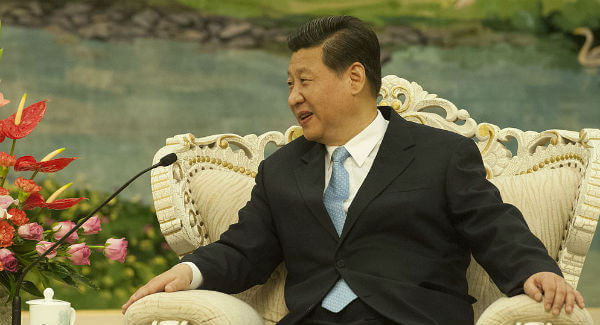
BBC News reports: China appears to be censoring social media posts on the Panama Papers document leak which has named several members of China’s elite, including President Xi Jinping’s brother-in-law.
Hundreds of posts on networks such as Sina Weibo and Wechat on the topic have been deleted since Monday morning. [Continue reading…]
Find out more about the Panama Papers.
Travelling inside ISIS-controlled Syria and Iraq
Jürgen Todenhöfer writes: Abu Qatadah, a German-born Muslim convert, who has brokered our visit to the Islamic State, is almost as wide as he is tall, with a thick, reddish-brown beard. My photographer son Frederic and I load our bags into the bed of the white pickup Qatadah and his driver arrived in. The driver’s head and face are so thoroughly wrapped with a large grey shawl that only his eyes and the contours of his nose are visible. He murmurs a greeting in English in a strikingly rhythmic accent. For security reasons, we can’t use the main roads. The drive to Raqqa takes more than three hours.
Qatadah claims business is booming in Isis. Almost all the shops are open and lots of goods are being sold, above all at the markets. We notice the new construction. “In places that are not being bombed, life goes on as normal,” Qatadah tells us. Then he gives us a short lecture on Isis’s version of sharia.
Christians have to pay jizya, a protection tax. It comes to about $300 (£210) a year for poor people and $600 (£420) for the rich. But then that is the only tax. Christians are among the more prosperous inhabitants of the country. All they have to do is sell a couple of sheep to raise the money to cover the tax. [Continue reading…]
The Daily Beast reports: Two senior intelligence analysts at U.S. Central Command say the military has forced them out of their jobs because of their skeptical reporting on U.S.-backed rebel groups in Syria, three sources with knowledge of their claim told The Daily Beast. It’s the first known instance of possible reprisals against CENTCOM personnel after analysts accused their bosses of manipulating intelligence reports about the U.S.-led campaign against ISIS in order to paint a rosier picture of progress in the war.
One of the analysts alleging reprisals is the top analyst in charge of Syria issues at CENTCOM. He and a colleague doubted rebels’ capabilities and their commitment to U.S. objectives in the region. The analysts have been effectively sidelined from their positions and will no longer be working at CENTCOM, according to two individuals familiar with the dispute, and who spoke on condition of anonymity. [Continue reading…]
Investigators believe at least 22 suspects are still at large following Brussels and Paris attacks
The Wall Street Journal reports: At least 22 radical Islamists from Europe linked to the terror network behind the Brussels and Paris attacks are suspected to be still at large, putting security services on high alert as they rush to prevent Islamic State from striking again in the region.
Many of the fugitives have been involved in previous Islamic State plots, officials say, and almost all of them have spent months or years fighting in Syria.
Interviews and confidential court documents seen by The Wall Street Journal portray the fugitives as part of an extensive web of young men who developed a deep hatred of the West after embracing radical Islam at underground mosques and clandestine meetings in Molenbeek, a heavily Muslim district in the heart of Brussels. They have since become central to Islamic State’s plans to strike the West, according to investigators, who suspect the Brussels network is behind the movement of battle-hardened operatives from Syria to Europe.
“We see many plots and several cells that we now know are part of the same network,” said Jean-Charles Brisard, president of the Center for the Analysis of Terrorism, a Paris think tank. “They’re already here. The problem is how to find them.”
The 22 men investigators are scrutinizing include those prosecuted in absentia during a major terror trial in Belgium last year, as well as several with links to a foiled plot to kill Belgian police last year. But people familiar with investigations say they believe the reach of the Brussels network extends beyond the group to others from the city who went to Syria and their sympathizers who stayed behind. [Continue reading…]
Obama’s nuclear security summit neglected 98 percent of the world’s bomb-ready uranium
The Intercept reports: At President Obama’s fourth and final nuclear security summit which took place last week, world leaders confronted the danger posed by nuclear terrorism — specifically, by reducing the ways that terrorists could get their hands on the uranium they would need to build a nuclear bomb.
But critics have pointed out that the summits have only focused on highly enriched uranium in civilian possession, which, according to the Department of Energy, only accounts for 2 to 3 percent of the world’s supply. That small percentage is used mostly by academics for research and medical isotope production.
The remaining 97 to 98 percent is held in military stockpiles, which the security summits have largely ignored. Countries keep the safeguards on these stockpiles secret, and military material falls outside the scope of international security agreements. [Continue reading…]
Intelligence community olive branch on data sharing greeted with skepticism
The Intercept reports: Top intelligence community lawyer Robert Litt has offered a rare olive branch to privacy advocates, in the form of information.
In a post on one of the intelligence community’s favorite blogs on Wednesday, Litt, general counsel for the Office of the Director of National Intelligence, outlined new intelligence data-sharing guidelines that he said will be released soon.
The post, on Just Security, was essentially a response to reporting last month from the New York Times’s Charlie Savage that the NSA would soon be sharing with other government agencies the raw, unfiltered intelligence from the depths of its massive overseas spying programs.
“There has been a lot of speculation about the content of proposed procedures that are being drafted to authorize the sharing of unevaluated signals intelligence,” Litt wrote.
The New York Times story raised concerns that the data, which inevitably includes information about Americans, would become too easily accessible by intelligence agencies including the FBI, potentially leading to fishing expeditions. [Continue reading…]
BuzzFeed reports: Just days after breaking into a terrorist’s iPhone using a mysterious third-party technique, FBI officials on Friday told local law enforcement agencies it will assist them with unlocking phones and other electronic devices.
The advisory, obtained by BuzzFeed News, was sent in response to law enforcement inquiries about its new method of unlocking devices — a technique the FBI said was successful at gaining access to the iPhone 5C belonging to one of the shooters in the deadly San Bernardino, California, attack.
“In mid-March, an outside party demonstrated to the FBI a possible method for unlocking the iPhone,” the message said. “That method for unlocking that specific iPhone proved successful.” [Continue reading…]
British authorities demand encryption keys in case with ‘huge implications’

The Intercept reports: British authorities are attempting to force a man accused of hacking the U.S. government to hand over his encryption keys in a case that campaigners believe could have ramifications for journalists and activists.
England-based Lauri Love was arrested in October 2013 by the U.K.’s equivalent of the FBI, the National Crime Agency, over allegations that he hacked a range of U.S. government systems between 2012 and 2013, including those of the Department of Defense, the Environmental Protection Agency, the Department of Energy, and NASA.
The U.S. Justice Department is seeking the extradition of Love, claiming that he and a group of conspirators breached “thousands of networks” in total and caused millions of dollars in damages. But Love has been fighting the extradition attempt in British courts, insisting that he should be tried for the alleged offenses within the U.K. The 31-year-old, who has been diagnosed with Asperger’s syndrome, has argued that he would not get a fair trial in the U.S., where his legal team says he could face a sentence of up to 99 years in jail. [Continue reading…]
Is Mohammed Dahlan likely to replace Mahmoud Abbas as Palestinian leader?
Adnan Abu Amer writes: The most important world capitals that provided Dahlan with this regional and international network are Cairo and Abu Dhabi, where Dahlan enjoys undeniable influence since he is considered the security adviser of UAE’s Crown Prince Sheikh Mohammed bin Zayed Al Nahyan. This position has provided Dahlan with influence that many UAE officials may not enjoy within the state.
Dahlan also enjoys considerable influence in Egypt through his direct ties with Sisi, which allows him to influence Egyptian media. In addition, he has been deploying efforts to buy some news websites in Jordan.
Ahmed Youssef, former political adviser to former Prime Minister Ismail Haniyeh, told Al-Monitor, “Dahlan is welcomed on the regional and international levels. As long as elections are not the only criterion on the Palestinian scene — in light of regional and international pressure to export this leader and sideline others — Dahlan may have better chances at accessing high Palestinian positions than others. This is considering Israel’s [relative] satisfaction with him and his special ties with the UAE, Egypt, Saudi Arabia, Jordan and the Syrian opposition. The international relations that a Palestinian official has may allow him to climb to rungs of the leadership ladder.” [Continue reading…]
The Panama Papers
The Panama Papers is an unprecedented investigation that reveals the offshore links of some of the globe’s most prominent figures.
The International Consortium of Investigative Journalists, together with the German newspaper Suddeutsche Zeitung and more than 100 other media partners, spent a year sifting through 11.5 million leaked files to expose the offshore holdings of world political leaders, links to global scandals, and details of the hidden financial dealings of fraudsters, drug traffickers, billionaires, celebrities, sports stars and more. [Continue reading…]
The Guardian reports: The Panama Papers reveal:
- Twelve national leaders are among 143 politicians, their families and close associates from around the world known to have been using offshore tax havens.
- A $2bn trail leads all the way to Vladimir Putin. The Russian president’s best friend – a cellist called Sergei Roldugin – is at the centre of a scheme in which money from Russian state banks is hidden offshore. Some of it ends up in a ski resort where in 2013 Putin’s daughter Katerina got married.
- Among national leaders with offshore wealth are Nawaz Sharif, Pakistan’s prime minister; Ayad Allawi, ex-interim prime minister and former vice-president of Iraq; Petro Poroshenko, president of Ukraine; Alaa Mubarak, son of Egypt’s former president; and the prime minister of Iceland, Sigmundur Davíð Gunnlaugsson.
- Six members of the House of Lords, three former Conservative MPs and dozens of donors to UK political parties have had offshore assets.
- The families of at least eight current and former members of China’s supreme ruling body, the politburo, have been found to have hidden wealth offshore.
- Twenty-three individuals who have had sanctions imposed on them for supporting the regimes in North Korea, Zimbabwe, Russia, Iran and Syria have been clients of Mossack Fonseca. Their companies were harboured by the Seychelles, the British Virgin Islands, Panama and other jurisdictions.
- A key member of Fifa’s powerful ethics committee, which is supposed to be spearheading reform at world football’s scandal-hit governing body, acted as a lawyer for individuals and companies recently charged with bribery and corruption.
- One leaked memorandum from a partner of Mossack Fonseca said: “Ninety-five per cent of our work coincidentally consists in selling vehicles to avoid taxes.”
Learn more at the International Consortium of Investigative Journalists, Suddeutsche Zeitung, the BBC, and the Guardian.
China’s rulers possessed by Maoist nostalgia and Leninist-style leadership

Orville Schell writes: “As a liberal, I no longer feel I have a future in China,” a prominent Chinese think tank head in the process of moving abroad recently lamented in private. Such refrains are all too familiar these days as educated Chinese professionals express growing alarm over their country’s future. Indeed, not since the 1970s when Mao still reigned and the Cultural Revolution still raged has the Chinese leadership been so possessed by Maoist nostalgia and Leninist-style leadership.
As different leaders have come and gone, China specialists overseas have become accustomed to reading Chinese Communist Party (CCP) tea leaves as oscillating cycles of political “relaxation” and “tightening.” China has long been a one-party Leninist state with extensive censorship and perhaps the largest secret police establishment in the world. But what has been happening lately in Beijing under the leadership of Chinese Communist Party General Secretary Xi Jinping is no such simple fluctuation. It is a fundamental shift in ideological and organizational direction that is beginning to influence both China’s reform agenda and its foreign relations.
At the center of this retrograde trend is Xi’s enormously ambitious initiative to purge the Chinese Communist Party of what he calls “tigers and flies,” namely corrupt officials and businessmen both high and low. Since it began in 2012, the campaign has already netted more than 160 “tigers” whose rank is above or equivalent to that of the deputy provincial or deputy ministerial level, and more than 1,400 “flies,” all lower-level officials.1 But it has also morphed from an anticorruption drive into a broader neo-Maoist-style mass purge aimed at political rivals and others with differing ideological or political views.
To carry out this mass movement, the Party has mobilized its unique and extensive network of surveillance, security, and secret police in ways that have affected many areas of Chinese life. Media organizations dealing with news and information have been hit particularly hard. Pressured to conform to old Maoist models requiring them to serve as megaphones for the Party, editors and reporters have found themselves increasingly constrained by Central Propaganda Department diktats. Told what they can and cannot cover, they find that the limited freedom they had to report on events has been drastically curtailed. [Continue reading…]
Report: The foreign fighters phenomenon in the EU – profiles, threats & policies
International Centre for Counter-Terrorism – The Hague reports: Despite the widespread media attention for foreign fighters in Europe, very little is known about the phenomenon itself, something also evidenced by the lack of a single foreign fighter definition across the EU.
In a study commissioned by the Netherlands National Coordinator for Security and Counterterrorism (NCTV), ICCT addresses this gap by analysing not only the numbers and characteristics of foreign fighters across the EU, but also how the Union and Member States assess the threat of foreign fighters as well as their policy responses regarding security, preventive and legislative measures. The Report also outlines a series of policy options aimed both at the EU and its Member States.
Findings include:
- Of a total estimated 3,922 – 4,294 foreign fighters from EU Member States, around 30% have returned to their home countries.
- A majority of around 2,838 foreign fighters come from just four countries: Belgium, France, Germany, and the United Kingdom, with Belgium having the highest per-capita FF contingent.
- There is no clear-cut profile of a European foreign fighter. Data indicates that a majority originate from metropolitan areas, with many coming from the same neighbourhoods, that an average of 17% are female, and that the percentage of converts among foreign fighters ranges from 6% to 23%.
- The radicalisation process of foreign fighters is reported to be short and often involves circles of friends radicalizing as a group and deciding to leave jointly for Syria and Iraq.
EU suspects Russian agenda in refugees’ shifting Arctic route
The New York Times reports from Kandalaksha: So many decrepit Soviet-era cars carried migrants into Europe from this frozen Russian town in recent months that border officials in Finland, who confiscate the rust-bucket vehicles as soon as they cross the frontier, watched in dismay as their parking lot turned into a scrapyard.
To clear up the mess and provide some space for freshly confiscated cars, the Finnish customs service set up a separate dumping ground.
Then last month, as suddenly and as mysteriously as it had started, the parade of migrants in rusty old cars came to an abrupt halt, or at least a pause.
“We don’t know what is going on,” said Matti Daavittila, the head of the ice-entombed Finnish border post near Salla. “They suddenly stopped coming. That is all we know.”
Compared with the hundreds of thousands of people fleeing war or hardship who made the trek to Europe last year through Turkey to Greece, the flow of refugees and migrants on the Arctic route through Russia — first into Norway and later into Finland — is tiny.
But the stop-go traffic has added a hefty dose of geopolitical anxiety, not to mention intrigue, to a crisis that is tearing the European Union apart. It has sent alarm bells ringing in Helsinki, Finland’s capital far to the south, and in Brussels, where European Union leaders, at recent crisis meetings on migration, discussed the strange and ever-shifting Arctic route through Russia. [Continue reading…]