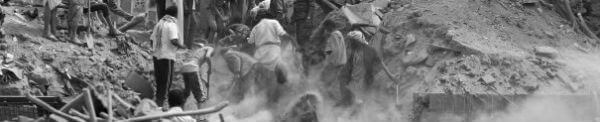
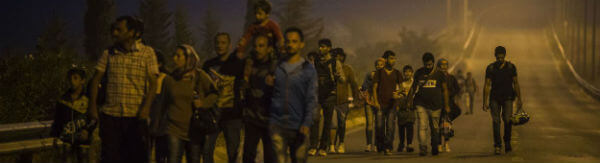
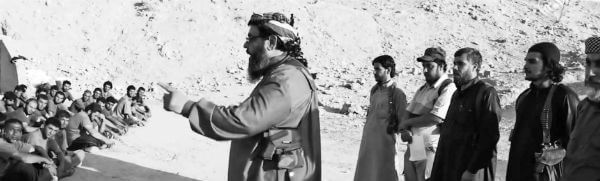
The New York Times reports: Fear engulfed Tunisia on Monday that Islamic State mayhem was spilling over from neighboring Libya, as dozens of militants stormed a Tunisian town near the border, assaulting police and military posts in what the president called an unprecedented attack.
At least 54 people were killed in the fighting in the town, Ben Gardane, which erupted at dawn and lasted for hours until the security forces chased out what remained of the assailants. An enormous stash of weapons was later found.
The authorities said at least 36 militants were among the dead. The others were a mix of security forces and civilians, including a 12-year-old girl.
It was unclear where the assailants had come from, although some witnesses reported that they had local accents and had pronounced themselves as liberators. But President Beji Caid Essebsi of Tunisia, increasingly alarmed about the Islamic State’s expansion in Libya, blamed the militant group. In a televised address, he suggested that the motive was to create a new Islamic State territory on Tunisian soil, similar to the 150-mile stretch it controls in Libya. [Continue reading…]
Category Archives: News
Takeover of opposition newspaper is a death warrant for free speech in Turkey
By Ahmet Erdi Öztürk, University of Ljubljana
On Friday March 4, a Turkish court ruled that the country’s biggest daily newspaper, Zaman, would be run by appointed trustees – ostensibly because of its so called “terrorist” activities, but more likely because the publication was linked to US-based Muslim preacher Fethullah Gülen, an opponent of the government.
Shortly after the court’s decision, police stormed the paper’s Istanbul headquarters in a dramatic midnight raid, firing tear gas and water cannon at the hundreds-strong crowd that formed outside.
The new administrative members dismissed the editor, executive editor and other senior staff, transforming the newspaper’s editorial line, in less than 48 hours, from a rigorous opposition voice into a propaganda mouthpiece for the president, Recep Tayyip Erdoğan.
Full disclosure: I have written oped pieces for Zaman for the past two years or so – at a rate of about two or three per month. Never at any time was there any attempt to dictate my angle or censor my work, even when – as I did several times – I wrote articles that were critical of Gulen or his movement. Now I feel that the doors of this newspaper are closed – not only for me but also for most of the other academic writers who had used the paper as a vehicle for their opinions.
This episode has not come as a huge surprise to anyone who has been following Turkey’s political scene. While Erdoğan and his AKP party enjoyed close relations with Gulen and his Hizmet educational and religious movement when the party first emerged – and observers believe that Hizmet used his enormous popularity to help Erdogan secure his first term as prime minister in 2002 – things have gone bad between them since 2013.
Turkey cracks down on foreign fighters
The Washington Post reports: The plea for help came from Sweden: Two young Muslim males had left Stockholm for Syria and would soon be terrorists-in-training unless authorities in Turkey could intercept them.
Turkish security caught the men arriving at an airport in Istanbul with one-way tickets and camouflage gear, officials said. The two were sent back to Sweden and the trouble averted — until eight days later, when the same duo turned up at a Turkish seaport, this time arriving by ferry from the Greek island of Kos.
The back-to-back deportations of those would-be militants last year were in some ways a sign of substantial progress in the cooperation between Western governments and Turkey in sharing intelligence and stemming the flow of foreign fighters to Syria.
But the sequence and hundreds of similar cases have also fueled rising levels of frustration in Turkey, which has been accused of enabling the migration of fighters into Syria even while being called upon to block militants on behalf of other governments unwilling or unable to do the job themselves. [Continue reading…]
Saudi Arabia’s unholy war in Yemen

Nasser Arrabyee writes: Since it began its war on the Houthis in March 2015, Saudi Arabia has justified its intervention as a broader holy duty to fight Shia and protect the government in exile. Yet Yemenis increasingly view Saudi intervention more as a campaign—in which they are collateral—to upgrade Riyadh’s own influence and an ill-conceived effort to promote Mohammed Bin Salman as a powerful future Saudi king. As such, Yemenis fail to see any moral or legal justification for the U.S.-backed Saudi war. What is evident to them is the deliberate destruction of people and capital—all to no end, as the war has failed to accomplish Saudi Arabia’s goal of weakening the Houthis. Instead, the airstrikes and blockade that form the core of Saudi Arabia’s strategy have increased anti-Saudi hatred, driving greater numbers of Yemenis to support the Houthis every day.
The war has done particular damage to infrastructure — including reservoirs, airports, electric power stations, bridges and roads, markets, factories, stadiums, and hospitals. The education sector has been hit especially hard, with 39 universities damaged, 810 primary and secondary schools damaged, and another 3,809 closed. About 85 percent of the population of 27 million is in dire need of food, water, medicine, and fuel. Over 2.5 million Yemenis are displaced, and the attacks have killed or injured more than 23,000 civilians — among them thousands of women and children—using internationally prohibited weapons such as cluster bombs, as documented by Human Rights Watch and Amnesty International. [Continue reading…]
How AIPAC mainstreams anti-Muslim hate
Ali Gharib writes: ast year, Investigative Project on Terrorism head Steven Emerson quietly pulled out of the annual conference of Washington’s most influential pro-Israel lobby group, the American Israel Public Affairs Committee (AIPAC). He pinned the withdrawal on “an unexpected medical problem that required my immediate attention,” but it was impossible not to notice that it came amid reverberations of criticism for the latest of Emerson’s Islamophobic outbursts.
A couple months before the AIPAC summit, Emerson had taken to the airwaves of Fox News to expound on so-called no-go zones in Europe, purported Muslim enclaves where governments dared not go. But there was a problem: “They don’t exist,” David Graham wrote in The Atlantic. And yet Emerson took the myth even farther. In the United Kingdom, he reported on Fox, “There are actual cities like Birmingham that are totally Muslim, where non-Muslims simply don’t go in!”
The Birmingham comment elicited ridicule from across the spectrum — “This guy is clearly a complete idiot,” British Prime Minister David Cameron said in an interview — and eventually Emerson and, perhaps more improbably, Fox News itself apologized. A few weeks later, Emerson was out at AIPAC.
Now, Emerson is back. His name appears on a list of confirmed speakers published by AIPAC ahead of its Washington, DC, conference later this month. [Continue reading…]
Refugee crisis magnified by European divisions

Der Spiegel reports: A rickety gate of galvanized wire is all that separates desperation from hope. The gate is part of the fence erected in the farming village of Idomeni on the border between Greece and Macedonia. At this moment, some 12,000 people are waiting for it to be opened.
It’s the gateway to Europe and the gateway to Germany.
A woman in boots and a blue uniform stands guard in front of the gate. Her name is Foteini Gagaridou and she is an official with the Greek border police — and she looks exhausted. All it would take for her to open the border would be to pull a thin metal pin out of the latch, but she’s not allowed to.
If it were up to her, she says, she would let every single one of these people pass through, just as they were able to do just a few weeks earlier — across the border to Macedonia and on through Serbia, Croatia and Slovenia to Austria, where they could continue their journey to Germany on what is known as the Balkan Route. It’s the same path chosen by hundreds of thousands of refugees last year, but the Balkan Route is now closed. It ends at Gagaridou’s wire gate.
This is where Fortress Europe begins, secured with razor wire and defended with tear gas. Desperate scenes played out here on Monday, reminiscent of those witnessed in Hungary back in September. A group of young men used a steel beam as a battering ram to break down the gate. Rocks flew through the air as the gate flew off its hinges, prompting the volleying of tear gas cartridges and stun grenades from the Macedonian side. Men could be seen running and children screaming. One woman lay on the ground with her daughter, crying.
This frontier has become Europe’s new southern border, with Greece serving as Europe’s waiting room — and the possible setting for a humanitarian disaster. Around 32,000 migrants are currently stranded in the country, a number that the Greek Interior Ministry says could quickly swell to 70,000. The aid organization Doctors Without Borders is even expecting 200,000 refugees. Greece’s reception camps are already full, and the highly indebted country is stretched well beyond its capacity.
The decision as to whether and how many refugees will be able to cross the border isn’t one for border guard Gagaridou to make. Rather, it will be taken by the Macedonian government. Macedonia, for its part, is pointing fingers at countries further to the north, noting it is they who have tightened their borders, especially Austria, which created a chain reaction of border closures last week. The countries apparently felt they could wait no longer for the broader European solution German Chancellor Angela Merkel has promised will result from a special EU summit scheduled for March 7.
Merkel wants to see Turkey stem the flow of refugees and put a stop to the exodus to Europe. European leaders agreed on Feb. 18 that this plan remains the “priority.” But Austria and the Balkan states nevertheless moved ahead and closed their borders.
Idomeni has become a symbol of the current political chaos in Europe and the crumbling of a joint European refugee policy. The town is emblematic of the new Europe of fences. It is here that German Chancellor Angela Merkel’s open border policies have met their end. Under Austria’s leadership, the Balkan Route has been closed in the precise move Berlin had hoped to avoid.
Merkel has begun warning of the EU’s disintegration “into small states” that will be unable to compete in a globalized world, as well as of the possibility that border controls might soon be reintroduced all across Europe.
Were Europe in agreement, it would be unproblematic to accommodate 2-3 million refugees, given the Continent’s population of a half billion people. From such a perspective, the current spat actually seems somewhat ridiculous. But in the run up to next week’s EU summit, Europe is gripped by strife. Europe’s greatest achievement, the opening of its borders through the Schengen agreement, is at stake, and the increasingly toxic atmosphere between countries has reached alarming dimensions. [Continue reading…]

Reports of uprising against ISIS in Raqqa are false, Syrian activists say
The Independent reports: Syrian activists say media reports of a popular uprising against Isis in Raqqa are false.
It has been reported that 200 Isis militants had switched sides to fight against their former comrades, securing at least five neighbourhoods in the city and replacing the black flag of Isis with the Syrian national flag.
”About 200 Syrian militants of Daesh took the side of residents of Raqqa, which forced the terrorists to organize roadblocks at the entrance to the city,” one source told Sputnik, the Russian government’s news agency.
However, the reports are false according to Raqqa is Being Slaughtered Silently (RBSS), a group of citizen journalists reporting on life under Isis. [Continue reading…]
Rivalries stall push to retake Mosul
The Wall Street Journal reports: Defense Secretary Ash Carter said last week that the Syrian town of Shaddadi had been cleared of militants, cutting off an important supply line between Mosul and Raqqa, Islamic State’s de facto capital in Syria. Mr. McGurk [President Obama’s envoy on the fight against ISIS] described Shaddadi’s liberation and a similar victory in the Iraqi city of Sinjar as the beginning of an effort to isolate Mosul.
Over the weekend, Iraq’s military airdropped leaflets over the occupied city addressed to “the patient sons of Mosul.” “Your security forces settled the fight in Ramadi in Iraq’s favor,” it read. “Now they are readying for the biggest battle…be ready.”
But Iran, through the Shiite militias it supports, is insisting on a role in Mosul after being sidelined in recently liberated Ramadi, according to Iraqi and U.S. officials. Iraq’s Sunni groups and the U.S. fear militia participation will fan sectarian tensions and expand Iran’s already sizable influence in Iraq.
Kurdish officials insist their forces should have a role in the fight to recapture Mosul, as well. But Baghdad worries the Kurds will use the fight to take territory that helps strengthen their case for an autonomous Kurdish homeland.
The jockeying among Iraq’s splintered groups, and the foreign powers that back them, have repeatedly pushed back the timetable to retake Mosul. As a result, some Iraqi and U.S. officials are now predicting the offensive won’t even begin this year. [Continue reading…]
Iraq is broke — add that to its list of worries
The Washington Post reports: Some Iraqi officials refer to it as “the gap,” and it is becoming as pressing a concern as the fight against the Islamic State.
Each month, Iraq’s government pays out nearly $4 billion in salaries and pensions to the military and a bloated array of public-sector workers. But with more than 90 percent of government revenue coming from oil, it is bringing in only about half that as crude prices plunge.
The United States is stepping in to try to make sure the country can continue military spending while it seeks international loans and embarks on an austerity plan. Still, some Iraqi officials and analysts say the government might struggle later this year to pay the 7 million people on the public payroll, which could trigger mass unrest.
With oil prices hovering around $30 a barrel, the entire region is being forced to cut budgets, reduce state handouts and make other painful adjustments. But for Iraq, the decline comes in the midst of an already destabilizing war. There are bills for reconstructing flattened cities and assistance for 3.3 million Iraqis who have been internally displaced over the past two years, with more expected to come. [Continue reading…]
Tunisia: At least 45 dead in clashes near Libyan border
The Associated Press reports: At least 45 people were killed Monday near Tunisia’s border with Libya in one of the deadliest clashes seen so far between Tunisian forces and extremist attackers, the government said.
The fighting in the border town of Ben Guerdane in eastern Tunisia comes amid increasing concern that violent extremism in Libya could destabilize the region.
The government closed its two border crossings with Libya because of the attack that left 28 “terrorists,” seven civilians and 10 members of Tunisia’s security forces dead, the Tunisian interior and defense ministries said in a statement. [Continue reading…]
U.S. considering boosting forces in Europe for defense against Russia
Military Times reports: The Pentagon is discussing plans to permanently move one or more Army brigade combat teams back to Europe, where the top American commander has signaled an urgent need to shore up allied defenses against the Russians, Military Times has learned.
If approved, the move could involve thousands of troops — an average BCT is composed of between 3,000 and 5,000 personnel — and mark the first time in decades that U.S. European Command has increased its footprint on the continent.
The EUCOM Commander, Air Force Gen. Philip Breedlove, discussed his proposals with top-level Pentagon officials while in Washington last week, according to a defense official familiar with the plans. Any increase would come in addition to the brigade-size force that would rotate through Eastern Europe as part of the $3.4 billion “European Reassurance Initiative,” which was included in the Pentagon’s latest budget request. [Continue reading…]
This judge says toddlers can defend themselves in immigration court
Judge Jack H. Weil
Department of Justice
Office of the Chief Immigration Judge
Jack.Weil@usdoj.gov
The Los Angeles Times reports: A federal immigration judge believes migrant toddlers can defend themselves in court, according to a deposition in a court case brought by advocates seeking government-appointed attorneys for the youths.
“I’ve taught immigration law literally to 3-year-olds and 4-year-olds. It takes a lot of time. It takes a lot of patience,” Judge Jack Weil said. “They get it. It’s not the most efficient, but it can be done.”
The startling statement from Weil, a Virginia-based judge responsible for training his peers, comes at a time when the number of young unaccompanied migrants crossing the southern border has sharply risen.
In immigration court, there is no guarantee of counsel for adults or children. Advocates for immigrants have long argued that a person’s ability to make informed decisions — and their chances of being allowed to stay in the U.S. — are enhanced if an attorney represents them.
Last month, Senate Minority Leader Harry Reid of Nevada and other Democrats introduced legislation that would require the government to appoint attorneys for children in immigration court who crossed the border alone or were victims of abuse, torture and other violence. [Continue reading…]
New clues on how the brain tracks time

Emily Singer writes: Our brains have an extraordinary ability to monitor time. A driver can judge just how much time is left to run a yellow light; a dancer can keep a beat down to the millisecond. But exactly how the brain tracks time is still a mystery. Researchers have defined the brain areas involved in movement, memory, color vision and other functions, but not the ones that monitor time. Indeed, our neural timekeeper has proved so elusive that most scientists assume this mechanism is distributed throughout the brain, with different regions using different monitors to keep track of time according to their needs.
Over the last few years, a handful of researchers have compiled growing evidence that the same cells that monitor an individual’s location in space also mark the passage of time. This suggests that two brain regions — the hippocampus and the entorhinal cortex, both famous for their role in memory and navigation — can also act as a sort of timer.
In research published in November, Howard Eichenbaum, a neuroscientist at Boston University, and collaborators showed that cells in rats that form the brain’s internal GPS system, known as grid cells, are more malleable than had been anticipated. Typically these cells act like a dead-reckoning system, with certain neurons firing when an animal is in a specific place. (The researchers who discovered this shared the Nobel Prize in 2014.) Eichenbaum found that when an animal is kept in place — such as when it runs on a treadmill — the cells keep track of both distance and time. The work suggests that the brain’s sense of space and time are intertwined. [Continue reading…]
Former Petraeus adviser, Lt Col David Kilcullen: ‘No ISIS if we didn’t invade Iraq’
In a review of Kilcullen’s new book, Blood Year: Islamic State and the Failures of the War on Terror, David Gardner writes: “The greatest strategic screw-up since Hitler’s invasion of Russia” is how David Kilcullen describes George W Bush’s invasion of Iraq in 2003. If anyone thinks that is a throwaway line they should read on. For it comes from one of the architects of the 2007-08 “surge” into Iraq that sought to restore security to a society the US-led occupation broke, and to create space to rebuild a state it destroyed.
Kilcullen was a young lieutenant colonel in the Australian army who had served in Iraq and Afghanistan, a scholar steeped in counter-insurgency theory, “watching closely and keeping notes as this enormous slow-motion train wreck took place”. In 2007 he was seconded to US forces as chief adviser to General David Petraeus, commander of the surge. This strategy combined a big influx of American troops with co-opted Sunni tribal fighters to defeat al-Qaeda. The jihadis, later to transmute into the far greater threat of Isis, had virtually no presence in Iraq prior to the invasion — but used it to turn the country into a charnel house and trigger the region-wide war between Sunni and Shia Islam that has now ripped Syria apart.
Put simply, Kilcullen argues we should never have gone into Iraq, with the job still unfinished in Afghanistan after 9/11. But the US and its allies were morally and legally obliged afterwards to try to “halt the carnage and restore some normality”. Like many soldiers, Kilcullen does not do gore. So when he mentions, in the sparest of prose given the depravity of the sectarian bloodletting, the “commercial kidnapping gangs auctioning off terrified children for slaughter, in a makeshift night market that operated under lights near the soccer stadium”, it is a kick in the stomach.
The surge sharply reduced the violence. But the US, now under President Barack Obama, had exhausted its attention span. Meanwhile, Iraqi leaders twisted by sectarianism would not use the space this success created for reconciliation.
Mr Obama, to be fair, was elected on a pledge to extract Americans from Middle East wars. Yet in Kilcullen’s judgment, he left Iraq irresponsibly early. He failed to register how Nouri al-Maliki, the Shia Islamist premier and joint protégé of the US and Iran, was stampeding Iraq’s Sunni minority into jihadi arms by his sectarian power grab. With al-Qaeda wounded by its “near death experience” with the surge, few noticed its rebirth in the ashes of Syria. Recklessness in Iraq was followed by fecklessness in Syria — “passivity in the face of catastrophe” that spells strategic disaster for the US and the west. [Continue reading…]
The Donald Trump show
Decoding the changing nature of ISIS’s insurgency

Hassan Hassan writes: The war against ISIL is changing, and how its opponents adapt will be a key test of the group’s ability to achieve its goals.
A string of attacks and counter-attacks over the course of this year so far signal a major shift in the way the group is conducting its military operations, leaning back on insurgency tactics it used when US troops were still present in Iraq.
The change comes amid widespread perception in western capitals that the group is now on the back foot. But it also follows a variety of crises – financial and political – that may cause deeper western involvement in the Syrian and Iraqi conflicts.
Last Sunday, the group launched an assault inside the city of Abu Ghraib, 15 kilometres from Baghdad International Airport. More than 50 people were killed and the attack was repelled. In the process, the militants reportedly controlled the grain silo in Khan Dhari and took with them a dozen lorries full of badly needed grain into besieged Fallujah, which is around 30 kilometres away. [Continue reading…]
U.S. planning to strike ISIS in Libya based on ‘faulty intelligence’
The Telegraph reports: The United States is basing plans for military intervention in Libya on faulty intelligence, Western officials and country experts have told the Sunday Telegraph.
American intelligence agencies assess that the Islamic State of Iraq and the Levant (Isil) has doubled in size in Libya, with between 5,000 and 6,500 fighters in the country.
Privately, however, some US officials say they believe these estimates to be overblown. Independent experts have come to the same conclusion.
“The estimates of the number of jihadists is grossly exaggerated,” said Karim Mezran, a Libya expert with the Atlantic Council in Washington.
Whilst Mr Mezran and other analysts were loathe to put a number on the size of the organisation, citing the chaos and lack of access to Isil areas in Libya, all said they believed the real figure to be only 20 to 40 per cent of the US estimate. [Continue reading…]
Israel employs legal principle of collective punishment used by Nazi Germany
In an editorial, Haaretz says: Over the past few months, Israel has adopted the principle known in German as sippenhaft – meaning a family’s shared responsibility for a crime committed by one of its members. Its origins lie in ancient times, when an offender’s entire tribe would be punished for his crimes. In the modern era, this principle was characteristic of totalitarian regimes, when the relatives of “enemies of the state” were punished by exile, imprisonment or execution. Today, this method is common in North Korea.
The Netanyahu government’s response to shooting, knifing and car-ramming attacks is based on the same principle: The family that “supports and assists” the terrorist, as Netanyahu put it, is as guilty of terror as the offender. That is why house demolitions have been renewed. According to figures by the nonprofit B’Tselem, 31 Palestinian homes have been demolished whose relatives were involved in attacks, with other demolitions planned. That is also why Israel is holding the bodies of attackers from East Jerusalem and punishing their families by delaying burials. Israeli advocates of sippenhaft argue that it’s the only way to deter the Palestinians, citing cases in which families gave up suspects as proof that the method works. To them, the deportation of families to Gaza seems the ultimate weapon against lone-wolf attacks.
But the Palestinians are not the only ones who’ll pay the price for punishing the families; Israel will, too. Because a state that adopts the legal methods and laws of totalitarian states begins to look like those countries, even if it calls itself “the only democracy in the Middle East.” [Continue reading…]