Category Archives: News

The future of Aleppo will show whether Syria can rise from the ashes

Anshel Pfeffer reports: The forces besieging Aleppo will not try to capture it. Tens of thousands of fighters who have hardened by over four years of fighting for their homes are determined to defend their city and now every corner and rooftop of its ancient alleyways. Even a large and advanced army would emerge from such an urban warfare operation with hundreds, perhaps thousands of casualties. The ill-trained Shi’ite militias who have no experience of such warfare and are unacquainted with the city have little chance.

Abu Firas, a former Syrian army colonel and today a commander in the Shami Front, the largest rebel group fighting in Aleppo, says, “we haven’t seen on the battlefield recently any Syrian soldiers fighting for the regime. All the banners and the bodies of fighters we killed are of foreigners from Lebanon, Iraq, Afghanistan and Pakistan. We have no problem fighting them off, our men are well-trained after all these years of fighting. But they have the Russian airstrikes which make all the difference.”

Even if the forces fighting for President Bashar Assad’s regime cut off the last road leading to Aleppo, and close the last remaining kilometers in the ring of siege, the regime does not have sufficient forces to keep the pressure up for long. The rebels will succeed in breaking a way out and bringing in supplies. The local civil organizations have accumulated enough food for around a quarter of million civilians still in the city, which will last months and are meanwhile practicing growing vegetables on rooftops and digging supply tunnels. Instead of the fuel that cannot reach the city to powers it generators, they are working on alternative energy sources from waste.

Other large civilian areas in Syria, such as the rebel-held East Goutah suburb of Damascus, have withheld siege for years now. Aleppo will not fall. It will be bombarded and exhausted and as long as fighters are willing to remain, it won’t be occupied. But life there will become hell. An even worse hell than that which has existed in Syria for the last five years. And for how long can a nation live in hell?

That is, if there is still a Syrian nation.

In opposition circles, there is talk in recent months that the Assad regime has given up on recapturing most of the Syria’s territory and is now focusing on establishing “Suria al-mufida” – useful Syria. They’ve given up long ago on eastern Syria which is occupied by ISIS. The Kurdish enclaves in the north and the Druze area in the south will be allowed to remain autonomous without regime interference (no-one of course is talking any more of regaining the Golan from Israel). The regime is aiming at capturing and “cleansing” the Damascus and Aleppo districts and deepening its control of Latakia on the Mediterranean coast. That is enough to keep the Assad family regime, as a Russian client-state and an Iranian dependancy.

The regime’s main obstacle to achieving that goal is the rebel groups still controlling large areas of “Useful Syria” which continue to demand either democracy or the rule of Islam. The solution to this is carnage, exile and complete submission.

Last week, the international community’s diplomatic attempts at imposing a political solution totally failed, when the talks on Syria’s future ended in Geneva before they began. The official reason was the refusal of the opposition’s representatives to enter negotiations while Russian planes were bombing their homes back in Aleppo. Even if a ceasefire is announced at some stage, what is doubtful right now while the Russians believe they have the advantage, a “political solution” will be far from enough for a country that has lost a third of its population.

Syria has almost ceased to exist. There are enclaves and fiefdoms and an organized crime family which continues to safeguard its interests in Damascus and on the coast and a government in exile in Turkey and millions of refugees. The resilience of the people of Aleppo in face of the siege will be an indication of whether Syria can rise from the ashes. [Continue reading…]


Facebooktwittermail

Russia agrees to ‘ceasefire’ during which it will continue bombing Syria

Syria Deeply reports: World powers agreed Friday to the “cessation of hostilities” in Syria in one week and to redouble efforts to deliver humanitarian aid to civilians across the country, but failed to secure a nationwide ceasefire or an end to Russian bombing.

U.S. Secretary of State John Kerry announced the deal in Munich shortly after a marathon meeting with top diplomats from more than a dozen countries, including Russia, to push forward a ceasefire deal and to resurrect peace talks that collapsed last week.

“First, we have agreed to accelerate and expand the delivery of humanitarian aid beginning immediately,” Kerry told reporters.

“Second, we have agreed to implement a nationwide cessation of hostilities to begin in a target of one week’s time. That’s ambitious, but everybody is determined to move as rapidly as possible to try to achieve this.”

Kerry was quick to acknowledge that the meeting produced commitments on paper only.

“What we need to see in the next few days are actions on the ground, in the field,” he said, adding that “without a political transition, it is not possible to achieve peace.”

Russian foreign minister Sergei Lavrov said that Moscow would not halt its air raids in Syria, saying the cessation of hostilities did not apply to the Islamic State group (ISIS) and the al-Nusra Front, the al-Qaida affiliate in Syria.

Diplomats from the U.S. and the E.U. have said very few of Russia’s air raids have targeted Islamic extremist groups; instead, they have primarily targeted western-backed rebel groups seeking to oust President Bashar al-Assad. [Continue reading…]

The Washington Post reports: Russian warplanes resumed their bombardment of rebel positions across Syria within hours of the deal, striking areas in the countryside around the northern city of Aleppo in support of a 10-day-old government offensive to lay siege to the city.

In Brussels, Russian Foreign Minister Sergei Lavrov told reporters that Moscow would continue its attacks against groups including the Islamic State.

The Russians have repeatedly said that they consider a number of Islamist groups fighting within the opposition to be “terrorist,” and have used this formulation to justify air attacks that have largely targeted the anti-Assad opposition.

Under the agreement, the United States and Russia will chair a task force to adjudicate questions about where and when bombing is permitted. But it remains unclear how those decisions will be made. [Continue reading…]

U.S. State Department: Statement of the International Syria Support Group

Meeting in Munich on February 11 & 12, 2016, as the International Syria Support Group (ISSG), the Arab League, China, Egypt, the EU, France, Germany, Iran, Iraq, Italy, Jordan, Lebanon, the Organization of Islamic Cooperation, Oman, Qatar, Russia, Saudi Arabia, Turkey, United Arab Emirates, the United Kingdom, the United Nations, and the United States decided that humanitarian access will commence this week to besieged areas, and an ISSG task force will within one week elaborate modalities for a nationwide cessation of hostilities. [Continue reading…]

Facebooktwittermail

Death toll from war in Syria now 470,000, group finds

The New York Times reports: As waves of heavy Russian airstrikes edged closer to the Turkish border on Thursday, a Syrian research group issued a report saying the impact of five years of war in Syria has been even more devastating than already thought.

The report from the Syrian Center for Policy Research said that at least 470,000 Syrians had died as a result of the war, almost twice the 250,000 counted a year and a half ago by the United Nations until it stopped counting because of a lack of confidence in the data.

Life expectancy has dropped 14 years, to 56 from 70, since the war began, with an even deeper plunge for Syrian men, says the report, which the group compiled from its longtime base in the capital, Damascus. It put the war’s economic cost at $255 billion, essentially wiping out the nation’s wealth.

The report stood out because it shows a state in collapse in many ways even though it comes from an organization that was, until recently, based in Damascus, the seat of a government that seeks to control tightly how it is portrayed. The report was released on a day that world leaders were scheduled to meet in Munich, even though hopes that Russia and the United States could agree on a cease-fire were sinking. [Continue reading…]

Facebooktwittermail

Aiding disaster: How the United Nations’ OCHA helped Assad and hurt Syrians in need

Annie Sparrow writes: Syria, the world’s largest humanitarian crisis, is also the most expensive. OCHA, shorthand for the Office for the Coordination of Humanitarian Affairs, is the UN agency tasked with managing such crises, along with determining the global humanitarian budget, more than $20 billion in 2016, and allocating funds received from donor governments. OCHA’s forecast for 2016 is $3.2 billion for Syria alone, where it estimates that 13.5 million people are in need of humanitarian aid. Another $4.8 billion is solicited for the regional cost of putting up some four million refugees in Jordan, Lebanon, and Turkey.

Yet five years into the Syrian crisis, long-festering concerns over OCHA’s lack of neutrality are growing. Characteristic of many agencies of the United Nations, OCHA places a premium on maintaining good relations with the Syrian government, a position fueled by its desire to stay in Damascus. With no end to the conflict in sight, though, it is worth asking whether OCHA’s bottom line is harming the agency’s efforts to alleviate the catastrophic consequences of Damascus’ anti-civilian strategy. Indeed, the 2016 UN plan for Syria provides a real-time illustration of what happens when a UN agency loses sight of humanitarian principles and prioritizes relations with a government intent on violating them.

The UN plan must be understood in the context of Syria’s incredibly complicated humanitarian situation. The most recent estimates place 800,000 civilians under siege, denied access to safe water, food, health care, fuel, and warmth. Of these, more than 600,000 civilians are besieged by the government. An additional 200,000 civilians are held by the self-proclaimed Islamic State (also known as ISIS) in the city of Deir ez-Zor. OCHA relies on permission from the government to gain access to these people, but the government rarely grants it. Madaya, for example, is less than an hour’s drive from Damascus, yet between July 1, 2015, and January 12, 2016, OCHA could arrange only a single convoy, which contained expired food aid. The last convoy to Duma, where 175,000 civilians have been under siege since November 2012, was on July 2, 2015. Duma is barely ten miles from the Four Seasons in Damascus, where Yacoub El Hillo, OCHA’s resident/humanitarian coordinator, is based. [Continue reading…]

Facebooktwittermail

Residents in Syria’s Aleppo fear blockade as regime advances

AFP reports: Shop shelves are bare and prices have doubled in Syria’s Aleppo as the threat of a blockade looms after advancing regime forces cut off the second city’s main supply route last week.

“What will happen when food runs out? We’ll die of hunger,” said Abu Mohammed, who has seven children.

“Everybody here fears a blockade. We can feel it unavoidably coming,” said the 42-year-old salesman from the southeastern Fardoss neighbourhood.

Some 300,000 people are at risk of being placed under siege in Aleppo, a city that has been divided since 2012, with government forces controlling the west and rebels the east. [Continue reading…]

Facebooktwittermail

Inside the Syrian provincial capital where 200,000 face starvation

The Daily Beast reports: Deir Ezzor, a once relatively prosperous city of more than 300,000 people, is modern-day Syria in a microcosm. When anti-government protests broke out in 2011, the government sent in tanks. When rebels occupied the city, the ideals of those who protested state repression were betrayed by the arbitrary arrests and Islamist repression of al-Qaeda’s Syrian affiliate, Jabhat al-Nusra. Now, half the city is occupied by the Islamic State, which for more than a year has been besieging and starving the other half controlled by the Syrian government led by Bashar al-Assad — with the complicity, current and former residents say, of the government itself.

What’s left today of government-controlled Deir Ezzor is a poor and tired population. Some of those people are stubborn, or proud: having survived nearly five years of a war that has killed more than 250,000 of their fellow Syrians, they refuse to abandon their homes. Most, however — the vast majority — are there not because they choose to be, but because they have no choice. Many are refugees from other areas of Deir Ezzor province or from the city’s other half, taken over by the Islamic State in July 2014, on the other side of the Euphrates River. [Continue reading…]

Facebooktwittermail

Turkish president threatens to send millions of Syrian refugees to EU

AFP reports: Turkish President Recep Tayyip Erdoğan has threatened to send the millions of refugees in Turkey to EU member states, as Nato agreed to deploy ships to the Aegean Sea to ease the migrant crisis.

In a speech in Ankara on Thursday, Erdoğan stepped up his denunciations of western policy in the refugee crisis, confirming he had threatened EU leaders at a summit meeting in November that Turkey could say “goodbye” to the refugees.

But in a separate move, Nato agreed to send a naval group “without delay” to the Aegean to crack down on the people smugglers who have helped hundreds of thousands of migrants cross to EU territory in the last year.

Alarm is growing in EU capitals that thousands of refugees are still crossing the Aegean daily from Turkey after over a million made the perilous journey last year.

But Turkey, already home to some 3 million refugees, is also under EU and UN pressure to take in tens of thousands of Syrian refugees fleeing regime advances in the Aleppo region.

Erdoğan sought to turn the tables on the EU by saying Turkey had every right to send the refugees out of the country if it so wished. [Continue reading…]

Facebooktwittermail

Putin is a bigger threat to Europe’s existence than ISIS

George Soros writes: Putin is a gifted tactician, but not a strategic thinker. There is no reason to believe he intervened in Syria in order to aggravate the European refugee crisis. Indeed, his intervention was a strategic blunder because it embroiled him in a conflict with Turkey’s president, Recep Tayyip Erdoğan, which has hurt the interests of both.

But once Putin saw the opportunity to hasten the EU’s disintegration, he seized it. He has obfuscated his actions by talking of cooperating against a common enemy, Isis. He has followed a similar approach in Ukraine, signing the Minsk agreement but failing to carry out its provisions.

It is hard to understand why US and EU leaders take Putin at his word rather than judging him by his behaviour. The only explanation I can find is that democratic politicians seek to reassure their publics by painting a more favourable picture than reality justifies. The fact is that Putin’s Russia and the EU are engaged in a race against time: the question is which one will collapse first.

The Putin regime faces bankruptcy in 2017, when a large part of its foreign debt matures, and political turmoil may erupt sooner than that. The president’s popularity, which remains high, rests on a social compact requiring the government to deliver financial stability and a slowly but steadily rising standard of living. Western sanctions, coupled with the sharp decline in the price of oil, will force the regime to fail on both counts. [Continue reading…]

Facebooktwittermail

Scientists glimpse Einstein’s gravitational waves

Phys.org reports: In a landmark discovery for physics and astronomy, scientists said Thursday they have glimpsed the first direct evidence of gravitational waves, ripples in the fabric of space-time that Albert Einstein predicted a century ago.

When two black holes collided some 1.3 billion years ago, the joining of those two great masses sent forth a wobble that hurtled through space and reached Earth on September 14, 2015, when it was picked up by sophisticated instruments, researchers announced.

“Up until now we have been deaf to gravitational waves, but today, we are able to hear them,” said David Reitze, executive director of the LIGO Laboratory, at a packed press conference in the US capital.

Reitze and colleagues compared the magnitude of the discovery to Galileo’s use of the telescope four centuries ago to open the era of modern astronomy.

“I think we are doing something equally important here today. I think we are opening a window on the universe,” Reitze said. [Continue reading…]

Facebooktwittermail

Aleppo airlift: Maybe the U.S. has not run out of options in Syria

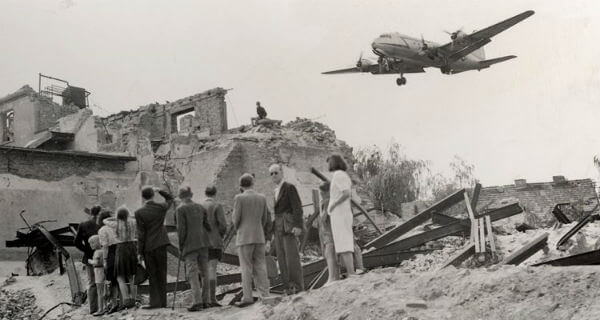
berlin-airlift

After I posed the question, can the U.S. take action to protect Aleppo? a reader reasonably asked: What would a productive engagement look like? Indeed.

For several years, the off-the-shelf answer to this question has included imposing a no-fly zone. The frequency with which this option has been proposed — and then ignored or dismissed — has undermined its credibility. Even so, it’s worth remembering that the northern no-fly zone enforced following the First Gulf War in 1991 provided the basis for the development of enduring Kurdish self-rule in what has since become the most stable part of Iraq. American actions in the Middle East are not always destined to make things fall apart.

The U.S. and its allies could have imposed a no-fly zone in Syria. But President Obama delayed long enough for that option to get knocked off the table by Vladimir Putin.

The latest high-profile proponents of a no-fly zone, Michael Ignatieff and Leon Wieseltier, seem to be engaged in an exercise in wishful thinking.

I don’t doubt that their outrage over American inaction is heartfelt. Even so, they gloss over the fact that since Russia now controls Syrian airspace, there isn’t the faintest chance the Obama administration would be willing to try and impose a no-fly zone because — as officials keep on saying — the U.S. isn’t going to risk starting World War Three.

Does that mean, therefore, that U.S. Syria policy now rests in the hands of John Kerry and his efforts to breath life into a political track — an approach that has little more vitality than the Middle East peace process? If that’s true, then the conventional wisdom is probably right: nothing can be done.

Dualistic thinking is always convenient. Debate gets simplified if we only have to weigh up two options. Other options are easy to marginalize, not necessarily because they are unworthy of consideration but because the debate risks becoming open-ended if too much gets brought to the table. Thus the current debate has largely been reduced to military action versus diplomacy and with the former ruled out, Kerry ends up as the embodiment of U.S. Syria policy. Unfortunately for him, diplomatic successes are much harder to accrue than frequent flier miles — especially when the U.S. has no bargaining power.

The Russians now say that they intend to carry on bombing Syria through the rest of this month while proposing a truce in March. Translated into plain English, that means they will continue bombing until their current military objectives have been accomplished.

Russia’s UN Ambassador Vitaly Churkin says that their airstrikes are being conducted in a “transparent manner” and says Russia’s critics are politically exploiting humanitarian issues.

“They rather crudely use humanitarian matters in order to play, we believe, a destructive role as far as the political process is concerned,” he says.

So this is Russia’s position: It claims it’s military actions are constructive while it accuses the proponents of diplomacy of undermining the political process.

No one should be in any doubt: for Assad and his powerful allies, Geneva is now just a sideshow — a useful distraction and an occasional stage for diplomatic games.

With no military options and no effective diplomacy, it’s easy to see why so many have concluded that nothing can be done.

But there’s never nothing…

In 1948, having as many as one million soldiers based in Germany, the Soviet Union tightened a blockade around Berlin. At that time, the U.S. had 31,000 combat troops in West Germany. It seemed very reasonable to conclude that there was nothing the West could do to prevent the whole of Berlin coming under the control of the Soviets. The only way of preventing that outcome was to break the blockade and launch an airlift, unprecedented in scale.

The airlift began on June 24 and was anticipated to run for three weeks. The Communist press in East Berlin mocked the project, describing it as “the futile attempts of the Americans to save face and to maintain their untenable position in Berlin.”

Over the following weeks and months, the U.S., Britain, and France, succeeding in delivering up to 6,000 tons of supplies every day, as a result of which on May 12, 1949, the Soviets lifted the blockade. The operation continued through the end of September in order to amass a sufficient stockpile of supplies in the event that the airlift needed to be restarted.

In the course of the airlift’s operation, 2,326,406 tons of supplies were carried on 278,228 flights. And this was at a time that Europe was still weighed down by the economically crippling effects of World War Two.

The cost of the Berlin airlift was equivalent to less than the United States gives to Israel each year in military aid.

In August 2014, President Obama was persuaded to intervene in Iraq to provide humanitarian assistance to 40,000 Yazidis, trapped in the Sinjar Mountains, under threat from ISIS. The operation continued for a few days and the Yazidis were led to safety by Kurdish fighters from the PKK and YPG. This wasn’t reminiscent of 1948, but it was an emergency response.

At times of crisis the U.S. has often shown its willingness and capacity to make constructive interventions. (Acknowledging that fact doesn’t require we ignore America’s destructive impact on the world.)

What the U.S. did in Berlin and the Sinjar Mountains does not offer a template for humanitarian operations in Syria, although it might suggest new ways to consider the application of military resources to serve humanitarian goals.

Obama might be unwilling to risk direct conflict between American and Russian fighter jets patrolling the same skies, but when the U.S. started sending cargo planes into Berlin, in was on the assumption that the Soviets would not risk a war by attacking non-combatant aircraft. The same principle could apply to Syria. Whatever Churkin claims, delivering food, clothing, and medicine to those in need is a legitimate humanitarian endeavor.

UN Resolution 2165 was passed with Russia’s support to “ensure that humanitarian assistance, including medical and surgical supplies, reaches people in need throughout Syria through the most direct routes,” but the UN’s ability to make good on that promise is currently being obstructed by both Russia and the Assad regime.

Moreover, the UN has increasingly come under fire from Syrians who see humanitarian aid being used to support the Assad regime. “For many of us in Syria, the UN has turned from a symbol of hope into a symbol of complicity,” besieged Syrians wrote in a letter to Stephen O’Brien, the UN Undersecretary for Humanitarian Affairs.

There are cities across Syria under siege with populations facing starvation. If the U.S. was to start humanitarian airlift operations whose scope might initially be quite limited, it would send several important messages:

  • Assad’s policy of siege warfare will not continue unchallenged
  • The West has not turned its back on those Syrians now facing starvation
  • Russia is not being given a free hand in shaping Syria’s future

This isn’t a political solution for the war in Syria and the logistical challenges would be huge, but facing emergencies has more to do with the willingness to act than it has with being able to construct the perfect plan.

Discovering what is possible often requires ignoring the many ways in which one risks failing. If the Berlin airlift had been proposed on the assumption that it would need to continue for 15 months, it would most likely have been dismissed as impossible and never undertaken.

Facebooktwittermail

Why the time is again ripe for American socialism

By Michael Espinoza, UCL

Vermont Senator Bernie Sanders has handily beaten Hillary Clinton to win the New Hampshire primary – and after being dismissed as more or less an ideological sideshow when it first began, his campaign has become an unlikely but remarkable movement.

With the Republican Party in a seemingly unstoppable rightward spiral, as the likes of Ted Cruz and Donald Trump dominate its race, the seemingly unexpected rise of as such a proud left-wing candidate as Sanders might seem inconsistent with every trend in recent American politics. At the beginning of the race, he was unknown to many voters outside his home state of Vermont. He is also the Senate’s only self-proclaimed socialist, a label that many once thought would make him utterly unelectable.

But Sanders’s support for “democratic socialism” hasn’t just been surprisingly popular: it’s rapidly changing the way America perceives socialism and all it stands for.

A major strength of Sanders’s campaign is an economic argument against income inequality. This message is at the heart of Sanders’s self-described democratic socialism, but the “revolution” he’s advocating isn’t a Marxist seizure of the means of production; it’s a democratic political uprising.

But this in itself is hardly anything new by the standards of American politics, even at the presidential level.

Continue reading

Facebooktwittermail

Bernie Sanders’ universalism

Haaretz reports: One of [Richard Sugarman’s] duties seems to be explaining Sanders’ Jewish identity – or lack thereof – to the media. [Sugarman is an Orthodox Jewish academic and longtime friend of Sanders.] In October, Sugarman told the Jewish Telegraphic Agency that his friend is not “embarrassed or ashamed” of being Jewish, but he is a “universalist” and “doesn’t focus on those issues.” In November, Sugarman made a similar point to NPR – that Sanders is “not into identity politics, and I don’t think … this campaign is going to change him.”

His prediction has held true. Sanders has never referred to his Judaism except in jest – as in his Saturday Night Live appearance – or when asked directly about it by a reporter. In the latter circumstance, he usually refers to his family’s history with the Holocaust and his commitment to social justice and economic equality, but avoids talk of theology or observance.

When, last fall, Sanders was asked on-camera whether he believed in God – by, of all people, late-night host Jimmy Kimmel, he avoided directly answering the question, and invoked none other than the Pope in his answer: “I am who I am, and what I believe in and what my spirituality is about is that we’re all in this together. I think it is not a good thing to believe as human beings we can turn our backs on the suffering of other people, And this is not Judaism. This is what Pope Francis is talking about, that we cannot worship just billionaires and the making of more and more money.”

More recently, Sanders shook off the whispers that he may well be an atheist simply afraid to say the word, by telling the Washington Post that “I think everyone believes in God in their own ways,” he said. “To me, it means that all of us are connected, all of life is connected, and that we are all tied together.” [Continue reading…]

Facebooktwittermail

Bernie Sanders has raised $5.2 million since the polls closed in New Hampshire

BuzzFeed reports: The Money Bomb is a short, online-driven fundraising drive tied to a specific event or date. It’s a mainstay of modern, internet-driven politics.

Bernie Sanders has unleashed a new kind of fundraising weapon the world has never seen.

In the hours since polls closed in New Hampshire Tuesday at 7 p.m. ET, the Sanders campaign raised $5.2 million, aides told reporters Wednesday. The average contribution was just $34. [Continue reading…]

Facebooktwittermail

Since the war began, 177 hospitals have been destroyed in Syria

AFP reports: An airstrike hit a hospital in southern Syria that is supported by Médecins Sans Frontières, killing three people and wounding six, the medical charity has said.

“The strike on Tafas field hospital, some 12 km (seven miles) from the Jordanian border, took place on the night of 5 February,” MSF said in a statement on Tuesday, adding that a nurse was among the casualties. “It caused partial damage to the hospital building, and put its heavily used ambulance service out of action.

“The hospital is the latest medical facility to be hit in a series of airstrikes in southern Syria, which have been escalating over the past two months.”

In addition to the Syrian government, Russia and a US-led coalition targeting the Islamic State group are also carrying out raids in the war-torn country.

A Syrian aid group in January said 177 hospitals had been destroyed and nearly 700 health workers killed since the outbreak of the country’s civil war in March 2011.

It is not the first time MSF-supported facilities in Syria have been hit.

“Since the start of this year alone, 13 health facilities in Syria have been hit, confirming that hospitals and clinics are no longer places where patients can recover in safety,” the charity said. [Continue reading…]

Facebooktwittermail

France’s Fabius accuses U.S. of ‘ambiguous’ Syria policy

Reuters reports: French Foreign Minister Laurent Fabius on Wednesday questioned the commitment of the United States to resolving the crisis in Syria, saying its “ambiguous” policy was contributing to the problem.

“There are ambiguities, including among the actors of the coalition … I’m not going to repeat what I’ve said before about the main pilot of the coalition,” Fabius told reporters, in a clear reference to the United States.

“But we don’t have the feeling that there is a very strong commitment that is there.” [Continue reading…]

Facebooktwittermail

Syrian opposition see Obama’s support having been worthless

The New York Times reports: The United States and its allies have spent many millions of dollars backing Syrian opposition fighters they deem relatively moderate and secular, and civilian groups whose work on small businesses and local councils they billed as the cornerstone of Syria’s future.

But the very Syrians who benefited — and risked their lives in the process — now say that investment is in danger of going down the drain, and they see little urgency from Washington, diplomatic or military, to save it.

“What are you going to do, other than statements?” Zakaria Malahifji, the political chief of one of the largest rebel groups given weapons and salaries by the C.I.A. and its counterparts in several European and Arab states, demanded in a recent message to contacts at the French Embassy.

In nearly five years of war and insurrection, many Syrians have been repeatedly disillusioned by what they saw as a mismatch between tough American rhetoric against the Syrian government and comparatively modest efforts to aid some of its opponents. President Obama said President Bashar al-Assad must go, and drew a red line over the use of chemical weapons, but backed off on both, diminishing anti-government Syrians’ trust.

But the confusion and despair has reached a new level over the last week, as forces backing Mr. Assad have pushed farther north into Aleppo Province, sending tens of thousands of new refugees to the Turkish border. With insurgent groups losing troops and territory, their villages shattered by Russian warplanes, civilians and fighters have in recent days used phrases like “no hope,” “it’s finished” and “it’s over.”

“Bye-bye, revolution,” Abu al-Haytham, a spokesman for Thuwwar al-Sham, another rebel group supported through the C.I.A. program, said in a text message on Friday from Tal Rifaat, a town in northern Aleppo that is increasingly threatened by the government advance.

American-backed insurgents have long been used to the American stance in recent years, that the United States did not want them to actually win the war — lest a sudden toppling of Mr. Assad lead to Islamist rule — but wanted to prevent them from losing for long enough to pressure the government to negotiate for a political solution.

Now they fear that the United States and its allies may actually let them lose. [Continue reading…]

Facebooktwittermail

Why are Russian engineers working at an ISIS-controlled gas plant in Syria?

Foreign Policy reports: The Syrian government originally awarded the contract to construct the Tuweinan facility [the largest such facility in Syria, located 60 miles southwest of Raqqa] to Stroytransgaz in 2007. The construction utilized a Syrian subcontractor, Hesco, which was owned by Russian-Syrian dual national George Haswani. Last November, the Treasury Department sanctioned Haswani for allegedly brokering oil sales between the Islamic State and the Assad regime, charges he denies.

The partnership between Hesco and Stroytransgaz goes far beyond this one deal. The companies have worked in joint projects in Sudan, Algeria, Iraq, and the UAE since 2000, according to Haswani’s son-in-law, Yusef Arbash, who runs Hesco’s Moscow office.

Construction continued slowly until a coalition of Syrian rebel groups seized the facility in a joint operation with the al Qaeda-affiliated al-Nusra Front in January 2013. Abu Khalid, a member of the Qwais al-Qarani brigade, which was a part of the rebel coalition, said that when they entered the area, Russian engineers and advisors had already fled, leaving Syrian employees behind. “We decided to protect this plant; we thought it is belonging to Syrian people since it was owned by the Syrian state,” he said.

The Islamic State has been in control of the facility since early 2014. A senior Turkish official said that after its seizure, Stroytransgaz, through its subcontractor Hesco, continued the facility’s construction with the Islamic State’s permission. He also claimed that Russian engineers have been working at the facility to complete the project.

Syrian state-run newspaper Tishreen published a report appearing to corroborate this claim. In January 2014, after the facility was captured by the Islamic State, the paper cited Syrian government sources, saying that Stroytransgaz had completed 80 percent of the project and expected to hand over the facility to the regime during the second half of the year. The article didn’t mention that the facility was under the control of the Islamic State. [Continue reading…]

Facebooktwittermail

Chechen leader threatens foes in bid to gain Putin’s support

Ramzan-Kadyrov

The Associated Press reports: The Kremlin-backed strongman of Chechnya has issued a stream of threats against Russia’s liberal opposition, but his primary audience appears to be the Russian president himself.

With Ramzan Kadyrov’s five-year stint as regional leader about to expire, he is trying to parlay his strong personal ties with President Vladimir Putin to extend his hold on power. The Russian president must now decide whether to keep him in place or yield to rising pressure from law-enforcement agencies to get rid of the wayward strongman, who has ruled Chechnya like his personal fiefdom.

Putin has seen the burly, red-haired 39-year-old former rebel as essential to keeping Chechnya stable after two separatist wars, and has given him privileges no one else in Russia’s tightly controlled political system has seen. If he backs Kadyrov for another term, the Chechen leader is certain to easily win the popular vote set for September.

Kadyrov has converted his personal relationship with Putin into a steady flow of federal subsidies and immunity from federal controls. Even Russia’s all-powerful security agencies have been forced to bow to Kadyrov’s diktat, maintaining a symbolic presence in Chechnya but depending entirely on his will.

Kadyrov’s unprecedented clout has worried many in Russia, who see it as a dangerous erosion of federal authority and a looming threat to the country’s integrity. The Chechen leader’s defiant posture also has won him numerous enemies among the leaders of law-enforcement agencies, but they have had to bite their tongues. [Continue reading…]

Facebooktwittermail