Category Archives: News

Pegida leader criticised for linking Munich terror plot with city’s refugee intake

The Guardian reports: The leader of Germany’s anti-Islamic Pegida movement has caused indignation by linking a planned terrorist attack on Munich’s railway station with the tens of thousands of refugees who were applauded when they arrived there earlier this year.

In a tweet sent soon after police shut the station, Lutz Bachmann said that Germans who welcomed the refugees as they disembarked from trains should go back there and risk being blown up.

“All welcome-clappers should arrive immediately at Munich’s main train station,” Bachmann posted. He added the hashtag #RefugISISnotWelcome, a swipe at leftwing groups who have held counter-demonstrations at Pegida rallies using the slogan: “Refugees are welcome here.” [Continue reading…]


Facebooktwittermail

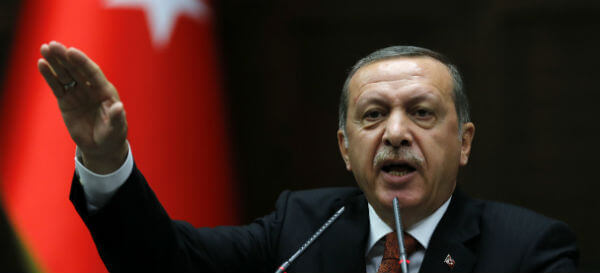
Erdoğan cites Hitler’s Germany as example of effective government — updated

erdogan

The Guardian reports: Turkey’s president has been pushing for some time for a new presidential system to govern the country, sparring with critics who accuse him of attempting a power grab.

Recep Tayyip Erdoğan’s latest comments in favour of greater executive powers are unlikely to help him bring those critics round. On Friday he was quoted by Turkish media as citing a striking example of an effective presidential system – Germany under Adolf Hitler.

Asked on his return from a visit to Saudi Arabia whether an executive presidential system was possible while maintaining the unitary structure of the state, he said: “There are already examples in the world. You can see it when you look at Hitler’s Germany. [Continue reading…]

The Associated Press now reports: The Turkish president’s office said Friday that Recep Tayyip Erdogan was not advocating a Hitler-style government when he called for a state system with a strong executive.

A statement from Erdogan’s office said the Turkish president has declared the Holocaust, anti-semitism and Islamophobia as crimes against humanity and that it was out of the question for him to cite Hitler’s Germany as a good example. [Continue reading…]

Facebooktwittermail

Why has the AK-47 become the jihadi terrorist weapon of choice?

The Guardian reports: In the early years after 9/11 the suicide belt, the car bomb and the homemade explosive device were the weapons of choice for jihadis: hidden, brutal and hard to counter.

But as 2015 heaves to a close, its atrocities littered across the calendar – Charlie Hebdo, Sousse, Garissa, Tunis, Copenhagen and Paris – it is the AK-47 that has come to the fore.

Across Europe more terrorist attacks have been carried out with Kalashnikov-type assault rifles this year than with any other device. In the 13 November Paris attacks, suicide bombers killed few but gunmen killed many. Further afield, in Tunisia and Kenya, it was also automatic weapons that did the damage.

The widespread availability of these guns has been known for years. But it took the scale of death meted out in Paris last month to force Europe to address the threat.

Now law enforcement officers across the continent are trying to establish some basic truths. Where do they come from? Who are the middlemen that deal in these deadly weapons? And why have they become so popular again? [Continue reading…]

Facebooktwittermail

Gun-friendly Texas is getting even friendlier

The New York Times reports: Texas is so gun-friendly that it is easier to get into the Capitol in Austin with a firearm than without one — licensed, gun-carrying lawmakers and members of the public have their own no-wait security lane, and the unarmed masses have to stand in line and slog through the metal detectors.

But on Friday, gun rights throughout the state expanded still more, as a new law took effect that allows certain Texans to wear their handguns in holsters on their hips — or in shoulder holsters, Dirty Harry-style — openly displaying the fact that they are armed as they work, shop, dine and go about their day.

The so-called open-carry law has set off a long-simmering debate over the limits of the Texas gun culture and has given gun rights advocates a hard-fought victory after they pushed for the expansion for years. Members of the pro-gun group Open Carry Texas were to gather at noon Friday on the south steps of the Capitol for a gun-on-their-hips celebration before walking down Congress Avenue. Other groups plan to display their weaponry at events in Houston, Dallas and other cities. [Continue reading…]

Facebooktwittermail

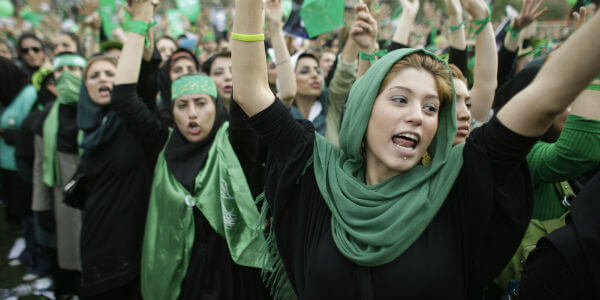
Will Green Movement haunt Iran’s upcoming elections?

green-movement

Arash Karami reports: The registration process for the February 2016 parliamentary and Assembly of Experts elections has come to end with a record number of candidates: Nearly 12,000 individuals registered to compete for a seat in the 290-member parliament. It will be the job of the conservative Guardian Council to determine which candidates pass through their filters and ultimately will be allowed to run. While the council is not obligated to specify publicly why the candidates are qualified or disqualified, it seems the 2009 presidential elections will be a central factor in their decision-making process.

Guardian Council spokesman Nejatollah Ebrahimian told Tasnim News Agency on Dec. 27 that the council will review all the comments and actions of the candidates during 2009 postelection protests. He said that the behavior of the candidates should not have been such that it could be construed that they participated in the illegal activities during 2009, adding they should have “clear and specific lines drawn with the sedition of 2009.”

The contested 2009 presidential elections, which hard-liners refer to as the “2009 sedition,” was a turning point in Iranian elections. The incumbent, controversial hard-liner Mahmoud Ahmadinejad, was announced the victor. The Reformist candidates, Mir Hossein Mousavi and Mehdi Karroubi, challenged the results and encouraged their supporters to hold street protests — the largest since the 1979 Islamic Revolution. Despite hundreds of arrests, dozens of deaths and the house arrest of the so-called Green Movement leaders, Iranian officials responsible for the crackdown continue to raise the issue of the 2009 elections as a sort of dividing line between those who should be allowed to be part of the political process and those who should not. [Continue reading…]

Facebooktwittermail

Iran vows to respond to any new U.S. sanctions

The Wall Street Journal reports: Iranian President Hassan Rouhani ordered his defense minister to expedite Iran’s ballistic-missile program following newly planned U.S. sanctions, he said Thursday, casting fresh doubt on the implementation of a landmark nuclear accord reached in July.

Mr. Rouhani made the announcement on his official Twitter account, without elaborating on what steps he had ordered Defense Minister Hossein Dehghan to take.

“If [the] U.S. continues its illegitimate interference [with] Iran’s right to defend itself a new program will be devised to enhance missile capabilities,” Mr. Rouhani tweeted.

“We have never negotiated regarding our defense capabilities, including our missile program & will not accept any restrictions in this regard,” he said.

An Iranian Foreign Ministry spokesman said earlier Thursday that Iran considered any new U.S. sanctions on its ballistic-missile program illegal and would respond accordingly.

“Such actions are unilateral, arbitrary and illegal and the Islamic Republic of Iran has warned the U.S. in this respect,” said spokesman Hossein Jaber Ansari, according to the official Islamic Republic News Agency.

The Obama administration is planning new sanctions on Iran, targeting almost a dozen companies and individuals in Iran, Hong Kong and the United Arab Emirates, U.S. officials told The Wall Street Journal on Wednesday. The planned action by the Treasury Department is targeted at businesses and individuals for their alleged role in developing Iran’s ballistic-missile program and would represent the first new sanctions on Iran since six world powers, including the U.S., reached the nuclear deal with Tehran. [Continue reading…]

Facebooktwittermail

Months of fighting leaves 80% of Ramadi in ruins

Al Jazeera reports: Months of fighting and the recent pitched battle to take Iraq’s Ramadi from ISIL have levelled most of the key city as officials warned it was too soon for civilians to return after it was recaptured.

Local official Eid Amash said 80 percent of Ramadi, the provincial capital of Anbar, has been destroyed in the battles between Iraq’s army – backed by US air strikes – and the Islamic State of Iraq and the Levant group.

Amash, spokesman of Anbar’s provincial council, told Kurdish media network Rudaw that some districts of Ramadi were yet to be cleared of ISIL fighters. [Continue reading…]

Facebooktwittermail

Are clashes spreading to western Turkey?

Metin Gurcan writes: Clashes between the Turkish government and Kurdish forces continue unabated in southeastern towns mostly inhabited by Kurds. But now the Kurds appear to be taking the battle to Istanbul and other western Turkey cities.

Despite increasing social and economic costs, the parties show no signs of cooling down. Ankara says it will continue to combat terrorism no matter the cost, and the Kurdistan Workers Party (PKK) issues stern warnings that the clashes could escalate and spread.

The latest such threat came from Cemil Bayik, co-chair of the Union of Kurdish Communities’ (KCK) executive council. KCK is a unit of the PKK. Bayik bluntly said, “We are heading to the establishment of a revolutionary resistance front with the participation of organizations that will come from inside and outside of Turkey.” [Continue reading…]

Facebooktwittermail

Israel bans novel on Palestinian-Jewish romance, seen as threat to ‘national-ethnic identity’

Haaretz reports: Israel’s Education Ministry has disqualified a novel that describes a love story between an Israeli woman and a Palestinian man from use by high schools around the country. The move comes even though the official responsible for literature instruction in secular state schools recommended the book for use in advanced literature classes, as did a professional committee of academics and educators, at the request of a number of teachers.

Among the reasons stated for the disqualification of Dorit Rabinyan’s “Gader Haya” (literally “Hedgerow,” but known in English as “Borderlife”) is the need to maintain what was referred to as “the identity and the heritage of students in every sector,” and the belief that “intimate relations between Jews and non-Jews threatens the separate identity.” The Education Ministry also expressed concern that “young people of adolescent age don’t have the systemic view that includes considerations involving maintaining the national-ethnic identity of the people and the significance of miscegenation.”

The book, published in Hebrew by Am Oved about a year and a half ago, tells the story of Liat, an Israeli translator, and Hilmi, a Palestinian artist, who meet and fall in love in New York, until they part ways for her to return to Tel Aviv and he to the West Bank city of Ramallah. The book was among this year’s winners of the Bernstein Prize for young writers.

A source familiar with the ministry’s approach to the book said that in recent months a large number of literature teachers asked that “Borderlife” be included in advanced literature classes. After consideration of the request, a professional committee headed by Prof. Rafi Weichert from the University of Haifa approved the request. The committee included academics, Education Ministry representatives and veteran teachers. The panel’s role is to advise the ministry on various educational issues, including approval of curriculum.

According to the source, members of the professional committee, as well as the person in charge of literature studies, “thought that the book is appropriate for students in the upper grades of high schools – both from an artistic and literary standpoint and regarding the topic it raises. Another thing to remember is that the number of students who study advanced literature classes is anyhow low, and the choice of books is very wide.”

Another source in the Education Ministry said that the process took a number of weeks, and that “it’s hard to believe that we reached a stage where there’s a need to apologize for wanting to include a new and excellent book into the curriculum.” [Continue reading…]

Facebooktwittermail

New human species may rewrite history

New Scientist reports: We may have lived alongside an archaic human species just 10,500 years ago in China. Controversial bone discoveries suggest we even interbred with and cannibalised these mystery hominins.

Some think the findings could overturn our understanding of what it means to be human. “If true, this would be rather spectacular and it would make the finds of truly global importance,” says Michael Petraglia at the University of Oxford, who wasn’t involved in the discoveries.

One of the most exciting finds is a hominin femur found in Muladong cave in south-west China, alongside other human and animal bones. It shows evidence of having been burned in a fire that was used for cooking other meat, and has marks consistent with it being butchered. It has also been broken in a way that is used to access bone marrow. Unusually, it has been painted with a red clay called ochre, associated with burial rituals (PLoS One, doi.org/97c).

Things got more interesting when the team tried to identify the bone. “Our work shows clearly that the femur resembles archaic humans,” says Darren Curnoe of the University of New South Wales in Sydney, Australia, who led the team behind the discoveries. Yet the sediment the bone was found in dates to just 14,000 years ago. This would make it the most recent human species to go extinct. [Continue reading…]

Facebooktwittermail

Middle East still rocking from First World War pacts made 100 years ago

isis-sykes-picot

Ian Black writes: In an idle moment between cocktail parties in the Arab capital where they served, a British and French diplomat were chatting recently about their respective countries’ legacies in the Middle East: why not commemorate them with a new rock band? And they could call it Sykes-Picot and the Balfour Declaration.

It was just a joke. These first world war agreements cooked up in London and Paris in the dying days of the Ottoman empire paved the way for new Arab nation states, the creation of Israel and the continuing plight of the Palestinians. And if their memory has faded in the west as their centenaries approach, they are still widely blamed for the problems of the region at an unusually violent and troubled time.

“This is history that the Arab peoples will never forget because they see it as directly relevant to problems they face today,” argues Oxford University’s Eugene Rogan, author of several influential works on modern Middle Eastern history.

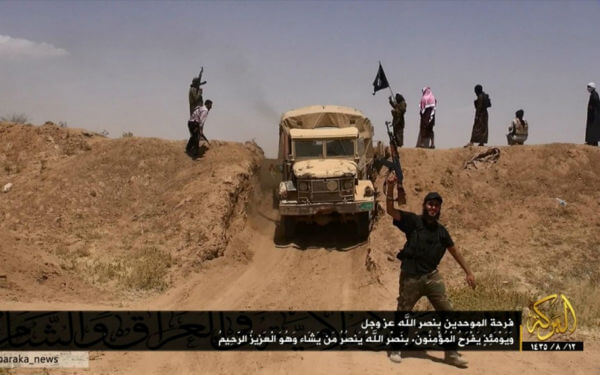
In 2014, when Islamic State fighters broke through the desert border between Iraq and Syria – flying black flags on their captured US-made Humvees – and announced the creation of a transnational caliphate, they triumphantly pronounced the death of Sykes-Picot. That gave a half-forgotten and much-misrepresented colonial-era deal a starring role in their propaganda war – and a new lease of life on Twitter. [Continue reading…]

Facebooktwittermail

As U.S. focuses on ISIS and the Taliban, Al Qaeda re-emerges

The New York Times reports: Even as the Obama administration scrambles to confront the Islamic State and a resurgent Taliban, an old enemy seems to be reappearing in Afghanistan: Qaeda training camps are sprouting up there, forcing the Pentagon and American intelligence agencies to assess whether they could again become a breeding ground for attacks on the United States.

Most of the handful of camps are not as big as those that Osama bin Laden built before the Sept. 11, 2001, attacks. But had they re-emerged several years ago, they would have rocketed to the top of potential threats presented to President Obama in his daily intelligence briefing. Now, they are just one of many — and perhaps, American officials say, not even the most urgent on the Pentagon’s list in Afghanistan.

The scope of Al Qaeda’s deadly resilience in Afghanistan appears to have caught American and Afghan officials by surprise. Until this fall, American officials had largely focused on targeting the last remaining senior Qaeda leaders hiding along Afghanistan’s rugged, mountainous border with Pakistan.

At least in public, the administration has said little about the new challenge or its strategy for confronting the threat from Al Qaeda, even as it rushes to help the Afghan government confront what has been viewed as the more imminent threat, the surge in violent attacks from the Taliban, the Haqqani network and a new offshoot of the Islamic State. Former administration officials have been more outspoken — especially those who were on the front lines of the original battle to destroy Al Qaeda’s central leadership. [Continue reading…]

Facebooktwittermail

A year of Taliban gains shows that ‘we haven’t delivered,’ top Afghan official says

The Washington Post reports: As the Afghan convoy entered the battered village, Taliban fighters opened fire. U.S.-trained Afghan policemen poured out of their Humvees and began wildly shooting their AK-47 rifles in every direction.

“The enemy is firing one bullet, and you are responding with dozens!” their commander, Col. Khalil Jawad, screamed into his radio in frustration. “Aim, then fire!”

A minute later, the militants melted away. On this day in early December in the southern province of Helmand, they had delivered their message: The Taliban is back, its fighters showing a battle discipline and initiative far superior to the Afghan security forces trained and equipped by the United States.

In private, top Afghan and American officials have begun to voice increasingly grim assessments of the resurgent Taliban threat, most notably in a previously undisclosed transcript of a late-October meeting of the Afghan National Security Council. [Continue reading…]

Facebooktwittermail

NSA’s targeting of Israeli leaders also caught private conversations between U.S. lawmakers and Israel lobby

The Wall Street Journal reports: President Barack Obama announced two years ago he would curtail eavesdropping on friendly heads of state after the world learned the reach of long-secret U.S. surveillance programs.

But behind the scenes, the White House decided to keep certain allies under close watch, current and former U.S. officials said. Topping the list was Israeli Prime Minister Benjamin Netanyahu.

The U.S., pursuing a nuclear arms agreement with Iran at the time, captured communications between Mr. Netanyahu and his aides that inflamed mistrust between the two countries and planted a political minefield at home when Mr. Netanyahu later took his campaign against the deal to Capitol Hill.

The National Security Agency’s targeting of Israeli leaders and officials also swept up the contents of some of their private conversations with U.S. lawmakers and American-Jewish groups. That raised fears — an “Oh-shit moment,” one senior U.S. official said — that the executive branch would be accused of spying on Congress.

White House officials believed the intercepted information could be valuable to counter Mr. Netanyahu’s campaign. They also recognized that asking for it was politically risky. So, wary of a paper trail stemming from a request, the White House let the NSA decide what to share and what to withhold, officials said. “We didn’t say, ‘Do it,’ ” a senior U.S. official said. “We didn’t say, ‘Don’t do it.’ ”

Stepped-up NSA eavesdropping revealed to the White House how Mr. Netanyahu and his advisers had leaked details of the U.S.-Iran negotiations — learned through Israeli spying operations — to undermine the talks; coordinated talking points with Jewish-American groups against the deal; and asked undecided lawmakers what it would take to win their votes, according to current and former officials familiar with the intercepts. [Continue reading…]

Facebooktwittermail

Could an end to Syria’s civil war be in sight?

By James L Gelvin, University of California, Los Angeles

If, as cliché has it, the definition of insanity is doing the same thing over and over and expecting different results, isn’t the recent flurry of diplomatic activity aimed at bringing about a negotiated settlement to the Syrian civil war insane?

None of the previous attempts to resolve the conflict among the warring parties through negotiations, such as the Geneva II talks in the beginning of 2014, has had a happy ending. And, in retrospect most observers would go so far as to say that they were doomed to failure.

But if, until now, there was zero chance for all principals, both external and internal, to work out a settlement, there currently exists a slender – a very slender – chance for success.

This is the straw at which Secretary of State John Kerry is grasping on the eve of talks in New York.

Continue reading

Facebooktwittermail

New Jaish al-Islam chief says group will not pull out of peace talks

Middle East Eye reports: The new head of a key rebel group in Syria has denied that it is pulling out of peace talks after its previous leader was killed in an airstrike last week.

Zahran Alloush was head of Jaish al-Islam, and was killed in a strike east of Damascus that was launched on Friday by forces loyal to President Bashar al-Assad, with conflicting reports indicating that the plane might have been Russian or Syrian.

Immediately after the killing the group announced that it would be pulling out of a negotiations council formed during an opposition conference in Riyadh earlier this month.

However, in his first public statements since taking over leadership of the group, Abu Hammam al-Buyedhani said Jaish al-Islam’s stance on negotiations “has not changed”.

“We will not adopt a position on our own without discussing it with our partners.”

The United Nations has set 25 January as a target date to begin peace talks on Syria. [Continue reading…]

Facebooktwittermail

Turkey may finally be ‘accepting the inevitable’ in Syria

Business Insider reports: A Kurdish militia with ties to an organization waging an insurgency in Turkey’s southeast region violated Turkey’s “red line” in Syria over the weekend by crossing the Euphrates River during an anti-ISIS operation.

The operation to take back Tishrin Dam from ISIS was staged by the Western-backed Syrian Democratic Forces and spearheaded by the Kurdish YPG — the military arm of the Kurdish Democratic Union Party (PYD).

It served as a huge blow to ISIS, which had relied on the dam to move weapons and fighters between its de-facto capital of Raqqa in Syria and the cities of Manbij and Jarablous it controls in the northern countryside of Aleppo Province.

But ISIS was not the only loser. The operation was also a major affront to Turkey, which declared the Euphrates a “red line” for Kurdish territorial expansion over the summer. Indeed, Turkey struck the YPG twice in October after it defied Ankara’s warning not to cross the river. [Continue reading…]

Facebooktwittermail

ISIS leaders fall, ISIS remains

Kyle Orton writes: Last night, Steve Warren, the American colonel who is the spokesman for the international campaign against the Islamic State (IS), the U.S.-led Operation INHERENT RESOLVE, announced that between December 7 and December 27, ten IS “leaders” had been killed. Col. Warren adumbrated the positions of the IS leaders, allowing the conclusion that five had been part of IS’s external operations wing, which conducts international terrorism, and five were part of IS’s internal operations, i.e. part of the military operations and security infrastructure that helps IS maintain and expand its statelet in Syria and Iraq. Col. Warren presented this as an important blow to IS that had assisted in the recent loss of territorial losses for IS. There is reason for scepticism on these points. [Continue reading…]

Facebooktwittermail