Nicholas Kristof writes: Any day now, our Saudi Arabian allies may behead and crucify a young man named Ali al-Nimr.
His appeals following his court sentence for this grisly execution have been exhausted, so guards may lead Nimr to a public square and hack off his head with a sword as onlookers jeer. Then, following Saudi protocol for crucifixion, they would hang his body as a warning to others.
Nimr’s offense? He was arrested at age 17 for participating in anti-government protests. The government has said he attacked police officers and rioted, but the only known evidence is a confession apparently extracted under torture that left him a bloody mess.
“When I visited my son for the first time I didn’t recognize him,” his mother, Nusra al-Ahmed, told The Guardian. “I didn’t know whether this really was my son Ali or not.”
Nimr was recently moved to solitary confinement in preparation for execution. In Britain, where the sentence has received attention, the foreign secretary says he does “not expect” it to be carried out. But Nimr’s family fears execution could come any day.
Saudi Arabia’s medieval criminal justice system also executes “witches,” and flogs and imprisons gay people.
It’s time for a frank discussion about our ally Saudi Arabia and its role legitimizing fundamentalism and intolerance in the Islamic world. Western governments have tended to bite their tongues because they see Saudi Arabia as a pillar of stability in a turbulent region — but I’m not sure that’s right.
Saudi Arabia has supported Wahhabi madrasas in poor countries in Africa and Asia, exporting extremism and intolerance. Saudi Arabia also exports instability with its brutal war in Yemen, intended to check what it sees as Iranian influence. Saudi airstrikes have killed thousands, and the blockading of ports has been even more devastating. Some Yemeni children are starving, and 80 percent of Yemenis now need assistance.
There’s also an underlying hypocrisy in Saudi behavior. This is a country that sentenced a 74-year-old British man to 350 lashes for possessing alcohol (some British reports say he may be allowed to leave Saudi Arabia following international outrage), yet I’ve rarely seen as much hard liquor as at Riyadh parties attended by government officials.
A Saudi prince, Majed Abdulaziz al-Saud, was just arrested in Los Angeles in a $37 million mansion he had rented, after allegedly drinking heavily, hiring escorts, using cocaine, terrorizing women and threatening to kill people.
“I am a prince,” he declared, according to an account in The Los Angeles Times. “And I do what I want.” [Continue reading…]
Category Archives: News
Why is the Center for American Progress hosting Benjamin Netanyahu?
Ali Gharib writes: When Prime Minister Benjamin Netanyahu comes to town next month, he’ll meet with President Obama at the White House for the first time since the right-wing Israeli led a failed campaign to block the liberal Democrat’s nuclear deal with Iran. During the course of his long, no-holds-barred fight against diplomacy with Iran, Netanyahu took a stand with congressional Republicans against the White House, attracting minimal Democratic support for his position against Obama’s signal foreign policy achievement. Three years ago, Netanyahu all but endorsed Obama’s opponent in the presidential race, Mitt Romney. And Netanyahu’s own behavior at home — most notably the modus operandi of his successful reelection bid this year, which included anti-Arab bigotry and a vow to block a two-state solution to the Israeli-Palestinian conflict — strained relations further.
So it was altogether fitting that Netanyahu, during his swing through Washington, would be given an award by the American Enterprise Institute, a neoconservative think tank close to the Republican Party that never strays too far from Netanyahu’s ideological home turf. Though Israel — and its most influential DC lobby group, AIPAC — has traditionally garnered bipartisan support, neoconservatives don’t give a whit about it; they have long thought Democrats, and especially today’s Democrats, were insufficiently hawkish to give Israel the kind of support it needed in the Middle East. And Netanyahu has more than made clear where his allegiances lay on the American political spectrum: with the Republicans, and especially the neoconservatives among them.
It was jarring, then, to see the news yesterday that Netanyahu would be invited to address the liberal Washington think tank Center for American Progress, a group that serves the purpose of fueling the Democratic Party with progressive policies and ideas. The Israeli embassy approached CAP, the Huffington Post reported (in an article in which I was quoted), and asked for an opportunity to speak. “He’s looking for that progressive validation,” a former CAP staffer told the news website, “and they’re basically validating a guy who race-baited during his election and has disavowed the two-state solution.” [Continue reading…]
Why are so many Iranian generals getting killed in Syria?
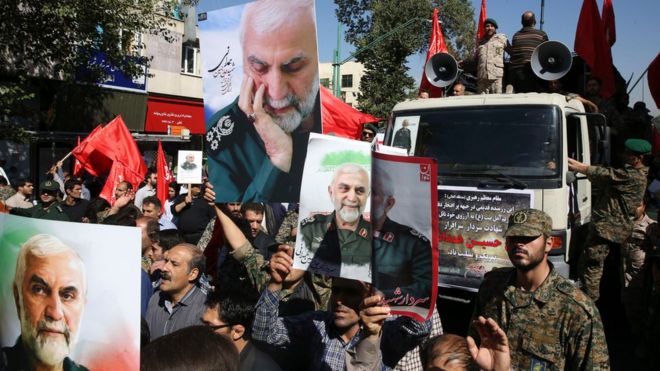
McClatchy reports: At least six generals from the elite Islamic Revolutionary Guards Corps have been killed in Syria since 2013, according to an official of the U.S. Defense Intelligence Agency, who requested anonymity because of the sensitivity of the issue. Three of those, including Hamadani, who was killed Oct.9 in the embattled northern city of Aleppo, have died since the beginning of the month.
A seventh Revolutionary Guard general was killed by an Islamic State sniper in Iraq last year.
Experts say the deaths of so many senior officers in Syria underscore the Iranian commitment to preserving Assad’s government in a “rump” Syria that includes most of the country’s major cities and the coastal province of Latakia, the traditional center of Assad’s religious sect, the Alawites.
It also is a reflection of the difference between Iran’s fighting tactics and those of Western militaries, whose senior officers usually direct operations from heavily protected command centers far in the rear.
Just one U.S. general has been killed in a conflict zone since the Vietnam War ended more than 40 years ago. That officer, Army Maj. Gen. Harold Greene, was shot by an Afghan soldier during a visit to a Kabul military academy in August 2014.
The need for close battlefield supervision by senior commanders has grown as the pro-Assad force has become a diverse amalgam of fighters from Lebanon, Iraq and Iran as well as Syria, cobbled together to compensate for the Syrian army’s serious manpower shortages. In addition to coordinating with one another, the units must be synchronized with airstrikes from Russian and Syrian jet fighters and helicopter gunships.
“When you need as many bodies on the ground to do the fighting . . . they need better coordination,” said Philip Smyth, a University of Maryland researcher who tracks Iranian-backed Shiite militias. “You need guys who are hard core and can really provide the stiff style of leadership and command, people who are not going to flinch under fire.” [Continue reading…]
Aleppo faces ISIS ‘siege nightmare’
NOW reports: Fears have risen in regime-controlled quarters of Aleppo after ISIS cut off the government’s main supply line leading into the city late last week.
Pro-Damascus daily Al-Akhbar published a report Tuesday on the situation in Syria’s second city, saying the mood among residents has worsened after “the great extent of the breach ISIS has achieved” on the key front became clear.
Describing the feelings of regime supporters in the Aleppo, Al-Akhbar reporter Basel Dayoub said that the city’s residents were “remembering the nightmare of the first siege in 2013,” in reference to a rebel siege from August to October of that year.
The period was marked by the hardships suffered by residents of the regime controlled areas of east Aleppo, which saw an increase of prices and shortages of basic staples.
The prospects of another long-siege renewed last Friday when ISIS seized a stretch of the Khanaser-Ithriyah highway southeast of Aleppo—cutting off the main regime controlled route into the city—while rebels staged fierce counterattacks against the Iranian-backed government offensive southwest of Aleppo. [Continue reading…]
Obama weighs moving U.S. troops closer to front lines in Syria, Iraq
The Washington Post reports: President Obama’s most senior national security advisers have recommended measures that would move U.S. troops closer to the front lines in Iraq and Syria, officials said, a sign of mounting White House dissatisfaction with progress against the Islamic State and a renewed Pentagon push to expand military involvement in long-running conflicts overseas.
The debate over the proposed steps, which would for the first time position a limited number of Special Operations forces on the ground in Syria and put U.S. advisers closer to the firefights in Iraq, comes as Defense Secretary Ashton B. Carter presses the military to deliver new options for greater military involvement in Iraq, Syria and Afghanistan.
The changes would represent a significant escalation of the American role in Iraq and Syria. They still require formal approval from Obama, who could make a decision as soon as this week and could decide not to alter the current course, said U.S. officials who spoke on the condition of anonymity because the discussions are still ongoing. It’s unclear how many additional troops would be required to implement the changes being considered by the president, but the number for now is likely to be relatively small, these officials said. [Continue reading…]
Iran to attend Syria talks in Vienna
BBC News reports: Iranian Foreign Minister Mohammad Javad Zarif will attend multilateral talks on finding a political solution to the conflict in Syria in Vienna this week, a government spokeswoman has said.
It will be the first time Iran – an ally of President Bashar al-Assad – has attended such a summit with the US.
Representatives of Russia, Saudi Arabia and Turkey will also attend the talks. [Continue reading…]
New allies in northern Syria don’t seem to share U.S. goals
McClatchy reports: After the failure of its $500 million program to stand up a Syrian volunteer force to battle Islamic State extremists, the Obama administration has begun an effort to enable Arab militias to fight alongside a Kurdish force that has gotten U.S. air support for the past year.
The stated U.S. aim is to oust the Islamic State from its de facto capital of Raqqa in Syria. But if the Shammar tribal militia, the biggest in Hasaka province, is any example, many Arab forces on the ground have a different agenda. For that matter, so does the Kurdish People’s Protection Force, or YPG, which dominates this area and has worked closely with the United States since the siege last year of the border town of Kobani.
The road to the palace of Sheikh Humaydi Daham al Hadi, the head of the Shammar tribe, winds through vast wheat fields in this isolated corner of eastern Syria, past checkpoints manned by YPG fighters, and then by his own guards.
Hasaka, an oil, gas and grain producing area, is now part of what the YPG calls Jazera, one of three cantons that comprise Rojava, or west Kurdistan, a 200-mile-long corridor on Syria’s border with Turkey. The Syrian government, which still has troops in at least two cities, has acquiesced to YPG control.
Because Turkey views the YPG as a terrorist group and has closed its borders because of the YPG’s affiliation with the Kurdistan Workers Party, or PKK, the only way into Rojava is by a ferry across the Tigris River from Iraq and hours of driving on secondary roads.
Welcoming visitors in his vast reception room, Sheikh Humaydi says his goal is to lead a Shammar tribal uprising against the Islamic State “to liberate Syria, Iraq and beyond.” But he also wants to carry on a 2-century-old struggle against conservative Wahabi Islam, which he said destroyed the last Shammar emirate, and he favors the breakup of Saudi Arabia, where the puritanical sect dominates. “We are already working on that,” he said. [Continue reading…]
Freed prisoners of ISIS describe beatings and torture
The New York Times reports: Muhammad Hassan Abdullah al-Jibouri had little hope that he would ever make it out of the Islamic State’s jail alive, and he had not even seen the sun in more than a month. Then, early last Thursday morning, he heard the helicopters overhead.
The 35-year-old police officer heard bursts of gunfire, and shouts in Kurdish and in English. Suddenly, the door to his cell was battered open.
“Who is there? Who is there?” a soldier yelled, first in Kurdish and then in Arabic.
“We are prisoners!” Mr. Jibouri’s cellmates yelled back.
Mr. Jibouri was one of 69 Arab prisoners of the Islamic State freed in a military raid near the northern Iraqi town of Hawija last week, the first in which American Special Operations forces were confirmed to have accompanied their Kurdish counterparts onto the battlefield.
On Tuesday, in their first interviews since being brought to the Kurdish autonomous region by American Chinook helicopters, four of the former prisoners described life under the thumb of the Islamic State. [Continue reading…]
Diplomatic opening has not led to any improvement in Iran’s human rights record
Foreign Policy reports: It has been a bumper year for capital punishment in Iran.
Tehran hanged at least 694 people between Jan. 1 and Sept. 15, the highest rate of executions in the Islamic Republic in some 25 years, according to a report released Tuesday by a U.N. human rights monitor.
The pace of executions is likely driven by a surge in drug crimes, which accounted for 69 percent of the executions in the first half of 2015, according to the 26-page report.
The report’s findings present a decidedly harsh image of the country at a time when Iranian President Hassan Rouhani and his American-educated foreign minister, Mohammad Javad Zarif, have been promoting a more moderate vision of Iran to the outside world.
Since signing a landmark nuclear deal with the United States and other world powers in July, Tehran has been hosting a procession of Western officials and business leaders looking to do business with a newly sanctions-free Iran. But even if the country has seen a diplomatic opening of sorts since Rouhani came to power in the summer of 2013, that hasn’t translated into any improvement in other sensitive areas.
“In terms of human rights, there has been no sign of improvement in the country,” Ahmed Shaheed, the U.N. special rapporteur for human rights in Iran, told reporters at a press conference Tuesday at U.N. headquarters. [Continue reading…]
UK academics boycott universities in Israel to fight for Palestinians’ rights
The Guardian reports: More than 300 academics from dozens of British universities have pledged to boycott Israeli academic institutions in protest at what they call intolerable human rights violations against the Palestinian people.
The declaration, by 343 professors and lecturers, is printed in a full-page advertisement carried in Tuesday’s Guardian, with the title: “A commitment by UK scholars to the rights of Palestinians.”
The pledge says the signatories, from a variety of universities in England and Wales, will not accept invitations to visit Israeli academic institutions, act as referees for them, or take part in events organised or funded by them. They will, however, still work with individual Israeli academics, it adds.
The advert says the signatories are “deeply disturbed by Israel’s illegal occupation of Palestinian land, the intolerable human rights violations that it inflicts on all sections of the Palestinian people, and its apparent determination to resist any feasible settlement”.
In a statement on behalf of the organisers of the boycott, Prof Jonathan Rosenhead, of the London School of Economics, said Israel’s universities were “at the heart of Israel’s violations of international law and oppression of the Palestinian people”. [Continue reading…]
French court upholds heavy fines while rejecting free speech for activists calling for boycott against Israel
JTA reports: France’s highest court of appeals confirmed earlier rulings that found promoters of a boycott against Israel guilty of inciting hate or discrimination.
The rulings passed on Tuesday by the Paris-based Court of Cassation confirmed the Nov. 27 convictions of 12 individuals by the Colmar Court of Appeals in connection with their 2009 and 2010 actions in supermarkets near the eastern city of Mulhouse.
The individuals arrived at the supermarket wearing shirts emblazoned with the words: “Long live Palestine, boycott Israel.” They also handed out fliers that said that “buying Israeli products means legitimizing crimes in Gaza.”
The court in Colmar imposed fines to the collective tune of $14,500 and court expenses on Laila Assakali, Yahya Assakali, Assya Ben Lakbir, Habiba Assakali, Sylviane Mure, Farida Sarr, Aline Parmentier, Mohammad Akbar, Jean-Michel Baldassi, Maxime Roll, Jacques Ballouey and Henry Eichholtzer. [Continue reading…]
Indonesia’s fires are driving climate, public health crises
Climate Central reports: Indonesia is in the grips of a double-headed climate and public health crisis as fires rage across the country. On Monday, the fires reached such a fever pitch that Indonesian Prime Minister Joko Widodo cut a trip to the U.S. short to return home and deal with the inferno that’s turning air toxic and putting more carbon dioxide in the atmosphere than the U.S. on a daily basis.
Nearly 116,000 fires have been documented and air quality in Indonesia and its neighboring countries has suffered. The fires are a yearly occurrence, but this year is already the second-most prolific burn year on record and dry conditions driven by this year’s strong El Niño mean it still has a shot at the top spot. [Continue reading…]
Iran invited to participate in international talks on Syria’s future
On Friday, the Wall Street Journal reported: “European Union foreign policy chief Federica Mogherini spoke in favor of including Iran. ‘All relevant actors, regionally and internationally should be involved,’ she said. ‘I hope that Iran can be part of this common effort.’ ”
But US Secretary of State John Kerry said: “For the moment Iran is not at the table. And there will come a time perhaps where we will talk to Iran but we are not at the moment at this point of time.”
That was Friday, now it’s Tuesday.
The Associated Press reports: Iran has been invited to participate for the first time in international talks over Syria’s future, U.S. officials said Tuesday, a shift in strategy for the United States and its allies as they seek to halt the four-year civil war and eventually ease President Bashar Assad out of power.
Iran has yet to reply, the officials said.
The next diplomatic round starts Thursday in Vienna, with Secretary of State John Kerry, Russian Foreign Minister Sergey Lavrov and several top European and Arab diplomats attending.
Washington had held out the possibility of Iran joining the discussions in future, but is only now offering Tehran a seat after days of behind-the-scenes negotiation, particularly with its regional rival Saudi Arabia. Russia extended the invitation. [Continue reading…]
will #Iran go to #Syria talks? 'Not to my knowledge," Iranian official tells me.
— Laura Rozen (@lrozen) October 27, 2015
What Russia’s own videos and maps reveal about who they are bombing in Syria
Bellingcat reports: The Russian Federation launched an air campaign on 30 September 2015, allegedly targeting Islamic State (or ISIS) positions in Syria. The Russian Ministry of Defense (MoD) has been releasing selected videos on its YouTube channel ever since. Bellingcat began geolocating and independently verifying videos published by the Russian MoD after initial reports from the ground indicated that Russian airstrikes have instead destroyed positions held by the Free Syrian Army and other groups rather than ISIS.
Bellingcat has geolocated, verified, and visualised each airstrike published by the Russian MoD on its official YouTube channel as of 25 October. The outcome of our work is unequivocal: the overwhelming majority of Russian airstrikes have targeted positions held by non-ISIS rebel groups posing a more immediate threat to the Syrian regime and its head, Bashar al-Assad. In contrast, ISIS strongholds have rarely been attacked. The methodology and results of the investigation are laid out below.
We noticed that, for many videos, the Russian MoD adds a description in Russian before the video of the strike itself begins. A longer, more in-depth description is also appended to each upload, along with the title of the video. For the verification process, each video was uploaded to Bellingcat’s Checkdesk verification project. We Google-translated the description and pasted the original one in Russian alongside to keep track of the information in an independently managed online space. [Continue reading…]
Iran’s generals are dying in Syria
Robin Wright writes: The Islamic Republic described the first men to die as a few young “volunteers” deployed to protect symbols of the faith. The numbers have escalated since then. In June, the Islamic Republic News Agency reported that more than four hundred volunteers from Iran, including Afghan refugees living in the country, had died in Syria so far. Iranian news agencies and social media are now rife with stories about senior officers killed in Syria on the war’s toughest front lines. Last week, Iran’s Fars News Agency reported that the death toll hit eight in just two days. The funerals have become major events, sometimes drawing thousands onto Tehran’s streets to escort the coffins to Zahra’s Paradise.
Iran has increasingly been forced to acknowledge its losses—including at least four generals in the past year—with some reports suggesting that twice that number have been killed since the intervention began. Brigadier General Hossein Hamedani, who was killed on October 8th, was given a state funeral. Iran’s Supreme Leader, Ayatollah Ali Khamenei, personally called on Hamedani’s family to convey his condolences. Khamenei’s official Twitter account, in English, lauded the general for fulfilling his “martyrdom wish.”
Hamedani’s death was a setback for Iran—and possibly for Syria, too. According to Jane’s Defense Weekly, Syria’s regular Army has been halved since the war began, in 2011. Assad has increasingly relied on leaders in Iran to develop strategy, and counted on Hezbollah, Iran’s proxy force in Lebanon, to provide new fighters. Hamedani was the senior Iranian tactician in northern Syria, where the regime is simultaneously fighting Western-backed rebels, the Islamic State, a local Al Qaeda franchise, and smaller militias. Hamedani was a hero of the war with Iraq—the deadliest modern conflict in the Middle East—and his death was the most notable Iranian military loss since that war ended. [Continue reading…]
Who of the great journalists covering Syria has nailed, or will, why so many high-level pro-Assad officers/operatives are dying in Syria?
— Hassan Hassan (@hxhassan) October 26, 2015
Pro-Assad pages confirm the death of Major General Izzadin Ibrahim in Deir Ezzor pic.twitter.com/whLPGYqZxS
— Hassan Hassan (@hxhassan) October 26, 2015
Russian airstrikes in Syria appear to violate laws of war, says Human Rights Watch
Human Rights Watch: At least two air strikes in northern Homs on October 15, 2015, that local residents believed to be Russian, apparently violated the laws of war. The air strikes killed a total of 59 civilians, residents said, including 33 children and a commander of the local armed opposition group. Russia should investigate the attacks.
The deadliest attack hit a house in the village of Ghantou, where the extended Assaf family had taken shelter, killing a reported 46 family members, all civilians, including 32 children and 12 women, first responders and local activists said. The victims were related to a local commander affiliated with the opposition Free Syrian Army (FSA), but witnesses said that he was away from the home at the front lines. The second air strike, on the neighboring town of Ter Maaleh, hit near a bakery, and according to local witnesses, killed at least 13 civilians as well as a local FSA commander who was a Syrian army defector. It is not clear whether he was the intended target, as neither Russia nor Syria have issued statements about the specific air strikes. [Continue reading…]
Yemen hospital hit by Saudi-led air strike: Medecins Sans Frontieres
Reuters reports: A hospital in north Yemen run by medical aid group Medecins Sans Frontieres (MSF) was bombed in a Saudi-led air strike, wrecking the facility and lightly wounding two staff members, the group said on Tuesday.
A Saudi-led Arab coalition intervened in Yemen’s civil war in March to try to restore its government after its toppling by Iran-allied Houthi forces, but a mounting civilian death toll has alarmed human rights groups.
“Our hospital in the Heedan district of Saada governorate was hit several times. Fortunately, the first hit damaged the operations theater while it was empty and the staff were busy with people in the emergency room. They just had time to run off as another missile hit the maternity ward,” MSF country director Hassan Boucenine told Reuters by telephone from Yemen.
“It could be a mistake, but the fact of the matter is it’s a war crime. There’s no reason to target a hospital. We provided (the coalition) with all of our GPS coordinates about two weeks ago,” he said. [Continue reading…]
Poets are the latest target in crackdown by Iranian hardliners
The Associated Press reports: Two Iranian poets jailed for their work and sentenced to 99 lashes apiece for shaking hands with members of the opposite sex are the latest targets in a crackdown that analysts say pits hard-liners against those offering new glimpses of life in the Islamic Republic.
The sentences follow a pattern of arrests and convictions targeting activists, journalists and artists that has served as a grim backdrop to President Hassan Rouhani’s efforts to soften the country’s image and improve relations with the West, including through the landmark nuclear agreement reached last summer.
Hard-liners in the police, judiciary and military view any rapprochement with the West as a threat to the Islamic Republic and a sign of moral decay. Rights groups and analysts say those targeted in the ongoing crackdown on expression in Iran also serve as pawns in the hard-liners’ struggle with moderates ahead of February’s parliamentary elections.
“I think people thought with the nuclear deal, there would be sort of a bit of a thaw as well or a bit of an opening up,” said Karin Deutsch Karlekar, the director of Free Expression Programs at PEN America, an organization promoting literature and freedom of speech. “I think the judiciary is sort of pushing back and trying to make clear that there isn’t going to be that opening people were hoping for.” [Continue reading…]