Category Archives: News

Iraqi president: Egypt, Saudi Arabia, UAE don’t need to join airstrikes against ISIS

The Associated Press reports: Iraq’s president says Arab powers Egypt, the United Arab Emirates and Saudi Arabia do not need to join airstrikes against the Islamic State group.

In an exclusive interview with The Associated Press, President Fouad Massoum also expressed regret that Iran was not invited to take part in the 26-nation conference in Paris on Monday to try to counter the Islamic extremists who control vast parts of Iraq and neighboring Syria.

The conference of mostly Western and Arab world countries and the five permanent U.N. Security Council members aims to show a united front, especially from majority-Muslim nations. [Continue reading…]

Facebooktwittermail

This is how you can expose ISIS using Twitter and Google Earth

The Independent: Eliot Higgins is the British analyst who, from his home in Leicester more than 3,000 miles away, helped expose Syrian president Bashar al-Assad’s use of Sarin gas.

The 35-year-old began blogging about the Syrian conflict as a hobby in 2012 under the pseudonym Brown Moses, after leaving a job in admin.

He had never been to Syria and did not speak Arabic. Now, Higgins runs the crowdfunded website Bellingcat, which recently claimed to have uncovered the location of an Islamic State (Isis) training camp using Google Earth; located where James Foley was killed; and spotted the Buk missile launcher which could have downed MH17 inside Russia – all within a month of reaching its funding goal on Kickstarter.

As well as investigations, with Bellingcat, Higgins aims to help educate journalists, activists and researchers about how to geolocate, verify and investigate images and videos that appear on social media. [Continue reading…]

Facebooktwittermail

Fear of ISIS and warnings about ‘wide open’ U.S. borders fuels Islamophobia

Fox News reports: Midland County Sheriff Gary Painter said that law enforcement agencies along the “wide open” border have received alerts to be on the lookout for terrorists from the Islamic State of Iraq and Syria crossing into the United States.

Painter, who said he has worked along the border for “about eight years,” stated that alerts have been issued to border law enforcement to be on the lookout for suspicious terrorist activity, specifically involving ISIS cells being smuggled into the United States.

“I received an intelligence report that said that there was ISIS cells that were active in the Juarez area, which is the northern part of the Chihuahua state, and that they were moving around over there, that there was some activity…” Painter told Fox News. The report asked “for the sheriffs along the border to be on the alert, for all law enforcement to be on the alert, and to be on the lookout for these people maybe trying to come across.”

Painter sidestepped any direct knowledge that ISIS, specifically, is along the border, but he reiterated that the border “is wide open.” [Continue reading…]

Facebooktwittermail

Veterans of elite Israeli intel unit refuse reserve duty, citing mistreatment of Palestinians

The New York Times reports: Denouncing Israel’s treatment of Palestinians under occupation, a group of veterans from an elite, secretive military intelligence unit have declared they will no longer “take part in the state’s actions against Palestinians” in required reserve duty because of what they called “our moral duty to act.”

In a letter sent Thursday night to their commanders as well as Israel’s prime minister and army chief, 43 veterans of the clandestine Unit 8200 complained that Israel made “no distinction between Palestinians who are and are not involved in violence” and that information collected “harms innocent people.” Intelligence “is used for political persecution,” they wrote, which “does not allow for people to lead normal lives, and fuels more violence, further distancing us from the end of the conflict.”

The letter, revealed Friday in Israel’s Yediot Aharonot newspaper as well as The Guardian in Britain, echoes similar periodic protests by reservists over the years, including a group of 27 pilots who refused to participate in what Israel calls targeted assassinations, and 13 members of the vaunted commando unit known as Sayeret Matkal, both in 2003. But it is the first public collective refusal by intelligence officers rather that combat troops. Unit 8200 has a special role in Israeli society as a coveted pipeline to its high-technology industry.

“After our service we started seeing a more complex picture of a nondemocratic, oppressive regime that controls the lives of millions of people,” said one of the group’s organizers, a 32-year-old sergeant major who was on active duty from 2001 to 2005. He spoke on the condition of anonymity because the military prohibits Unit 8200 members from being publicly identified. [Continue reading…]

Facebooktwittermail

The Sunnis who see the Iraqi government as a terrorist organization

Lauren Bohn reports: In the past year alone, 43-year-old Omar says he’s watched hundreds die. Or as he describes it, “boom, gone, the end.”

Omar is an administrator of one of the busiest hospitals in Fallujah, in Iraq’s restive Anbar province. First, his brother nearly lost a leg in a mortar attack. Then, his neighbor’s home was destroyed in shelling. Soon after, his mother narrowly missed a bombing in their once-placid neighborhood. But it wasn’t until he watched a 5-year-old girl in a bright pink shirt take her last gasp of air outside his office, her body torn apart from shelling, that he knew he had to leave his hometown. Life in Iraq, as he puts it, has become an endless flow of “dark, dark red.”

“Every day, I saw children watching parents die and parents watching children die,” he says, recalling grim scenes from the hospital he’s worked at for years. “I couldn’t raise my children there any longer … we all have targets on our head.”

Back in January, six months before the Islamic State, then still ISIS, seized the world’s attention by capturing Mosul, Iraq’s second-largest city, the group and its allies took the city of Fallujah and parts of the provincial capital of Ramadi. It was one of the first signs that Iraq’s Sunni regions were falling into a state of open rebellion against the Shiite-led government in Baghdad.

The ragtag fighters saw an opening after then-Prime Minister Nouri al-Maliki ordered security forces to dismantle a yearlong sit-in camp near Ramadi, claiming it had become a base for al Qaeda-linked militants. Sunnis like Omar had been protesting for the release of Sunni prisoners who they said were detained arbitrarily and without trial; they deeply resented their political exclusion from the Shiite-led central government. This wasn’t the first time Anbar province had become a center of revolt: After the 2003 U.S.-led invasion that overthrew Saddam Hussein, the region became ground zero for a Sunni-led insurgency against the Iraqi government and U.S. troops.

Omar is one of the hundreds of thousands of internally displaced people who have fled Iraq’s largest province since fighting swept the region in January. He and his family have resettled in Shaqlawa, a mountain-ringed city near the regional capital of Erbil. There are so many displaced people from Fallujah that residents jokingly call the town “Shaqlujah.”

Many live cramped lives in converted hotels, but middle-class families like Omar have rented homes, blending into a town they once traveled to for summer holidays. Christians and Yazidis have also sought refuge from other Islamic State-controlled territories, bringing with them horror stories of mass executions and kidnappings. But as a Sunni Arab, who complains of systemic oppression by Shiites in Baghdad, Omar wasn’t fleeing the Islamic State — in fact, he believes it is necessary in what he calls a renewed fight for the survival of Iraqi Sunnis. [Continue reading…]

Facebooktwittermail

Free Syrian Army will not join U.S.-led coalition against ISIS

Middle East Eye reports: The Free Syrian Army has announced that it will not sign up to the US-led coalition to destroy Islamic State (IS) militants in Iraq and Syria.

The group’s founder, Colonel Riad al-Asaad, stressed that toppling Syrian President Bashar al-Assad is their priority, and that they will not join forces with US-led efforts without a guarantee that the US is committed to his overthrow.

“If they want to see the Free Syrian Army on their side, they should give assurances on toppling the Assad regime and on a plan including revolutionary principles.”

The announcement appears to be reversing an earlier satement on Thursday by the National Coalition opposition, the Free Syrian Army’s political wing, which said it was ready to work with the coalition against IS.

Saying they had “long called for this action”, the coalition called on US politicians to authorise the training and equipping of the Free Syrian Army “as soon as possible”.

The Free Syrian Army, mostly composed of military personnel who have defected from Assad’s armed forces, had already been engaged in battles against IS militants. [Continue reading…]

Facebooktwittermail

Civilians and ISIS ship out of Raqqa ahead of U.S. airstrikes

Middle East Eye reports: Huge numbers of people have continued fleeing areas of Syria controlled by militants from the self-styled Islamic State (IS), in advance of planned US-led airstrikes on IS strongholds.

Thousands have joined a mass exodus that began on Wednesday, as US President Obama announced in a televised speech that his plan for confronting the IS threat includes launching airstrikes on its militants within Syrian territory.

Residents have been leaving towns in IS strongholds in droves, fearing that the bombardment will cause civilian casualties as well as targeting militants.

Ferat al-Wafa, head of Broadcasters Without Borders who hails from al-Raqqa province, told Anadolu that residents of the area, “who buried around 50 martyrs killed by Assad’s planes on Thursday, are living every day in a state of fear.”

“The city of Raqqa has seen an active wave of fleeing to rural areas, which they see as being safer, in order to be further from the sites where IS are amassed.”

According to Wafa this wave of flight will exacerbate an “appalling” health situation in the city, where several of the hospitals are out of service. [Continue reading…]

Facebooktwittermail

Qatar expels Egypt Muslim Brotherhood leaders

The Associated Press reports: Leaders of Egypt’s Muslim Brotherhood group and allied clerics said on Saturday that they are departing Qatar, where they had sought refuge following the ouster of Egypt’s Islamist President Mohammed Morsi and the crackdown on his supporters.

Their presence in Qatar had severely strained Doha’s relations with Egypt as well as Saudi Arabia and the United Arab Emirates, all of which view the more than 85-year-old Islamist movement as a threat. The expulsion threatens to further isolate the group, which rose to power in Egypt through a string of post-Arab Spring elections but suffered a dramatic fall from grace during Morsi’s divisive year in office.

Former minister Amr Darrag, who was also the top foreign affairs official in the Brotherhood’s Freedom and Justice Party, and fiery cleric Wagdi Ghoneim said they are leaving Qatar following a request to do so by the Gulf monarchy. [Continue reading…]

Facebooktwittermail

Syrian Kurds ally with rebel groups to fight ISIS

Vice reports: Kurdish and rebel armed groups fighting extremist militants the Islamic State (IS) in Syria have agreed to join forces against their common enemy, the latest in a complex and shifting series of battlefield allegiances.

Units affiliated with the Kurdish People’s Protection Units (YPG), Islamic Front (IF) and US-backed Free Syrian Army (FSA) will form a new coalition named Burkan al-Forat (Euphrates Volcano) after the river which flows through the region in which the agreement was formalized.

The alliance was announced via a video posted on Wednesday in which a man read a statement in front of an armed group including a number of women fighters backed by YPG pennants alongside the three-starred flag of Syrian opposition groups and others. The UK-based Syrian Observatory for Human Rights also reported the news.

The man asked those who had joined IS to desert the group, called for assistance from the international community and finished by saying that the coalition wished to free all areas of Syria under IS control, including Qaraqozaq, Jarabulus, Sirin, Manbaj and Raqqa.

Syrian rebel groups have not always had a smooth relationship with Kurdish militias. The YPG, which is the main force in majority Kurdish parts of the country, has maintained an uneasy truce with President Bashar al-Assad’s forces in the region, leading some rebels to accuse them of colluding with the government, a charge the Kurds deny.

However, it has been instrumental in the fight against IS and has been one of the few forces to mount an effective defense against the jihadis, inflicting heavy losses against them clashes across northern Syria and stymying their efforts to extend control into Kurdish regions. Problematically for the US, the YPG is affiliated with the Kurdistan Worker’s Party (PKK), an organization which is on both America and the EU’s terrorist blacklist. [Continue reading…]

Facebooktwittermail

Paris wants Iran to help crush ISIS

The Associated Press reports: France is prepared to invite Iran to an international conference Monday aimed at coordinating actions to knock out the Islamic State extremists in Iraq — even though that runs counter to the U.S. refusal to deal with Tehran.

The position reflects a recent shift in France’s policy toward Iran, a Shiite Muslim nation and neighbor of Iraq that joins regional states and the West in adamantly opposing the advance of the radicals. Tehran’s long-time influence in Sunni Iraq, including at times a military presence, makes it a logical partner in France’s eyes.

A French official helping plan the conference says the only hitch is agreeing with partners, but added “we are not far from a consensus.” The official, who was not authorized to be publicly named, didn’t elaborate. [Continue reading…]

Facebooktwittermail

Will the U.S. launch airstrikes in Syria?

The New York Times reports: The prospect of the first American attacks on Syrian soil during three years of brutal civil war electrified Syrians on Thursday, prompting intense debate over whether airstrikes on the extremist Islamic State in Iraq and Syria would help or harm President Bashar al-Assad, his armed Syrian opponents and war-weary civilians.

Raqqa, the northeastern city that ISIS has ruled for more than a year, was abuzz with the news. Civilians fled areas near ISIS headquarters. Anti-ISIS insurgents pronounced themselves energized by the prospect of new American aid and said Turkish officials had recently contacted them, promising new arms to fight the foreign-led Sunni group.

But even among fervent opponents of ISIS — including Syrian insurgents, some of whom stand to gain aid to battle the group — there was ambivalence over President Obama’s declaration that he would “not hesitate” to strike ISIS in Syria.

Many warned that if weakening ISIS strengthened Mr. Assad, allowing him to continue attacking opposition-held civilian areas with impunity, and was not accompanied by political enfranchisement of the Sunni majority in Syria, the strikes could backfire, driving more Sunnis to support or tolerate ISIS. Others worried that Syrian civilians could be killed in the attacks. [Continue reading…]

In his national address last night, President Obama said:

I have made it clear that we will hunt down terrorists who threaten our country, wherever they are. That means I will not hesitate to take action against ISIL in Syria as well as Iraq. This is a core principle of my presidency: If you threaten America, you will find no safe haven.

In terms of military strategy, it’s well understood that ISIS will not be weakened, let alone destroyed, if it is pushed back in Iraq while consolidating its strength in Syria. But when Obama says he will not hesitate to strike ISIS in Syria, he is not tying that choice to the campaign in Iraq. Instead, he appears to be making it conditional on his assessment of the threat that ISIS poses to the United States.

He also said, “we have not yet detected specific plotting against our homeland,” and warned that ISIS fighters “could try to return to their home countries and carry out deadly attacks.”

So, Obama appears not to see ISIS as posing an imminent threat to the U.S. and for as long as that remains the case, I’m doubtful that he will order airstrikes in Syria.

If the White House lawyers insist that an imminent threat is the required trigger, then identifying an imminent threat could simply be a matter of political convenience. But I really doubt that Obama is itching to launch such an attack, so I don’t think he’s actively looking for a pretext.

At the same time, if as many have argued, ISIS is trying to bait the U.S., then an adequate bait would involve nothing more than making a few phone calls (which can predictably be intercepted by the NSA) in which plotters discuss plans for attacking America.

As things stand right now, I believe that neither ISIS nor Obama are ready to see U.S. airstrikes on Raqqa.

Foreign Policy notes:

[T]here are good reasons American policymakers haven’t yet rushed to bomb Syria. “There’s a good risk of losses to the U.S. Air Force if we go into Syria without consent,” says Poss. “Syrian air defenses are among the best in the world because they have to go up against one of the best air forces in the world, the Israelis, almost daily.” Israel has managed to outwit its neighbor’s ground-to-air missile defenses a few times thanks to tactical surprise. But a concerted U.S. air campaign against IS in Syria would require multiple sorties every day. Syria’s foreign minister has already warned that the United States will need President Bashar al-Assad’s permission to carry out operations against the terrorist group — something few in Washington have the appetite for requesting. Even so, there’s a risk that bombing in Syria could open an unwanted front in the war.

Facebooktwittermail

An explosion that could change the Syrian war

The Washington Post: On Tuesday, a single event happened that could change the course of the the Syrian war. At least a dozen commanders of Ahrar al-Sham, including leader Hassan Aboud, were wiped out in an instance by what has been described as a suicide bomb during a high-level meeting in Ram Hamdan in Syria’s Idlib province.

Less than 24 hours after the explosion, the group announced new leaders, but relatively little is known about them. In a video, its new leadership announced that the group will continue on the same course as before.

Analysts have their doubts, however, on whether that will be true – or even if Ahrar al-Sham can survive at all. “This will be a turning point of sorts,” Syrian journalist and analyst Hassan Hassan tweeted shortly after the news spread.

Could one explosion really change the Syrian war?

Formed in 2011 by former Islamist prisoners – including a number of al-Qaeda alumni – Ahrar al-Sham pushed a Salafist agenda and called for a Sunni Islamist state, but steered clear of calls for a global jihad and focused on the Syrian state. Over the course of the Syrian civil war, the group (whose name means “The Free Men of Syria”) gained a reputation as one of the strongest and best organized forces among the rebel groups. [Continue reading…]

Facebooktwittermail

Turkey refuses U.S. permission for combat missions against ISIS

AFP reports: Turkey will refuse to allow a U.S.-led coalition to attack jihadists in neighboring Iraq and Syria from its air bases, nor will it take part in combat operations against militants, a government official told Agence France Presse Thursday.

“Turkey will not be involved in any armed operation but will entirely concentrate on humanitarian operations,” the official said on condition of anonymity.

The decision echoes the country’s refusal to allow the U.S. to station 60,000 troops in Turkey in 2003 to invade Iraq from the north, which triggered a crisis between the two allies.

Ankara then also refused Washington permission to use its air bases to attack Saddam Hussein’s regime.

Turkey has come under fire by some critics for indirectly encouraging the formation of the Islamic State because of its support of Islamist opponents of Syrian President Bashar Al-Assad, and its loose control of its borders.

But Ankara vehemently denies its strategy has backfired. [Continue reading…]

Facebooktwittermail

Obama ready to strike at ISIS in Syria, he tells policy experts

The Washington Post reports: President Obama is prepared to use U.S. military airstrikes in Syria as part of an expanded campaign to defeat the Islamic State and does not believe he needs formal congressional approval to take that action, according to people who have spoken with the president in recent days.

Obama discussed his plans at a dinner with a bipartisan group of foreign policy experts this week at the White House and made clear his belief that he has the authority to attack the militant Islamist group on both sides of the Iraq-Syria border to protect U.S national security, multiple people who participated in the discussion said. The move to attack in Syria would represent a remarkable escalation in strategy for Obama, who has sought during his presidency to reduce the U.S. military engagement in the Middle East.

Administration officials have been working in recent days to enlist the support of the nation’s political establishment to help sell their strategy to the American public, which Obama will address in a prime-time speech Wednesday night. The president met with the top four congressional leaders Tuesday, while his aides held briefings on Capitol Hill. [Continue reading…]

Facebooktwittermail

Effort continues to see 9/11’s secret 28-page history released

Lawrence Wright writes: On the bottom floor of the United States Capitol’s new underground visitors’ center, there is a secure room where the House Intelligence Committee maintains highly classified files. One of those files is titled “Finding, Discussion and Narrative Regarding Certain Sensitive National Security Matters.” It is twenty-eight pages long. In 2002, the Administration of George W. Bush excised those pages from the report of the Joint Congressional Inquiry into the 9/11 attacks. President Bush said then that publication of that section of the report would damage American intelligence operations, revealing “sources and methods that would make it harder for us to win the war on terror.”

“There’s nothing in it about national security,” Walter Jones, a Republican congressman from North Carolina who has read the missing pages, contends. “It’s about the Bush Administration and its relationship with the Saudis.” Stephen Lynch, a Massachusetts Democrat, told me that the document is “stunning in its clarity,” and that it offers direct evidence of complicity on the part of certain Saudi individuals and entities in Al Qaeda’s attack on America. “Those twenty-eight pages tell a story that has been completely removed from the 9/11 Report,” Lynch maintains. Another congressman who has read the document said that the evidence of Saudi government support for the 9/11 hijacking is “very disturbing,” and that “the real question is whether it was sanctioned at the royal-family level or beneath that, and whether these leads were followed through.” Now, in a rare example of bipartisanship, Jones and Lynch have co-sponsored a resolution requesting that the Obama Administration declassify the pages.

The Saudis have also publicly demanded that the material be released. “Twenty-eight blanked-out pages are being used by some to malign our country and our people,” Prince Bandar bin Sultan, who was the Saudi Ambassador to the United States at the time of the 9/11 attacks, has declared. “Saudi Arabia has nothing to hide. We can deal with questions in public, but we cannot respond to blank pages.”

The effort to declassify the document comes at a time when a lawsuit, brought ten years ago on behalf of the victims of the attacks and their families, along with the insurers who paid out claims, is advancing through the American court system. [Continue reading…]

Facebooktwittermail

International response to Syria failing on ‘every front’ says Oxfam

Oxfam: The international response to Syria is failing on three fronts – insufficient aid, meager resettlement offers and continued arms transfers – Oxfam warns in a report published today.

Oxfam is calling on the UN to impose an arms embargo on all warring parties in Syria and is urging governments to provide their fair share of aid, and offer a haven to greater numbers of refugees fleeing violence.

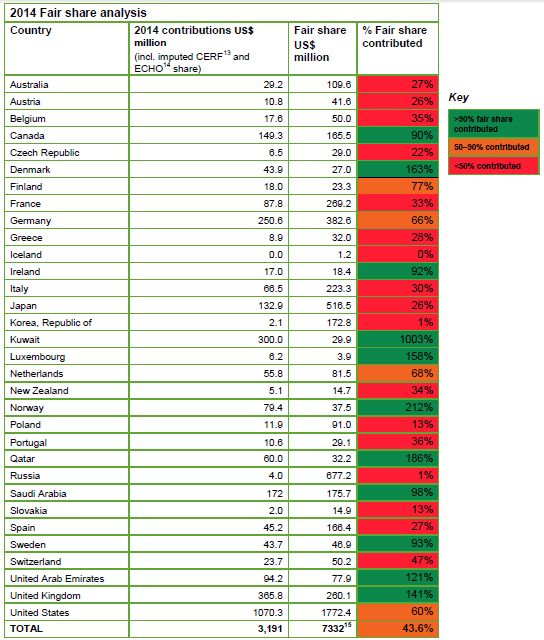
The report, A Fairer Deal for Syrians, details how the $7.7 billion humanitarian appeals are less than half funded, while a continued supply of arms is fuelling widespread violations and undermining peace efforts. Rich countries are offering a safe haven to a paltry number of refugees from Syria while neighboring countries are struggling to support more than 3 million people who have fled the conflict.

Russia, a major arms exporter to Syria, has committed only one percent of its fair share of aid. France and the USA have provided just 33 percent and 60 percent of their fair share respectively and are continuing to supply arms, undermining efforts to stop the conflict. Many Gulf countries are giving more than their fair share but need to do more to stop arms flowing. Other generous donors include the UK and Denmark. [Continue reading…]

syria-fair-share

Facebooktwittermail

New Iraqi Shiite militia copycats ISIS atrocities

France 24 reports: The Islamic State organisation (IS), a jihadist group that controls parts of Syria and Iraq, is infamous for releasing gory images of the atrocities its fighters commit. But now, a newly-formed Shiite militia fighting IS in Iraq has committed a similar act by recording a video where its combatants pose with severed heads.

This video shows a group of Shiite militiamen holding up two severed heads, which they describe as belonging to IS fighters. Mugging for the camera, the men chant: “We are coming for you! We’ll behead you and make mountains with your skulls!” The men’s clothing, armbands and flag show that they belong to the “Islamic Movement of Iraq”, a little-known militia that was recently formed, and which documents its activities on a Facebook page. The video’s caption indicates it was filmed when the city of Amerli was taken back from IS earlier this month. It was captured by Iraqi soldiers, Kurd peshmerga fighters and Shiite militias, who were aided by US air strikes.

According to the group’s Facebook page, its leader is Alhaj Abou Jabar Alasadi, a man unknown on Iraq’s political scene. Strangely enough, on his own Facebook page, he recently posted a photo of himself posing with Iraq’s former prime minister, Nuri al Maliki, just two weeks after the Shiite politician stepped down. He had been accused of being too sectarian. [Continue reading…]

Facebooktwittermail