Category Archives: News

Obama has leeway on Iran, despite U.S. lawmakers’ concerns

Reuters reports: Republican and Democratic U.S. senators on Sunday voiced skepticism about an interim nuclear deal reached with Iran but Congress looked likely to give President Barack Obama room to see if the agreement works.

The deal does not need to be ratified by Congress and Obama is using his executive power to temporarily suspend some existing U.S. sanctions on Iran.

Senators have been discussing for months imposing even tighter sanctions, which could anger Tehran and put Sunday’s deal reached in Geneva in jeopardy.

But influential Democrats – who control the Senate – made clear that any new sanctions against Iran would include a six-month window before they took effect.

That would allow time to see if Iran is sticking by the pact, worked out between Tehran, the United States and other world powers.

“It is a choice between a pause or imminent war. I choose a verifiable pause,” Senator Bill Nelson, a Democrat from Florida said.

Influential Democratic Senator Robert Menendez, who is known as a hawk on Iran, said forthcoming legislation would “provide for a six-month window to reach a final agreement before imposing new sanctions on Iran.” [Continue reading…]

Facebooktwittermail

Arab states show cautious optimism on nuclear deal

The Wall Street Journal reports: Saudi Arabia maintained a pointed silence Sunday on the new nuclear pact between world powers and Saudi Arabia’s top rival, Iran, while other Gulf and Arab states gave a cautious welcome to a deal hoped to ease tensions in a region bloodied by proxy battles between Shiite Iran and Sunni Arab states.

Saudi political commentators voiced persistent fears that Iran would now see itself as freed to advance on other, non-nuclear fronts against its Middle East rivals.

By early Monday in the Middle East, most of the region’s Muslim powers — Turkey, Egypt, and at least four of the six wealthy Arab Gulf countries — had issued statements expressing support for the deal. The United Arab Emirates., a commerce-minded nation that traditionally has thrived on doing business with both Iran and Arab states, welcomed the deal as one it hoped would protect the region “from the tension and danger of nuclear proliferation,” the emirates’ council of ministers said.

Saudi Arabia, the most powerful of the Arab states and the most intensely suspicious rival of Shiite Iran, made no public comment on the pact Sunday, and its foreign ministry didn’t return requests for comment. [Continue reading…]

Facebooktwittermail

New U.S. sanctions would spell ‘end of deal’ to limit nuclear program

NBC News reports: Iran will not honor the nuclear agreement it just signed with the United States and other world powers if Congress imposes new sanctions, Iran’s foreign minister told NBC News after the deal was announced.

“If there are new sanctions, then there is no deal. It’s very clear. End of the deal. Because of the inability of one party to maintain their side of the bargain,” Foreign Minister Javad Zarif said during an exclusive interview with NBC News.

After four days of marathon bargaining, on Sunday the United States and its allies agreed to offer Iran “modest relief” from harsh economic sanctions and access to a portion of the revenue that the country has been denied through these sanctions. In exchange, Iran will give inspectors broader access to nuclear sites and allow spontaneous inspections.

If NBC News actually read the text of the agreement, they would not be reporting “Iran’s foreign minister told NBC News.” They would have seen it in black and white:

The U.S. Administration, acting consistent with the respective roles of the President and the Congress, will refrain from imposing new nuclear-related sanctions.

Can the crazy people on Capitol Hill exercise some restraint over the coming months? We’ll see.

Facebooktwittermail

Egypt passes law restricting public protests

Al Jazeera reports: Egypt’s interim president, Adly Mansour, has signed a restrictive new “protest law” that would require Egyptians to seek approval days in advance before organising demonstrations.

The law will take effect later this week once the final text is published in the official state register. It gives police wide latitude to use force against demonstrators, which could give the government a pretext for a widespread crackdown.

The law has gone through numerous revisions, but rights groups say the latest version requires protesters to seek approval from police three days in advance, and allows the interior ministry to block rallies that could “pose a serious threat to security or peace”.

Election campaign events are subject to a 24-hour notification period in some drafts, and “processions” of more than 10 people are only allowed for “non-political” purposes. Violators could face fines of up to $4,360.

“They could have stuck to earlier versions, where if the interior ministry wants to ban a protest, the onus is on them to go to court and seek a ban,” said Heba Morayef, the Egypt director for Human Rights Watch. “Instead they’ve done the opposite. The end result is that we could see an increase in violent crackdowns on peaceful protests.” [Continue reading…]

Facebooktwittermail

As Syrian chemical attack loomed, missteps doomed civilians

The Wall Street Journal reports: As Syrian troops battled rebel forces in the Damascus suburbs Aug. 18, U.S. eavesdropping equipment began picking up ominous signals.

A special Syrian unit that handles chemical weapons was ordered closer to the front lines, officials briefed on the intelligence say, and started mixing poisons. For two days, warning signs mounted until coded messages went out for the elite team to bring in the “big ones” and put on gas masks.

U.S. intelligence agencies didn’t translate the intercepts into English right away, so White House officials didn’t know what the Syrian regime was planning until the assault began. Just before 2:30 a.m. on Aug. 21, the first salvo of poison-filled rockets streaked through the clear night sky and crashed into rebel strongholds.

Sarin gas, which kills almost instantly by attacking the nervous system, spread across sleeping farms. Pushed down by falling temperatures, the poison settled in low-lying areas and penetrated homes.

Men, women and children began coughing and gagging, with little more than wet handkerchiefs and T-shirts to hold over their mouths. Neighborhood doctors quickly ran out of antitoxins, and, in a desperate effort to wash away the poison, flooded clinic floors and dragged unconscious victims through the water. More than 1,400 people died, according to U.S. estimates, making it the worst chemical-weapons strike in a quarter century.

A final report is due soon from the United Nations. The Wall Street Journal has pieced together a reconstruction of that fateful day from battlefield reports and dozens of interviews with eyewitnesses, rebels, medics, activists and Western intelligence officials. It reveals both the horror of the attack and the months of miscalculations by the Syrian regime, opposition groups and U.S. government that left them all unprepared for what happened.

U.S. and Israeli communications intercepts reveal chaos inside the Syrian regime that night. When the reports of mass casualties filtered back from the field, according to the officials briefed on the intelligence, panicked Syrian commanders shot messages to the front line: Stop using the chemicals!

Calls came in to the presidential palace from Syrian allies Russia and Iran, as well as from Hezbollah, the Lebanese militant group whose fighters were inadvertently caught up in the gassing, according to previously undisclosed intelligence gathered by U.S., European and Middle Eastern spy agencies. The callers told the Syrians that the attack was a blunder that could have profound international repercussions, U.S. officials say.

The Obama administration had been closely monitoring Syria’s chemical-weapons stockpile since the conflict began in 2011, and had watched the regime carry out about a dozen small-scale chemical attacks before the big one, U.S. officials say. Even if they had translated the intercepts before the Aug. 21 strike, these officials say, they likely wouldn’t have acted because there were no indications it would be out of the ordinary.

Top policy makers had little appetite for getting more deeply involved in the conflict, and questions loomed large about the legality of providing support to the rebels and the best strategy for managing the chemical-weapons threat, these officials say. Rebel leaders and their allies in the U.S. government say the White House failed to act on requests for gas masks, antidote injectors and other protective gear until it was too late.

All told, the events of Aug. 21 changed the Middle East and U.S. policy in ways likely to reverberate for years. It prompted the U.S. to consider and then pull back from military action. The eventual deal to avert a strike, in which Syria agreed to destroy its chemical-weapons stockpiles, elevated Russia, for now, to a leadership position in the region.

President Bashar al-Assad has tightened his hold on power. His regime has denied using chemical weapons, blaming the attacks on the rebels. In exchange for giving up his chemical arsenal, he avoided an American military intervention and likely will get even more support from Russia and Iran. Mr. Assad has pressed ahead with his offensive using conventional arms. U.S. intercepts show a Russian official later boasting to a Syrian counterpart about how easy it had been to get the U.S. to back off strike plans, officials briefed on the intelligence say.

Syrian opposition leaders made their first formal appeal to the U.S. for protection from chemical weapons back in June 2012. At a meeting in Washington, opposition representatives handed administration officials a request for various nonlethal supplies, including 2,500 gas masks, say people who attended.

Samantha Power, then the White House’s top human-rights official and now U.S. ambassador to the United Nations, was receptive, these people say. But other White House advisers, they say, questioned whether the masks would make much of a difference. Some worried that if Islamic extremists in the opposition got their hands on them they might try to seize poison gas from the regime. Administrative lawyers worried about potentially running afoul of domestic and international law.

“It was never ‘no.'” says one opposition representative about what would become a series of requests. “But it would never happen.”

A senior administration official says, “Decisions that were made on assistance to the opposition were made in consultation with them as to what their priorities were.”

That July, American and Israeli spy agencies for the first time intercepted fragmentary intelligence about regime forces using chemical weapons on a small scale. The evidence wasn’t conclusive—there were no physical traces—but some top military officials say they found it persuasive and wanted to make it clear right away to Syria the U.S. wouldn’t tolerate even small attacks.

Then-White House Deputy National Security Adviser Denis McDonough and other officials told their agency counterparts that the top-secret information shouldn’t be made public, but congressional committees were briefed, according to officials. Mr. McDonough also decided to restrict the distribution of such “raw” intelligence inside the government because of its sensitivity, these people say. White House officials didn’t want to set off a chain reaction that would restrict their ability to decide how active a role to play, senior U.S. officials say.

The following month, on Aug. 20, President Barack Obama said the regime would cross the U.S.’s “red line” if it started moving or using “a whole bunch of chemical weapons.”

Last December, the U.S. intercepted an unusually complete communication in which Syrian officials spoke about a potentially larger-scale chemical attack involving aircraft. The White House sent private messages to the Russian government, which in turn asked Iran to lean on the Syrians to scrap the plan, according to current and former U.S. officials involved in the matter. Iran did just that, the officials say. A spokesperson for Iran’s U.N. mission said Iran had made it clear it opposed the use of chemical weapons. [Continue reading…]

Facebooktwittermail

Destruction of Syria’s chemical weapons may be outsourced to private contractors

The Associated Press reports: The global chemical weapons watchdog is inviting private companies to bid to get involved in destroying Syria’s stockpile of toxic agents and precursor chemicals.

The Organization for the Prohibition of Chemical Weapons is posting a request for “expressions of interest” from companies who want a role in “the treatment and disposal of hazardous and non-hazardous organic and inorganic chemicals.”

Facebooktwittermail

NSA report outlined goals for more power

James Risen and Laura Poitras report: Officials at the National Security Agency, intent on maintaining its dominance in intelligence collection, pledged last year to push to expand its surveillance powers, according to a top-secret strategy document.

In a February 2012 paper laying out the four-year strategy for the N.S.A.’s signals intelligence operations, which include the agency’s eavesdropping and communications data collection around the world, agency officials set an objective to “aggressively pursue legal authorities and a policy framework mapped more fully to the information age.”

Written as an agency mission statement with broad goals, the five-page document said that existing American laws were not adequate to meet the needs of the N.S.A. to conduct broad surveillance in what it cited as “the golden age of Sigint,” or signals intelligence. “The interpretation and guidelines for applying our authorities, and in some cases the authorities themselves, have not kept pace with the complexity of the technology and target environments, or the operational expectations levied on N.S.A.’s mission,” the document concluded.

Using sweeping language, the paper also outlined some of the agency’s other ambitions. They included defeating the cybersecurity practices of adversaries in order to acquire the data the agency needs from “anyone, anytime, anywhere.” The agency also said it would try to decrypt or bypass codes that keep communications secret by influencing “the global commercial encryption market through commercial relationships,” human spies and intelligence partners in other countries. It also talked of the need to “revolutionize” analysis of its vast collections of data to “radically increase operational impact.”

The strategy document, provided by the former N.S.A. contractor Edward J. Snowden, was written at a time when the agency was at the peak of its powers and the scope of its surveillance operations was still secret. Since then, Mr. Snowden’s revelations have changed the political landscape. [Continue reading…]

Facebooktwittermail

House intel bill adds $75 million to NSA budget to stop future Snowdens

Ars Technica reports: On Thursday, the House Intelligence Committee approved a spending bill to fund the National Security Agency and other intelligence organizations. Included in the bill is a provision that would set aside $75 million for the NSA to improve its internal security and mitigate insider threats to classified material. In other words, the bill seeks to prevent future Edward Snowdens.

Facebooktwittermail

U.S. ranks #27 in Web freedom and openness

Web Index: Designed and produced by the World Wide Web Foundation, the Web Index is the first multi-dimensional measure of the World Wide Web’s contribution to development and human rights globally. It covers 81 countries, incorporating indicators that assess the areas of universal access; freedom and openness; relevant content; and empowerment.

First released in 2012, the 2013 Index has been expanded and refined to include 20 new countries and features an enhanced data set, particularly in the areas of gender, Open Data, privacy rights and censorship. The Index combines existing secondary data with new primary data derived from an evidence-based expert assessment survey.

This is the second edition of the Web Index, which will be published annually. It will eventually allow for comparisons of trends over time and the benchmarking of performance across countries, continuously improving our understanding of the Web’s value for humanity.

Facebooktwittermail

Son of Israeli ex-president takes helm of Labor Party, urging peace

The New York Times reports: Isaac Herzog, the son of a former president, took the helm of Israel’s Labor Party and thus Parliament’s opposition on Friday, vowing to restore the party’s historic focus on promoting peace with the Palestinians and to mount a vigorous challenge to Prime Minister Benjamin Netanyahu’s right-leaning government.

“Only bold steps toward peace with the Palestinians will enable us to break through on all fronts,” Mr. Herzog said at a news conference in Tel Aviv. “I am not sure — I have grave doubts — whether Prime Minister Netanyahu understands this and if he’s working toward it.”

Promising to “restore the political banner to center stage” for “the sake of a just state,” he said he would “outflank those in power until we return to lead the country.”

A lawyer universally known as Buji and a father of three, Mr. Herzog, 53, hails from a beloved Israeli dynasty: His father, Chaim Herzog, a military man and diplomat, served as Israel’s sixth president, from 1983 to 1993, and his grandfather Yitzhak HaLevi Herzog was the first Ashkenazi chief rabbi of the modern state.

Mr. Herzog, who has served in Parliament since 2003 and held several ministerial posts, replaced Shelly Yacimovich, a former journalist who emphasized domestic socioeconomic concerns during her two years leading Labor, and was virtually invisible on the international stage. [Continue reading…]

Facebooktwittermail

Toxic mix of frustration and aggravation among U.S. officers controlling nuclear weapons

The Associated Press reports: Trouble inside the Air Force’s nuclear missile force runs deeper and wider than officials have let on.

An unpublished study for the Air Force, obtained by The Associated Press, cites “burnout” among launch officers with their fingers on the triggers of 450 weapons of mass destruction. Also, evidence of broader behavioral issues across the intercontinental ballistic missile force, including sexual assaults and domestic violence.

The study, provided to the AP in draft form, says that court-martial rates in the nuclear missile force in 2011 and 2012 were more than twice as high as in the overall Air Force. Administrative punishments, such as written reprimands for rules violations and other misbehavior, also were higher in those years.

These indicators add a new dimension to an emerging picture of malaise and worse inside the ICBM force, an arm of the Air Force with a proud heritage but an uncertain future.

Concerned about heightened levels of misconduct, the Air Force directed RAND Corp., the federally funded research house, to conduct a three-month study of work conditions and attitudes among the men and women inside the ICBM force. It found a toxic mix of frustration and aggravation, heightened by a sense of being unappreciated, overworked, micromanaged and at constant risk of failure.

Remote and rarely seen, the ICBM force gets little public attention. The AP, however, this year has documented a string of missteps that call into question the management of a force that demands strict obedience to procedures. [Continue reading…]

Facebooktwittermail

Saudi prince frets about ‘this perception that America is going down.’

The Wall Street Journal reports: ‘The U.S. has to have a foreign policy. Well-defined, well-structured. You don’t have it right now, unfortunately. It’s just complete chaos. Confusion. No policy. I mean, we feel it. We sense it, you know.”

Members of the Saudi royal family have voiced their displeasure with the Obama administration’s approach to the Middle East through private channels and recently in public as well. None of them puts it quite like HRH Prince Alwaleed bin Talal bin Abdulaziz Alsaud.

One of some three-dozen living grandsons of the first Saudi King Abdulaziz, this prince is a prominent but atypical royal. His investment company made him the Arab world’s richest businessman. He strikes a modern image for a Saudi, employing female aides and jet-setting on a private Boeing. He’s at ease with Western media.

Passing through New York earlier this week, Mr. Alwaleed, who is 58, sits down with the Journal editorial board between a couple of television appearances. He wears a blue suit, shirt and tie. These days, his bouffant widow’s peak has more salt than pepper. The prince holds no important government post in Saudi Arabia, but it’s hard to shake the impression that here is the uncensored id of the reserved House of Saud.

“America is shooting itself in the foot,” he says. “Saudi Arabia and me, myself, we love the United States. But what’s happening right now here, from Republicans and Democrats, is just not helping the image of the United States and is making this perception that America is going down a reality.” [Continue reading…]

Facebooktwittermail

Egypt expels Turkish ambassador, Turkey retaliates

Reuters reports: Egypt said on Saturday it was expelling Turkey’s ambassador and accused Ankara of backing organizations bent on undermining the country – an apparent reference to the Muslim Brotherhood of ousted Egyptian president Mohamed Mursi.

Turkey, which had forged close ties with Egypt under Mursi, responded by declaring the Egyptian ambassador, currently out of the country, persona non grata.

“We are saddened by this situation,” Turkey’s foreign ministry said in a statement. “But responsibility before history belongs to Egypt’s temporary administration which came to power under the extraordinary circumstances of the July 3 coup.”

Turkey has emerged as one of the fiercest international critics of Mursi’s removal, calling it an “unacceptable coup”. Mursi’s Muslim Brotherhood, which has been staging protests calling for his reinstatement, has close ties with Turkish Prime Minster Tayyip Erdogan’s AK Party.

Facebooktwittermail

Iran nuclear deal appears imminent

The Los Angeles Times reports: A deal to limit Iran’s nuclear program appeared close to completion Friday as negotiators from six world powers and Tehran smoothed remaining conflicts and top diplomats began arriving to join the talks.

After a rocky day Thursday, negotiators appeared for now to have overcome their differences on Iran’s entitlement to enrich uranium and on how to curb progress on a partially built nuclear research reactor that Western powers view as a particular threat.

U.S. Secretary of State John F. Kerry left late Friday for Geneva to help “narrow the differences and move closer to an agreement,” the State Department said. Sergei Lavrov, Russia’s foreign minister, arrived from Moscow early Friday evening, making him the first of the six nations’ ministers to show up for a possible signing ceremony that would end a decade of usually stalemated negotiations.

“Negotiations are moving on a positive track,” Iranian Deputy Foreign Minister Takht Ravanchi said.

A deal would be a first-stage agreement that would give Iran temporary relief from the crushing Western sanctions on its economy in exchange for temporary limits on its nuclear program. Many nations fear that Iran, despite its insistence that its program is for peaceful purposes only, is seeking weapons capability with its huge nuclear infrastructure.

This deal would open the way for tough bargaining on a final, comprehensive agreement that would take six months or longer to be reached.

A preliminary agreement would be a major step and could reduce the threat of another war in the Middle East. But as soon as it is signed it is likely to come under attack by Republican and Democratic lawmakers and U.S. allies such as Israel and Saudi Arabia, who fear that it will be too lenient. [Continue reading…]

Facebooktwittermail

Israeli military signals positive view of nuclear deal with Iran

Christian Science Monitor reports: Even as Prime Minister Benjamin Netanyahu continues his diplomatic offensive against what he calls a “dangerous” compromise on Iran’s nuclear program, Israel’s military intelligence seems open to a deal, even one that relaxes the Western sanctions on Iran that Mr. Netanyahu has vocally supported.

According to an unclassified assessment shared by a senior Israeli officer, military intelligence is focused on the implications of a potential compromise between Iran and the P5+1 (the US, Britain, France, Russia, China, and Germany).

A deal would boost President Hassan Rouhani, whose surprise victory in June appeared to herald a political shift in Iran – although he is up against hardliners who oppose a deal.

In the background briefing with foreign journalists, which covered a wide range of Middle East hotspots, the intelligence officer said Iran was one of several countries that could buck the general turmoil across the region.

“We see a bit of a possibility, although it’s quite problematic, of more … stability,” said the officer, who spoke on the basis of anonymity. But that is dependent on the success of negotiations “over the nuclear project, but more than that, over the relief of the sanctions on the Iranian economy,” he said. [Continue reading…]

Facebooktwittermail

Gaps narrowing as Iran nuclear talks continue

Laura Rozen reports: A second day of high level of nuclear talks broke for the night here Thursday with Iranian and western negotiators saying progress was being being made in narrowing gaps, but four or five issues still remain to be resolved and need more time. Talks are set to continue here Friday and are very likely to extend into the weekend.

A day “of intense, substantial and detailed negotiations on Iran nuclear programme, conducted in good atmosphere,” Michael Mann, spokesperson for European Union foreign policy chief Catherine Ashton, said Thursday. “Talks continue tomorrow.”

There are fewer and fewer gaps between the two sides, “the process is efficient, we have a very deep treatment” of the issues, a senior European diplomat, speaking not for attribution, said Thursday of the days’ discussions.

“Some big obstacles [to an accord] have been removed, but not all of them,” the European diplomat said. There are still about four to five elements on the table for negotiation, he said, most of them pertaining to the first phase of the agreement, which is intended to halt the expansion of Iran’s nuclear program over the course of six months while a comprehensive agreement is negotiated.

There is “no rupture with the Iranians, but it doesn’t mean agreement tomorrow,” the European diplomat said. “There is a feeling something could happen tomorrow, or after tomorrow,” but there’s no guarantee, he said. If an accord is reached over the next day, P5+1 foreign ministers could possibly come on Saturday. [Continue reading…]

This morning, Reuters reports that Russian Foreign Minister Sergei Lavrov is already on his way to Geneva.

Facebooktwittermail

Sen. Mark Kirk’s unshakable loyalty to Israel

Eli Clifton and Ali Gharib report: During an invitation-only phone briefing for supporters, one of the Senate’s top Iran hawks relished his battle with the Obama administration over the imposition of more sanctions against Iran amid the latest round of diplomatic negotiations underway in Geneva. During the call, Sen. Mark Kirk, R-Ill., reserved special attacks for Secretary of State John Kerry and lead U.S. negotiator Under Secretary of State Wendy Sherman.

“It’s the reason why I ran for the Senate, [it] is all wrapped up in this battle. I am totally dedicated to the survival of the state of Israel in the 21st century,” said Kirk, whose office framed the call as an update on Iran’s nuclear program and Kirk’s efforts to pass additional sanctions. “This has been very much a one-senator show, unfortunately,” he said of his confrontational, public approach.

Kirk is leading the Republican effort to introduce new sanctions in the Senate. Along with six co-sponsors, Kirk on Tuesday announced his intention to introduce amendments to the National Defense Authorization Act, the annual bill that budgets for the military, that would increase sanctions on Iran and impose restrictions on any possible interim nuclear deal with Iran. The effort is currently being held up by the upper chamber’s Democratic leadership.

The 28-minute phone call with Kirk, which occurred on Monday afternoon, was by invitation only, but Salon reporters obtained an invitation and RSVPed by name to Kirk for Senate finance director Barret Kedzior. [Continue reading…]

Facebooktwittermail

Working around Keystone XL, Suncor Energy steps up oil production in Canada

The New York Times reports: Suncor Energy, Canada’s top petroleum producer, announced on Thursday that it would expand its oil production in 2014 by 10 percent in another sign that the Obama administration’s delay in approving the Keystone XL pipeline extension is not holding back growth in the western Canadian oil sands fields.

“We’re set for a strong year of continued production,” Suncor’s chief executive, Steven W. Williams, said. The company announced a capital spending program of $7.45 billion for 2014, $477 million more than it had forecast earlier this year.

Suncor, which is based in Calgary, produces oil and gas around Canada, and has operations in North Africa and the North Sea. But its oil sands operations are the main driver for the company. In the most recent quarter, its oil sands output rose 16 percent from the year before for a record of 396,000 barrels a day, nearly 20 percent of the country’s total oil sands production.

The company said it expected its oil sands production to increase again next year to 430,000 barrels a day.

Reports of increased production are coming even as Canadian oil executives are privately questioning whether the Obama administration will ever approve the Keystone XL pipeline, which it has been considering for more than two years.

The extension is intended to transport more than 800,000 barrels a day of oil sands output to refineries on the Gulf of Mexico coast, but environmentalists have made stopping the pipeline their top priority since emissions from oil sands production are higher than for most crude oils consumed in the United States.

But over the last several months, oil companies have sought to go around the dispute by announcing plans for three large rail loading terminals with the combined capacity of transporting 350,000 barrels a day.

The companies are poised to quadruple rail-loading capacity over the next few years to as many as 900,000 barrels a day, whether or not the Keystone pipeline is built. [Continue reading…]

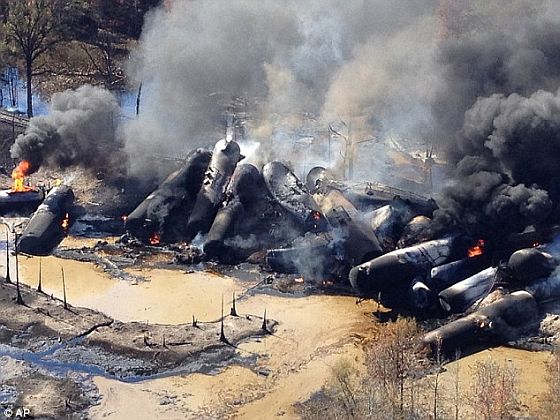
It’s long been reported that rail transportation of oil was already making the construction of Keystone XL an issue of questionable relevance in relation to the environmental consequences of oil sands production, which makes me wonder why so much activist energy was focused on the pipeline. Was it simply because “stop the pipeline” is such an easy rallying-cry?

Ironically, the dangers posed by rail delivery of oil are probably far greater than those posed by Keystone XL as an accident in Alabama earlier this month made all too clear:

oil-spill

Facebooktwittermail