Reuters reports: The White House is nearing a decision on splitting up the eavesdropping National Security Agency and U.S. Cyber Command, which conducts cyber warfare, a proposed reform prompted in part by revelations of NSA’s widespread snooping, individuals briefed on the matter said on Wednesday.
As part of the emerging plan, the NSA likely would get a civilian director for the first time in its 61-year history, the individuals said.
Both agencies are now headed by the same person, Army General Keith Alexander, who is retiring in March as NSA’s longest-serving director.
While Alexander is highly regarded in the intelligence community, critics have questioned the current arrangement. They say it concentrates too much power in one individual and that the two agencies have different missions. [Continue reading…]
Category Archives: News
Pakistan’s PTI party names CIA station chief
Firedoglake: A political party in Pakistan has named the CIA station chief in the country and accused the chief and CIA director John Brennan of murder for their role in a recent drone strike in Hangu, where an Islamic school was targeted.
The drone strike on November 21 killed six and, injured a “large number of those present including children,” according to a letter submitted to police by Dr. Shireen M. Mazari, the central information secretary for Pakistan Tehreek-e-Insaf (PTI).
Following the strike in the Khyber Pakhtunkwa province, a settled urban area, a First Information Report (FIR) was submitted to a nearby police station asking them to investigate crimes committed by those who were behind the strike.
Firedoglake is not revealing the alleged station chief’s name. The identity of the alleged CIA station chief in Pakistan has already been exposed by PTI, and his alleged name is circulating in the country.
The letter nominates Brennan and alleged CIA station chief Craig Osth for “committing the gross offenses of committing murder and waging war against Pakistan.” [Continue reading…]
Penny Lane: Gitmo’s other secret CIA facility
The Associated Press reports: A few hundred yards from the administrative offices of the Guantánamo Bay prison, hidden behind a ridge covered in thick scrub and cactus, sits a closely held secret.
A dirt road winds its way to a clearing where eight small cottages sit in two rows of four. They have long been abandoned. The special detachment of Marines that once provided security is gone.
But in the early years after 9/11, these cottages were part of a covert CIA program. Its secrecy has outlasted black prisons, waterboarding and rendition.
In these buildings, CIA officers turned terrorists into double agents and sent them home.
It was a risky gamble. If it worked, their agents might help the CIA find terrorist leaders to kill with drones. But officials knew there was a chance that some prisoners might quickly spurn their deal and kill Americans.
For the CIA, that was an acceptable risk in a dangerous business. For the American public, which was never told, it was one of the many secret trade-offs the government made on its behalf. At the same time the government used the threat of terrorism to justify imprisoning people indefinitely, it was releasing dangerous people from prison to work for the CIA.
Nearly a dozen current and former U.S. officials described aspects of the program to The Associated Press. All spoke on condition of anonymity because they were not authorized to publicly discuss the secret program, even though it ended in about 2006. [Continue reading…]
Americans back Iran deal by 2-to-1 margin
Reuters reports: Americans back a newly brokered nuclear deal with Iran by a 2-to-1 margin and are very wary of the United States resorting to military action against Tehran even if the historic diplomatic effort falls through, a Reuters/Ipsos poll showed on Tuesday.
The findings were rare good news in the polls for President Barack Obama, whose approval ratings have dropped in recent weeks because of the botched rollout of his signature healthcare reform law.
According to the Reuters/Ipsos survey, 44 percent of Americans support the interim deal reached between Iran and six world powers in Geneva last weekend, and 22 percent oppose it.
Fallout from NSA surveillance threatens ‘the existence of the World Wide Web’ says agency’s former director
The Wall Street Journal reports: Revelations about the NSA’s surveillance operations are fueling international efforts to divide up the Internet by country, [Michael Hayden, former director of both the NSA and the CIA] said, which is a movement the U.S. government — and U.S. tech companies — have worked hard to prevent.
“This is threatening the existence of the World Wide Web,” Mr. Hayden said, adding that a Balkanization of the Internet is “a no-fooling danger.”
In the near term, Germany wants a “no-spy” agreement and has sought to insert tough data-privacy measures into a long-sought U.S.-European trade pact. Ms. Merkel told parliament last Monday the NSA affair was “putting to the test” Germany’s relationship with the U.S., and the trade pact negotiations in particular.
Microsoft boosts effort to encrypt its Internet traffic to avoid NSA spying
The Washington Post reports: Microsoft is moving toward a major new effort to encrypt its Internet traffic amid fears that the National Security Agency may have broken into its global communications links, said people familiar with the emerging plans.
Suspicions at Microsoft, while building for several months, sharpened in October when it was reported that the NSA was intercepting traffic inside the private networks of Google and Yahoo, two industry rivals with similar global infrastructures, said people with direct knowledge of the company’s deliberations. They said top Microsoft executives are meeting this week to decide what encryption initiatives to deploy and how quickly.
Documents obtained from former NSA contractor Edward Snowden suggest — but do not prove — that the company is right to be concerned. Two previously unreleased slides that describe operations against Google and Yahoo include references to Microsoft’s Hotmail and Windows Live Messenger services. A separate NSA e-mail mentions Microsoft Passport, a Web-based service formerly offered by Microsoft, as a possible target of that same surveillance project, called MUSCULAR, which was first disclosed by The Washington Post last month.
Though Microsoft officials said they had no independent verification of the NSA targeting the company in this way, general counsel Brad Smith said Tuesday that it would be “very disturbing” and a possible constitutional breach if true. [Continue reading…]
Spies worry over ‘doomsday’ cache alleged to be stashed on cloud by Snowden
Reuters reports: British and U.S. intelligence officials say they are worried about a “doomsday” cache of highly classified, heavily encrypted material they believe former National Security Agency contractor Edward Snowden has stored on a data cloud.
The cache contains documents generated by the NSA and other agencies and includes names of U.S. and allied intelligence personnel, seven current and former U.S. officials and other sources briefed on the matter said.
The data is protected with sophisticated encryption, and multiple passwords are needed to open it, said two of the sources, who like the others spoke on condition of anonymity to discuss intelligence matters.
The passwords are in the possession of at least three different people and are valid for only a brief time window each day, they said. The identities of persons who might have the passwords are unknown.
Spokespeople for both NSA and the U.S. Office of the Director of National Intelligence declined to comment.
One source described the cache of still unpublished material as Snowden’s “insurance policy” against arrest or physical harm.
U.S. officials and other sources said only a small proportion of the classified material Snowden downloaded during stints as a contract systems administrator for NSA has been made public. Some Obama Administration officials have said privately that Snowden downloaded enough material to fuel two more years of news stories.
“The worst is yet to come,” said one former U.S. official who follows the investigation closely. [Continue reading…]
Obama’s overhaul of spy programs cloaked in more secrecy
McClatchy reports: President Barack Obama has faced withering criticism around the globe for his secret spying programs. How has he responded? With more secrecy.
Obama has been gradually tweaking his vast government surveillance policies. But he is not disclosing those changes to the public. Has he stopped spying on friendly world leaders? He won’t say. Has he stopped eavesdropping on the United Nations, the World Bank and the International Monetary Fund? He won’t say.
Even the report by the group Obama created to review and recommend changes to his surveillance programs has been kept secret.
Critics note that this comes after he famously promised the most open administration in history.
“They seem to have reverted to a much more traditional model of secrecy except when it’s politically advantageous,” said Steven Aftergood, who directs the Federation of American Scientists Project on Government Secrecy, and is an expert on – and prominent critic of – government secrecy. “That’s normal but not consistent with their pledge. [Continue reading…]
Top-secret document reveals NSA propaganda operations designed to discredit ‘radicalizers’
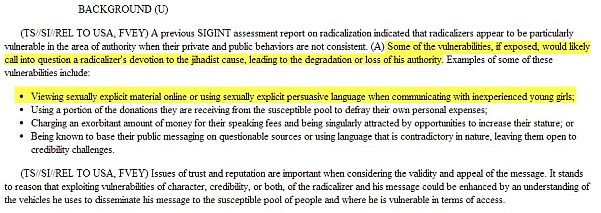
The Huffington Post reports: The National Security Agency has been gathering records of online sexual activity and evidence of visits to pornographic websites as part of a proposed plan to harm the reputations of those whom the agency believes are radicalizing others through incendiary speeches, according to a top-secret NSA document. The document, provided by NSA whistleblower Edward Snowden, identifies six targets, all Muslims, as “exemplars” of how “personal vulnerabilities” can be learned through electronic surveillance, and then exploited to undermine a target’s credibility, reputation and authority.
The NSA document, dated Oct. 3, 2012, repeatedly refers to the power of charges of hypocrisy to undermine such a messenger. “A previous SIGINT” — or signals intelligence, the interception of communications — “assessment report on radicalization indicated that radicalizers appear to be particularly vulnerable in the area of authority when their private and public behaviors are not consistent,” the document argues.
Among the vulnerabilities listed by the NSA that can be effectively exploited are “viewing sexually explicit material online” and “using sexually explicit persuasive language when communicating with inexperienced young girls.”
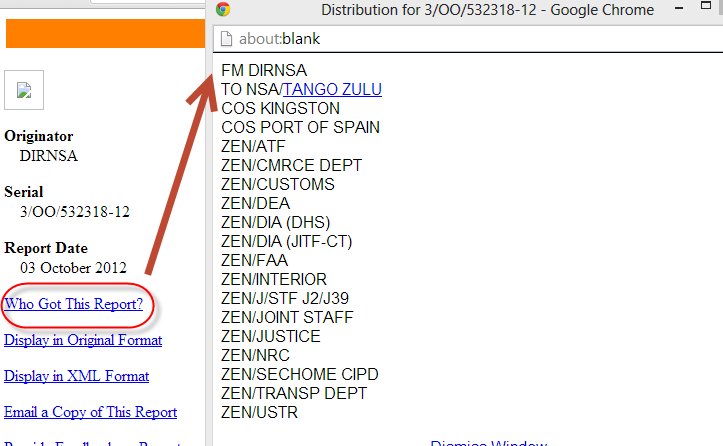
The Director of the National Security Agency — described as “DIRNSA” — is listed as the “originator” of the document. Beyond the NSA itself, the listed recipients include officials with the Departments of Justice and Commerce and the Drug Enforcement Administration. [Continue reading…]
Pope attacks ‘tyranny’ of capitalism
Reuters reports: Pope Francis attacked unfettered capitalism as “a new tyranny” and beseeched global leaders to fight poverty and growing inequality, in a document on Tuesday setting out a platform for his papacy and calling for a renewal of the Catholic Church.
The 84-page document, known as an apostolic exhortation, was the first major work he has authored alone as pope and makes official many views he has aired in sermons and remarks since he became the first non-European pontiff in 1,300 years in March.
In it, Francis went further than previous comments criticizing the global economic system, attacking the “idolatry of money”, and urged politicians to “attack the structural causes of inequality” and strive to provide work, healthcare and education to all citizens.
He also called on rich people to share their wealth. “Just as the commandment ‘Thou shalt not kill’ sets a clear limit in order to safeguard the value of human life, today we also have to say ‘thou shalt not’ to an economy of exclusion and inequality. Such an economy kills,” Francis wrote in the document issued on Tuesday. [Continue reading…]
NSA may have hit Internet companies at a weak spot
The New York Times reports: The recent revelation that the National Security Agency was able to eavesdrop on the communications of Google and Yahoo users without breaking into either company’s data centers sounded like something pulled from a Robert Ludlum spy thriller.
How on earth, the companies asked, did the N.S.A. get their data without their knowing about it?
The most likely answer is a modern spin on a century-old eavesdropping tradition.
People knowledgeable about Google and Yahoo’s infrastructure say they believe that government spies bypassed the big Internet companies and hit them at a weak spot — the fiber-optic cables that connect data centers around the world and are owned by companies like Verizon Communications, the BT Group, the Vodafone Group and Level 3 Communications. In particular, fingers have been pointed at Level 3, the world’s largest so-called Internet backbone provider, whose cables are used by Google and Yahoo.
The Internet companies’ data centers are locked down with full-time security and state-of-the-art surveillance, including heat sensors and iris scanners. But between the data centers — on Level 3’s fiber-optic cables that connected those massive computer farms — information was unencrypted and an easier target for government intercept efforts, according to three people with knowledge of Google’s and Yahoo’s systems who spoke on the condition of anonymity. [Continue reading…]
Egypt’s government struggles to gain footing as dissent grows
The New York Times reports: When the new military-backed Egyptian government lifted a nationwide state of emergency more than 10 days ago, it seemed to be proclaiming a momentary victory in the battle with its principal foe, the Muslim Brotherhood, whose regular protests had begun to wither.
But the government’s problems hardly abated. In brazen and occasionally spectacular attacks, militants have stepped up a campaign of assassinations and bombings aimed at the security services.
Non-Islamist critics have accused the government of incompetence or growing authoritarianism, potentially broadening the opposition beyond supporters of Mohamed Morsi, the deposed Islamist president. At the same time, unrest has begun to surface in different places, lately sweeping up Islamist students on university campuses.
And notably, small cracks have begun to appear in the coalition that supported the ouster of Mr. Morsi as the government has faced anger from recent allies and rare criticism in the once-fawning local news media. It has become harder for officials to blame the Brotherhood for all the nation’s woes, nearly five months after it was swept from power and then battered by a relentless campaign of state repression. But rather than trying to move beyond the conflict, the government still seems largely shaped by it.
Officials have started to dismiss critics using the language of previous autocratic rulers, blaming a shadowy fifth column or foreign meddling. And in response to dissent, they have drafted repressive new laws to replace the state of emergency, including a law issued on Sunday that bans protests by more than 10 people without the government’s approval.
“They have kept alive the idea of ‘enemies of the nation’ and the war on terror — the only glue keeping the bits and pieces together,” said Rabab el-Mahdi, a political science professor at the American University of Cairo, speaking of the interim government. “For any ruling alliance to be stable, it cannot depend on force or coercion. They lack any kind of ideological shield, except being against the Brotherhood.”
“They are not delivering,” Ms. Mahdi added, “and they will keep facing the dissent.” [Continue reading…]
Julian Assange unlikely to face U.S. charges over publishing classified documents
The Washington Post reports: The Justice Department has all but concluded it will not bring charges against WikiLeaks founder Julian Assange for publishing classified documents because government lawyers said they could not do so without also prosecuting U.S. news organizations and journalists, according to U.S. officials.
The officials stressed that a formal decision has not been made, and a grand jury investigating WikiLeaks remains impaneled, but they said there is little possibility of bringing a case against Assange, unless he is implicated in criminal activity other than releasing online top-secret military and diplomatic documents.
The Obama administration has charged government employees and contractors who leak classified information — such as former National Security Agency contractor Edward Snowden and former Army intelligence analyst Bradley Manning — with violations of the Espionage Act. But officials said that although Assange published classified documents, he did not leak them, something they said significantly affects their legal analysis.
Britain warns Israel: Don’t undermine Iran nuclear deal
Reuters reports: Israel should avoid taking any action that would undermine the interim nuclear agreement reached between Iran and world powers at the weekend, Britain’s Foreign Secretary William Hague said on Monday.
Urging world leaders to give the interim deal a chance, Hague said it was important to try to understand those who opposed the agreement. But he urged Israel and others to confine their criticism to rhetoric.
“We would discourage anybody in the world, including Israel, from taking any steps that would undermine this agreement and we will make that very clear to all concerned,” Hague told parliament.
Syria seen as most dire refugee crisis in a generation
The New York Times reports: As the boom of shelling resounded along Turkey’s border with Syria here on a recent afternoon, Zakaria Deeb had nowhere left to run.
He had traveled 100 miles to Kilis with his family, chasing a false rumor that refugees would be allowed into a Turkish-run camp in the city, about 50 miles north of the Syrian city Aleppo. Instead, along with hundreds of other Syrians, the Deebs were now squatting in a gravel-strewn field across from the camp, sleeping under plastic sheets hanging from the branch of a cypress tree.
Nearly three years of bloody civil war in Syria have created what the United Nations, governments and international humanitarian organizations describe as the most challenging refugee crisis in a generation — bigger than the one unleashed by the Rwandan genocide and laden with the sectarianism of the Balkan wars. With no end in sight in the conflict and with large parts of Syria already destroyed, governments and organizations are quietly preparing for the refugee crisis to last years.
The Deebs fled their home a year ago because of fighting between Syrian rebels and government forces. Recent clashes between Kurdish fighters and the Al Qaeda-linked Islamic State of Iraq and Syria, or ISIS, pushed them into Turkey. Now, just on the other side of the border here, ISIS fighters were battling yet another rebel group, the Northern Storm.
“We expected the revolution to be over quickly, like in Libya and Egypt, but it’s been nearly three years already, and God knows when this war will end,” Mr. Deeb, 31, said, peering at the plumes of white smoke rising inside Syria. Children shrieked as another large mortar shell exploded across the border.
A stray bullet from Syria had landed inside the camp in the morning, wounding a 5-year-old girl in the foot. “If this camp is full, we’re willing to go to any camp inside Turkey,” he said. “We don’t want to go back to Syria.”
Syrians have been pouring out of their country in recent months, fleeing an increasingly violent and murky conflict that is pitting scores of armed groups against one another as much as against the government. Numbering just 300,000 one year ago, the refugees now total 2.1 million, and the United Nations predicts their numbers could swell to 3.5 million by the end of the year. [Continue reading…]

Saudi Arabia welcomes Iran nuclear agreement
Al Jazeera reports: Saudi Arabia has said an interim deal on Iran’s nuclear programme could be a step towards a comprehensive solution – and hoped it could lead to the removal of WMD from the Middle East.
“The government of the kingdom sees that if there was goodwill, this agreement could represent a preliminary step towards a comprehensive solution to the Iranian nuclear programme,” the cabinet said in a statement.
It said the deal could eventually lead “to the removal of weapons of mass destruction, especially nuclear weapons, from the Middle East and the Arab Gulf region”.
Google mulled ditching U.S. after NSA scandal
CNBC reports: Google, the giant of the Internet, thought about moving its servers out of the U.S. after the NSA debacle, said Eric Schmidt, the company’s chairman, on Friday at the Paley International Council Summit in New York.
“Actually, we thought about that and there are many, many reasons why it’s impossible for Google to leave the United States, although it’s attractive,” Schmidt said.
“But the reason it’s an interesting idea is because American firms are subject to these rules, the [Foreign Intelligence Surveillance Act] rules, Patriot Act and so forth, and this government surveillance is really a problem.”
Secret U.S.-Iran talks set stage for nuke deal
The Associated Press reports: The United States and Iran secretly engaged in a series of high-level, face-to-face talks over the past year, in a high-stakes diplomatic gamble by the Obama administration that paved the way for the historic deal sealed early Sunday in Geneva aimed at slowing Tehran’s nuclear program, The Associated Press has learned.
The discussions were kept hidden even from America’s closest friends, including its negotiating partners and Israel, until two months ago, and that may explain how the nuclear accord appeared to come together so quickly after years of stalemate and fierce hostility between Iran and the West.
But the secrecy of the talks may also explain some of the tensions between the U.S. and France, which earlier this month balked at a proposed deal, and with Israel, which is furious about the agreement and has angrily denounced the diplomatic outreach to Tehran. [Continue reading…]
Haaretz reports: Israel found out about the existence of secret talks between the United States and Iran months before they were officially informed of the negotiations by the U.S. government, a senior Israeli official told Haaretz. The Israeli government learned of the secret negotiations sometime near the beginning of the summer through intelligence it managed to obtain.
Managed to obtain how? Through surveillance on U.S. diplomatic communications? Or, more likely, through leaks from an Israel-friendly Washington insider.