The New York Times reports: The nation’s top spymaster said on Tuesday that the White House had long been aware in general terms of the National Security Agency’s overseas eavesdropping, stoutly defending the agency’s intelligence-gathering methods and suggesting possible divisions within the Obama administration.
The official, James R. Clapper Jr., the director of national intelligence, testified before the House Intelligence Committee that the N.S.A. had kept senior officials in the National Security Council informed of surveillance it was conducting in foreign countries. He did not specifically say whether President Obama was told of these spying efforts, but he appeared to challenge assertions in recent days that the White House had been in the dark about some of the agency’s practices.
Mr. Clapper and the agency’s director, Gen. Keith B. Alexander, vigorously rejected suggestions that the agency was a rogue institution, trawling for information on ordinary citizens and leaders of America’s closest allies, without the knowledge of its Washington overseers.
Their testimony came amid mounting questions about how the N.S.A. collects information overseas, with Republicans and Democrats calling for a congressional review, lawmakers introducing a bill that would curb its activities and Mr. Obama poised to impose his own constraints, particularly on monitoring the leaders of friendly nations. At the same time, current and former American intelligence officials say there is a growing sense of anger with the White House for what they see as attempts by the administration to pin the blame for the controversy squarely on them.
General Alexander said news media reports that the N.S.A. had vacuumed up tens of millions of telephone calls in France, Italy and Spain were “completely false.” That data, he said, is at least partly collected by the intelligence services of those countries and provided to the N.S.A.
Still, both he and Mr. Clapper said that spying on foreign leaders — even those of allies — was a basic tenet of intelligence tradecraft and had gone on for decades. European countries, Mr. Clapper said, routinely seek to listen in on the conversations of American leaders. [Continue reading…]
Category Archives: News
Obama orders curbs on NSA spying on UN headquarters
Reuters reports: President Barack Obama recently ordered the National Security Agency to curtail eavesdropping on the United Nations headquarters in New York as part of a review of U.S. electronic surveillance, according to a U.S. official familiar with the decision.
Obama’s order is the latest known move by the White House to limit the NSA’s vast intelligence collection, in the wake of protests by allies, including German Chancellor Angela Merkel, over U.S. spying on foreign heads of state.
The full extent of U.S. eavesdropping on the United Nations is not publicly known, nor is it clear whether the United States has stopped all monitoring of diplomats assigned to the U.N. in New York or elsewhere around the world.
“The United States is not conducting electronic surveillance targeting the United Nations headquarters in New York,” said a senior Obama administration official, who spoke on condition of anonymity.
The official did not address past surveillance of the world body. Such programs are highly classified, although some details have been leaked by former NSA contractor Edward Snowden. [Continue reading…]
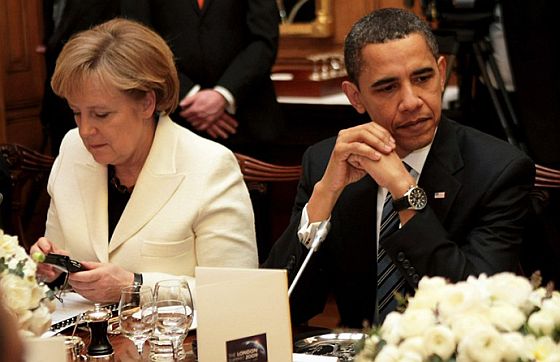
Intelligence officials confirm Obama misled Merkel

Obama pretending he can't see Merkel texting.
The Los Angeles Times reports: The White House and State Department signed off on surveillance targeting phone conversations of friendly foreign leaders, current and former U.S. intelligence officials said Monday, pushing back against assertions that President Obama and his aides were unaware of the high-level eavesdropping.
Professional staff members at the National Security Agency and other U.S. intelligence agencies are angry, these officials say, believing the president has cast them adrift as he tries to distance himself from the disclosures by former NSA contractor Edward Snowden that have strained ties with close allies.
The resistance emerged as the White House said it would curtail foreign intelligence collection in some cases and two senior U.S. senators called for investigations of the practice.
Precisely how the surveillance is conducted is unclear. But if a foreign leader is targeted for eavesdropping, the relevant U.S. ambassador and the National Security Council staffer at the White House who deals with the country are given regular reports, said two former senior intelligence officials, who spoke on condition of anonymity in discussing classified information.
Obama may not have been specifically briefed on NSA operations targeting a foreign leader’s cellphone or email communications, one of the officials said. “But certainly the National Security Council and senior people across the intelligence community knew exactly what was going on, and to suggest otherwise is ridiculous.”
If U.S. spying on key foreign leaders was news to the White House, current and former officials said, then White House officials have not been reading their briefing books.
Some U.S. intelligence officials said they were being blamed by the White House for conducting surveillance that was authorized under the law and utilized at the White House.
“People are furious,” said a senior intelligence official who would not be identified discussing classified information. “This is officially the White House cutting off the intelligence community.”
Any decision to spy on friendly foreign leaders is made with input from the State Department, which considers the political risk, the official said. Any useful intelligence is then given to the president’s counter-terrorism advisor, Lisa Monaco, among other White House officials.
When Angela Merkel phoned Barack Obama to tell him she didn’t appreciate being spied on by the NSA, it’s not as though Obama got blind-sided by the call. “You have a call on line one Mr President. It’s a woman with a German accent. She sounds pissed off.”
On the contrary, it’s reasonable to assume that Obama, in consultation with his staff, had time to craft a response, and if that response was not exactly crafted then it should at least have sounded halfway plausible.
Senior White House adviser: Just tell her you knew nothing about it but you promise it’ll never happen again.
Obama: But that’s going to sound like the lame excuse a 12-year-old would give in response to a reprimand from a school teacher.
Adviser: You got any better ideas?
The Most Powerful Man in the World: ….
What should he have said? How about:
I am aware of the reports you are referring to. I understand your concerns. I have ordered a comprehensive review of our surveillance policies and I am fully committed to taking whatever steps are necessary to restore trust between the United States and Germany. To that end, I’d like to invite you to send a team of your intelligence officials to meet their counterparts in Washington and in that context we will be able to address more specific issues and hopefully arrive at a common understanding.
You remain dear to my heart, Angela.
Well, maybe not the last bit.
The case for NSA reform
Sen. Patrick Leahy and Rep. Jim Sensenbrenner write: In the days and weeks following Sept. 11, 2001, we were the primary authors of the USA PATRIOT Act — legislation that responded to those attacks by enhancing the government’s ability to gather information to prevent terrorism. Some checks and balances that were proposed then were included in the final bill; others were not. The PATRIOT Act has been much debated these past 12 years, and we have not always been on the same side of those debates. But whatever our differences may have been in the past, we strongly agree that the dragnet collection of millions of Americans’ phone records every day — whether they have any connection at all to terrorism — goes far beyond what Congress envisioned or intended to authorize. More important, we agree it must stop.
Over the past five months, we have seen a slow trickle of additional disclosures that have only added to our concerns. Since the revelation that the National Security Agency is collecting the details of Americans’ phone calls on an unprecedented scale, it has come out that the government searches the content of huge troves of emails, collects in bulk the address books from email accounts and social networking sites, at least temporarily collected geolocation data from our cellphones, committed thousands of privacy violations and made substantial misrepresentations to courts and Congress.
Not only do many of these programs raise serious legal questions, they have come at a high cost to Americans’ privacy rights, business interests and standing in the international community. It is time for a new approach.
On Tuesday we will introduce bicameral, bipartisan legislation that will put an end to the National Security Agency’s indiscriminate collection of personal information. Our proposal, the USA FREEDOM Act, provides stronger privacy safeguards with respect to a range of government surveillance programs. [Continue reading…]
Former NSA supporters join critics in calling for reform
MSNBC reports: Even as President Obama’s administration seeks to stem the growing global outrage over its eavesdropping, a movement to curb government snooping is gaining ground in Congress.
Six members of Congress who voted against the effort to defund the National Security Agency’s communications data collection program late last July will now be among the co-sponsors of surveillance reform legislation meant to rein in the NSA. The proposal would outlaw the NSA’s bulk data collection program, make the secret Foreign Intelligence Surveillance court more transparent, and place new restrictions on the government’s handling of the data it collects.
According to a Republican House aide, Reps. Duncan Hunter of California, Lee Terry of Nebraska, and Darrell Issa of California, who chairs of the House government oversight committee, will be among those co-sponsoring the legislation. On the Democratic side, Rep. Sheila Jackson Lee of Texas, Rep. Hank Johnson of Georgia, and Mike Quigley of Illinois will co-sponsor. All six voted against an amendment in late July sponsored by two Michigan congressmen, Republican Justin Amash and Democrat John Conyers, that would have defunded the NSA’s bulk data collection program. Republicans Todd Rokita of Indiana and Howard Coble of North Carolina, who abstained from the Amash-Conyers vote, will also support the surveillance reform legislation.
The Amash-Conyers amendment was defeated by only 12 votes. [Continue reading…]
NSA hinted Israel was behind cyberattack on French president
AFP reports: France believed the United States attempted to hack into its president’s communications network, a leaked US intelligence document published on Friday suggests.
US agents denied having anything to do with a May 2012 cyber attack on the Elysee Palace, the official residence of French presidents, and appeared to hint at the possible involvement of Mossad, Israel’s intelligence agency, a classified internal note from the US National Security Agency suggests.
Extracts from the document, the latest to emerge from the NSA via former contractor Edward Snowden, were published by Le Monde newspaper alongside an article jointly authored by Glenn Greenwald, the US journalist who has been principally responsible for a still-unravelling scandal over large-scale US snooping on individuals and political leaders all over the world.
The document is a briefing note prepared in April this year for NSA officials who were due to meet two senior figures from France’s external intelligence agency, the DGSE. The French agents had travelled to Washington to demand explanations over their discovery in May 2012 of attempts to compromise the Elysee’s communications systems.
The note says that the branch of the NSA which handles cyber attacks, Tailored Access Operations (TAO), had confirmed that it had not carried out the attack and says that most of its closest allies (Australia, Britain, Canada and New Zealand) had also denied involvement.
It goes on to note: “TAO intentionally did not ask either Mossad or (Israel’s cyber intelligence unit) ISNU whether they were involved as France is not an approved target for joint discussions.” [Continue reading…]
UN confirms polio outbreak in Syria
The New York Times reports: United Nations officials confirmed an outbreak of polio among children in Syria on Tuesday, lending urgency to plans for vaccination campaigns there and in nearby countries to try to halt the spread of the disease.
Tests confirmed polio in 10 out of 22 children in Deir al-Zour Province in northeastern Syria who became ill this month, Oliver Rosenbauer, a spokesman for the World Health Organization, said. Results of tests on the other 12 children are expected soon, he added.
“With population movements, it can travel to other areas, so the risk is high of spread across the region,” Mr. Rosenbauer said.
United Nations officials said last week they were launching a campaign to immunize 2.4 million children in Syria against polio and other diseases. With thousands of refugees fleeing daily from Syria’s civil war to neighboring countries, they are also intensifying immunization efforts in six countries, including Lebanon, Jordan, Iraq and Turkey, which have taken in more than two million Syrian refugees, as well as Egypt and Israel.
Most of the affected children in Syria are under two years old, Mr. Rosenbauer said, underscoring the impact of 31 months of conflict on Syria’s health infrastructure. The United Nations says half a million Syrian children have not been inoculated against polio in a country where, before the conflict, 95 percent of the country’s population was immunized.
Despite the difficulty of delivering vaccines in a country convulsed by war, the United Nations Children’s Fund said it had vaccinated about a million Syrian children this year, including 800,000 who were vaccinated against polio.
After confirming the presence of the disease, attention is turning to identifying the source, Mr. Rosenbauer said. Public health officials have speculated that a possible source may have been jihadists traveling to Syria from Pakistan which, with Afghanistan and Nigeria, are the only countries where the disease is still endemic. [Continue reading…]
Lebanon suffers under the strain of a refugee crisis now out of control
The Observer reports: As you come through the military checkpoints on the way into Wadi Khaled, local mobile phones bleep with an unsolicited text: “The Ministry of Tourism welcomes you to Syria.”
This part of northern Lebanon, which juts like a knucklebone into Syria, is so close to the war that the villagers can watch the rockets land and palls of smoke rising across the hillsides. Children have swarmed up on to the first floor of the shell of a half-built house and are pointing excitedly to where the outlying villages of Homs begin. “I can see our house,” shouts Satash, six.
His mother, Maro, 28, stands back with her eyes cast down. “The older girls come up here and spend hours and hours sitting and looking out at Syria. I cannot even look.”
Satash’s home is, in reality, long gone. He now lives in Lebanon, in what used to be a shed for slaughtering chickens, with his parents and grandparents, his three-year-old sister and six orphaned cousins. The cousins’ mother was killed by shelling that stopped the delivery of medicines to treat her sickness; their father died from shrapnel wounds.
After fleeing in the middle of the night when a shell landed in their yard, taking only the clothes they stood up in, the family walked south for seven hours before crossing into Lebanon. They wandered for several months looking for help and accommodation, and ended up in the village of Knaisse in Wadi Khaled, only three miles from their Syrian home.
The family live in a shed, the rent waived by a kindly Lebanese. They have one blanket between five people, and plastic bags stuffed along the flimsy roof to stop the rain coming in. The grandmother lies on a scrap of matting, suffering from afflictions for which there is no money to buy treatment.
Maro and family live on a small monthly cash handout from a UN agency. Like most of the 1.3 million Syrian refugees now in Lebanon, a country of just 4.2 million people, they are worried about the snow that will start falling on the hills of Wadi Khaled within weeks. This will be their second winter here. “The room becomes like a refrigerator in the winter, the water floods like a lake all around and the wind is so cold,” said Maro’s husband, Ahmad, who is clearly under strain. He shouts again and again: “The people who stayed are dead under the rubble!” [Continue reading…]
Obama may ban spying on heads of allied states — including Israel?
The New York Times reports: President Obama is poised to order the National Security Agency to stop eavesdropping on the leaders of American allies, administration and Congressional officials said Monday, responding to a deepening diplomatic crisis over reports that the agency had for years targeted the cellphone of Chancellor Angela Merkel of Germany.
The White House informed a leading Democratic lawmaker, Senator Dianne Feinstein of California, of its plans, which grew out of a broader internal review of intelligence-gathering methods, prompted by the leak of N.S.A. documents by a former contractor, Edward J. Snowden.
In a statement on Monday, Senator Feinstein, chairwoman of the Senate Intelligence Committee, said, “I do not believe the United States should be collecting phone calls or emails of friendly presidents and prime ministers.” Ms. Feinstein, who has been a stalwart defender of the administration’s surveillance policies, said her committee would begin a “major review of all intelligence collection programs.”
The White House said Monday evening that no final decision had been made on the monitoring of friendly foreign leaders. But the disclosure that it is moving to prohibit it marks a landmark shift for the N.S.A., which has had nearly unfettered powers to collect data on tens of millions of people around the world, from ordinary citizens to heads of state, including the leaders of Brazil and Mexico.
It is also likely to prompt a fierce debate on what constitutes an American ally. [Continue reading…]
The 2013 ‘black budget’ for the U.S. intelligence community, provided to the Washington Post by Edward Snowden and published at the end of August, states that although overall the budget was declining it was being increased in specific areas:
“[W]e are investing in target surveillance and offensive CI [counterintelligence] against key targets, such as China, Russia, Iran, Israel, Pakistan, and Cuba.”
Monitoring the communications of the leaders of Israel, a country that has repeatedly made explicit threats that it might trigger another major conflict in the Middle East, would appear to serve the interests of both the U.S. and most of its allies.
NSA oversight dismissed as ‘illusory’ as anger intensifies in Europe and beyond
The Guardian reports: The Obama administration’s international surveillance crisis deepened on Monday as representatives from a Latin American human rights panel told US diplomats that oversight of the programs was “illusory”.
Members of the Inter-American Commission on Human Rights, an arm of the Organization of American States, expressed frustration and dissatisfaction with the National Security Agency’s mass surveillance of foreign nationals – something the agency argues is both central to its existence and necessary to prevent terrorism.
“With a program of this scope, it’s obvious that any form of control becomes illusory when there’s hundreds of millions of communications that become monitored and surveilled,” said Felipe Gonzales, a commissioner and Chilean national.
“This is of concern to us because maybe the Inter-American Committee on Human Rights may become a target as well of surveillance,” said Rodrigo Escobar Gil, a commissioner and Colombian citizen.
Frank La Rue, the United Nations special rapporteur on the right to freedom of opinion and expression, told the commission that the right to privacy was “inextricably linked” to free expression.
“What is not permissible from a human rights point of view is that those that hold political power or those that are in security agencies or, even less, those in intelligence agencies decide by themselves, for themselves, what the scope of these surveillance activities are, or who will be targeted, or who will be blanked surveilled,” La Rue said.
While the US sent four representatives to the hearing, they offered no defence, rebuttal or elaboration about bulk surveillance, saying the October government shutdown prevented them from adequate preparation. “We are here to listen,” said deputy permanent representative Lawrence Gumbiner, who pledged to submit written responses within 30 days. [Continue reading…]
Spain warns U.S. of breakdown in trust after new NSA revelations
The Guardian reports: The Spanish government has warned the US that revelations of widespread spying by the National Security Agency could, if confirmed, “lead to a breakdown in the traditional trust” between the two countries.
The diplomatic row followed a report in Spain’s El Mundo newspaper on Monday, based on a leaked NSA document, claiming that the US had intercepted 60.5m phone calls in Spain between 10 December 2012 and 8 January this year.
In the latest revelations from the documents leaked by the US whistleblower Edward Snowden, El Mundo published an NSA graphic, entitled “Spain – last 30 days”, showing the daily flow of phone calls within Spain. On one day alone – 11 December 2012 – the NSA reportedly intercepted more than 3.5m phone calls. It appears that although the content of the calls was not monitored the serial and phone numbers of the handsets used, the locations, sim cards and the duration of the calls were. Emails and other social media were also monitored.
The White House has so far declined to comment on the El Mundo report. Spain, however, expressed its concern. José Manuel García Margallo, Spain’s foreign minister, warned of a breakdown in trust between Madrid and Washington at a press conference in Warsaw, where he was on an official visit. [Continue reading…]
Obama lied to Merkel when claiming to know nothing about NSA bugging her phone, says new report
BBC News reports: Mrs Merkel phoned the US president when she first heard of the spying allegations on Wednesday.
President Barack Obama apologised to the German chancellor and promised Mrs Merkel he knew nothing of the alleged phone monitoring and would have stopped it if he had, Der Spiegel reports.
But on Sunday Bild newspaper quoted US intelligence sources as saying NSA head Keith Alexander personally briefed the president about the covert operation targeting Mrs Merkel in 2010.
“Obama did not halt the operation but rather let it continue,” the newspaper quoted a senior NSA official as saying.
Her number was still on a surveillance list in 2013.
Bild is a tabloid that does not have a reputation for journalistic excellence. Even so, if a conflict between the NSA and the White House is escalating, then an NSA source might turn to this type of publication as a way of making a veiled threat. The report has the effect of sowing doubt about Obama’s statements even if NSA officials now make dismissive responses, pointing out the unreliability of the press.
Obama has a dilemma. On the one hand it is becoming increasingly evident that he will need to steer some kind of reform in the NSA’s operations. But at the same time he doesn’t want to foster the appearance of the agency having become a rogue operation since that would also make him look like a negligent, ineffectual president. Neither does he want to get into an open fight since by their nature, intelligence agencies are dirty fighters. He can be reasonably confident that none of his communications are being monitored by any foreign intelligence agencies, yet why should he assume the NSA would never spy on an American president?
In a speech NSA chief Keith Alexander gave this summer, as he referred to when Obama “first came on board,” either unconsciously or intentionally, the four-star general seemed to be alluding to the transience of elected officials. The president, his cabinet, and members of Congress, sustain the facade of democracy, but the captains of the state like Alexander generally move around in the background, loyal to the president and the Constitution as they like to declare, yet harboring the conceit that they are America’s most stalwart defenders.
19 Syria rebel groups reject Geneva talks
AFP reports: Nineteen Islamist groups fighting to topple President Bashar al-Assad have rejected outright a mooted US-Russian peace initiative for Syria dubbed Geneva 2, a statement said.
“We announce that the Geneva 2 conference is not, nor will it ever be our people’s choice or our revolution’s demand,” the groups said in a late Saturday statement read in an online video by Ahmad Eissa al-Sheikh, chief of the Suqur al-Sham chief.
“We consider it just another part of the conspiracy to throw our revolution off track and to abort it.”
The statement also warned that anyone who went to such talks would be committing “treason, and … would have to answer for it before our courts”.
The statement comes weeks after dozens of major rebel groups across Syria said the Western-backed opposition umbrella grouping the National Coalition had “failed”.
As Iraq seeks U.S. arms, bombs kill another 55
Reuters reports: A dozen bombings in Iraq killed 55 people on Sunday as the prime minister prepares to travel to Washington to seek President Barack Obama’s help in confronting a wave of sectarian violence fuelled by Syria’s civil war.
Killings, mostly blamed by the Shi’ite-led government on Sunni Islamists from al Qaeda, are running at daily rates not seen in five years and Nuri al-Maliki will ask Obama on Friday to speed up promised deliveries of drones and F-16 jets that he believes can help staunch the long desert border with Syria.
Iraq’s own security forces, trained and equipped by the U.S. troops who withdrew in late 2011 after a nine-year occupation, have been unable to prevent a surge in violence which has taken the civilian death toll so far this year to about 7,000. Sealing the Syrian border would only address part of the problem.
On Sunday, police reported 11 vehicles blowing up in mainly Shi’ite Muslim areas in and around Baghdad, killing 41 people in an apparently coordinated series of explosions typical of al Qaeda. A further 14 people were killed when a suicide bomber drove up to a line of soldiers waiting to collect their pay from a bank in the northern city of Mosul and detonated his car.
The NSA is undermining the fight against terrorism
The Guardian reports: Germany and France are to spearhead a drive to try to force the Americans to agree new transatlantic rules on intelligence and security service behaviour in the wake of the Snowden revelations and allegations of mass US spying in France and tapping of the German chancellor Angela Merkel’s mobile phone.
At an EU summit in Brussels that was hijacked by the furore over the activities of the National Security Agency in the US and Britain’s GCHQ, the French president, François Hollande, also called for a new code of conduct agreed between national intelligence services in the EU, raising the question of whether Britain would opt to join in.
Shaken by this week’s revelations of NSA operations in France and Germany, EU leaders and Merkel in particular warned that the international fight against terrorism was being jeopardised by the perception that mass US surveillance was out of control.
The leaders “stressed that intelligence-gathering is a vital element in the fight against terrorism”, a summit statement said. “A lack of trust could prejudice the necessary co-operation in the field of intelligence-gathering.”
Merkel drove the point home: “We need trust among allies and partners. Such trust now has to be built anew … The United States of America and Europe face common challenges. We are allies. But such an alliance can only be built on trust.” [Continue reading…]
U.S. tells terror suspect it will use surveillance evidence, setting up possible legal challenge
The Washington Post reports: The Justice Department on Friday informed a terrorism suspect in Colorado that it intends to use evidence against him gathered through the government’s warrantless surveillance program, a move that will likely lead to a constitutional challenge to the law.
It is the first time the government has informed a criminal defendant that it intends to use “information obtained or derived from acquisition of foreign intelligence information conducted pursuant to the Foreign Intelligence Surveillance Act.”
It is important because the Supreme Court last term declined to consider the constitutionality of the law amended five years ago because it said those who brought a lawsuit against it could not prove they had been subject to its provisions.
With the filing Friday, “it’s the first time since 2008 when the act was signed into law that the government has acknowledged the use of surveillance derived from the law in a criminal prosecution,” said Jameel Jaffer, deputy legal director of the American Civil Liberties Union.
Jaffer, who argued the previous case at the Supreme Court, said it was a “big deal” that “will undoubtedly set up a constitutional challenge to it.” [Continue reading…]
Leaked memos reveal GCHQ efforts to keep mass surveillance secret
The Guardian reports: The UK intelligence agency GCHQ has repeatedly warned it fears a “damaging public debate” on the scale of its activities because it could lead to legal challenges against its mass-surveillance programmes, classified internal documents reveal.
Memos contained in the cache disclosed by the US whistleblower Edward Snowden detail the agency’s long fight against making intercept evidence admissible as evidence in criminal trials – a policy supported by all three major political parties, but ultimately defeated by the UK’s intelligence community.
Foremost among the reasons was a desire to minimise the potential for challenges against the agency’s large-scale interception programmes, rather than any intrinsic threat to security, the documents show. [Continue reading…]
NSA: Brazil and Germany lead calls for UN resolution on internet privacy
The Guardian reports: Brazil and Germany are spearheading efforts at the United Nations to protect the privacy of electronic communications in the wake of the Edward Snowden revelations and allegations of mass US spying.
Diplomats from the two countries, which have both been targeted by America’s National Security Agency, are leading efforts by a coalition of nations to draft a UN general assembly resolution calling for the right to privacy on the internet.
Although non-binding, the resolution would be one of the strongest condemnations of US snooping to date.
“This resolution will probably have enormous support in the GA [general assembly] since no one likes the NSA spying on them,” a western diplomat told Reuters on condition of anonymity.
The Brazilian president, Dilma Rousseff, has previously cancelled a state visit to Washington over the revelation that the NSA was scooping up large amounts of Brazilian communications data, including from the state-run oil company Petrobras. The drafting of the UN resolution was confirmed by the country’s foreign ministry.
The Associated Press quoted a diplomat who said the language of the resolution would not be “offensive” to any nation, particularly the US.
He added that it would expand the right to privacy guaranteed by the international covenant on civil and political rights, which went into force in 1976. [Continue reading…]