Shadi Hamid writes: The announcement of a new Islamist “alliance” in Syria—bringing together the largest and most influential rebel factions—is only the latest sign of a failed Western strategy. Several of these groups, including Liwa al-Islam and Liwa al-Tawhid, were previously linked to the Western-backed “moderate” Supreme Military Council (SMC). The implications are significant not just for Syria’s fractious opposition but for American strategy more broadly. As Charles Lister writes, this “effectively depletes…the SMC,” which, at least until recently, embodied Western hopes for a more palatable, more unified rebel force.
For more than two years, the U.S. and its allies have embarked on a quixotic effort to mold the political and military opposition, an effort that has only grown less effective over time. Repeatedly, the rebels were promised greater support and more arms, but it was usually a case of too little too late, if at all. After the U.S.-Russia deal on chemical weapons, Syria’s rebels had even less reason to count on Western support. They were demoralized after military strikes seemed imminent only to be scrapped at the last minute. As one rebel commander put it, “we should have known better than to believe them.” Sheikh Omar Othman, a leader in Liwa al-Tawhid, one of the constituent groups of the new “Islamic alliance,” said, “we were depending on this.”
But “this” never came and the sense of betrayal that was always there took further hold. With his seemingly eager compliance on chemical weapons, Syrian President Bashar al-Assad was looking more like a partner than an enemy, prompting John Kerry, in yet another classic Kinsley gaffe, to give “credit” to the dictator. Perhaps Assad didn’t “need to go” after all.
For some time, members of both the military and political opposition had wondered whether the United States was really on their side. It was Foreign Policy‘s Daniel Drezner who, in June, put the pieces together and popularized the idea that a bloody stalemate in Syria wasn’t evidence of the administration’s failure but its success. It sounded awfully cynical at the time, but the Obama administration did, in fact, fear an outright rebel victory. And, more recently, American officials have made the unstated rather explicit, telling the Washington Post that the CIA’s efforts to train Syrian rebels were meant to be limited and ineffectual. The goal, the Post reported, was “to provide enough support to help ensure that politically moderate, U.S.-supported militias don’t lose but not enough for them to win.” [Continue reading…]
Khaled Diab writes: No news is good news, the adage tells us. But just because something does not make it on to the evening news does not mean the situation has improved, as demonstrated by the US-sparked civil war in Iraq, which continues to exact a heavy toll.
Though the situation is nowhere near as bad, Egypt, too, has been eclipsed in the United States’ and much of the western media by the ongoing carnage in Syria, and by the new Iranian President Hassan Rouhani’s conciliatory gestures and charm offensive towards the west, not to mention the weekend’s US raids in Somalia and Libya.
But it is still very much news for us Egyptians and those who take a deep interest in the future of the country. In fact, as my four-year-old and I embark on a trip home to his “fatherland”, I am plagued by worries and dogged by questions.
How much further will the violence escalate? Where will the clash between pro-military jingoism and divine demagoguery lead the country?
Borrowing from the neocon American lexicon once so despised in Egypt, General Abdel-Fattah al-Sisi’s “war on terror” has, like its US counterpart, mushroomed into a war of terror, as reflected in the death this week of at least 50 people during pro-Morsi protests. [Continue reading…]
Yochai Benkler writes: Congress may be on the verge of prohibiting the NSA from continuing its bulk telephony metadata collection program. Two weeks ago, the Senate national security dissenters: Wyden, Udall, Paul, and Blumenthal proposed prohibition. Last week, the move received a major boost from a bipartisan proposal by core establishment figures: Senator Patrick Leahy, and Representatives Jim Sensenbrenner and John Conyers.
It’s a prohibition whose time has come. Dragnet surveillance, or bulk collection, goes to the heart of what is wrong with the turn the NSA has taken since 2001. It implements a perpetual “state of emergency” mentality that inverts the basic model outlined by the fourth amendment: that there are vast domains of private action about which the state should remain ignorant unless it provides clear prior justification. And all public evidence suggests that, from its inception in 2001 to this day, bulk collection has never made more than a marginal contribution to securing Americans from terrorism, despite its costs.
In a 2 October hearing of the Senate judiciary committee, Senator Leahy challenged the NSA chief, General Keith Alexander:
Would you agree that the 54 cases that keep getting cited by the administration were not all plots, and that of the 54 only 13 had some nexus to the US? Would you agree with that, yes or no?
Alexander responded:
Yes.
Leahy then demanded that Alexander confirm what his deputy, Christopher Inglis, had said in the prior week’s testimony: that there is only one example where collection of bulk data is what stopped a terrorist activity. Alexander responded that Inglis might have said two, not one.
In fact, what Inglis had said the week before was that there was one case “that comes close to a but-for example and that’s the case of Basaaly Moalin“. So, who is Moalin, on whose fate the NSA places the entire burden of justifying its metadata collection program? Did his capture foil a second 9/11?
A cabby from San Diego, Moalin had immigrated as a teenager from Somalia. In February, he was convicted of providing material assistance to a terrorist organization: he had transferred $8,500 to al-Shabaab in Somalia.
After the Westgate Mall attack in Nairobi, few would argue that al-Shabaab is not a terrorist organization. But al-Shabaab is involved in a local war, and is not invested in attacking the US homeland. The indictment against Moalin explicitly stated that al-Shabaab’s enemies were the present Somali government and “its Ethiopian and African Union supporters”. Perhaps, it makes sense for prosecutors to pursue Somali Americans for doing essentially what some Irish Americans did to help the IRA; perhaps not. But this single successful prosecution, under a vague criminal statute, which stopped a few thousand dollars from reaching one side in a local conflict in the Horn of Africa, is the sole success story for the NSA bulk domestic surveillance program. [Continue reading…]
Computers are everywhere. They are now something we put our whole bodies into—airplanes, cars—and something we put into our bodies—pacemakers, cochlear implants. They HAVE to be trustworthy. — Electronic Freedom Frontier Fellow Cory Doctorow
Cindy Cohn and Trevor Timm write: Cory’s right, of course. And that’s why the recent New York Times story on the NSA’s systematic effort to weaken and sabotage commercially available encryption used by individuals and businesses around the world is so important — and not just to people who care about political organizing, journalists or whistleblowers. Thanks to additional reporting, we now know it matters deeply to companies including Brazil’s Petrobras and Belgium’s Belgacom, who are concerned about protecting their infrastructure, negotiating strategies and trade secrets. But really, it matters to all of us.
We all live in an increasingly networked world. And one of the preconditions of that world has to be basic computer security — freedom to use strong technologies that are fully trustworthy.
Every casual Internet user, whether they know it or not, uses encryption daily. It’s the “s” in https and the little lock you see in your browser — signifying a secure connection — when you purchase something online, when you’re at your bank’s website or accessing your webmail, financial records, and medical records. Cryptography security is also essential in the computers in our cars, airplanes, houses and pockets.
By weakening encryption, the NSA allows others to more easily break it. By installing backdoors and other vulnerabilities in systems, the NSA exposes them to other malicious hackers—whether they are foreign governments or criminals. As security expert Bruce Schneier explained, “It’s sheer folly to believe that only the NSA can exploit the vulnerabilities they create.” [Continue reading…]
Vasant Dhar writes: Remember Watson, IBM’s Jeopardy champion? A couple years ago, Watson beat the top two human champions Ken Jennings and Brad Rutter at a game where even interpreting the cue is complex with language nuances. Not to mention finding answers at lightning speed on any subject matter.
Yet after the initial excitement, most people (except for a notable few) forgot about Watson. But we need to pay attention, and now. Because Watson heralds the emergence of “thinking machines” capable of knowledge creation that will trump today’s knowledge retrieval machines. And this could be the beginning of a serious challenge to Google, whose most ambitious initiatives — from wearables to cars to aging — are funded through its thriving advertising business.
Watson was arguably the first computer ever to pass the “Turing Test,” a test designed by British mathematician Alan Turing, to determine whether a computer could think. Turing argued that it was too hard to define “thinking,” but a computer could be considered “intelligent” if a human interlocutor is unable to distinguish which of two entities being questioned is a machine and which is a human.
If you had a choice between asking a question to a Jeopardy champion and a search engine, which would you choose; that is, who has the upper hand — Watson or PageRank? One obvious answer is that it depends on what people value more: retrieving information or solving problems. But information retrieval is part of problem solving. If IBM did search, Watson would do much better than Google on the tough problems, and they could still resort to a simple PageRank-like algorithm as a last resort. Which means there would be no reason for anyone to start their searches on Google. All the search traffic that makes Google seemingly invincible now could begin to shrink over time.
To put this in perspective: We were pleasantly surprised when the computer returned anything even remotely related to what we wanted when we typed a query into search engines like Altavista, Lycos, or Excite. But that was because our expectations for computers were very low back in the 1990s. When Google came along with its PageRank algorithm for gauging relevance of a free-form text query to web pages, it cornered the search market.
Today, more than 90 percent of Google’s current revenues are from sponsored search. Advertisers want to be where people search.
Google continues to top the search game with the mission of “organiz[ing] the world’s information and mak[ing] it universally accessible and useful.” But this mission is limited given how rapidly artificial intelligence has pushed the boundaries of what’s possible (Siri is just one such instance): It’s raised expectations of what we expect from computers. In this new mindset, Google is basically a gigantic database with rich access and retrieval mechanisms without the ability to create new knowledge. The company may have embellished PageRank with “semantic” knowledge that enables it to return incrementally better results — but it cannot solve problems.
But Watson can. It can solve problems through its ability to reason about its store of information, and it can do it by conversing with people in natural language. It can create new knowledge from the ever-increasing store of human and computer-generated information on the Internet.
In other words: Google can retrieve, but Watson can create. [Continue reading…]
David Mizner writes: The U.S. government kills a lot of Muslims. With its war against Afghanistan, its sanctions on and wars against Iraq, its drone campaigns in Pakistan, Yemen, and Somalia, it’s probably killed more than a million Muslims in the last quarter century. Let’s say a million. That’s more than a 9/11’s worth of corpses every month. And that doesn’t include the killing done by governments the United States props up and arms. Nor does it account for torture, maiming, poisoning, and terrorization. The brutalization of Muslims might be the defining feature of U.S. foreign policy in the post-Cold War era.
Not many Americans care. Their — our — indifference is both cause and effect of the dominant tenor of antiwar advocacy in the United States. Pundits and politicians tell Americans that we should oppose this or that American war or this or that involvement in another country’s war because it would hurt … Americans. It would cost “us” money. Or put “our” soldiers “in harm’s way.” Or threaten our safety. Or subvert our democracy. Or tarnish our reputation. Or violate our constitution. Rarely mentioned are the bodies ripped apart by the U.S. military monster. Rachel Maddow wrote an entire book opposing U.S. war-making and made only fleeting references to non-American victims.
During the debate over the proposed U.S. bombing of Syria, New York Times columnist Frank Bruni set out to remind us of the human toll of war. Justly taking aim at the expression “boots on the ground,” he pointed out that there would be people in those boots — so far, so good — but didn’t think to mention that Syrian footwear would be similarly inhabited. He went on to say that “the toll of our best intentions and tortured interventions” in Iraq and Afghanistan are thousands of dead, injured, and traumatized Americans.
Of the tens of millions of Iraqi and Afghan victims he wrote not a word. Post Traumatic Stress Disorder? Americans wars have given entire populations PTSD.
While the overwhelming opposition of Americans to (further) U.S. military intervention in Syria’s civil war was heartening, the rhetoric of some leading opponents was sickening. Congressman Alan Grayson (D-FL), warning against intervention from the ostensible left, kept saying that the suffering of Syrians was “none of our business.” In an interview on Democracy Now he wandered into truly dark territory when he seconded the stateswoman from Alaska: “…Palin actually has this right: Let Allah sort it out.”
I’m not suggesting that opponents of war should use only moral arguments; they’re wise to try to appeal to people’s self-interest, and nationalism in pursuit of peace is, if not a virtue, nonetheless preferable to nationalism in pursuit of war. Likewise, antiwar advocates on the Left can’t afford to be finicky about allies: I’d team up with the ideological descendants of Charles Lindberg to try to stop a U.S. military intervention. But nowadays, to listen to the rhetoric of mainstream war opponents is to hear a story in which foreign victims of American wars — almost always people of color — do not appear. The popular way of opposing war draws on the very chauvinism and racism that produce war. [Continue reading…]
Danny Postel writes: The American peace movement has been celebrating what it sees as its victory on Syria. “The U.S. is not bombing Syria, as we certainly would have been if not for a huge mobilization of anti-war pressure on the president and especially on Congress,” writes Phyllis Bennis of the Institute for Policy Studies (IPS). This represents “an extraordinary, unforeseen victory for the global anti-war movement,” she goes on, one that “we should be savoring.” Robert Naiman of the organization Just Foreign Policy vaunts “How We Stopped the U.S. Bombing of Syria”.
This turn of events is “something extraordinary – even historic,” writes my good friend Stephen Kinzer, coming from a different but overlapping perspective. “Never in modern history have Americans been so doubtful about the wisdom of bombing, invading or occupying another country,” writes the author of the classic Overthrow: America’s Century of Regime Change from Hawaii to Iraq. “This is an exciting moment,” he rhapsodizes, “the start of a new, more realistic approach to foreign policy.”
The tireless progressive journalist David Sirota, whom I admire a lot, extols “How the Antiwar Majority Stopped Obama.” The opposition of “angry Americans” to the administration’s push for a military strike, he contends, proved “absolutely critical” and is “why there now seems to be a possibility of avoiding yet another war in the Middle East.”
I completely understand this jubilance. And yet it leaves me feeling uneasy.
Let me be clear: I too was against the Obama administration’s proposed military strike on Syria. I thought it strange that after two and a half years of doing essentially nothing about the deepening crisis in Syria, the White House suddenly decided to act with such a sense of urgency that it was unwilling to wait for the United Nations inspection team to complete its job. As if the world should just trust American claims about weapons of mass destruction. That went really well last time.
I also thought chemical weapons were exactly the wrong issue. To paraphrase Shadi Hamid of the Brookings Doha Center, why draw a “red line” at the use of chemical weapons but not at 100,000 dead? Or at two and a half years of crimes against humanity? The vast majority of the civilians killed since the Syrian uprising began in March of 2011 have died by means of conventional, not chemical weapons.
I agreed wholeheartedly with the International Crisis Group that the Obama administration’s case for action was based on “reasons largely divorced from the interests of the Syrian people,” who “have suffered from far deadlier mass atrocities during the course of the conflict without this prompting much collective action in their defence.”
Hinging its case on chemical weapons turned out to be a huge strategic mistake as well. Russia cleverly short-circuited the Obama administration, taking advantage of the thinness of its case. So Syria’s chemical weapons stockpiles will be removed from the equation – then what? The Assad killing machine, which was overwhelmingly nonchemical to begin with, can continue unfettered on its rampage. Chemical weapons issue – solved. The killing fields of Syria – no end in sight.
Given this horrific picture, it’s hard for me to share the peace movement’s triumphalism. Yes, a US military attack was thwarted – good. But is that where the story ends? [Continue reading…]
Graham E. Fuller writes: Is it possible that President Obama — without articulating it, perhaps without even fully intending it — may have strayed into the radical reforging of American foreign policy?
For the first time since the fall of the Soviet Union — or even the end of World War II — a linked body of enshrined foreign policy axioms may be quietly unraveling: American exceptionalism, American unilateralism, America as world policeman, moral commentator and hector, global hegemon and architect of a “world order.” Yesterday bombs were about to fall on Syria, now they are suspended. After months — years, decades — of talk about possible air strikes on Iran, suddenly we receive accounts of civil exchanges between the American and the Iranian presidents. These may only be false starts, but the larger implications beckon and burgeon. They start with the Middle East but radiate out to touch relations with Russia, China, Israel and the U.N., for starters.
Neoconservatives, hawks and liberal interventionists are aghast; progressives are heartened but holding their breath. Witness the mirror imaging in the U.S. media around these developments. The traditional nostrums don’t vary: The U.S. must draw red lines; lines once drawn must be acted upon; U.S. credibility is at stake; military readiness must be pumped to permanent alert in the Middle East to meet permanent security threats; American monopoly of decision-making must be jealously husbanded on all that moves in the world. Hawks stand with liberal interventionists, fearful that Obama is giving away the American store in acts of colossal naiveté, weakness and inexperience. Progressives perceive in these same acts the first glimmers of wisdom and rationality creeping into U.S. policy formulation — hints of strategic perestroika that just might rescue the U.S. from spiraling decades of foreign policy disasters that have undermined the country in countless ways: wartime presidents, global recoil from our policies, massive defense budgets, self-fulfilling proclamation of enemies, interventions, national paranoia, the building of a national security state, and pervasive intrusion into citizens’ private lives in the quest to keep America safe from tireless enemies. [Continue reading…]
Noah Feldman writes: If you blinked, you missed it, but the democratically elected Islamist government of an Arab country just promised to resign peacefully, with no threat of a coup d’etat in sight.
Tunisia is still a long way from political stability. Yet once again, the nation that started the Arab Spring is showing the rest of the region how it’s supposed to be done. Reasonable people facing deep disagreements are negotiating and power-sharing their way to the Holy Grail of legitimate constitutional democracy.
Start with the deal. Ennahda, the Islamic democratic party that formed a government after Tunisia’s free elections in 2011, didn’t agree to step down for nothing. In exchange for agreeing to resign in favor of a caretaker government of nonpartisan technocrats, Ennahda got the opposition to agree to ratify a draft constitution that has been painstakingly drafted and debated over the last year and a half.
Under the rules of the road, adopted after the old regime fell in January 2011, the constituent assembly can approve the constitution if two-thirds of its members vote in favor. That structure put a premium on consensus, the political value most valued by Tunisian political culture. It also put Ennahda in a tough position during the drafting process: Its slight coalition majority in the assembly gave it almost no leverage, because it needed lots of opposition votes to get to two-thirds. The only alternative was to go to the public, which might have approved the constitution by a bare majority. But that would have violated the goal of consensus, and Ennahda consistently refused to treat it as an option. [Continue reading…]
George Monbiot writes: It’s as clear and chilling a statement of intent as you’re likely to read. Scientists should be “the voice of reason, rather than dissent, in the public arena”. Vladimir Putin? Kim Jong-un? No, Professor Ian Boyd, chief scientific adviser at the UK’s Department for Environment.
Boyd’s doctrine is a neat distillation of government policy in Britain, Canada and Australia. These governments have suppressed or misrepresented inconvenient findings on climate change, pollution, pesticides, fisheries and wildlife. They have shut down programmes that produce unwelcome findings and sought to muzzle scientists. This is a modern version of Soviet Lysenkoism: crushing academic dissent on behalf of bad science and corporate power.
Writing in an online journal, Boyd argued that if scientists speak freely, they create conflict between themselves and policymakers, leading to a “chronically deep-seated mistrust of scientists that can undermine the delicate foundation upon which science builds relevance”. This, in turn, “could set back the cause of science in government”. So they should avoid “suggesting that policies are either right or wrong”. If they must speak out, they should do so through “embedded advisers (such as myself), and by being the voice of reason, rather than dissent, in the public arena”.
Shut up, speak through me, don’t dissent – or your behaviour will ensure that science becomes irrelevant. Note that the conflicts between science and policy are caused by scientists, rather than by politicians ignoring or abusing the evidence. Or by chief scientific advisers. [Continue reading…]
In an interview with Vice magazine, filmmaker Matthew VanDyke was asked:
What do you have to say to those in the journalist community who are angered about you switching between being a journalist and being a freedom fighter when it suits you? You know, the Committee to Protect Journalists lobbying for your release [while he was held prisoner for six months by Gaddafi’s forces in Libya] under the asumption you were a freelance journalist, then you returning to fight as soon as your release had been secured.
Please don’t call me a journalist. People still do that, even though I’m not. And the journalist community isn’t irritated. There were, like, ten people who were irritated to bicker and bitch and a lot of them have their own reasons for doing it. The fact is that I’ve been balefully accused for two years now and it causes me such immense emotional distress. These people try to destroy me.
The reason they still call me a journalist is that they are looking for a one-worder that fits in a headline. My family argued with journalists not to call me a journalist when I was missing, and they still did it. When I escaped prison and found out that I was a journalist, it was news to me. I’m not unbiased, not impartial like journalists should be. I don’t report news. When I was in Syria, partly because of my actions in Libya, I had access to things that I would see in the news weeks later, but I did not report on them.
Why did you actively choose not to be a journalist?
Because I don’t cross lines—don’t mix things. I don’t think journalists should be pro-revolution; journalists should show up, report the news and not take a side. I’m so determined not to cross lines that I take financial hardship for it, I risk my life for it. I was wearing a uniform while I was making that film—sometimes with a Free Syrian Army flag on my arm—to make it clear that I’m not a journalist. The consequence of that could have been that, if I’d have been captured, I would have been tortured to death.
The Jewish Iranian-Israeli commentator, Meir Javedanfar, writes: At last, Rouhani mentioned the holocaust.
In his recent interview with Christianne Amanpour he stated:
“I am not a historian and when it comes to speaking of the dimensions of the Holocaust it is the historians that should reflect,”.
Note the word “dimensions”. He is saying the holocaust did happen, but he is leaving it to the historians to decide its full extent.
Now we could say he is disputing the numbers. Thats a valid argument.
Yet, he did go on to say:
“Whatever criminality they committed against the Jews we condemn”.
So he is not saying that six millions were not killed. He is saying whatever the numbers, which could be six million or less, was a crime.
The next frustrating question is: why doesn’t he just put an end to this discussion by saying “Yes, six million were killed in the holocaust”. Because now others could say that by leaving out the exact numbers he is still disputing the holocaust.
The answer, which much like the question is also frustrating is that Rouhani works for a holocaust denier, called Ayatollah Khamenei. In Rouhani’s case what happens in Vegas doesn’t stay in Vegas. In Iran the supreme leader and his allies are listening to and analyzing every word he utters at the UN.
Vegas is nice, but you always have to go back home to face the music. Rouhani did not want to gamble too much while he was away, as he has a boss to go back to in Tehran.
Which is also why in my opinion he refused to meet with the Americans, even though Obama was reportedly ready to do this.
To conclude, in my opinion, within the limitations that Rouhani faces from Khamenei & Co at home, and based on my understanding of nuances of double talk which is quite prevalent in Iranian politics, Rouhani recognized that the holocaust happened. On this question, he pushed the envelope as far as it could go, without endangering his position with Khamenei, who to him is far more important than Netanyahu or Obama.
However not everyone in the world is interested in understanding his limitations, or the nuances of Iranian political parlance. There are many people who lost their loved ones in the terrible tragedy that is the holocaust, and to them, the full, open recognition of that tragedy is far more important than the limitation which Rouhani faces. So the discussions are likely to continue.
Jack Stilgoe writes: Today marked an important punctuation mark in story of humanity’s attempts to get to grips with climate change. The Intergovernmental Panel on Climate Change published its summary for policymakers (pdf here). Climate sceptic journalists and interest groups will be making the most of the tiniest surprises and variations in the climate scientists’ new representation of the state of their art. But the evidence is largely unsurprising. For all the talk of a ‘hiatus’ in warming, the IPCC continue to fly their one big fact: more greenhouse gases means more warming.
The big surprise comes in the final paragraph, with a mention of geoengineering. In the scientific world, a final paragraph is often the place to put caveats and suggestions for further research. In the political world, a final paragraph is a coda, a big finish, the place for a triumphant, standing-ovation-inducing summary. The IPCC tries to straddle both worlds. The addition of the word ‘geoengineering’ to the most important report on climate change for six years, counts as a big surprise.
There are many reasons to be worried about geoengineering. The idea is old. Countless inventions have been proposed as a technological fix to climate change. But scientists have only recently taken it seriously. Their previous reticence was largely due to a concern that talking about easy solutions to climate change would wobble the consensus on the need for emissions cut that had been painstakingly built over decades. Geoengineering was taboo – too seductive, too dangerous and too uncertain. It is now moving towards the mainstream of climate science. As the number of geoengineering studies published shoots up, it is now acceptable to discuss it in polite scientific company.
There is an argument that the taboo has already been broken and that, like sex education, it therefore has to be discussed. Those of us interested in geoengineering were expecting it to appear in one or two of the main reports when they are published in the coming months. To bring it up front is to give it premature legitimacy. [Continue reading…]
Clive Hamilton writes: Momentum is gathering to respond to global warming using geoengineering instead of, or in addition to, carbon abatement policies. Last week Russia proposed adding support for research into methods such as sulphate aerosol spraying and ocean iron fertilization to the Intergovernmental Panel on Climate Change’s (IPCC) Summary for Policy Makers, a move that would have given geoengineering – efforts to alter the Earth’s natural systems to slow or reverse global warming – a powerful stamp of legitimacy.
Russia’s move failed, but it only means a delay of six months because the third part of the IPCC’s report, due out in April, will for the first time carry an assessment of climate engineering as a policy response.
A network of geoengineering researchers, some with links to entrepreneurs and large corporations, is pushing ahead and taking out patents. And research programs are now underway in the United States, China, Germany, Britain and Russia. [Continue reading…]
Note to commenters: Geoengineering is a serious issue not to be confused with crackpot conspiracy theories about chemtrails. Spare me any comments on the latter.
The Guardian: Seymour Hersh has got some extreme ideas on how to fix journalism – close down the news bureaus of NBC and ABC, sack 90% of editors in publishing and get back to the fundamental job of journalists which, he says, is to be an outsider.
It doesn’t take much to fire up Hersh, the investigative journalist who has been the nemesis of US presidents since the 1960s and who was once described by the Republican party as “the closest thing American journalism has to a terrorist”.
He is angry about the timidity of journalists in America, their failure to challenge the White House and be an unpopular messenger of truth.
Don’t even get him started on the New York Times which, he says, spends “so much more time carrying water for Obama than I ever thought they would” – or the death of Osama bin Laden. “Nothing’s been done about that story, it’s one big lie, not one word of it is true,” he says of the dramatic US Navy Seals raid in 2011.
The Obama administration lies systematically, he claims, yet none of the leviathans of American media, the TV networks or big print titles, challenge him.
“It’s pathetic, they are more than obsequious, they are afraid to pick on this guy [Obama],” he declares in an interview with MediaGuardian.
He isn’t even sure if the recent revelations about the depth and breadth of surveillance by the National Security Agency will have a lasting effect. [Continue reading…]
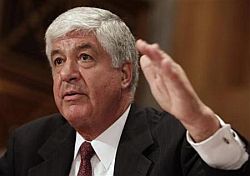
Paul Krugman writes: Robert Benmosche, the chief executive of the American International Group, said something stupid the other day. And we should be glad, because his comments help highlight an important but rarely discussed cost of extreme income inequality — namely, the rise of a small but powerful group of what can only be called sociopaths.Robert Benmosche
For those who don’t recall, A.I.G. is a giant insurance company that played a crucial role in creating the global economic crisis, exploiting loopholes in financial regulation to sell vast numbers of debt guarantees that it had no way to honor. Five years ago, U.S. authorities, fearing that A.I.G.’s collapse might destabilize the whole financial system, stepped in with a huge bailout. But even the policy makers felt ill used — for example, Ben Bernanke, the chairman of the Federal Reserve, later testified that no other episode in the crisis made him so angry.
And it got worse. For a time, A.I.G. was essentially a ward of the federal government, which owned the bulk of its stock, yet it continued paying large executive bonuses. There was, understandably, much public furor.
So here’s what Mr. Benmosche did in an interview with The Wall Street Journal: He compared the uproar over bonuses to lynchings in the Deep South — the real kind, involving murder — and declared that the bonus backlash was “just as bad and just as wrong.”
You may find it incredible that anyone would, even for an instant, consider this comparison appropriate. But there have actually been a series of stories like this. In 2010, for example, there was a comparable outburst from Stephen Schwarzman, the chairman of the Blackstone Group, one of the world’s largest private-equity firms. Speaking about proposals to close the carried-interest loophole — which allows executives at firms like Blackstone to pay only 15 percent taxes on much of their income — Mr. Schwarzman declared, “It’s a war; it’s like when Hitler invaded Poland in 1939.”
And you know that such publicly reported statements don’t come out of nowhere. Stuff like this is surely what the Masters of the Universe say to each other all the time, to nods of agreement and approval. It’s just that sometimes they forget that they’re not supposed to say such things where the rabble might learn about it. [Continue reading…]

No nations should possess nuclear weapons as there are no right hands for these wrong weapons #UNGA #Live
— Hassan Rouhani (@HassanRouhani) September 26, 2013
Baraa Shiban writes: On Monday night I was held and questioned at an airport because of my work investigating western counter-terrorism abuses in Yemen. But this did not happen in Sanaa or at the hands of some tyrannical regime. It happened at Gatwick. British officials interrogated me under the controversial schedule 7 provision of the Terrorism Act 2000 – the same provision recently used to chilling effect to detain David Miranda.
Not satisfied with clamping down on attempts to report on blanket surveillance and the “war on terror”, the UK government seems to have branched out to people like me – activists working to uncover and prevent such abuses.
I have visited the UK before without incident. I have long admired British culture – I spent part of my education in Wales. This time I came at the invitation of Chatham House to speak at a seminar on Yemen. Standing at passport control, bleary eyed from the long flight, I expected another routine trip.
The border agent asked what my job is. When I explained I was the Yemen project co-ordinator for London-based legal charity Reprieve he said, “Sir, please come with me. We have a Terrorism Act and I have some questions I need to ask you.”
I was then taken away from the desk and interrogated for over an hour. The suited man quizzed me about my political opinions. When I suggested that these should have no bearing on whether I am allowed into the country, the agent threatened to hold me for the maximum extent of his powers. “I am authorised to detain you for up to nine hours,” he said. “We have only been here for an hour, but we can be here for up to nine. So you understand what this can lead to.”
He took my Reprieve business card and disappeared. When he returned – I would guess having made use of a computer and a popular search engine – he suggested he had detained me not merely because I was from Yemen, but also because of Reprieve’s work investigating and criticising the efficacy of US drone strikes in my country.
A telling exchange followed: “So,” he asked, “does your organisation have anything to do with terrorism in Yemen?”
I replied, “My organisation addresses counter-terrorism abuses inside the country.”
“Exactly!” He said. “Why doesn’t your organisation do something about the terrorism that happens in your country, instead of focusing on the counter-terrorism abuses?”
What could I reply? Of course I oppose terrorism. But I also oppose the secret air war in my country – waged by the US, apparently with covert support from the UK and others. [Continue reading…]