
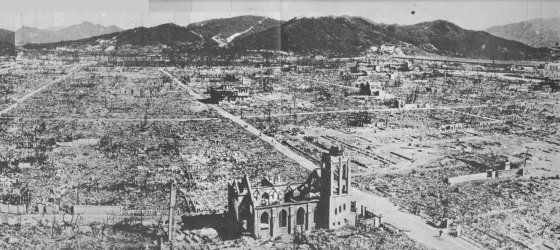
War and the death of personal responsibility

Hiroshima, August, 1945

The testimony of those who have fought in war is filled with accounts about gruesome acts that few individuals could ever have imagined engaging in or witnessing in any other circumstances. War opens up dark realms that don’t even enter the nightmares of those who have never been there. The more horrific the event, the more haunting the memory — or at least, so one might expect.

Sixty-eight years after the first atomic bomb was dropped on Hiroshima, Greg Mitchell looks back at the experiences of some of those who were involved.

Never before, nor subsequently, has there been an act of genocide in human history where so many people have been slaughtered in such a brief span of time.

At 8.15 am, local time, on August 6, 1945, Colonel Paul W. Tibbets unleashed the greatest force of human destruction ever devised, while piloting an aircraft to which the personal touch had been added: his mother’s name — the Enola Gay.

Forty years after the event, Mitchell spoke to Tibbets and they talked about his experience. But prior to that conversation, Mitchell visited Hiroshima.

While spending a month in Japan on a grant in 1984, I met a man named Akihiro Takahashi. He was one of the many child victims of the atomic attack, but unlike most of them, he survived (though with horrific burns and other injuries), and grew up to become a director of the memorial museum in Hiroshima.

Takahashi showed me personal letters to and from Tibbets, which had led to a remarkable meeting between the two elderly men in Washington, D.C. At that recent meeting, Takahashi expressed forgiveness, admitted Japan’s aggression and cruelty in the war, and then pressed Tibbets to acknowledge that the indiscriminate bombing of civilians was always wrong.

But the pilot (who had not met one of the Japanese survivors previously) was non-committal in his response, while volunteering that wars were a very bad idea in the nuclear age. Takahashi swore he saw a tear in the corner of one of Tibbets’ eyes.

So, on May 6, 1985, I called Tibbets at his office at Executive Jet Aviation in Columbus, Ohio, and in surprisingly short order, he got on the horn. He confirmed the meeting with Takahashi (he agreed to do that only out of “courtesy”) and most of the details, but scoffed at the notion of shedding any tears over the bombing. That was, in fact, “bullshit.”

“I’ve got a standard answer on that,” he informed me, referring to guilt. “I felt nothing about it. I’m sorry for Takahashi and the others who got burned up down there, but I felt sorry for those who died at Pearl Harbor, too…. People get mad when I say this but — it was as impersonal as could be. There wasn’t anything personal as far as I’m concerned, so I had no personal part in it.

“It wasn’t my decision to make morally, one way or another. I did what I was told — I didn’t invent the bomb, I just dropped the damn thing. It was a success, and that’s where I’ve left it. I can assure you that I sleep just as peacefully as anybody can sleep.” When August 6 rolled around each year “sometimes people have to tell me. To me it’s just another day.”

One of the other aircraft on the mission to bomb Hiroshima, at the time unnamed, was later named Necessary Evil — a response presumably to what had become the conventional wisdom: that as horrific as the use of nuclear weapons had been, their use had been necessary as the means to bring to an end the Second World War. The lives lost in Hiroshima and Nagasaki prevented even greater loss of life, had the war dragged on — so the argument goes.

But as Ward Wilson has persuasively argued, it was not the nuclear destruction of two of its cities that led Japan to surrender; it was instead the Soviet Union’s decision to invade.

The Soviet invasion invalidated the military’s decisive battle strategy, just as it invalidated the diplomatic strategy. At a single stroke, all of Japan’s options evaporated. The Soviet invasion was strategically decisive — it foreclosed both of Japan’s options — while the bombing of Hiroshima (which foreclosed neither) was not.

For many of those involved, war, seemingly driven by necessity, closes off the faculty of choice and where there is no sense of choice, there is little sense of responsibility.

Those who look back and question their own actions are implicitly considering the possibility that they could have acted otherwise.

Though it’s often said that truth is the first casualty of war, what keeps the war machine in perpetual motion is the conviction: we have no choice.


Facebooktwittermail

America cares for you — until you start asking questions

Gary Younge writes: When Ray Kelly, the man Barack Obama is currently considering to lead homeland security, was the New York City police commissioner, he allegedly had a policy of terrorising black and Latino neighbourhoods.

A hearing into the city’s stop-and-frisk policies in spring heard how Kelly told state senator Eric Adams that “he targeted and focused on [black and Latino youth] because he wanted to instil fear in them every time they left their homes that they could be targeted by the police”. The hearing also heard a secret recording of South Bronx deputy inspector Christopher McCormack telling a subordinate to stop “the right people at the right time, the right location”, and focus stop-and-frisks on “male blacks” between 14 and 21.

A decision on the constitutionality of the city’s stop-and-frisk practices is expected any time now, marking the latest in a summer of legal showdowns that have exposed both the power and partiality of the American state. Many who previously understood the legal system and its enforcers to be dispassionate arbiters of justice working in the interests of society as a whole have been forced to re-evaluate their assumptions.

First came the trial of Bradley Manning, charged in a military court with “aiding the enemy” for passing diplomatic cables and other classified military information to WikiLeaks. Then came the manhunt for Edward Snowden, the former National Security Agency contractor, who leaked evidence of mass snooping. More recently there was the trial of George Zimmerman, the neighbourhood watchman in Florida who pursued Trayvon Martin, a young, black, unarmed teen, and shot him dead after Martin confronted him. Soon will come the verdict on stop-and-frisk.

Each, clearly, is its own case, with its own dynamics, outcomes and facts on the ground. There are many who will favour prosecution in one case but not in another. The point here is not that the cases raise identical issues.

And yet for all their glaring differences they share at some crucial traits: each, in its own way, raises fundamental questions about the function and purpose of the American state, the moral underpinnings of the legal system in which it is grounded, and the degree to which the law is designed to work for or against the people in whose name it operates. [Continue reading…]

Facebooktwittermail

Obama’s game: Push for change and be content when nothing’s accomplished

Under the headline, “Obama Plan to Revamp NSA Faces Obstacles,” the Wall Street Journal reports: Obama faces pushback from civil-liberties advocates who say his proposals don’t go far enough. Sen. Ron Wyden (D., Ore.) said he welcomed the proposals but would fight to have them “strengthened” so that, among other things, the phone-data collection program is ended.

One question is how strongly Mr. Obama will fight for his plan. He devised it while under growing pressure from some Democrats and foreign allies after former NSA contractor Edward Snowden leaked information about NSA surveillance.

Mr. Obama said his chief goal was to gain public trust in the NSA programs and engage in a national debate about surveillance. But he also has said he was comfortable with the current programs. So he could say he spurred a debate and tried to address privacy concerns even if no changes result.

Facebooktwittermail

Michael Hayden, Bob Schieffer and the media’s reverence of national security officials

Glenn Greenwald writes: In 2006, the New York Times won the Pulitzer Prize for having revealed that the NSA was eavesdropping on Americans without warrants. The reason that was a scandal was because it was illegal under a 30-year-old law that made it a felony, punishable by up to 5 years in prison for each offense, to eavesdrop on Americans without those warrants. Although both the Bush and Obama DOJs ultimately prevented final adjudication by raising claims of secrecy and standing, and the “Look Forward, Not Backward (for powerful elites)” Obama DOJ refused to prosecute the responsible officials, all three federal judges to rule on the substance found that domestic spying to be unconstitutional and in violation of the statute.

The person who secretly implemented that illegal domestic spying program was retired Gen. Michael Hayden, then Bush’s NSA director. That’s the very same Michael Hayden who is now frequently presented by US television outlets as the authority and expert on the current NSA controversy – all without ever mentioning the central role he played in overseeing that illegal warrantless eavesdropping program.

As Marcy Wheeler noted: “the 2009 Draft NSA IG Report that Snowden leaked [and the Guardian published] provided new details about how Hayden made the final decision to continue the illegal wiretapping program even after DOJ’s top lawyers judged it illegal in 2004. Edward Snowden leaked new details of Michael Hayden’s crime.” The Twitter commentator sysprog3 put it this way:

Inviting Hayden to comment on regulation of surveillance is like having Bernie Madoff comment on regulation of Wall Street.”

But inviting Hayden to do exactly that is what establishment media outlets do continually. [Continue reading…]

Facebooktwittermail

The innocents caught under the drones: For fearful Yemenis the U.S. and al Qaeda look very similar

The Independent reports: I have encountered two separate Yemens this past week: the one portrayed in Western media outlets and the other reality of living in Sana’a. One was rife with conflict and insecurity, the other associated with the navigation of the capital’s gridlocked traffic. Yet the two Yemens collided in a visceral way for most people.

The al-Qa’ida in the Arabian Peninsula (AQAP) plot, described vaguely by President Obama as a “threat stream”, and the subsequent US embassy closure in Sana’a were far from the minds of most Yemenis. Most were more preoccupied with the approaching conclusion of Ramadan, the Eid al-Fitr celebrations and the political direction of the nation, most notably the United Nations-backed National Dialogue Conference, which aims at drafting a new constitution before elections in February.

Then, the calm and pre-Eid excitement in Sana’a was punctured on Tuesday morning, two days before the end of Ramadan. Sana’a residents were shocked and terrified by the strange buzzing sound that accompanied an unfamiliar aircraft hovering above the capital, which followed a morning drone strike in the Hadramaut region.

The buzzing induced terror in residents, and speculation between friends and family as well as on social media. The capital was abuzz with concern about drone strikes in different sections of the city. The terror was unquantifiable. [Continue reading…]

Facebooktwittermail

The U.S. must not bear silent witness to another crackdown in Bahrain

Jeffrey Bachman and Matar Ebrahim Matar write: While the US media focuses on events in Egypt, Syria and elsewhere, the people of Bahrain continue to risk their freedom, their mental and physical well-being, and their lives, to carry on with their demands for democracy and human rights. Members of the political opposition, human rights activists, doctors and ordinary Bahraini citizens have been arbitrarily detained, charged with crimes such as “inciting hatred of the regime” and “attempting to overthrow the government”, tortured as a form of punishment and as a means to acquiring forced confessions, and killed by excessive use of force.

The popular protest movement in Bahrain began on 14 February 2011. At one point, early in the uprising, an estimated quarter of Bahrain’s population participated in nonviolent protests. That is equivalent to 75 million Americans protesting simultaneously. The Bahraini regime and its Gulf Co-operation Council partners, led by Saudi Arabia, crushed the protests with overwhelming force.

Yet, Bahraini people still do not have the overt support of the US government – despite President Obama’s (and other administration officials’) claims that the United States stands with all who have democratic aspirations. [Continue reading…]

Facebooktwittermail

The NSA is turning the internet into a total surveillance system

Alexander Abdo and Patrick Toomey write: Another burst of sunlight permeated the National Security Agency’s black box of domestic surveillance last week.

According to the New York Times, the NSA is searching the content of virtually every email that comes into or goes out of the United States without a warrant. To accomplish this astonishing invasion of Americans’ privacy, the NSA reportedly is making a copy of nearly every international email. It then searches that cloned data, keeping all of the emails containing certain keywords and deleting the rest – all in a matter of seconds.

If you emailed a friend, family member or colleague overseas today (or if, from abroad, you emailed someone in the US), chances are that the NSA made a copy of that email and searched it for suspicious information.

The NSA appears to believe this general monitoring of our electronic communications is justified because the entire process takes, in one official’s words, “a small number of seconds”. Translation: the NSA thinks it can intercept and then read Americans’ emails so long as the intrusion is swift, efficient and silent. [Continue reading…]

Facebooktwittermail

There is no terrorist threat: The feds want you to think there is, compliant media goes along

Patrick Smith writes: Summertime, and the chicanery is easy. The Obama administration’s latest rendering of our invisible but eternal “terrorist threat,” I mean.

After a week of ghost stories about an imminent but vaporous plot on the part of an al-Qaida “affiliate” — this is the big new word — it is hard to decide which is more disheartening: 1) The White House’s blithe if clumsy deployment of factoids, 2) the supine complicity of the media (and this, frankly, is my choice), or 3) the willingness of honorable liberals and capital-D Democrats to go along with the show simply because Obama is maestro and one stays with Obama no matter what he does.

Nothing can be said for certain as to what prompted the State Department to close more than 20 embassies and consulates in the Middle East and North Africa last Sunday, and this is by design. But it is no excuse not to raise the possibility that Americans are eating a summer salad of nonsense served to justify objectionable surveillance practices now coming in for scrutiny.

This prospect seems so self-evident that one feels almost silly raising it, except that so few have. Let us insert it into the conversation. To me, the silence among our newspapers and broadcasters on this point confirms only how dangerously circumscribed American political discourse has become. It is all text and subtext now, and the subtext, by definition, is known but never allowed to pierce the surface of silence. [Continue reading…]

Facebooktwittermail

Our instincts for privacy evolved in tribal societies where walls didn’t exist

Ian Leslie writes: In October 2012 a woman from Massachusetts called Lindsey Stone went on a work trip to Washington DC, and paid a visit to Arlington National Cemetery, where American war heroes are buried. Crouching next to a sign that said ‘Silence and Respect’, she raised a middle finger and pretended to shout while a colleague took her photo. It was the kind of puerile clowning that most of us (well me, anyway) have indulged in at some point, and once upon a time, the resulting image would have been noticed only by the few friends or family to whom the owner of the camera showed it. However, this being the era of sharing, Stone posted the photo to her Facebook profile.

Within weeks, a ‘Fire Lindsey Stone’ page had materialised, populated by commentators frothing with outrage at a desecration of hallowed ground. Anger rained down on Stone’s employer, a non-profit that helps adults with special needs. Her employers decided, reluctantly, that Stone and her colleague would have to leave.

More recently, Edward Snowden’s revelations about the panoptic scope of government surveillance have raised the hoary spectre of ‘Big Brother’. But what Prism’s fancy PowerPoint decks and self-aggrandising logo suggest to me is not so much an implacable, omniscient overseer as a bunch of suits in shabby cubicles trying to persuade each other they’re still relevant. After all, there’s little need for state surveillance when we’re doing such a good job of spying on ourselves. Big Brother isn’t watching us; he’s taking selfies and posting them on Instagram like everyone else. And he probably hasn’t given a second thought to what might happen to that picture of him posing with a joint.

Stone’s story is hardly unique. Earlier this year, an Aeroflot air hostess was fired from her job after a picture she had taken of herself giving the finger to a cabin full of passengers circulated on Twitter. She had originally posted it to her profile on a Russian social networking site without, presumably, envisaging it becoming a global news story. Every day, embarrassments are endured, jobs lost and individuals endangered because of unforeseen consequences triggered by a tweet or a status update. Despite the many anxious articles about the latest change to Facebook’s privacy settings, we just don’t seem to be able to get our heads around the idea that when we post our private life, we publish it.

At the beginning of this year, Facebook launched the drably named ‘Graph Search’, a search engine that allows you to crawl through the data in everyone else’s profiles. Days after it went live, a tech-savvy Londoner called Tom Scott started a blog in which he posted details of searches that he had performed using the new service. By putting together imaginative combinations of ‘likes’ and profile settings he managed to turn up ‘Married people who like prostitutes’, ‘Single women nearby who like to get drunk’, and ‘Islamic men who are interested in other men and live in Tehran’ (where homosexuality is illegal).

Scott was careful to erase names from the screenshots he posted online: he didn’t want to land anyone in trouble with employers, or predatory sociopaths, or agents of repressive regimes, or all three at once. But his findings served as a reminder that many Facebook users are standing in their bedroom naked without realising there’s a crowd outside the window. Facebook says that as long as users are given the full range of privacy options, they can be relied on to figure them out. Privacy campaigners want Facebook and others to be clearer and more upfront with users about who can view their personal data. Both agree that users deserve to be given control over their choices.

But what if the problem isn’t Facebook’s privacy settings, but our own?

A few years ago George Loewenstein, professor of behavioural economics at Carnegie Mellon University in Pittsburgh, set out to investigate how people think about the consequences of their privacy choices on the internet. He soon concluded that they don’t. [Continue reading…]

Facebooktwittermail

Piece Process: West Bank settlement expansion — 1,200 new homes — moves ahead with Obama’s approval

The Associated Press reports: Israel approved building nearly 1,200 more settlement homes Sunday and prepared the release of more than two dozen long-held Palestinian prisoners — highlighting an apparent settlements-for-prisoners trade-off that got both sides back to peace talks after a five-year freeze.

Yet concerns were mounting, especially among Palestinians, that the price is too steep. Sunday’s announcement was Israel’s third in a week on promoting Jewish settlements on war-won lands the Palestinians want for a state. It fueled Palestinian fears of a new Israeli construction spurt under the cover of U.S.-sponsored negotiations.

(Just in case it’s not obvious: “Piece” process is not a typo.)

Facebooktwittermail

Assange hails Obama spy scheme reform

Al Jazeera reports: WikiLeaks founder Julian Assange has called President Barack Obama’s announcement of plans to limit sweeping US government surveillance programmes a “victory of sorts” for fugitive former spy agency contractor Edward Snowden.

“Today, the President of the United States validated Edward Snowden’s role as a whistleblower by announcing plans to reform America’s global surveillance program,” Assange said in a statement on Saturday referring to Obama’s announcement a day earlier.

“Today was a victory of sorts for Edward Snowden and his many supporters,” Assange said in the statement, which was posted on the WikiLeaks website.

Facebooktwittermail

In Cairo camps, protesters dig in and live on

The New York Times reports: Reaching the heavily sandbagged entrance to the sprawling protest camp in the northeast of this city requires navigating past makeshift brick walls and stepping around circles of stone marking the places where “martyrs” shot by the government fell dead.

Once there, visitors must submit to ID checks and pat-downs by bearded men with orange vests, hard hats and clubs. Signs on a towering new tent read “Children against the coup.”

And then, stretching into the distance is the camp, where tens of thousands of people have built what amounts to a well-equipped community in what was once a traffic-clogged intersection. There are tents with electricity, televisions and Internet access, some of them two stories tall. There are a hospital, communal kitchens, latrines and showers.

This and a smaller camp across town are the front lines in Egypt’s dangerous political stalemate between a military-installed government and the Muslim Brotherhood and its Islamist allies who support the ousted president, Mohamed Morsi. The new government accuses them of gathering weapons and says they must leave or it will evict them by force.

But breaking up the camps will be difficult because of the crowds they have amassed, the infrastructure they have built, and the religious fervor the protesters bring to the fight. The military and the police have already killed dozens of people, and human rights groups have reported cases in which Mr. Morsi’s supporters have detained and tortured opponents. But instead of scaring the protesters into going home, the crackdowns have reinforced their conviction to stay. [Continue reading…]

Facebooktwittermail

Marx’s lesson for the Muslim Brothers

Sheri Berman writes: Karl Marx wrote that history repeats itself, first as tragedy, then as farce. He had in mind the Revolution of 1848, when a democratic uprising against the French monarchy collapsed into a Bonapartist dictatorship just as the French Revolution had six decades earlier.

In 1848, workers joined with liberals in a democratic revolt to overthrow the French monarchy. However, almost as soon as the old order collapsed, the opposition fell apart, as liberals grew increasingly alarmed by what they saw as “radical” working class demands. Conservatives were able to co-opt fearful liberals and reinstall new forms of dictatorship.

Those same patterns are playing out in Egypt today — with liberals and authoritarians playing themselves, and Islamists playing the role of socialists. Once again, an inexperienced and impatient mass movement has overreached after gaining power. Once again, liberals have been frightened by the changes their former partners want to enact and have come crawling back to the old regime for protection. And as in 1848, authoritarians have been happy to take back the reins of power. [Continue reading…]

Facebooktwittermail

New vision of al Qaida rises from U.S. embassy closings

McClatchy reports: The rise in prominence of Nasir al Wuhayshi, the Yemeni head of al Qaida in the Arabian Peninsula, underscores the transformation of al Qaida from a relatively small group led by one charismatic man into a diffuse global organization with many branches that pursue local objectives but follow a single ideology, according to counterterrorism analysts and officials.

The change has undermined the Obama administration’s boast that U.S. drone strikes in Pakistan have “decimated” what’s been called core al Qaida, according to veteran al Qaida watchers. Instead, the organization, no longer dependent on the leadership of a single personality, is growing, with authority now spread among leaders not just in Yemen but also in Iraq, Somalia, Syria and Egypt’s Sinai. The branches that operate in those regions aren’t affiliates, the experts say, they’re al Qaida.

The experts are still uncertain how the various leaders of al Qaida interact with one another, and there are signs that Ayman al Zawahiri, the Egyptian doctor who was named to lead al Qaida after U.S. special forces shot and killed Osama bin Laden in May 2011, still holds special influence.

But experts say it’s no longer accurate to talk about a core al Qaida that’s in charge of groups operating in the Arabian Peninsula, North Africa, Iraq and Syria.

“The great fiction al Qaida perpetrated on the West is that a centralized, hierarchical group controlled things from a cave in Afghanistan. That might’ve been true five years ago, but it’s certainly not true now,” said Christopher Swift, an adjunct professor of national security studies at Georgetown University who advises U.S. officials on counterterrorism strategy. [Continue reading…]

Facebooktwittermail

Yemenis call U.S. drone strikes an overreaction to al Qaida threat

McClatchy reports: The United States’ launching of eight drone strikes in Yemen in the span of 13 days has ignited widespread outrage in the country.

The anger over the strikes, which came as an al Qaida-related threat shuttered U.S. embassies and consulates in Yemen and 15 other countries, has overwhelmed attention to the threat itself, which many here view skeptically anyway.

“In the end, I think the American reaction has been far more than has been reasonable,” said Abdulghani al Iryani, a Sanaa-based political analyst. “It comes off almost as a show of strength. But, ultimately, it may end up backfiring, as al Qaida is getting more attention now than they would have even if they carried out an attack.” [Continue reading…]

Facebooktwittermail

The biggest secret is that intelligence is dumb

Adam Curtis writes: The recent revelations by the whistleblower Edward Snowden were fascinating. But they – and all the reactions to them – had one enormous assumption at their heart.

That the spies know what they are doing.

It is a belief that has been central to much of the journalism about spying and spies over the past fifty years. That the anonymous figures in the intelligence world have a dark omniscience. That they know what’s going on in ways that we don’t.

It doesn’t matter whether you hate the spies and believe they are corroding democracy, or if you think they are the noble guardians of the state. In both cases the assumption is that the secret agents know more than we do.

But the strange fact is that often when you look into the history of spies what you discover is something very different.

It is not the story of men and women who have a better and deeper understanding of the world than we do. In fact in many cases it is the story of weirdos who have created a completely mad version of the world that they then impose on the rest of us.

I want to tell some stories about MI5 – and the very strange people who worked there. They are often funny, sometimes rather sad – but always very odd.

The stories also show how elites in Britain have used the aura of secret knowledge as a way of maintaining their power. But as their power waned the “secrets” became weirder and weirder.

They were helped in this by another group who also felt their power was waning – journalists. And together the journalists and spies concocted a strange, dark world of treachery and deceit which bore very little relationship to what was really going on. And still doesn’t. [Continue reading…]

Facebooktwittermail

Obama’s weak agenda on spying reform

The New York Times Editorial Board: President Obama, who seems to think the American people simply need some reassurance that their privacy rights are intact, proposed a series of measures on Friday that only tinker around the edges of the nation’s abusive surveillance programs.

He said he wants “greater oversight, greater transparency, and constraints” on the mass collection of every American’s phone records by the National Security Agency. He didn’t specify what those constraints and oversight measures would be, only that he would work with Congress to develop them. But, in the meantime, the collection of records will continue as it has for years, gathering far more information than is necessary to fight terrorism.

He said he wants an adversary to challenge the government’s positions at the secret Foreign Intelligence Surveillance Court, a long-needed reform that would allow the court’s federal judges to hear more than one point of view in approving targets and security policy. But if those arguments remain closed to the public — and the president did not suggest otherwise — then it will be impossible to evaluate whether the change has had any effect. At a minimum, he could have urged the court to release unclassified summaries of its opinions when possible.

Finally, he announced that the N.S.A. would hire a civil liberties and privacy officer and create a Web site about its mission, and that a task force would review the nation’s surveillance technologies. These measures, however, are unlikely to have a real effect on intelligence gathering.

Fundamentally, Mr. Obama does not seem to understand that the nation needs to hear more than soothing words about the government’s spying enterprise. He suggested that if ordinary people trusted the government not to abuse their privacy, they wouldn’t mind the vast collection of phone and e-mail data.

Bizarrely, he compared the need for transparency to showing his wife that he had done the dishes, rather than just telling her he had done so. Out-of-control surveillance is a bit more serious than kitchen chores. It is the existence of these programs that is the problem, not whether they are modestly transparent. As long as the N.S.A. believes it has the right to collect records of every phone call — and the administration released a white paper Friday that explained, unconvincingly, why it is perfectly legal — then none of the promises to stay within the law will mean a thing.

If all Mr. Obama is inclined to do is tweak these programs, then Congress will have to step in to curb these abuses, a path many lawmakers of both parties are already pursuing. There are bills pending that would stop the bulk collection of communications data, restricting it to those under suspicion of terrorism. Other measures would require the surveillance court to make public far more of its work. If the president is truly concerned about public anxiety, he can vocally support legislation to make meaningful changes, rather than urging people to trust him that the dishes are clean.

Facebooktwittermail