Robert Manne writes: Twenty five years ago, scientists with an interest in the climate were moving towards a consensual understanding, that primarily through the burning of fossil fuels human beings were responsible for potentially catastrophic global warming. At present, at least 97% of climate scientists have reached that conclusion.
Through voluntary international cooperation, the Montreal Protocol of 1992 went a long way to solving the problem of the hole in the ozone layer. Using it as their model for the solution to the even more daunting problem of global warming, in 1997 most nations of the earth signed the Kyoto Protocol. It was eventually ratified by almost all advanced economies being asked to commit to greenhouse gas emission targets.
The one exception was the United States. And yet, since Kyoto, greenhouse gas emissions have risen very steeply. The level of carbon dioxide in the atmosphere — 280 parts per million before the industrial revolution — is now 400 parts per million. The conference which was supposed to find a replacement for Kyoto — Copenhagen in 2009 — was a comprehensive failure. There is at present no reason to suppose that the next major international conference on which hopes now rest — Paris in 2015 — will succeed.
Virtually no one any longer believes that temperature will be able to be contained to the internationally recognised tipping point of two degrees Celsius above temperature levels at the time of the industrial revolution. Many climate scientists fear a temperature rise of four or five degrees Celsius by century’s end.
We know that if we continue to use fossil fuels as our primary energy source, the conditions of life on the earth for our own species and for others will be damaged perhaps beyond repair. And yet, eyes wide shut the nations of the earth are doing very little to avert the impending, entirely foreseeable catastrophe. [Continue reading…]
America no longer has a functioning judicial system
Washington’s Blog: The Department of Justice told a federal court this week that the NSA’s spying “cannot be challenged in a court of law”.
(This is especially dramatic given that numerous federal judges and legal scholars – including a former FISA judge – say that the FISA spying “court” is nothing but a kangaroo court.)
Also this week, the Department of Justice told a federal court that the courts cannot review the legality of the government’s assassination by drone of Americans abroad:
“‘Are you saying that a US citizen targeted by the United States in a foreign country has no constitutional rights?’ [the judge] asked Brian Hauck, a deputy assistant attorney general. ‘How broadly are you asserting the right of the United States to target an American citizen? Where is the limit to this?’
“She provided her own answer: ‘The limit is the courthouse door’ . . . .
“‘Mr. Hauck acknowledged that Americans targeted overseas do have rights, but he said they could not be enforced in court either before or after the Americans were killed.’”
(Indeed, the Obama administration has previously claimed the power to be judge, jury and executioner in both drone and cyber-attacks. This violates Anglo-Saxon laws which have been on the books in England and America for 800 years.)
Mood shifting, Congress may move to limit NSA spying
McClatchy reports: Congress is growing increasingly wary of controversial National Security Agency domestic surveillance programs, a concern likely to erupt during legislative debate _ and perhaps prod legislative action _ as early as next week.
Skepticism has been slowly building since last month’s disclosures that the super-secret NSA conducted programs that collected Americans’ telephone data. Dozens of lawmakers are introducing measures to make those programs less secret, and there’s talk of denying funding and refusing to continue authority for the snooping.
The anxiety is a sharp contrast to June’s wait-and-see attitude after Edward Snowden, a government contract worker, leaked highly classified data to the media. The Guardian newspaper of Britain reported one program involved cellphone records. The Guardian, along with The Washington Post, also said another program allowed the government access to the online activity of users at nine Internet companies.
Obama administration officials quickly provided briefings about the programs, and they continue to have strong defenders at the Capitol. “People at the NSA in particular have heard a constant public drumbeat about a laundry list of nefarious things they are alleged to be doing to spy on Americans _ all of them wrong,” House Intelligence Committee Chairman Mike Rogers, R-Mich., said last month. “The misperceptions have been great, yet they keep their heads down and keep working every day to keep us safe.”
Most in Congress remain reluctant to tinker with any program that could compromise security, but lawmakers are growing frustrated. “I think the administration and the NSA has had six weeks to answer questions and haven’t done a good job at it. They’ve been given their chances, but they have not taken those chances,” said Rep. Rick Larsen, D-Wash. [Continue reading…]
The Way of the Knife: The CIA, a Secret Army, and a War at the Ends of the Earth
Joshua Hersh writes: When the calls home stopped in November of 2011, friends assumed the worst for Jude Kenan Mohammad. A few years earlier, the young Pakistani-American born in North Carolina had come under the sway of a radicalized Islamic preacher, who taught him about violent jihad and urged him to seek out his roots in Pakistan. Soon, Mohammad departed for Pakistan’s tribal lands where, apart from some calls to family on the holidays, he all but disappeared.
In May, the White House finally acknowledged what many back in North Carolina had long come to believe: Mohammad had been killed by an American drone strike one and a half years earlier. There had been no trial, no public presentation of evidence. He would have been twenty-three years old.
Mohammad’s death was just one small piece of a decade-old, shadowy war started in the years following the September 11 attacks by President George W. Bush and expanded with unwavering intensity by his successor, Barack Obama. Waged high in the skies above rural Pakistan and Yemen, and in the back alleys of Somalia and Afghanistan, it is a war that has received virtually no scrutiny from the public, even as it summarily takes the lives of thousands of individuals, many of them innocent civilians—and a few, like Mohammad, American citizens.
A slew of new books seek to cast light on the private meeting rooms and hidden bunkers from which this covert war has been conducted, among them Jeremy Scahill’s Dirty Wars: The World is a Battlefield; Daniel Klaidman’s Kill or Capture: The War on Terror and the Soul of the Obama Presidency; and Mark Mazzetti’s The Way of the Knife: The CIA, a Secret Army, and a War at the Ends of the Earth. Mazzetti’s is the most richly illustrative of the internal tensions and often careless decision making of America’s leaders in the last decade—and the least burdened by outrage.
The result, from the veteran New York Times national security reporter, is an even-handed tale of this era that will likely leave the reader outraged nonetheless. [Continue reading…]
Syria’s Nusra Front tries to show it’s a different kind of al Qaida
McClatchy reports: Two al Qaida-linked rebel groups in Syria appear to be distancing themselves from each other in what may be an effort by the Nusra Front, which the United States has branded as an international terrorist organization, to remain relevant amid signs that major portions of the Syrian population are chafing under harsh rule by conservative religious fighters.
A series of incidents in which residents and fighters in rebel-held areas have protested what they say is a heavy-handed approach to a raft of issues have put Nusra and the other group, the Islamic State of Iraq and the Levant, on the political defensive even as the umbrella group of rebels that the West recognizes, the Free Syrian Army, comes under pressure by the United States to reduce the groups’ influence.
“The jihadists are rightly worried that the U.S. will demand action against jihadists as a vetting bottom line. They talk a lot about the FSA being recruited by the CIA to fight them,” said Joshua Landis, an associate professor at University of Oklahoma who’s an expert on Syria.
When the Obama administration agreed last month to supply weaponry to the Free Syrian Army’s Supreme Military Council, it quickly became clear that ensuring that those weapons didn’t go to Nusra or the Islamic State was a major condition of the aid, which nevertheless has been slow to materialize. Adding to the tensions has been the killing by an Islamic State member of a commander from a pro-Free Syrian Army unit in the mountains along the Syrian coast, allegedly in a dispute over a checkpoint.
In an effort to tamp down the perception that the Free Syrian Army was powerless over these al Qaida-linked groups, a commander in the area said the Free Syrian Army had demanded an arrest. The Islamic State’s response was to order the arrest and trial of the suspected shooter.
That hasn’t yet happened. “There has been no reaction from his group,” said Tasmim al Laathiqiyah, a member of the Khalwah Bin al Azwar Battalion, a rebel unit affiliated with the Free Syrian Army. [Continue reading…]
Across Syria, violent day of attacks and ambush
The New York Times reports: Violence raged across Syria on Sunday as government forces killed dozens of rebels in an ambush east of Damascus, fighters linked to Al Qaeda battled Kurdish militias and Syria’s military peppered an outdoor market with mortar rounds.
Antigovernment activists also accused government forces of killing 13 members of a family in northwestern Syria.
In the deadliest attack, government forces ambushed a group of rebel fighters in the town of Adra, northeast of Damascus, and left dozens of dead bodies lying in the sand, according to video broadcast on Al Manar, a television station run by Hezbollah, the Lebanese militant group and political party that supports President Bashar al-Assad.
The Syrian Observatory for Human Rights, an anti-Assad group based in Britain that tracks the conflict through a network of contacts on the ground, said on Monday that 65 people had been killed in the countryside around Damascus, including 58 insurgent fighters. The ambush in Adra accounted for 49 rebel deaths.
It was another blow to the rebel movement. The momentum in the civil war has shifted in favor of Mr. Assad, whose forces have rolled back a number of rebel gains near Damascus, the capital, and elsewhere. Infighting among rebels who took up arms to topple Mr. Assad has allowed his forces to solidify their hold on central Syria and gradually expand their reach. [Continue reading…]
Music: Thalma de Freitas — ‘Minha Noite É De Manhã’
Obama’s global expansion of drone operations
The Washington Post reports: The steel-gray U.S. Air Force Predator drone plunged from the sky, shattering on mountainous terrain near the Iraq-Turkey border. For Kurdish guerrillas hiding nearby, it was an unexpected gift from the propaganda gods.
Fighters from the Kurdistan Workers’ Party, or PKK, filmed the charred wreckage on Sept. 18 and posted a video on YouTube. A narrator bragged unconvincingly that the group had shot down the drone. But for anyone who might doubt that the flying robot was really American, the video zoomed in on mangled parts stamped in English and bearing the label of the manufacturer, San Diego-based General Atomics.
For a brief moment, the crash drew back the curtain on Operation Nomad Shadow, a secretive U.S. military surveillance program. Since November 2011, the U.S. Air Force has been flying unarmed drones from Incirlik Air Base in Turkey in an attempt to suppress a long-simmering regional conflict. The camera-equipped Predators hover above the rugged border with Iraq and beam high-resolution imagery to the Turkish armed forces, helping them pursue PKK rebels as they slip back and forth across the mountains.
As the Obama administration dials back the number of drone attacks in Afghanistan, Pakistan and Yemen, the U.S. military is shifting its huge fleet of unmanned aircraft to other hot spots around the world. This next phase of drone warfare is focused more on spying than killing and will extend the Pentagon’s robust surveillance networks far beyond traditional, declared combat zones.
Over the past decade, the Pentagon has amassed more than 400 Predators, Reapers, Hunters, Gray Eagles and other high-altitude drones that have revolutionized counterterrorism operations. Some of the unmanned aircraft will return home with U.S. troops when they leave Afghanistan. But many of the drones will redeploy to fresh frontiers, where they will spy on a melange of armed groups, drug runners, pirates and other targets that worry U.S. officials.
Elsewhere in the Middle East, the U.S. Air Force has drone hubs in Qatar and the United Arab Emirates to conduct reconnaissance over the Persian Gulf. Twice since November, Iran has scrambled fighter jets to approach or fire on U.S. Predator drones that edged close to Iranian airspace.
In Africa, the U.S. Air Force began flying unarmed drones over the Sahara five months ago to track al-Qaeda fighters and rebels in northern Mali. The Pentagon has also set up drone bases in Ethiopia, Djibouti and Seychelles. Even so, the commander of U.S. forces in Africa told Congress in February that he needed a 15-fold increase in surveillance, reconnaissance and intelligence-gathering on the continent. [Continue reading…]
How big is the NSA’s haystack?
Sounding like a logic-defying Zen master, NSA chief Keith Alexander this week claimed: “You need a haystack to find a needle.” I pity any foreign journalist who took on the challenge of attempting to translate that into an intelligible statement.
Alexander’s staff, on the other hand, seem less inclined to speak in riddles — though just as eager to portray the operations of a police state in terms more appropriate for a kindergarten.
Anyone who might have previously been wondering whether the NSA is really watching everyone, should no longer be in any doubt — once they’ve grasped the humans-like-rabbits metaphor that we each stand a certain number of “hops” apart.
Following National Security Agency Deputy Director Chris Inglis’s revelation that the agency conducts surveillance as many as “three hops” away from a suspected terrorist, Sean Gallagher digs into the numbers:
A great deal of research has been done into the interconnectedness of people in the Internet age. Social scientists, mathematicians, and computer scientists have explored the “small world” phenomenon with studies and experiments for over 50 years, and their findings show that the “small world” keeps getting smaller as technology advances. In 1979, chair and founder of MIT’s political science department Ithiel de Sola Pool and the University of Michigan’s Manfred Kochen published a paper titled “Contacts and Influence,” which draws on a decade of research into social networks. De Sola Pool and Kochen posited that “in a country the size of the United States, if acquaintanceship were random and the mean acquaintance volume were 1,000, the mean length of minimum chain between pairs of persons would be well under two intermediaries.”
In other words, if the average person in the US has contact with and is acquainted with 1,000 others (through brief interactions, such as an e-mail or a phone call, or through stronger associations), then we’re at most two hops from anyone else in the US. Ergo, if any one person in the US is one hop from a terrorist, chances are good that you are three hops away.
The actual degrees of separation between people may be somewhat larger because the population of the US has grown significantly since 1979; our interconnectedness with the world at large has grown as well, widening the potential links between people. Live in a major metropolitan center in the US and you’re bound to be two degrees of separation away from someone in a country that’s of interest to the NSA. For example: I have been a regular customer of restaurants owned by Baltimore’s Karzai family, which is headed by a brother of Afghan President Hamid Karzai—two hops. I’m also, according to LinkedIn, two degrees of separation away from President Obama. Am I a good guy or a bad guy?
The Internet has blown the level of interconnectedness though the proverbial roof—we now have e-mail, social media, and instant message interactions with people we’ll never meet in real life and in places we’ll never go. A 2007 study by Carnegie Mellon University machine learning researcher Jure Leskovec and Microsoft Research’s Eric Horvitz found that the average number of hops between any two arbitrary Microsoft Messenger users, based on interaction, was 6.6. And a study of Twitter feeds published in 2011 found the average degree of separation between random Twitter users to be only 3.43.
So even if the NSA limited its surveillance activities—and by “surveillance” I mean active probing of the content of communications of an individual—to people within two hops of suspected terrorists, that’s a sizable population. Three ratchets it up to hundreds of millions or potentially billions of people, especially when the definition of a hop is based on relationships so casual we could create them by accidentally clicking on a link in a spam e-mail. So far, we know that there have been about 20,000 requests for FISA warrants to surveil domestic targets since 2001, but if those warrants covered three hops from the suspects at the center of the requests—depending on how tightly or loosely the NSA defines a relationship—three hops could encompass as much as 50 percent of the Internet-using population of the world. [Continue reading…]
German intelligence ‘prolific partner’ in NSA spy program
Der Spiegel reports: Germany’s foreign intelligence service, the BND, and its domestic intelligence agency, the Federal Office for the Protection of the Constitution (BfV), used a spying program of the American National Security Agency (NSA). This is evident in secret documents from the US intelligence service that have been seen by SPIEGEL journalists. The documents show that the Office for the Protection of the Constitution was equipped with a program called XKeyScore intended to “expand their ability to support NSA as we jointly prosecute CT (counterterrorism) targets.” The BND is tasked with instructing the domestic intelligence agency on how to use the program, the documents say.
According to an internal NSA presentation from 2008, the program is a productive espionage tool. Starting with the metadata — or information about which data connections were made and when — it is able, for instance, to retroactively reveal any terms the target person has typed into a search engine, the documents show. In addition, the system is able to receive a “full take” of all unfiltered data over a period of several days — including, at least in part, the content of communications.
This is relevant from a German perspective, because the documents show that of the up to 500 million data connections from Germany accessed monthly by the NSA, a major part is collected with XKeyScore (for instance, around 180 million in December 2012). The BND and BfV, when contacted by SPIEGEL, would not discuss the espionage tool. The NSA, as well, declined to comment, referring instead to the words of US President Barack Obama during his visit to Berlin and saying there was nothing to add.
Furthermore, the documents show that the cooperation of the German intelligence agencies with the NSA has recently intensified. Reference is made to the “eagerness and desire” of BND head Gerhard Schindler. “The BND has been working to influence the German government to relax interpretation of the privacy laws to provide greater opportunities of intelligence sharing,” the NSA noted in January. Over the course of 2012, German partners had shown a “willingness to take risks and to pursue new opportunities for cooperation with the US.” [Continue reading…]
Video — Syria: A war within a war
Israel to free ‘heavyweight’ Palestinian prisoners
The Guardian reports: Israel has said it will release “heavyweight” Palestinian prisoners as part of an agreement to enter preliminary talks in Washington, with the aim of an eventual resumption of long-stalled peace negotiations.
Hours after the US secretary of state, John Kerry, announced that the two sides in the conflict had agreed to discuss terms for negotiations, Yuval Steiniz, Israel’s minister for international relations, said a prisoner release would be carried out in stages.
“I don’t want to give numbers but there will be heavyweight prisoners who have been in jail for tens of years,” he told Israel Radio. The release of long-serving prisoners has been a key Palestinian demand.
But Steinitz said Israel would balk at agreeing on the pre-1967 border as the parameter for territorial negotiations. “There is no chance we will agree to enter any negotiations that begin with defining territorial borders or concessions by Israel, nor a [settlement] construction freeze,” he said.
Kerry’s announcement of progress in his four-month mission to revive the Middle East peace process was delivered in Amman on Friday night after four months of intensive diplomacy. It received mixed interpretations. [Continue reading…]
Žižek vs. Chomsky
Peter Thompson writes: In the great spat between King Kong Chomsky and Tyrannosaurus Žižek people are often asked which side they are on. Or maybe they are not, because until now these two great beasts have been roaring and knocking down trees without anyone outside leftist discourse hearing them fall. But maybe we should think who we would cheer on, because this is a debate about something very important – namely the relationship between theory, ideology and reality.
Noam Chomsky, the professional contrarian, has accused Slavoj Žižek, the professional heretic, of posturing in the place of theory. This is an accusation often levelled at Žižek from within the Anglo-Saxon empirical tradition. Even those like Chomsky who are on the proto-anarchist left of this tradition like to maintain that their theories are empirically verifiable and rooted in reality.
Žižek has countered with the side-swipe that nobody had been so empirically wrong throughout his life as Chomsky. He brought up Chomsky’s supposed support for the Khmer Rouge in the 1970s and Chomsky’s later self-justification that there hadn’t been empirical evidence at the time of the crimes of the Khmer Rouge. It has all got rather heated and intemperate, but then, debates on the left are like that. More time is spent ripping flesh out of each other than it is trying to find a common cause against an apparently invisible and impregnable enemy. But terms have to be defined, ground has to be laid out. [Continue reading…]
The crystalline wall of shyness
Joe Moran writes: If I had to describe being shy, I’d say it was like coming late to a party when everyone else is about three glasses in. All human interaction, if it is to develop from small talk into meaningful conversation, draws on shared knowledge and tacit understandings. But if you’re shy, it feels like you just nipped out of the room when they handed out this information. W Compton Leith, a reclusive curator at the British Museum whose book Apologia Diffidentis (1908) is a pioneering anthropology of shy people, wrote that ‘they go through life like persons afflicted with a partial deafness; between them and the happier world there is as it were a crystalline wall which the pleasant low voices of confidence can never traverse’.
Shyness has no logic: it impinges randomly on certain areas of my life and not others. What for most people is the biggest social fear of all, public speaking, I find fairly easy. Lecturing is a performance that allows me simply to impersonate a ‘normal’, working human being. Q&As, however, are another matter: there the performance ends and I will be found out. That left-field question from the audience, followed by brain-freeze and a calamitous attempt at an answer that ties itself up in tortured syntax and dissolves into terrifying silence. Though this rarely happens to me in real life, it has occurred often enough to fuel my catastrophising imagination.
The historian Theodore Zeldin once wondered how different the history of the world might seem if you told it, not through the story of war, politics or economics, but through the development of emotions. ‘One way of tackling it might be to write the history of shyness,’ he mused. ‘Nations may be unable to avoid fighting each other because of the myths and paranoias that separate them: shyness is one of the counterparts to these barriers on an individual level.’ The history of shyness might well make a fascinating research project, but it would be hellishly difficult to write. Shyness is by its nature a subjective, nebulous state that leaves little concrete evidence behind, if only because people are often too uncomfortable with their shyness to speak or write about it. [Continue reading…]
Fewer calories, healthier gut, longer life
Genetic Engineering & Biotechnology News: Emerging research continues to show that the microbes inhabiting the gut play pivotal roles in health and disease throughout life. Two recent studies highlight how gut microbiota affect their hosts over the long term.
The first, published today in Nature Communications, charts changes to microbial composition based on life-long caloric restriction. In it, Shanghai Jiao Tong University’s Liping Zhao, Ph.D., and his colleagues show that mice that were calorie-restricted on both high-fat or low-fat diets throughout their lives showed gut microbiota phylotypes that correlated positively with lifespan, such as Lactobacillus, as compared with their non-calorie-restricted counterparts.
“These calorie restriction-induced changes in the gut microbiota are concomitant with signifcantly reduced serum levels of lipopolysaccharide-binding protein, suggesting that animals under calorie restriction can establish a structurally balanced architecture of gut microbiota that may exert a health benefit to the host via reduction of antigen load from the gut,” Dr. Zhao et al. write. [Continue reading…]
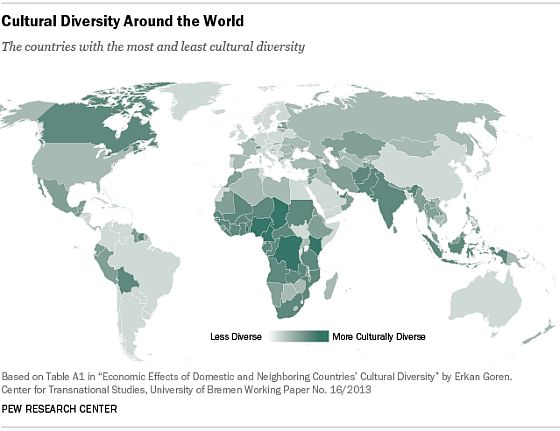
The most (and least) culturally diverse countries in the world

Pew Research Center: Looking for a real multicultural experience? Head to Chad in north-central Africa where 8.6 million residents belong to more than 100 ethnic groups or to Togo, home to 37 tribal groups that speak one of 39 languages and share little in the way of a common culture or history.
But if you find a kaleidoscope of cultures distracting, then consider a visit to Argentina, Haiti or the isolated Comoros islands off the southeast coast of Africa. They rank among the least culturally diverse countries in the world.
This multicultural map of the world is based on an analysis of data reported in a new study of cultural diversity and economic development by researcher Erkan Gören of the University of Oldenberg in Germany.
Music: Thalma de Freitas — ‘Tranquilo’
A boy killed by his own government. The Obama administration still refuses to explain why
Nasser al-Awlaki writes: I learned that my 16-year-old grandson, Abdulrahman — a United States citizen — had been killed by an American drone strike from news reports the morning after he died.Abdulrahman al-Aulaqi, a sixteen-year-old American citizen killed by a U.S. military strike in Yemen, October 14, 2011.
The missile killed him, his teenage cousin and at least five other civilians on Oct. 14, 2011, while the boys were eating dinner at an open-air restaurant in southern Yemen.
I visited the site later, once I was able to bear the pain of seeing where he sat in his final moments. Local residents told me his body was blown to pieces. They showed me the grave where they buried his remains. I stood over it, asking why my grandchild was dead.
Nearly two years later, I still have no answers. The United States government has refused to explain why Abdulrahman was killed. It was not until May of this year that the Obama administration, in a supposed effort to be more transparent, publicly acknowledged what the world already knew — that it was responsible for his death.
The attorney general, Eric H. Holder Jr., said only that Abdulrahman was not “specifically targeted,” raising more questions than he answered.
My grandson was killed by his own government. The Obama administration must answer for its actions and be held accountable. On Friday, I will petition a federal court in Washington to require the government to do just that. [Continue reading…]