The New York Times reports: The chairwoman of the Senate Intelligence Committee says she is planning a push to declassify hundreds of pages of a secret committee report that accuses the Central Intelligence Agency of misleading Congress and the White House about the agency’s detention and interrogation program, which is now defunct.
The 6,000-page report, which took years to complete and cost more than $40 million, is the only detailed account to date of a program that set off a national debate about torture. The report has been the subject of a fierce partisan fight and a vigorous effort by the C.I.A. to challenge its conclusions, and last month, the agency’s director, John O. Brennan, delivered a lengthy rebuttal to the report to committee leaders.
But the committee’s chairwoman, Senator Dianne Feinstein, Democrat of California, said in a statement this week that the report was on “firm ground” and that she planned to ask the White House and C.I.A. to declassify its 300-page executive summary after “making any factual changes to our report that are warranted after the C.I.A.’s response.”
The committee’s top Republican, Senator Saxby Chambliss of Georgia, said he believed the report was deeply flawed and agreed with the intelligence agency’s critique. But he said he believed that a summary of the report could be made public, as long as it was accompanied by a summary of the agency’s response and a dissenting statement from committee Republicans.
The clash over the report is, at its core, a fight over who writes the history of what is perhaps the most bitterly disputed part of the American government’s response to the Sept. 11, 2001, terrorist attacks. More than four years have passed since the C.I.A. closed its secret prisons, and nearly a decade since agency interrogators subjected Qaeda detainees to the most brutal interrogation methods, including the near-drowning technique known as waterboarding. [Continue reading…]
What happens when the U.S. government wants to hack your network?
Pete Ashdown, CEO of an internet service provider in Utah, received a Foreign Intelligence Service Act (FISA) warrant in 2010 mandating he let the feds monitor one of his customers: The first thing I do when I get a law enforcement request is look for a court signature on it. Then I pass it to my attorneys and say, “Is this legitimate? Does this qualify as a warrant?” If it does, then we will respond to it. We are very up front that we respond to warrants.
If it isn’t, then the attorneys write back: “We don’t believe it is in jurisdiction or is constitutional. We are happy to respond if you do get an FBI request in jurisdiction or you get a court order to do so.”
The FISA request was a tricky one, because it was a warrant through the FISA court — whether you believe that is legitimate or not. I have a hard time with secret courts. I ran it past my attorney and asked, “Is there anyway we can fight this?” and he said “No. It is legitimate.”
It was also different [from other warrants] because it was for monitoring. They wanted to come in and put in equipment on my network to monitor a single customer. The customer they were monitoring was a particular website that was very benign. It seems ridiculous to me. It was beyond absurd. It wasn’t like a guns and ammo website. [Continue reading…]
Helen Thomas 1920-2013

Helen Thomas died today at the age of 92.
Bloomberg reports: In 2012, Palestinian leaders gave Thomas an award for her career. According to an account in the Washington Report on Middle East Affairs, a magazine critical of U.S. foreign policy in the region, Thomas told supporters at the Virginia home of Maen Areikat, the top Palestinian envoy to the U.S., that she accepted the honor “on behalf of brave supporters of Palestinians who have taken an unpopular stand despite the personal and professional costs.”
In 2010, Thomas described the way she was betrayed by the White House press corps — many of whose members will today be stepping up to offer their vacuous words of praise.
Rise of America’s warrior cops

Radley Balko writes: On Jan. 4 of last year, a local narcotics strike force conducted a raid on the Ogden, Utah, home of Matthew David Stewart at 8:40 p.m. The 12 officers were acting on a tip from Mr. Stewart’s former girlfriend, who said that he was growing marijuana in his basement. Mr. Stewart awoke, naked, to the sound of a battering ram taking down his door. Thinking that he was being invaded by criminals, as he later claimed, he grabbed his 9-millimeter Beretta pistol.
The police say that they knocked and identified themselves, though Mr. Stewart and his neighbors said they heard no such announcement. Mr. Stewart fired 31 rounds, the police more than 250. Six of the officers were wounded, and Officer Jared Francom was killed. Mr. Stewart himself was shot twice before he was arrested. He was charged with several crimes, including the murder of Officer Francom.
The police found 16 small marijuana plants in Mr. Stewart’s basement. There was no evidence that Mr. Stewart, a U.S. military veteran with no prior criminal record, was selling marijuana. Mr. Stewart’s father said that his son suffered from post-traumatic stress disorder and may have smoked the marijuana to self-medicate.
Early this year, the Ogden city council heard complaints from dozens of citizens about the way drug warrants are served in the city. As for Mr. Stewart, his trial was scheduled for next April, and prosecutors were seeking the death penalty. But after losing a hearing last May on the legality of the search warrant, Mr. Stewart hanged himself in his jail cell.
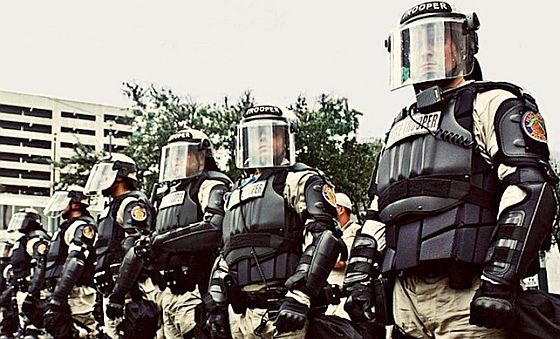
The police tactics at issue in the Stewart case are no anomaly. Since the 1960s, in response to a range of perceived threats, law-enforcement agencies across the U.S., at every level of government, have been blurring the line between police officer and soldier. Driven by martial rhetoric and the availability of military-style equipment—from bayonets and M-16 rifles to armored personnel carriers—American police forces have often adopted a mind-set previously reserved for the battlefield. The war on drugs and, more recently, post-9/11 antiterrorism efforts have created a new figure on the U.S. scene: the warrior cop—armed to the teeth, ready to deal harshly with targeted wrongdoers, and a growing threat to familiar American liberties. [Continue reading…]
Attention, shoppers: store is tracking your cell
The New York Times reports: Like dozens of other brick-and-mortar retailers, Nordstrom wanted to learn more about its customers — how many came through the doors, how many were repeat visitors — the kind of information that e-commerce sites like Amazon have in spades. So last fall the company started testing new technology that allowed it to track customers’ movements by following the Wi-Fi signals from their smartphones.
But when Nordstrom posted a sign telling customers it was tracking them, shoppers were unnerved.
“We did hear some complaints,” said Tara Darrow, a spokeswoman for the store. Nordstrom ended the experiment in May, she said, in part because of the comments.
Nordstrom’s experiment is part of a movement by retailers to gather data about in-store shoppers’ behavior and moods, using video surveillance and signals from their cellphones and apps to learn information as varied as their sex, how many minutes they spend in the candy aisle and how long they look at merchandise before buying it.
All sorts of retailers — including national chains, like Family Dollar, Cabela’s and Mothercare, a British company, and specialty stores like Benetton and Warby Parker — are testing these technologies and using them to decide on matters like changing store layouts and offering customized coupons.
But while consumers seem to have no problem with cookies, profiles and other online tools that let e-commerce sites know who they are and how they shop, some bristle at the physical version, at a time when government surveillance — of telephone calls, Internet activity and Postal Service deliveries — is front and center because of the leaks by Edward J. Snowden. [Continue reading…]
People, power, or propaganda? Unraveling the Egyptian opposition
Max Blumenthal writes: The debate over the legitimacy of Egypt’s new, military-installed government has become a popularity battle, with some of the most vocal supporters of the coup claiming that the June 30 protests against President Mohammed Morsi represented the largest demonstrations in human history, a real-life Cecil B. DeMille production, with crowd sizes ranging anywhere between 14 to 33 million people – over one-third of the entire population of Egypt.
Substituting subjective head counts for vote totals, Morsi’s opponents have also pointed to the 22 million signatures supposedly gathered by the newfangled Tamarod youth movement. To them, the tens of millions in the streets were a clear sign that “the people” had sided unequivocally with the army and its political allies.
The importance of head counts to the military-installed government’s international legitimacy was on display at a July 11 press conference at the US State Department. Pressed by Matt Lee of the Associated Press on whether the Obama administration considered Morsi’s ouster a coup, and if it would respond by canceling aid including a planned shipment of four F-16’s to Egypt, State Department spokesperson Jen Psaki countered by citing Tamarod’s figures, declaring that the US could not reverse the will of the “22 million people who spoke out and had their voices heard.”
Days later, the Pentagon announced that the F-16 sale would proceed as planned. As far as the US was concerned, Egypt had not just witnessed a military coup. Instead, “the people” – or at least 22 million of them – had spoken.
With Egypt’s new army-backed regime relying on jaw dropping, record-shattering crowd estimates and petition drive figures to assert its democratic legitimacy, it is worth investigating the source of the numbers, and asking whether they add up at all. [Continue reading…]
Egypt’s return to military rule
The Washington Post reports: When the military ousted Egypt’s first democratically elected president, Zeinhom Hassan Ibrahim slaughtered a sheep, hired a DJ and threw a block party for his neighbors.
Ibrahim, a former parliamentarian from longtime ruler Hosni Mubarak’s now-defunct National Democratic Party, had lived through the year of Mohamed Morsi’s rule in blinking disbelief, as if the whole world had turned upside down.
But now, things are finally getting back to normal.
Egypt’s new power dynamic, following the July 3 coup that ousted Morsi, is eerily familiar. Gone are the Islamist rulers from the once-banned Muslim Brotherhood. Back are the faces of the old guard, many closely linked to Mubarak’s reign or to the all-
powerful generals. And for a seemingly broad array of Egyptians, that’s exactly the way they want it.The overthrow of Morsi has yielded a new appreciation for military rule in a country that so recently shunned it, and a striking return to the way things were before the 2011 revolution against a Mubarak regime that was widely considered irredeemably corrupt and exploitative.
Telltale signs of the old guard are cropping up in Egypt’s new cabinet, where Mubarak-era figures abound and Islamists are absent; in the halls of the nation’s justice system, where prosecutors are investigating the nation’s pre-coup leaders on charges of incitement; and in darkened jail cells, where prisoners are blindfolded, handcuffed and interrogated about their adherence to the Brotherhood.
Gen. Abdel Fatah al-Sissi, the man who delivered news of Morsi’s dismissal on national television, has now assumed the role of deputy prime minister in addition to his earlier titles of defense minister and commander of Egypt’s armed forces. Few observers doubt that he pulls the levers behind a facade of civilian rule. [Continue reading…]
U.S. provides refuge for fugitive ex-CIA convict
The Associated Press reports: A former CIA base chief convicted in the 2003 abduction of an Egyptian terror suspect is being sent to the United States instead of Italy, which wanted him to serve prison time for his role in the notorious anti-terrorism program known as extraordinary rendition, the U.S. State Department said Friday.
Robert Seldon Lady was detained in Panama this week after Italy and Interpol requested his arrest. After barely two days in detention, he was put on a plane to the U.S. by Panama, a close U.S. ally that offered no explanation for its decision.
“It’s my understanding that he is in fact either en route or back in the United States,” State Department spokeswoman Marie Harf told reporters in Washington. She declined to disclose other details about his case.
Italy’s deputy foreign minister, Lap Pistelli, said in a statement that Italy “acknowledges” Panama’s decision, adding nothing more about the case. Italy and Panama have no extradition treaty, Italian diplomats said, but Panama would have been free to send Lady to Italy if it wanted.
Lady had crossed the border into Costa Rica this week and was sent back to Panama where he was detained, according to an Italian official familiar with Italy’s investigation of the rendition of Cleric Osama Moustafa Hassan Nasr. The official spoke on condition of anonymity because the official was not authorized to discuss the case.
A Panamanian National Police official said Lady, 59, had been detained Wednesday on the Costa Rica-Panama border. The official also spoke on condition of anonymity due to lack of authorization to discuss the matter.
A senior U.S. administration official said that Lady was detained in Panama on Thursday and that he was “expelled” by Panamanian immigration officials. The official spoke on condition of anonymity because they were not authorized to discuss the details of the case.
“It’s just pretty astonishing that this hopeful moment for some accountability turned so quickly on its head,” said Katherine Gallagher, a senior attorney at the New York-based Center for Constitutional Rights, which has fought against U.S. practices such as extraordinary rendition and detention of terrorism suspected at the Guantanamo Bay prison. [Continue reading…]
When it comes to Israel, EU no longer willing to act like a sucker
Alan Philps writes: On Sunday, the Israeli journalist Gideon Levy published a startling article. As a patriotic Israeli, he wrote in Haaretz newspaper, he had no choice but to declare himself in favour of an economic boycott of his own country until it withdrew from the occupied territories. Given the prospects of “another round of deep stalemate” – a reference to US secretary of state John Kerry’s best efforts to rekindle Israeli-Palestinian peace talks – only sanctions would make Israel change.
Mr Levy is a maverick in Israeli journalism, a lone figure trying to stand in the way of the juggernaut of the Israeli state as it settles ever more Palestinian land. His article was greeted with a shrug, perhaps barely even that.
Two days later, it emerged that the European Union, after many years of dithering, had decided that it would not support any settler projects in the occupied territories. None of its grants, prizes or other sorts of funding would be available to settler entities or institutions, and Israel would have to formally accept this condition in applying for funds.
This news was not greeted with a shrug. One Israeli official called it an “earthquake”. Prime minister Benjamin Netanyahu issued a defiant statement that Israel would never accept foreign “dictates” on its borders. There were dark hints about the “unhelpful” timing of the move: Yair Lapid, the finance minister, said it would “sabotage” the Kerry mission by encouraging the Palestinians to believe that Israel could be subject to outside pressure.
The move is of little financial significance, but deeply symbolic. The “green line” marking the border between internationally recognised Israel and the occupied territory has long disappeared from Israeli maps. The road network already knits the Jewish settlements seamlessly with major Israeli towns.
The 28 member states of the European Union are not going to change those facts on the ground, and the decision does not immediately affect Israel’s $40 billion trade with the EU. But it does mark a belated stiffening of the European backbone. [Continue reading…]
Music: Mateus Aleluia & Thalma de Freitas — ‘Pelebé Nitobé’
Secret court lets NSA extend its trawl of Verizon customers’ phone records
The Guardian reports: The National Security Agency has been allowed to extend its dragnet of the telephone records of millions of US customers of Verizon through a court order issued by the secret court that oversees surveillance.
In an unprecedented move prompted by the Guardian’s disclosure in June of the NSA’s indiscriminate collection of Verizon metadata, the Office of the Director of National Intelligence (ODNI) has publicly revealed that the scheme has been extended yet again.
The statement does not mention Verizon by name, nor make clear how long the extension lasts for, but it is likely to span a further three months in line with previous routine orders from the secret Foreign Intelligence Surveillance Court (Fisa).
The announcement flowed, the statement said, from the decision to declassify aspects of the metadata grab “in order to provide the public with a more thorough and balanced understanding of the program”. [Continue reading…]
Bradley Manning ‘aiding the enemy’ charge is a threat to journalism
Yochai Benkler writes: Thursday, Colonel Denise Lind, the judge in the Bradley Manning court martial, refused to dismiss the “aiding the enemy” charge. The decision is preliminary, and the judge could still moderate its effect if she finds Manning not guilty. But even if she ultimately acquits Manning, the decision will cast a long shadow on national security journalists and their sources.
First, this case is about national security journalism, not WikiLeaks. At Monday’s argument in preparation for Thursday’s ruling, the judge asked the prosecution to confirm: does it make any difference if it’s WikiLeaks or any other news organization: New York Times, Washington Post, or Wall Street Journal? The prosecution answered: “No, it would not. It would not potentially make a difference.”
Second, the decision establishes a chilling precedent: leaking classified documents to the these newspapers can by itself be legally sufficient to constitute the offense of “aiding the enemy”, if the leaker was sophisticated enough about intelligence and how the enemy uses the internet. [Continue reading…]
Intelligence chiefs would consider NSA data collection changes – top DNI lawyer
The Guardian reports: The top lawyer for the US director of national intelligence suggested Friday that the intelligence community would consider changes to its controversial bulk surveillance of telephone records.
The apparent openness to modifying the surveillance efforts comes after a week of increasing criticism on Capitol Hill by Republican and Democratic legislators.
Robert S Litt, speaking at the Brookings Institution in Washington on Friday, strongly defended the legality and propriety of the National Security Agency collecting telephone records on millions of Americans prior to specific national-security investigations.
“It is, however, not the only way that we could regulate intelligence collection,” Litt said. “We’re currently working to declassify more information about our activities to inform that discussion,” particularly concerning the bulk collection of Americans’ telephone records. [Continue reading…]
Fugitive former CIA officer arrested in Panama
Edward Snowden is accused of breaking the law, but Robert Seldon Lady, the former CIA chief in Milan, was convicted of kidnapping and given a nine-year prison sentence.
In 2003, Lady initially claimed diplomatic immunity but after that was rejected by an Italian judge in 2005 and he has been on the run ever since. It’s now reported that he ended up in Panama where he was arrested yesterday.
Panama and Italy don’t have an extradition treaty and so it remains to be seen whether Lady will be able to continue evading his prison sentence.
President Obama has zero tolerance for whistleblowers but he still thinks kidnapping is cool, so in this particular case it doesn’t look like the U.S. government will show any interest in justice.
Washington casts a friendly eye on those who commit crimes at its request, but anyone who dares to expose the government’s criminality will be made to suffer the consequences.
White House stays silent on renewal of NSA data collection order
The Guardian reports: The Obama administration is refusing to say whether it will seek to renew a court order that permits the National Security Agency’s bulk collection of phone records on millions of Verizon customers when it expires at the end of this week.
Officials declined to discuss what action they intend to take about the order at the center of the current surveillance scandal, which formally expires at 5pm Friday.
The looming expiration of the order, issued by the secretive Fisa court, provides an early test of Barack Obama’s claim to welcome debate over “how to strike this balance” between liberty and security. Beyond the question of the phone records collection, the court order authorizing it is a state secret.
On Thursday, the administration would not answer a question first posed by the Guardian six days ago about its intentions to continue, modify or discontinue the Verizon bulk-collection order. The White House referred queries to the Justice Department. “We have no announcement at this time,” said Justice Department spokesman Brian Fallon. The NSA and office of the Director of National Intelligence did not respond to questions. [Continue reading…]
Netanyahu’s crying wolf on Iran
Gary Sick writes: Israeli Prime Minister Benjamin Netanyahu is not a subtle man. When he has an objective in mind, he is not above resorting to hyperbole, exaggeration, or apocalyptic scenarios to make his point. He has been crying wolf nearly as long as he has been in politics. For a very good reason: It works. And it works. And it works.
Unlike the boy in the story who lost credibility when he sounded the alarm one time too many, each new iteration by Mr. Netanyahu is greeted with nods of grave concern. The latest edition of this long-running show was his appearance on “Face the Nation” on Sunday.
More than 20 years ago, Mr. Netanyahu solemnly informed us that, unless someone intervened, Iran would have a nuclear weapon within five years. That was one of the origins of the “three to five year” mantra. Almost every year since the early 1990s, senior political figures, intelligence specialists and respected commentators have assured us that Iran would surely have a nuclear weapon in three to five years, sometimes less, unless Iran were forced to stop its mad dash for the bomb.
It is not hard to understand the logic of this assertion. Israel itself managed to develop a nuclear weapons capability in absolute secrecy in only a few years. It was not alone. South Africa, India, even poor Pakistan with virtually no heavy industrial base, managed to develop nuclear weapons in secret within a decade or so of the decision to launch a determined program. By most accounts, Iran decided to restart its nuclear program — started under the shah and interrupted by the Iranian revolution — in the mid-1980s, nearly 30 years ago. [Continue reading…]
Over 100 House members sign letter supporting U.S. diplomacy with Iran
Laura Rozen reports: Some 118 House members have signed onto a bipartisan letter calling on President Obama to try to advance opportunities for a diplomatic resolution with Iran in the wake of the election of Hassan Rouhani last month.
The letter, being circulated by Representatives David Price (D-North Carolina) and Charles Dent (R-Pennsylvania), is the biggest ever pro-Iran diplomacy letter from the Hill, those supporting the initiative said.
A spokesperson for Rep. Price’s office said the letter would close for signatures Thursday night and he expected it to be sent to the White House on Friday. It had 118 signatures as of Thursday afternoon, he said, 14 of them Republican.
NSA’s massive data center coming online ahead of schedule — it’s more powerful than you thought
BuzzFeed reports: The National Security Agency’s massive Utah Data Center, designed for communications storage and processing is already up and running, despite agency claims the center won’t open until September. Opening the facility — the largest of its kind in history — is the key final step that will allow the agency to collect and store massive amounts of data on United States citizens. The NSA has numerous other data centers, but the Utah facility will be the central repository, enabling data collection on an unprecedented scale.
And according to Russ Tice, a former NSA intelligence analyst who still maintains close ties with numerous colleagues at the agency, it’s not just metadata — which has been a key distinction in the administration’s defense of its intelligence gathering programs. The agency, according to Tice, is currently able to collect the full contents of digital communications. That includes the contents of emails, text messages, Skype communications, and phone calls, as well as financial information, health records, legal documents, and travel documents. This comports with statements given this week by a former senior intelligence official, claiming that NSA Director Keith Alexander’s ethos was to “collect it all, tag it, store it … And whatever it is you want, you go searching for it.”
The NSA’s ability to collect and store such vast quantities of information is difficult to grasp. But so is the enormous footprint of the data center in Bluffdale, Utah, 25 miles south of Salt Lake City. The facility, which cost the government $2 billion, covers 1 million square feet, 100,000 of which is purely for computer servers and storage hardware. According to James Bamford’s Wired magazine article published last year, “The Pentagon is attempting to expand its worldwide communications network, known as the Global Information Grid, to handle yottabytes (10^24 bytes) of data. (A yottabyte is a septillion bytes—so large that no one has yet coined a term for the next higher magnitude.)” [Continue reading…]