Former GOP Senator wishes Snowden well and encourages him to persevere

Glenn Greenwald was able to confirm the authenticity of the letter below, written by the former two-term GOP Senator Gordon Humphrey of New Hampshire. Greenwald’s post also includes Snowden’s reply.

Mr. Snowden,

Provided you have not leaked information that would put in harms way any intelligence agent, I believe you have done the right thing in exposing what I regard as massive violation of the United States Constitution.

Having served in the United States Senate for twelve years as a member of the Foreign Relations Committee, the Armed Services Committee and the Judiciary Committee, I think I have a good grounding to reach my conclusion.

I wish you well in your efforts to secure asylum and encourage you to persevere.

Kindly acknowledge this message, so that I will know it reached you.

Regards,
Gordon J. Humphrey
Former United States Senator
New Hampshire

Facebooktwittermail

Egyptians hate U.S. government, not American people

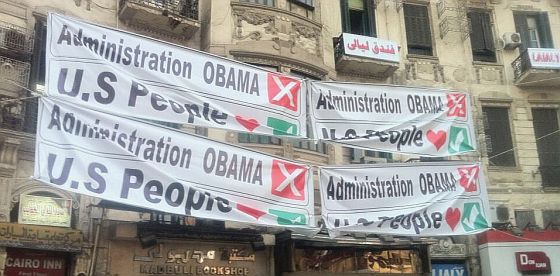
Tahrir Square banners, Cairo.

Marc Lynch writes: This week, Hosni Mubarak’s old media boss, Abdel Latif el-Menawy, published an astonishing essay on the website of the Saudi-funded, Emirati-based satellite television station Al Arabiya. Menawy described a wild conspiracy in which the U.S. ambassador to Egypt, Anne Patterson, directed Muslim Brotherhood snipers to murder Egyptian soldiers.

It would be easy to dismiss the ravings of an old Mubarak hand if they were not almost tame compared with the wild rumors and allegations across much of the Egyptian media and public. Even longtime observers of Egyptian rhetoric have been taken aback by the vitriol and sheer lunacy of the current wave of anti-American rhetoric. The streets have been filled with fliers, banners, posters, and graffiti denouncing President Barack Obama for supporting terrorism and featuring Photoshopped images of Obama with a Muslim-y beard or bearing Muslim Brotherhood colors.

A big Tahrir Square banner declaring love for the American people alongside hatred for Obama rings somewhat false given the fierce, simultaneous campaign against CNN and American journalists. The rhetoric spans the political spectrum: veteran leftist George Ishaq (Patterson “is an evil lady”), the Salafi Front (calling for demonstrations at the U.S. Embassy against foreign interference), the reckless secularist TV host Tawfik Okasha (whipping up xenophobic hatred), leaders of the Tamarod campaign (refusing to meet with Deputy Secretary of State William Burns because the United States “supports terrorism”), and Brotherhood leaders (blaming the United States for the military coup).

Would it be strange for Egyptians not to make a sharp distinction between the American press and the U.S. government? All too often CNN, the New York Times and other pillars of the media establishment display such a cozy relationship with government that even if they are not technically arms of state media, they very often act like that.

To treat what are explicitly attacks on the U.S. government as though they represent attacks on the American people seems just as irresponsible as some of the conspiracy theories themselves. Maybe this difficulty in discriminating between the government and the people isn’t so much a problem for the Egyptians as it is for someone who is both trapped inside the Washington bubble and has been an occasional adviser to the White House.

Facebooktwittermail

Palestinians in Gaza feel the Egypt effect as smuggling tunnels close

The Guardian reports: The usually clogged streets of Gaza City are noticeably quieter. Hospitals are warning that their emergency reserves of fuel, used to power generators, are running dangerously low. Construction sites that until recently throbbed with the sound of heavy machinery are deserted.

Palestinians in Gaza are feeling the impact of regime change in next-door Egypt. Since the Egyptian president, Mohammed Morsi, was ousted by the military on 3 July, not only have Gaza’s rulers, Hamas, lost their close political allies, but the Egyptian army has clamped down on the smuggling trade through the tunnels, which for six years have been a major lifeline for the 1.7m population of the tiny coastal strip.

The Egyptian authorities have targeted the underground passages as part of a drive to regain control of the vast Sinai desert, whose population is hostile to Cairo.

At the height of the black market trade between Gaza and Egypt, there were thought to be more than 1,000 tunnels employing around 7,000 people – providing Hamas with an income from taxes and permits of millions of dollars a month, estimated at 40% of the government’s revenue. But Egypt is thought to have closed or destroyed around 80% of the tunnels.

“The Gaza Strip has lost around $225m during the past month due to the halt of imports, namely fuel and crude materials for construction, such as cement, gravel and steel,” said the Hamas economy minister, Alaa al-Rafati. [Continue reading…]

Facebooktwittermail

The U.S. practice of training and harboring terrorists

Blake Fleetwood writes: For more than 50 years the U.S. has harbored and trained Cuban exile terrorists who have blown up civilian planes and mounted raids killing innocent civilians and tourists in Havana and other South American countries.

The most famous example of this is Luis Posada Carriles, who Venezuela and Cuba have been seeking for more than three decades for blowing up a Cuban airliner in 1976, killing 73 innocent civilians. It was then the deadliest terrorist airline attack in the Western Hemisphere — before 9/11.

The reason Venezuela has been offering Snowden asylum is directly linked to the asylum the U.S. has provided to exiled Cuban terrorists. President Nicolas Maduro of Venezuela contrasted Snowden’s action with those of Luis Posada Carriles, who is living freely and openly in Miami despite the fact that he is wanted for blowing up Cubana de Aviación Flight 55.

“Who is the terrorist? A government like ours that seeks to serve the young Snowden fight humanitarian asylum against persecution of the American Empire, or the U.S. government that protects political asylum to Luis Posada Carriles, murderer and confessed and convicted terrorist who is requested by Venezuela”, Nicolas Maduro said.

I interviewed Posada years ago after I snuck into a Venezuelan prison, against all the rules, and he was quite proud of his terrorist activities throughout Latin American.

Posada told me he was trained by the U.S. Army in the art of bomb-making and was on their, as well as the CIA’s, payroll for a number of years. People think the reason that Posada has avoided prosecution is because the U.S. is protecting the secrets he might spill — tying the CIA and the Bush family to illegal terrorist activities. [Continue reading…]

Facebooktwittermail

Damn Rolling Stone — for what?

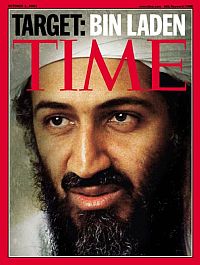
Shortly after 9/11, Osama bin Laden appeared on the cover of Time magazine. What later became an iconic image — the embodiment of evil, global terrorist #1, the face of Islamic extremism, or however else Americans came to view this face — did at the time show a man with an indisputable look of serenity.

Since the icons of terrorism were at that juncture still in the process of being manufactured, America’s first glimpses of Public Enemy Number One portrayed — dare I say it — a rather Christ-like figure.

Even though this was still a nation very much in shock, the appearance of a flattering image of the prime suspect behind the attacks was apparently something that America could handle.

Twelve years later and Rolling Stone’s use of a flattering image of Dzhokhar Tsarnaev is now supposedly beyond the pale.

Michelle Malkin, outraged that the magazine’s choice of cover image shows that its “editors are as muddle headed as ever about our war with Islam,” suggests that Rolling Stone is telling America’s youth that Tsarnaev “is just like you!

And she’s probably right — not on the issue of her war with Islam, but on the idea that Tsarnaev should be seen as an American youth.

He’s just turned 19, he’s a U.S. citizen, he likes hip hop, he’s smoked a lot of weed and he obviously thinks it’s cool to look cool.

This isn’t a land of saints and to belong to the ranks of American youth does not preclude the possibility of doing some awful things before even reaching adulthood. Does ‘cool’ connote any particular virtues? Not that I’ve noticed.

If there’s one thing worth highlighting more than anything else about Tsarnaev, it is precisely his normality. He doesn’t seem to have been unhinged like James Eagan Holmes, Jared Lee Loughner, or Adam Lanza.

Is it disturbing that an ordinary American kid could be involved in a bombing that killed three people and injured many more? Sure.

But that doesn’t mean we now have to plunge into denial and pretend that he wasn’t really an American kid or that there are horns concealed under his locks of hair or that his name or religion makes him foreign.

Osama bin Laden had some Christ-like features and Dzhokhar Tsarnaev looks a bit like Jim Morrison.

Maybe the problem isn’t the images — it’s the simplistic ideas we have about terrorism.

Facebooktwittermail

Global opposition to U.S. drone strikes

Pew Research Global Attitudes Project: In most of the nations polled, there continues to be extensive opposition to the American drone campaign against extremist leaders and organizations. In 31 nations, at least half disapprove of the U.S. conducting drone missile strikes targeting extremists in places such as Pakistan, Yemen and Somalia. At least three-in-four hold this view in 15 countries from all corners of the world, including nations from the Middle East, Europe, Latin America and Asia.

The only three countries where majorities support the drone campaign are Israel (64% approve), Kenya (56%), and the U.S. itself (61%). In the U.S., Republicans (69% approve) are especially likely to endorse this policy, although most independents (60%) and Democrats (59%) also approve.

Opinions on this issue are essentially divided in Australia, Canada and Germany. German support for U.S. drone attacks has actually risen slightly since last year – today, 45% approve, compared with 38% in 2012. Although most in France still oppose the drone strikes, support has also increased there, rising from 37% last year to 45% now. [Continue reading…]

Facebooktwittermail

Momentum shifts in Syria, bolstering Assad’s position

The New York Times reports: Not long ago, rebels on the outskirts of Damascus were peppering the city with mortar rounds, government soldiers were defecting in droves and reports circulated of new territory pried from the grip of President Bashar al-Assad.

As his losses grew, Mr. Assad unleashed fighter jets and SCUD missiles, intensifying fears that mounting desperation would push him to lash out with chemical weapons.

That momentum has now been reversed.

In recent weeks, rebel groups have been killing one another with increasing ferocity, losing ground on the battlefield and alienating the very citizens they say they want to liberate. At the same time, the United States and other Western powers that have called for Mr. Assad to step down have shown new reluctance to provide the rebels with badly needed weapons.

Although few expect that Mr. Assad can reassert his authority over the whole of Syria, even some of his staunchest enemies acknowledge that his position is stronger than it has been in months. His resilience suggests that he has carved out what amounts to a rump state in central Syria that is firmly backed by Russia, Iran and Hezbollah and that Mr. Assad and his supporters will probably continue to chip away at the splintered rebel movement. [Continue reading…]

Facebooktwittermail

Afghanistan: What Pakistan wants

Anatol Lieven writes: To understand Pakistan’s position in the conundrum of Afghanistan’s future, it is necessary to understand that in certain respects, Pakistan and Afghanistan have long blended into each other, via the population of around 35 million Pashtuns that straddles both sides of the border between them (a border drawn by the British which Afghanistan has never recognized). Pashtuns have always regarded themselves as the core of Afghanistan, where they form a plurality of the population (Afghan is indeed simply the old Farsi word for Pashtun); yet around two thirds of Pashtuns actually live in Pakistan, where they form the backbone of the present Islamist revolt against the state.

In the 1980s, the US encouraged this merger of Afghan and Pakistani Pashtun sentiment in order to strengthen support of Pakistani Pashtuns for the Afghan Mujahedin. In the 2000s, this came back to haunt America, since most Pakistani Pashtuns with whom I have spoken over the years regard the Taliban fight against the US and its Afghan allies in very much the same light that they regarded the Mujahedin fight against the USSR and its Afghan allies. [Continue reading…]

Facebooktwittermail

How do birds navigate?

The Economist: For decades scientists have known that birds’ ability to navigate with great accuracy over long distances, in some cases migrating from one side of the world to the other, relies on a magnetic sense that humans lack. Experiments with homing pigeons performed in the early 1970s found that attaching a magnet disrupted their ability to orientate themselves. Since then, research has intensified into the precise mechanism of birds’ magnetic sense. So how does it work?

Scientists have focused their attention in three areas: the beak, the inner ear and the eyes. Birds’ beaks contain tiny grains of magnetite, a form of iron oxide which is easily magnetised, and is known to be involved in magnetic sensing in bacteria. But when David Keays of the Institute of Molecular Pathology in Vienna examined the beaks of 200 pigeons, the results were surprising. He found that the magnetite grains were mostly located in macrophages, which are sort of biological garbage collectors that wander around the body, rather than in specialised sense cells. This strengthened the case that birds’ magnetic sense resides not in their beaks, but in their inner ears. Dr Keays and his colleagues changed tack, and earlier this year they reported that they had found tiny concentrations of iron in the neurons of a pigeon’s inner ear.

Case closed? Not quite. The latest research, published in June, suggests the beak does have a role to play after all. [Continue reading…]

Facebooktwittermail

Obama’s ‘Insider Threat’ policy equates whistleblowers, spies, and terrorists

Steven Aftergood writes: A national policy on “insider threats” was developed by the Obama Administration in order to protect against actions by government employees who would harm the security of the nation. But under the rubric of insider threats, the policy subsumes the seemingly disparate acts of spies, terrorists, and those who leak classified information.

The insider threat is defined as “the threat that an insider will use his/her authorized access, wittingly or unwittingly, to do harm to the security of the United States. This threat can include damage to the United States through espionage, terrorism, [or] unauthorized disclosure of national security information,” according to the newly disclosed National Insider Threat Policy, issued in November 2012.

One of the implications of aggregating spies, terrorists and leakers in a single category is that the nation’s spy-hunters and counterterrorism specialists can now be trained upon those who are suspected of leaking classified information.

The National Insider Threat Policy directs agencies to “leverag[e] counterintelligence (CI), security, information assurance, and other relevant functions and resources to identify and counter the insider threat.”

“Agency heads shall ensure personnel assigned to the insider threat program are fully trained in… counterintelligence and security fundamentals….”

Agency heads are directed to grant insider threat program personnel access to “all relevant databases and files” needed to identify, analyze, and resolve insider threat matters.

The National Insider Threat Policy was developed by the Insider Threat Task Force that was established in 2011 by executive order 13587. The Policy document itself was issued by the White House via Presidential Memorandum on November 21, 2012 but it was not publicly released until last week. [Continue reading…]

Facebooktwittermail

The NSA admits it analyzes way more people’s data than previously revealed

Atlantic Wire: As an aside during testimony on Capitol Hill today, a National Security Agency representative rather casually indicated that the government looks at data from a universe of far, far more people than previously indicated.

Chris Inglis, the agency’s deputy director, was one of several government representatives — including from the FBI and the office of the Director of National Intelligence — testifying before the House Judiciary Committee this morning. Most of the testimony largely echoed previous testimony by the agencies on the topic of the government’s surveillance, including a retread of the same offered examples for how the Patriot Act and Foreign Intelligence Surveillance Act had stopped terror events.

But Inglis’ statement was new. Analysts look “two or three hops” from terror suspects when evaluating terror activity, Inglis revealed. Previously, the limit of how surveillance was extended had been described as two hops. This meant that if the NSA were following a phone metadata or web trail from a terror suspect, it could also look at the calls from the people that suspect has spoken with — one hop. And then, the calls that second person had also spoken with — two hops. Terror suspect to person two to person three. Two hops. And now: A third hop. [Continue reading…]

Let’s put that into numbers. Let’s suppose the suspect has a small circle of 25 contacts but each of them has a more commonplace network of 100 contacts and each of them also has 100 contacts.

That means when the NSA identifies one suspect it will then actively engage in surveillance on as many and perhaps more than 250,000 people!

Facebooktwittermail

The creepy, long-standing practice of undersea cable tapping

Following revelations that both the U.S. and the U.K. spy agencies, the NSA and GCHQ, are tapping directly into the Internet’s backbone, The Atlantic asks: how does one tap into an underwater cable?

The process is extremely secretive, but it seems similar to tapping an old-fashioned, pre-digital telephone line — the eavesdropper gathers up all the data that flows past, then deciphers it later.

More than 550,000 miles of flexible undersea cables about the size of garden watering hoses carry all the world’s emails, searches, and tweets. Together, they shoot the equivalent of several hundred Libraries of Congress worth of information back and forth every day.

In 2005, the Associated Press reported that a submarine called the USS Jimmy Carter had been repurposed to carry crews of technicians to the bottom of the sea so they could tap fiber optic lines. The easiest place to get into the cables is at the regeneration points — spots where their signals are amplified and pushed forward on their long, circuitous journeys. “At these spots, the fiber optics can be more easily tapped, because they are no longer bundled together, rather laid out individually,” Deutsche Welle reported.

But such aquatic endeavors may no longer even be necessary. The cables make landfall at coastal stations in various countries, where their data is sent on to domestic networks, and it’s easier to tap them on land than underwater. Britain is, geographically, in an ideal position to access to cables as they emerge from the Atlantic, so the cooperation between the NSA and GCHQ has been key. Beyond that partnership, there are the other members of the “Five Eyes” — the Australians, the New Zealanders, and the Canadians — that also collaborate with the U.S., Snowden said.

The tapping process apparently involves using so-called “intercept probes.” According to two analysts I spoke to, the intelligence agencies likely gain access to the landing stations, usually with the permission of the host countries or operating companies, and use these small devices to capture the light being sent across the cable. The probe bounces the light through a prism, makes a copy of it, and turns it into binary data without disrupting the flow of the original Internet traffic. [Continue reading…]

Facebooktwittermail

Obama’s Orwellian America

The Washington Post reports: The Department of Homeland Security has warned its employees that the government may penalize them for opening a Washington Post article containing a classified slide that shows how the National Security Agency eavesdrops on international communications.

An internal memo from DHS headquarters told workers on Friday that viewing the document from an “unclassified government workstation” could lead to administrative or legal action. “You may be violating your non-disclosure agreement in which you sign that you will protect classified national security information,” the communication said.

The memo said workers who view the article through an unclassified workstation should report the incident as a “classified data spillage.” [Continue reading…]

Facebooktwittermail

From Tom Paine to Glenn Greenwald, we need partisan journalism

Jack Shafer writes: I would sooner engage you in a week-long debate over which taxonomical subdivision the duck-billed platypus belongs to then spend a moment arguing whether Glenn Greenwald is a journalist or not, or whether an activist can be a journalist, or whether a journalist can be an activist, or how suspicious we should be of partisans in the newsroom.

It’s not that those arguments aren’t worthy of time — just not mine. I’d rather judge a work of journalism directly than run the author’s mental drippings through a gas chromatograph to detect whether his molecules hang left or right or cling to the center. In other words, I care less about where a journalist is coming from than to where his journalism takes me.

Greenwald’s collaborations with source Edward Snowden, which resulted in Page One scoops in the Guardian about the National Security Agency, caused such a rip in the time-space-journalism continuum that the question soon went from whether Greenwald’s lefty style of journalism could be trusted to whether he belonged in a jail cell. Last month, New York Times business journalist Andrew Ross Sorkin called for the arrest of Greenwald (he later apologized) and Meet the Press host David Gregory asked with a straight face if he shouldn’t “be charged with a crime.” NBC’s Chuck Todd and the Washington Post‘s Walter Pincus and Paul Farhi also asked if Greenwald hadn’t shape-shifted himself to some non-journalistic precinct with his work.

The reactions by Sorkin, Gregory, Todd, Pincus, Farhi, and others betray — dare I say it? — a sad devotion to the corporatist ideal of what journalism can be and — I don’t have any problem saying it — a painful lack of historical understanding of American journalism. [Continue reading…]

Facebooktwittermail

How the NSA threatens America’s universities

The sooner that flaws in computer code can be found, the sooner they can be fixed — these are the fixes required to reduce the vulnerability that all networks face from cyberattacks. The problem is that government agencies such as the NSA are now outbidding software manufacturers when such vulnerabilities get discovered, meaning that the flaws remain unfixed and the attacks continue. In order to advance their own cyberwarfare capabilities, the NSA and other intelligence agencies now have a vested interest in perpetuating network insecurity. America’s research universities are now suffering the fallout.

The New York Times reports: America’s research universities, among the most open and robust centers of information exchange in the world, are increasingly coming under cyberattack, most of it thought to be from China, with millions of hacking attempts weekly. Campuses are being forced to tighten security, constrict their culture of openness and try to determine what has been stolen.

University officials concede that some of the hacking attempts have succeeded. But they have declined to reveal specifics, other than those involving the theft of personal data like Social Security numbers. They acknowledge that they often do not learn of break-ins until much later, if ever, and that even after discovering the breaches they may not be able to tell what was taken.

Universities and their professors are awarded thousands of patents each year, some with vast potential value, in fields as disparate as prescription drugs, computer chips, fuel cells, aircraft and medical devices.

“The attacks are increasing exponentially, and so is the sophistication, and I think it’s outpaced our ability to respond,” said Rodney J. Petersen, who heads the cybersecurity program at Educause, a nonprofit alliance of schools and technology companies. “So everyone’s investing a lot more resources in detecting this, so we learn of even more incidents we wouldn’t have known about before.”

Tracy B. Mitrano, the director of information technology policy at Cornell University, said that detection was “probably our greatest area of concern, that the hackers’ ability to detect vulnerabilities and penetrate them without being detected has increased sharply.” [Continue reading…]

Facebooktwittermail

How the CIA breaks into the computers the NSA cannot reach

Matthew Aid writes: During a coffee break at an intelligence conference held in The Netherlands a few years back, a senior Scandinavian counterterrorism official regaled me with a story. One of his service’s surveillance teams was conducting routine monitoring of a senior militant leader when they suddenly noticed through their high-powered surveillance cameras two men breaking into the militant’s apartment. The target was at Friday evening prayers at the local mosque. But rather than ransack the apartment and steal the computer equipment and other valuables while he was away — as any right-minded burglar would normally have done — one of the men pulled out a disk and loaded some programs onto the resident’s laptop computer while the other man kept watch at the window. The whole operation took less than two minutes, then the two trespassers fled the way they came, leaving no trace that they had ever been there.

It did not take long for the official to determine that the two men were, in fact, Central Intelligence Agency (CIA) operatives conducting what is known in the U.S. intelligence community as either a “black bag job” or a “surreptitious entry” operation. Back in the Cold War, such a mission might have involved cracking safes, stealing code books, or photographing the settings on cipher machines. Today, this kind of break-in is known inside the CIA and National Security Agency as an “off-net operation,” a clandestine human intelligence mission whose specific purpose is to surreptitiously gain access to the computer systems and email accounts of targets of high interest to America’s spies. As we’ve learned in recent weeks, the National Security Agency’s ability to electronically eavesdrop from afar is massive. But it is not infinite. There are times when the agency cannot gain access to the computers or gadgets they’d like to listen in on. And so they call in the CIA’s black bag crew for help.

The CIA’s clandestine service is now conducting these sorts of black bag operations on behalf of the NSA, but at a tempo not seen since the height of the Cold War. Moreover, these missions, as well as a series of parallel signals intelligence (SIGINT) collection operations conducted by the CIA’s Office of Technical Collection, have proven to be instrumental in facilitating and improving the NSA’s SIGINT collection efforts in the years since the 9/11 terrorist attacks.

Over the past decade specially-trained CIA clandestine operators have mounted over one hundred extremely sensitive black bag jobs designed to penetrate foreign government and military communications and computer systems, as well as the computer systems of some of the world’s largest foreign multinational corporations. Spyware software has been secretly planted in computer servers; secure telephone lines have been bugged; fiber optic cables, data switching centers and telephone exchanges have been tapped; and computer backup tapes and disks have been stolen or surreptitiously copied in these operations. [Continue reading…]

Facebooktwittermail

Former FISA judge spells out why court cannot perform judicial role

James Robertson, a former federal district judge who served on the secret Foreign Intelligence Surveillance Court, addressing the new Privacy and Civil Liberties Oversight Board, on July 9, explained why FISA cannot perform the function which is assigned to judges: that they choose between adversaries. Dan Froomkin quotes Robertson from the transcript:

I read the other day that one of my former FISA Court colleagues resisted the suggestion that the FISA approval process accommodated the executive, or maybe the word was cooperated. Not so, the judge replied. The judge said the process was adjudicating.

I very respectfully take issue with that use of the word adjudicating. The ex parte FISA process hears only one side and what the FISA process does is not adjudication, it is approval.

Which brings me to my second and I think closely related point. The FISA approval process works just fine when it deals with individual applications for surveillance warrants because approving search warrants and wiretap orders and trap and trace orders and foreign intelligence surveillance warrants one at a time is familiar ground for judges.

And not only that, but at some point a search warrant or wiretap order, if it leads on to a prosecution or some other consequence is usually reviewable by another court.

But what happened about the revelations in late 2005 about NSA circumventing the FISA process was that Congress passed the FISA Amendments Act of 2008 and introduced a new role for the FISC, which was to approve surveillance programs.

That change, in my view, turned the FISA Court into something like an administrative agency which makes and approves rules for others to follow.

Again, that’s not the bailiwick of judges. Judges don’t make policy. They review policy determinations for compliance with statutory law but they do so in the context once again of adversary process.

Facebooktwittermail