



#Snowden demanded all 41 pages of #PRISM document be published but neither WaPo nor Guardian had the courage washingtonpost.com/world/national…
— WikiLeaks (@wikileaks) June 10, 2013
Kevin Poulsen writes: What’s in Edward Snowden’s 41-slide PowerPoint deck that’s so hot that nobody dare publish it?
Now that Snowden has revealed himself to the world as the NSA whistleblower, details about his interaction with the press are surfacing. And at the center of the drama is a still mostly unpublished 41-slide presentation, classified top secret, that Snowden gave to the Washington Post and the Guardian to expose the NSA’s internet spying operation “PRISM.”
Only five slides from the presentation have been published. The other 36 remain a mystery. Both the Guardian’s Glenn Greenwald and the Post’s Barton Gellman have made it clear that the rest of the PowerPoint is dynamite stuff … which we’re not going to be seeing any time soon. “If you saw all the slides you wouldn’t publish them,” wrote Gellman on Twitter, adding in a second tweet: “I know a few absolutists, but most people would want to defer judgment if they didn’t know the full contents.”
But as Gellman himself has reported, Edward Snowden urgently wanted all the slides to be published while also saying: “I don’t desire to enable the Bradley Manning argument that these were released recklessly and unreviewed.”
So, we’re in the curious position where the two journalists the whistleblower is relying on to deliver his message seem to have taken it upon themselves to serve as both messengers and gatekeepers.
If you could see these secret slides you’d know why they must remain secret — that’s exactly the argument the government makes. The Guardian and the Washington Post seem to be casting their source as both responsible and irresponsible.
And let’s not forget: we’re talking about PowerPoint slides and information whose continued secrecy is vital to national security could surely be redacted.
On the other hand, as Edward Tufte duly notes, the NSA itself in its list of useful information sources didn’t bother including PowerPoint presentations.
So, maybe that’s the reason we haven’t seen the remaining 36 slides. When Gellman said, “If you saw all the slides you wouldn’t publish them,” perhaps what he actually meant was that the other 36 slides contain nothing of interest whatsoever.
List of spy-PRISM collected information includes nearly everything, except PPT decks. No useful information at all? twitter.com/EdwardTufte/st…
— Edward Tufte (@EdwardTufte) June 7, 2013
Daniel Ellsberg writes: In my estimation, there has not been in American history a more important leak than Edward Snowden’s release of NSA material – and that definitely includes the Pentagon Papers 40 years ago. Snowden’s whistleblowing gives us the possibility to roll back a key part of what has amounted to an “executive coup” against the US constitution.
Since 9/11, there has been, at first secretly but increasingly openly, a revocation of the bill of rights for which this country fought over 200 years ago. In particular, the fourth and fifth amendments of the US constitution, which safeguard citizens from unwarranted intrusion by the government into their private lives, have been virtually suspended.
The government claims it has a court warrant under Fisa – but that unconstitutionally sweeping warrant is from a secret court, shielded from effective oversight, almost totally deferential to executive requests. As Russell Tice, a former National Security Agency analyst, put it: “It is a kangaroo court with a rubber stamp.”
For the president then to say that there is judicial oversight is nonsense – as is the alleged oversight function of the intelligence committees in Congress. Not for the first time – as with issues of torture, kidnapping, detention, assassination by drones and death squads –they have shown themselves to be thoroughly co-opted by the agencies they supposedly monitor. They are also black holes for information that the public needs to know.
The fact that congressional leaders were “briefed” on this and went along with it, without any open debate, hearings, staff analysis, or any real chance for effective dissent, only shows how broken the system of checks and balances is in this country.
Obviously, the United States is not now a police state. But given the extent of this invasion of people’s privacy, we do have the full electronic and legislative infrastructure of such a state. If, for instance, there was now a war that led to a large-scale anti-war movement – like the one we had against the war in Vietnam – or, more likely, if we suffered one more attack on the scale of 9/11, I fear for our democracy. These powers are extremely dangerous. [Continue reading…]
Why should law-abiding Americans care if their communications and movements are being monitored by the NSA?
Many Americans don’t even care enough to pose the question (it would be interesting to see polling numbers right now showing how many Americans know what the letters N-S-A stand for or what the agency does), and among those who do pose the question, for most it is most likely a rhetorical question — a way of saying, this is an issue I have little reason to be concerned about. If the surveillance diminishes the risk of terrorist attacks, all well and good.
Even if there is a superficial rationality to this indifference about loss of privacy, there is also in this passive consent an attitude that represents the condition of democracy — a condition that Alexis de Tocqueville described over 150 years ago:
…the species of oppression by which democratic nations are menaced is unlike anything that ever before existed in the world; our contemporaries will find no prototype of it in their memories. I seek in vain for an expression that will accurately convey the whole of the idea I have formed of it; the old words despotism and tyranny are inappropriate: the thing itself is new, and since I cannot name, I must attempt to define it.
I seek to trace the novel features under which despotism may appear in the world. The first thing that strikes the observation is an innumerable multitude of men, all equal and alike, incessantly endeavoring to procure the petty and paltry pleasures with which they glut their lives. Each of them, living apart, is as a stranger to the fate of all the rest; his children and his private friends constitute to him the whole of mankind. As for the rest of his fellow citizens, he is close to them, but he does not see them; he touches them, but he does not feel them; he exists only in himself and for himself alone; and if his kindred still remain to him, he may be said at any rate to have lost his country.
Above this race of men stands an immense and tutelary power, which takes upon itself alone to secure their gratifications and to watch over their fate. That power is absolute, minute, regular, provident, and mild. It would be like the authority of a parent if, like that authority, its object was to prepare men for manhood; but it seeks, on the contrary, to keep them in perpetual childhood: it is well content that the people should rejoice, provided they think of nothing but rejoicing. For their happiness such a government willingly labors, but it chooses to be the sole agent and the only arbiter of that happiness; it provides for their security, foresees and supplies their necessities, facilitates their pleasures, manages their principal concerns, directs their industry, regulates the descent of property, and subdivides their inheritances: what remains, but to spare them all the care of thinking and all the trouble of living?
Thus it every day renders the exercise of the free agency of man less useful and less frequent; it circumscribes the will within a narrower range and gradually robs a man of all the uses of himself. The principle of equality has prepared men for these things;it has predisposed men to endure them and often to look on them as benefits.
After having thus successively taken each member of the community in its powerful grasp and fashioned him at will, the supreme power then extends its arm over the whole community. It covers the surface of society with a network of small complicated rules, minute and uniform, through which the most original minds and the most energetic characters cannot penetrate, to rise above the crowd. The will of man is not shattered, but softened, bent, and guided; men are seldom forced by it to act, but they are constantly restrained from acting. Such a power does not destroy, but it prevents existence; it does not tyrannize, but it compresses, enervates, extinguishes, and stupefies a people, till each nation is reduced to nothing better than a flock of timid and industrious animals, of which the government is the shepherd.
— “What sort of despotism democratic nations have to fear,” Chapter VI, Section IV, Volume III, Democracy in America, by Alexis de Tocqueville.
The New York Times reports: Edward J. Snowden’s employer, Booz Allen Hamilton, has become one of the largest and most profitable corporations in the United States almost exclusively by serving a single client: the government of the United States.
Over the last decade, much of the company’s growth has come from selling expertise, technology and manpower to the National Security Agency and other federal intelligence agencies. Booz Allen earned $1.3 billion, 23 percent of the company’s total revenue, from intelligence work during its most recent fiscal year.
The government has sharply increased spending on high-tech intelligence gathering since 2001, and both the Bush and Obama administrations have chosen to rely on private contractors like Booz Allen for much of the resulting work.
Thousands of people formerly employed by the government, and still approved to deal with classified information, now do essentially the same work for private companies. Mr. Snowden, who revealed on Sunday that he provided the recent leak of national security documents, is among them.
As evidence of the company’s close relationship with government, the Obama administration’s chief intelligence official, James R. Clapper Jr., is a former Booz Allen executive. The official who held that post in the Bush administration, John M. McConnell, now works for Booz Allen.
“The national security apparatus has been more and more privatized and turned over to contractors,” said Danielle Brian, the executive director of the Project on Government Oversight, a nonprofit group that studies federal government contracting. “This is something the public is largely unaware of, how more than a million private contractors are cleared to handle highly sensitive matters.”
It has gone so far, Ms. Brian said, that even the process of granting security clearances is often handled by contractors, allowing companies to grant government security clearances to private sector employees. [Continue reading…]
Chris Hedges writes: The military trial of Bradley Manning is a judicial lynching. The government has effectively muzzled the defense team. The Army private first class is not permitted to argue that he had a moral and legal obligation under international law to make public the war crimes he uncovered. The documents that detail the crimes, torture and killing Manning revealed, because they are classified, have been barred from discussion in court, effectively removing the fundamental issue of war crimes from the trial. Manning is forbidden by the court to challenge the government’s unverified assertion that he harmed national security. Lead defense attorney David E. Coombs said during pretrial proceedings that the judge’s refusal to permit information on the lack of actual damage from the leaks would “eliminate a viable defense, and cut defense off at the knees.” And this is what has happened.
Manning is also barred from presenting to the court his motives for giving the website WikiLeaks hundreds of thousands of classified diplomatic cables, war logs from Afghanistan and Iraq, and videos. The issues of his motives and potentially harming national security can be raised only at the time of sentencing, but by then it will be too late.
The draconian trial restrictions, familiar to many Muslim Americans tried in the so-called war on terror, presage a future of show trials and blind obedience. Our email and phone records, it is now confirmed, are swept up and stored in perpetuity on government computers. Those who attempt to disclose government crimes can be easily traced and prosecuted under the Espionage Act. Whistle-blowers have no privacy and no legal protection. This is why Edward Snowden—a former CIA technical assistant who worked for a defense contractor with ties to the National Security Agency and who leaked to Glenn Greenwald at The Guardian the information about the National Security Council’s top-secret program to collect Americans’ cellphone metadata, e-mail and other personal data—has fled the United States. The First Amendment is dead. There is no legal mechanism left to challenge the crimes of the power elite. We are bound and shackled. And those individuals who dare to resist face the prospect, if they remain in the country, of joining Manning in prison, perhaps the last refuge for the honest and the brave. [Continue reading…]
NBC News: A former Air Force drone operator who says he participated in missions that killed more than 1,600 people remembers watching one of the first victims bleed to death.
Brandon Bryant says he was sitting in a chair at a Nevada Air Force base operating the camera when his team fired two missiles from their drone at three men walking down a road halfway around the world in Afghanistan. The missiles hit all three targets, and Bryant says he could see the aftermath on his computer screen – including thermal images of a growing puddle of hot blood.
The Guardian has a video “presenting two expert views on Edward Snowden’s decision to seek refuge in Hong Kong and the likelihood or not of his finding such refuge there.”
Timothy B. Lee notes: If Snowden had chosen to stay in the United States, he would have faced a stark choice: accept a multi-year prison sentence for actions he believed to be in the public interest or go to trial and risk decades in prison if the courts were not persuaded by his legal and constitutional arguments. The American activist Aaron Swartz was facing exactly that choice when he committed suicide in January.
Because of the government’s misconduct in the Ellsberg case, the courts never reached the legal and constitutional merits of prosecuting a whistleblower under the Espionage Act. But as he was going to trial, he would have had reason to be optimistic that the courts would see things his way. The Supreme Court had declared warrantless wiretapping unconstitutional in 1967 and refused to block publication of the Pentagon Papers in 1971.
The current Supreme Court is less sympathetic to civil liberties. For example, earlier this year, the justices threw out a constitutional challenge to the FISA Amendments Act because the plaintiffs could not prove that they had personally been targets of surveillance. Because of the documents Snowden released, we now know that the FISA Amendments Act is the basis for the NSA’s PRISM program.
Julian Borger reports: Just before sovereignty over Hong Kong passed from Britain to China in 1997, the US signed a new extradition treaty with the semi-autonomous territory. Under that treaty, both parties agree to hand over fugitives from each other’s criminal justice systems, but either side has the right of refusal in the case of political offences.
Beijing, which gave its consent for Hong Kong to sign the agreement, also has a right of veto if it believes the surrender of a fugitive would harm the “defence, foreign affairs or essential public interest or policy” of the People’s Republic of China. In short, the treaty makes Snowden’s fate a matter of political expediency not just in Hong Kong but in Beijing.
In his Guardian interview, Snowden denied that his decision to fly to Hong Kong to make his allegations on NSA intrusion and infringement of American civil liberties was intended as a vote of confidence in Chinese human rights. But he noted that the people of Hong Kong have “a spirited commitment to free speech and the right of political dissent”.
Certainly in comparison with mainland China, Hong Kong is an island of press freedom and political tolerance. When the UK ended 156 years of colonial rule and Hong Kong became China’s first ‘special administrative region’, it was given special status under the principle of “one country, two systems”. Most importantly, Hong Kong passed its own constitution, its Basic Law, giving it a “high degree of autonomy” on all issues except foreign relations and defence.
The Washington Post reports: Sen. Rand Paul (R-Ky.) said Sunday that he plans to file a class action lawsuit against the Obama administration for its “unconstitutional” surveillance programs.
On “Fox News Sunday,” Paul said he wants to get the support of 10 million Americans.
“I’m going to be seeing if I can challenge this at the Supreme Court level,” Paul said, according to a rush transcript. “I’m going to be asking all the Internet providers and all of the phone companies, ask your customers to join me in a class action lawsuit. If we get 10 million Americans saying we don’t want our phone records looked at, then somebody will wake up and say things will change in Washington.”
Paul noted that public outcry over two pieces of legislation that raised Internet privacy concerns — known as SOPA and PIPA — proved very successful.
Rory Carroll reports: The campaign on Crowdtilt, an alternative to Kickstarter, has raised over $4,700 and is aiming for $15,000, urging would-be donors: “We should set a precedent by rewarding this type of extremely courageous behavior.”
Dwight Crow, a Facebook employee from San Francisco’s bay area, said he launched the initiative to reward and encourage whistleblowing and because he heard Snowden’s accounts had been frozen.
The Guardian reports: [T]he former foreign secretary Sir Malcolm Rifkind said Britain’s electronic eavesdropping centre would have been in breach of the law if it asked for data about UK citizens without the approval of ministers
As the shadow foreign secretary, Douglas Alexander, said he would challenge Hague to explain the legal basis on which GCHQ operated, Rifkind indicated that he would ask the US National Security Agency (NSA) about the matter this week.
Rifkind, the chairman of parliament’s security and intelligence committee, was speaking after Edward Snowden confirmed he leaked sensitive NSA documents to the Guardian. Snowden said these showed that US agencies had embarked on blanket monitoring of personal data from websites.
The documents suggested that GCHQ had generated 197 intelligence reports from the NSA-run Prism last year. The system would appear to allow GCHQ to bypass formal legal processes to access personal material, such as emails and photographs, from the world’s biggest internet companies.
Rifkind, who was responsible for overseeing GCHQ as foreign secretary between 1995 and 1997, said Snowden had broken the law. He told the Today programme on BBC Radio 4: “If you work for an intelligence agency you are required, as are the rest of us, to obey the law of the land. Revealing classified information is normally a criminal offence and leads to various consequences.”
But he indicated that GCHQ might have also fallen foul of the law if it accepted information from the NSA on British citizens. “One of the big questions that is being asked is if British intelligence agencies want to seek to know the content of emails can they get round the normal law in the UK by simply asking an American agency to provide that information?” he said.
Wired: Here’s a seemingly comforting statistic: In all of 2012, the Obama administration went to the secretive Foreign Intelligence Surveillance Court only 200 times to ask for Americans’ “business records” under the USA Patriot Act.
Every year, the Justice Department gives Congress a tally of the classified wiretap orders sought and issued in terrorist and spy cases – it was 1,789 last year. At the same time, it reports the number of demands for “business records” in such cases, issued under Section 215 of the USA Patriot Act. And while the number of such orders has generally grown over the years, it has always managed to stay relatively low. In 2011, it was 205. There were 96 orders in 2010, and only 21 in 2009.
Thanks to the Guardian’s scoop, we now know definitively just how misleading these numbers are. You see, while the feds are required to disclose the number of orders they apply for and receive (almost always the same number, by the way), they aren’t required to say how many people are targeted in each order. So a single order issued to Verizon Business Solutions in April covered metadata for every phone call made by every customer. That’s from one order out of what will probably be about 200 reported in next year’s numbers.
The public numbers are the one bit of accountability around the surveillance court, and the Justice Department used them to misdirect the public away from a massive domestic NSA spying operation that, as several Senators approvingly noted today, has been running for seven years. [Continue reading…]
Whenever we think about America’s seemingly super-powerful intelligence community, we should be less in awe of its capabilities and much more alert to its incompetence.
Farhad Manjoo makes an excellent argument: Edward Snowden sounds like a thoughtful, patriotic young man, and I’m sure glad he blew the whistle on the NSA’s surveillance programs. But the more I learned about him this afternoon, the angrier I became. Wait, him? The NSA trusted its most sensitive documents to this guy? And now, after it has just proven itself so inept at handling its own information, the agency still wants us to believe that it can securely hold on to all of our data? Oy vey!
According to the Guardian, Snowden is a 29-year-old high-school dropout who trained for the Army Special Forces before an injury forced him to leave the military. His IT credentials are apparently limited to a few “computer” classes he took at a community college in order to get his high-school equivalency degree — courses that he did not complete. His first job at the NSA was as a security guard. Then, amazingly, he moved up the ranks of the United States’ national security infrastructure: The CIA gave him a job in IT security. He was given diplomatic cover in Geneva. He was hired by Booz Allen Hamilton, the government contractor, which paid him $200,000 a year to work on the NSA’s computer systems.
Let’s note what Snowden is not: He isn’t a seasoned FBI or CIA investigator. He isn’t a State Department analyst. He’s not an attorney with a specialty in national security or privacy law.
Instead, he’s the IT guy, and not a very accomplished, experienced one at that. If Snowden had sent his résumé to any of the tech companies that are providing data to the NSA’s PRISM program, I doubt he’d have even gotten an interview. Yes, he could be a computing savant anyway — many well-known techies dropped out of school. But he was given access way beyond what even a supergeek should have gotten. As he tells the Guardian, the NSA let him see “everything.” He was accorded the NSA’s top security clearance, which allowed him to see and to download the agency’s most sensitive documents. But he didn’t just know about the NSA’s surveillance systems—he says he had the ability to use them. “I, sitting at my desk, certainly had the authorities [sic] to wiretap anyone from you or your accountant to a federal judge to even the president if I had a personal email,” he says in a video interview with the paper.
Because Snowden is now in Hong Kong, it’s unclear what the United States can do to him. But watch for officials to tar Snowden — he’ll be called unpatriotic, unprofessional, treasonous, a liar, grandiose, and worse. As in the Bradley Manning case, though, the more badly Snowden is depicted, the more rickety the government’s case for surveillance becomes. After all, they hired him. They gave him unrestricted access to their systems, from court orders to PowerPoint presentations depicting the crown jewels of their surveillance infrastructure. [Continue reading…]
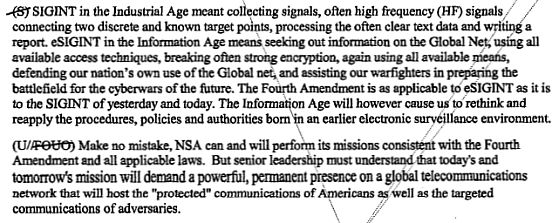
NSA 'Transition 2001', December 2000
An NSA memo written in December 2000 expressed ambivalence about the impact of the Fourth Amendment on the agency’s ability to gather electronic signals intelligence. While paying lip service to the protection of the Constitution, the agency underlined that it would need a “powerful, permanent presence on a global telecommunications network that will host the ‘protected’ communications of Americans” — the implication being that the NSA’s “presence” (read: surveillance) on the network would inevitably expose U.S. citizens’ communications to government scrutiny. In other words, the global nature of the network would mean that the NSA would no longer be able to draw any sharp differentiation between domestic and foreign communications.

The Guardian reports: The individual responsible for one of the most significant leaks in US political history is Edward Snowden, a 29-year-old former technical assistant for the CIA and current employee of the defence contractor Booz Allen Hamilton. Snowden has been working at the National Security Agency for the last four years as an employee of various outside contractors, including Booz Allen and Dell.
The Guardian, after several days of interviews, is revealing his identity at his request. From the moment he decided to disclose numerous top-secret documents to the public, he was determined not to opt for the protection of anonymity. “I have no intention of hiding who I am because I know I have done nothing wrong,” he said.
Snowden will go down in history as one of America’s most consequential whistleblowers, alongside Daniel Ellsberg and Bradley Manning. He is responsible for handing over material from one of the world’s most secretive organisations – the NSA.
In a note accompanying the first set of documents he provided, he wrote: “I understand that I will be made to suffer for my actions,” but “I will be satisfied if the federation of secret law, unequal pardon and irresistible executive powers that rule the world that I love are revealed even for an instant.” [Continue reading…]
The New York Times reports: The [National Security] agency’s ability to efficiently mine metadata, data about who is calling or e-mailing, has made wiretapping and eavesdropping on communications far less vital, according to data experts. That access to data from companies that Americans depend on daily raises troubling questions about privacy and civil liberties that officials in Washington, insistent on near-total secrecy, have yet to address.
“American laws and American policy view the content of communications as the most private and the most valuable, but that is backwards today,” said Marc Rotenberg, the executive director of the Electronic Privacy Information Center, a Washington group. “The information associated with communications today is often more significant than the communications itself, and the people who do the data mining know that.”
In the 1960s, when the N.S.A. successfully intercepted the primitive car phones used by Soviet leaders driving around Moscow in their Zil limousines, there was no chance the agency would accidentally pick up Americans. Today, if it is scanning for a foreign politician’s Gmail account or hunting for the cellphone number of someone suspected of being a terrorist, the possibilities for what N.S.A. calls “incidental” collection of Americans are far greater.
United States laws restrict wiretapping and eavesdropping on the actual content of the communications of American citizens but offer very little protection to the digital data thrown off by the telephone when a call is made. And they offer virtually no protection to other forms of non-telephone-related data like credit card transactions.
Because of smartphones, tablets, social media sites, e-mail and other forms of digital communications, the world creates 2.5 quintillion bytes of new data daily, according to I.B.M.
The company estimates that 90 percent of the data that now exists in the world has been created in just the last two years. From now until 2020, the digital universe is expected to double every two years, according to a study by the International Data Corporation.
Accompanying that explosive growth has been rapid progress in the ability to sift through the information.
When separate streams of data are integrated into large databases — matching, for example, time and location data from cellphones with credit card purchases or E-ZPass use — intelligence analysts are given a mosaic of a person’s life that would never be available from simply listening to their conversations. Just four data points about the location and time of a mobile phone call, a study published in Nature found, make it possible to identify the caller 95 percent of the time.
“We can find all sorts of correlations and patterns,” said one government computer scientist who spoke on condition of anonymity because he was not authorized to comment publicly. “There have been tremendous advances.”
Here’s a fantasy portrayal of how harvesting metadata can save lives. The storyteller is Palantir Technologies whose database integration system is reported to have become “an indispensable tool employed by the U.S. intelligence community in the war on terrorism.”
In October, a foreign national named Mike Fikri purchased a one-way plane ticket from Cairo to Miami, where he rented a condo. Over the previous few weeks, he’d made a number of large withdrawals from a Russian bank account and placed repeated calls to a few people in Syria. More recently, he rented a truck, drove to Orlando, and visited Walt Disney World by himself. As numerous security videos indicate, he did not frolic at the happiest place on earth. He spent his day taking pictures of crowded plazas and gate areas.
None of Fikri’s individual actions would raise suspicions. Lots of people rent trucks or have relations in Syria, and no doubt there are harmless eccentrics out there fascinated by amusement park infrastructure. Taken together, though, they suggested that Fikri was up to something. And yet, until about four years ago, his pre-attack prep work would have gone unnoticed. A CIA analyst might have flagged the plane ticket purchase; an FBI agent might have seen the bank transfers. But there was nothing to connect the two. Lucky for counterterror agents, not to mention tourists in Orlando, the government now has software made by Palantir Technologies, a Silicon Valley company that’s become the darling of the intelligence and law enforcement communities.
The day Fikri drives to Orlando, he gets a speeding ticket, which triggers an alert in the CIA’s Palantir system. An analyst types Fikri’s name into a search box and up pops a wealth of information pulled from every database at the government’s disposal. There’s fingerprint and DNA evidence for Fikri gathered by a CIA operative in Cairo; video of him going to an ATM in Miami; shots of his rental truck’s license plate at a tollbooth; phone records; and a map pinpointing his movements across the globe. All this information is then displayed on a clearly designed graphical interface that looks like something Tom Cruise would use in a Mission: Impossible movie.
As the CIA analyst starts poking around on Fikri’s file inside of Palantir, a story emerges. A mouse click shows that Fikri has wired money to the people he had been calling in Syria. Another click brings up CIA field reports on the Syrians and reveals they have been under investigation for suspicious behavior and meeting together every day over the past two weeks. Click: The Syrians bought plane tickets to Miami one day after receiving the money from Fikri. To aid even the dullest analyst, the software brings up a map that has a pulsing red light tracing the flow of money from Cairo and Syria to Fikri’s Miami condo. That provides local cops with the last piece of information they need to move in on their prey before he strikes.
Now let’s make a tiny tweak to this story: Fikri, mindful that it’s probably not wise to draw the attention of law enforcement, carefully observes all traffic regulations. He doesn’t get a speeding ticket and the CIA’s Palantir system is not triggered into action.
Shane Harris writes: To date, there have been practically no examples of a terrorist plot being pre-emptively thwarted by data mining these huge electronic caches. (Rep. Mike Rogers, chairman of the House Intelligence Committee, has said that the metadatabase has helped thwart a terrorist attack “in the last few years,” but the details have not been disclosed.)
When I was writing my book, The Watchers, about the rise of these big surveillance systems, I met analyst after analyst who said that data mining tends to produce big, unwieldy masses of potential bad actors and threats, but rarely does it produce a solid lead on a terrorist plot.
Those leads tend to come from more pedestrian investigative techniques, such as interviews and interrogations of detainees, or follow-ups on lists of phone numbers or e-mail addresses found in terrorists’ laptops. That shoe-leather detective work is how the United States has tracked down so many terrorists. In fact, it’s exactly how we found Osama bin Laden.
What the proponents of mass surveillance need to explain is how, given the existing scope of data gathering, the NSA did not intercept Tamerlan Tsarnaev and Dzhokhar Tsarnaev before they planted their bombs in Boston. Neither was Faisal Shahzad prevented from attempting to bomb Times Square.
What mass data collection is extremely effective in doing, is identifying trends — such as the emergence of a political movement. As a tool for suppressing political dissent, nothing could be more effective.
The Obama administration might not be in the business of large-scale political oppression, but what it is doing is putting in place and expanding the infrastructure of oppression.
Americans may never face a dramatic moment in which freedoms are suddenly stripped away, if instead we willingly abandon liberty, bit by bit, in favor of an illusory security.
Washington Post reporter Barton Gellman: “The source believes that exposure is inevitable and was prepared to face that consequence –”
“The source believes that he or she will be exposed?”
“Yes. The source does not believe that it’s possible to stay masked forever, and I don’t even think wants to stay masked forever. I think the source believes himself to be a — because I said in the story it’s “he” — he believes himself to be a whistleblower, that he’s operating out of conscience. He thinks that what the NSA is doing exceeds all reasonable boundaries of privacy or necessity. And I think he wants to stand up and say that. But in order to even be in a position to get word out, he had to be stealthy for a while or he simply would have been preempted. He would have been arrested and preempted and that would have been the end of that.”
Reuters reports: A U.S. intelligence agency requested a criminal probe on Saturday into the leak of highly classified information about secret surveillance programs run by the National Security Agency, a spokesman for the intelligence chief’s office said.
Confirmation that the NSA filed a “crimes report” came a few hours after the nation’s spy chief, Director of National Intelligence James Clapper launched an aggressive defense of a secret government data collection program.
Jonathan Schanzer writes: Sensational reports in the Guardian and Washington Post recently blew the lid off of the National Security Agency’s (NSA) electronic surveillance efforts, which have harvested everything from phone calls to Facebook posts for intelligence purposes.
Curiously, Twitter still appears outside the grasp of the NSA’s PRISM program, which gathers information from major U.S. Internet companies. But a group of lawmakers are concerned that the popular microblogging service has become too hospitable an environment for terrorist groups. The platform hosts a number of official feeds for terrorist groups, including Somalia’s al-Shabab, the North African al Qaeda in the Islamic Maghreb, Syria’s Jabhat al-Nusra, the Taliban, and Hamas.
Rep. Ted Poe (R-TX), who currently serves as the chairman of the House Foreign Affairs Subcommittee on Terrorism, Nonproliferation and Trade, is looking to curtail terrorist activity on Twitter. Poe is mindful of free speech concerns, but believes terrorist organizations are not entitled to the same free speech protections. As he argued last year, after watching Hamas use the platform for propaganda purposes during its November war with Israel, “Twitter must recognize sooner rather than later that social media is a tool for the terrorists.”
First Amendment activists will almost certainly cry foul. But they will not be alone: This would be one of their rare moments of harmony with the U.S. intelligence community, which has used Twitter feeds of extremists to monitor their messaging for strategies, tactics, and policies. America’s spies also monitor the feeds of extremist personalities and groups to see who follows them and who sympathizes with them, with the goal of identifying potential security threats at home or abroad. In fact, Twitter has made it possible for official bodies to interact with a banned group — even if those interactions haven’t been pleasant. [Continue reading…]
Twitter’s non-participation in PRISM might have provided the company with a small PR coup — in defense of civil liberties and all that — but it probably has just as much to do with the fact that the intelligence community is already perfectly happy with how the platform operates. The front door is wide open. Who needs a back door? Why should we not simply assume that the NSA is already merrily harvesting every single tweet?