Heather McRobie writes: A recurring theme at the Nobel Women’s Initiative conference in Belfast has been a reflection on the last decade in terms of its global impact on women and human rights. A picture emerged of a period wherein the excuse of ‘war on terror’ as a justificatory narrative for exclusivist identities, state violence and violence against women gave way to official austerity narratives that, in their own way, entrench inequalities and disempower women. Central to the decade was the elevation of the sanctity of the nation state’s security or perceived security, often – paradoxically – at the expense of both its citizens and those outside its borders.
Several speakers reflected on the ‘war on terror’ period in terms of its interrelated assault on human rights and women. The human rights violations and mass violation of human dignity enacted under the guise of the ‘war on terror’ runs from arbitrary detention to drone-strikes, from Guantanamo to Yemen to the encroachment of the rights of ‘citizens’ in the homelands that those who instigated the ‘war on terror’ were claiming to ‘protect’. The attack on women was similarly wide-sweeping: from the neo-colonial appropriation of the discourse of ‘women’s rights’ – toothless and sanitised in its neo-con costume – as an empty vessel to further the cause of militarism in Afghanistan and Iraq, to the ossification of rigid binary gender roles in the ‘homeland’ of America; rapes were committed by occupying soldiers at sites of invasion while in countries such as Yemen and Pakistan women’s lives were eroded by the chaos in their lives caused by the ‘war on terror’.
Amina Mama, Director of the Women and Gender Studies programme at UC Davis, spoke at the conference about how the process of militarisation works in tandem with the construction and reinforcement of rigid, exclusivist gender roles, creating matrixes of power-structures in favour of the nation state and military and against alternative, non-hierarchical ways of being. The epidemic levels of sexual assault within the US military itself – while due to its own complex set of causes – in some sense plays out this dynamic in microcosm, in the interlocking of patriarchy and militarism that is central to the dominant conception of Western statecraft. [Continue reading…]
Syria is now Saudi Arabia’s problem
Hassan Hassan writes: Hezbollah can finally claim a victory in Syria. The town of Qusayr, adjacent to the Lebanese border, has fallen to the Lebanese militia after nearly a month of fierce battles with Syrian rebels. Dozens of Hezbollah’s fighters have been killed, despite air cover and ground support from Bashar al-Assad’s regime.
The Qusayr battle has been constantly, and wrongly, described as a turning point in the Syrian war. Why has this small town of some 30,000 residents become “strategic,” as it is constantly described in the press, all of a sudden? The town had previously been run by its Sunni residents for more than a year, with little mention of its strategic benefits.
Hezbollah’s open military intervention in Syria partly explains the publicity the Qusayr battle has received. As a result, the “Party of God” has lost much of its political and ideological capital in the region — a capital the militia had painstakingly acquired from its three-decade career of “resisting” Israel.
But beyond the supposed military benefits of Qusayr, the battle for the town carried important consequences for the balance of power within the Syrian opposition. Qusayr is arguably the first battle in Syria to be completely sponsored by Saudi Arabia, marking the kingdom’s first foray outside its sphere of influence along the Jordanian border. Riyadh has now taken over Qatar’s role as the rebels’ primary patron: In one sense, the Saudis can also claim a victory in Qusayr, as they have successfully put various rebel forces under the command of their ally in the Free Syrian Army (FSA), Chief of Staff Gen. Salim Idriss. [Continue reading…]
Hezbollah’s Vietnam?
Michael Young writes: Hezbollah’s deepening involvement in the Syrian war is a high-risk venture. Many see this as a mistake by the party, and it may well be. Qusayr will be small change compared to Aleppo, where the rebels are well entrenched and benefit from supply lines leading to Turkey. In the larger regional rivalry between Iran and Turkey, the Turkish army and intelligence services have an interest in helping make things very difficult for Hezbollah and the Syrian army in northern Syria, particularly after the car-bomb attack in Reyhanli in May.
Many will be watching closely to see how the current crisis in Turkey affects Prime Minister Recep Tayyip Erdogan’s ability to react to the Syrian situation, particularly if the epicenter of the fighting shifts to Aleppo. Erdogan has faced the displeasure among many in Turkey’s southern border areas with their government’s policy in Syria. At the same time, a defeat of the Syrian rebels in and around Aleppo is not something that Turkey can easily swallow so near to its borders, particularly if Hezbollah is instrumental in the fighting.
Hezbollah is willing to take heavy casualties in Syria, if this allows it to rescue the Assad regime. The real question is what time frame we are talking about, and how this affects the party’s vital interests elsewhere. For now, Hezbollah has entered Syria with no exit strategy. [Continue reading…]
Video — Self illusion: The brain’s greatest con trick?
How not to circumscribe the mind
Ethan Watters writes: Imagine for a moment that the American Psychiatric Association was about to compile a new edition of its Diagnostic and Statistical Manual of Mental Disorders. But instead of 2013, imagine, just for fun, that the year is 1880.
Transported to the world of the late 19th century, the psychiatric body would have virtually no choice but to include hysteria in the pages of its new volume. Women by the tens of thousands, after all, displayed the distinctive signs: convulsive fits, facial tics, spinal irritation, sensitivity to touch, and leg paralysis. Not a doctor in the Western world at the time would have failed to recognize the presentation. “The illness of our age is hysteria,” a French journalist wrote. “Everywhere one rubs elbows with it.”
Hysteria would have had to be included in our hypothetical 1880 DSM for the exact same reasons that attention deficit hyperactivity disorder is included in the just-released DSM-5. The disorder clearly existed in a population and could be reliably distinguished, by experts and clinicians, from other constellations of symptoms. There were no reliable medical tests to distinguish hysteria from other illnesses then; the same is true of the disorders listed in the DSM-5 today. Practically speaking, the criteria by which something is declared a mental illness are virtually the same now as they were over a hundred years ago.
The DSM determines which mental disorders are worthy of insurance reimbursement, legal standing, and serious discussion in American life. That its diagnoses are not more scientific is, according to several prominent critics, a scandal. In a major blow to the APA’s dominance over mental-health diagnoses, Thomas R. Insel, director of the National Institute of Mental Health, recently declared that his organization would no longer rely on the DSM as a guide to funding research. “The weakness is its lack of validity,” he wrote. “Unlike our definitions of ischemic heart disease, lymphoma, or AIDS, the DSM diagnoses are based on a consensus about clusters of clinical symptoms, not any objective laboratory measure. In the rest of medicine, this would be equivalent to creating diagnostic systems based on the nature of chest pain or the quality of fever.” As an alternative, Insel called for the creation of a new, rival classification system based on genetics, brain imaging, and cognitive science.
This idea — that we might be able to strip away all subjectivity from the diagnosis of mental illness and render psychiatry truly scientific — is intuitively appealing. But there are a couple of problems with it. The first is that the science simply isn’t there yet. A functional neuroscientific understanding of mental suffering is years, perhaps generations, away from our grasp. What are clinicians and patients to do until then? But the second, more telling problem with Insel’s approach lies in its assumption that it is even possible to strip culture from the study of mental illness. Indeed, from where I sit, the trouble with the DSM — both this one and previous editions — is not so much that it is insufficiently grounded in biology, but that it ignores the inescapable relationship between social cues and the shifting manifestations of mental illness. [Continue reading…]
An even more profound problem with the reductionism of neuroscience is that it fails to question the physicalism that has become the bedrock of the scientific outlook. In other words, the belief that if something is real then it must be observable through standardized instruments which enable different observers to agree on the characteristics of the same thing.
In reality, human experience and the human world is primarily constructed from non-physical entities: ideas.
Take for instance the idea of a road — something that at first glance might seem indisputably physical. Imagine a six-lane freeway, filled with fast moving traffic. What could be more physical than that mass of steel and concrete carved emphatically through the landscape?
In fact, a road is a highly abstract concept that only exists inside a human mind and what allows us to drive on roads is the fact that generally speaking we share the same idea about what a road is — that it is a place which allows for the passage of wheel vehicles and is not suitable for picnics or sunbathing; that in the absence of symbolic warnings its boundaries will remain parallel and its continuation will not terminate without warning; that the road’s users will conform to a code of behavior that makes individual actions generally predictable by, for instance, avoiding contact with adjacent vehicles, driving on the same side, and at similar speeds. To drive at night, when sensory input is reduced to a minimum — from road markings whose location we mentally compute; from the narrow field of vision provided by headlights; from the lights of other vehicles whose standardized positions and locations allow us to unconsciously compute their proximity — is to place full faith in the idea of the road.
Neuroscience has advanced to the point where it’s now possible to map in some detail the neural foundations of thought, but a thought can no more be reduced to the firing of neurons than can a word be reduced to the illumination of a configuration of pixels. Ideas do not have an atomic structure and are not bound by time or space. The cartography of the mind cannot be charted by any kind of imaging technology. Not only is such technology ineffective; it is also redundant, since mind is by its very nature (along with a certain amount of discipline and practice) open to self scrutiny.

Music: Bill Evans — ‘The Two Lonely People’
‘Boundless Informant’: the NSA’s secret tool to track global surveillance data
The Guardian reports: The National Security Agency has developed a powerful tool for recording and analysing where its intelligence comes from, raising questions about its repeated assurances to Congress that it cannot keep track of all the surveillance it performs on American communications.
The Guardian has acquired top-secret documents about the NSA datamining tool, called Boundless Informant, that details and even maps by country the voluminous amount of information it collects from computer and telephone networks.
The focus of the internal NSA tool is on counting and categorizing the records of communications, known as metadata, rather than the content of an email or instant message.
The Boundless Informant documents show the agency collecting almost 3 billion pieces of intelligence from US computer networks over a 30-day period ending in March 2013. One document says it is designed to give NSA officials answers to questions like, “What type of coverage do we have on country X” in “near real-time by asking the SIGINT [signals intelligence] infrastructure.” [Continue reading…]
Guardian publishes fifth NSA PPT slide — 36 slides remain hidden from public view
“In the interests of aiding the debate over how Prism works, the Guardian is publishing an additional slide from the 41-slide presentation which details Prism and its operation. We have redacted some program names.”
And in the interests of boosting its U.S. operations, does The Guardian plan on dragging this story out for another 36 days, one slide a day perhaps being the maximum amount the paper has determined its readers can digest without being overwhelmed? Give me a break.
As “ImpartiallyApathetic” comments: “Perhaps some brave soul at the Guardian will leak the leak?” Or does The Guardian guard its secrets even more carefully than the NSA?
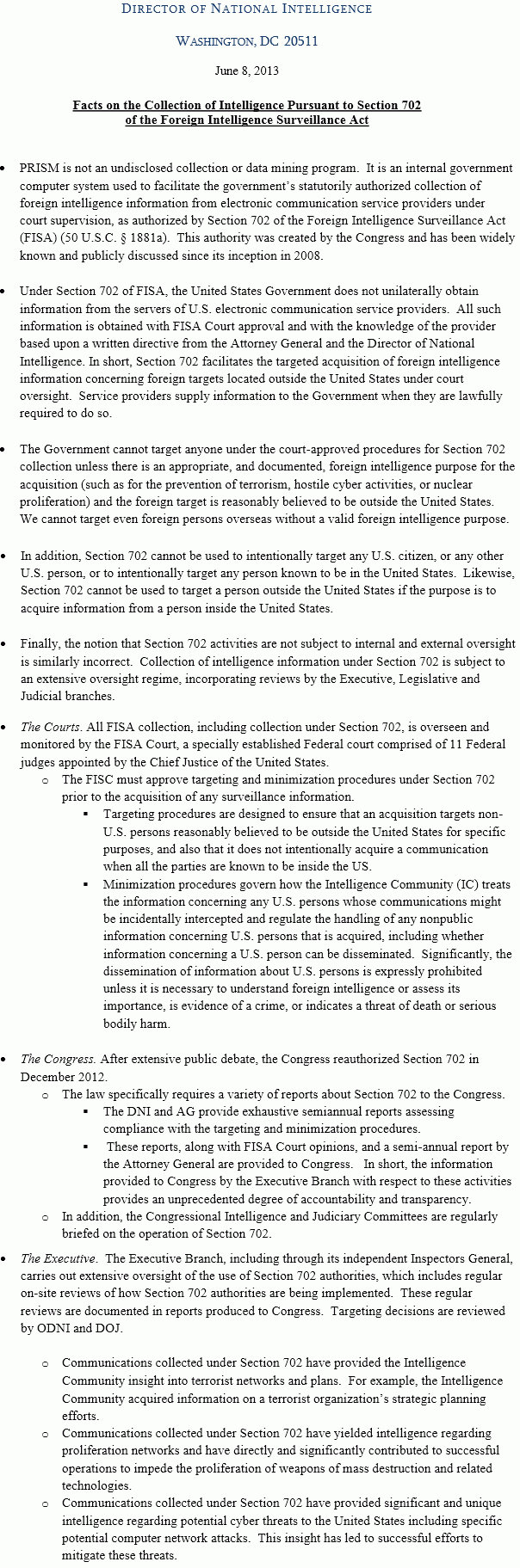
Statement on PRISM from the DNI
The Intel-Tech Complex
The New York Times reports: When government officials came to Silicon Valley to demand easier ways for the world’s largest Internet companies to turn over user data as part of a secret surveillance program, the companies bristled. In the end, though, many cooperated at least a bit.
Twitter declined to make it easier for the government. But other companies were more compliant, according to people briefed on the negotiations. They opened discussions with national security officials about developing technical methods to more efficiently and securely share the personal data of foreign users in response to lawful government requests. And in some cases, they changed their computer systems to do so.
The negotiations shed a light on how Internet companies, increasingly at the center of people’s personal lives, interact with the spy agencies that look to their vast trove of information — e-mails, videos, online chats, photos and search queries — for intelligence. They illustrate how intricately the government and tech companies work together, and the depth of their behind-the-scenes transactions.
The companies that negotiated with the government include Google, which owns YouTube; Microsoft, which owns Hotmail and Skype; Yahoo; Facebook; AOL; Apple; and Paltalk, according to one of the people briefed on the discussions. The companies were legally required to share the data under the Foreign Intelligence Surveillance Act. People briefed on the discussions spoke on the condition of anonymity because they are prohibited by law from discussing the content of FISA requests or even acknowledging their existence.
In at least two cases, at Google and Facebook, one of the plans discussed was to build separate, secure portals, like a digital version of the secure physical rooms that have long existed for classified information, in some instances on company servers. Through these online rooms, the government would request data, companies would deposit it and the government would retrieve it, people briefed on the discussions said.
The negotiations have continued in recent months, as Martin E. Dempsey, chairman of the Joint Chiefs of Staff, traveled to Silicon Valley to meet with executives including those at Facebook, Microsoft, Google and Intel. Though the official purpose of those meetings was to discuss the future of the Internet, the conversations also touched on how the companies would collaborate with the government in its intelligence-gathering efforts, said a person who attended.
Twitter, Google and other companies have typically fought aggressively against requests they believe reach too far. Google, Microsoft and Twitter publish transparency reports detailing government requests for information, but these reports do not include FISA requests because they are not allowed to acknowledge them.
Yet since tech companies’ cooperation with the government was revealed Thursday, tech executives have been performing a familiar dance, expressing outrage at the extent of the government’s power to access personal data and calling for more transparency, while at the same time heaping praise upon the president as he visited Silicon Valley.
Even as the White House scrambled to defend its online surveillance, President Obama was mingling with donors at the Silicon Valley home of Mike McCue, Flipboard’s chief, eating dinner at the opulent home of Vinod Khosla, the venture capitalist, and cracking jokes about Mr. Khosla’s big, shaggy dogs.
The Guardian reports: At the end of the first day of the his summit with the Chinese premier Xi Jinping in California, the president described disclosures about the National Security Agency’s access to telephone and internet data as “a very limited issue”.
However in comments that appeared more emollient than his remarks earlier in the day, when he criticised “leaks” and “hype” in the media, Obama tried to deflect criticism, saying internet privacy posed “broad implications for our society”. He said privacy concerns also related to private corporations, which he said collect more data than the federal government.
How Obama turned into Bush
The Washington Post reports: As a junior senator with presidential aspirations, Barack Obama built his persona in large part around opposition to Bush administration counterterrorism policies, and he sponsored a bill in 2005 that would have sharply limited the government’s ability to spy on U.S. citizens.
That younger Obama bears little resemblance to the commander in chief who stood on a stage here Friday, justifying broad programs targeting phone records and Internet activities as vital tools to prevent terrorist attacks and protect innocent Americans.
The former constitutional law professor — who rose to prominence in part by attacking what he called the government’s post-Sept. 11 encroachment on civil liberties — has undergone a philosophical evolution, arriving at what he now considers the right balance between national security prerogatives and personal privacy.
“I came in with a healthy skepticism about these programs,” Obama said in San Jose on Friday. “My team evaluated them. We scrubbed them thoroughly. We actually expanded some of the oversight, increased some of safeguards. But my assessment and my team’s assessment was that they help us prevent terrorist attacks.”
“On net,” the president added, “it was worth us doing.”
As Obama strived to reassure the American people following startling revelations this week about top-secret federal data-mining and surveillance programs, he said that he, too, has long been torn on the issue and that there is no easy answer.
“You can’t have 100 percent security and also then have 100 percent privacy and zero inconvenience,” he said. “We’re going to have to make some choices as a society.”
But are Americans in large numbers or any numbers calling for or expecting 100 percent security? An expectation of perfect security is no more realistic than the expectation that citizens will have perfect trust in their government and the absence of a basis for such perfect trust is exactly why the powers of government must always be constrained.
Companies dodge core question on PRISM: who has access to data?
In its original report on a PowerPoint presentation revealing the existence of the NSA’s PRISM surveillance program, the Washington Post noted:
Government officials and the document itself made clear that the NSA regarded the identities of its private partners as PRISM’s most sensitive secret, fearing that the companies would withdraw from the program if exposed. “98 percent of PRISM production is based on Yahoo, Google and Microsoft; we need to make sure we don’t harm these sources,” the briefing’s author wrote in his speaker’s notes.
The Post yesterday reported:
[I]f the NSA asked for data from a company, it is likely only a few officials would know of the request — and those employees would be barred from disclosing that information.
Other technology experts said the government could be scooping up the data after it leaves a company’s servers and travels across Internet networks.
When traveling across those pipes, the data is often encrypted, and a company could fulfill a government request by handing over the encryption keys to that data, said Peter Eckersley, the technology projects director at the privacy advocacy group Electronic Frontier Foundation.
“The companies’ denials are all deniable denials because each one of them contains loopholes of various cleverness that don’t address how they might have a transform mechanism for large amounts of user data to the NSA,” he said.
The Patriot Act must not be used to violate the rights of law-abiding citizens
Senators Ron Wyden and Mark Udall write: In our capacity as members of the Senate select committee on intelligence, we have spent years examining the intelligence collection operations that have been secretly authorized under the USA Patriot Act. Based on this experience, we respectfully but firmly disagree with the way that this program has been described by senior administration officials.
After years of review, we believe statements that this very broad Patriot Act collection has been “a critical tool in protecting the nation” do not appear to hold up under close scrutiny. We remain unconvinced that the secret Patriot Act collection has actually provided any uniquely valuable intelligence. As far as we can see, all of the useful information that it has provided appears to have also been available through other collection methods that do not violate the privacy of law-abiding Americans in the way that the Patriot Act collection does. We hope that President Obama will probe the basis for these assertions, as we have.
We also disagree with the statement that the broad Patriot Act collection strikes the “right balance” between protecting American security and protecting Americans’ privacy. In our view, it does not. When Americans call their friends and family, whom they call, when they call, and where they call from is private information. We believe the large-scale collection of this information by the government has a very significant impact on Americans’ privacy, whether senior government officials recognize that fact or not.
Finally, we have long been concerned about the degree to which this collection has relied on “secret law”. Senior administration officials have stated on multiple occasions that the Patriot Act’s “business records” authority is “analogous to a grand jury subpoena”. And multiple senior officials have stated that US intelligence agencies do not collect information or dossiers on “millions of Americans”.
We appreciate the recent statement from the director of national intelligence, which declassified certain facts about this collection, including its breadth. Now that the fact of bulk collection has been declassified, we believe that more information about the scale of the collection, and specifically whether it involves the records of “millions of Americans” should be declassified as well.
The American people must be given the opportunity to evaluate the facts about this program and its broad scope for themselves, so that this debate can begin in earnest.
Palantir has nothing to do with the NSA’s PRISM program
If a technology company creates a platform that allows data integration from disparate databases and a component in its software is called Prism, is that sufficient reason to speculate that it might have some connection with the much-reported NSA PRISM surveillance program?
It seems like it was good enough reason for Talking Points Memo and Gawker.
Gawker‘s Sam Biddle says: “No one knows what Palantir — named after a magical rock in Lord of The Rings that granted remote vision — exactly does.” But it turns out the “secretive data-mining company” provides a lot of information about what it does both through its website and its YouTube channel with 261 videos.
Josh Marshall’s post at TPM was initially based on an email from an anonymous reader who, for what it’s worth (not much), knows a guy who works for Palo Alto-based Palantir (which has over 800 employees). “I want to stress this is a reader email, not TPM reporting,” Marshall wrote before later adding multiple updates but neglecting to include a statement from the company, relayed on Twitter by the Financial Times tech correspondent, Tim Bradshaw: “Palantir’s Prism platform is completely unrelated to any US government program of the same name.”
Why should the company’s denial be taken at face value?
Here’s a good reason.
In the widely seen PowerPoint slide which depicts dates when PRISM collection began for providers beginning with Microsoft, the first date is September 11, 2007. Yahoo came on board in March 2008.
In a 2012 interview with TechCrunch, Palantir founder and CEO Alex Karp describing their platform said: “We didn’t know it would actually work, until 2008, and we didn’t know anyone would buy it until mid-2008, so third quarter 2008.”
Whatever the NSA was using for data collection from Microsoft and Yahoo in late 2007 and early 2008, it’s pretty clear it wasn’t Palantir software.
U.S. government invokes special privilege to stop scrutiny of data mining
The Guardian reports: The Obama administration is invoking an obscure legal privilege to avoid judicial scrutiny of its secret collection of the communications of potentially millions of Americans.
Civil liberties lawyers trying to hold the administration to account through the courts for its surveillance of phone calls and emails of American citizens have been repeatedly stymied by the government’s recourse to the “military and state secrets privilege”. The precedent, rarely used but devastating in its legal impact, allows the government to claim that it cannot be submitted to judicial oversight because to do so it would have to compromise national security.
The government has cited the privilege in two active lawsuits being heard by a federal court in the northern district of California – Virginia v Barack Obama et al, and Carolyn Jewel v the National Security Agency. In both cases, the Obama administration has called for the cases to be dismissed on the grounds that the government’s secret activities must remain secret.
The claim comes amid a billowing furore over US surveillance on the mass communications of Americans following disclosures by the Guardian of a massive NSA monitoring programme of Verizon phone records and internet communications.
The director of national intelligence, James Clapper, has written in court filings that “after careful and actual personal consideration of the matter, based upon my own knowledge and information obtained in the course of my official duties, I have determined that the disclosure of certain information would cause exceptionally grave damage to the national security of the United States. Thus, as to this information, I formally assert the state secrets privilege.”
The use of the privilege has been personally approved by President Obama and several of the administration’s most senior officials: in addition to Clapper, they include the director of the NSA Keith Alexander and Eric Holder, the attorney general. “The attorney general has personally reviewed and approved the government’s privilege assertion in these cases,” legal documents state.
In comments on Friday about the surveillance controversy, Obama insisted that the secret programmes were subjected “not only to congressional oversight but judicial oversight”. He said federal judges were “looking over our shoulders”.
But civil liberties lawyers say that the use of the privilege to shut down legal challenges was making a mockery of such “judicial oversight”. Though classified information was shown to judges in camera, the citing of the precedent in the name of national security cowed judges into submission. [Continue reading…]
Obama orders U.S. to draw up overseas target list for cyber-attacks
The Guardian reports: Barack Obama has ordered his senior national security and intelligence officials to draw up a list of potential overseas targets for US cyber-attacks, a top secret presidential directive obtained by the Guardian reveals.
The 18-page Presidential Policy Directive 20, issued in October last year but never published, states that what it calls Offensive Cyber Effects Operations (OCEO) “can offer unique and unconventional capabilities to advance US national objectives around the world with little or no warning to the adversary or target and with potential effects ranging from subtle to severely damaging”.
It says the government will “identify potential targets of national importance where OCEO can offer a favorable balance of effectiveness and risk as compared with other instruments of national power”.
The directive also contemplates the possible use of cyber actions inside the US, though it specifies that no such domestic operations can be conducted without the prior order of the president, except in cases of emergency.
The aim of the document was “to put in place tools and a framework to enable government to make decisions” on cyber actions, a senior administration official told the Guardian.
The administration published some declassified talking points from the directive in January 2013, but those did not mention the stepping up of America’s offensive capability and the drawing up of a target list.
Obama’s move to establish a potentially aggressive cyber warfare doctrine will heighten fears over the increasing militarization of the internet.
The directive’s publication comes as the president plans to confront his Chinese counterpart Xi Jinping at a summit in California on Friday over alleged Chinese attacks on western targets.
Even before the publication of the directive, Beijing had hit back against US criticism, with a senior official claiming to have “mountains of data” on American cyber-attacks he claimed were every bit as serious as those China was accused of having carried out against the US. [Continue reading…]
Clapper admits secret NSA surveillance program to access user data
The Guardian reports: The US has admitted using a secret system to mine the systems of the biggest technology companies to spy on millions of people’s online activity, overshadowing attempts by Barack Obama to force China to abandon its cyber-espionage program.
As concern mounted over the sweeping nature of US surveillance, the director of national intelligence, James Clapper, confirmed revelations by the Guardian that the National Security Agency uses companies such as Google, Facebook and Apple to obtain information that includes the content of emails and online files.
Coupled with the acknowledgement that authorities had undertaken a seven-year program to monitor the telephone calls of potentially millions of people in the US, it has become clear that the Obama administration has embraced and expanded the surveillance regime began under President Bush.
Clapper insisted that the internet surveillance program, known as Prism and disclosed by the Guardian and the Washington Post on Thursday, only covered communications with foreigners and did not target US citizens. “Information collected under this program is among the most important and valuable intelligence information we collect, and is used to protect our nation from a wide variety of threats,” Clapper said.
He acknowledged that Section 702 of the Foreign Intelligence Surveillance Act was being used to “facilitate the acquisition of foreign intelligence information”. [Continue reading…]
New York Times tones down scathing editorial
Politico: The New York Times editorial board has quietly changed the language in the most widely cited line from Thursday’s scathing editorial about the Obama administration’s surveillance of U.S. citizens.
The line — “The administration has now lost all credibility” — was changed Thursday night to read, “The administration has now lost all credibility on this issue.” No correction or explanatory note was appended.
“The change was for clarity’s sake,” Andrew Rosenthal, the Times editorial page editor, told POLITICO on Friday morning. “It was clear from the context of the editorial that the issue of credibility related to this subject and the final edit of the piece strengthened that point.”
It’s hardly surprising. The New York Times’s displays of courage are generally short-lived.
Did they get an angry phone call from the White House threatening to no longer feed officially-approved leaks to the paper’s reporters?