Hassan Hassan writes: Last week, Moaz Al-Khatib [who recently resigned as head of the National Coalition of Syrian Revolutionary and Opposition Forces] recorded a video in which he addressed Hizbollah’s leader Hassan Nasrallah in relation to the party’s involvement in Syria. Al-Khatib’s speech was moving and powerful. But Al-Khatib seemed convinced that Nasrallah was a virtuous person who could be dissuaded, through emotive words, from partnering with the Assad regime in slaughtering Syrians.
On Tuesday, Nasrallah addressed his party’s involvement in Syria in a Qaddafisque long speech — major Arabic channels aired only part of the speech. Nasrallah snubbed Al-Khatib’s calls for withdrawing forces from Syria, even refraining from mentioning Al-Khatib by name when he spoke about his peace initiative. He said when the “‘resigned head” of the National Coalition spoke of a political solution, he was severely attacked by outside countries and his colleagues. In their videos, both Al-Khatib and Nasrallah spoke of a catastrophic fitna (sectarian strife) in the offing but each from his own vantage point.
Nasrallah’s speech is still shrouded with mystery. There area few points to make about it.
The first one is whether he needed to make his party’s involvement in Syria so public. The party previously benefited from denial and vagueness to maintain its image as a non-sectarian resistance party. His announcement has now made the party nakedly sectarian.
That is a huge development and will change the way Hizbollah is viewed across the region. Even though Hizbollah had always been exclusive to Shia members, many in the Arab world showed understanding and gave the party the benefit of the doubt. I remember a Lebanese Palestinian friend of mine, in Damascus, saying that Palestinians were urging Hizbollah to allow them to join its ranks. The idea that Hizbollah is a Shia party that fought for Lebanese, Palestinians and the Arab world led many to ignore its ideological background. [Continue reading…]
The bad joke called ‘the FISA court’ shows how a ‘drone court’ would work
Glenn Greenwald writes: In the mid-1970s, an investigation by the US Senate, conducted by the Church Committee, uncovered decades of serious, systemic abuse by the US government of its eavesdropping powers: listening in on the telephone calls of civil rights leaders, reading the mail of political opponents, spying on anti-war groups. The supposed lesson learned from this was that political leaders will inevitably abuse their surveillance powers if they are permitted to exercise them in the dark and without meaningful oversight. The “solution” was the enactment of a law – the 1978 Foreign Intelligence Surveillance Act (Fisa) – that made it a criminal offense for government officials to eavesdrop on the electronic communications of Americans without first obtaining a warrant from the newly created Fisa court.
From the start, the Fisa court was a radical perversion of the judicial process. It convened in total secrecy and its rulings were classified. The standard the government had to meet was not the traditional “probable cause” burden imposed by the Fourth Amendment but a significantly diluted standard. There was nothing adversarial about the proceeding: only the Justice Department (DOJ) was permitted to be present, but not any lawyers for the targets of the eavesdropping request, who were not notified. Reflecting its utter lack of real independence, the court itself was housed in the DOJ.
And, and was totally predictable, the court barely ever rejected a government request for eavesdropping. From its inception, it was the ultimate rubber-stamp court, having rejected a total of zero government applications – zero – in its first 24 years of existence, while approving many thousands. In its total 34 year history – from 1978 through 2012 – the Fisa court has rejected a grand total of 11 government applications, while approving more than 20,000. [Continue reading…]
Pentagon upgrades ‘bunker buster’ to appease Israelis
The Wall Street Journal reports: The Pentagon has redesigned its biggest “bunker buster” bomb with more advanced features intended to enable it to destroy Iran’s most heavily fortified and defended nuclear site.
U.S. officials see development of the weapon as critical to convincing Israel that the U.S. has the ability to prevent Iran from getting a nuclear bomb if diplomacy fails, and also that Israel’s military can’t do that on its own.
Several times in recent weeks, American officials, seeking to demonstrate U.S. capabilities, showed Israeli military and civilian leaders secret Air Force video of an earlier version of the bomb hitting its target in high-altitude testing, and explained what had been done to improve it, according to diplomats who were present.
In the video, the weapon can be seen penetrating the ground within inches of its target, followed by a large underground detonation, according to people who have seen the footage.
The newest version of what is the Pentagon’s largest conventional bomb, the 30,000-pound Massive Ordnance Penetrator, or MOP, has adjusted fuses to maximize its burrowing power, upgraded guidance systems to improve its precision and high-tech equipment intended to allow it to evade Iranian air defenses in order to reach and destroy the Fordow nuclear enrichment complex, which is buried under a mountain near the Iranian city of Qom. The upgraded MOP designed for Fordow hasn’t been dropped from a plane yet.
The improvements are meant to address U.S. and Israeli concerns that Fordow couldn’t be destroyed from the air. Overcoming that obstacle could also give the West more leverage in diplomatic efforts to convince Iran to curtail its nuclear program. [Continue reading…]
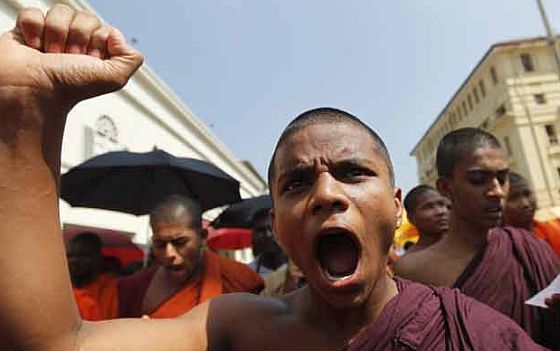
Why are Buddhist monks attacking Muslims?

Cynical as it might sound, religious teachings are marketing tools — indeed, there is nothing in commerce that makes claims as grandiose as those made by any religion. The success of religious marketing is always evident when something happens that seems to expose a glaring gap between a religion and the behavior of some of its adherents.
Since Buddhism with its humanistic values and lack of doctrinal baggage has wide appeal in this secular age, it seems particularly jarring when Buddhists — and not just the laity but worst of all those donning the colors — are out on the streets beating up their opponents.
Aren’t Buddhists, as the Dalai Lama advises, meant to regard their adversaries as teachers — not enemies to be crushed?
That is of course what the Middle Way teaches, but just like every other religion, Buddhism has throughout the ages progressed as a social force by aligning itself to power. Moreover, through institutionalizing the lifestyle of the sannyasin — the renunciate who gives up home and possessions and wanders alone relying on the charity of others — Buddhist monasticism never adopted the values of self-reliance which gave other monastic systems a higher degree of autonomy and thus a measure of economic and cultural insulation from forces in society at large.
Buddhist monks cannot so easily rise above the political passions of the people who feed them.
Alan Strathern writes:[H]istorically, Buddhism has been no more a religion of peace than Christianity.
One of the most famous kings in Sri Lankan history is Dutugamanu, whose unification of the island in the 2nd Century BC is related in an important chronicle, the Mahavamsa.
It says that he placed a Buddhist relic in his spear and took 500 monks with him along to war against a non-Buddhist king.
He destroyed his opponents. After the bloodshed, some enlightened ones consoled him: “The slain were like animals; you will make the Buddha’s faith shine.”
Burmese rulers, known as “kings of righteousness”, justified wars in the name of what they called true Buddhist doctrine.
In Japan, many samurai were devotees of Zen Buddhism and various arguments sustained them – killing a man about to commit a dreadful crime was an act of compassion, for example. Such reasoning surfaced again when Japan mobilised for World War II.
Buddhism took a leading role in the nationalist movements that emerged as Burma and Sri Lanka sought to throw off the yoke of the British Empire. Occasionally this spilled out into violence. In 1930s Rangoon, amid resorts to direct action, monks knifed four Europeans.
More importantly, many came to feel Buddhism was integral to their national identity – and the position of minorities in these newly independent nations was an uncomfortable one. [Continue reading…]
Neurocriminology: Inside the criminal mind
Adrian Raine writes: The scientific study of crime got its start on a cold, gray November morning in 1871, on the east coast of Italy. Cesare Lombroso, a psychiatrist and prison doctor at an asylum for the criminally insane, was performing a routine autopsy on an infamous Calabrian brigand named Giuseppe Villella. Lombroso found an unusual indentation at the base of Villella’s skull. From this singular observation, he would go on to become the founding father of modern criminology.
Lombroso’s controversial theory had two key points: that crime originated in large measure from deformities of the brain and that criminals were an evolutionary throwback to more primitive species. Criminals, he believed, could be identified on the basis of physical characteristics, such as a large jaw and a sloping forehead. Based on his measurements of such traits, Lombroso created an evolutionary hierarchy, with Northern Italians and Jews at the top and Southern Italians (like Villella), along with Bolivians and Peruvians, at the bottom.
These beliefs, based partly on pseudoscientific phrenological theories about the shape and size of the human head, flourished throughout Europe in the late 19th and early 20th centuries. Lombroso was Jewish and a celebrated intellectual in his day, but the theory he spawned turned out to be socially and scientifically disastrous, not least by encouraging early-20th-century ideas about which human beings were and were not fit to reproduce—or to live at all.
The racial side of Lombroso’s theory fell into justifiable disrepute after the horrors of World War II, but his emphasis on physiology and brain traits has proved to be prescient. Modern-day scientists have now developed a far more compelling argument for the genetic and neurological components of criminal behavior. They have uncovered, quite literally, the anatomy of violence, at a time when many of us are preoccupied by the persistence of violent outrages in our midst.
The field of neurocriminology—using neuroscience to understand and prevent crime—is revolutionizing our understanding of what drives “bad” behavior. More than 100 studies of twins and adopted children have confirmed that about half of the variance in aggressive and antisocial behavior can be attributed to genetics. Other research has begun to pinpoint which specific genes promote such behavior.
Brain-imaging techniques are identifying physical deformations and functional abnormalities that predispose some individuals to violence. In one recent study, brain scans correctly predicted which inmates in a New Mexico prison were most likely to commit another crime after release. Nor is the story exclusively genetic: A poor environment can change the early brain and make for antisocial behavior later in life.
Most people are still deeply uncomfortable with the implications of neurocriminology. Conservatives worry that acknowledging biological risk factors for violence will result in a society that takes a soft approach to crime, holding no one accountable for his or her actions. Liberals abhor the potential use of biology to stigmatize ostensibly innocent individuals. Both sides fear any seeming effort to erode the idea of human agency and free will. [Continue reading…]
Music: Michel Petrucciani — ‘Round midnight’
As long as it stays open, Guantánamo is a stain on America’s reputation
Morris Davis, former chief prosecutor for the military commissions at Guantánamo, writes: I am going to say something I have not said as often as I would have liked: I agree with President Obama. Despite indications to the contrary – such as fighting me tooth and nail in court the past three years (and counting) over my firing by the Library of Congress for writing op-eds critical of his and President Bush’s detainee policies – he apparently came to the same realization I had several years ago that, in his words, “we’ve got to close Guantánamo.”
At a press conference on Tuesday, the president said that Guantánamo is unnecessary to keep America safe; it is expensive and inefficient; it diminishes the standing of the United States in the international community; it hampers cooperation with allies on counterterrorism efforts; and it serves as a recruitment tool for extremists. He is right on all counts. How, then, could anyone find an upside to perpetuating the Guantánamo fiasco?
Well, some see advantage in pandering to fear, particularly politicians on the far right of the ideological spectrum. They argue that anyone who would consider moving the “crazy bastards” out of Guantánamo and closing it is soft on terrorism. They are wrong: they are the ones who are soft … in the head and the spine. American law enforcement agencies, prison systems and judicial processes have proven themselves quite capable of dealing with “crazy bastards” of all types. They can handle a Khalid Sheikh Mohammed. It is time to stop wasting the taxpayers’ money and squandering what credibility America has left keeping a folly afloat. [Continue reading…]
How to close Guantanamo
Laura Pitter writes: President Barack Obama finally broke his long silence on Tuesday on the need to close Guantanamo. Echoing comments he made four years ago — when, on his second day in office he promised to close the facility within a year — he said “Guantanamo is not necessary to keep America safe. It is expensive. It is inefficient…. It needs to be closed.”
Welcome words, but it’s unlikely they will brighten the day of the 100 men currently on hunger strike at the facility. Twenty-one are currently being tube-fed, a procedure that entails being put in a restraint chair while a lubricated plastic tube is inserted down a detainee’s nose and into his stomach. (Detainees are then held in the chair for approximately two hours to make sure the liquid supplement fed into the tube is digested.) Obama’s words might carry more resonance with those who have been lobbying for closure of the facility for the better part of a decade, though perhaps more so if he didn’t seem so keen to apportion blame elsewhere.
In his remarks, made in response to questions at the White House press briefing, Obama pointed the finger at Congress saying it had been “determined” not to let him close the facility, and that he promised to “re-engage with Congress” on the issue. While it’s true that Congress has certainly placed obstacles in the way of closing the facility, such as restricting the use of funds to transfer detainees to the United States for trial, there are still a number of steps the Obama administration could have taken — and can still take now — to begin closing the facility and ending indefinite detention without trial. [Continue reading…]
Video: Will Obama close Guantanamo?
U.S. drone strikes being used as alternative to Guantánamo, lawyer says
The Guardian reports: The lawyer who first drew up White House policy on lethal drone strikes has accused the Obama administration of overusing them because of its reluctance to capture prisoners that would otherwise have to be sent to Guantánamo Bay.
John Bellinger, who was responsible for drafting the legal framework for targeted drone killings while working for George W Bush after 9/11, said he believed their use had increased since because President Obama was unwilling to deal with the consequences of jailing suspected al-Qaida members.
“This government has decided that instead of detaining members of al-Qaida [at Guantánamo] they are going to kill them,” he told a conference at the Bipartisan Policy Center.
Obama this week pledged to renew efforts to shut down the jail but has previously struggled to overcome congressional opposition, in part due to US disagreements over how to handle suspected terrorists and insurgents captured abroad.
An estimated 4,700 people have now been killed by some 300 US drone attacks in four countries, and the question of the programme’s status under international and domestic law remains highly controversial. [Continue reading…]
The CIA’s rogue operations
Following the New York Times’ revelation earlier this week that the CIA has been regularly delivering shopping bags full of cash to Afghan President Hamid Karzai, Sarah Chayes writes:
Karzai’s relationship with the CIA is believed to long predate the tense days in late 2001 when CIA officers joined him and his followers in the mountains north of Kandahar as the Taliban regime was falling. In a 2003 conversation, the most renowned commander of anti-Soviet resistance fighters in southern Afghanistan, where I lived at the time, told me that in the late 1980s Karzai introduced him to CIA officials so he could obtain some of the all-important Stinger missiles that helped the Afghan fighters neutralize Soviet helicopters. U.S. support of the anti-Soviet resistance was covert. Very few Afghans had direct contact with the CIA. Most received U.S. money or military equipment by way of Pakistani intermediaries. Karzai, according to this commander, was one of the early exceptions.
Given this long relationship with the CIA, Karzai may believe that the agency somehow represents the true voice of the U.S. government. Indeed, the competing and often contradictory exhortations and demands transmitted by ambassadors and special envoys who come and go, the successive commanders of international forces with their different approaches, the congressional delegations who troop through his office, even secretaries of State or Defense, must start to sound like a lot of cacophonous noise to the man on the receiving end. Amid the din, CIA money can ring a clear note.
The tendency to read CIA signals as conveying the “real” intent of the U.S. government is not limited to Afghan leaders. In his book The Arab Center, for example, former Jordanian Foreign Minister Marwan Muasher describes a tense episode in 2004 when Jordan was promoting a broad-based Arab initiative to break the deadlock in the Middle East peace process.
A meeting between President George W. Bush and King Abdullah II was hanging in the balance, with the king awaiting the result of fraught negotiations between Muasher and National Security Advisor Condoleezza Rice over the contents of a letter of intent from Bush to Abdullah. A full day of talks resulted in a mutually agreeable formulation.
But in the meantime, a CIA official had been speaking back channel with Jordan’s intelligence chief, waiting on the West Coast with the king; the CIA official urged the delegation to fly home to Jordan, and it did. In the end, the king and his advisors concluded that it was the CIA, not the national security advisor, that really counted in the U.S. government, and the Middle East peace process remained stalled. [Continue reading…]
Delegitimizing pro-Palestinian queer voices
Brandon Davis writes: In the last eight years, the Israeli government has sought to rebrand Israel as a “liberal haven” for gay rights in an otherwise-homophobic Middle East as a means of increasing tourism and international goodwill. Critics refer to the campaign as “pinkwashing,” an attempt to whitewash the Israeli occupation by focusing on gay and lesbian issues. Many of these critics are queer people themselves, and their movement against Israeli policies is building within the LGBT community. But recent pro-Israel initiatives hope to change that; rather than simply promoting Israeli gay images in the international sphere, these Israel advocates are actually attempting to sanitize LGBTQ spaces of pro-Palestinian activism entirely.
The most recent battleground is Toronto, where Councilman James Pasternak has proposed offering extra money to the Pride parade if the organizers prevent pro-Palestinian group Queers Against Israeli Apartheid (QuAIA) from marching this June. Pasternak had previously attempted to withdraw funding from Pride altogether, claiming QuAIA’s use of the phrase “Israeli Apartheid” constituted hate speech; when that failed, he proposed granting what he calls a “diversity bonus” if Pride keeps QuAIA off the roster. Pasternak’s idea is simple: we straight people will only support you if you exclude any dissenting voices.
Unfortunately, this thinking isn’t limited to straight people, and many in the gay community — especially gay Jews — are also attempting to keep LGBT spaces clear of any pro-Palestinian sentiment. Two years ago, a small group of gay Jews successfully campaigned the New York Gay and Lesbian Center from allowing Siege Busters, another pro-Palestinian group, to hold an event, claiming the group’s politics made them feel “unsafe.” As they see it, Israel is a natural “ally” to the gay community — so what does that make pro-Palestinian gays? [Continue reading…]
Why does Israel face no red lines?
Zvi Bar’el writes: It’s not important what’s said at the United Nations, what the superpowers are busy with or even what strategic issues are guiding the powers that be. When Israel speaks the world stands at attention. The Iranian threat? If it weren’t for the revelations by Israeli intelligence and the fears of a vicious response by Jerusalem, it’s doubtful whether the United States or the rest of the world would get excited about Iran’s nuclear program.
Syria’s chemical weapons? Only the public statements by Military Intelligence research chief Itai Brun forced the U.S. administration to admit that chemical weapons had been used. Al-Qaida in Sinai? A few rockets fired from Sinai and the deadly incident on the border turned Egypt into a threat, forced Mohammed Morsi’s regime to clash with armed Salafist groups and dragged the United States into the arena.
The wrong impression is that only Israel has precise intelligence in the region, and without it the world wouldn’t know about the dangers. The right impression is that Israel knows how to turn its intelligence into an international panic. This should be a proud achievement for such a small and strategically unimportant country. It’s an enormous success to harness the world’s strongest power to help the country that always says it doesn’t need foreign armies’ help.
But this same country that notices distant threats before anyone else has become deaf, dumb and blind when the threat is lying at its doorstep. When was the last time the prime minister spoke about the Israeli-Palestinian conflict? What happened to the polished finance minister who promised to launch talks with the Palestinians? What has the defense minister done except for closing and opening the Kerem Shalom crossing after every mortar shell falls on Israel?
True, the conflict with the Palestinians is dwarfed by the Iranian threat, Syria’s chemicals and the missiles from Sinai. It’s not a “strategic threat,” it’s like an annoyance that produces an expression of sympathy, or hand waving that expresses insignificance or boredom.
This isn’t a conflict that requires us to call up reserves, launch planes or locate weapons so they can be bombed. This is a conflict without the beef that has almost no Jewish casualties, doesn’t provoke demonstrations in Israel, and the media is sick of. It’s a conflict that’s unconvincing in its conflictedness, that doesn’t need the world’s participation or wrangling over red lines. It has no red lines – or Green Line. [Continue reading…]
Iran softens tune on Israel
Kaveh L Afrasiabi writes: With the Iranian presidential elections only two months away, foreign policy issues are hotly debated in the crowded field of candidates, and a chorus of prominent voices is aiming to lower the temperature with Israel.
The rising softer tone may reflect a new elite consensus that a revised approach toward Israel is in the nation’s interests, in light of Tel Aviv’s powerful influence in Western capitals, Turkey’s normalization of relations with Israel, and the Arab world’s indifference toward the Palestinian problem, compared with Iran’s traditional “overcommitment”.
Leading the march toward a new Israel policy, former president Ali Akbar Hashemi Rafsanjani, who has expressed interest in joining the presidential race, has flatly declared that Iran is not “at war” with Israel. Calling for a non-confrontational foreign policy, Rafsanjani has criticized President Mahmud Ahmadinejad for inflammatory rhetoric that has backfired on Iran. [Continue reading…]
Obama moving toward sending lethal arms to Syrian rebels, officials say
The Washington Post reports: President Obama is preparing to send lethal weaponry to the Syrian opposition and has taken steps to assert more aggressive U.S. leadership among allies and partners seeking the ouster of President Bashar al-Assad, according to senior administration officials.
The officials said they are moving toward the shipment of arms but emphasized that they are still pursuing political negotiation. To that end, the administration has launched an effort to convince Russian President Vladimir Putin that the probable use of chemical weapons by the Syrian government — and the more direct outside intervention that could provoke — should lead him to reconsider his support of Assad.
But Obama, who spoke by telephone with Putin on Monday and is sending Secretary of State John F. Kerry to Moscow in the coming days, is likely to make a final decision on the supply of arms to the opposition within weeks, before a scheduled meeting with Putin in June, the officials said.
Confirmation that the Assad government has used chemical weapons, Obama said Tuesday, would mean that “there are some options that we might not otherwise exercise that we would strongly consider.” [Continue reading…]
The lack of clarity in the calls for intervention in Syria
Micah Zenko writes: In December 1997, an Egyptian agent who had been vetted and polygraphed by his CIA handlers collected a soil sample 60 feet in front of the entrance to the El-Shifa pharmaceutical plant in Khartoum, Sudan, which the agency believed was connected to Osama bin Laden. The soil sample — apparently taken from land not belonging to El-Shifa — was analyzed and found to contain two-and-a-half times the normal trace of O-ethyl methylphosphonothioic acid, or Empta, a chemical precursor used in the production of VX nerve gas. Throughout 1998, intelligence analysts debated what to conclude from the soil sample, since it did not demonstrate whether the plant actually manufactured nerve gas. In July, the CIA recommended collecting an additional sample (that never happened), while on August 6, the State Department’s Bureau of Intelligence and Research concluded that “the evidence linking El-Shifa to bin Laden and chemical weapons was weak.” The following day, two truck bombs planted by al Qaeda cells killed 213 people — including 12 Americans — at the U.S. embassy in Nairobi, Kenya, and 11 more people outside the U.S. embassy in Dar es Salaam, Tanzania.
A small group of senior Clinton administration officials debated a military response, which included five targets in Khartoum nominated by the CIA. Eventually, those five were whittled down to two and then to one. On August 20, two U.S. Navy warships launched 13 cruise missiles — extra missiles were added to assure all the toxins would be incinerated — at El-Shifa, destroying it and killing its night watchman. When it quickly became apparent that bin Laden had no controlling interest in El-Shifa, Clinton administration officials settled on the single soil sample as being the strongest evidence to justify the attack. Six weeks later, President Clinton told historian Taylor Branch that the supporting intelligence included “soil samples, connecting an element in nerve gas found there and in Afghanistan at similarly high concentrations.”
The Obama administration now faces its own self-imposed decision-forcing point about whether to respond militarily to the reported evidence that the Syrian military has used chemical weapons against the armed opposition, an action interpreted as crossing an administration red line. The administration’s position on whether Syria used chemical weapons reached the height of opacity two weeks ago when James Clapper, the director of national intelligence, told the Senate Armed Services Committee: “That’s a policy question and not one for intelligence to comment on.” The intelligence community eventually sifted through what one official called the “shreds and shards of information” (soil samples, body tissue, photographs), with the normal dissension between agencies leaking into the press. Given the latest report from the U.N. Commission of Inquiry on Syria — which found countless crimes against humanity, war crimes, and gross violations of international human rights and humanitarian law — the Assad regime’s use of chemical weapons would not be surprising, though it has so far provided limited battlefield advantage. [Continue reading…]
Hezbollah is helping Assad fight Syria uprising, says Hassan Nasrallah
The Guardian reports: Hassan Nasrallah, the leader of Hezbollah, has confirmed for the first time that members of the powerful Lebanese Shia organisation are helping President Bashar al-Assad fight the uprising against his rule – and will stand by him.
Nasrallah – a close ally of Assad – also hinted that Russia and Iran, Syria’s principal supporters, would intervene militarily to prevent his defeat.
“Syria has real friends in the region and the world that will not let Syria fall in the hands of America, Israel or Takfiri (extreme jihadi) groups,” Nasrallah said in a broadcast on Hezbollah’s al-Manar TV channel. “How will this happen? Details will come later. I say this based on information … rather than wishful thinking.”
Alluding to concerns about growing sectarianism in the region, Nasrallah that there would be “dangerous retribution” if any harm befell the historic Sayyida Zeinab Shia shrine near Damascus.
Fighting in the Qusayr region inside Syria but close to the Lebanese border, was “not over,” he said. Overall, his combative statement was widely seen as a pledge of public support for the Damascus government – and as such an escalation of the already grave crisis.
235,000 Palestine refugees displaced inside Syria
UNRWA: Palestine refugees in Syria are being killed, injured and displaced in greater numbers than ever before, as the armed conflict continues to overwhelm refugee camps across the country. The United Nations Relief and Works Agency for Palestine Refugees (UNRWA) now estimates that approximately 235,000 Palestine refugees have been displaced inside Syria and is particularly concerned about news that was confirmed today on the displacement of some 6,000 Palestinians from Ein El Tal on 26 April, a Palestine refugee camp some 12 kilometres from Aleppo in northern Syria.
Months of sporadic armed engagements intensified last week, culminating in armed opposition groups occupying Ein El Tal camp in the early morning hours of 26 April and immediately declaring it a “military zone”. Exchanges of fire ensued with forces loyal to the government who were present inside the camp. Mortars and small arms were reportedly used, damaging and destroying refugee homes and contributing to dozens of fatalities and injuries, including among Palestinian civilians. In the aftermath of the fighting, a number of young Palestine refugee men were reportedly taken away by the armed opposition groups who now remain in Ein El Tal camp, where a situation of high tension prevails.
Staff from UNRWA’s Office in Aleppo responded within a few hours to the emergency needs of the refugees displaced from Ein El Tal camp. Rapid arrangements were put into place to provide food and cash assistance to the displaced, many of whom are still seeking temporary accommodation in Aleppo city. UNRWA’s response efforts are continuing amidst reports that significant numbers of the displaced refugees may be trapped without adequate shelter in rural areas around Aleppo where intense armed conflict continues to rage.