



YaleNews: Good mental health and clear thinking depend upon our ability to store and manipulate thoughts on a sort of “mental sketch pad.” In a new study, Yale School of Medicine researchers describe the molecular basis of this ability — the hallmark of human cognition — and describe how a breakdown of the system contributes to diseases such as schizophrenia and Alzheimer’s disease.
“Insults to these highly evolved cortical circuits impair the ability to create and maintain our mental representations of the world, which is the basis of higher cognition,” said Amy Arnsten, professor of neurobiology and senior author of the paper published in the Feb. 20 issue of the journal Neuron.
High-order thinking depends upon our ability to generate mental representations in our brains without any sensory stimulation from the environment. These cognitive abilities arise from highly evolved circuits in the prefrontal cortex. Mathematical models by former Yale neurobiologist Xiao-Jing Wang, now of New York University, predicted that in order to maintain these visual representations the prefrontal cortex must rely on a family of receptors that allow for slow, steady firing of neurons. The Yale scientists show that NMDA-NR2B receptors involved in glutamate signaling regulate this neuronal firing. These receptors, studied at Yale for more than a decade, are responsible for activity of highly evolved brain circuits found especially in primates.
The disease-bias of medical research dictates that research funding is invariably going to hinge on the promise of treatment for one or more major disorders, in this case schizophrenia and Alzheimer’s. Still, in research such as that described above, it might be just as interesting and fruitful to investigate the neurological impact of what have become ubiquitous forms of behavior such as text-messaging.
In non-neurological language the use of these slow-firing neurons seems to include a constellation of cognitive activities including deliberation, reflection, analysis, and problem-solving.
Do handheld devices and the distractions they cause impair our ability to create and maintain sound mental representations of the world?
I don’t imagine Apple or anyone else with a vested interest in proving that hyper-connectivity is harmless, would welcome this line of inquiry, but still, it seems like a question worth asking.
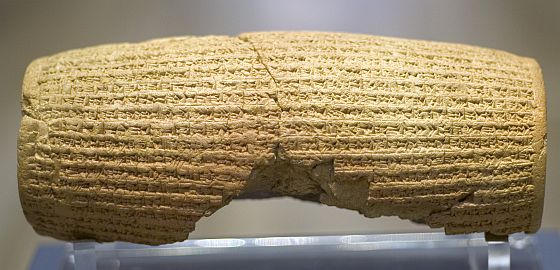
Roger Cohen writes: I wanted to test a theory about Iran, so the other evening I made my way to the British Museum, strolled past glass cases full of the sarcophagi and mummies of ancient Egypt, and found myself in a room whose centerpiece is a baked clay cylinder smaller than an American football.
The object, somewhat the worse for wear after two-and-a-half millennia, was dug up in what once was Babylon, now Iraq, in 1879 during a British Museum excavation. Made soon after Cyrus of Persia captured Babylon in 539 B.C., it is covered in the spiky characters of Babylonian cuneiform. Neil MacGregor, the director of the museum, has called it “the first real press release.” More dubiously, and more frequently, it has been called “the first bill of human rights.”
This, of course, is the much debated Cyrus Cylinder, which says that, aided by the chief Babylonian god Marduk, Cyrus (“King of the universe, the great king”) captured Babylon without a fight, repatriated deported people living in Babylonian exile, and, as the museum put it in 2010, “restored shrines dedicated to different gods.”
It has been widely interpreted as the decree of an enlightened ruler determined to allow diverse peoples to rebuild their altars and worship their gods in their own way in their own place with their own sacred images. Cyrus, in this reading, is a father of the multifaith society.
Among the peoples allowed by Cyrus to return — at least in a widely accepted reading recounted in the Bible — were the Jews, who went back to Jerusalem to rebuild the Temple. So did their exile end. Weeping beside the waters of Babylon ceased. Cyrus the Persian became a revered figure in the Hebrew Bible, a monarch from what is now Iran who ended the banishment of the Jews.
A small crowd had gathered around the Cylinder. They were there to wish it well. This week it departs for a nine-month stay in the United States, where it has not previously been seen, although presidents, including Thomas Jefferson (who owned two copies of the Cyropaedia, Xenophon’s description of a ruler’s ideal education), have been admirers of Cyrus.
The Cylinder will be displayed on the East Coast at the Smithsonian in Washington and the Metropolitan Museum in New York; and on the West Coast at the Asian Art Museum in San Francisco and the Getty Villa in Los Angeles. It will also make an appearance in Texas at Houston’s Museum of Fine Arts.
This New World odyssey of the Cyrus Cylinder is timely. It occurs with the United States and Iran still locked in the negative stereotypes the movie “Argo” has done nothing to assuage. As John Limbert, a former U.S. hostage in Iran, has observed, the Islamic Republic sees America as “belligerent, sanctimonious, godless and immoral.” America, in turn, sees Iran as “devious, mendacious, fanatical.” Or at least on the surface they do. Somewhere beneath that lurks mutual fascination.
The Cylinder will not resolve this antagonism. But, compact and mute, it carries a message of tolerance. It is a powerful antidote to belligerent certitudes and shrieking “truths” — an object packed with ambiguity and now freighted with a 2,500-year-old tale of human vanity and frailty. [Continue reading…]

Michael Cohen writes: On 1 March, the most dreaded word in Washington will become a fiscal reality – sequestration. Just those four syllables are enough to send chills up the spine. The across-the-board spending cuts will impact a host of federal agencies, but especially the Defense Department. It will become the law of the land, plunging the nation into a bleak, dystopian future in which (possibly) the rivers will boil over, locusts will consume the nation’s agricultural bounty, and cats will sleep with dogs. America will almost overnight be reduced to a second-rate power, quickly to be overrun by hordes of foreign insurgents empowered by America’s retreat from the global stage.
Obviously, I am exaggerating. But only sort of. If you listen to American’s military leaders talk about the impact of sequestration, you might be convinced that, in fact, the sky is falling.
According to the nation’s highest-ranking soldier, chairman of the Joint Chiefs of Staff, Martin Dempsey (pdf), sequestration will “put the nation at greater risk of coercion”. This is actually tame when compared to Secretary of Defense Leon Panetta’s prediction that sequestration would “invite aggression”. His deputy, Ashton Carter calls sequestration and the possibility of a year-long continuing resolution to fund military operation as “twin evils” (pdf). In the words of Chuck Hagel, the man likely to replace Panetta, the spending reductions would “devastate” the military.
The uniformed military is no less ominous in its warnings. Admiral Jonathan Greenert, head of US Naval Operations, says the cuts will “dramatically reduce: (pdf) our overseas presence; our ability to respond to crises; our efforts to counter terrorism and illicit trafficking” and “may irreversibly damage the military industrial base”. General James Amos, Commandant of the Marin Corps goes even further (pdf), in warning that a failure to properly resource the military will put the “continued prosperity and security interests” of the United States at risk.
This is threat-mongering that gives threat-mongering a bad name. While one can reasonably argue that sequestration is a brain-dead method of cutting Pentagon spending (it is) the rhetoric of the Joint Chiefs is so over the top it should give every American pause – not only in its confidence about the supposed adaptability of our armed forces, but also in the unseemly public relations game being played here. [Continue reading…]
Rachel Shabi writes: On Wednesday, George Galloway walked out of a meeting because it turned out he was going to be debating an Israeli. “I was misinformed” he said. “I don’t debate with Israelis. I don’t recognise Israel.” Later, he clarified the tactic on Twitter: “Israel: simple, No recognition No normalisation. Just Boycott, divestment, sanctions.”
Galloway is not alone in holding such sentiments – but as a tactic in support of Palestinians, it’s a dead end. Primarily, that’s because the Boycott, Divestment and Sanctions (BDS) movement doesn’t call for the avoidance of people purely on the basis of nationality. Thanks to Galloway, its national committee has just issued a statement, to clear up this particular fallacy.
Whatever your views on BDS – and there are many – Galloway’s move is plainly an own goal (assuming his goal is to support Palestinians, rather than generate publicity for himself). One reason that many left-leaning Jews don’t join the BDS movement is precisely because the boycott is perceived to be about rage against people, rather than an effective political tool. What’s the best way to cement that belief? Announce you’re avoiding Israelis as part of your commitment to BDS. Cue a flood of “told you sos” from those who say its all about punishing Israelis just for being who they are. [Continue reading…]
There’s a big difference between concluding that talking is fruitless, and refusing to talk.
Refusing to talk, prejudges the outcome and it attaches more significance to the act of communication than its content.
What talking can do is open a door into a creative space. It opens the possibility of arriving somewhere new.
Talking engages the plasticity of the human mind.
Rigid minds are always in conflict with the world because the world is always changing. So, even if we find ourselves up against the rigidity of others, it at least serves our own interests to keep our own minds flexible and explore the malleability of our own thought.
Yousaf Butt at Bulletin of the Atomic Scientists writes: Last week, the Washington Post reported that “purchase orders obtained by nuclear researchers show an attempt by Iranian agents to buy 100,000 … ring-shaped magnets” and that such “highly specialized magnets used in centrifuge machines … [are] a sign that the country may be planning a major expansion of its nuclear program.” As evidence, the Post’s Joby Warrick cited a report authored by David Albright of the Institute for Science and International Security (ISIS); dated Feb. 13, the report says that an Iranian firm, Jahan Tech Rooyan Pars Co., made an inquiry “posted on a Chinese commercial website … to buy 100,000 ring magnets.” As Warrick goes on to explain: “it is unclear whether the attempt succeeded.”
There are serious deficiencies in both the Washington Post story and the assertions in the ISIS report. Given that issues of war and peace may hang on the veracity of such claims, the assertions warrant careful scrutiny.
The magnets in question have many uses besides centrifuges and are not only, as Warrick describes them, “highly specialized magnets used in centrifuge machines.” Such ceramic ring magnets are everyday items and have been used in loudspeakers, for example, for more than half a century. The ISIS report neglects to explain the many other applications for such ceramic ring magnets and jumps to the conclusion that the inquiry is surely related to Iran’s nuclear program. Why ISIS does not offer alternate and more plausible applications of these unspecialized magnets is a puzzle. Such magnets are used in a variety of electronic equipment. For instance, one vendor outlines some of the various possible uses in speakers, direct current brushless motors, and magnetic resonance imaging equipment.
This is not the first time ring magnets have surfaced in allegations related to centrifuge applications. Almost exactly a decade ago, as the United States was preparing to invade Iraq, then-director of the International Atomic Energy Agency Mohamed ElBaradei said that reports regarding similar ring magnets in Iraq were unrelated to centrifuges: [Continue reading…]
Goran Tomasevic reports: Rebel fighters in Damascus are disciplined, skilled and brave.
In a month on the frontline, I saw them defend a swathe of suburbs in the Syrian capital, mount complex mass attacks, manage logistics, treat their wounded – and die before my eyes.
But as constant, punishingly accurate, mortar, tank and sniper fire attested, President Bashar al-Assad’s soldiers on the other side, often just a room or a grenade toss away, are also well drilled, courageous – and much better armed.
So while the troops were unable to dislodge brigades of the Free Syrian Army from devastated and depopulated neighborhoods just east of the city centre – and indeed made little effort to do so – there seems little immediate prospect of the rebels overrunning Assad’s stronghold. The result is bloody stalemate.
I watched both sides mount assaults, some trying to gain just a house or two, others for bigger prizes, only to be forced back by sharpshooters, mortars or sprays of machinegun fire.
As in the ruins of Beirut, Sarajevo or Stalingrad, it is a sniper’s war; men stalk their fellow man down telescopic sights, hunting a glimpse of flesh, an eyeball peering from a crack, use lures and decoys to draw their prey into giving themselves away. [Continue reading…]
David Rohde writes: The Obama administration’s policy toward Syria is a failure. Iran, Hezbollah and Russia are funneling more aid, armaments and diplomatic cover to Bashar al-Assad. And Syrian rebels who once hailed the United States now loathe it.
Across the country, pro-Assad forces use airplanes, Scud ballistic missiles and artillery to level rebel controlled neighborhoods. While Syrian insurgents fight with the tragi-comic “D.I.Y. weapons” displayed in this Atlantic slide show.
In an incisive essay published this week in the London Review of Books, Ghaith Abdul-Ahad, a journalist with the Guardian, described the continued atomization of the Syrian opposition. Abdul-Ahad, an Iraqi who covered the dissolution of his own nation, freely admits that “we in the Middle East have always had a strong appetite for factionalism.” But then he delivers a damning description of how prevarication in Washington creates deepening anti-Americanism among the rebels.
“Why are the Americans doing this to us?” one rebel commander demands. “They told us they wouldn’t send us weapons until we united. So we united in Doha. Now what’s their excuse?”
In the meantime, hard-line jihadists and their funders in the Persian Gulf are filling the void.
“Maybe we should all become jihadis,” the exasperated commander declares. “Maybe then we’ll get money and support.”
The time has come for the Obama administration to mount a new policy in Syria. But don’t expect one anytime soon.
In an interview on Thursday, a senior administration official played down a report in the The New York Times Monday that President Barack Obama might reconsider arming Syria’s opposition. The official confirmed that Obama rejected a proposal last year from four of his top national security advisers that the U.S. arm the rebels.
But he said a subsequent review by American intelligence officials had concluded that only a large infusion of sophisticated weaponry would tip the military balance against the Assad regime.
“We have to assess what it would take to change the calculus,” the official said, “and hasten the transition.”
Repeating prior arguments, the official said the administration opposed supplying the rebels with anti-aircraft missiles out of concern that the weapons could fall into the hands of jihadists.
“God forbid a U.S. weapon be used to strike an Israeli passenger plane or land in Israel,” said the official, who asked not to be named.
The Independent reports: Hundreds of children – some as young as nine – have been illegally detained and in many cases tortured by the Egyptian police following the protests which erupted after the second anniversary of the 2011 uprising.
In what lawyers and activists say is a retrenchment of state brutality akin to the worst abuses of power during Hosni Mubarak’s regime, large numbers of children have been unlawfully imprisoned in camps used by Egypt’s central security forces.
Rights groups say that many of those detained have been subjected to cruel mistreatment, including beatings, electrocution and “hanging” torture. Others were forced by their tormentors to strip naked before being drenched with cold water.
One lawyer said he believed that up to 400 children, many of them barely teenagers, may have been rounded up during police operations following the outbreak of street clashes on 25 January, the anniversary of Egypt’s rebellion two years ago. [Continue reading…]
Nesrine Malik writes: On a Cambridge University panel on the future of the Arab spring late last year, I nodded and agreed wholeheartedly as a fellow panellist criticised the west’s complicity with fallen Arab dictators, citing the sale of arms to Middle Eastern despots as an indicator of the west’s apathy towards poor human rights records in the region. After rapturous applause, a retired British diplomat in the audience raised his hand, and politely proceeded to dampen the speaker’s moral indignation by stating that the UK was in a difficult situation. Diplomacy, he said, was a far less black and white affair. He pointed out that lucrative military and oil contracts sold to the United Arab Emirates, Saudi Arabia and other countries in the Gulf provided, especially in a time of recession, both much-needed revenue for the state and employment opportunities in the UK.
He acknowledged that human rights abuses in an ideal world should be a primary concern for the west, but said that there were more immediate needs that subordinate such crimes. He even went on to suggest that selling arms, and generally putting trade first in this context, was patriotic – fulfilling a country’s duty to look out for the interest of its citizens. Put starkly, would you take food off British tables to uphold a moral cause abroad?
The extremes of this diplomatic tension occurred in stark uncomfortable proximity this week. The human rights charity Reprieve yesterday claimed that three British tourists arrested for the possession of a synthetic form of cannabis, who have been in custody in the UAE for seven months, had been tortured. Speaking on BBC Radio 4 this morning, the father of one of the three detainees detailed the extent of the mistreatment they endured. A spokesperson for the UK’s Foreign and Commonwealth Office (FCO) confirmed it had been providing “consular assistance” and added the usual “The FCO takes all allegations of mistreatment and torture extremely seriously”. If this is how seriously the British foreign office takes the alleged torture of its own citizens, spare a thought for those non-western prisoners and expats without such representation.
Meanwhile, it was announced two days ago that the UAE had purchased $1.4bn worth of military defence contracts, including drones, from the US. Last year, David Cameron visited the country peddling Eurofighter Typhoon fighter jets in a deal apparently worth over £3bn. [Continue reading…]
Fred Kaplan writes: The New York Times’ front-page report this week that the Chinese army is hacking into America’s most sensitive computer networks from a 12-story building outside Shanghai might finally persuade skeptics that the threat of “cyber warfare” isn’t the fevered fantasy of Richard Clarke, the producers of Die Hard 4, or the generals at the ever-growing U.S. Cyber Command. Alas, it’s real.
But what is the threat? Few of those in the know believe that some fine day, out of the blue, China will zap the programs that run our power grids, gas lines, waterworks, or banking systems, sending our economy — and much else — into a tailspin. Even if the Chinese could pull off such a feat with one keystroke, it’s hard to imagine what they’d accomplish, especially since their fortunes are wrapped up with our own.
The more worrisome threat is subtler: that the Chinese (or some other powers) will use their ability to wreak cyberhavoc as leverage to strengthen their position, and weaken ours, in a diplomatic crisis or a conventional war.
For instance, in a brewing conflict over Taiwan or the South China Sea (areas where China has asserted claims aggressively in recent years), would an American president respond with full military force if he knew that the Chinese would retaliate by turning out all the lights on the Eastern Seaboard?
A familiar concept in strategic war games is “escalation-dominance.” The idea is that victory goes to the player who can take a conflict to the next level of violence in a way that inflicts enormous damage on his opponent but very little on himself. The expected outcome of the next round is so obvious that the opponent decides not to escalate; the dominant player thus controls the subsequent course of the battle and possibly wins the war.
Real war is messier than war games. Escalation holds risks all round. The two sides might have different perceptions of which one is dominant. Or the dominant side might miscalculate the opponent’s strategic priorities. For instance, China might think the American president values uninterrupted electricity on the East Coast more than a free, independent Taiwan — but that thought might be mistaken.
Still, leaders in war and crisis do take these kinds of factors into account. Many surrenders in history have been prompted less by the damage already absorbed than by fears of the damage to come.
And China is not the only foe or rival whose calculations are complicating this new cyber world. Iran is another. Last summer, all of a sudden, a computer virus nicknamed Shamoon erased three-quarters of the Aramco oil company’s corporate files, replacing much of it with images of a burning American flag. It is widely believed that the Iranians planted the “kill switch” in retaliation for the U.S.-Israeli Stuxnet virus that disabled the centrifuges in their nuclear program.
The implicit message sent not only to the United States but also, and perhaps more importantly, to its Arab commercial partners: Don’t mess with us, or we will mess with you. The Shamoon virus is now regarded as the hint of another consequence that we’d likely face in the aftermath of a military strike on Iran’s nuclear facilities. Will it deter such a strike or serve as the final straw in a pile of risks that deters us from striking (or deters the West’s Arab allies from playing whatever part they might play in an attack)? Hard to say, but the Iranians probably intended the virus to have that effect. [Continue reading…]
Imad Mesdoua writes: Retaking the north was the easy part. Now Mali faces guerrilla attacks, reportedly increasing cooperation between rebel groups, ‘the Tuareg problem’, and a divided government.
Early on during the French intervention which began in January 2013, many journalists in the international press were quick to note that Islamist militants had just “melted away” into the vast desert regions of northern Mali. As French jets attacked key strongholds, hundreds of Islamist fighters prepared convoys, which would escort leaders, weapons and fighters away from major towns.
Eye witness accounts confirmed suspicions that the militants’ departure was “orderly” and well-prepared. Their planned withdrawal may indicate their clear intention to redefine the nature of the conflict in Mali on their terms. Indeed, in a document allegedly left behind by al-Qaeda in the Islamic Maghreb (AQIM) in Timbuktu, a senior commander admits that an international intervention would exceed the group’s capability and that they ought therefore to retreat to their “rear bases” for the time being.
Recent events have also shown that local and international troops should prepare for increased resistance and a protracted campaign. Malian soldiers faced the first wave of attacks when various suicide bombers targeted Malian army bases and checkpoints in the city of Gao. A day later, two militants (one Arab and one Tuareg) were intercepted with explosive belts strapped to their bodies. Malian troops were also tested by a significant counter offensive led by the Movement for Oneness and Jihad in West Africa (MUJAO) in the same city on 10 February.
As Mali’s northern provinces become more secure, Islamist militants will increasingly engage in targeted attacks, using asymmetric warfare to test international troops and regain the upper hand. The caves and mountains of the Adrar des Ifoghas region, for example, are ideal locations for militant groups to hide and prepare hit and run operations. [Continue reading…]
Yahoo News: Add Bob Dole—former senator, former presidential candidate, grievously wounded in World War II—to the list of Republican heavy-hitters urging the Senate to confirm the embattled Chuck Hagel as defense secretary.
“Hagel’s wisdom and courage make him uniquely qualified to be Secretary of Defense and lead the men and women of our armed forces,” Dole said in a statement released by the White House. “Chuck Hagel will be an exceptional leader at an important time.”
Hagel, a decorated Vietnam War veteran and Republican former senator from Nebraska, already had the support of five former secretaries of defense from Republican and Democratic administrations—Bob Gates, Bill Cohen, William Perry, Harold Brown and Melvin Laird. He also enjoyed the support of former Senate Armed Services Committee chairmen Sam Nunn (D-Georgia) and John Warner (R- Virginia).
While it’s not clear what pull Dole retains with his former colleagues, Democrats already appear to have lined up the 60 votes needed to break through another Republican filibuster and definitely have the 51 needed to confirm Hagel as Leon Panetta’s successor. Republican Sen. Richard Shelby announced earlier Thursday that he would support Hagel.
Al Monitor reports: During rehearsals in a music school in Gaza, Firas al-Sharafi, age 10, and his friend Abdel Aziz Abu Sharkh, age 11, were playing a song by Lebanese singer Fairuz. The two boys were playing the dulcimer, reading musical notes and occasionally glancing at each other with a smile on their faces.
They dream of joining a big musical group that plays both Eastern and Western musical instruments. Their dream moved closer to reality when they enrolled in the only music school in Gaza five years ago. They go to the school three times a week, and they have mastered the art of reading music and playing both the dulcimer and percussion instruments.
Firas and Abdel Aziz know that their school faces a major challenge this year: financial problems have left the school on the brink of closure. The school had been free to attend, but students now have to pay roughly $600 a year.
“Closing the school would truly sadden us,” Abdel Aziz told Al-Monitor. “What will we do if it closes? Where will we go to learn music? We will continue to send endless emails to people to help our school. I will also make a film about the school to give people an incentive to donate.”
Sefi Rachlevsky writes: Ben Zygier didn’t betray his country. Ben Zygier was betrayed. Between his two home countries, he was placed in a situation he couldn’t deal with. Those who know the facts can attest to this. From the outset of this affair, Israeli contempt for the feeble Jews of the Diaspora knew no boundaries. According to foreign sources, the desire to make use of Ben Zygier’s identity and passport overrode the fact that he was screamingly incompatible for the mission.
The story is a simple one, really. According to foreign sources, Israel allowed itself to cross three boundaries: a Mossad man was asked to retain Australian citizenship – leading to a dual-loyalty dilemma; the identity that he was instructed to use as a cover was his real Australian identity; and, worst of all, he was sent to operate in his homeland.
According to foreign sources, after he was told to change his name in his home country multiple times, an entirely foreseeable problem arose. Zygier’s activities raised suspicions in Australia and its security services called him in for interrogation. He didn’t cooperate with the enemy. Not on his own initiative, nor voluntarily. He was forced to talk to his country’s security services, who threatened to harm his father’s honor, and who sent journalists to speak to him.
Israel is the one that placed him in an impossible dilemma. And then, despite the furor over passports, according to foreign sources, Israel used dozens of them not against the main enemy, Iran – but against Hamas targets, which was probably not a worthy reason to risk these passports’ use. Only then did Australia retaliate by exposing its citizen.
The crass Israeli habit of concealing its misdeeds lost all proportion. Instead of achieving, after a brief inquiry, silence and good will (silence from a man who broke after being left to deal with his identity issues alone, silence obtained for instance even by bringing his father and whole family to Israel to care for them here) – Israel abandoned an Israel-Australian patriot to a fate worse than death.
Those who were raised in Kfar Yehoshua as I did were exposed to a practice whereby chickens that were suspected of carrying diseases were killed before they could infect the others. At the age of eight, I couldn’t bring myself to kill them with my bare hands like my father did. So I found a "humane" solution. Next to the coops were pits full of the rotting corpses of dead birds. I threw the birds that were suspected of being ill into these pits. And Ben Zygier was thrown into such a pit.
The cell in which Ben Zygier died had been built for a prime minister’s murderer. Ben Zygier is that man’s polar opposite. The prime minister’s murderer is the worst traitor in Israel. He was not caught between the dilemmas of dual nationalities. For the murderer, the messianic-religious dilemma superseded his Israeli identity. He was not placed under brutal pressure in his cell to reveal the identities of rabbis who influenced him. He remained smiling and victorious. He was not subjected to suffocating pressure.
During the existential days of the War of Independence, one Meir Tobianski was shot. He was suspected of treason, sentenced in a lightning-quick trial, and was eliminated. His widow, who was not sentenced to silence, fought to restore his honor. A year later, Ben Gurion exonerated him and wrote to her: "Your husband was innocent."
Two things must come out of the Zygier affair. One is clear: the establishment of a quasi-secret state commission of inquiry. The commission must examine the links between Zygier’s death and his identity. But it must also do more than that. There must be genuine examination of how Israel exploits the goodwill of its Jewish supporters, and a clear demarcation of its boundaries.
AFP reports: Israeli guards supposedly keeping a round-the-clock watch on a mystery dual nationality prisoner held in isolation failed to notice his suicide for a full hour, a newspaper reported on Thursday.
Although his cell was fitted with four CCTV cameras, the guards did not see Ben Zygier, identified by media as an Australian-Israeli Mossad agent, remove a sheet from his bed and take it with him into the shower cubicle.
“For an unknown reason, none of the guards discerned him doing that,” the Yediot Aharonot newspaper reported.
It said that one camera covered the shower “in a way that allowed for the prisoner’s head to be visible without invading his more intimate privacy.”
“It was only after an entire hour had passed that (the guards) realised that the prisoner was nowhere to be seen in any of the areas picked up by the four cameras, at which point they rushed to his cell, where they discovered his body dangling in the shower stall,” it said.
“They were busy with something else,” an prisons service official told the paper.
“The bottom line is that the prisoner died, and we failed in our job of keeping him alive.”
The Guardian reports: An Academy-nominated Palestinian film-maker has spoken of the “unpleasant experience” of being detained by US immigration officials when he arrived for this weekend’s Oscars ceremony.
Emad Burnat said that he was held for about an hour at Los Angeles airport on Tuesday, along with his wife and youngest son Gibreel, who plays a central role in Oscar-nominated documentary 5 Broken Cameras.
Burnat said that he thought that US immigration officials – who apparently doubted his credentials – would send him back to Palestine. He compared the incident to daily life for Palestinians under the Israeli occupation.
“Immigration officials asked for proof that I was nominated for an Academy Award for 5 Broken Cameras, and they told me that if I couldn’t prove the reason for my visit, my wife Soraya, my son Gibreel and I would be sent back to Turkey on the same day,” Burnat said in a statement.
“After 40 minutes of questions and answers, Gibreel asked me why we were still waiting in that small room. I simply told him the truth: ‘Maybe we’ll have to go back.’ I could see his heart sink.”
Five Broken Cameras chronicles the events surrounding Israel’s creation of a separation wall in Burnat’s West Bank village of Bil’in. Burnat, a farmer, initially bought the camera to capture Gibreel’s development before using footage for the documentary.
Burnat said his experience was “a very minor example of what my people face every day.”
Although it’s ironic that a possible recipient of America’s most celebrated cultural honor would get this kind of reception, what most Americans do not understand is that every foreigner entering this country is treated as a criminal suspect. Every noncitizen visitor is fingerprinted and this along with other biometric data is kept by the Department of Homeland Security for 75 years. Welcome to America.
Some stories you have to work for – while others just fall in your lap. That was the case for me in the summer of 2006, when a senior source inside the Pentagon laid out the Bush administration’s covert program to arm and then set loose a Fatah militia in Gaza. It was hoped that the resulting coup would reverse the January 2006 Palestinian election, which Hamas had won, and buttress the fortunes of Palestinian Authority President Mahmoud Abbas. The story came complete with documents and enraged officials. That is to say: it fell into my lap.
What was so shocking about the story was that, at least here in the U.S., the details of the Bush administration’s initiative were almost unknown. That wasn’t true in the Middle East, where regional leaders openly questioned the covert program’s necessity. Egypt’s then-President Mubarak and Jordan’s King Abdullah bluntly told U.S. officials that they believed the program would backfire – staining America’s already sullied regional reputation.
In early January of 2007, just months after being fed details of the covert program, I wrote and published a summary of what I had found. Elliot Abrams was at the center of my story because he was at the center of the covert program. It was his brainchild, his “baby.”
That same month I sent the details of what I knew to my colleague David Rose, who was following the same leads. His article, “The Gaza Bombshell,” was published by Vanity Fair in April 2008 and contained new details of the Bush administration’s plan – and how it had failed. “The Gaza Bombshell” was, in fact, a bombshell.
Sorting through the history of the Bush administration’s adventures in the Middle East is crucial to understanding how and why America lost its footing in the region and continues to struggle to recoup its credibility. But you wouldn’t know that from reading Elliot Abrams’ new tome, Tested By Zion, on his time as President Bush’s most powerful Middle East advisor. Touted as a “diplomatic tour de force” and “definitive,” the book’s promoters elegantly ignore a larger truth: that Abrams authored one of the most ill-conceived Middle East interventions in American history.

Elliot Abrams, former Deputy National Security Advisor for Global Democracy Strategy in the Bush Administration, 2005-2009.
Deputy National Security Advisor, Elliott Abrams — who Newsweek recently described as “the last neocon standing” — has had it about for some months now that the U.S. is not only not interested in dealing with Hamas, it is working to ensure its failure. In the immediate aftermath of the Hamas elections, last January, Abrams greeted a group of Palestinian businessmen in his White House office with talk of a “hard coup” against the newly-elected Hamas government — the violent overthrow of their leadership with arms supplied by the United States. While the businessmen were shocked, Abrams was adamant — the U.S. had to support Fatah with guns, ammunition and training, so that they could fight Hamas for control of the Palestinian government.
While those closest to him now concede the Abrams’ words were issued in a moment of frustration, the “hard coup” talk was hardly just talk. Over the last twelve months, the United States has supplied guns, ammunition and training to Palestinian Fatah activists to take on Hamas in the streets of Gaza and the West Bank. A large number of Fatah activists have been trained and “graduated” from two camps — one in Ramallah and one in Jericho. The supplies of rifles and ammunition, which started as a mere trickle, has now become a torrent (Haaretz reports the U.S. has designated an astounding $86.4 million for Mahmoud Abbas’s security detail), and while the program has gone largely without notice in the American press, it is openly talked about and commented on in the Arab media — and in Israel. Thousands of rifles and bullets have been poring into Gaza and the West Bank from Egypt and Jordan, the administration’s designated allies in the program.
At first, it was thought, the resupply effort (initiated under the guise of “assist[ing] the Palestinian Authority presidency in fulfilling PA commitments under the road map to dismantle the infrastructure of terrorism and establish law and order in the West Bank and Gaza,” according to a U.S. government document) would strengthen the security forces under the command of Palestinian President Mahmoud Abbas. Officials thought that the additional weapons would easily cow Hamas operatives, who would meekly surrender the offices they had only recently so dearly won. That has not only not happened, but the program is under attack throughout the Arab world — particularly among America’s closest allies.
While both Egypt and Jordan have shipped arms to Mahmoud Abbas under the Abrams program (Egypt recently sent 1,900 rifles into Gaza and the West Bank, nearly matching the 3000 rifles sent by the Jordanians), neither Jordan’s King Abdullah nor Egypt’s Hosni Mubarak believe the program will work — and both are now maneuvering to find a way out of it. “Who can blame them?” an administration official told us recently. “While Mubarak has no love for Hamas, they do not want to be seen as bringing them down. The same can be said for Jordan.” A Pentagon official was even more adamant, cataloguing official Washington’s nearly open disdain for Abrams’ program. “This is not going to work and everyone knows it won’t work. It is too clever. We’re just not very good at this. This is typical Abrams stuff.” This official went on to note that “it is unlikely that either Jordan or Egypt will place their future in the hands of the White House. Who the hell outside of Washington wants to see a civil war among Palestinians? Do we really think that the Jordanians think that’s a good idea. The minute it gets underway, Abdullah is finished. Hell, fifty percent of his country is Palestinian.”
Senior U.S. Army officers and high level civilian Pentagon officials have been the most outspoken internal administration critics of the program, which was unknown to them until mid-August, near the end of Israel’s war against Hezbollah. When Secretary of Defense Donald Rumsfeld learned about it he was enraged, and scheduled a meeting with President Bush in an attempt to convince him the program would backfire. Rumsfeld was concerned that the anti-Hamas program would radicalise Muslim groups among American allies and eventually endanger U.S. troops fighting Sunni extremists in Iraq. According to our reports, Rumsfeld was told by Bush that he should keep his focus on Iraq, and that “the Palestinian brief” was in the hands of the Secretary of State. After this confrontation, Rumsfeld decided there was not much he could do.
The Abrams program was initially conceived in February of 2006 by a group of White House officials who wanted to shape a coherent and tough response to the Hamas electoral victory of January. These officials, I am told, were led by Abrams, but included national security advisors working in the Office of the Vice President, including prominent neo-conservatives David Wurmser and John Hannah. The policy was approved by Condoleezza Rice. The President then, I am told, signed off on the program in a CIA “finding” and designated that its implementation be put under the control of Langley. But the program ran into problems almost from the beginning. “The CIA didn’t like it and didn’t think it would work,” I was told in October. “The Pentagon hated it, the US embassy in Israel hated it, and even the Israelis hated it.” A prominent American military official serving in Israel called the program “stupid” and “counter-productive.” The program went forward despite these criticisms, however, though responsibility for its implementation was slowly put in the hands of anti-terrorism officials working closely with the State Department. The CIA “wriggled out of” retaining responsibility for implementing the Abrams plan, I have been told. Since at least August, Rice, Abrams and U.S. envoy David Welch have been its primary advocates and the program has been subsumed as a “part of the State Department’s Middle East initiative.” U.S. government officials refused to comment on a report that the program is now a part of the State Department’s “Middle East Partnership Initiative,” established to promote democracy in the region. If it is, diverting appropriated funds from the program for the purchase of weapons may be a violation of Congressional intent — and U.S. law.
The recipients of U.S. largesse have been Palestinian President Mahmoud Abbas and Mohammad Dahlan, a controversial and charismatic Palestinian political leader from Gaza. The U.S. has also relied on advice from Mohammad Rashid, a well-known Kurdish/Palestinian financier with offices in Cairo. Even in Israel, the alliance of the U.S. with these two figures is greeted with almost open derision. While Prime Minister Ehud Olmert has hesitantly supported the program, many of his key advisors have made it clear that they want to have nothing to do with starting a Palestinian civil war. They also doubt whether Hamas can be weakened. These officials point out that, since the beginning of the program, Hamas has actually gained in strength, in part because its leaders are considered competent, transparent, uncorrupt and unwilling to compromise their ideals — just the kinds of democratically elected leaders that the Bush Administration would want to support anywhere else in the Middle East.
Of course, in public, Secretary Rice appears contrite and concerned with “the growing lawlessness” among Palestinians, while failing to mention that such lawlessness is exactly what the Abrams plan was designed to create. “You can’t build security forces overnight to deal with the kind of lawlessness that is there in Gaza which largely derives from an inability to govern,” she said during a recent trip to Israel. “Their [the Hamas-led Palestinian Authority] inability to govern, of course, comes from their unwillingness to meet international standards.” Even Middle East experts and State Department officials close to Rice consider her comments about Palestinian violence dangerous, and have warned her that if the details of the U.S. program become public her reputation could be stained. In fact, Pentagon officials concede, Hamas’s inability to provide security to its own people and the clashes that have recently erupted have been seeded by the Abrams plan. Israeli officials know this, and have begun to rebel. In Israel, at least, Rice’s view that Hamas can be unseated is now regularly, and sometimes publicly, dismissed.
According to a December 25 article in the Israeli daily Haaretz, senior Israeli intelligence officials have told Israeli Prime Minister Ehud Olmert that not only can Hamas not be replaced, but that its rival, Fatah, is disintegrating. Any hope for the success of an American program aimed at replacing Hamas, these officials argued, will fail. These Israeli intelligence officials also dismissed Palestinian President Mahmoud Abbas’s call for elections to replace Hamas — saying that such elections would all but destroy Fatah. As Haaretz reported: “Shin Bet chief Yuval Diskin told the cabinet Sunday [December 24] that should elections be held in the Palestinian Authority, Fatah’s chances of winning would be close to zero. Diskin said during Sunday’s weekly cabinet meeting that the Fatah faction is in bad shape, and therefore Israel should expect Hamas to register a sweeping victory.”
Apparently Jordan’s King Abdullah agrees. On the day this article appeared, December 25, Abdullah kept Palestinian President Mahmoud Abbas waiting for six hours to see him in Amman. Eventually, Abdullah told Abbas that he should go home — and only come to see him again when accompanied by Hamas leader and Palestinian Prime Minister, Ismail Haniyeh. Most recently, Saudi officials have welcomed Haniyeh to Saudi Arabia for talks, having apparently made public their own views on the American program to replace Hamas. And so it is: one year after the election of Hamas, and one year after Elliot Abrams determined that sowing the seeds of civil war among a people already under occupation would somehow advance America’s program for democracy in the Middle East, respect for America’s democratic ideals has all but collapsed — and not just in Iraq.
Mark Perry is a Washington-based author and reporter. His most recent book is Talking To Terrorists. His forthcoming book (Basic Books, 2013) is a study of the relationship between President Franklin Roosevelt and General Douglas MacArthur. Perry served as an unofficial advisor to PLO Chairman and Palestinian President Yasser Arafat from 1989 to 2004.
