Palestine says Israel ‘torture’ killed inmate

Al Jazeera reports: The Palestinian government is alleging that a Palestinian man who died in Israeli custody was tortured to death, dismissing claims that his death was due to a heart attack.

Arafat Jaradat’s autopsy showed torture resulting from fractures in his body and skull while his heart was in good condition, said Issa Qaraqaa, the minister in charge of prisoner affairs, citing a Palestinian doctor who took part in the autopsy.

“These results prove Israel killed him,” Qaraqaa told a news conference on Sunday.

Jaradat died on Saturday in an Israeli jail from what prison authorities initially said appeared to have been a cardiac arrest.

The 30-year-old man from Sair near Hebron in the occupied West Bank was arrested last Monday for alleged involvement in a November 2012 stone-throwing incident that injured an Israeli, according to Israel’s Shin Bet domestic intelligence service.

The death of Jaradat set off more clashes between Israeli troops and Palestinian stone-throwers in several areas of the West Bank on Sunday.

Facebooktwittermail

Israeli licence to Cheney-linked energy firm on Golan Heights raises eyebrows

IPS reports: In a potential new source of contention between President Barack Obama and Israeli Prime Minister Benjamin Netanyahu, Israel has reportedly granted a U.S. energy firm with heavyweight political connections to explore for oil and gas in the occupied Golan Heights.

The company is a local subsidiary of New Jersey-based Genie Energy Ltd. The Strategic Advisory Board of another subsidiary, Genie Oil and Gas, includes former Vice President Dick Cheney, media magnate Rupert Murdoch, and former Republican Rep. Jim Courter.

It also includes several prominent investment managers, such as Jacob Rothschild, chairman of the J. Rothschild group, and Michael Steinhardt, a major contributor to Jewish and Zionist causes, notably Birthright Israel, a multi-million-dollar programme to bring young Diaspora Jews to Israel.

The granting of the licence by Israel’s Ministry of Energy and Water Resources, which was initially reported by Dow Jones Thursday, comes amidst continuing civil war in Syria, which has demanded the return of the Heights since Israel took them in the 1967 Arab-Israeli War.

It also comes a month before Obama is scheduled to make his first visit to Israel as president.

Some analysts here compared the move to previous announcements by the Netanyahu government of new settlement construction on the West Bank or East Jerusalem — either on the eve of or during meetings with top U.S. officials – that have clearly contributed to thinly veiled tensions that exist between the two leaders.
[Continue reading…]

Facebooktwittermail

Islamist rebels recruited child soldiers from Mali schools

The Associated Press reports: The radical Islamic fighters showed up at Mohammed Salia’s Quranic school, armed with weapons and demanding to address his students.

The leader, named Hamadi, entered one of the classrooms, took a piece of chalk and scrawled his message on the blackboard.

“How to wage holy war,” he wrote in Arabic. “How to terrorise the enemy in combat,” the lesson plan continued.

Then his mobile phone rang, and he stepped away to answer. Mr Salia urged his students to pose some questions of their own when he returned: Where had he come from and what did he want with a bunch of young people?

Hamadi told the students that people didn’t ask questions like that – where he was from.

Islam knows no nationality, he replied and then left – and did not return before the French-led military operation ousted him and his fighters from power last month.

“I told my students to be careful: that these men may be well-versed in the Quran but their Islamic point of view is not the same as ours,” the teacher recalled.

Nearly a month after the Al Qaeda-linked militants were driven out of Gao and into the surrounding villages, students are now returning to the city’s Quranic schools.

Many classrooms, though, are still half full, as tens of thousands of people fled the fighting and strict Islamic rule the extremists.

However, other pupils left Gao not with their families but with the Islamic fighters when they retreated, say human rights activists and local officials. [Continue reading…]

Facebooktwittermail

Is smart making us dumb?

Evgeny Morozov writes: Would you like all of your Facebook FB -0.56% friends to sift through your trash? A group of designers from Britain and Germany think that you might. Meet BinCam: a “smart” trash bin that aims to revolutionize the recycling process.

BinCam looks just like your average trash bin, but with a twist: Its upper lid is equipped with a smartphone that snaps a photo every time the lid is shut. The photo is then uploaded to Mechanical Turk, the Amazon-run service that lets freelancers perform laborious tasks for money. In this case, they analyze the photo and decide if your recycling habits conform with the gospel of green living. Eventually, the photo appears on your Facebook page.

You are also assigned points, as in a game, based on how well you are meeting the recycling challenge. The household that earns the most points “wins.” In the words of its young techie creators, BinCam is designed “to increase individuals’ awareness of their food waste and recycling behavior,” in the hope of changing their habits.

BinCam has been made possible by the convergence of two trends that will profoundly reshape the world around us. First, thanks to the proliferation of cheap, powerful sensors, the most commonplace objects can finally understand what we do with them—from umbrellas that know it’s going to rain to shoes that know they’re wearing out—and alert us to potential problems and programmed priorities. These objects are no longer just dumb, passive matter. With some help from crowdsourcing or artificial intelligence, they can be taught to distinguish between responsible and irresponsible behavior (between recycling and throwing stuff away, for example) and then punish or reward us accordingly — in real time.

And because our personal identities are now so firmly pegged to our profiles on social networks such as Facebook and Google, our every interaction with such objects can be made “social”—that is, visible to our friends. This visibility, in turn, allows designers to tap into peer pressure: Recycle and impress your friends, or don’t recycle and risk incurring their wrath.

These two features are the essential ingredients of a new breed of so-called smart technologies, which are taking aim at their dumber alternatives. Some of these technologies are already catching on and seem relatively harmless, even if not particularly revolutionary: smart watches that pulsate when you get a new Facebook poke; smart scales that share your weight with your Twitter followers, helping you to stick to a diet; or smart pill bottles that ping you and your doctor to say how much of your prescribed medication remains.

But many smart technologies are heading in another, more disturbing direction. A number of thinkers in Silicon Valley see these technologies as a way not just to give consumers new products that they want but to push them to behave better. Sometimes this will be a nudge; sometimes it will be a shove. But the central idea is clear: social engineering disguised as product engineering.

In 2010, Google Chief Financial Officer Patrick Pichette told an Australian news program that his company “is really an engineering company, with all these computer scientists that see the world as a completely broken place.” Just last week in Singapore, he restated Google’s notion that the world is a “broken” place whose problems, from traffic jams to inconvenient shopping experiences to excessive energy use, can be solved by technology. The futurist and game designer Jane McGonigal, a favorite of the TED crowd, also likes to talk about how “reality is broken” but can be fixed by making the real world more like a videogame, with points for doing good. From smart cars to smart glasses, “smart” is Silicon Valley’s shorthand for transforming present-day social reality and the hapless souls who inhabit it. [Continue reading…]

Facebooktwittermail

Why America reserves the right to start a nuclear war

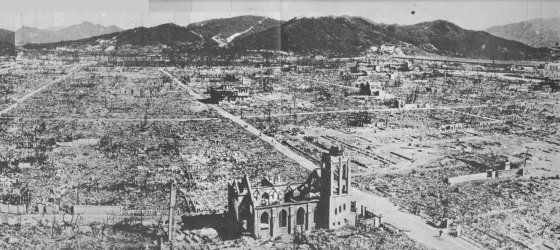
Hiroshima, August, 1945

John Arquilla writes: In 1945, Harry Truman ordered the first atomic bombing of another country; today, Barack Obama reserves the right to mount the world’s next nuclear strike — as have all American presidents since Truman. It is very odd that senior U.S. foreign policy officials, who have devoted most of the past seven decades to trying to control the spread of nuclear weapons, still want Washington to be able to use them first in a pinch. Even President Obama, a supporter of the abolition of all nuclear weapons, wants to be able to fire the first nuclear shot. No wonder North Korea, Iran, and others view efforts to get them to renounce their proliferation programs with much skepticism.

To be sure, the American ardor for atomic weapons has cooled since the famous Fortune magazine survey of December 1945, in which 22 percent of the public expressed the view that far more than “just” two nukes should have been dropped on Japan. Yet even as enthusiasm for inflicting massive destruction on others waned, there was still considerable fascination with these weapons in government and the military. Indeed, the idea of waging preventive nuclear war on Soviet Russia or communist China — that is, hitting them before they had nukes of their own — was closely considered for years, finally being rejected by Dwight Eisenhower in 1954.

This was the same year, however, that he articulated a doctrine of “massive retaliation” for any sort of act of aggression. Thus an incursion by some aggressor’s conventional forces was now theoretically subject to a nuclear riposte. The idea was that this threat would keep the peace around the world. It didn’t. Instead, a spate of irregular wars and acts of terrorism arose and, as Thomas Schelling put it in his classic Arms and Influence, the massive retaliation policy “was in decline almost from its enunciation.” [Continue reading…]

Facebooktwittermail

No, North Korea did not just test an Iranian nuke

Jeffrey Lewis writes: When I last traveled to Seoul, I took in a ballgame. (I am now a fierce partisan of the Doosan Bears.) I headed to the ballpark, anticipating the perfect marriage of Korean and American culture: kimchi dogs!

As it turns out, South Koreans eat fried chicken at baseball games. Who knew? For reasons I cannot fathom, it has never occurred to anyone to smother a hot dog in spicy kimchi, despite the fact that this is fusion cuisine’s answer to peanut butter and jelly. The moral of this little tale is that just because two things ought to go great together, the real world sometimes disappoints.

Which brings us to nuclear cooperation between North Korea and Iran. There have been any number of stories in recent days detailing the allegedly close and continuing cooperation between nuclear weaponeers in both countries. A casual reader perusing the Sunday Times, Jerusalem Post, Kyodo News, and Chosun Ilbo might very well conclude that North Korea’s nuclear test was as good as an Iranian one. “Why Iran already has the bomb,” was the provocative title of an article in Tablet.

But, like kimchi dogs, it’s an obvious idea that doesn’t seem to have a basis in fact.

Many of the people pushing the “Iranian test” hypothesis are simply trying to hijack a Northeast Asian crisis for their own preferred policy in the Middle East, which usually involves bombing the crap out of Iran. Others are probably just fascinated by the idea of an international rogues gallery of scientists holed up in a fortress of doom, testing nuclear weapons. (Imagine Mohsen Fakhrizadeh asking Dr. No how he lost his hands, with Ri Je-son rolling his eyes at having to hear that story one more time.)

Few of these authors, however, seem to have thought very carefully about either the status of Iran’s nuclear program or the purpose of testing nuclear weapons in general. A careful consideration of both, however, helps illustrate why the reality is probably a lot less exciting than the headlines. [Continue reading…]

Facebooktwittermail

The British Empire was built on a mountain of skulls

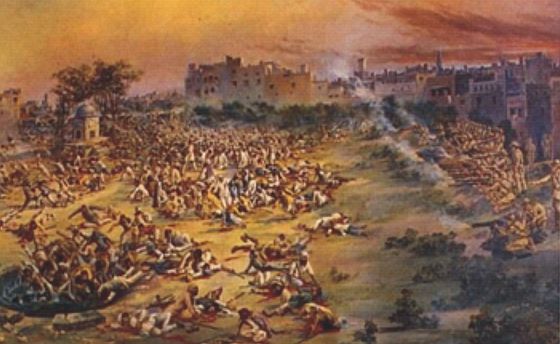
William Dalrymple writes: On 13 April 1919 a large group of Punjabis protesting against British rule gathered in the Jallianwala Bagh in Amritsar. They were incensed at the arrest of two of their leaders, and for 24 hours the city had been consumed by riots. At five in the afternoon, General Reginald Dyer marched into Jallianwala Bagh with 140 troops, most of them Gurkhas, but with a few Sikhs and Baluchis as well. Having blocked the exits, they fired into the peaceful and unresisting crowds until they had exhausted all their ammunition. Official estimates put the casualties at 379 killed and 1,200 injured. Popular estimates put the casualties as much as 10 times higher.

The massacre was a major turning point for the Indian freedom struggle and, along with Gandhi’s Salt March 11 years later in 1930, was one of the two forces that gave India’s march towards independence its unstoppable momentum. For a generation of Anglophile Indians brought up on British propaganda that British rule was just and uncorrupt, and that it had replaced centuries of arbitrary tyranny at the hands of brutal Muslim invaders, Jallianwala Bagh was a moment of revelation. Rabindranath Tagore immediately gave back his knighthood. The Nehrus were radicalised overnight. Gandhi lost his faith – intact until that point – in British justice, and wrote that he had “underrated the forces of evil” in the British empire.

But Jallianwala Bagh was by no means the worst atrocity committed by the British in India. Following the British conquest of Bengal in 1757, the province was left devastated by war and high taxation, then stricken by famine. According to Edmund Burke, the women of Bengal suffered mass rape at the hands of East India Company tax collectors. Certainly the wealth of Bengal rapidly drained into British bank accounts, while its prosperous weavers and artisans were coerced “like so many slaves” by their new British masters, and the markets flooded with British products.

More horrific still were the actions of the British army sent into Afghanistan in 1842 to take revenge for the massacre of troops during the retreat from Kabul earlier in the year. All the villages in its path were looted and torched and the women were raped. When the army got to Kabul the city was deliberately consigned to the flames. [Continue reading…]

Facebooktwittermail

The next wave of religious violence

Patrick Martin writes: A new wave of sectarian violence has engulfed the Near East, the crest of which has reached Pakistan, where 200 Shia Muslims have been killed in two recent bombing attacks carried out by Sunni extremists.

The first attack came Jan. 10, when twin bombs were used. First, a suicide bomber detonated his explosives inside a popular Shia billiards hall in the Baluchistan capital of Quetta, killing several people. Then, a car bomb was detonated moments later when enough people had rushed to the scene to help the wounded.

Members of the Shia community say that, coming after several months of lower-level assaults that claimed the lives of more than 400 people in 2012, this sinister attack had finally gone too far.

In a profound protest, thousands of Shiites in Baluchistan province blocked the streets and announced they would not bury their dead until the government dismissed the provincial governor and declared martial law. The government relented after days of such demonstrations, joined by others across the country and in many cities around the world, including Toronto.

It did little good. On Feb. 16 another attack hit the community when a water truck filled with explosives blew up in the middle of a Shia market. About 90 people perished.

This time there was more of a response from government and scores of suspects were rounded up. No one, however, thinks the persecution is over. [Continue reading…]

Facebooktwittermail

Hollywood can no longer shield itself from the Occupation

Lisa Goldman writes: For years, Paul Newman and his blue eyes shaped America’s perception of Israel.

Newman starred in Exodus, a 1960 Hollywood blockbuster set in 1947, the final year of the British mandate in Palestine. The film depicts Ari Ben Canaan, played by Newman, as an idealized sabra hero-warrior — tough, brave, handsome, taciturn, and a lady-killer. Ben Canaan, a leader in the Haganah, the preeminent Jewish paramilitary organization of the time, fought with the British during World War II; but now he is fighting against their policy of limiting the immigration of Jewish refugees from the scorched remains of Hitler’s Europe. The film takes its name from the SS Exodus, a leaky boat packed with Holocaust survivors that the British ultimately sent back to Europe. It goes on to recount the story of the establishment of the State of Israel in a mythical narrative, entirely from the Zionist point of view.

A few years later, Kirk Douglas starred in Cast a Giant Shadow, a fictionalized account of Col. David “Mickey” Marcus, an assimilated Jewish-American who fought with the U.S. Army in Europe during World War Two, where he saw Dachau. Recruited by Haganah representatives in New York, Marcus agrees to train and command units of the nascent Israel Defense Forces during the 1948 War of Independence. Naturally, the blond, assimilated American Jew falls in love with an olive-skinned, raven-haired female Israeli warrior who knows how to handle a weapon. The film’s a classic, so I don’t suppose I’ll be guilty of spoiling the end by revealing that Marcus is killed. But of course he lives on as a legend, etc.

Hollywood churned out one more film about heroic Israelis. Raid on Entebbe, released in 1977, stars Charles Bronson as the commander of an elite military unit tasked with rescuing Jewish and Israeli passengers on an Air France flight hijacked by terrorists. The film may have continued the tradition of the heroic sabra warrior, but stylistically it was a mediocre made-for-television production with a clunky script and wooden acting.

Since then, however, the image of the heroic Israeli valiantly fighting for survival has faded from the silver screen. Hollywood movies about Jews have focused on the Holocaust. Meanwhile, Israel’s domestic films — the stories that Israelis tell about themselves — have long been much more self-critical. [Continue reading…]

Facebooktwittermail

Israel is an apartheid state, says former Israeli ambassador to South Africa

The Times of Israel reports: As long as there is no Palestinian state and Israel rules over the West Bank, Israel is a de facto apartheid state, a former top Foreign Ministry official said Wednesday, using a highly contentious term usually employed only by radical anti-Israel activists.

Alon Liel, a former Foreign Ministry director-general and ex-ambassador to South Africa, also called on President Barack Obama to stay home if he didn’t intend to warn Israelis about the dangers of an approaching “apartheid cliff.”

“In the situation that exists today, until a Palestinian state is created, we are actually one state. This joint state — in the hope that the status quo is temporary — is an apartheid state,” Liel said at a Jerusalem conference about whether Israel is or could become an apartheid state.

“As someone who knows the original apartheid well, and also knows the State of Israel quite well – I was born here, grew up here, served and fought for it for 30 years — someone like me knows that Zionism isn’t apartheid and the State of Israel that I grew up in wasn’t an apartheid state,” Liel emphasized.

“I’m here today because I came to the conclusion that the occupation of the West Bank as it exists today is a sort of Israeli apartheid,” said Liel. “The occupation became a hump on the back of Zionism; it has now become the hump of the State of Israel.”

There is a real danger of Israel’s occupation of the West Bank becoming an integral part of the state, he said. “When that happens, when the West Bank and [Israel in the pre-1967 lines] become one, and the Palestinian residents of the West Bank will not have citizenship — we’re apartheid,” he said.

Facebooktwittermail

Documents reveal how U.S. let Israel off the hook over ‘execution’ of American Furkan Dogan

Alex Kane reports: In May 2010, 18-year-old American citizen Furkan Dogan was shot at point-blank range by Israeli naval commandos as he was standing on the deck of a ship and filming the violent raid on the flotilla to Gaza. It took three days for the U.S. to contact his family–and that was after the U.S. made repeated inquiries to the government of Israel for information about his death.

That information was recently revealed by the Center for Constitutional Rights after obtaining documents that have now been published as a result of Freedom of Information Act requests to the U.S. government. The documents reveal new details on the U.S. government’s actions in the aftermath of the flotilla.

In the immediate aftermath of the flotilla raid, Ahmet Dogan, the father of Furkan, desperately called U.S. officials to inquire about the whereabouts of his son, who was a passenger on the flotilla trying to break the blockade of Gaza. Ahmet did not know where his son was, but was extremely worried after he saw news reports stating that the Israeli military had violently raided the ship in international waters and killed 9 passengers in the early morning hours of May 31, 2010. On June 3, 2010, Ahmet Dogan identified his son’s body as being amongst the dead after he saw his son’s body riddled with bullets in Turkey.

That same day, e-mail messages between U.S. officials in Istanbul and Washington concerning the death of Furkan Dogan were being sent back and forth. [Continue reading…]

Facebooktwittermail

The riddle of the Israel lobby

Uri Avnery writes: One of the most interesting and prolonged private debates I have had in my life was with the brilliant Dr. Nahum Goldmann. The subject: American peace initiatives.

It was an unequal debate, of course. Goldmann was my elder by 28 years. While I was a mere editor of an Israeli news magazine, he was an international figure, President of the World Zionist Organization and the World Jewish Congress.

In the mid ’50s, when I was looking for a personality who could possibly contest David Ben-Gurion’s stranglehold on the prime minister’s office, I thought of Goldmann. He had the necessary stature and was liked by moderate Zionists. No less important, he had a clear set of opinions. From the first day of the State of Israel, he had proposed that Israel become a “Middle Eastern Switzerland”, neutral between the US and the Soviet Union. For him, peace with the Arabs was absolutely essential for the future of Israel.

I visited him in a luxury suite in Jerusalem’s classy Kind David hotel. He was wearing a silken dressing gown, and when I made my offer, he responded: “Look, Uri, I like the good life. Luxury hotels, good food and beautiful women. If I challenged Ben-Gurion, all these would disappear. His people would vilify me as they do you. Why would I risk all that?”

We also started a discussion that ended only with his death, some 27 years later. He was convinced that the US wanted peace between us and the Arabs, and that a major American peace effort was just around the corner. This was not simply an abstract hope. He assured me that he had just met with the highest policy-makers and had it from the highest authority. Straight from the American horse’s mouth, so to say.

Goldman was also an inveterate name-dropper. He regularly met with most major American, Soviet and other political personalities, and never failed to mention this in his conversation. So, being assured by the incumbent US presidents, ministers and ambassadors that the US was just about to impose peace on Israelis and Arabs, he told me just you wait. You’ll see.

This belief in an American Imposed Peace has haunted the Israeli peace movement for decades. In advance of the coming visit of President Obama to Israel next month, it is raising its weary head once more. [Continue reading…]

Facebooktwittermail

Who said it: Sen. Hagel or the Shin Bet?

Foreign Policy: As he’s been considered for secretary of defense, one of the most persistent criticisms leveled at Chuck Hagel has been that he has been too critical of Israel. His critiques of Israel pale in comparison to those made by Avraham Shalom, Yaakov Peri, Carmi Gillon, and Avi Dichter, former heads of the Israeli intelligence service Shin Bet, interviewed in the new documentary The Gatekeepers. Both Hagel and the former directors of the Shin Bet have voiced some tough love on the subject of Israel’s relationship with the Palestinians and broader Arab world. We’ve picked some quotes from each. Can you guess who said it, Chuck Hagel or a former head of the Shin Bet?

1. “I know about plenty of junctures since 1967 when in my view…we should have reached an agreement and ran away from [Palestine].” [Answer — continue reading…]

Facebooktwittermail

Syria’s breakup is a Levantine norm

Rami G Khouri writes: The talk about Syria by knowledgeable friends and colleagues whose views I respect has turned increasingly pessimistic in recent weeks, with expectations ranging across a span of many bad outcomes. These range from Syria becoming a Levantine Somalia, where power is in the hands of hundreds of local warlords and tribal chieftains, to a totally fractured state defined by a combination of raging civil war and sectarianism that pulls in interested neighbors and perhaps ignites new regional wars.

Speculation about the future of Syria is a growth industry these days, for good reason: What happens in Syria will have an impact on the region, given its central role in the political geography, ideologies and security of the Levant and areas further afield. The events in recent years in Iraq and Libya remind us that developments in one state in the region can have repercussions in neighboring countries, sometimes immediately and sometimes a few years down the road.

The longer Syria’s domestic war goes on, the more fragmented the country becomes, alongside three other dangerous trends: Sectarianism increasingly becomes the option of choice for Syrian citizens who seek security but cannot get it from the state; revenge killings will become a more likely occurrence after Bashar Assad’s downfall; and militant Salafists may increasingly take root in local communities across the country as they prove to be well organized and funded adversaries of the Assad regime.

Next month we will mark two years since the outbreak of protests against the regime, as the domestic battle continues to rage. Syrians have paid a very heavy price for their desire to remove the Assad regime and replace it with a more democratic and accountable system of governance, but there are no signs that either side is tiring of this fight. Despite the destruction of the economy and urban infrastructure, Syrians seem determined to keep fighting until one side defeats the other. The chances of a negotiation or dialogue to end the fighting and usher in a peaceful transition of power seem slim, given the wide gap between Assad and the opposition groups. [Continue reading…]

Facebooktwittermail

How languages shape our understanding of the world

Pormpuraaw, Queensland, Australia

There are currently about 7,000 languages spoken around the world. It is estimated that by the end of this century as many as 90% of them will have become extinct.

Some people might think that the fewer languages there are spoken, the more readily people will understand each other and that ideally we should all speak the same language. The divisions of Babel would be gone. But as rational as this perspective might sound, it overlooks the degree to which humanity is further impoverished each time a language is lost — each time a unique way of seeing the world vanishes.

To understand the value of language diversity it’s necessary to recognize the ways in which each language serves as a radically different prism through which its speakers engage with life.

Lera Boroditsky, an assistant professor of psychology at Stanford, talks about how the languages we speak, shape the way we think. The excerpt below comes a video presentation which can be viewed at John Brockman’s Edge:

Let me give you three of my favorite examples on how speakers of different languages think differently in important ways. I’m going to give you an example from space; how people navigate in space. That ties into how we think about time as well. Second, I’m going to give you an example on color; how we are able to discriminate colors. Lastly, I’m going to give you an example on grammatical gender; how we’re able to discriminate objects. And I might throw in an extra example on causality.

Let’s start with one of my favorite examples, this comes from the work of Steve Levinson and John Haviland, who first started describing languages that have the following amazing property: there are some languages that don’t use words like “left” and “right.” Instead, everything in the language is laid out in absolute space. That means you have to say things like, “There is an ant on your northwest leg,” Or “can you move the cup to the south southeast a little bit?” Now to speak a language like this, you have to stay oriented. You have to always know which way you’re facing. And it’s not just that you have to stay oriented in the moment, all your memories of your past have to be oriented as well, so that you can say things like “Oh, I must have left my glasses to the southwest of the telephone.” That is a memory that you have to be able to generate. You have to have represented your experience in absolute space with cardinal directions.

What Steve Levinson and John Haviland found is that folks who speak languages like this indeed stay oriented remarkably well. There are languages like this around the world; they’re in Australia, they’re in China, they’re in South America. Folks who speak these languages, even young kids, are able to orient really well.

I had the opportunity to work with a group like this in Australia in collaboration with Alice Gaby. This was an Aboriginal group, the Kuuk Thaayorre. One of my first experiences there was standing next to a five year old girl. I asked her the same question that I’ve asked many eminent scientists and professors, rooms full of scholars in America. I ask everyone, “Close your eyes, and now point southeast.” When I ask people to do this, usually they laugh because they think, “well, that’s a silly question. How am I supposed to know that?” Often a lot of people refuse to point. They don’t know which way it is. When people do point, it takes a while, and they point in every possible direction. I usually don’t know which way southeast is myself, but that doesn’t preclude me from knowing that not all of the possible given answers are correct, because people point in every possible direction.

But here I am standing next to a five year old girl in Pormpuraaw, in this Aboriginal community, and I ask for her to point southeast, and she’s able to do it without hesitation, and she’s able to do it correctly. That’s the case for people who live in this community generally. That’s just a normal thing to be able to do. I had to take out a compass to make sure that she was correct, because I couldn’t remember. [Continue reading…]

Facebooktwittermail