French troops in Kidal; 90% of Timbuktu’s manuscripts saved

BBC News reports: The French arrival at Kidal came only 24 hours after securing Timbuktu with Malian forces.

The troops had to secure the streets after hundreds of people looted shops they said had belonged to militant sympathisers.

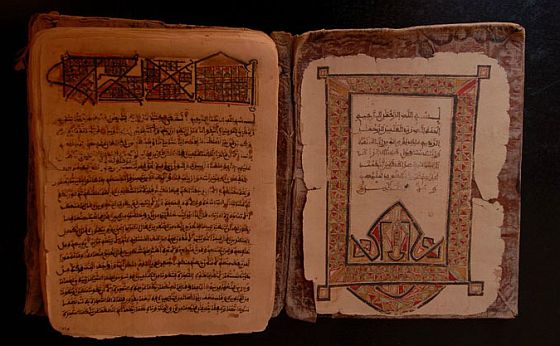
The retreating Islamist militants were also accused of destroying ancient manuscripts held in the city.

However on Wednesday, Shamil Jeppie, the Timbuktu Manuscripts Project director at the University of Cape Town, said that more than 90% of the 300,000 manuscripts said to be in the region were safe.

Kidal, 1,500km (930 miles) north-east of the capital Bamako, was until recently under the control of the Ansar Dine Islamist group, which has strong ties to al-Qaeda in the Islamic Maghreb (AQIM).

The Islamist militants had taken advantage of a military coup in March last year to impose Sharia in a number of cities in the north.

However, the Islamic Movement of Azawad (IMA), which recently split from Ansar Dine, says it is now in charge in Kidal.

The IMA has said it rejects “extremism and terrorism” and wants a peaceful solution.

An IMA spokesman confirmed the French arrival in Kidal and said that its leader was in talks with them.

However, another rebel group, the secular National Movement for the Liberation of Azawad (MNLA), is also influential in the area. It is ethnically driven, fighting mostly for the rights of Mali’s minority Tuareg community.

An MNLA spokesman told the BBC its fighters had entered Kidal on Saturday and found no Islamist militants there.

The MNLA has also said it is prepared to work with the French “to eradicate terrorist groups” in the north but that it would not allow the return of the Malian army, which it accused of “crimes against the civilian population”.

Facebooktwittermail

2013 World Press Freedom Index — dashed hopes after Arab Spring

Reporters Without Borders: Last year’s index was marked by the Arab spring’s major news developments and the heavy price paid by those covering the protest movements. A range of scenarios has been seen in 2012, including countries such as Tunisia, Egypt and Libya, where regime change has taken place, countries such as Syria and Bahrain where uprisings and the resulting repression are still ongoing, and countries such as Morocco, Algeria, Oman, Jordan and Saudi Arabia, where the authorities have used promises and compromise to defuse calls for political and/or social and economic change.

Some of the new governments spawned by these protests movements have turned on the journalists and netizens who covered these movements’ demands and aspirations for more freedom. With legal voids, arbitrary appointments of state media chiefs, physical attacks, trials and a lack of transparency, Tunisia (138th, -4) and Egypt (158th, +8) have remained at a deplorable level in the index and have highlighted the stumbling blocks that Libya (131st, +23) should avoid in order to maintain its transition to a free press.

The deadliest country for journalists in 2012 was Syria (176th, 0), where journalists and netizens are the victims of an information war waged by both the Assad regime, which stops at nothing in order to crack down and impose a news blackout, and by opposition factions that are increasingly intolerant of dissent. In Bahrain (165th, +8) the repression let up slightly, while in Yemen (169th, +2) the prospects continue to be disturbing despite a change of government. Oman (141st, -24) fell sharply because of a wave of arrests of netizens.

Facebooktwittermail

On culture and artifacts

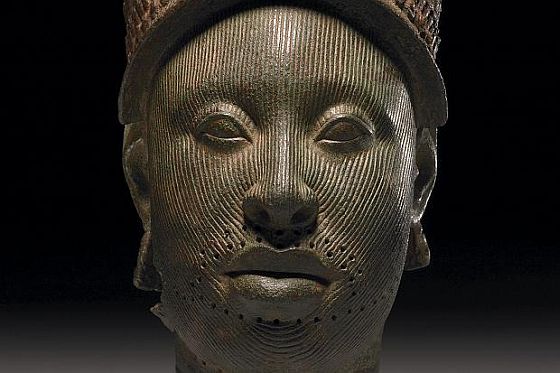
The Olokun Head discovered in Nigeria in 1910 and initially regarded by European scholars as too great a masterpiece to have originated from Africa.

One of the conceits of Western societies is that our museums and galleries and private collections represent our appreciation of culture. Indeed, our appreciation of culture is supposedly so refined that we have often asserted the right or even duty to become self-appointed custodians of artifacts whose protection demanded, we claimed, that they be removed from their place of origin.

It is reasonable to assume that in the coming months and years, artifacts from Timbuktu will find their way into the hands of art collectors who rationalize their actions with the idea that only individuals with the finest taste recognize the real value of such rare treasures.

What those who either buy such artifacts or merely view them while wandering around museums are inclined to believe is that culture and its material expressions are one and the same.

Even so, such objects only become artifacts as culture falls apart. Our museums serve less to preserve human genius and function more as cultural graveyards.

In cultures that no longer sustain oral tradition, we have forgotten that the written word was not intended to subordinate the value of the spoken word — it merely expands the voice’s reach. Language’s rhythmical structure serves first to allow thought to be housed in memory before being left to reside on the page.

Yes, it will be an immense loss if Timbuktu’s manuscript collections have been decimated, but there as elsewhere, the real cultural loss long preceded the effort to breath life into dead remains.

The culture most in jeopardy and most in need of protection lives in what Wade Davis calls the planet’s “ethnosphere”: the cultural web of life which is the “sum total of all thoughts and dreams, myths, ideas, inspirations, intuitions brought into being by the human imagination since the dawn of consciousness.”

This is culture which no museum can house and no collector can buy because it exists solely through its ability to animate human life.

Facebooktwittermail

Tuareg rebels say they’re now in charge of Kidal

The Associated Press reports: As French and Malian soldiers held control of the fabled desert city of Timbuktu following the retreat of Islamist extremists, Tuareg fighters claimed Tuesday that they seized the strategic city of Kidal and other northern towns.

The National Movement for the Liberation of Azawad — the Tuareg group’s name for northern Mali — appears to have taken advantage of a French-led bombing and ground campaign to dislodge al- Qaida-linked Islamist fighters from the towns in northern Mali.

Phone lines were down in Kidal, making it difficult to independently confirm the group’s claim.

The Tuareg movement said on its website that it was ready to work with French troops and fight terror organizations.

However, it said it would refuse to allow Malian soldiers in Kidal, and the other towns under its control in northeastern Mali, following allegations that the troops killed civilians suspected of having links to the Islamists.

Reuters adds: The International Monetary Fund has approved an $18.4m loan to strife-torn Mali to help the West African nation stabilise its economy over the next 12 months, the IMF said.

It said on Monday that approval of the loan, under its Rapid Credit Facility, should send a signal that Mali’s economy is on the right path, prompting other donors to offer financial assistance to Mali.

“Mali’s economy is traversing a particularly difficult period as a result of the 2011 drought, insurgent attacks in the north of the country and political instability in the wake of the military coup in March 2012,” the IMF said in a statement.

Note that this is just a loan and it’s for an amount that in this case is deemed sufficient to prop up a West African economy, but in the hands of the 1% would buy a townhouse in Greenwich Village.

Facebooktwittermail

British troops to be sent to Mali

The Guardian reports: A major increase in the UK commitment to help French and African forces in Mali and the region has been confirmed by Downing Street and the defence secretary, Philip Hammond, in an urgent statement to the House of Commons.

Amid concerns on the Tory benches that Britain is being drawn into a conflict without an exit strategy, the government said that 200 UK troops would train an African regional force outside Mali, with up to 40 more on an EU training mission inside the country. A further 70 RAF personnel will oversee the use of Sentinel surveillance, to be based in Senegal with 70 supporting crew and technical staff, and 20 will staff a C-17 transport plane for a further three months.

Britain has offered a roll-on, roll-off ferry to help transport French armour to Mali by sea, landing on the African coast. Britain is also offering air-to-air refuelling capacity to operate outside the UK, but based in Britain. It is possible the US will provide air-to-air refuelling.

Facebooktwittermail

America’s widening clandestine operations in Africa

The New York Times reports: The United States military is preparing to establish a drone base in northwest Africa so that it can increase surveillance missions on the local affiliate of Al Qaeda and other Islamist extremist groups that American and other Western officials say pose a growing menace to the region.

For now, officials say they envision flying only unarmed surveillance drones from the base, though they have not ruled out conducting missile strikes at some point if the threat worsens.

The move is an indication of the priority Africa has become in American antiterrorism efforts. The United States military has a limited presence in Africa, with only one permanent base, in the country of Djibouti, more than 3,000 miles from Mali, where French and Malian troops are now battling Qaeda-backed fighters who control the northern part of Mali.

A new drone base in northwest Africa would join a constellation of small airstrips in recent years on the continent, including in Ethiopia, for surveillance missions flown by drones or turboprop planes designed to look like civilian aircraft.

If the base is approved, the most likely location for it would be in Niger, a largely desert nation on the eastern border of Mali. The American military’s Africa Command, or Africom, is also discussing options for the base with other countries in the region, including Burkina Faso, officials said.

The immediate impetus for a drone base in the region is to provide surveillance assistance to the French-led operation in Mali. “This is directly related to the Mali mission, but it could also give Africom a more enduring presence for I.S.R.,” one American military official said Sunday, referring to intelligence, surveillance and reconnaissance.

A handful of unarmed Predator drones would carry out surveillance missions in the region and fill a desperate need for more detailed information on a range of regional threats, including militants in Mali and the unabated flow of fighters and weapons from Libya. American military commanders and intelligence analysts complain that such information has been sorely lacking.

The Africa Command’s plan still needs approval from the Pentagon and eventually from the White House, as well as from officials in Niger. American military officials said that they were still working out some details, and that no final decision had been made. But in Niger on Monday, the two countries reached a status-of-forces agreement that clears the way for greater American military involvement in the country and provides legal protection to American troops there, including any who might deploy to a new drone base.

The plan could face resistance from some in the White House who are wary of committing any additional American forces to a fight against a poorly understood web of extremist groups in North Africa.

If approved, the base could ultimately have as many as 300 United States military and contractor personnel, but it would probably begin with far fewer people than that, military officials said.

Some Africa specialists expressed concern that setting up a drone base in Niger or in a neighboring country, even if only to fly surveillance missions, could alienate local people who may associate the distinctive aircraft with deadly attacks in Pakistan, Somalia and Yemen.

Last June, a Washington Post report noted that: conventional aircraft hold two big advantages over drones: They are cheaper to operate and far less likely to draw attention because they are so similar to the planes used throughout Africa.

The bulk of the U.S. surveillance fleet is composed of single-engine Pilatus PC-12s, small passenger and cargo utility planes manufactured in Switzerland. The aircraft are not equipped with weapons. They often do not bear military markings or government insignia.

The Pentagon began acquiring the planes in 2005 to fly commandos into territory where the military wanted to maintain a clandestine presence. The Air Force variant of the aircraft is known as the U-28A. The Air Force Special Operations Command has about 21 of the planes in its inventory.

Facebooktwittermail

The Pentagon’s expanding cyberwarfare capabilities

The Washington Post reports: The Pentagon has approved a major expansion of its cybersecurity force over the next several years, increasing its size more than fivefold to bolster the nation’s ability to defend critical computer systems and conduct offensive computer operations against foreign adversaries, according to U.S. officials.

The move, requested by the head of the Defense Department’s Cyber Command, is part of an effort to turn an organization that has focused largely on defensive measures into the equivalent of an Internet-era fighting force. The command, made up of about 900 personnel, will expand to include 4,900 troops and civilians.

Details of the plan have not been finalized, but the decision to expand the Cyber Command was made by senior Pentagon officials late last year in recognition of a growing threat in cyberspace, said officials, who spoke on the condition of anonymity because the expansion has not been formally announced. The gravity of that threat, they said, has been highlighted by a string of sabotage attacks, including one in which a virus was used to wipe dat a from more than 30,000 computers at a Saudi Arabian state oil company last summer.

The plan calls for the creation of three types of forces under the Cyber Command: “national mission forces” to protect computer systems that undergird electrical grids, power plants and other infrastructure deemed critical to national and economic security; “combat mission forces” to help commanders abroad plan and execute attacks or other offensive operations; and “cyber protection forces” to fortify the Defense Department’s networks. [Continue reading…]

Facebooktwittermail

Inside the war for Syria’s mountains

Martin Chulov reports from the Alawite heartland in the mountains of western Syria: The al-Nusra member the Guardian met had not been expecting strangers. His head swathed in a black turban, and with a Kalashnikov strapped to his chest, he walked slowly down a potholed road towards us before stopping warily several metres away. He scanned us purposefully from head to toe, inhaled deeply, then said: “What’s going on?”

The American-accented English was as much a surprise as finding him there in the first place, living in a house next door to the main rebel outpost in the region, along with 20 or so other members of the group at the vanguard of the fighting.

His opening remark was less an icebreaker, however, than the beginning of an interrogation. For 40 minutes, sometimes chilling, sometimes charming, he tried to gauge our provenance and our reason for journeying south into Jebel al-Krud, the giant plateau that soars above Latakia and Tartous to the south.

The region is steeped in Islamic history, and has a tradition of sectarian coexistence. About 800 years ago, the Islamic warrior Salah al-Din – a Kurd better known to Europeans as Saladin – used the mountains and valleys of the area to prepare to battle the Crusaders. Kurds travelled with him from what is now northern Iraq, and settled here. Christian and Alawite communities are also long established.

Our interrogator eventually offered tea. “You do not share my ideology,” he said. “But you are here on humanitarian grounds.” The concession amounted to a travel pass. “Where is your flak jacket? We have an obligation before God to do what we can to protect ourselves,” he said, pointing at the camouflage vest covering his shirt. “So should you.”

Sheer cliffs climbed vertically from the first stretch of the road south, soon giving way to plunging, emerald ravines still flush with blue floodwaters. Villages peppered the hilltops, grey blobs against an iridescent green whenever they emerged from the fog.

Around one bend, white crosses jutted starkly from the graves on a hilltop. This was the Christian village of Jdeida, on the edge of Idlib province and Jebel al-Krud. Barely a home here had escaped shell damage since it was taken by rebel groups six weeks earlier. And next to none of the locals had remained.

One family had stayed behind. “We don’t have an option,” the elderly Christian man said. “The situation is as you see it. This is the first time there hasn’t been shelling here in more than a week. We haven’t seen the sun or sat in our garden in all that time.”

The man’s wife picked an orange from the tree at the centre of the courtyard and offered it on a silver tray.

His 90-year-old mother sat on a stone wall, her left eye red with a chronic infection, her right streaming with tears. “We can’t go anywhere to get medicine,” she said between sobs. “We are not with anyone, my son. We are too old for this. Please let it end.”

Neither side seems to have any will to bring the war for the mountains to a close. [Continue reading…]

Facebooktwittermail

Most of Timbuktu’s manuscripts saved?


Updated with comment below.

In interviews with TIME on Monday, the preservationists [of Timbuktu’s centuries-old artifacts] said that in a large-scale rescue operation early last year, shortly before the militants seized control of Timbuktu, thousands of manuscripts were hauled out of the Ahmad Baba center to a safe house elsewhere. Realizing that the documents might be prime targets for pillaging or vindictive attacks from Islamic extremists, staff left behind just a small portion of them, perhaps out of haste, but also to conceal the fact that the center had been deliberately emptied. “The documents which had been there are safe, they were not burned,” said Mahmoud Zouber, Mali’s presidential aide on Islamic affairs, a title he retains despite the overthrow of the former president, his boss, in a military coup a year ago; preserving Timbuktu’s manuscripts was a key project of his office. By phone from Bamako on Monday night, Zouber told TIME, “They were put in a very safe place. I can guarantee you. The manuscripts are in total security.”

In a second interview from Bamako, a preservationist who did not want to be named confirmed that the center’s collection had been hidden out of reach from the militants. Neither of those interviewed wanted the location of the manuscripts named in print, for fear that remnants of the al-Qaeda occupiers might return to destroy them.

That was confirmed too by Shamil Jeppie, director of the Timbuktu Manuscripts Project at the University of Cape Town, who told TIME on Monday night, “There were a few items in the Ahmad Baba Library, but the rest were kept away.” The center, financed by the South African government as a favored project by then-President Thabo Mbeki, who championed reviving Africa’s historical culture, housed state-of-the-art equipment to preserve and photograph hundreds of thousands of pages, some of which had gold illumination, astrological charts and sophisticated mathematical formulas. Jeppie said he had been enraged by the television footage on Monday of the building trashed, and blamed in part Mali’s government, which he said had done little to ensure the center’s security. “It is really sad and disturbing,” he said.

After posting this last night, I thought I should add a question mark to the headline. At this point it doesn’t seem like anyone is in a position to accurately quantify how many of Timbuktu’s rare manuscripts might have been destroyed by the city’s Islamist occupiers before they fled. Although the Ahmed Baba Instititute, where fire damage was reported, is the principal facility housing Timbuktu’s treasures, there are dozens of family-owned libraries around the city containing thousands more manuscripts. None of the reporting I have seen indicates whether these collections were either secured or damaged.

While the fate of the manuscripts remains unclear, it’s easy for journalists to overplay a story that dovetails so neatly with the routing-of-the-barbarians narrative, rather than stick with what can actually be established at this time — which is not much.

Facebooktwittermail

Destruction of Timbuktu manuscripts is an offence against the whole of Africa

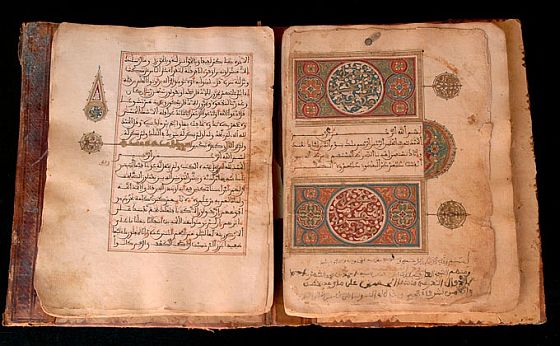
A Quran from the 12th century in Timbuktu

Jonathan Jones writes: The reported destruction of two important manuscript collections by Islamist rebels as they fled Timbuktu is an offence to the whole of Africa and its universally important cultural heritage. Like their systematic destruction of 300 Sufi saints’ shrines while they held Timbuktu at their mercy, it is an assault on world heritage comparable with the demolition of the Buddhas of Bamiyan by the Taliban in 2001.

The literary heritage of Timbuktu dates back to the 15th and 16th centuries when the gold-rich kingdoms of Mali and Songhai traded across the Sahara with the Mediterranean world. It took two months for merchant caravans to cross the desert, and while gold and slaves went north, books were going south.

In his Description of Africa, published in 1550, the traveller Leo Africanus marvels that in the bustling markets of Timbuktu, under the towers of its majestic mosques, the richest traders were booksellers.

They were selling manuscripts by Arab scholars on everything from astronomy and arithmetic to Islamic law, as well as mystical texts on Sufism, the otherworldly, saintly style of faith that the al-Qaida-affiliated Ansar Dine finds so offensive. [Continue reading…]

In a 2010 BBC documentary, Aminatta Forna tells the story of the lost libraries of Timbuktu.

Facebooktwittermail

In Israel, advocates of peace are viewed as extremists

Outside Israel, Shlomi Eldar is best known as the TV broadcaster who spoke to Gaza doctor, Ezzeldeen Abu al-Aish, moments after al-Aish’s three daughters had been killed in an Israeli strike during Operation Cast Lead in 2009.

In an interview with Haaretz, Eldar says:

A few days after the end of Operation Pillar of Defense [November, 2012], I gave a talk at a Herzliya high school. The children, who said they came from good homes, told me we have to kill all the Arabs, including the Israeli Arabs, because where do they get off thinking they will get control of the country. Their ideal is to go into the army and kill as many Arabs as possible. That’s one side of the picture, Israeli youth, the new generation, living in an atmosphere of demonizing the Palestinians − which is something the Israeli media are responsible for in no small measure. The other side of the picture is the young generation in Gaza, a child of five or nine. Let’s say he is not wounded, but a four-ton bomb landed next to his house. Do you know that in Operation Pillar of Defense, not one pane of glass remained intact in the whole of Gaza? It’s a tactic of creating sonic booms to frighten people without hurting them. A child who has a bomb like that land next to him can’t hear anything for the next three days. What does he think about the Jews afterward? And where will we end up, if this is how Jewish youngsters think about Arabs?

Nowhere good.

We are on a nothing-to-lose track. Which is why I say there is no future. When I told the high school class that we have to look at them as human beings, one boy jumped up and said, “Who do you vote for? You’re extreme left, no?” I replied, “It would surprise you to know who I vote for.” But that’s not the point. The point is that we in Israel have reached a situation in which if someone says we have to talk peace, he’s considered extreme left.

Facebooktwittermail

How the New York Times covers the Israel lobby: by pretending it doesn’t exist

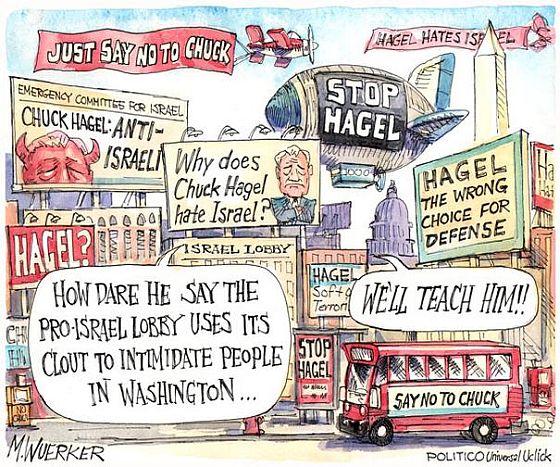
Cartoon by Matt Wuerker appearing in Politico, January 23, 2013.

The cartoon above, which appeared in Politico a few days ago, is pretty straightforward in identifying who is behind the campaign against Chuck Hagel’s nomination as defense secretary: the Israel lobby. (It’s worth noting, Politico is a fairly lobby-friendly publication, so the willingness of its editors to name names in this case has more to do with stating what is blindingly obvious rather than springing from some desire to ‘out’ the lobby.)

How does the New York Times cover the same story? Assign it to a reporter who apparently doesn’t believe the Israel lobby exists.

In Jim Rutenberg’s mind, the campaign against Chuck Hagel is a story about the effects of the Supreme Court decision, Citizen’s United. You have to go all the way down to paragraph nineteen in his report before Rutenberg mentions the Emergency Committee for Israel (creators of the anti-Hagel ChuckHagel.com website which doesn’t even get mentioned in the article).

Even though Rutenberg refers to Sheldon Adelson as a prominent backer of the anti-Hagel campaign, he only comes up after mentioning major conservative groups like Americans for Prosperity and Crossroads GPS who are not involved in the fight against Hagel.

Facebooktwittermail

How the pharmaceutical industry deceives doctors and patients

Fake pharma ad for "Havidol"

Ben Goldacre writes: In 2010, three researchers from Harvard and Toronto found all the trials looking at five major classes of drug — antidepressants, ulcer drugs and so on — and then measured two key features: were they positive, and were they funded by industry? They found over 500 trials in total: 85 percent of the industry-funded studies were positive, but only 50 percent of the government-funded trials were. That’s a very significant difference.

In 2007, researchers looked at every published trial that set out to explore the benefit of a statin. These are cholesterol-lowering drugs which reduce your risk of having a heart attack, and they are prescribed in very large quantities. This study found 192 trials in total, either comparing one statin against another, or comparing a statin against a different kind of treatment. Once the researchers controlled for other factors (we’ll delve into what this means later), they found that industry-funded trials were 20 times more likely to give results favoring the test drug. Again, that’s a very big difference.

We’ll do one more. In 2006, researchers looked into every trial of psychiatric drugs in four academic journals over a 10-year period, finding 542 trial outcomes in total. Industry sponsors got favorable outcomes for their own drug 78 percent of the time, while independently funded trials only gave a positive result in 48 percent of cases. If you were a competing drug put up against the sponsor’s drug in a trial, you were in for a pretty rough ride: You would only win a measly 28 percent of the time.

These are dismal, frightening results, but they come from individual studies. When there has been lots of research in a field, it’s always possible that someone — like me, for example — could cherry-pick the results and give a partial view. I could, in essence, be doing exactly what I accuse the pharmaceutical industry of doing by only telling you about the studies that support my case while hiding the rest from you.

To guard against this risk, researchers invented the systematic review. In essence a systematic review is simple: Instead of just mooching through the research literature, consciously or unconsciously picking out papers here and there that support your pre-existing beliefs, you take a scientific, systematic approach to the very process of looking for scientific evidence, ensuring that your evidence is as complete and representative as possible of all the research that has ever been done.

Systematic reviews are very, very onerous. In 2003, by coincidence, two were published, both looking specifically at the question we’re interested in. They took all the studies ever published about whether industry funding is associated with pro-industry results. Each took a slightly different approach to finding research papers, and both found that industry-funded trials were, overall, about four times more likely to report positive results. A further review in 2007 looked at the new studies that had been published in the four years after these two earlier reviews: It found 20 more pieces of work, and all but two showed that industry-sponsored trials were more likely to report flattering results.

I am setting out this evidence at length because I want to be absolutely clear that there is no doubt on the issue. Industry-sponsored trials give favorable results, and that is not just my opinion or a hunch from the occasional passing study. This is a very well-documented problem, and it has been researched extensively without anybody stepping out to take effective action, as we shall see. [Continue reading…]

Facebooktwittermail

Timbuktu mayor: Mali rebels torched library of historic manuscripts

The Guardian reports: Islamist insurgents retreating from Timbuktu set fire to a library containing thousands of priceless historic manuscripts, according to the Saharan town’s mayor, in an incident he described as a “devastating blow” to world heritage.

Hallé Ousmani Cissé told the Guardian that al-Qaida-allied fighters on Saturday torched two buildings that held the manuscripts, some of which dated back to the 13th century. They also burned down the town hall, the governor’s office and an MP’s residence, and shot dead a man who was celebrating the arrival of the French military.

French troops and the Malian army reached the gates of Timbuktu on Saturday and secured the town’s airport. But they appear to have got there too late to rescue the leather-bound manuscripts that were a unique record of sub-Saharan Africa’s rich medieval history. The rebels attacked the airport on Sunday, the mayor said.

“It’s true. They have burned the manuscripts,” Cissé said in a phone interview from Mali’s capital, Bamako. “They also burned down several buildings. There was one guy who was celebrating in the street and they killed him.”

He added: “This is terrible news. The manuscripts were a part not only of Mali’s heritage but the world’s heritage. By destroying them they threaten the world. We have to kill all of the rebels in the north.”

On Monday French army officers said French-led forces had entered Timbuktu and secured the town without a shot being fired. A team of French paratroopers crept into the town by moonlight, advancing from the airport, they said. Residents took to the streets to celebrate.

Facebooktwittermail

As rebels flee, world turns to challenge of repairing Mali

Toronto’s Globe and Mail reports: Faster than expected, a French-led offensive has swept into two key towns in northern Mali, putting Islamist rebels on the run. But as the insurgents melt back into the Sahara wastes, the world is left with the same dilemma as before: how to rebuild a shattered state that remains a haven for terrorists.

It’s a challenge that Western donors will confront at a conference on Tuesday, when the African Union pleads for more than $400-million to allow thousands of African troops to remain in Mali for at least a year. But money alone is not enough to put the country back together.

Canada is among the countries that will consider pledging funds to support Africa’s military effort. Canada is already contributing a massive military transport plane for a 30-day mission in Mali, and is considering other non-military help.

By capturing the strategic city of Gao and pushing the rebels out of the fabled town of Timbuktu on the weekend, the French and Malian forces have regained two of the three biggest urban centres in northern Mali with surprising ease.

Thousands of people celebrated in the streets of Gao on Sunday, dancing to music that had been banned under the harsh rule of the Islamist extremists. They cheered the French and Malian troops, greeting them as liberators from radical militias that had ruled with brutal force, compelling women to wear veils and amputating the hands of accused thieves.

Meanwhile, the insurgents were reported to have abandoned Timbuktu after repeated French air strikes, while French and Malian forces took control of its airport and probed into the ancient town, cautious because of the risk of ambush or counterattack.

Of the three main northern towns, only the town of Kidal – much further north – remains in rebel hands.

Yet the battle for the main towns was always destined to be the easiest step in a vastly complex task. The insurgents have spent months preparing a network of caves and tunnels in the desert and mountains. They have dramatically expanded their weaponry and vehicles. And they remain an elusive foe, ready to strike back when Mali is vulnerable again.

France has neither the resources nor the will to remain an occupying power in Mali indefinitely. The task for Africa and the West now is to restore Mali’s crumbling military and government structures, filling the vacuum that had allowed the Islamist radicals to thrive for years.

Facebooktwittermail