Syrian army weakening as rebels make gains

The Washington Post reports: After nearly two years of fighting, Syria’s vaunted war machine is showing serious cracks as emboldened rebels snap up more bases and airfields and force army units to retrench behind defensive lines in major cities, Western officials and military analysts say.

Bolstered by a steady flow of arms from foreign backers, opposition forces have scored a s eries of tactical victories in the Damascus suburbs in recent days and are advancing steadily toward the city’s airport, adding to what some analysts view as a sense of momentum that has been building since late summer.

Powerful antitank and antiaircraft weapons have helped level what was once a lopsided contest, the officials say, so much so that army commanders have been unable or unwilling to challenge rebel assaults on large military bases on the capital’s outskirts.

“The regime isn’t intervening to defend its positions,” said Jeffrey White, a former Middle East military analyst with the Pentagon’s Defense Intelligence Agency. “And when it does try to counterattack, it often fails.” [Continue reading…]

Facebooktwittermail

Assad seeking political asylum in Latin America if forced to flee Syria

Haaretz reports: Syrian President Bashar Assad has been looking into the possibility of claiming political asylum for himself, his family and his associates in Latin America, in case he is forced to flee Damascus.

Syria’s Deputy Foreign Minister Faisal al-Miqdad held meetings in Cuba, Venezuela and Ecuador over the past week, and brought with him classified personal letters from Assad to local leaders.

A source in the Venezuelan capital Caracas who spoke to Haaretz was not able to say what the response to the Syrian request was, but Venezuela’s foreign ministry confirmed to the El Universal newspaper that al-Miqdad did indeed bring a letter for President Hugo Chavez. Chavez received the letter just before he set out to Cuba last Wednesday to undergo further treatment for cancer.

All that the official spokesperson in Caracas could confirm was that Assad’s message touched on “the personal relationship between the two presidents,” and that the deputy foreign minister’s visit defines the close relationship between the two states.

Since the crisis in Syria began in March last year, Chavez has not hidden his support for the Assad regime. A number of times over the past year Venezuela has sent petrol and diesel fuel to Syria, so that the regime’s tanks and armored personnel carriers can continue to operate against what Chavez defines as terrorists. The Venezuelan leader’s close relationship with Iran, and his personal friendship with Iranian President Ahmadinejad, have turned him into a major player in efforts to save Assad.

Although the Syrian Ambassador in Venezuela, Ghassan Abbas, confirmed on Tuesday that al-Miqdad did hold talks with senior officials in Caracas, he claimed that he knows nothing about the content of Assad’s letter to Chavez. The deputy foreign minister had similar meetings last week in the Cuban capital, Havana, and the Ecuadorian capital, Quito.

A report in the New York Times on Monday said: A Russian political analyst with contacts at the [Syrian] Foreign Ministry said that “people sent by the Russian leadership” who had contact with Mr. Assad two weeks ago described a man who has lost all hope of victory or escape.

“His mood is that he will be killed anyway,” Fyodor Lukyanov, editor of a Russian foreign affairs journal and the head of an influential policy group, said in an interview in Moscow, adding that only an “extremely bold” diplomatic proposal could possibly convince Mr. Assad that he could leave power and survive.

“If he will try to go, to leave, to exit, he will be killed by his own people,” Mr. Lukyanov said, speculating that security forces dominated by Mr. Assad’s minority Alawite sect would not let him depart and leave them to face revenge. “If he stays, he will be killed by his opponents. He is in a trap. It is not about Russia or anybody else. It is about his physical survival.”

Facebooktwittermail

How would Assad use chemical weapons?

Jeffrey White writes: The regime could use chemical weapons in a variety of ways, from a limited or demonstration attack to large-scale offensive or defensive use to fundamentally change the military situation. At present, reports that the regime is weaponizing relatively small quantities of agent suggest the former. Limited CW use could be controlled better in terms of effects and visibility. The regime might also find it easier to explain away small-scale strikes as the work of “terrorists” or as a justifiable response to the military situation and the threat to the country.

One form of limited attack could be a strike against a specific military target, aimed at affecting a local but important tactical situation. Such an attack would also demonstrate that the regime was ready, willing, and able to carry out such actions.

The regime could also conduct small-scale strikes on civilian targets to intimidate the population or punish them for supporting the rebels. This would be an escalation from the regime’s routine use of explosives and incendiary weapons against civilians and could produce substantially greater casualties. It would undoubtedly have profound psychological effects on an essentially defenseless population.

As for broader CW use, the regime could employ such weapons to support ground offensives in key areas where its forces have been unable to achieve success via conventional tactics (e.g., around Maarrat al-Numan in Idlib province; in and around Aleppo city; in Deir al-Zour province, perhaps near Abu Kamal or Mayadin). It could use them to support defensive operations in places where rebel forces are on the offensive (e.g., the relatively remote Raqqa province) or have regime forces surrounded (as happened at the 46th Regiment base near Atareb in Aleppo province and the artillery fire base at Mayadin; in both cases, the positions fell to the rebels after prolonged siege and final assault). Using CW in close proximity to its own forces would be risky, but the military has some chemical defense equipment and training and might be able to provide a measure of protection.

Facebooktwittermail

U.S. might name Syrian rebel Nusra Front a foreign terrorist group

McClatchy reports: In an apparent bid to isolate Islamist extremists and bolster a new Western-backed Syrian opposition alliance, the United States is moving to declare one of the most effective Syrian rebel groups a foreign terrorist organization because of its alleged ties to al Qaida.

The State Department originally planned to add the Nusra Front – Jabhat al Nusra in Arabic – to its list of international terrorist groups this week, McClatchy learned. The announcement was postponed, however, as officials discussed how to get the maximum impact from the designation.

The designation now is likely just before the United States and its European and Arab allies meet with leaders of the new opposition alliance at a conference Dec. 12 in Morocco, where a significant aid package for the new alliance is expected to be announced.

The impact of the terrorist designation for Nusra, whose members have been at the forefront of many of the rebels’ most recent victories, remains unclear. Many rebel sympathizers said they were concerned that the designation would make it impossible for rebel groups to coordinate in their fight to topple Syrian President Bashar Assad. [Continue reading…]

Facebooktwittermail

Al Qaida-linked group Syria rebels once denied now key to anti-Assad victories

McClatchy reports: When the group Jabhat al Nusra first claimed responsibility for car and suicide bombings in Damascus that killed dozens last January, many of Syria’s revolutionaries claimed that the organization was a creation of the Syrian government, designed to discredit those who opposed the regime of President Bashar Assad and to hide the regime’s own brutal tactics.

Nearly a year later, however, Jabhat al Nusra, which U.S. officials believe has links to al Qaida, has become essential to the frontline operations of the rebels fighting to topple Assad.

Not only does the group still conduct suicide bombings that have killed hundreds, but they’ve proved to be critical to the rebels’ military advance. In battle after battle across the country, Nusra and similar groups do the heaviest frontline fighting. Groups who call themselves the Free Syrian Army and report to military councils led by defected Syrian army officers move into the captured territory afterward.

The prominence of Nusra in the rebel cause worries U.S. and other Western officials, who say its operations rely on the same people and tactics that fueled al Qaida in Iraq – an assertion that is borne out by interviews with Nusra members in Syria.

Among Nusra fighters are many Syrians who say they fought with al Qaida in Iraq, which waged a bloody and violent campaign against the U.S. presence in that country and is still blamed for suicide and car bombings that have killed hundreds of Iraqis since the U.S. troops left a year ago.

According to Nusra members, some of the group’s leaders, including the emir, or top ruler, in Syria’s Deir al Zour province, are Iraqis.

The group’s prominence makes clear the dilemma of Syria’s revolutionaries, as well as those who might provide support to them. Though members of Nusra operate independently of the other rebel groups that have taken up arms — and particularly those that are calling for elections if Assad is deposed — it is increasingly clear that their operations are closely coordinated with more secular rebels. [Continue reading…]

Facebooktwittermail

Islamic fighters in northern Syria not united

Tareq al-Abed writes: “Beware the jihadists.” This is the phrase that the international community keeps repeating as an excuse to avoid supplying the Syrian opposition with arms. They mean to say that extremist elements are entering Syria and that they should not be given arms. But an examination of the Islamic groups in the Syrian north reveals the true situation.

The jihadists in this area are few, but the effectiveness of the Salafists and the quality of their operations has made society support them more than they do other combat battalions, which follow a more moderate discourse and which sometimes act as exclusive rulers.

“Not everyone with a beard is a Salafist.” This is how a media activist from the town of Bench, near Idlib, begins his discussion about Islamist fighters in the north. He said that calling most groups Salafists is inaccurate, and that this will eventually become clear. Even though most, if not all, battalions in Idlib and Aleppo and their countrysides have a religious bent, it is not accurate to characterize them as jihadists. In fact, they can be classified into three groups:

  1. Battalions with a moderate Islamist philosophy. This is the philosophy of most of the north and in fact all of Syria. Many of these are not seeking leadership positions. They are civilians who had to take up arms. They formed military groups based on family or geographic ties. Despite the Islamist discourse which appears in their media declarations, many of those fighters don’t care about the jihadist/Salafist discourse when you get down to it. According to those we have met, many fighters have beards because it is a general symbol among the fighters, who know little about the jihadist doctrine, and even the Salafist ideology. Those military groups often have organizational and financing problems, particularly in Aleppo. They are sometimes joined by criminals, bandits, kidnappers and those who fight on the basis of regional or sectarian hatred. In some cases, these criminals use the banner of revolution to justify kidnapping, theft, killing and even mutilation, as was the case with the “Storm of the North Battalion” in Azaz.
  2. Salafist Battalions. These battalions have a declared commitment to the Salafist philosophy. They also plan their operations without coordinating with the Free Syrian Army (FSA). These battalions are more organized and some of their fighters receive a monthly salary, such as the Storm of the North Battalion. Those battalions are wary of minorities. Each one of them has its own “Shariah officer” who issues religious edicts, or fatwas, regarding battles or jihad. Some of those “Shariah officers” have studied Islamic law but others hold that position simply because they are well read. Their fighters consider themselves “newcomers” to religious life but have devoted themselves for “jihad for Allah’s sake and for the establishment of the Islamic state.” The contact of those battalions with the outside are limited to financing by outside individuals or groups. They also have not declared their allegiance to al-Qaeda or any other organization. But there is a glaring contradiction when those groups say to the media that they want a civil state and that they will return to normal life once the conflict ends, while at other times they do not hesitate to assert their support for a religious state as they mount scathing attacks on liberals and other sects.
  3. Al-Nusra Front. This battalion is thought to have fewer members than those described above, but it is highly organized. It is hard for volunteers to join it. It does not allow its fighters to smoke cigarettes. Its leaders refuse to talk to the media. It has declared its allegiance to al-Qaeda and its late leader Osama bin Laden. Some of its fighters have fought in Iraq during the American occupation and are therefore familiar with jihadist ideology, which they consider their main calling. Therefore, their uncompromising goal of establishing a religious state and their rejection of all opposition groups is not surprising. The battalion’s members have recently attacked the new opposition coalition for appointing Munther Majos as its ambassador to France on the grounds that he belongs to the Alawi sect. [Continue reading…]
Facebooktwittermail

92 Senators vote to require Pentagon to report on Syria military options

The Cable reports: The Senate voted 92-6 today to require the Pentagon to report on options for using U.S. military assets to degrade Syrian President Bashar al-Assad’s ability to use air power against his own people.

The amendment, led by Sen. John McCain (R-AZ) with Sens. Carl Levin (D-MI), Chris Coons (D-DE), and Joe Lieberman (I-CT), gives the Defense Secretary Leon Panetta 90 days after the enactment of the National Defense Authorization Act to report back to the House and Senate Armed Services Committees on military options in Syria. The principle purpose of the legislation is “to advance the goals of President Obama of stopping the killing of civilians in Syria and creating conditions for a transition to a democratic, pluralistic, political system in Syria.”

The resolution does not explicitly call for the Assad to step down in Syria, a matter of contention when the Senate Foreign Relations Committee approved a resolution on Syria earlier this year. It also explicitly does not authorize the use of military force in Syria.

The legislation does say that any U.S. military activity with regard to Syria should be done in conjunction with allies, should not involve U.S. boots on the ground, and should minimize the risk to U.S. forces as well as financial costs to U.S. taxpayers.

Facebooktwittermail

Confrontation between rival protesters looms in Egypt crisis

Reuters reports: Egypt’s Muslim Brotherhood called for a rally backing President Mohamed Mursi outside his palace on Wednesday and leftists planned a counter-demonstration, raising fears of clashes in a crisis over a disputed push for a new constitution.

Mursi returned to work at his compound a day after it came under siege from opposition protesters furious at his drive to ratify a new constitution in a snap referendum set for December 15 after temporarily expanding his powers by decree.

The Islamist president said he acted to prevent courts still full of appointees from the era of autocratic predecessor Hosni Mubarak from derailing the draft constitution meant to complete a political transition in the Arab world’s most populous state.

The Brotherhood, from which Mursi emerged to narrowly win a free election in June, summoned supporters to a demonstration outside the palace in response to what it termed “oppressive abuses” by opposition parties. [Continue reading…]

Facebooktwittermail

Why the military is unlikely to intervene in Egypt’s messy power struggle

Tony Karon writes: If a cabal of Egyptian generals had been planning a coup, their moment to strike should be imminent. Tuesday saw new clashes between police and tens of thousands of antigovernment demonstrators outside Cairo’s presidential palace as a constitutional deadlock hardened into a not-yet-violent civil war between Islamists and their rivals — and as political camps brought their supporters onto the streets ahead of a Dec. 15 referendum on a controversial draft constitution. The turmoil plays out against the backdrop of an Egyptian “fiscal cliff” that urgently demands political stability. Still, even if the current scenario includes conditions similar to those that have preceded coups in unstable societies with powerful militaries, a putsch by Egypt’s generals remains unlikely.

“Remember,” says Century Foundation analyst Michael Wahid Hanna, “Egypt’s military didn’t enjoy their time at the head of the government after [President Hosni] Mubarak was ousted.” And while President Mohamed Morsi has antagonized his political opponents with a power grab that has put his decrees beyond judicial restraint, and with an unseemly rush to ram through a constitution critics say opens the way to authoritarian Islamist rule, he has been careful to keep the military onside.

“The military’s core institutional priorities have been well catered to in the draft constitution,” notes Hanna. “Its autonomy from civilian decisionmaking and budgetary oversight has been largely preserved, while the national security establishment has a significant, if not yet clearly defined, role in national-security decisionmaking. The military got a good deal in this constitutional process, and unless their intervention is required to stop Egypt plunging into civil strife, they’re going to stay on the sidelines. This isn’t their fight.” [Continue reading…]

Facebooktwittermail

Is there an Egyptian nation?

Shadi Hamid writes: In the latest round of Egypt’s current crisis — once again pitting Islamists against non-Islamists — demonstrators gathered at the presidential palace in Cairo to protest President Mohamed Morsi’s stunning decision to claim authoritarian, albeit temporary powers and his subsequent moves to rush through a controversial constitution. In a grim reminder of the country’s precarious state, police clashed with protesters and fired tear gas.

But this isn’t really about Morsi and his surprise decree — though to be sure, parts of the decree employ language straight out of Orwell and seem almost designed to provoke and polarize. However, neither the decree nor the draft constitution are quite as bad as Morsi’s opponents insisted. The opposition’s sometimes bizarre comparisons to Adolf Hitler, Benito Mussolini, the 1933 Enabling Act, and the French Revolution suggest a legitimate fury (and an intriguing fascination with fascism), but make little sense as historic analogies.

Morsi could have read his Friday shopping list on national television, and it might have made little difference. The decree, after all, was only the latest in what Morsi’s opponents see as a long list of abuses. Egypt’s “original” revolutionaries are one such group that blast the Brotherhood’s compromises small and large with the old state bureaucracy, lamenting how their revolution was sacrificed on the altar of expediency and gradualism. And it is true that the Brotherhood-appointed leaders of the Ministry of the Interior, the military, and the intelligence apparatus include men who were complicit in some of the worst human rights abuses of the Hosni Mubarak era — and have gone unpunished to this day.

But these mostly younger revolutionaries, whose critiques have been admirably consistent, are a small minority. The rest of the opposition is an odd assortment of liberals, socialists, old regime nostalgists, and ordinary, angry Egyptians, each whom have their own disparate grievances and objectives. The liberals and leftists in the equation, led by figures such as Mohamed ElBaradei, Hamdeen Sabbahi, and Amr Moussa, have little in common with each other — besides a fear that their country is being taken over, and taken away, by Islamists. While they may be “liberal,” in the sense of opposing state interference in private morality, their attachment to democracy is mercurial at best. Many of them welcomed the dissolution of Egypt’s first democratically elected parliament, called on the military to intervene and “safeguard” the civil state, and even cast their presidential ballot for Ahmed Shafiq, Morsi’s opponent and Mubarak’s last prime minister. [Continue reading…]

Facebooktwittermail

Just because Mohammad Morsi is paranoid doesn’t mean he doesn’t have enemies

Nathan Brown writes: When the Egyptian military took control of the Egyptian political system in February 2011, its heavy handed conduct and a series of missteps led Egyptians to ask one another: Were the generals incompetent or malevolent? That question can now be answered: They devised a political transition for Egypt that was so bad that it has led to the current crisis. They were far less an evil master sorcerer than they were a very hapless sorcerer’s apprentice.

Now the same question can be asked of all of Egypt’s leading political actors: are they purposely trying to destroy the country’s democratic hopes or merely doing so by accident? My own evaluation of the actors is that the Brotherhood’s intentions are less questionable than those of their rivals. But its actions are more dangerous: good intentions may help the Islamists in the next life, but what they are doing now may damn their county to either instability or renewed autocracy in this one.

Let us begin by reviewing how the generals put their civilian countrymen in such a difficult position. In 2011, the military oversaw a process that resulted in a set of interim governing procedures that were long on loopholes and short on guarantees. As the euphoria of Tahrir Square gave way to the nitty-gritty of daily politics, political actors on all sides began growing increasingly suspicious. By reserving all authority in its own hands, the military encouraged a system in which each civilian force saw its rivals as acting in an underhanded manner to persuade the military to do its bidding. Many such suspicions were justified. With elections looming, Islamists saw various leftist and liberal forces as seeking to disrupt the process and prolong military rule. And non-Islamists charged that Islamists had struck a deal with the generals to plunge the country into rounds of voting that would reward the types of strong networks that the Muslim Brotherhood, above all, already had.

When a process did emerge for writing a permanent constitution it was poorly organized and weak on guarantees for minority viewpoints. The newly elected parliament was to elect 100 people who would have six months to rush out a draft—and the population would then be granted only fifteen days to discuss it before giving their approval or rejection (in a country where voters are accustomed to being expected to agree). The procedure was not only overly hasty; it was also tilted toward the Islamists, since it was clear from the beginning that religious forces would do well in parliamentary elections (though the extent of their electoral victory at the end of 2011 surprised their adversaries). [Continue reading…]

Facebooktwittermail

Bradley Manning lawyer: soldier’s treatment a blemish on nation’s history

The Guardian reports: David Coombs, the civilian lawyer representing Bradley Manning at his court martial for supplying WikiLeaks with a trove of US state secrets, has described the soldier’s treatment in solitary confinement at Quantico marine base as criminal and a blot on the nation’s history.

Making rare comments outside the courtroom, Coombs addressed an audience of Bradley Manning supporters in a Unitarian church in Washington on Monday night and lashed out at the military hierarchy for allowing the intelligence analyst to be subjected to nine months of harsh suicide prevention regime against the advice of doctors. “Brad’s treatment at Quantico will forever be etched into our nation’s history as a disgraceful moment in time,” he said.

“Not only was it stupid and counter-productive, it was criminal. An entire group of individuals, who I have no doubt were honourable, chose to turn a blind eye to how he was being treated … They cared about something more: the media impact.” [Continue reading…]

Facebooktwittermail

Do photographs pose an existential threat to Israel?

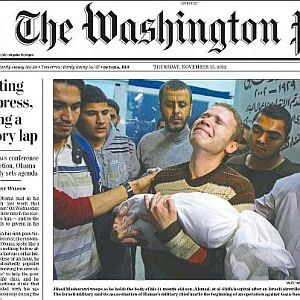
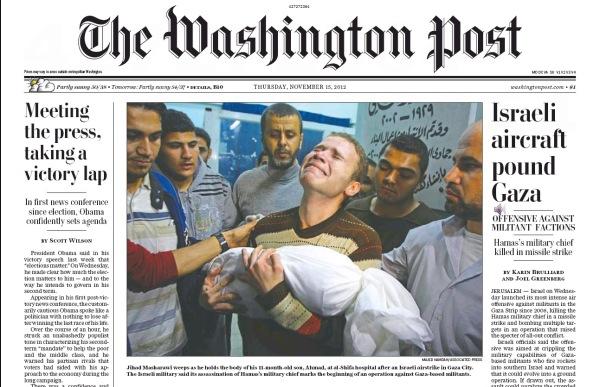
Amahl Bishara writes: One of the most wrenching images from the November 2012 conflict between Israel and Hamas was that of BBC journalist Jihad Masharawi holding the shrouded body of his eleven-month-old son. His face is gripped with agony, his eyes closed as he looks upward. We can imagine that he feels utterly alone in his grief, but he must also be aware of the men around him in this hospital room. Some or all of the men are likely fathers, uncles, or older brothers to young children. They reach out to touch Masharawi on his shoulder. In their downcast glances, I feel I recognize the strange shame of people who wish they could do more. Behind the camera, taking the picture, is a colleague, Majed Hamdan, a photographer for the Associated Press. Behind the photographer are all of us.

The photograph was on the front page of the The Washington Post on 15 November, and apparently it caused a hassle for the paper. According to ombudsman Patrick Pexton, many accused its placement of being biased. Many asked why this image was not “balanced” with one of Israeli suffering. Pexton replied that no such image existed, since, as of the day of Masharawi’s son’s death, no Israeli civilians had been killed by Gaza rocket fire for over a year. Pexton also described the fundamental imbalance in arms between Israel and Hamas, and concluded, “Let’s be clear: The overwhelming majority of rockets fired from Gaza are like bee stings on the Israeli bear’s behind.”

He is suggesting, but does not say outright, that an expectation of balance is unreasonable not only because an equivalent image from the “other side” may not be available but for another reason as well. Expecting balance obfuscates our understanding of conflicts that are not in reality balanced. Israel has some of the most advanced military technology in the world. Hamas has rockets with limited range and accuracy. Even more fundamentally, Israel remains the occupying power over Gaza, and thus has ultimate responsibility for civilian welfare — as well as a legal responsibility to end the occupation. (The metaphor of balance and the seesaw image it evokes has other problems, too. The myth of “two sides” to the conflict obscures differences of opinion and hierarchies of power within Israeli and Palestinian societies.) [Continue reading…]

Facebooktwittermail

Iran says extracts data from U.S. spy drone

Reuters reports: Iran has obtained data from a U.S. intelligence drone that shows it was spying on the country’s military sites and oil terminals, Iranian media reported its armed forces as saying on Wednesday.

Iran announced on Tuesday that it had captured a ScanEagle drone belonging to the United States, but Washington said there was no evidence to support the assertion.

The incident has underscored tensions in the Gulf as Iran and the United States draw attention to their military capabilities in the vital oil exporting region in a standoff over Iran’s disputed nuclear program.

“We have fully extracted the drone’s information,” Iran’s Islamic Revolutionary Guard Corps (IRGC) said in a statement on Wednesday, according to Iran’s English-language Press TV.

Facebooktwittermail

Signs the Assad regime may soon fall

Brian Whitaker picks out six pointers suggesting Assad’s days are numbered:

Each day’s news brings more reasons to believe the Assad regime’s fall cannot be far away. Viewed individually these signs may not in themselves spell doom for the regime but collectively they do.

1. Withdrawal of UN and diplomatic personnel: The UN announced yesterday that it has cancelled all missions to Syria from abroad and suspended its activities inside the country. All non-essential staff are to be withdrawn because of the “prevailing security situation”. The European Union, which has a diplomatic office in Damascus, also said it will cut back activities ” to a minimum level due to the current security conditions”. In effect, the UN and EU are now only a step away from ordering a complete evacuation.

2. Jihad Makdissi flees: The foreign ministry spokesman, Jihad Makdissi, has fled Syria and yesterday was reported to have arrived in London. This may not be as big a loss as some of the earlier defections and assassinations but it does tell us how someone who was privy to a lot of regime information now views the situation.

Whether Makdissi actually has a political quarrel with the regime is unclear but the Washington Post, citing a friend of Makdissi,
says he is “taking a break from the pressure of being the official face of the government in the media while having no security protection for himself or his family”.

If we take this at face value and assume he has not fallen out with Assad, it’s a message of no confidence in the regime’s once-feared security apparatus.

3. Damascus airport: A capital city without a functioning airport isn’t really a capital city any more. Syrian officials insist the airport is still open, but to what extent it may be operating is a different matter. Travel to and from the airport is dangerous and very few of the few remaining scheduled flights appear to be arriving or leaving. Egyptair announced yesterday that it was resuming flights but then changed its mind. [Continue reading…]

Facebooktwittermail

Defection or escape? Syria’s foreign ministry spokesman ‘on way to U.S.’

The Guardian reports: The former Syrian foreign ministry spokesman, Jihad Makdissi, is on his way to the United States after apparently defecting, the Guardian has learned.

Makdissi, the most senior Christian official yet to abandon Bashar al-Assad’s regime, was reported on Monday to have variously been sacked or defected and to have arrived back in London, where he used to serve in the Syrian embassy.

But usually reliable diplomatic sources revealed on Tuesday that he is en route for – or already in – the US after managing to leave the capital, Damascus, for Beirut. He was not in the UK, British officials insisted. In Washington, a state department spokesman said: “We are not in a position to confirm his actions or whereabouts.”

Facebooktwittermail

How Tahrir is reshaping Cairo

Joseph Dana writes: Jamel Mubarak leans over the side of his balcony overlooking Tahrir Square and makes a simple observation: Cairo, the city of his birth, is not as pretty as it used to be.

For 40 years, Mubarak has lived in a 10-story building on Cairo’s most prominent public square. In that time, he’s watched it transform from a downtown traffic roundabout and symbol of former President Hosni Mubarak’s regime to become, last year, a ground zero for the overthrow of that same regime.

And now, nearly two years after the first protest of the Egyptian Revolution, the square has again sprung to life as a center of opposition, this time in protest over the drafting of the country’s constitution and sweeping new self-granted powers of its Islamist president, Mohamed Morsi, who took power democratically after Mubarak’s fall.

Looking down at the tens of thousands of protesters filling the square below him, waving flags and chanting slogan’s against the country’s ruling party, Jamel Mubarak (no relation to the ousted leader) notes that the once-peaceful square is not likely to quiet down anytime soon.

“People are angry with Morsi and emboldened by the fact that they removed one Egyptian president,” he said, speaking loudly to be heard over the din of chants emanating from the square below. “They might try to do it again and one thing is for sure, the entire process is going to unfold in Tahrir.”

It’s no exaggeration to say that Tahrir Square has emerged as a living laboratory for the social shifts sweeping Egypt’s densely populated capital city. [Continue reading…]

Facebooktwittermail