Michael Wahid Hanna writes: Reflecting on the lessons of the Arab uprisings in November 2011, Secretary of State Hillary Clinton was adamant that traditional U.S. policies in the region were no longer tenable. “[A]s the fall of Hosni Mubarak in Egypt made clear,” she said “the enduring cooperation we seek will be difficult to sustain without democratic legitimacy and public consent.” But such revelations necessitate drastic changes, and in the face of unanticipated events and crises, it’s all too easy for the familiar policies of the past to re-emerge. As Egypt descends again into turmoil over the country’s fraught constitution-writing process, it appears that the United States is once again embracing the past and eschewing the lessons it learned the hard way during the uprising.
In a move that bears the hallmark of U.S. policy in the Mubarak era, the United States has largely reduced its relationship with Egypt to the maintenance of the peace treaty with Israel and withheld serious judgment of the Muslim Brotherhood-led government, even as it actively undermines the country’s already troubled democratic transition.
The most severe political crisis to strike Egypt since the fall of Mubarak was sparked by President Mohamed Morsy’s Nov. 22 constitutional decree, which granted the executive absolute authority and immunized his decisions from judicial review for the remainder of the transitional period. Morsy defended the move as an attempt to protect the constituent assembly — tasked with drafting Egypt’s new constitution — from potential judicial dissolution, but his unilateral steps provoked outrage among opposition forces who again took to the streets.
The crisis deepened when the president directed the assembly to ram through a governing document in a chaotic, all-night session that made a mockery of deliberative constitutional process and design. If approved in a hastily called referendum, that slipshod document will bound Egypt’s political future and institutionalize its crisis. With a significant portion of the country’s judges declaring a strike in response to Morsy’s declaration and dueling protesters mobilizing on opposing sides, Egypt’s flawed transition now risks tipping into outright civil strife and prolonged instability. [Continue reading…]
Music: Ampouailh — Yaouank 2007
How Obama doomed the two-state solution
Henry Siegman writes: With his decision to oppose the U.N. General Assembly’s granting Palestine non-member state observer status, U.S. President Barack Obama leaves no doubt he is not modifying his pre-election position that “There is no daylight between Israel and the United States,” and that no matter how deeply Israeli behavior violates international norms and existing agreements, U.S. support for Israel remains “rock solid.” This continuity of U.S. Middle East peace policy was promptly reinforced by Secretary of State Hillary Clinton when she assured Israel that despite her condemnation of its decision to proceed with new construction in the E1 corridor of the West Bank that will doom the two-state solution, this administration will continue to “have Israel’s back.”
The decision confirms America’s irrelevance not only to a possible resolution of the Israel-Palestine conflict but to the emerging political architecture of the entire region, the shape and direction of which will increasingly be determined by popular Arab opinion, not autocratic regimes dependent on the United States for their survival.
The efforts promised by President Obama to renew Israeli-Palestinian peace talks will be seen universally for the empty and purposeless exercise they will be. To be taken seriously, a new U.S. peace initiative would have to begin with an insistence that Israel’s government accept the pre-1967 border as the starting point of resumed negotiations. Without such a U.S. demand, backed by effective diplomatic pressure, the United States will have no right to ask Palestinians to return to negotiations that have no terms of reference, and therefore no prospect of producing anything other than cover for Israel’s continuing predatory colonial behavior in the West Bank.
The administration’s admonitions to the Palestinians that they find the political courage to return to negotiations with a government whose intention to prevent viable Palestinian statehood has been clearly and repeatedly demonstrated are singularly inappropriate. A U.S. administration that since the third year of its first term has been pandering to the Israel lobby by withdrawing its insistence that Israel’s illegal settlements project must end, followed by a muting of its demand that resumed negotiations be framed by reasonable terms of reference, should exercise considerably greater restraint before presuming to preach to others on the subject of political courage. [Continue reading…]
U.S. sees Syria prepping chemical weapons
A Danger Room headline reads, “Exclusive: U.S. Sees Syria Prepping Chemical Weapons for Possible Attack.” But the sources for the report actually say: “We’re not sure what’s the intent.”
Engineers working for the Assad regime in Syria have begun combining the two chemical precursors needed to weaponize sarin gas, an American official with knowledge of the situation tells Danger Room. International observers are now more worried than they’ve even been that the Damascus government could use its nerve agent stockpile to slaughter its own people.
The U.S. doesn’t know why the Syrian military made the move, which began in the middle of last week and is taking place in central Syria. Nor are they sure why the Assad government is transferring some weapons to different locations within the country, as the New York Times reported on Monday.
All that’s certain is that the arms have now been prepped to be used, should Assad order it.
“Physically, they’ve gotten to the point where the can load it up on a plane and drop it,” the official adds.
Sarin gas has two main chemical components — isopropanol, popularly known as rubbing alcohol, and methylphosphonyl difluoride. The Assad government has more than 500 metric tons of these precursors, which it ordinarily stores separately, in so-called “binary” form, in order to prevent an accidental release of nerve gas.
Last week, that changed. The Syrian military began combining some of the binaries. “They didn’t do it on the whole arsenal, just a modest quantity,” the official says. “We’re not sure what’s the intent.”
Back in July, the Assad regime publicly warned that it might use its chemical weapons to stop “external” forces from interfering in Syria’s bloody civil war. The announcement sparked a panic in the intelligence services of the U.S. and its allies, which stepped up their efforts to block shipments of precursors for those weapons from entering the country.
“This is a more serious moment than July,” according to the official. [Continue reading…]
Red lines or green lights for Assad?
The New York Times reports: Secretary of State Hillary Rodham Clinton on Monday warned President Bashar al-Assad of Syria not to use chemical weapons and said that the United States was prepared to act if he ignored the warning.
“This is a red line for the United States,” Mrs. Clinton said. “I am not going to telegraph in any specifics what we would do in the event of credible evidence that the Assad regime has resorted to using chemical weapons against their own people. But suffice it to say we are certainly planning to take action if that eventuality were to occur.”
There have been signs in recent days of heightened activity at some of Syria’s chemical weapons sites, according to American and Israeli officials familiar with intelligence reports. Mrs. Clinton did not confirm the intelligence reports or say what sort of activity was occurring.
The Syrian Foreign Ministry, in a swift response, said the government “would not use chemical weapons, if it had them, against its own people under any circumstances.” The statement was reported on Syrian state television and on the Lebanese channel LBC.
Ostensibly, this reiteration of a red line President Obama already laid down in August has been precipitated by observations which suggest “some potential chemical weapon preparation.” Still, these tokens of assertiveness from the U.S. and its allies do nothing to abate the ongoing carnage. Indeed, they underline the fact that 40,000 Syrians killed without the use of chemical weapons is in some sense tolerable.
To be ripped apart by explosives or shrapnel, or crushed under the rubble of collapsing buildings — these are the methods of killing that fall short of Washington’s red line. And this begs the question: do warning’s such as Clinton’s actually constrain Assad’s behavior or merely confirm how much latitude he already has?
Video: Palestine — state of play
Peter Beinart, Ethan Bronner, Tony Karon, and Rashid Khalidi, in discussion with Marwan Bishara.
Israel feels heat from Europe over settlements?
The Associated Press reports: Israel’s decision to approve 3,000 new homes on occupied territory drew sharp condemnation from European allies on Monday, with at least three governments summoning ambassadors to express their disapproval of an action they say undermines an already troubled peace process.
The Israeli envoy to Paris was called to a meeting late Monday morning, according to a statement from the French foreign ministry spokesman, Philippe Lalliot. France, which was the first major European country to announce support for the Palestinian effort to win recognition at the U.N., also sent a letter to the Israeli government, calling the settlement decision “a considerable obstacle to the two-state solution.”
Britain and Sweden also summoned the Israeli ambassadors, and Germany said the decision would hurt Israel’s ability to negotiate a long-term peace agreement.
None of the European governments openly threatened any concrete measures to punish Israel.
Earlier, Haaretz reported a senior European diplomat saying: “This time it won’t just be a condemnation, there will be real action taken against Israel.”
Is huffing and puffing, real action? So far it just looks like the familiar ritual of condemnation. For Israel to really feel the heat will require more than stern disapproval being expressed to a couple of Israeli ambassadors.
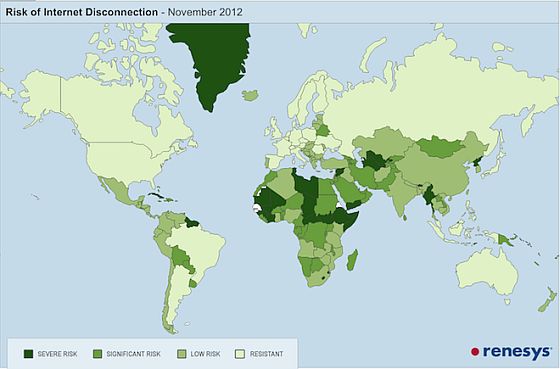
The 61 countries a mad despot could instantly unplug from the internet

Wired: It’s becoming the trademark move of failing regimes: silence your critics and cripple their communications by cutting off the internet. Libya did it. Egypt too. And last week, Syria pulled the plug on its own internet system.
According to new research from network monitoring company Renesys, it could just as easily happen in many other countries too, including Greenland, Yemen, and Ethiopia. Sixty-one of the world’s countries have just one or two service providers connecting them to the rest of the internet.
“If you’re a sufficiently small place it’s almost inescapable that there will be so little internet that it’s almost trivial to turn it off,” says James Cowie, chief technology officer with Renesys.
On the other extreme, more than 30 countries — including the U.S., Canada and the Netherlands — have over 40 network providers each at their electronic frontiers. They’re almost impossible to unplug.
No disrespect intended towards Greenlanders, but I think they should have been left off the map. The massive dark green country at the top of the map jumps out as the largest country in jeopardy of having its internet access cut off. But there are only 56,749 people who live there. How many ISPs could they expect to have?
To see a world in a cubic foot

To see a world in a grain of sand
And a heaven in a wild flower,
Hold infinity in the palm of your hand,
And eternity in an hour.
Thus William Blake’s Auguries of Innocence begins. The same insight — that in the smallest things we can discover the significance of life — has now been revealed (though not as poetically expressed) by a photographer who scoured the world examining life circumscribed by a cubic foot.
John Vidal writes: Long live the creepy crawlies, the bugs, the tiny wigglers and wrigglers, the minuscule parasites and nematodes, the mites and oribatids and all the myriad life forms that buzz, crawl and throb below our feet. Most have barely been given a second thought by science, but biologists now think that these mostly named creatures make up the beating heart of the biosphere and that the fate of all life may depend on the wellbeing of their fragile worlds.
Thanks to photographer David Liittschwager, we now have a visual inkling of what exactly lives high in the cloud forest canopy, below our feet in the parks, in the sediments of rivers and on coral reefs. Liittschwager, primarily a portrait photographer, had the idea of taking a one-cubic-foot metal frame and recording what moved through this habitat over the course of a day and night. He then made portraits of the life that could be seen with the naked eye.
What was found even in fairly nondescript places was wondrous. When the metal frame was dropped in the Duck river in Tennessee, it recorded 32 fish species, and nearly 100 others in the day. “Dig a few handfuls of sediment from the bottom and the river’s significance begins to reveal itself. Half of what you hold in your hands is sand and gravel, and the rest is live species – mussels, snails, juvenile crayfish, the larvae of stoneflies and dragonflies. It seems possible that the driving force of planetary life is actually very small and that its intricacies are lost on most of us,” author Alan Huffman remarks in an essay accompanying the pictures.
A whole, unknown world was found when the cube was suspended from the branch of a tree in Costa Rica’s rainforest. This time, 145 species – birds, mammals, mosses, bromeliads and epiphytes – were recorded. “This is the last biotic frontier, the missing pieces of the phenomenal jigsaw puzzle that is the tropical rainforest. How forest canopy populations become established, grow and disperse to other sites remains wholly unknown,” said canopy researcher Nalini Nadkarni.
The cubic foot was dropped on Temae coral reef near Tahiti in the Pacific. There, 600 individual animals and plants more than a millimetre in size – some living permanently in the space, others swimming or floating through – were recorded. “And this is not counting the many thousands of smaller creatures that floated by each hour. Wrasses, sea slugs, a baby octopus, shrimp, worms and crabs as small as the letters on the page were all recorded,” reported author Elizabeth Kolbert.
Jasper Slingsby, a researcher at the South Africa environmental observational network, recorded life in a cubic foot of Table mountain national park in South Africa. “In the course of 24 hours, the one cubic foot of mountain fynbos that we sampled revealed almost 30 plant species and roughly 70 invertebrates. But being stationary the cube could not capture what is arguably the most amazing component of fynbos diversity – how much it changes from location to location. If we picked the cube up and walked 10ft we could get as much as 50% difference in plant species we encountered. [Continue reading…]
NPR’s Robert Krulwich describes a Liittschwager-like experiment that his colleague, commentator and science writer Craig Childs, conducted in a cornfield in Iowa.
There were no bees. The air, the ground, seemed vacant. He found one ant “so small you couldn’t pin it to a specimen board.” A little later, crawling to a different row, he found one mushroom, “the size of an apple seed.” Then, later, a cobweb spider eating a crane fly (only one). A single red mite “the size of a dust mote hurrying across the barren earth,” some grasshoppers, and that’s it. Though he crawled and crawled, he found nothing else.
“It felt like another planet entirely,” he said, a world denuded.
Yet, 100 years ago, these same fields, these prairies, were home to 300 species of plants, 60 mammals, 300 birds, hundreds and hundreds of insects. This soil was the richest, the loamiest in the state. And now, in these patches, there is almost literally nothing but one kind of living thing. We’ve erased everything else.
Music: Dhafer Youssef & Hüsnü Senlendirici Group — ‘Gözüm’
Noam Chomsky: Palestine 2012 – Gaza and the U.N. resolution
Noam Chomsky writes: An old man in Gaza held a placard that reads: “You take my water, burn my olive trees, destroy my house, take my job, steal my land, imprison my father, kill my mother, bombard my country, starve us all, humiliate us all but I am to blame: I shot a rocket back.”
The old man’s message provides the proper context for the timelines on the latest episode in the savage punishment of Gaza. They are useful, but any effort to establish a “beginning” cannot help but be misleading. The crimes trace back to 1948, when hundreds of thousands of Palestinians fled in terror or were expelled to Gaza by conquering Israeli forces, who continued to truck them over the border for years after the official cease-fire. The persecution of Gazans took new forms when Israel conquered the Strip in 1967. From recent Israeli scholarship we learn that the goal of the government was to drive the refugees into the Sinai, and if feasible the rest of the population too.
Expulsions from Gaza were carried out under the direct orders of General Yeshayahu Gavish, commander of the Southern Command. Expulsions from the West Bank were far more extreme, and Israel resorted to devious means to prevent the return of those expelled, in direct violation of Security Council orders. The reasons were made clear in internal discussion immediately after the war. Golda Meir, later Prime Minister, informed her Labor colleagues that Israel should keep the Gaza Strip while “getting rid of its Arabs.” Defense Minister Dayan and others agreed. Prime Minister Eshkol explained that those expelled cannot be allowed to return because “We cannot increase the Arab population in Israel” – referring to the newly occupied territories, already tacitly considered part of Israel. In accord with this conception, all of Israel’s maps were changed, expunging the Green Line (the internationally recognized borders), though publication was delayed to permit UN Ambassador Abba Eban to attain what he called “favorable impasse” at the General Assembly, by concealing Israel’s intentions. [Continue reading…]
For first time, Britain, France may recall ambassadors in protest at Israel’s settlement construction
Haaretz reports: Britain and France are poised to take action − possibly including the unprecedented step of recalling their ambassadors, according to senior European diplomats − in protest at Prime Minister Benjamin Netanyahu’s decision to move settlement construction ahead in the area known as E1, between Ma’aleh Adumim and Jerusalem.
“This time it won’t just be a condemnation, there will be real action taken against Israel,” a senior European diplomat said.
Netanyahu’s decision Friday to move ahead on construction in E1 and to build 3,000 housing units in the settlement blocs east of Jerusalem, has apparently shocked the foreign ministries and the leaders in London and Paris. Not only do Britain and France view construction in E1 as a “red line,” they are reportedly angry because they view Israel as having responded ungratefully to the support the two countries gave it during the recent Gaza operation.
“London is furious about the E1 decision,” a European diplomat told Haaretz.
According to three senior diplomats from various EU countries, Britain and France were coordinating their moves against Israel, which they will reportedly implement over the next few days, and have discussed the extraordinary step of recalling their ambassadors from Tel Aviv for consultations. This step has never been taken before by these countries toward Israel. It would be so extreme that Britain and France may not take such action at this point but, rather, could invoke it in the case of further escalation of Israeli actions against the Palestinians. A final decision in the matter will be made today by the British and the French foreign ministers. [Continue reading…]
Uncle Morsi
Sarah Carr writes: The crude binary (Islamist/pro-Morsi vs. “secular”/anti-Morsi) that was produced by last year’s referendum is now at its most pronounced – as is inevitable in a context of long suppressed (political and religious) identities and fear mongering about The Other.
Campaigning between the two camps has been reduced to who can mobilise the most bodies in one place. On Tuesday the seculars organised a huge show of force in their old stomping ground Tahrir Square. Islamists responded by holding an equally impressive rally outside Cairo University.
The two rallies couldn’t have been more different. Now that the opposition movement is going after Morsi it has attracted the Ahmed Shafiq/Omar Suleiman/Amr Moussa crowd, people like some members of my family who aren’t necessarily felool (pro or affiliated with the Mubarak regime) but who have a morbid terror of the Muslim Brotherhood and political Islam generally. I have a pro-revolution aunt who supported Hamdeen Sabahy in the first round of the presidential elections and then switched to Shafiq in the run-offs when Sabahy lost.
Not all of this group are affluent or from chichi neighbourhoods, but the ones that are were prominent on Tuesday, furiously marching from Zamalek in their velour tracksuits and ugg boots and manicured nails, holding forth in Arabic, English and French about the outrage of it all.
Their appearance has added a new dimension to the binary, with the pro-Morsi camp accusing the opposition of being dominated by felool and atheists who engage in lewd acts in Tahrir, while some members of the anti-Morsi crowd respond with equally vile slurs, calling Islamists uneducated peasants, or sheep unable to think for themselves.
As usual El-Baradei is a convenient shorthand for Islamist criticism of their enemies, especially given his recent visibility, actually in Egypt and actually in public. He popped up in Tahrir on Friday, bustled on to a stage looking uncomfortable as usual where he gave a barely audible speech through the evening’s murk. I’m still undecided about whether he played a shrewd game by being absent, and above, all of 2011’s political yuckiness and base shenanigans. Supporters laud him for not compromising on his principles and for his consistency, but it is easy to do that from the nosebleed seats.
ElBaradei’s name was bandied around at the Islamist rally, too, protesters reminding him and Sabahy that Morsi was elected president and not them.
My friend Adam and I got talking to a man, Mahmoud, at the Morsi rally who said that the president’s political opposition are necessarily against any decision he takes, no matter how prudent, because they reject his Islamic project. Mahmoud was dressed in a neat plaid shirt and casual weekend jacket with the telltale just too short trousers, his chin adorned with a wispy candy floss-like beard. He held a sign above his head demanding the implementation of Sharia, and on the subject of Sharia said that it has never been implemented in the modern age but that the Taliban came the closest to doing so. He added that the media misrepresented the Taliban. [Continue reading…]
Video: The human cost of Syria’s war
Demonstrations still an integral feature of Syria’s revolution
McClatchy reports: Wael Nasrallah has organized more than 100 demonstrations in the past 20 months. On Friday, he led another one in Qalat al Mudiq, a city of about 30,000 in central Syria.
Even with civil war engulfing the country, the peaceful demonstrations that kicked off the rebellion against the government of President Bashar Assad so long ago continue, at least in this part of Syria. Often, the target is no longer the Assad regime but the rebels who now rule in many areas.
“It is still necessary because we have demands,” said the 35-year-old Nasrallah, who’s a truck driver by trade. “Today we mentioned two things: We want the revolutionaries to organize electricity service and to organize the distribution of bread.”
In other parts of the country, demonstrators also have called on the rebels to provide security, something Nasrallah and others say isn’t an issue here, and for the international community to provide weapons to the rebels.
In a country where people were generally terrified to speak freely before the rebellion began, the demonstrations are an important advance, activists say, and one people are loath to lose. People now can discuss what the future holds and generally appear unafraid to criticize the rebels themselves. The rebellion has empowered conservative Islamist groups who’ve done much of the frontline fighting and call openly for a state based on Islamic law, but the demonstration here Friday encompassed a wide range of the opposition’s members, from the conservative to the secular. [Continue reading…]
Demonstrators in Damascus today:
Flow of arms to Syria through Iraq persists
The New York Times reports: The American effort to stem the flow of Iranian arms to Syria has faltered because of Iraq’s reluctance to inspect aircraft carrying the weapons through its airspace, American officials say.
The shipments have persisted at a critical time for President Bashar al-Assad of Syria, who has come under increasing military pressure from rebel fighters. The air corridor over Iraq has emerged as a main supply route for weapons, including rockets, antitank missiles, rocket-propelled grenade and mortars.
Iran has an enormous stake in Syria, which is its staunchest Arab ally and has also provided a channel for Iran’s support to the Lebanese Islamist movement Hezbollah.
To the disappointment of the Obama administration, American efforts to persuade the Iraqis to randomly inspect the flights have been largely unsuccessful.
Adding to American concerns, Western intelligence officials say they are picking up new signs of activity at sites in Syria that are used to store chemical weapons. The officials are uncertain whether Syrian forces might be preparing to use the weapons in a last-ditch effort to save the government, or simply sending a warning to the West about the implications of providing more help to the Syrian rebels.
“It’s in some ways similar to what they’ve done before,” a senior American official said, speaking on the condition of anonymity to discuss intelligence matters. “But they’re doing some things that suggest they intend to use the weapons. It’s not just moving stuff around. These are different kind of activities.”
The official said, however, that the Syrians had not carried out the most blatant steps toward using the chemical weapons, such as preparing them to be fired by artillery batteries or loaded in bombs to be dropped from warplanes. [Continue reading…]
Jabhat al-Nusra’s expanding role in Syria
David Ignatius writes: Syrian opposition leaders report an alarming growth within their ranks of fighters from Jabhat al-Nusra, an extremist group linked to al-Qaeda.
The Jabhat group now has somewhere between 6,000 and 10,000 fighters, according to officials of an non-governmental organization that represents the more moderate wing of the Free Syrian Army (FSA). They say that the al-Qaeda affiliate now accounts for 7.5 percent to 9 percent of the Free Syrian Army’s total fighters, up sharply from an estimated 3 percent three months ago and 1 percent at the beginning of the year.
The extremist group is growing in part because it has been the most aggressive and successful arm of the rebel force. “From the reports we get from the doctors, most of the injured and dead FSA are Jabhat al-Nusra, due to their courage and [the fact they are] always at the front line,” said a message sent today to the State Department by the moderate Free Syrian Army representatives, warning of the extremists’ rise.
These estimates are very rough, given the scattered and disorganized nature of the opposition. But they are based on detailed reporting from the field by the members’ military councils, which are the closest thing to an organized command structure among the rebels. [Continue reading…]
Atheists and Islam
The Economist: A mob attacked Alexander Aan even before an Indonesian court in June jailed him for two and a half years for “inciting religious hatred”. His crime was to write “God does not exist” on a Facebook group he had founded for atheists in Minang, a province of the world’s most populous Muslim nation. Like most non-believers in Islamic regions, he was brought up as a Muslim. And like many who profess godlessness openly, he has been punished.
In a handful of majority-Muslim countries atheists can live safely, if quietly; Turkey is one example, Lebanon another. None makes atheism a specific crime. But none gives atheists legal protection or recognition. Indonesia, for example, demands that people declare themselves as one of six religions; atheism and agnosticism do not count. Egypt’s draft constitution makes room for only three faiths: Christianity, Judaism and Islam.
Sharia law, which covers only Muslims unless incorporated into national law, assumes people are born into their parents’ religion. Thus ex-Muslim atheists are guilty of apostasy—a hudud crime against God, like adultery and drinking alcohol. Potential sanctions can be severe: eight states, including Iran, Saudi Arabia, Mauritania and Sudan have the death penalty on their statute books for such offences.
In reality such punishments are rarely meted out. Most atheists are prosecuted for blasphemy or for inciting hatred. (Atheists born to non-Muslim families are not considered apostates, but they can still be prosecuted for other crimes against religion.) Even in places where laws are lenient, religious authorities and social attitudes can be harsh, with vigilantes inflicting beatings or beheadings.
Many, like Kacem el-Ghazzali, a Moroccan, reckon the only solution is to escape abroad. The 23-year-old was granted asylum in Switzerland after people found out he was the author of an anonymous blog, Atheistica.com. Even in non-Muslim lands ex-believers are scared of being open, says Nahla Mahmoud, a 25-year-old Sudanese atheist who fled to Britain in 2010. “Muslim communities here don’t feel comfortable with having an ex-Muslim around,” she says, noting that extremists living in the West may harass non-believers there too.
Facebook groups for atheists, mostly pseudonymous, exist in almost every Muslim country. Social media give non-believers more clout—but also make them more conspicuous, and therefore vulnerable. But the real blame lies with religious intolerance. In the 1950s and 1960s secularism and tolerance prevailed in many majority-Muslim countries; today religion pervades public and political life. Sami Zubaida, a scholar at London’s Birkbeck College, speaks of increasing polarisation, with “growing religiosity at one end of the spectrum and growing atheism and secularism at the other.”
The rise to power of Islamist parties after the Arab revolutions is likely to make life more miserable still for those who leave Islam. New rulers in Tunisia and Egypt have jailed several young people who have been outspoken about their lack of belief. Such cases occurred before the revolutions, but seem to have become more common. Alber Saber Ayad, an Egyptian Christian activist who ran a Facebook page for atheists, has been in custody since September for “insulting religion”. His alleged offence was posting a link to an infamous YouTube video that caused protests in the Islamic world that month. He was arrested by a Christian policeman: Egypt’s Coptic church does not look kindly on atheism either.
The irony and perversity of religious intolerance — or any other form of intolerance — is that it rewards hypocrisy and deceit. In other words, such efforts to police faith will primarily have the effect of making most of the faithless prudently disguise their true beliefs. A few will dare to speak out, but many more will remain married to a religion of convenience.
The protectors of the faith would apparently rather have their houses of worship accommodate hollow expressions of faith rather than encourage individuals to act with integrity.
When ideology thus becomes a bludgeon of conformity, what this suggests is that the core of faithlessness actually resides in the hearts of those who fix their attention on the beliefs of others. A faith that depends on such rigid external buttresses is no faith at all.