



Human Rights Watch: President Bashar al-Assad should release all peaceful activists, media professionals, and humanitarian assistance providers as part of an amnesty announced on October 23, 2012, Human Rights Watch, Alkarama, the Euro-Mediterranean Human Rights Network, the Gulf Centre for Human Rights, Index on Censorship, the International Federation for Human Rights (FIDH), Reporters Without Borders, and Samir Kassir Foundation – Skeyes Center for Media and Cultural Freedom said today. These persons have been detained purely for exercising their basic rights such as freedom of assembly and freedom of expression, or for assisting others and therefore should not have been detained or prosecuted in the first place, the groups said.
The president’s Legislative Decree No. 71 grants a general amnesty, reducing or eliminating prison terms for most crimes, but it excludes those who have been charged or convicted of terrorism offenses under the Anti-Terrorism Law enacted on July 2. Although Assad issued four amnesty decrees in 2011 and two others in January and May, security forces have kept many peaceful activists in detention. To ensure that the amnesty does not exclude them, the government should allow independent United Nations monitors inside Syria’s detention facilities, the groups said.
“If President Assad is serious about his amnesty, he should open the doors of all his prisons to independent monitors to check who is actually detained and why,” said Sarah Leah Whitson, Middle East director at Human Rights Watch. “Otherwise, this amnesty will be yet another false promise, with released detainees soon replaced by other activists, humanitarians, and journalists locked up for peacefully doing their jobs.” [Continue reading…]
Reuters reports: Syrian opposition activists reported a return to heavy government bombardment in major cities on Saturday, further undermining a truce intended to mark the Muslim Eid al-Adha religious holiday.
Activists in the eastern city of Deir al-Zor, the suburbs of Damascus and in Aleppo, where rebels hold roughly half of Syria’s most populous city, said that mortar bombs were being fired into residential areas on Saturday morning.
The bombardment came on the second day of a truce called by international peace envoy Lakhdar Brahimi, who had hoped to use it to build broader moves towards ending the 19-month-old conflict which has killed an estimated 32,000 people.
“The army began firing mortars at 7 a.m. I have counted 15 explosions in one hour and we already have two civilians killed,” said Mohammed Doumany, an activist from the Damascus suburb of Douma, where pockets of rebels are based. “I can’t see any difference from before the truce and now,” he added.
The Syrian military has said it responded to attacks by insurgents on army positions on Friday, in line with its announcement on Thursday that it would cease military activity during the holiday but reserved the right to react to rebel actions.
Maryam al-Khawaja writes: When you pick up the day’s newspaper, it is not likely that you will find much coverage of the ongoing popular revolt in Bahrain. But on the off chance that Bahrain is mentioned, it is almost certain that two words will jump at you: Sunni and Shia. It is even more likely you will see some mention of a Shia revolt against a Sunni monarchy.
This is unfortunate; a very complicated situation is expediently packaged into a soundbite-like myth. That narrative is ahistorical and dangerous because, like all myths, there is a grain of truth to it.
Last year, when Bahrain’s revolution began, it was not about sects. Sunnis, Shia along with Bahrain’s “sushis” (people of mixed background), non-Muslims, atheists; all came together in Bahrain’s version of Tahrir – Pearl Square. Their unifying demand was for a constitutional monarchy to be established in Bahrain. The people were demanding that the king honour his lofty reform promises made when he inherited the position from his Emir father.
This was the third act in a struggle predating the so-called Arab spring. It had started in the 1990s when the people of Bahrain had their own uprising largely forgotten in the west. Then, their demand was a return to Bahrain’s more democratic 1973 constitution that gave people a real parliament. Instead, thousands of citizens were arrested and imprisoned. Dozens were killed, many under torture.
In 1999 that cycle was interrupted as Hamad bin Isa al-Khalifa inherited power from his late father amid soaring hopes of reconciliation and reform. His first act was to announce a referendum promising to establish a constitutional monarchy. [Continue reading…]
Reuters reports: Al Qaeda leader Ayman al-Zawahri has called on Muslims to kidnap Westerners, join Syria’s rebellion and to ensure Egypt implements sharia, SITE Monitoring reported on Saturday, citing a two-part film posted on Islamist websites.
The Egypt-born cleric, who became al Qaeda leader last year after the death of Osama bin Laden, spoke in a message that lasted more than two hours.
“We are seeking, by the help of Allah, to capture others and to incite Muslims to capture the citizens of the countries that are fighting Muslims in order to release our captives,” he said, praising the kidnapping of Warren Weinstein, a 71-year-old American aid worker in Pakistan last year.
Zawahri’s message was first released on Wednesday, SITE said, just two weeks after the cleric issued a filmed statement calling for more protests against the United States over a California-made film mocking the Prophet Mohammad.
In his new message, he called on Muslims to ensure Egypt’s revolution continued until sharia law was implemented and urged fellow Muslims to join the uprising against President Bashar al-Assad in Syria.
The release of his message had been delayed, he said, because of the “conditions of the fierce war” in Afghanistan and Pakistan where he said U.S.-led forces had intensified a bombing campaign.
U.S. President Barack Obama, whom Zawahri described as a “liar” and “one of the biggest supporters of Israel”, has stepped up the use of unmanned drones to target militants in both countries as well as in Yemen.
The New York Times reports: For all their disputes, President Obama and Mitt Romney agree that the world is warming and that humans are at least partly to blame. It remains wholly unclear what either of them plans to do about it.
Even after a year of record-smashing temperatures, drought and Arctic ice melt, none of the moderators of the four general-election debates asked about climate change, nor did either of the candidates broach the topic.
Throughout the campaign, Mr. Obama and Mr. Romney have seemed most intent on trying to outdo each other as lovers of coal, oil and natural gas — the very fuels most responsible for rising levels of carbon dioxide in the atmosphere.
Mr. Obama has supported broad climate change legislation, financed extensive clean energy projects and pushed new regulations to reduce global warming emissions from cars and power plants. But neither he nor Mr. Romney has laid out during the campaign a legislative or regulatory program to address the fundamental questions arising from one of the most vexing economic, environmental, political and humanitarian issues to face the planet. Should the United States cut its greenhouse gas emissions, and, if so, how far and how fast? Should fossil fuels be more heavily taxed? Should any form of clean energy be subsidized, and for how long? Should the United States lead international mitigation efforts? Should the nation pour billions of new dollars into basic energy research? Is the climate system so fraught with uncertainty that the rational response is to do nothing?
Many scientists and policy experts say the lack of a serious discussion of climate change in the presidential contest represents a lost opportunity to engage the public and to signal to the rest of the world American intentions for dealing with what is, by definition, a global problem that requires global cooperation. [Continue reading…]
Larry Derfner writes: The only way Israel is ever going to give up the occupation and its habit of military aggression is by going too far – by becoming such a Goliath that the Western world finally tells it to clean up its act or find some new allies. Tonight’s union between Bibi Netanyahu’s Likud and Avigdor Lieberman’s Yisrael Beiteinu into one big Likud Beiteinu – “Likud Is Our Home” – marks a sizable step in that direction.
Netanyahu hurt himself. I don’t know whether the new party will win more Knesset seats in the January 22 election than Likud and Yisrael Beiteinu could have won separately, but Netanyahu has dirtied himself in the eyes of the world, including even a lot of his mainstream Jewish supporters in the United States. Avigdor Lieberman has a thoroughly deserved international reputation as an Arab-hating, war-loving neo-fascist (this last label having been pinned on him even by Martin Peretz, the stridently pro-Israel ex-publisher of The New Republic.)
Foreign Minister Lieberman calls for expelling, by means of a land swap, hundreds of thousands of Israeli citizens simply for being Arab. He ran an election campaign highlighted by the slogan, “Only Lieberman understands Arabic.” He was a member of Kach in the late 1970s, which he understandably denies but which Kach veterans from that era swear to. He’s fantasized aloud in the Knesset about executing Arab MKs and threatened to bomb Egypt’s Aswan Dam. Plus, of course, he’s been under Israel Police investigation for corruption for nearly 15 years, and could face indictment pretty soon.
And now Netanyahu, who made Lieberman his right-hand man during his first term as prime minister, has identified himself completely with this guy. There was a report tonight by Channel 2′s well-connected Amnon Abramovitch that the unity deal calls for Lieberman to take over as PM in the fourth year of the next term, which Likud Beiteinu is likely to win in the upcoming election. [Continue reading…]
Reuters reports: Lakhdar Brahimi’s holiday truce may have saved Syrian lives on Friday, as government troops and rebels drew breath on several fronts – though dozens still shed blood on Eid al-Adha, the Muslim Feast of Sacrifice.
The U.N. envoy, discreetly downbeat since he succeeded a disillusioned Kofi Annan two months ago, could scarcely be surprised at ceasefire breaches that included tank fire and a car bombing; two previous attempts to end the conflict over the past year both quickly descended into ever more bitter fighting.
But more troubling for Brahimi, the Algerian troubleshooter called on to mediate in a civil war that has divided the United Nations, may be that when compared to the ceasefire attempts in January and April, each side seems even less ready now to talk.
“Brahimi faces an impossible task because both sides are still convinced that they can win and are determined to press every advantage,” said Syria expert Joshua Landis, associate professor of Middle East Studies at the University of Oklahoma.
Veteran dissident Fawaz Tello, now in exile in Germany, put it bluntly – mediation focused on forming a transitional unity government might have been possible a year ago, he said: “But after all this blood, all this sectarian conflict, it has become impossible. So now it’s a battle – and one side must win.”
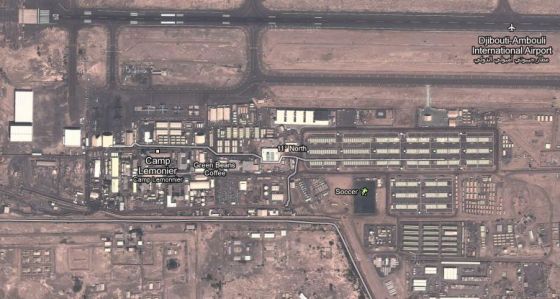
Camp Lemonier, Djibouti
The Washington Post reports: Around the clock, about 16 times a day, drones take off or land at a U.S. military base here, the combat hub for the Obama administration’s counterterrorism wars in the Horn of Africa and the Middle East.
Some of the unmanned aircraft are bound for Somalia, the collapsed state whose border lies just 10 miles to the southeast. Most of the armed drones, however, veer north across the Gulf of Aden to Yemen, another unstable country where they are being used in an increasingly deadly war with an al-Qaeda franchise that has targeted the United States.
Camp Lemonnier, a sun-baked Third World outpost established by the French Foreign Legion, began as a temporary staging ground for U.S. Marines looking for a foothold in the region a decade ago. Over the past two years, the U.S. military has clandestinely transformed it into the busiest Predator drone base outside the Afghan war zone, a model for fighting a new generation of terrorist groups.
The Obama administration has gone to extraordinary lengths to conceal the legal and operational details of its targeted-killing program. Behind closed doors, painstaking debates precede each decision to place an individual in the cross hairs of the United States’ perpetual war against al-Qaeda and its allies.
Increasingly, the orders to find, track or kill those people are delivered to Camp Lemonnier. Virtually the entire 500-acre camp is dedicated to counterterrorism, making it the only installation of its kind in the Pentagon’s global network of bases.
Secrecy blankets most of the camp’s activities. The U.S. military rejected requests from The Washington Post to tour Lemonnier last month. Officials cited “operational security concerns,” although they have permitted journalists to visit in the past.
After a Post reporter showed up in Djibouti uninvited, the camp’s highest-ranking commander consented to an interview — on the condition that it take place away from the base, at Djibouti’s lone luxury hotel. The commander, Army Maj. Gen. Ralph O. Baker, answered some general queries but declined to comment on drone operations or missions related to Somalia or Yemen.
Despite the secrecy, thousands of pages of military records obtained by The Post — including construction blueprints, drone accident reports and internal planning memos — open a revealing window into Camp Lemonnier. None of the documents is classified and many were acquired via public-records requests.
Taken together, the previously undisclosed documents show how the Djibouti-based drone wars sharply escalated early last year after eight Predators arrived at Lemonnier. The records also chronicle the Pentagon’s ambitious plan to further intensify drone operations here in the coming months. [Continue reading…]

The Guardian reports: Britain has rebuffed US pleas to use military bases in the UK to support the build-up of forces in the Gulf, citing secret legal advice which states that any pre-emptive strike on Iran could be in breach of international law.
The Guardian has been told that US diplomats have also lobbied for the use of British bases in Cyprus, and for permission to fly from US bases on Ascension Island in the Atlantic and Diego Garcia in the Indian Ocean, both of which are British territories.
The US approaches are part of contingency planning over the nuclear standoff with Tehran, but British ministers have so far reacted coolly. They have pointed US officials to legal advice drafted by the attorney general’s office which has been circulated to Downing Street, the Foreign Office and the Ministry of Defence.
This makes clear that Iran, which has consistently denied it has plans to develop a nuclear weapon, does not currently represent “a clear and present threat”. Providing assistance to forces that could be involved in a pre-emptive strike would be a clear breach of international law, it states.
“The UK would be in breach of international law if it facilitated what amounted to a pre-emptive strike on Iran,” said a senior Whitehall source. “It is explicit. The government has been using this to push back against the Americans.”
As used by Israel and its supporters, “demographic problem” is a racist concept — it simply means, as candid Jewish Israelis would put it: too many Arabs. But as the latest polling makes clear, Israel has too many racists. Now that’s a real demographic problem.
In his latest column, “Meet the Israelis,” Gideon Levy writes: Nice to make your acquaintance, we’re racist and pro-apartheid. The poll whose results were published in Haaretz on Tuesday, conducted by Dialog and commissioned by the Yisraela Goldblum Fund, proved what we always knew, if not so bluntly. It’s important to recognize the truth that has been thrown in our faces and those of the world (where the survey is making waves ). But it’s even more important to draw the necessary conclusions from it.
Given the current reality, making peace would be an almost anti-democratic act: Most Israelis don’t want it. A just, egalitarian society would also violate the wishes of most Israelis: That, too, is something they don’t want. They’re satisfied with the racism, comfortable with the occupation, pleased with the apartheid; things are very good for them in this country. That’s what they told the pollsters.
Until a courageous leadership arises here, the kind that appears only rarely in history, and tries to change this nationalist, racist mood, there’s no point in hoping for change to come from below. It won’t come; indeed, it can’t come, because it is contrary to the desires of most Israelis. This fact must be recognized.
The world must also recognize this. Those who long to reach an agreement and draw up periodic peace plans must finally recognize that Israelis are plainly telling them, “No thanks, we’re not interested.” [Continue reading…]
Mark LeVine writes: “The Jewish majority is history.”
So declared Haaretz columnist Akiva Eldar in the space of Palestine/Israel in his most recent column, published on October 16. Eldar learned the news not from a public pronouncement to that effect by the Israeli government, which naturally has little interest to disseminate information of such “unparalleled importance”.
Rather, the new data, revealing that Jews now account for approximately 5.9 million out of the 12 million residents of Israel and the Occupied Territories was published in Haaretz’s economic magazine, The Marker, in an article dealing with government attempts to raise the bar for obtaining tax benefits.
A Ministry of Finance memorandum on the proposed changes to the law revealed the population figures without comment. But the implications are crucial. Not merely because of the demographic ceiling that has now been broken, but also because of what the structure of the tax law in question tells us about how Israelis have long considered the territory of Israel/Palestine – as one unit.
The Ministry of Finance wants to increase the threshold for companies to obtain tax breaks based on the number of consumers they sell to. The existing minimum market is 12 million people, and now that the population of Israel/Palestine as a whole has reached that level, any company that serves the Israeli/Palestinian market would be eligible for the tax break, when the law was intended to encourage exports outside the home market.
Fair enough. But what’s not fair is the fact that Israel and the Occupied Territories are considered as a single market from the perspective of Israeli enterprises, which have long had the West Bank and Gaza as a captive market, while Palestinian industries and agriculture have been severely restricted by Israel for decades in order to prevent them from competing with Israel.
The process of de-development and de-industrialisation has been a marked feature of Israeli rule over the Occupied Territories. Thanks to the weakness of Palestinian negotiators, the incompetence and corruption of the political leadership, and the connivance of the American and EU as “honest brokers”, it was institutionalised into the Oslo-era economic relationship through various agreements, most notably the Paris Protocol of 1994, which severely restricted the ability of Palestinians to develop any new industries which might challenge existing Israeli industries. [Continue reading…]
Tony Karon writes: Mindful of its declining appetite for projecting power in the Middle East, the U.S. is relying on more activist partners in the region such Qatar, Saudi Arabia and Turkey to arm the Syrian rebellion. But Tuesday’s visit to Gaza by Qatar’s Sheikh Hamad bin Khalifa al-Thani — to the delight of the territory’s Hamas rulers and Egypt’s Muslim Brotherhood, while Israel and Fatah fumed — was a reminder that U.S. allies in the region often pursue goals quite different from those of Washington, despite many shared objectives and common enemies. And the relative decline of U.S. influence in the Middle East has seen some of those independently-minded allies grow more assertive in pressing their agendas.
In Monday’s presidential campaign foreign policy debate, Gov. Mitt Romney rejected U.S. military intervention in Syria, noting instead that “The Saudis and the Qataris and the Turks are … willing to work with us. We need to have a very effective leadership effort in Syria, making sure that the insurgents there are armed, and that the insurgents that become armed are people who will be the responsible parties.” President Obama also talked up cooperation with regional allies, but warned that “we have to [make] absolutely certain that we know who we are helping; that we’re not putting arms in the hands of folks who eventually could turn them against us or allies in the region.”
But the Emir’s visit to Gaza makes clear that Qatar, the tiny Emirate whose massive natural gas reserves give it the world’s highest per capita income as well as geopolitical punching power way above its weight, has sharply different ideas from Washington’s about just who the ”responsible parties” will be in a changing Middle East. Hamas, after all, is formally shunned by the U.S. and European powers as a terrorist organization, and Washington has shown little enthusiasm for efforts by Arab governments, including Qatar, to promote reconciliation between the Islamists and the Fatah movement of President Mahmoud Abbas. Abbas was reportedly furious at the Qatari leader’s decision to become the first foreign head of state to visit the Hamas-controlled Gaza, effectively blessing the Islamist’ rule there. The Emir’s purpose was to inaugurate Qatar’s $400 billion investment in rebuilding infrastructure smashed in repeated confrontations with Israel — a massive stimulus to an economy choked off by a five-year siege imposed by Israel with Egyptian compliance. [Continue reading…]
Noah Shachtman reports: The regime of embattled Syrian dictator Bashar Assad is actively working to enlarge its arsenal of chemical weapons, U.S. officials tell Danger Room. Assad’s operatives have tried repeatedly in recent months to buy up the precursor chemicals for deadly nerve agents like sarin, even as his country plunges further and further into a civil war. The U.S. and its allies have been able to block many of these sales. But that still leaves Assad’s scientists with hundreds of metric tons of dangerous chemicals that could be turned into some of the world’s most gruesome weapons.
“Assad is weathering everything the rebels throw at him. Business is continuing as usual,” one U.S. official privy to intelligence on Syria says. “They’ve been busy little bees.”
Back in July, the Assad regime publicly warned that it might just use chemical weapons to stop “external” forces from interfering in its bloody civil war. American policy-makers became deeply concerned that Damascus just might follow through on the threats. Since the July announcement, however, the world community — including Assad’s allies — have made it clear to Damascus that unleashing weapons of mass destruction was unacceptable. The message appears to have gotten through to Assad’s cadre, at least for now. Talk of direct U.S. intervention in Syria has largely subsided.
“There was a moment we thought they were going to use it — especially back in July,” says the U.S. official, referring to Syria’s chemical arsenal. “But we took a second look at the intelligence, and it was less urgent than we thought.”
That hardly means the danger surrounding Syria’s chemical weapons program has passed. More than 500 metric tons of nerve agent precursors, stored in binary form, are kept at upward of 25 locations scattered around the country. If any one of those sites falls into the wrong hands, it could become a massively lethal event. And in the meantime, Assad is looking to add to his already substantial stockpile. [Continue reading…]
Tony Karon writes: Few expect that the four-day truce in Syria‘s civil war scheduled to take effect Friday will hold, much less serve as the prelude to a more sustained peace process (activists have already reported that fighting was occuring near a military base in Syria’s north). But the cease-fire proposed by U.N. Special Envoy Lakhdar Brahimi, to coincide with this weekend’s Eid al-Adha Muslim holiday, is likely an attempt to lay down a marker for a future mechanism to end a war that neither side is currently ready to stop. The veteran Algerian diplomat could take some small consolation in the fact that even if they have no intention of implementing the agreement, both sides felt obliged to agree to his plan rather than be seen to be saying no to the U.N. Instead, each side will seek to blame the other for thwarting Brahimi’s mission.
The regime of President Bashar al-Assad and some of the major rebel commanders on Thursday signed on to Brahimi’s plan, but each side set conditions that leave it plenty of room to keep fighting. The Syrian military announced it would “cease military operations” from Friday until Monday, but reserves the right to respond if attacked — and also to take action to prevent rebels reinforcing their current positions. It’s harder to pin down a rebel position because there are literally hundreds of insurgent groups fighting the regime. There is no single military chain of command, much less clear political leadership. Many rebel commanders have reportedly questioned the value of the truce, and a number of the Islamist battalions made clear they will fight on — which, of course, is what Assad is assuming. Still, a number of officials speaking for the Free Syrian Army, a loose umbrella of rebel forces headquartered in Turkey, indicated that they, too, would observe the Eid al-Adha truce, but set unlikely conditions of their own, including a demand for the release of prisoners on Friday, and withdrawal of government forces from key cities. “We will observe it as long as the regime does,” Col. Qassim Saad Eddine of the FSA told the LA Times, but “we don’t expect them to observe it for even one minute.”
Previous cease-fire agreements have been violated by both sides, and neither appears ready to stop a fight both believe is their best way forward. The absence of any external monitoring personnel or established protocols for disengagement, much less any enforcement mechanism, is a clear sign that the Eid al-Adha truce plan is largely an effort to have the combatants make a symbolic commitment to the idea of a future political settlement. Having honed his reputation in decades of mediating such intractable conflicts as the civil wars Lebanon and Afghanistan, Brahimi is not so naive as to believe Syria’s can be ended any time soon; instead, he’s establishing lines of communication with all sides, making sure that the Syrian combatants and their foreign sponsors will know where to turn when one or the other is ready to sue for peace. That moment, though, will likely be some time in coming. [Continue reading…]
Paul Mason writes: Newsnight’s report on the Greek far-right party Golden Dawn made headlines across Europe last week. [See video above.]
In it, MP Ilias Panagiotaros claimed Greece was “in civil war” and indeed advocated a new kind of civil war, pitting the far-right against migrants, anarchists, etc.
Within 24 hours Mr Panagiotaros had retracted his claim that Greece was “in civil war”, saying instead “there is no civil war” and accusing Newsnight of “paraphrasing” his words. We had simply broadcast them, un-edited and in English.
Now three new reports cast light on the substance of our story – which was: alleged police torture of anti-fascist detainees, Golden Dawn’s influence inside the Greek police force, and its potential influence on the operational behaviour and priorities of the police in the Attica region around Athens.
Today, lawyers for 15 protesters who claim they were mistreated and abused in police detention, have shown Newsnight coroners’ reports on eight of the detainees.
The most serious of the coroners’ documents confirms “grievous bodily harm caused by a sharp and blunt object,” requiring the victim to be off work for a month.
Another describes a kind of injury that is consistent with being caused by a taser, as claimed in the original Guardian report.
Fifteen protesters have told us they intend to bring a case against the Athens police.