Stephen Walt writes: What if our current policy towards Iran actually works, and Tehran gives in to every one of our demands? You’d think that would be a crowning diplomatic success, wouldn’t you? Think again. In fact, a one-sided triumph over Iran might solve little, because a deal dictated by Washington probably wouldn’t last.
Given where U.S. policy is today, there are two paths to a resolution of the Iranian nuclear issue. Both are inherently coercive. The first path is the one we are currently on: The United States and its allies keep ratcheting up economic sanctions until the Iranian economy collapses, accompanied by a fair amount of human suffering and untold deaths due to economic hardship. At that point, the clerical regime either says “uncle” or gets overthrown. In either case, whoever is in charge in Iran subsequently agrees to abandon all nuclear enrichment, get rid of all their current stockpile of enriched uranium, and dismantle all their centrifuges, with compliance to be verified by the United States and the IAEA.
In this scenario, a tightening vise of economic pressure will convince Iran to do what the late Muammar Qaddafi did in Libya in 2003 and abandon any interest in a nuclear capability. Unfortunately for us, Tehran has probably noticed what happened to him, which makes it less likely that they’d ever surrender in quite the same way.
The second path is the military option: The United States attacks Iran and destroys as much of its nuclear infrastructure as it can find. We also manage to convince Iran that we’ll keep coming back to repeat the job if they try to rebuild. In response, the clerical regime ignores the popular outrage that our attack would provoke and agrees to remain a non-nuclear power in perpetuity.
Let’s ignore for the moment the fact that U.S. intelligence services still believe that Iran is not actively seeking nuclear weapons at all, a view that our allies in Great Britain apparently share. Let’s also leave aside the question of whether either of these two paths is likely to succeed. Instead, let’s suppose one of them did, and Iran capitulated to our current demands. Would that be a good thing? I’m not so sure. [Continue reading…]
Obama’s next war in Africa
Time reports: Why should Americans care about Mali? Many probably asked themselves that question during the last presidential debate, when Mitt Romney twice mentioned the northwest African nation, a place most Americans might be hard-pressed to locate on a map. Yet seven months after Islamic militant groups seized control of northern Mali, the Western-designed military strategy to push them out could have real consequences for future antiterrorist operations, including for the U.S., according to some analysts. As the pieces steadily fall into place for a military assault on northern Mali, the intervention could serve as a model for future conflicts, at a time when Americans and Europeans have no appetite to fight another war. “We’re moving to a form of intervention which is much more typical of the post-Afghanistan era than anything we have seen before,” says François Heisbourg, a special advisor to the Foundation for Strategic Research in Paris. “If you are looking at future military interventions, it will not be like Iraq and Afghanistan.”
The objective is clear: to seize back control of northern Mali — an area the size of Texas — and crush the Islamic militants who have controlled it since last April. As a measure of how urgent the West believes the situation is, U.S. Secretary of State Hillary Clinton landed in Algiers on Monday to try to lock in President Abdelaziz Bouteflika’s support for a military assault across his border, with an aide telling reporters on the plane headed to Algeria’s capital that the country was “a critical partner” in dealing with al-Qaeda in North Africa. And last Wednesday U.S. Secretary of Defense Leon Panetta told reporters in Washington that the U.S. had to “ensure that al-Qaeda has no place to hide and that we have to continue to go after them.”
That will not be easy — especially since no Western troops will be deployed on the ground. The plan, crafted in a frenzy of diplomatic activity in Africa during the past two weeks, will instead rely on about 3,200 West African troops, together with 3,000 Malian troops trained by the E.U. Many of the West African troops are Nigerian, who have little experience in fighting across the remote, vast desert that characterizes northern Mali. In a French-led resolution at the U.N. on Oct. 12, African countries have until late November to craft a plan to get the Islamic groups out of northern Mali. Behind the scenes, U.S. and French Special Forces are increasingly involved in training and advising African militaries, according to Heisbourg, in advance of the attack, which could come early next year. And French officials have said they would likely deploy unarmed surveillance drones of the kind the U.S. already has at hand in the area.
But all that leaves out the region’s biggest military player: Algeria. Until now, Bouteflika has vowed to sit out the conflict, just as he did in last year’s war against Muammar Gaddafi in next-door Libya. The Algerian leader has good reason to fear getting involved: an all-out war by Algeria against al-Qaeda could spark conflict at home, in a country that is still recovering from a bitter, bloody civil war during the 1990s that claimed at least 150,000 lives. Algerian officials last week announced they were deploying more troops along their 1,200-mile border with Mali, but only in order to stop Islamic militants from escaping to Algeria once a military assault begins. [Continue reading…]
Video — Rory Stewart: Why democracy matters
Homeland no more: The end of the two-state solution
Joseph Dana reviews Occupation Diaries by Raja Shehadeh: Where has all the excitement gone for statehood in the West Bank? A year ago in September there were festivities and public displays of hope on the streets of Ramallah; one year later, little attention was paid to Palestinian Authority (PA) President Mahmoud Abbas’s United Nations speech reiterating the need for an independent Palestinian state. Lackluster support for the PA should come as no surprise. In the past 12 months alone, the United States blocked the PA’s bid to declare statehood; Israel has intensified settlement growth while Israeli settlers have rampaged, destroying property and desecrating holy sites with impunity; the international community, focused on Iran and the threat of regional war, has stood idly by. An equitable two state solution between Israel and the Palestinians is all but dead.
Last month’s surprise economic protests are a stark reminder of the genuine discontent simmering in the West Bank, as well as the dire economic straits many Palestinians experience. Fed up with rising prices for goods and services, Palestinians rose up in sweeping protests throughout the major cities dotting the rugged landscape of the West Bank. Demonstrators stormed the municipality of Hebron while thousands threw shoes at a poster of former IMF official and current Palestinian Prime Minister Salam Fayyad. Riding a wave of media hysteria that the Arab Spring might have arrived in Palestine, the Associated Press referred to these protests as the largest against the Palestinian Authority in its 18-year history.
Yet seemingly as soon as these protests began, they were gone. Some in Ramallah believed they were a show to scare the international community into providing emergency aid to the Palestinian Authority, another way of perpetuating the status quo of dependent Palestinians. From this melancholy perspective, the protests were successful. Israel released 250 million shekels in tax revenue, while the European Union authorized 100 million euros for the fledging Palestinian Authority. While this round of protests might have been carefully scripted, there can be no doubt that they tapped into a large reservoir of deep Palestinian anger. [Continue reading…]
The dangers of American exceptionalism
Janice Kennedy writes: My fellow North Americans, can we talk? Yes, I mean you, my starred-and-striped friends.
I’ve been mesmerized by the election campaign that will send you to the polls shortly, and I’d love to bounce an idea off you.
True, I’m an outsider. And I know what you think about outsiders, when you’re even aware they exist. (We Canadians sometimes get huffy that you pay no attention to us, but we shouldn’t. Unless you’re being attacked, you don’t pay attention to anyone beyond your borders.)
But I hope, as continental cousins, you’ll give me a moment of your time.
Here’s my idea. How about climbing down the hill? How about abandoning that shining city you love so much, and joining the rest of us here in the real world?
I realize that will be hard. The “city upon a hill” has been your informing inspirational metaphor since John Winthrop, the Puritan governor of the Massachusetts Bay Colony, invoked it in a 1630 sermon. Be a beacon unto the world, he urged the colonists. It’s a powerful image, crucial to your nation-building mythology. I can see why you’d be loath to abandon it.
But it’s time. American exceptionalism is no longer taking you where you need to be.
As long as you keep insisting you’re the biggest and best (a superiority complex that really grates on your world neighbours, whether in the Middle East or next door), your arrogant fantasy deprives you of the realities you need to fix your problems. In truth, you’re far from the best in many areas, as a brilliant essay in last Sunday’s New York Times suggested.
In The Opiate of Exceptionalism, reporter Scott Shane pointed to such things as the U.S. ranking in child poverty (34th of 35 countries); higher education among young adults (14th); infant mortality (worse than 48 other countries); incarceration rates, guns and obesity (top spot in all three).
And your cradle of modern democracy has become a sick joke, whether your gauge is woeful voter turnout (the U.S. ranks a distant last among G8 nations) or the plutocratic politics you have created.
But there has been no suggestion of such truths, from either party, during the campaign. In the presidential debates, there wasn’t even a hint that the U.S. is anything less than naturally the brightest and best. The mainstream credo of American exceptionalism means that some truths simply cannot be acknowledged.
In Tuesday’s debate (ostensibly about foreign policy, though the “foreign” seemed marginal), the president asked Mitt Romney how America can be expected to lead the world if it doesn’t maintain the world’s best school system — the assumption being that it’s already in place. Except it’s not.
Exceptionalism not only doesn’t recognize the truth, it doesn’t even accept that it might exist.
Nor does it accept abiding by the same rules that govern everyone else. Consider the murder of Osama bin Laden by Navy Seals — or other enemies, by drones — approved by a liberal president and applauded enthusiastically by Americans of all political stripes.
Romney (a classic exceptionalist, and not just because his Mormonism holds that the Garden of Eden was in Missouri) even voiced support for Obama’s kill missions during Monday’s debate. It is indeed desirable, he suggested from an ethical landscape shaped in the Wild West, to shoot up the bad guys.
In your city on the hill, might is usually right.
The thing is, you do yourselves no favours, at home or abroad, with your misplaced swaggering. We all like to think we live in “the greatest country in the world,” but only you Americans believe it wholeheartedly. Your claim to greatness is legitimate, but THE greatest? Ever? [Continue reading…]
Thank you Vasili Arkhipov, the man who stopped nuclear war
Edward Wilson writes: If you were born before 27 October 1962, Vasili Alexandrovich Arkhipov saved your life. It was the most dangerous day in history. An American spy plane had been shot down over Cuba while another U2 had got lost and strayed into Soviet airspace. As these dramas ratcheted tensions beyond breaking point, an American destroyer, the USS Beale, began to drop depth charges on the B-59, a Soviet submarine armed with a nuclear weapon.
The captain of the B-59, Valentin Savitsky, had no way of knowing that the depth charges were non-lethal “practice” rounds intended as warning shots to force the B-59 to surface. The Beale was joined by other US destroyers who piled in to pummel the submerged B-59 with more explosives. The exhausted Savitsky assumed that his submarine was doomed and that world war three had broken out. He ordered the B-59’s ten kiloton nuclear torpedo to be prepared for firing. Its target was the USS Randolf, the giant aircraft carrier leading the task force.
If the B-59’s torpedo had vaporised the Randolf, the nuclear clouds would quickly have spread from sea to land. The first targets would have been Moscow, London, the airbases of East Anglia and troop concentrations in Germany. The next wave of bombs would have wiped out “economic targets”, a euphemism for civilian populations – more than half the UK population would have died. Meanwhile, the Pentagon’s SIOP, Single Integrated Operational Plan – a doomsday scenario that echoed Dr Strangelove’s orgiastic Götterdämmerung – would have hurled 5,500 nuclear weapons against a thousand targets, including ones in non-belligerent states such as Albania and China.
What would have happened to the US itself is uncertain. The very reason that Khrushchev sent missiles to Cuba was because the Soviet Union lacked a credible long range ICBM deterrent against a possible US attack. It seems likely that America would have suffered far fewer casualties than its European allies. The fact that Britain and western Europe were regarded by some in the Pentagon as expendable pawn sacrifices was the great unmentionable of the cold war.
Fifty years on, what lessons can be drawn from the Cuban missile crisis? One is that governments lose control in a crisis. [Continue reading…]
The progressive case against Obama
Matt Stoller argues in favor of voting for a third party candidate — even when this may result in Mitt Romney becoming president. His argument hinges on this claim:
The case against Obama is that the people themselves will be better citizens under a Romney administration, distrusting him and placing constraints on his behavior the way they won’t on Obama. As a candidate, Obama promised a whole slew of civil liberties protections, lying the whole time. Obama has successfully organized the left part of the Democratic Party into a force that had rhetorically opposed war and civil liberties violations, but now cheerleads a weakened America too frightened to put Osama bin Laden on trial. We must fight this thuggish political culture Bush popularized, and Obama solidified in place.
Stoller’s reasons for opposing Obama are cogent and persuasive, but whether a President Romney would have the mobilizing effect on the opposition that Stoller envisages is debatable.
Stoller writes: A few days ago, I participated in a debate with the legendary antiwar dissident Daniel Ellsberg on Huffington Post live on the merits of the Obama administration, and what progressives should do on Election Day. Ellsberg had written a blog post arguing that, though Obama deserves tremendous criticism, voters in swing states ought to vote for him, lest they operate as dupes for a far more malevolent Republican Party. This attitude is relatively pervasive among Democrats, and it deserves a genuine response. As the election is fast approaching, this piece is an attempt at laying out the progressive case for why one should not vote for Barack Obama for reelection, even if you are in a swing state.
There are many good arguments against Obama, even if the Republicans cannot seem to muster any. The civil liberties/antiwar case was made eloquently a few weeks ago by libertarian Conor Friedersdorf, who wrote a well-cited blog post on why he could not, in good conscience, vote for Obama. While his arguments have tremendous merit, there is an equally powerful case against Obama on the grounds of economic and social equity. That case needs to be made. For those who don’t know me, here is a brief, relevant background: I have a long history in Democratic and liberal politics. I have worked for several Democratic candidates and affiliated groups, I have personally raised millions of dollars for Democrats online, I was an early advisor to Actblue (which has processed over $300 million to Democratic candidates). I have worked in Congress (mostly on the Dodd-Frank financial reform package), and I was a producer at MSNBC. Furthermore, I aggressively opposed Nader-style challenges until 2008.
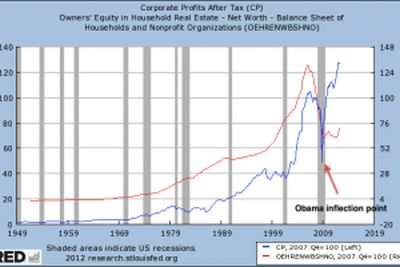
So why oppose Obama? Simply, it is the shape of the society Obama is crafting that I oppose, and I intend to hold him responsible, such as I can, for his actions in creating it. Many Democrats are disappointed in Obama. Some feel he’s a good president with a bad Congress. Some feel he’s a good man, trying to do the right thing, but not bold enough. Others think it’s just the system, that anyone would do what he did. I will get to each of these sentiments, and pragmatic questions around the election, but I think it’s important to be grounded in policy outcomes. Not, what did Obama try to do, in his heart of hearts? But what kind of America has he actually delivered? And the chart below answers the question. This chart reflects the progressive case against Obama.
The above is a chart of corporate profits against the main store of savings for most Americans who have savings — home equity. Notice that after the crisis, after the Obama inflection point, corporate profits recovered dramatically and surpassed previous highs, whereas home equity levels have remained static. That $5-7 trillion of lost savings did not come back, whereas financial assets and corporate profits did. Also notice that this is unprecedented in postwar history. Home equity levels and corporate profits have simply never diverged in this way; what was good for GM had always, until recently, been good, if not for America, for the balance sheet of homeowners. Obama’s policies severed this link, completely.
This split represents more than money. It represents a new kind of politics, one where Obama, and yes, he did this, officially enshrined rights for the elite in our constitutional order and removed rights from everyone else (see “The Housing Crash and the End of American Citizenship” in the Fordham Urban Law Journal for a more complete discussion of the problem). The bailouts and the associated Federal Reserve actions were not primarily shifts of funds to bankers; they were a guarantee that property rights for a certain class of creditors were immune from challenge or market forces. The foreclosure crisis, with its rampant criminality, predatory lending, and document forgeries, represents the flip side. Property rights for debtors simply increasingly exist solely at the pleasure of the powerful. The lack of prosecution of Wall Street executives, the ability of banks to borrow at 0 percent from the Federal Reserve while most of us face credit card rates of 15-30 percent, and the bailouts are all part of the re-creation of the American system of law around Obama’s oligarchy. [Continue reading…]
The price of a black president
Frederick C Harris writes: When African-Americans go to the polls next week, they are likely to support Barack Obama at a level approaching the 95 percent share of the black vote he received in 2008. As well they should, given the symbolic exceptionalism of his presidency and the modern Republican Party’s utter disregard for economic justice, civil rights and the social safety net.
But for those who had seen in President Obama’s election the culmination of four centuries of black hopes and aspirations and the realization of the Rev. Dr. Martin Luther King Jr.’s vision of a “beloved community,” the last four years must be reckoned a disappointment. Whether it ends in 2013 or 2017, the Obama presidency has already marked the decline, rather than the pinnacle, of a political vision centered on challenging racial inequality. The tragedy is that black elites — from intellectuals and civil rights leaders to politicians and clergy members — have acquiesced to this decline, seeing it as the necessary price for the pride and satisfaction of having a black family in the White House.
These are not easy words to write. Mr. Obama’s expansion of health insurance coverage was the most significant social legislation since the Great Society, his stimulus package blunted much of the devastation of the Great Recession, and the Dodd-Frank financial overhaul added major new protections for consumers. His politics would seem to vindicate the position of civil rights-era leaders like Bayard Rustin, who argued that blacks should form coalitions with other Democratic constituencies in support of universal, race-neutral policies — in opposition to activists like Malcolm X, who distrusted party politics and believed that blacks would be better positioned to advance their interests as an independent voting bloc, beholden to neither party.
But the triumph of “post-racial” Democratic politics has not been a triumph for African-Americans in the aggregate. It has failed to arrest the growing chasm of income and wealth inequality; to improve prospects for social and economic mobility; to halt the re-segregation of public schools and narrow the black-white achievement gap; and to prevent the Supreme Court from eroding the last vestiges of affirmative action. The once unimaginable successes of black diplomats like Colin L. Powell, Condoleezza Rice and Susan E. Rice and of black chief executives like Ursula M. Burns, Kenneth I. Chenault and Roger W. Ferguson Jr. cannot distract us from facts like these: 28 percent of African-Americans, and 37 percent of black children, are poor (compared with 10 percent of whites and 13 percent of white children); 13 percent of blacks are unemployed (compared with 7 percent of whites); more than 900,000 black men are in prison; blacks experienced a sharper drop in income since 2007 than any other racial group; black household wealth, which had been disproportionately concentrated in housing, has hit its lowest level in decades; blacks accounted, in 2009, for 44 percent of new H.I.V. infections. [Continue reading…]
Obama’s squandered advantages
Frank Bruni writes: After “a couple of Cadillacs,” a summer belly-flop abroad, a dismissive swipe at 47 percent of the population and a convention best remembered for Clint Eastwood’s chat with a chair, Mitt Romney is seemingly tied with President Obama. He has a real chance. It’s a remarkable turn of events, given how many errors he’s made and how ill suited he is to this particular juncture in the American story. And to size up the situation honestly is to consider one conclusion as seriously as any other:
Obama isn’t quite the candidate, or politician, he’s cracked up to be. The One is a fraction of his reputed self.
Yes, I know: the economy. It’s supposedly the source of most of his woes, the great weight he lugs around, a nearly fatal handicap. And the fact that he’s doing as well as he is affirms the sway of his personality and sense of his policies, at least according to his most fervent admirers.
I don’t buy it. For starters, a great many Americans understand that he doesn’t bear primary responsibility for the high rate of unemployment and the drops in home prices and incomes. A CNN/ORC poll last month showed that 54 percent of likely voters placed the blame chiefly on George W. Bush and Republicans.
Additionally, 68 percent indicated some optimism about economic conditions, which they said would be “somewhat good” or “very good” in a year. There’s room in those numbers for Obama to pull well ahead of a rival as profoundly flawed as Romney. Yet he hasn’t. [Continue reading…]
Syrian war spillover in Iraq will be much worse than in Lebanon
Joshua Landis writes: Many Western journalists are based in Lebanon, few in Iraq. This explains why relatively small events in Lebanon get dramatic reporting and much larger increases of violence in Iraq, are largely overlooked or elicit little concern.
Already in response to the growing civil war in Syria, Iraqi violence has spiked and al-Qaida is resurgent there. Some days as many as 100 Iraqi Shiites are killed by al-Qaida bombings in Iraq.
The threat of spillover in Lebanon is minor compared to Iraq because the sects in Lebanon all acknowledge that none can rule the country without the others. Even the most powerful, the Shiites, readily confess that they have no chance of turning Lebanon into an Islamic republic because Lebanon has a form of democracy and the majority is against it. Not only do all the sects buy into the notion of power-sharing, they also know that in Lebanon it is impossible for one group to dominate on the others. They learned these simple truths from decades of barbaric fighting.
In Iraq, the sects have found no peace and little acceptance of the balance of power now being hammered out. Prime Minister Maliki is busy building a Shiite dictatorship and pushing out the remaining centers of Sunni power left behind by the Americans in their doomed attempt to promote power-sharing.
Al-Qaida is rebuilding in Iraq to contest Shiite power. It probably has the backing of a larger segment of the Sunni community that still chafes from its loss of fortune following the US destruction of Saddam Hussein’s regime. Unlike Lebanon, the various sects of Iraq have not found a modus-vivendi. Relations between Kurds and Arabs in Iraq are becoming more vexed as Kurdistan takes ever more steps to assert its independence from Arab Iraq.
The Sunni-led attempt to depose Assad’s regime is sure to give a big boost to Al-Qaida in Iraq as arms and men flow across the border and find a refuge in Syria. Saudi, Turkish and Qatari support for Syria’s Sunnis is also likely to turbo-charge passions in Iraq, as Sunnis feel empowered to push back against Iranian influence and the Shiite hold on power.
These are the reasons why Iraq is seeing much more spillover from Syria than Lebanon. Of course, there will be pushing and shoving between the sects in Lebanon, especially as the Sunnis grow in confidence and feel that they can tip the scales on the Shiite assertiveness of the last several years. But they have few delusions of being able to rule Lebanon on their own.
I leave you with this plum from today’s New York Times: An Iraqi Shiite who just returned from years in Damascus says:
“I can tell that things are going to be crazy in Syria,” he said. “It’s a sectarian war, and it’s even worse than the one we had here, which was between the militias and the political parties. In Syria, all of the people are involved. You can feel the hatred between the Sunnis and the Alawites. They will do anything to get rid of each other.”
Syrian warplanes stage first airstrike under truce
The Associated Press reports: Syrian warplanes bombed a building in a Damascus suburb on Saturday, killing at least eight people in the first airstrike since an internationally mediated cease-fire went into effect, activists said.
The attack came a day after car bombs and clashes left 151 dead, according to activist tallies, leaving the four-day truce that began Friday at the start of a major Muslim holiday in tatters.
The rapid unraveling of the effort to achieve even a temporary peace marked the latest setback to ending Syria‘s civil war through diplomacy after months of failed efforts.
The Britain-based Syrian Observatory for Human Rights said eight people were killed and many others wounded in the airstrike in Arbeen, a suburb of the capital. The area also has witnessed heavy clashes and intense shelling.
Kuwait’s turmoil brings rare protest partnership
The Associated Press reports: For Kuwait’s embattled rulers, clashes earlier this week with anti-government protesters were more than just a sign tensions may be mounting. The crowds themselves showed the widening nature of the Gulf nation’s political crisis: Stirrings of a rare alliance of convenience between liberals and Islamists against Kuwait’s Western-backed leadership.
While it’s not the first time Middle East protests have brought together political foes — Cairo’s Tahrir Square last year and Iran’s postelection unrest in 2009 had a full spectrum of voices — Kuwait’s tiny size means that the coalescence of such varied groups could make for an opposition that punches far above its own weight.
Despite the rising unrest, the ruling family appears in no imminent danger of an Arab Spring-style revolt such as Bahrain’s 20-month-old Shiite Muslim-led uprising against the Sunni monarchy.
But the emerging alliance underscores the complicated challenges for Kuwait’s ruling family as the oil-rich country moves toward Dec. 1 parliamentary elections.
Simultaneous pressure from liberals and Islamist conservatives could push Kuwait deeper into a political morass that has already disrupted the economy and raised questions about stability in one of Washington’s most critical military footholds in the region.
Kuwait’s importance to the Pentagon rose sharply after the U.S. troop withdrawal from Iraq in December. It is now the hub for American ground forces in the Gulf, where the U.S. and its Arab allies seek to counter Iran’s military buildup.
U.N. team to investigate civilian drone deaths
The Bureau of Investigative Journalism reports: The United Nations plans to set up a special investigation unit examining claims of civilian deaths in individual US covert drone strikes.
UN investigators have been critical of US ‘extrajudicial executions’ since they began in 2002. The new Geneva-based unit will also look at the legality of the programme.
The latest announcement, by UN special rapporteur Ben Emmerson QC, was made in a speech on October 25 at Harvard law school. Emmerson, who monitors counter-terrorism for the UN, previously called in August for the US to hand over video of each covert drone attack.
The London-based lawyer became the second senior UN official in recent months to label the tactic of deliberately targeting rescuers and funeral-goers with drones ‘a war crime’. That practice was first exposed by the Bureau for the Sunday Times in February 2012.
‘The Bureau has alleged that since President Obama took office at least 50 civilians were killed in follow-up strikes when they had gone to help victims and more than 20 civilians have also been attacked in deliberate strikes on funerals and mourners. Christof Heyns … has described such attacks, if they prove to have happened, as war crimes. I would endorse that view,’ said Emmerson. [Continue reading…]
U.S. officials ‘question Imran Khan on drones’
Al Jazeera reports: Imran Khan, the Pakistani cricketer turned politician, has been stopped by US immigration officials and questioned about his views on US drone strikes in his country, party officials have said.
Khan, the leader of the Pakistan Movement for Justice party (PTI), has campaigned vociferously for an end to the controversial US campaign of missile strikes against suspected Taliban and al-Qaeda fighters in Pakistan’s tribal areas.
The 59-year-old, who was headed to New York, said he was stopped by US officials in Toronto on Friday.
“I was taken off from plane and interrogated by US Immigration in Canada on my views on drones. My stance is known. Drone attacks must stop,” he wrote on Twitter.
Khan said the delay meant he missed his flight and a party fundraising lunch in New York, but insisted “nothing will change my stance”.
Video: Are U.S. drone strikes a war crime?
Iran military action not ‘right course at this time’, Downing Street says
The Guardian reports: The UK government has reiterated that it does not believe military action against Iran would be appropriate at the moment, following the disclosure that Britain has rebuffed US requests to use UK military bases to support the buildup of forces in the Gulf.
Downing Street said: “We are working closely with the US with regard to UK bases” but “the government does not think military action is the right course at this point of time”.
David Cameron made a lengthy speech last week urging Israel to show restraint, and pointing to the way in which sanctions are having an impact on the Iranian economy.
The Guardian has been told that US diplomats have also lobbied for the use of British bases in Cyprus, and for permission to fly from US bases on Ascension Island in the Atlantic and Diego Garcia in the Indian Ocean, both of which are British territories.
The US approaches are part of contingency planning over the nuclear standoff with Tehran, but British ministers have so far reacted coolly. On Friday, Downing Street said such contingency planning was something that was done as a matter of routine.
They have pointed US officials to legal advice drafted by the attorney general’s office and which has been circulated to Downing Street, the Foreign Office and the Ministry of Defence.
It states that providing assistance to forces that could be involved in a pre-emptive strike would be a clear breach of international law on the basis that Iran, which has consistently denied it has plans to develop a nuclear weapon, does not currently represent “a clear and present threat”. [Continue reading…]
Saudis destroy Islam’s holy sites
The Independent reports: Three of the world’s oldest mosques are about to be destroyed as Saudi Arabia embarks on a multi-billion-pound expansion of Islam’s second holiest site. Work on the Masjid an-Nabawi in Medina, where the Prophet Mohamed is buried, will start once the annual Hajj pilgrimage ends next month. When complete, the development will turn the mosque into the world’s largest building, with the capacity for 1.6 million worshippers.
But concerns have been raised that the development will see key historic sites bulldozed. Anger is already growing at the kingdom’s apparent disdain for preserving the historical and archaeological heritage of the country’s holiest city, Mecca. Most of the expansion of Masjid an-Nabawi will take place to the west of the existing mosque, which holds the tombs of Islam’s founder and two of his closest companions, Abu Bakr and Umar.
Just outside the western walls of the current compound are mosques dedicated to Abu Bakr and Umar, as well as the Masjid Ghamama, built to mark the spot where the Prophet is thought to have given his first prayers for the Eid festival. The Saudis have announced no plans to preserve or move the three mosques, which have existed since the seventh century and are covered by Ottoman-era structures, or to commission archaeological digs before they are pulled down, something that has caused considerable concern among the few academics who are willing to speak out in the deeply authoritarian kingdom.
“No one denies that Medina is in need of expansion, but it’s the way the authorities are going about it which is so worrying,” says Dr Irfan al-Alawi of the Islamic Heritage Research Foundation. “There are ways they could expand which would either avoid or preserve the ancient Islamic sites but instead they want to knock it all down.” Dr Alawi has spent much of the past 10 years trying to highlight the destruction of early Islamic sites.
With cheap air travel and booming middle classes in populous Muslim countries within the developing world, both Mecca and Medina are struggling to cope with the 12 million pilgrims who visit each year – a number expected to grow to 17 million by 2025. The Saudi monarchy views itself as the sole authority to decide what should happen to the cradle of Islam. Although it has earmarked billions for an enormous expansion of both Mecca and Medina, it also sees the holy cities as lucrative for a country almost entirely reliant on its finite oil wealth.
Heritage campaigners and many locals have looked on aghast as the historic sections of Mecca and Medina have been bulldozed to make way for gleaming shopping malls, luxury hotels and enormous skyscrapers. The Washington-based Gulf Institute estimates that 95 per cent of the 1,000-year-old buildings in the two cities have been destroyed in the past 20 years. [Continue reading…]
Fear and loathing in Athens: the rise of Golden Dawn and the far right
The Guardian reports: You can hear it from blocks away: the deafening beat of Pogrom, Golden Dawn’s favourite band, blasting out of huge speakers by a makeshift stage. “Rock for the fatherland, this is our music, we don’t want parasites and foreigners on our land…”
It’s a warm October evening and children on bicycles are riding up and down among the young men with crew cuts, the sleeves of their black T-shirts tight over pumped-up biceps, strolling with the stiff swagger of the muscle-bound. They look relaxed, off-duty. Two of them slap a handshake: “Hey, fascist! How’s it going?”
Trestle tables are stacked with Golden Dawn merchandise: black T-shirts bearing the party’s name in Greek, Chrysi Avgi, the sigma shaped like the S on SS armbands; mugs with the party symbol, a Greek meander drawn to resemble a swastika; Greek flags and black lanyards, lighters and baseball caps. I lean over to talk to one woman stallholder, dressed in Golden Dawn black with thickly kohl-rimmed eyes, but as soon as she opens her mouth a man in a suit strides up: “What are you writing? Are you a journalist? Tear that page out of your notebook. No, no, you can’t talk to anyone.”
Tonight is the opening of the Golden Dawn office in Megara, a once prosperous farming town between Athens and Corinth. The Greek national socialist party polled more than 15% here – double the national average – in the June election, when it won 18 seats in parliament. (One was taken up by the former bassist with Pogrom, whose hits include Auschwitz and Speak Greek Or Die.)
Legitimised by democracy and by the media, Golden Dawn is opening branches in towns all over Greece and regularly coming third in national opinion polls. Its black-shirted vigilantes have been beating up immigrants for more than three years, unmolested by the police; lately they’ve taken to attacking Greeks they suspect of being gay or on the left. MPs participate proudly in the violence. In September, three of them led gangs of black-shirted heavies through street fairs in the towns of Rafina and Messolonghi, smashing up immigrant traders’ stalls with Greek flags on thick poles.
Such attacks are almost never prosecuted or punished. Ask Kayu Ligopora, of the Athens Tanzanian Community Association, whose premises were vandalised by around 80 “local residents” on 25 September after police walked away. He’s lived in Greece for 20 years; for the first time, he says, he’s thinking about leaving. Or Hussain Ahulam, 22, who told me how four men with dogs and a metal crowbar left him bleeding and unconscious by the side of the road as he walked home one day. Or 21-year-old HH, a Greek citizen of Egyptian origin, who was beaten on 12 October by three men with chains as he stepped off the trolley bus, and whose sight may be damaged for good. [Continue reading…]