Enemies of Assad in Syria fit a mold: Poor, pious, rural

The Associated Press reports: Most of the rebels fighting government forces in the city of Aleppo fit a specific mold: They’re poor, religiously conservative and usually come from the underdeveloped countryside nearby.

They bring to the battle their fury over years of economic marginalization, fired by a pious fervor, and they say their fight in the civil war is not only against President Bashar Assad but also the elite merchants and industrialists who dominate the city and have stuck by the regime. The rebels regard this support for the government to be an act of betrayal.

The blend of poverty, religious piety and anger could define the future of Aleppo, and perhaps the rest of Syria, if the rebels take over the country’s largest city, which is also its economic engine. They may be tempted to push their own version of Islam, which is more fundamentalist than what is found in the city. Their bitterness at the business class may prompt them to seek ways of redistributing the wealth.

“Those who have money in Aleppo only worry about their wealth and interests when we have long lived in poverty,” said Osama Abu Mohammed, a rebel commander who was a car mechanic in the nearby town of Beyanon before he joined the fight.

“They have been breast-fed cowardice and their hearts are filled with fear. With their money, we could buy weapons that enable us to liberate the entire city in a week,” he said. [Continue reading…]

Facebooktwittermail

Syria’s future lies in ruins

William Dalrymple writes: Few forms of conflict are so damaging to a country or its people as a prolonged civil war. By 1939, when Franco’s forces had finished mopping up the last Republican resistance in Spain, more than half a million lay dead and some of the most beautiful city centres in Europe had been destroyed.

A similar pattern played out in 1970s Lebanon, which saw 150,000 casualties and the almost complete destruction of the elegant villas of Ottoman Beirut. In Afghanistan it was not Soviet invasion or occupation that killed most people or wrecked Kabul, but the internecine street fighting that followed in the early 1990s. In a few years, as Masood‘s rockets fell on Pashtun neighbourhoods of Kabul, and Hekmatyar’s forces emptied the Tajik suburbs, palaces and museums were looted; while in the Shomali plain, Gandharan Buddhist sites were serially plundered of their treasure.

Today, as Syria faces the desperate prospect of an open-ended civil conflict, traumatised by its 20,000 dead and 250,000 refugees – the human cost of the war – it may seem trivial to mourn the speed with which its astonishing archaeological and architectural heritage is disappearing. But while the human pain inflicted by torture and killing is immeasurable, the destruction of a people’s heritage is irretrievable: once a monument is destroyed, it can never be replaced. With modern weaponry it only takes a few months of concerted shelling for the history of an entire people to be reduced to rubble. [Continue reading…]

Facebooktwittermail

BBC services jammed in Middle East, Europe

AFP reports: The BBC said Thursday its services in the Middle East and Europe were being deliberately jammed, along with those of other broadcasters — with the interference coming from Syria.

The jamming of Eutelsat satellites affected BBC television and radio services in English and Arabic, the British Broadcasting Corporation said.

The French-based satellite provider Eutelsat said the interference was coming from Syria.

A BBC spokeswoman said: “The BBC, together with a number of other broadcasters, is experiencing deliberate, intermittent interference to its transmissions to audiences in Europe and the Middle East.

“Impacted services include the BBC World News and BBC Arabic television channels and BBC World Service radio services in English and Arabic.

“Deliberate interference such as the jamming of transmissions is a blatant violation of international regulations concerning the use of satellites and we strongly condemn any practice designed to disrupt audiences’ free access to news and information.”

Facebooktwittermail

The Jordanian spring has begun

Zaki Bani Rashid writes: The call for reform started in Jordan well before the Arab spring. However, it has intensified since – not only because of the Arab revolutions, but also in response to widespread state corruption. Jordan’s reformers are demanding constitutional changes; in particular, changes to our election law so that a truly representative parliament is possible, together with an elected prime minister who is accountable to parliament.

The national demonstrations that took place earlier this month exposed the attitude of Jordanian officials toward reform. The demonstration was organised by the Muslim Brotherhood together with more than 70 independent initiatives. The announcement that the opposition was to hold a peaceful demonstration was met with a concerted campaign to disrupt it. The media even reported that radioactive pollution was present in the area of the demonstration. Various officials prepared a counter demonstration under the title “Loyalty to the King” in the same place, and at the same time.

However, the demonstration went ahead – the largest in the country’s history – putting Jordan on the path of true reform. What is most striking is that this large attendance was drawn from all parts of the country – cities, villages, Bedouin centres and refugee camps – and included many women. The official response had been designed to instil fear; it failed. Many in Jordan now speak of this demonstration as the beginning of the Jordanian spring. [Continue reading…]

Facebooktwittermail

CIA seeks major expansion of drone fleet and paramilitary operations

The Washington Post reports: The CIA is urging the White House to approve a significant expansion of the agency’s fleet of armed drones, a move that would extend the spy service’s decade-long transformation into a paramilitary force, U.S. officials said.

The proposal by CIA Director David H. Petraeus would bolster the agency’s ability to sustain its campaigns of lethal strikes in Pakistan and Yemen and be able, if directed, to shift aircraft to emerging al-Qaeda threats in North Africa or other trouble spots, officials said.

If approved, the CIA could add as many as 10 drones, the officials said, to an inventory that has ranged between 30 and 35 over the past few years.

The outcome has broad implications for counterterrorism policy and whether the CIA gradually returns to an organization focused mainly on gathering intelligence, or remains a central player in the targeted killing of terrorism suspects abroad.

U.S. officials said that the proposal was recently submitted to the National Security Council, but that the White House has not made a decision. In the past, officials from the Pentagon and other departments have raised concerns about the CIA’s expanding arsenal and involvement in lethal operations, but a senior Defense official said that the Pentagon had not opposed the agency’s current plan.
[…]
The administration has touted the collaboration between the CIA and the military in counterterrorism operations, contributing to a blurring of their traditional roles. In Yemen, the agency routinely “borrows” the aircraft of the military’s Joint Special Operations Command to carry out strikes. The JSOC is increasingly engaged in activities that resemble espionage.

The CIA’s request for more drones indicates that Petraeus has become convinced that there are limits to those sharing arrangements, and that the agency needs full control over a larger number of aircraft.

The U.S. military’s fleet dwarfs that of the CIA. A Pentagon report issued this year counted 246 Predators, Reapers and Global Hawks in the Air Force inventory alone, with hundreds of other remotely piloted aircraft distributed among the Army, the Navy and the Marines.

Petraeus, who had control of large portions of those fleets while serving as U.S. commander in Iraq and Afghanistan, has had to adjust to a different resource scale at the CIA, officials said. The agency’s budget has begun to tighten, after double-digit increases over much of the past decade.
[…]
The CIA also maintains a separate, smaller fleet of stealth surveillance aircraft. Stealth drones were used to monitor bin Laden’s compound in Abbottabad, Pakistan. Their use in surveillance flights over Iran’s nuclear facilities was exposed when one crashed in that country last year.

Any move to expand the reach of the CIA’s fleet of armed drones probably would require the agency to establish additional secret bases. The agency relies on U.S. military pilots to fly the planes from bases in the southwestern United States but has been reluctant to share overseas landing strips with the Defense Department.

Facebooktwittermail

How drones are turning America into a predatory state

Eric Posner writes: After the attack on American diplomats in Benghazi last month, President Obama vowed to hunt down the killers and bring them to justice. There is a good chance that this means that they will be incinerated by missiles fired from drones. If so, the United States will have used drones to kill members of al-Qaida and affiliated groups in Afghanistan, Iraq, Pakistan, Somalia, Yemen, and Libya—six countries in just a few years. Mali may take its turn as the seventh. This startlingly fast spread of drone warfare signifies a revolution in foreign affairs. And, for good or for ill, in an unprecedented way it has transformed the U.S. presidency into the most powerful national office in at least half a century.

In the past, presidents faced two major obstacles when trying to use force abroad. The first was technological. The available options—troops, naval vessels, or air power—posed significant risks to American military personnel, cost a lot of money, proved effective only under limited conditions, or all of the above. Dead and maimed soldiers, hostages, the massive expense of a large-scale military operation, and backlash from civilian casualties can destroy a presidency, as Vietnam and Iraq showed.

The second obstacle was constitutional. The Constitution includes a clause that gives Congress the power to declare war. Presidents have been able to evade this clause for small wars—those involving only naval or air power, or a small number of troops for a limited period of time. They have mostly felt compelled to seek congressional authorization for large wars, no doubt in part so that they could spread the blame if something went awry.

But drones have changed the calculus. Because they are cheap and do not risk the lives of American soldiers, these weapons remove the technological obstacle to the use of force. And because drone strikes resemble limited air attacks, they seem to fall into the de facto “small wars” exception to the Constitution’s declare-war requirement. Unlike large wars, drone actions do not provoke congressional attention or even much political debate.

Yet it is a mistake to think that drone warfare will resemble the small wars of the past—the air assault on Libya in 2011, which lasted seven months; or the air assault on Serbia in 1999, which lasted three months; or even the military invasion of Panama in 1989-1990, which lasted one month. Drones can be, and increasingly are, deployed continuously, outside the theater of war, anywhere that a threat takes shape. They are not subject to the rhythm of mobilization and demobilization that occurs in a regular war. They’re used not only as part of a larger arsenal flung against a nation-state but also on their own as police sentinels, which pick off individuals and organizations thought likely to commit terrorist attacks in the future. They’re a global law-enforcement operation—on a far larger scale than you might assume. [Continue reading…]

Facebooktwittermail

Malala’s attacker was held, freed in 2009

Reuters reports: The alleged organiser of the Taliban shooting of a Pakistani schoolgirl was captured during a 2009 military offensive against the hard-line Islamist group but released after three months, two senior officials told Reuters.

They identified the man who planned the attack on 14-year-old Malala Yousufzai only as Attaullah, and said he was one of the two gunmen who shot her on a school bus this month in the Swat Valley, northwest of Islamabad.

Believed to be in his 30s, Attaullah is on the run and may have fled to neighbouring Afghanistan, they said. He organised the attack on the orders of one of the Taliban’s most feared commanders, Maulana Fazlullah, officials said.

Critics say Pakistan’s low conviction rate of militants, even high-profile ones who carried out major attacks, is one reason why extremism has spread in the South Asian nation.

Facebooktwittermail

Up to 28,000 Syrians have ‘disappeared’ since uprising began

The Guardian reports: Up to 28,000 Syrians have disappeared over the past 19 months, with civilians snatched from the streets or forcibly abducted by government troops or security forces, human rights groups say.

Relatives had been unable to discover the fate of their loved ones. Many of those abducted were almost certainly dead, while others were alive and being held in Syrian prisons or secret detention centres where they were tortured, the groups claimed.

Since the uprising against President Bashar al-Assad began in March 2011, government forces had “disappeared” peaceful protesters on an unprecedented scale, the groups said. Some campaigners have estimated the number of those who have vanished could be as high as 80,000.

A harrowing film released on Thursday by the global campaign network Avaaz shows disturbing footage of forced disappearances. In one incident, three soldiers grab two women dressed in black abayas walking down a street. They hit them and drag them away. In another, soldiers abduct a Syrian man, yanking him by the hair past a tank.

Facebooktwittermail

U.N.: 150,000 Syrian refugees have fled to Egypt

The Associated Press reports: The U.N. refugee agency said Thursday the number of Syrian refugees who have fled their country’s civil war and found shelter in Egypt has now topped 150,000 – a significant jump from last month’s figure of 95,000.

The director of UNHCR in Egypt, Mohamed Dayri, said that despite the growing number of refugees in Egypt, only 4,800 Syrians have registered with the agency in Cairo. He called on Egyptian authorities to help UNHCR deal with the “rising emergency” of Syrian refugees here.

A U.N. official, speaking on the condition of anonymity because they were not authorized to brief the media, suggested Syria’s neighbors who have taken in refugees – Turkey, Lebanon, Iraq and Jordan – are “reaching (the) saturation point,” prompting an influx into Egypt, where the cost of living is cheaper.

Facebooktwittermail

Divided Palestinians hold municipal elections without Hamas

Reuters reports: Palestinians in the West Bank go to the polls on Saturday in long-delayed municipal elections that have already highlighted deep divisions in the occupied territory and stoked complaints about a lack of leadership.

The October 20 ballot will hold up a cracked mirror to a political landscape clouded by financial crises, failure to reconcile the major Palestinian factions and stalemate in peacemaking efforts with Israel.

The powerful Islamist group Hamas is boycotting the election and preventing voting from taking place in the Gaza Strip, leaving the field largely clear for the mainstream Fatah party in the race to take charge of 94 West Bank towns and villages.

But, as has happened so often in the past, President Mahmoud Abbas’s nationalist Fatah movement has failed to present a united face, with party rivals presenting their own candidates.

Facebooktwittermail

For Benghazi diplomatic security, U.S. relied on small British firm

Reuters reports: The State Department’s decision to hire Blue Mountain Group to guard the ill-fated U.S. diplomatic mission in Benghazi, Libya, entrusted security tasks to a little-known British company instead of the large firms it usually uses in overseas danger zones.

The contract was largely based on expediency, U.S. officials have said, since no one knew how long the temporary mission would remain in the Libyan city. The cradle of last year’s uprising that ended Muammar Gaddafi’s 42-year rule, Benghazi has been plagued by rising violence in recent months.

Security practices at the diplomatic compound, where Blue Mountain guards patrolled with flashlights and batons instead of guns, have come under U.S. government scrutiny in the wake of the September 11 attack in Benghazi that killed U.S. Ambassador J. Christopher Stevens and three other Americans.

Federal contract data shows that the Benghazi security contract, worth up to $783,284, was listed as a “miscellaneous” award, not as part of the large master State Department contract that covers protection for overseas embassies.

Facebooktwittermail

The role of Ansar al-Sharia in the attack on the U.S. consulate in Benghazi

The New York Times reports: Libyan authorities have singled out Ahmed Abu Khattala, a leader of the Benghazi-based Islamist group Ansar al-Sharia, as a commander in the attack that killed the American ambassador to Libya, J. Christopher Stevens, last month, Libyans involved in the investigation said on Wednesday.

Witnesses at the scene of the attack on the American Mission in Benghazi have said they saw Mr. Abu Khattala leading the assault, and his personal involvement is the latest link between the attack and his brigade, Ansar al-Sharia, a puritanical militant group that wants to advance Islamic law in Libya.

The identity and motivation of the assailants has become an intense flash point in the American presidential campaign. Republicans have sought to tie the attack to Al Qaeda to counter President Obama’s claim that by killing Osama bin Laden and other leaders his administration had crippled the group; Mr. Abu Khattala and Ansar al-Sharia share Al Qaeda’s puritanism and militancy, but operate independently and focus only on Libya rather than on a global jihad against the West.

On Monday, the New York Times reported: To those on the ground, the circumstances of the attack are hardly a mystery. Most of the attackers made no effort to hide their faces or identities, and during the assault some acknowledged to a Libyan journalist working for The New York Times that they belonged to the group. And their attack drew a crowd, some of whom cheered them on, some of whom just gawked, and some of whom later looted the compound.

The fighters said at the time that they were moved to act because of the video, which had first gained attention across the region after a protest in Egypt that day. The assailants approvingly recalled a 2006 assault by local Islamists that had destroyed an Italian diplomatic mission in Benghazi over a perceived insult to the prophet. In June the group staged a similar attack against the Tunisian Consulate over a different film, according to the Congressional testimony of the American security chief at the time, Eric A. Nordstrom.

At a news conference the day after the ambassador and three other Americans were killed, a spokesman for Ansar al-Shariah praised the attack as the proper response to such an insult to Islam. “We are saluting our people for this zeal in protecting their religion, to grant victory to the prophet,” the spokesman said. “The response has to be firm.” Other Benghazi militia leaders who know the group say its leaders and ideology are all homegrown. Those leaders, including Ahmed Abu Khattala and Mohammed Ali Zahawi, fought alongside other commanders against Col. Muammar el-Qaddafi. Their group provides social services and guards a hospital. And they openly proselytize for their brand of puritanical Islam and political vision.

They profess no interest in global fights against the West or distant battles aimed at removing American troops from the Arabian Peninsula.

Nevertheless, the group’s motivation became a source of disagreement. At last week’s Congressional hearing, Mr. Nordstrom tried to contradict lawmakers who insisted that the group was at least “loosely affiliated with Al Qaeda.”

Representative Dan Burton, Republican of Indiana, cut him off. “Don’t split words,” he said. “It is a terrorist organization.”

Some analysts argue that the White House, meanwhile, sought to play down any potential characterization of the assault as a Qaeda attack, because that would undercut its claims to have crushed Al Qaeda.

Libyan guards at the Benghazi compound and other witnesses told journalists working for The New York Times as early as Sept. 12 that the streets outside the mission were quiet in the moments before the attack had begun, without any prior protests.

Other Benghazi militia leaders who know Ansar al-Shariah say it was capable of carrying out the attack by itself with only a few hours’ planning, and as recently as June one of its leaders, Mr. Zahawi, declared that it could destroy the American Mission.

The Wall Street Journal adds: In Libya, the Americans have only a threadbare presence and thin security ties. The FBI team in Tripoli is interacting primarily with the nascent Libyan intelligence agency headed by former U.S. citizen Salem al-Hasi, a veteran Libyan political dissident who for decades lived in the Atlanta area and taught Arabic to U.S. soldiers, according to several Libyan officials.

Mr. Hasi has no direct control over the existing security bodies in Benghazi, whose commanders have forces to make arrests there. In Tripoli, meanwhile, civilian leaders are struggling to form a new government, leaving the nation without strong ministers of the interior or defense.

Other aspects of the American investigation, including the treatment of witnesses, are also generating criticism among Libyans.

Some witnesses from Benghazi have traveled at their own expense to meet with FBI investigators and share information with them. Three of these witnesses say the Americans have offered them no protection in exchange for their cooperation, prompting two of them to say they are trying to dissuade other Libyans from talking to the bureau. The FBI team has spent only a handful of hours on the ground in Benghazi, saying the city is too insecure.

For those who share Rep. Burton’s perspective, it matters little who conducted the attack since differentiating between different groups, their affiliations and their ideologies amounts, supposedly, to splitting hairs. But as the Century Foundation’s Michael Hanna pointed out to the New York Times, those who are linking the attack to al Qaeda are making “promiscuous use” of the term. “It can mean anything or nothing at all.”

Facebooktwittermail

How Obama is operating in unprecedented secrecy — while attacking the secret-tellers

Dan Froomkin writes: It’s a particularly challenging time for American national security reporting, with the press and public increasingly in the dark about important defense, intelligence and counterterrorism issues.

The post-post-9/11 period finds the U.S. aggressively experimenting with two new highly disruptive forms of combat — drone strikes and cyberattacks — for which our leaders appear to be making up the rules, in secret, as they go along.

Troubling legal and moral issues left behind by the previous administration remain unresolved. Far from reversing the Bush-Cheney executive power grab, President Barack Obama is taking it to new extremes by unilaterally approving indefinite detention of foreign prisoners and covert targeted killings of terror suspects, even when they are American citizens.

There is little to none of the judicial and legislative oversight Obama had promised, so the executive branch’s most controversial methods of violence and control remain solely in the hands of the president — possibly about to be passed along to a leader with less restraint.

More than a decade after it started, we still have no clue how much the government is listening in on us or reading our email, despite the obvious Fourth Amendment issues.

And the government’s response to this unprecedented secrecy is a war on leaks. [Continue reading…]

Facebooktwittermail

How Israel planned to push Palestinians to the brink of starvation

BBC News reports: An Israeli court has forced the release of government research detailing the number of calories Palestinians in Gaza need to consume to avoid malnutrition.

The study was commissioned after Israel tightened its blockade of the territory after Hamas came to power in June 2007.

The UN said if the research reflected a policy intended to cap food imports, it went against humanitarian principles.

But the Israeli government said the study was only ever a draft and was never used to determine policy.
‘Daily humanitarian portion’

The Israeli human rights group Gisha, which campaigns against Israel’s Gaza blockade, fought a long legal battle to get the Israeli ministry of defence to release this document.

Dated from 2008 and entitled, “Food Consumption in the Gaza Strip – The Red Lines“, it is a detailed study of how many calories Palestinians needed to eat to avoid malnutrition.

Facebooktwittermail

Banished Palestinian fighter: ‘I had the right to fight this occupation’

At Electronic Intifada, Joe Catron writes: “Why doesn’t the international community support the fighters of Palestine?” Iyad Abu Khaizaran asked, sitting in his Gaza apartment.

Abu Khaizaran, 41, was one of 477 detainees freed on 18 October 2011 in the first phase of Hamas’s prisoner exchange with Israel, and one of 205 banished by Israel from their homes in the West Bank. Like 163 others, Abu Khaizaran, a native of Tubas, was forcibly relocated to the Gaza Strip.

Hamas had reached the deal with Israel to free, in two phases, over a thousand Palestinian prisoners in exchange for an Israeli soldier they had captured in 2006.

A day before the exchange, two Palestinian human rights organizations, Addameer and Al-Haq, said in a statement that the “terms violate Article 49 of the Fourth Geneva Convention, which prohibits forcible transfers and deportations of protected persons, a proscription that is part of customary international humanitarian law.”

The organizations added: “Unlawful deportation or transfer also constitutes a grave breach of the Fourth Geneva Convention and qualifies as one of the most serious war crimes” (“Between a rock and a hard place: the fate of Palestinian political prisoners,” 17 October 2011).

However, Abu Khaizaran was less interested in discussing his own banishment than the Palestinian struggle. “I had the right to fight this occupation,” he said. “International law allowed me to do that.”

“I didn’t care about the length of my sentence, or how many years I would spend inside Israeli jails,” he added. “Our struggle was just. For this reason, I was never sad during my imprisonment.” [Continue reading…]

Facebooktwittermail

Israelis recognizing the Nakba

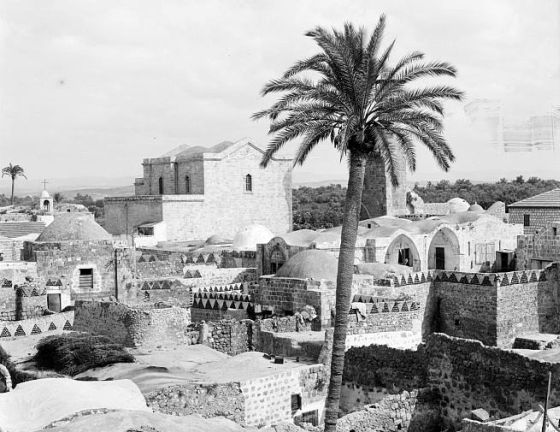
Rooftop view of Lydda and the Church of St George in the background, circa 1920.

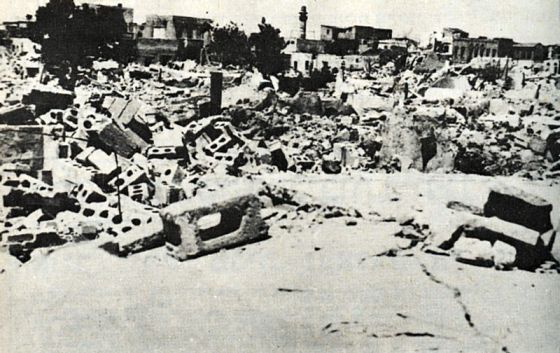
Ruins of Lydda, 1948.

Raja Shehadeh writes: Last Friday, some 40 Israeli Jews and Arabs gathered in Lydda, a small mixed Arab-Israeli city less than 10 miles southeast of Tel Aviv, for “a study tour” featuring “Zionist testimonies from 1948.” It was part of the project Towards a Common Archive, sponsored by Zochrot (Hebrew for remembering), an Israeli organization that hopes to bring “awareness and recognition of the Nakba” to Jewish Israelis so that they can take “responsibility for this tragedy.”

The Nakba refers to the expulsion of the Palestinians from the newly minted state of Israel. On no issue do Israelis and Palestinians differ more. Israelis celebrate May 15, 1948, as their day of independence; for Palestinians, it marks the “catastrophe.” That an Israeli group like Zochrot should organize a trip to a city where some of the Nakba’s worst atrocities occurred is an important and necessary attempt to bridge this nagging gap in perceptions.

During three and a half hours we got a description — in both Arabic and Hebrew — of the Arab city as it existed before 1948. We visited the old town, the church and the mosque where some Arab inhabitants hid in July 1948 to avoid expulsion. We also visited the site of the ghetto where 5,000 of the town’s 50,000 residents (including refugees from neighboring villages) were confined for one year after the Nakba, surrounded by barbed wire and guarded by Israeli soldiers. (They eventually became Israeli citizens and were allowed to stay in Israel.)

The group listened in respectful silence as the Palestinian guide, Ziad Abu Hamad, a descendant of Lydda’s few remaining original residents, described what his parents had told him about their hardships. A woman in her late 60s and other Arab residents approached us, pointing to the buildings that had been their family homes and which they have had to rent or buy back from those who took them away.

Wherever we stopped, members of Zochrot put up commemorative signs describing in Arabic and Hebrew what had happened at the sites. When I asked how long the posts would remain, I was told: until nightfall at best, or until some Israeli right-winger destroys them.

Present-day Lydda (which Israelis call Lod) is known for being one of the most violent cities in Israel and a center of drug addiction, and I expected our group to be stopped or heckled. But we made it through the dark history of the city in the clear midday sun without a hitch.

At the end we wound up in the hall of an old stone building where we were shown videos of two Israeli fighters from the elite Jewish force, the Palmach, testifying about their role in the Nakba.

Yerachmiel Kahanovich described how he had dug a hole in the wall of the Dahmash Mosque in the center of Lydda, where more than 150 Palestinians had taken shelter, and shot an anti-tank shell through it. Asked what had happened to the Palestinians, he said they were all crushed against the walls by the pressure from the blast. [Continue reading…]

Facebooktwittermail