Libya: Why the Supreme Security Committee must be brought to heel — before it’s too late

George Grant, Deputy Editor of the Libya Herald, writes: Many outsiders looking at events in Libya from afar are probably not fully aware of the powerful significance of the recent desecration of Sufi shrines and the dangerous truth that it exposed.

Perhaps more than any other event since the end of last year’s revolution, the attacks have encapsulated the biggest challenge now confronting post-Qaddafi Libya.

That challenge is for Libya’s democratically-elected authorities to achieve a monopoly on the use of force. This is the bedrock of any government’s power, without which the social contract between government and governed cannot be built.

Over a period of four days, from 23-26 August, the distance Libya’s government needs to travel before attaining that monopoly was laid bare.

On Thursday, one of Libya’s most important Sufi shrines, that of the Sidi Abdul-Salam Al-Asmar Al-Fituri in Zliten, a town some 150 kilometres east of Tripoli, was systematically targeted following tribal clashes there that left at least three dead.

On Saturday, another mausoleum, that of Sheikh Ahmed Al-Zarruq, was targeted in nearby Misrata, the same day that the Al-Sha’ab shrine in Tripoli was also hit.

This latter attack in the Libyan capital was the most brazen of all. Following the initial strike in the early hours of Saturday morning, the perpetrators returned later in the day with an automatic digger to continue the task over a period of some 48 hours.

Those responsible for the attacks were Salafists, puritanical Muslims who are closely associated with the Wahabbi form of Islam propagated by Saudi Arabia. The sites are revered by Sufis, whose practice of Islam is abhorred by Salafists. The latter believe that any veneration of human beings or physical objects constitutes idolatry.

What was so disturbing about this affair was not the attacks themselves but rather the manner of the government’s response.

In a fragile, transitional environment such as exists in Libya, attacks by opportunists are to be expected. But whilst failing to prevent a hit-and-run strike is one thing, standing idly by whilst the systematic and illegal destruction of an important religious building takes place over two days, in one of the most genteel parts of your capital city, is quite another.

In truth, the demolition of the shrines could not have come at a worse time for Libya’s new rulers.

The interim government, which took power on 22 November last year, is to all intents and purposes the lamest of lame ducks. Not only was it weak anyway, both by virtue of its limited mandate (it was not democratically elected) and by virtue of the practical realities imposed upon it (a weak army, fractured economy, shattered infrastructure and so forth), but it also has at most ten days before its term in office is scheduled to end.

As for the new National Congress, it only took power on 9 August 2012 and is still finding its feet. At the time of the attacks, Congressmen were still wrangling over the terms of their internal procedures and by-laws, and it is in any event only a legislative, not an executive body.

That, however, does not constitute a legitimate excuse. Back in June, the government successfully mobilised 3,000 men to retake control of Tripoli international airport in just a few hours, after it had been seized by an errant brigade armed with heavy machine guns and a tank.

Here, all that was required was for the government to put a stop to a demolition job by two-dozen men and a digger.

Unfortunately, what is now becoming clear is that short of rolling up their shirt-sleeves, dusting off their Kalashnikovs and heading down there personally, Libya’s government ministers could no more have put a stop to the destruction than could you or I.

The reason for this is now increasingly clear: the government had quite simply lost control. The body tasked with maintaining internal security in Libya, the notionally Interior Ministry-controlled Supreme Security Committee, had either refused point-blank to stop the attacks, or else had been complicit in authorising them in the first place.

This body of 100,000 former revolutionaries, which likes to call itself the ‘guardian of the revolution’, had not so much become a law unto itself as it had become the law. [Continue reading…]


Facebooktwittermail

Syria: past the point of no return

Martin Chulov reports: When power starts to shift in the Middle East, its people have long known what to expect. Challenges to authority have rarely been met with a promise of consensus or inclusion. Strong-arm suppression – the more forceful the better – has been the default reaction to dissent. The price has usually been brutal.

Syrians who wanted an end to regime dominance knew the rules when they started demanding changes in the region’s most uncompromising police state in March last year. Now, 18 months and more than 23,000 bodies later, and with no end in sight to the chaos ravaging the country, their worst fears are being realised on a scale that continues both to horrify and numb.

And yet, the events of the past 18 months have shattered one of the abiding guidelines to life under totalitarian rule – that absolute power is uncontestable. If anything has so far been achieved through the bedlam now rumbling through Syria and indeed other parts of the Arab world, it is a new reality: the power of the street has exposed the fragility of authority.

“I had always said they would fall over when we were no longer scared of them,” Moustafa Abu Khalil, a retired electricity worker from the northern Syrian town of Jisr al-Shughour, told me in June. “It took a long time to get to the point where people were prepared to risk everything, their families, their futures, just to bring about change. “The truth be told, [the people] probably wouldn’t have got here if the regime did not continue to escalate the violence every month. That just fed the flames. And now we have a true revolution, civil war, call it what you will. It is a point of no return.”

With all of Syria’s cities now under siege, its capital Damascus and commercial hub Aleppo engulfed in violence, Syria seems well past that proverbial point. Defections have whittled down the strength and numbers of the country’s vaunted military and destruction and misery is seriously testing the resolve of both regime supporters and those who want Bashar al-Assad gone.

The country’s economy has been under the anaconda-like grip of international sanctions, which have ground industry to a halt, crippled trade supply lines, battered the currency and shattered confidence. In the hard-hit north, little works any more. War has seen Syrian society, already stuck – seemingly permanently in 1973 – wound back even further. There are more donkey carts than cars on the streets of some towns between Aleppo and the Turkish border. Clapped-out tractors belch fumes from precious fuel that is sold in two-litre bottles on rubbish-strewn roadsides for around $8 (£5).

“None of us can afford it,” says Abu Nour, a member of the Free Syrian Army, who, before the Syrian uprising gained momentum, was a tailor whose only military experience was 15 months as a conscript more than a decade ago. “I’m not sure where the money is coming from to get us to the frontline. Those things a person like me doesn’t ask.”

Abu Nour is now a foot soldier in the rebel army that is at the vanguard of the fight for Syria’s destiny. Drawn largely from the rural poor, and also represented by conservative Islamic groupings such as the Muslim Brotherhood, the FSA has taken the battle to the country’s two lead cities, where it is now engaged in a fight to the death with the regime army.

Rebel groups entered Aleppo and Damascus in mid-July and their early gains sparked predictions that four decades of uncompromising rule was about to end. But as a withering summer draws to a close across the northern plains that have harboured Aleppo, and the central plateau on which Damascus, the world’s oldest capital has stood for more than 6,000 years, this early optimism has yielded to a more unpalatable reality – that neither side is about to secure a decisive victory in either city anytime soon. [Continue reading…]

Facebooktwittermail

Correspondence and collusion between the New York Times and the CIA

Glenn Greenwald writes: The rightwing transparency group, Judicial Watch, released Tuesday a new batch of documents showing how eagerly the Obama administration shoveled information to Hollywood film-makers about the Bin Laden raid. Obama officials did so to enable the production of a politically beneficial pre-election film about that “heroic” killing, even as administration lawyers insisted to federal courts and media outlets that no disclosure was permissible because the raid was classified.

Thanks to prior disclosures from Judicial Watch of documents it obtained under the Freedom of Information Act, this is old news. That’s what the Obama administration chronically does: it manipulates secrecy powers to prevent accountability in a court of law, while leaking at will about the same programs in order to glorify the president.

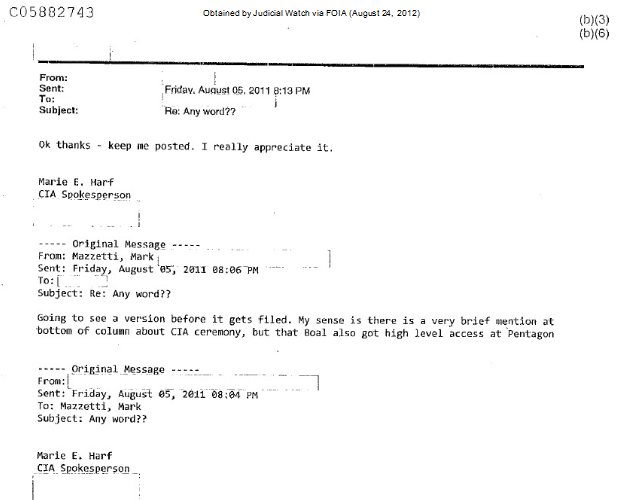
But what is news in this disclosure are the newly released emails between Mark Mazzetti, the New York Times‘s national security and intelligence reporter, and CIA spokeswoman Marie Harf. The CIA had evidently heard that Maureen Dowd was planning to write a column on the CIA’s role in pumping the film-makers with information about the Bin Laden raid in order to boost Obama’s re-election chances, and was apparently worried about how Dowd’s column would reflect on them. On 5 August 2011 (a Friday night), Harf wrote an email to Mazzetti with the subject line: “Any word??”, suggesting, obviously, that she and Mazzetti had already discussed Dowd’s impending column and she was expecting an update from the NYT reporter.

A mere two minutes after the CIA spokeswoman sent this Friday night inquiry, Mazzetti responded. He promised her that he was “going to see a version before it gets filed”, and assured her that there was likely nothing to worry about:

“My sense is there a very brief mention at bottom of column about CIA ceremony, but that [screenwriter Mark] Boal also got high level access at Pentagon.”

She then replied with this instruction to Mazzetti: “keep me posted”, adding that she “really appreciate[d] it”.

Mazzetti

Moments later, Mazzetti forwarded the draft of Dowd’s unpublished column to the CIA spokeswoman (it was published the following night online by the Times, and two days later in the print edition). At the top of that email, Mazzetti wrote: “this didn’t come from me … and please delete after you read.” [Continue reading…]

Mazzetti has told the Times’ public editor Arthur Bisbane, “I did make a bunch of calls and was doing this on deadline. As part of the process, I also did send the column [to the CIA]. It was definitely a mistake to do. I have never done it before and I will never do it again.”

Mazzetti was working on a deadline. So? He’s a reporter. That’s what reporters do.

Still, he’s acknowledged his mistake — but which one? Sending the column to the CIA? Or asking them to cover it up?

Then to cap the damage control he offers this assurance: he never did it before and will never do it again.

This is coming from a journalist who didn’t just get caught colluding with the CIA. He also got caught trying to cover up the evidence. And now he wants everyone to believe this was a one-time offense.

On the contrary, it sounds more like the kind of mea culpa one might expect from a serial liar. After all, he could merely have acknowledged this “mistake” without trying to portray himself as a choir boy.

Executive Editor Jill Abramson and Managing Editor Dean Baquet both went out of their way to minimize what Mazzetti did. If it turns out that he is really a serial offender, all three of them should get fired.

Facebooktwittermail

‘There are no civilians in wartime.’ Rachel Corrie’s family confronts the Israeli military in court

Max Blumenthal writes: In a small courtroom on the sixth floor of Haifa’s District Court, a colonel in the Israeli engineering corps who wrote a manual for the bulldozer units that razed the Rafah Refugee Camp in 2003 offered his opinion on the killing of the American activist Rachel Corrie.

“There are no civilians during wartime,” Yossi declared under oath.

Yossi made his remarkable statement under withering cross-examination by Hussein Abu Hussein, the lawyer for Corrie’s family, who was crushed to death by an Israeli bulldozer in Rafah on 17 March 2003. Rachel’s parents, Craig and Cindy, and her sister, Sarah, stood in the back of the courtroom to witness the 2010 proceedings. This marked their second visit for the second round of hearings in their civil suit against the state of Israel. Yesterday, an Israeli court issued its final judgment and exculpated the Israeli soldier who drove the bulldozer, the Army, and the State for all blame. Instead, the court held that Rachel bore responsibility for her own death for failing to move out of the bulldozer’s way.

In the immediate wake of Corrie’s killing, Colonel Lawrence Wilkerson, then the chief of staff to Secretary of State Colin Powell, instructed Corrie’s parents to demand a “thorough, fair and transparent investigation” from the Israeli government. Since then, the Israelis have stonewalled them, refusing to provide key details of their investigation, which was corrupted from the start by the investigators’ apparent attempts to find evidence that a bulldozer did not in fact kill Rachel. [Continue reading…]

Facebooktwittermail

Greed and debt: The true story of Mitt Romney and Bain Capital

Matt Taibbi writes: The great criticism of Mitt Romney, from both sides of the aisle, has always been that he doesn’t stand for anything. He’s a flip-flopper, they say, a lightweight, a cardboard opportunist who’ll say anything to get elected.

The critics couldn’t be more wrong. Mitt Romney is no tissue-paper man. He’s closer to being a revolutionary, a backward-world version of Che or Trotsky, with tweezed nostrils instead of a beard, a half-Windsor instead of a leather jerkin. His legendary flip-flops aren’t the lies of a bumbling opportunist – they’re the confident prevarications of a man untroubled by misleading the nonbeliever in pursuit of a single, all-consuming goal. Romney has a vision, and he’s trying for something big: We’ve just been too slow to sort out what it is, just as we’ve been slow to grasp the roots of the radical economic changes that have swept the country in the last generation.

The incredible untold story of the 2012 election so far is that Romney’s run has been a shimmering pearl of perfect political hypocrisy, which he’s somehow managed to keep hidden, even with thousands of cameras following his every move. And the drama of this rhetorical high-wire act was ratcheted up even further when Romney chose his running mate, Rep. Paul Ryan of Wisconsin – like himself, a self-righteously anal, thin-lipped, Whitest Kids U Know penny pincher who’d be honored to tell Oliver Twist there’s no more soup left. By selecting Ryan, Romney, the hard-charging, chameleonic champion of a disgraced-yet-defiant Wall Street, officially succeeded in moving the battle lines in the 2012 presidential race.

Like John McCain four years before, Romney desperately needed a vice-presidential pick that would change the game. But where McCain bet on a combustive mix of clueless novelty and suburban sexual tension named Sarah Palin, Romney bet on an idea. He said as much when he unveiled his choice of Ryan, the author of a hair-raising budget-cutting plan best known for its willingness to slash the sacred cows of Medicare and Medicaid. “Paul Ryan has become an intellectual leader of the Republican Party,” Romney told frenzied Republican supporters in Norfolk, Virginia, standing before the reliably jingoistic backdrop of a floating warship. “He understands the fiscal challenges facing America: our exploding deficits and crushing debt.”

Debt, debt, debt. If the Republican Party had a James Carville, this is what he would have said to win Mitt over, in whatever late-night war room session led to the Ryan pick: “It’s the debt, stupid.” This is the way to defeat Barack Obama: to recast the race as a jeremiad against debt, something just about everybody who’s ever gotten a bill in the mail hates on a primal level.

Last May, in a much-touted speech in Iowa, Romney used language that was literally inflammatory to describe America’s federal borrowing. “A prairie fire of debt is sweeping across Iowa and our nation,” he declared. “Every day we fail to act, that fire gets closer to the homes and children we love.” Our collective debt is no ordinary problem: According to Mitt, it’s going to burn our children alive.

And this is where we get to the hypocrisy at the heart of Mitt Romney. Everyone knows that he is fantastically rich, having scored great success, the legend goes, as a “turnaround specialist,” a shrewd financial operator who revived moribund companies as a high-priced consultant for a storied Wall Street private equity firm. But what most voters don’t know is the way Mitt Romney actually made his fortune: by borrowing vast sums of money that other people were forced to pay back. This is the plain, stark reality that has somehow eluded America’s top political journalists for two consecutive presidential campaigns: Mitt Romney is one of the greatest and most irresponsible debt creators of all time. In the past few decades, in fact, Romney has piled more debt onto more unsuspecting companies, written more gigantic checks that other people have to cover, than perhaps all but a handful of people on planet Earth. [Continue reading…]

Facebooktwittermail

Donors invest millions in Romney for billions in returns

Bloomberg reports: Wealthy donors and corporations are more heavily invested in this presidential election than at any time since the 1972 Watergate scandal led to stricter campaign- finance laws.

A series of court decisions and regulatory changes in 2010 unraveled federal limits on donations, paving the way for a return of the big players. They are pooling their money in nonprofits, which keep contributor names secret, and super- political action committees, which amassed $350 million through the end of July.

One-quarter of that money comes from just 10 donors, led by Las Vegas casino billionaire Sheldon Adelson, according to data from the Center for Responsive Politics, a Washington-based group that tracks such spending.

Top Republican contributors say they back the party’s presidential candidate Mitt Romney because they agree with his small-government philosophy or oppose President Barack Obama’s new regulations on banks and the health-care industry.

Yet Romney is more than just a political kindred spirit; he’s a sound investment. Here’s how a Romney presidency might pay off — literally — for some of these super-donors. [Continue reading…]

Facebooktwittermail

The disposable pawns of the American criminal-justice system

Sarah Stillman reports: On the evening of May 7, 2008, a twenty-three-year-old woman named Rachel Hoffman got into her silver Volvo sedan, put on calming jam-band music, and headed north to a public park in Tallahassee, Florida. A recent graduate of Florida State, she was dressed to blend into a crowd—bluejeans, green-and-white patterned T-shirt, black Reef flip-flops. On the passenger seat beside her was a handbag that contained thirteen thousand dollars in marked bills.

Before she reached the Georgia-peach stands and Tupelo-honey venders on North Meridian Road, she texted her boyfriend. “I just got wired up,” she wrote at 6:34 P.M. “Wish me luck I’m on my way.”

“Good luck babe!” he replied. “Call me and let me know what’s up.”

“It’s about to go down,” she texted back.

Behind the park’s oaks and blooming crape myrtles, the sun was beginning to set. Young mothers were pushing strollers near the baseball diamonds; kids were running amok on the playground. As Hoffman spoke on her iPhone to the man she was on her way to meet, her voice was filtered through a wire that was hidden in her purse. “I’m pulling into the park with the tennis courts now,” she said, sounding casual.

Perhaps what put her at ease was the knowledge that nineteen law-enforcement agents were tracking her every move, and that a Drug Enforcement Administration surveillance plane was circling overhead. In any case, Rachel Hoffman, a tall, wide-eyed redhead, was by nature laid-back and trusting. She was not a trained narcotics operative. On her Facebook page you could see her dancing at music festivals with a big, goofy smile, and the faux profile she’d made for her cat (“Favorite music: cat stevens, straycat blues, pussycat dolls”).

A few weeks earlier, police officers had arrived at her apartment after someone complained about the smell of marijuana and voiced suspicion that she was selling drugs. When they asked if she had any illegal substances inside, Hoffman said yes and allowed them in to search. The cops seized slightly more than five ounces of pot and several Ecstasy and Valium pills, tucked beneath the cushions of her couch. Hoffman could face serious prison time for felony charges, including “possession of cannabis with intent to sell” and “maintaining a drug house.” The officer in charge, a sandy-haired vice cop named Ryan Pender, told her that she might be able to help herself if she provided “substantial assistance” to the city’s narcotics team. She believed that any charges against her could be reduced, or even dropped.

Hoffman’s legal worries were augmented by the fact that this wasn’t her first drug offense. A year earlier, while she was a senior, police pulled her over for speeding and found almost an ounce of marijuana in her car. She was ordered into a substance-abuse program, which required regular drug testing. Later, after failing to report for a test, she spent three days in jail.

Hoffman chose to coöperate. She had never fired a gun or handled a significant stash of hard drugs. Now she was on her way to conduct a major undercover deal for the Tallahassee Police Department, meeting two convicted felons alone in her car to buy two and a half ounces of cocaine, fifteen hundred Ecstasy pills, and a semi-automatic handgun.

The operation did not go as intended. By the end of the hour, police lost track of her and her car. Late that night, they arrived at her boyfriend’s town house and asked him if Hoffman was inside. They wanted to know if she might have run off with the money. Her boyfriend didn’t know where she was.

“She was with us,” he recalled an officer saying. “Until shit got crazy.”

Two days after Hoffman disappeared, her body was found in Perry, Florida, a small town some fifty miles southeast of Tallahassee, in a ravine overgrown with tangled vines. Draped in an improvised shroud made from her Grateful Dead sweatshirt and an orange-and-purple sleeping bag, Hoffman had been shot five times in the chest and head with the gun that the police had sent her to buy.

By the evening of her death, Rachel Hoffman had been working for the police department for almost three weeks. In bureaucratic terms, she was Confidential Informant No. 1129, or C.I. Hoffman. In legal parlance, she was a “coöperator,” one of thousands of people who, each year, help the police build cases against others, often in exchange for a promise of leniency in the criminal-justice system.

Informants are the foot soldiers in the government’s war on drugs. By some estimates, up to eighty per cent of all drug cases in America involve them, often in active roles like Hoffman’s. [Continue reading…]

Facebooktwittermail

Envisioning a post-Assad Syria as civil war grinds on

The Los Angeles Times reports: On Tuesday, the United States Institute of Peace issued “The Day After” plan for a post-Assad Syria. The 133-page statement of goals and principles for a new Syria was six months in the making. It was produced by 45 Syrian opposition figures brought together by the State Department-funded institute’s Middle East experts and partners from the German Institute for International and Security Affairs. It is long on institution-building wonk-speak and short on how the opposition is supposed to get to the post-Assad era. But analysts hailed it as a worthy undertaking even as government and rebel forces are mired in protracted battles to control key areas of Damascus and Aleppo.

No representatives of the Free Syrian Army fighting the regime were party to the post-Assad project, said Steven Heydemann, a senior advisor on Middle East initiatives who coordinated the talks among Syrian exiles, defectors and regime opponents who managed to travel abroad or participate via video linkup.

“The group very sensibly recognized there was no way to anticipate how the transition would happen,” instead focusing on identifying the challenges that would confront the next leadership whether Assad flees, negotiates an exit or is deposed in a palace coup, Heydemann said. However the Assad dynasty ends, he noted, Syrians will have to grapple with divisive questions on how to treat those accused of war crimes, deter revenge killings and get the economy and social services back in working order.

While the United States is holding firm to its policy of providing only nonlethal aid to the rebels, Heydemann said, Washington could play a more effective role in coordinating other outside support. He pointed to the mounting incidents of Islamic extremists waging strikes against the Assad regime for their own purposes and weaponry coming in from autocratic supporters like Qatar and Saudi Arabia as giving “a Wild West quality” to help for the underdog rebels.

“The United States is very concerned that support from outside for elements of the Syrian opposition not lead to strengthening of Al Qaeda or Islamic fundamentalist forces that becomes problematic in the postwar process,” said Charles Ries, a career diplomat heading Rand Corp.’s Center for Middle East Public Policy. “But our reluctance [to supply arms] has paradoxically caused the division of the Syrian opposition and has encouraged those Islamist elements to find their own sources of support and influence.”

The task eluding the United States and its allies is uniting the disparate opposition forces inside and outside Syria into a cohesive leadership that they can support and ratchet up the pressure on Assad, Ries said.

Bilal Y. Saab, a Syria expert at the Monterey Institute of International Studies, shares other analysts’ concerns that Islamic militants are filling the vacuum left by a hands-off U.S. policy toward the rebels. But it would be “ill-advised,” he said, for the United States to recognize a transitional government that isn’t broadly inclusive of the myriad ethnic, sectarian, religious and political factions in Syria.

Facebooktwittermail

Turkey to press for safe zone in Syria

The Associated Press reports: Turkey’s foreign minister said Wednesday he would press the United Nations Security Council to set up a safe haven inside Syria to protect thousands of people fleeing the violence there as his country is straining to shelter an increasing flow of refugees.

Turkey has long been floating the idea of a no-fly zone, or buffer zone, to protect displaced Syrians from attacks by President Bashar Assad’s forces, but the issue has become more pressing now the number of refugees in Turkey has exceeded 80,000 — an amount it says approaches its limits.

The refugee agency has said up to 200,000 refugees could eventually flee to Turkey.

“We expect the U.N. to step in and protect the refugees inside Syria, and if possible, to shelter them in camps there,” Foreign Minister Ahmet Davutoglu told reporters before leaving for New York to attend Thursday’s high-level U.N. Security Council meeting on Syria.

Facebooktwittermail

French essayist blames multi-culturalism for Breivik’s killing spree

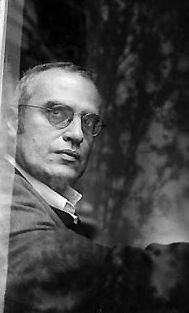
Richard Millet

Time magazine reports: Richard Millet is an accomplished figure in French literature. His le Sentiment du Langue (The Feeling of Language) won the Académie Française’s 1994 essay award. His work as an editor for celebrated publisher Gallimard, meanwhile, helped produce two recent Goncourt winners—including the 2006 novel les Bienveillantes (The Kindly Ones) by American author Jonathan Littell. Now, however, Millet is getting attention of an entirely different kind with a new work attacking immigration and multi-culturalism, and describing the acts of convicted Norwegian multi-murderer Anders Behring Breivik as “formal perfection…in their literary dimension.”

That bookish qualifier, says newsweekly l’Express in its critique of Millet’s new essay, Eloge Littéraire d’Anders Breivik (Literary Elegy of Anders Breivik), is a “gratuitous façade” for an otherwise “vindictive text” and thesis. Indeed, though Millet states he does not approve of Breivik’s murderous action July 22, 2011 that left 77 innocent people dead, he does write the slaughter was “without doubt what Norway deserved.” The reason? Norway, Millet contends, allowed immigration, multi-culturalism, and the domination of foreign customs, language, and religion to become such dominant influences that a self-designated defender of traditional society felt compelled to take decisive action.

“Multi-culturalism as it has been imported from the United States is the worst thing possible for Europe…and creates a mosaic of ghettoes in which the [host] nation no longer exists,” Millet told France Info radio Aug. 27. “Breivik, I believe, perceived that, and responded to that question with the most monstrous reply.”

Little wonder that such views — published just as Breivik was being sentenced Aug. 24 — have sparked controversy in France. As word of Millet’s writing spreads, so, too, may the objections it has inspired.

If so, that may only serve to reinforce Millet’s accusations that most of Europe — and indeed the West — is dominated by the same attitudes that motivated Breivik’s attack. Breivik, Millet writes, is “an exemplary product of Western decadence,” and a “child of the ideologico-racial fracture that extra-European immigration has introduced in Europe.” Because he sees the resulting “loss of national identity” and “Islamization of Europe” decaying “Christian roots” everywhere, Millet appears to believe acts similar to Breivik’s may be replicated outside Norway as well. [Continue reading…]

Facebooktwittermail

Syria: FSA captures missile storage base

A video posted on YouTube in the last few hours has this description:

The FSA captures a missile storage base near Damascus. Some of the missiles were being modified by the Assad regime so that chemically charged warheads could be fixed on them.

I can’t confirm any of that information or say anything about the Arabic text at the beginning. What seems evident, nevertheless, is that this video was indeed made in a missile storage facility which is no longer under the control of the Syrian military.

Watch the video at YouTube — embedding has been disable so I can’t post the video here.

Facebooktwittermail

Syria refugee exodus raises pressure for buffer zone

Reuters reports: Syria’s refugee exodus is accelerating and up to 200,000 people could settle in Turkey alone if the conflict worsens, the United Nations warned on Tuesday, increasing pressure for creation of a buffer zone inside Syria.

Turkey has floated the idea of a “safe zone” to be set up for civilians under foreign protection as fighting has intensified in a 17-month-old uprising against President Bashar al-Assad.

Up to 5,000 refugees a day have been crossing into Turkey over the past two weeks while the pace of refugees arriving at a camp in northern Jordan has doubled, heralding what could be a much bigger movement there, the U.N. refugee agency said.

Although there is no sign divided world powers are ready to back a buffer and no-fly zone, as rebels and aid organizations would like, U.N. Security Council foreign ministers are expected to discuss the idea at a meeting on Thursday.

While Turkey could in theory create a buffer zone itself, it has said it is reluctant to go it alone.

Already hosting more than 80,000 refugees, Turkey has warned it could run out of space if the number goes above 100,000.

Facebooktwittermail

Israel indicts Jewish teenagers over attack on Palestinian in Jerusalem

Reuters reports: Nine Jewish teenagers were indicted on Tuesday over a ferocious assault that nearly killed a young Arab in Jerusalem, an alleged hate crime in a city divided by religion and politics.

Israeli prosecutors said a girl, cursing and shouting anti-Arab taunts, lit the spark that set off a chain reaction of racist violence on August 16 in which Jamal Julani, a 17-year-old Palestinian, was punched, kicked and left for dead.

Julani’s heart stopped after the assault in a main Jerusalem square, where drunken teenagers often gather, but was brought back to life by a paramedic at the scene.

“Death to Arabs,” the youngsters chanted as they swept through the popular nightspot, rallying to the girl’s call to find and attack Palestinians, according to a summary of the charge sheet released by the Justice Ministry.

“Be a man and come and beat the Arabs,” one of the attackers shouted to the crowd, the indictment said.

Eight of the suspects are minors in their teens. A ninth suspect, aged 19, will be tried as an adult. Charges include assault and incitement to racism and violence.

Lawyers for the accused said they would study the indictment before entering a plea. It was not clear when the cases would go to trial.

The attack, which laid bare an undercurrent of racial tension in Jerusalem, was swiftly condemned by Prime Minister Benjamin Netanyahu and other Israeli leaders.

“This is something we cannot accept – not as Jews, not as Israelis,” Netanyahu said of the assault, whose intensity, along with the lack of remorse shown by some of the suspects in court appearances, jolted many in the Jewish state.

“He’s an Arab, and he cursed my mother, so he should die,” one suspect said at a remand hearing last week.

Julani comes from mainly Arab east Jerusalem, which was captured by Israel in the 1967 war. The state later declared that the city was the “complete and undivided” capital of Israel, an assertion not recognized by international powers.

Adnan Husseini, the Palestinian minister for Jerusalem affairs, said Palestinians in the city faced a constant battle against racism.

“This widely publicized incident revealed the true face of Israel and the true culture of hatred that is imbedded in its youth,” he told Reuters.

Facebooktwittermail

Rachel Corrie lawsuit result ‘dangerous precedent’ say human rights groups

The Guardian reports: Human rights organisations have warned of a “dangerous precedent” following an Israeli court’s dismissal of a civil lawsuit over the death of US activist Rachel Corrie, which stated that Israel could not be held responsible because its army was engaged in a combat operation.

Corrie “was accidentally killed in the framework of a ‘war-related activity’ … [and] the state bears no responsibility for the damages inflicted on the plaintiffs resulting from a war-related action,” said Judge Oded Gershon at Haifa district court.

The 23-year-old activist was crushed by a military bulldozer which she believed was intent on demolishing a Palestinian home in Rafah, southern Gaza, in March 2003. Gershon ruled that it was a “regrettable accident” that Corrie had brought upon herself. There had been no fault in the internal Israeli military investigation, which cleared the bulldozer driver of any blame, the court found. “The deceased was in a blind spot – the operator didn’t see her,” said Gershon.

Corrie had “put herself in a dangerous situation” and could have saved herself by moving out of the zone of danger, he said. The area was “the site of daily warfare” and a closed military zone, and the US government had warned its citizens not to go there.

Hussein Abu Hussein, the Corrie family’s lawyer, said the ruling sent “a very dangerous message and precedent that there are no restrictions on Israeli military behaviour in Gaza and the West Bank”. The ruling would “close the doors of justice to civilian victims”, including foreigners, and “expand a legal black hole” in which Israel seeks to evade responsibility for its actions.

The verdict, he said, was “yet another example of where impunity has prevailed over accountability and fairness. We knew from the beginning that we had an uphill battle to get truthful answers and justice, but we are convinced that this verdict distorts the strong evidence presented in court, and contradicts fundamental principles of international law with regard to protection of human rights defenders. In denying justice in Rachel Corrie’s killing, this verdict speaks to the systemic failure to hold the Israeli military accountable for continuing violations of basic human rights.”

Human Rights Watch said the ruling contravened international law, which is intended to protect non-combatants in war zones, and set “a dangerous precedent”. “The idea that there can be no fault for killing civilians in a combat operation flatly contradicts Israel’s international legal obligations to spare civilians from harm during armed conflict and to credibly investigate and punish violations by its forces,” said Bill van Esveld, a senior Middle East researcher at HRW.

Shawan Jabarin, director of the Palestinian human rights organisation, Al Haq, said: “Israel has claimed that it is not responsible for the death of a civilian in armed conflict. However, this flatly ignores international law, which stipulates that Israel is under an obligation to take all measures to ensure that no civilians will be harmed during hostilities, and must at all times distinguish between military targets and civilians.

“The presence of a civilian in a combat zone does in any way not affect their right to protection. Instead, their protected status applies regardless of their location in a conflict, and international law clearly states that they must be protected against acts of violence in all circumstances.”

Amnesty International: Amnesty International condemns an Israeli court’s verdict that the government of Israel bears no responsibility in the death of Rachel Corrie, saying the verdict continues the pattern of impunity for Israeli military violations against civilians and human rights defenders in the Occupied Palestinian Territories (OPT). The verdict shields Israeli military personnel from accountability and ignores deep flaws in the Israeli military’s internal investigation of Corrie’s death.

“Rachel Corrie was a peaceful American protestor who was killed while attempting to protect a Palestinian home from the crushing force of an Israeli military bulldozer,” said Sanjeev Bery, Middle East and North Africa advocacy director for Amnesty International USA.

“More than nine years after Corrie’s death, the Israeli authorities still have not delivered on promises to conduct a ‘thorough, credible and transparent’ investigation. Instead, an Israeli court has upheld the flawed military investigation and issued a verdict that once again shields the Israeli military from any accountability,” Bery said.

The verdict, issued by Judge Oded Gershon in the Haifa District Court, maintains that the Israeli military is not responsible for ‘damages caused’ because the D9 Caterpillar bulldozer was engaged in a combat operation in Rafah in the southern Gaza Strip on March 16, 2003.

International humanitarian law prohibits the destruction of property unless required by imperative military necessity, and requires that in any military operation, constant care is taken to protect civilians.

“Rachel Corrie was clearly identifiable as a civilian, as she was wearing a fluorescent orange vest when she was killed,” said Bery. “She and other non-violent activists had been peacefully demonstrating against the demolitions for hours when the Israeli military bulldozer ran over her.”

By upholding the flawed Israeli military investigation, completed within one month of Rachel Corrie’s death in 2003, the verdict seems to have ignored substantial evidence presented to the court, including by eyewitnesses. The full military investigation has never been made public, but US government officials have stated that they do not believe the investigation was ‘thorough, credible and transparent.’

Amnesty International has made similar criticisms of Israel’s system of military investigations for many years. For example, the organization has monitored the investigations carried out by IDF commanders and the Israeli military police into violations during Operation ‘Cast Lead’, launched by Israeli forces on December 27, 2008, in which hundreds of unarmed civilians in the Gaza Strip were killed.

Israel’s military investigations have lacked independence, impartiality, transparency, appropriate expertise and sufficient investigatory powers. The failure of both Israel and the Hamas de facto administration to conduct credible investigations into violations committed during the conflict led Amnesty International to call for the Gaza situation to be referred to the International Criminal Court.

Palestinian civilians from the OPT are killed or injured by the Israeli military all too frequently, but they face significant barriers in accessing Israeli civil courts, which means that Israeli civil courts rarely examine the killings of civilians in the OPT, particularly those in Gaza. Steep court fees required of claimants before the case can begin are beyond the means of most Palestinians. As part of Israel’s continuing closure of the Gaza Strip, the Israeli authorities deny Palestinian victims or witnesses from Gaza permission to enter Israel to testify in court, lawyers from Gaza cannot represent clients before Israeli courts, and Israeli lawyers cannot enter Gaza to meet with clients.

Amnesty International has repeatedly condemned Israel’s policy of demolishing homes and other structures in the OPT, but demolitions are still routine in the occupied West Bank. Over 600 structures were demolished in 2011, resulting in the forcible eviction of almost 1,100 people. In the first seven months of 2012, the Israeli military demolished 327 structures in the West Bank, displacing 575 people, according to the UN Office for the Coordination of Humanitarian Affairs.

Facebooktwittermail

Rachel Corrie verdict exposes Israeli military mindset

Chris McGreal writes: Reporters covering Israel are routinely confronted with the question: why not call Hamas a terrorist organisation? It’s a fair point. How else to describe blowing up families on buses but terrorism?

But the difficulty lies in what then to call the Israeli army when it, too, at particular times and places, has used indiscriminate killing and terror as a means of breaking Palestinian civilians. One of those places was Rafah, in the southern tip of the Gaza strip, where Rachel Corrie was crushed by a military bulldozer nine years ago as she tried to stop the Israeli army going about its routine destruction of Palestinian homes.

An Israeli judge on Tuesday perpetuated the fiction that Corrie’s death was a terrible accident and upheld the results of the military’s own investigation, widely regarded as such a whitewash that even the US ambassador to Israel described it as neither thorough nor credible. Corrie’s parents may have failed in their attempt to see some justice for their daughter, but in their struggle they forced a court case that established that her death was not arbitrary but one of a pattern of killings as the Israeli army pursued a daily routine of attacks intended to terrorise the Palestinian population of southern Gaza into submission.

The case laid bare the state of the collective Israeli military mind, which cast the definition of enemies so widely that children walking down the street were legitimate targets if they crossed a red line that was invisible to everyone but the soldiers looking at it on their maps. The military gave itself a blanket protection by declaring southern Gaza a war zone, even though it was heavily populated by ordinary Palestinians, and set rules of engagement so broad that just about anyone was a target.

With that went virtual impunity for Israeli troops no matter who they killed or in what circumstances – an impunity reinforced by Tuesday’s verdict in Haifa. [Continue reading…]

Facebooktwittermail