AFP reports: On the edge of the Saif al-Dawla district of Aleppo, a commander argues with a rebel. He has ordered him to try to take out a regime tank, alone and with a single rocket-propelled grenade.
“Just one is enough — you can take out the whole army,” the commander tells the reluctant fighter.
The scene is one repeated across the frontlines of the battle between the Free Syrian Army and the Syrian regime, as the rag-tag rebel forces try to take on tanks, helicopter gunships and fighter jets with armoury that is desperately lacking.
Rebel commanders say the weapons they do have — Kalashnikovs, some RPGs, a handful of anti-aircraft guns — are old and expensive while the weapons they need to take on the might of an army are impossible to come by.
“I flew MIG war planes for 12 years, and we are fighting these planes with Kalashnikovs, and not even good Kalashnikovs,” says Alaa Saadeddin, a defected pilot.
“Anti-aircraft guns are the heaviest weapon we have,” he adds. “We don’t have ground-to-ground rockets, we don’t have Grads, we don’t have surface-to-air missiles.”
When Abu Maryam decided to set up his own rebel brigade, he approached the Liwa al-Tawhid, a rebel umbrella group, to ask about the possibility of getting weapons.
“Liwa al-Tawhid gave us two Kalashnikovs, but we had to find a way to buy the rest. We have 22 men and 12 guns, so we will go in groups. The first group will take the guns, when they come back, they will give the guns to the second group.”
And the weapons that are available don’t come cheap — a Kalashnikov goes for 150,000 Syrian pounds, nearly $2,400, bullets start at $2 each, and a grenade will set you back over $150, according to commanders.
Syria’s rebels laugh at stories of Libyan fighters who regularly unloaded their weapons into the air to celebrate a victory on the battlefront.
“If any rebel in any group fires a single bullet in any direction other than at the enemy, they will be kicked out of the group,” Saadeddin said.
Western nations have said they are providing non-lethal aid, in the form of money or communications equipment to the rebels, and the opposition Syrian National Council says countries including Saudi Arabia and Qatar have provided arms to fighters inside the country.
But the weapons in evidence on the ground look as old as rebels claim they are — beaten-up guns and dusty RPGs that are a world away from the shiny new equipment that was in circulation on the Libyan battlefield.
How the Syrian revolution became militarized
Sharif Abdel Kouddous writes: Emad Khareeta says he had no choice but to defect. The 23-year-old member of the Free Syrian Army stands outside his family home in a deserted section of town. Shards of concrete and glass litter the ground, the result of nearby shelling. The street is dark and quiet, Emad’s face only discernible in the glow of his cigarette. He tells his story slowly.
In April 2010, Emad was called up for his mandatory army service. When the revolution broke out in March 2011, he was deployed to various parts of the country—but it was his time in Homs, where he was sent on December 31, 2011, that compelled him to leave his unit. Sometimes called the ‘capital of the revolution,’ the restive city in western Syria had been under siege by the regime of Bashar al-Assad since May and was the site of some of its bloodiest crackdowns. Emad describes indiscriminate killing and widespread looting by fellow soldiers, as well as an incident that deeply affected him, when an unarmed truck driver shot in the arm and legs was left to bleed to death in front of him. Ordered to fire on protesters at demonstrations, he says he aimed away.
“I was ready to die after what I had seen and been through,” he says. “I don’t want to oppress anyone.” He eventually bribed an officer 20,000 Syrian pounds (approximately $300) for a three-day vacation leave. On January 26, Emad left and never returned, making his way back home to Zabadani.
Emad is just one of thousands of army defectors who are switching sides in a conflict that began as a nonviolent popular uprising but has since spiraled into an increasingly bitter and polarizing civil war, one that has become a theater for geopolitical interests.
The armed opposition to the Assad regime first began to take form in the late summer of 2011, following months of mass demonstrations that were overwhelmingly nonviolent. Facing repeated crackdowns and mass detentions by security forces, protesters began to arm themselves, many by purchasing smuggled weapons from border countries like Lebanon, Iraq and Jordan. The revolt was further militarized by increasing numbers of army soldiers defecting to their local communities and bringing their weapons with them.
“They dragged us into arming ourselves,” says Malek al-Tinnawi, a 25-year-old FSA volunteer. He limps badly as he goes to retrieve a newly acquired assault rifle. Two months ago, he was shot through the ankle in clashes with the army. The local doctor inserted a metal rod in his leg to replace the shattered bone. “It’s a good one, isn’t it?” he smiles, brandishing the German-made H&K Model G3 rifle. “Not too used, almost like new.”
The rifle was brought to him on foot, through a mountainous smuggling route from Lebanon. Malek received it as a gift, along with two extra magazines and a chain of bullets, compliments of his fellow opposition fighters who gave it to him, he says, in acknowledgment of his role in being one of the first to demonstrate in Zabadani, and one of the first in the town to take up arms against the regime. Still, Malek says, he would have preferred for the revolution to have remained nonviolent. “When we were peaceful, we were stronger than when we had weapons,” he says, patting the gun in his lap.
“This revolt started out with very modest demands concerning the state of emergency, and it has been dealt with since then as a war of the security state against its people,” says Fawwaz Traboulsi, a Beirut-based historian and columnist. “What should be understood is that this militarization of the response to a vast popular movement ended up by militarizing the opposition.” [Continue reading…]
When Assad falls, Kurds in Syria say they’ll take back lands given to Arabs
David Enders reports: Sattam Sheikhmous still farms wheat on what’s left of his grandfather’s land, shrunk from more than 32,000 acres to less than 5,000 by the Syrian government in 1966.
“They said it was a socialist policy, but we believe it was political,” said Sheikhmous, now in his 60s, referring to the government confiscation of land that began when Syria joined with Egypt, then ruled by Gamal Abdel Nasser, to form the United Arab Republic in 1958.
The land confiscation took place across the country. But in the predominantly Kurdish province of Hasaka, in Syria’s northeast corner, the resettlement of Arabs from another part of the country in the 1970s created ethnic tensions that could manifest themselves violently when the Syrian government fully relinquishes control of the area, now seen by many as only a matter of time.
“We have to ask them to give us our land back. If they don’t, we have to do whatever we need to do,” said Sheikhmous. “It’s not just our land, it’s Kurdish land. If they don’t leave peacefully, we will use weapons.”
With Syria convulsed by a civil war that shows no signs of ending soon, the country’s Kurdish region, fast against Turkey and Iraq, is surprisingly peaceful, thanks to a maneuver by the government of President Bashar Assad, who first granted the Kurds greater rights last year, then surrendered security to a Kurdish militia this summer. While anti-Assad demonstrations still take place here, there is none of the kind of fighting that has convulsed other parts of Syria.
But the history of relations between Syria’s Kurdish and Arab ethnic groups suggests that peace may be short-lived, especially if Assad falls and a successor government clashes with Kurds over long-held grievances. The confiscated Kurdish areas contain both rich agricultural land and oil, and neither will be easy for Kurds to take control of. [Continue reading…]
‘I saw the whole beating, it’s a good thing that they beat the Arabs…’
The Institute for Middle East Understanding: Just days after a mob of Jewish Israelis beat and injured three Palestinian youth, one nearly to death, Israel’s Ynet news website conducted interviews in central Jerusalem’s Kikar Hahatulot [Cat Square], just a few hundred feet from the site of what was dubbed by Israeli police a “lynching.” The video is reminiscent of a controversial 2009 video made by Jewish-American journalist/author Max Blumenthal and American-Israeli journalist Joseph Dana titled “Feeling the hate in Jerusalem.”
IMEU also provides a translation of the transcript of the video.
Along with the Arctic ice, the rich world’s smugness will melt
George Monbiot writes: There are no comparisons to be made. This is not like war or plague or a stockmarket crash. We are ill-equipped, historically and psychologically, to understand it, which is one of the reasons why so many refuse to accept that it is happening.
What we are seeing, here and now, is the transformation of the atmospheric physics of this planet. Three weeks before the likely minimum, the melting of Arctic sea ice has already broken the record set in 2007. The daily rate of loss is now 50% higher than it was that year. The daily sense of loss – of the world we loved and knew – cannot be quantified so easily.
The Arctic has been warming roughly twice as quickly as the rest of the northern hemisphere. This is partly because climate breakdown there is self-perpetuating. As the ice melts, for example, exposing the darker sea beneath, heat that would previously have been reflected back into space is absorbed.
This great dissolution, of ice and certainties, is happening so much faster than most climate scientists predicted that one of them reports: “It feels as if everything I’ve learned has become obsolete.” In its last assessment, published in 2007, the Intergovernmental Panel on Climate Change noted that “in some projections, Arctic late-summer sea ice disappears almost entirely by the latter part of the 21st century”. These were the most extreme forecasts in the panel’s range. Some scientists now forecast that the disappearance of Arctic sea-ice in late summer could occur in this decade or the next.
As I’ve warned repeatedly, but to little effect, the IPCC’s assessments tend to be conservative. This is unsurprising when you see how many people have to approve them before they are published. There have been a few occasions – such as its estimate of the speed at which glaciers would be lost in the Himalayas – on which the panel has overstated the case. But it looks as if these will be greatly outnumbered by the occasions on which the panel has understated it. [Continue reading…]
Obama administration backs Shell in Supreme Court case
CorpWatch reports: The Obama administration is backing Shell Oil after abruptly changing sides in a landmark U.S. Supreme Court case that could make it even more difficult for survivors of human rights abuses overseas to sue multinational corporations in federal courts. The case will be heard on October 1.
Lawyers at EarthRights International, a Washington-based human rights law nonprofit, say they suspect that a new legal submission – which was signed only by the U.S. Justice Department – reflects tensions inside the government on how to deal with multinational corporations do business in the U.S. Significantly, neither the State nor the Commerce Department signed on to the brief, despite their key roles in the case.
“It was shocking,” Jonathan Kaufman EarthRights legal policy coordinator commented to Reuters. “The brief was largely unexpected, based on what they had filed previously, and pretty breathtaking.”
At issue is the Alien Torts Claim Act (ATCA) – an 18th century U.S. law originally designed to combat piracy on the high seas – that has been used during the last 30 years as a vehicle to bring international law violations cases to U.S. federal courts.
Lawyers began using ATCA as a tool in human rights litigation in 1979, when the family of 17-year-old Joel Filartiga, who was tortured and killed in Paraguay, sued the Paraguayan police chief responsible. Filartiga v. Peña-Irala set a precedent for U.S. federal courts to punish non-U.S. citizens for acts committed outside the U.S. that violate international law or treaties to which the U.S. is a party. ATCA has brought almost 100 cases of international (often state-sanctioned) torture, rape and murder to U.S. federal courts to date.
In recent years, a number of ATCA lawsuits have also been filed against multinationals which has angered the business lobby. [Continue reading…]
U.S. more than doubles previous record in global weapons sales
In the last two years, American arms manufacturers have profited massively from increased tension between Gulf states and Iran, thanks in large part to repeated threats of war emanating from Israel.
The New York Times reports: Weapons sales by the United States tripled in 2011 to a record high, driven by major arms sales to Persian Gulf allies concerned about Iran’s regional ambitions, according to a new study for Congress.
Overseas weapons sales by the United States totaled $66.3 billion last year, or more than three-quarters of the global arms market, valued at $85.3 billion in 2011. Russia was a distant second, with $4.8 billion in deals.
The American weapons sales total was an “extraordinary increase” over the $21.4 billion in deals for 2010, the study found, and was the largest single-year sales total in the history of United States arms exports. The previous high was in fiscal year 2009, when American weapons sales overseas totaled nearly $31 billion.
A worldwide economic decline had suppressed arms sales over recent years. But increasing tensions with Iran drove a set of Persian Gulf nations — Saudi Arabia, the United Arab Emirates and Oman — to purchase American weapons at record levels. [Continue reading…]
The U.S. Navy adviser who thwarted a plan to provoke war with Iran
Jeff Stein reports: Gwenyth Todd had worked in a lot of places in Washington where powerful men didn’t hesitate to use sharp elbows. She had been a Middle East expert for the National Security Council in the Clinton administration. She had worked in the office of Defense Secretary Dick Cheney in the first Bush administration, where neoconservative hawks first began planning to overthrow Iraqi dictator Saddam Hussein.
But she was not prepared a few years later in Bahrain when she encountered plans by high-ranking admirals to confront Iran, any one of which, she reckoned, could set the region on fire. It was 2007, and Todd, then 42, was a top political adviser to the U.S. Navy’s 5th Fleet.
Previous 5th Fleet commanders had resisted various ploys by Bush administration hawks to threaten the Tehran regime. But in spring 2007, a new commander arrived with an ambitious program to show the Iranians who was boss in the Persian Gulf.
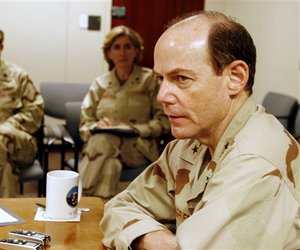
Vice Adm. Kevin J. Cosgriff had amassed an impressive résumé, rising through the ranks to command a cruiser and a warship group after the Sept. 11, 2001, terrorist attacks. Following a customary path to three stars, he had also spent as much time in Washington as he had at sea, including stints at the Defense Intelligence Agency and as director of the Clinton White House Situation Room.Vice Adm (Ret) Kevin J. Cosgriff now sits on the board of the Washington DC think tank, the Stimson Center.
Cosgriff — backed by a powerful friend and boss, U.S. Central Command (Centcom) chief Adm. William J. “Fox” Fallon — was itching to push the Iranians, Todd and other present and former Navy officials say.
“There was a feeling that the Navy was back on its heels in dealing with Iran,” according to a Navy official prohibited from commenting in the media. “There was an intention to be far more aggressive with the Iranians, and a diminished concern about keeping Washington in the loop.”
Two people who were there said Cosgriff mused in a staff meeting one day that he’d like to steam a Navy frigate up the Shatt al Arab, the diplomatically sensitive and economically crucial waterway dividing Iraq and Iran. In another, they said, he wanted to convene a regional conference to push back Iran’s territorial claims in the waterway, a flash point for the bloody Iran-Iraq war in the 1980s.
Then he presented an idea that not only alarmed Todd, but eventually, she believes, launched the chain of events that would end her career.
Cosgriff declined to discuss any of these meetings on the record. This story includes information from a half-dozen Navy and other government officials who demanded anonymity because of the sensitivity of the matter, many parts of which remain classified.
According to Todd and another witness, Cosgriff’s idea, presented in a series of staff meetings, was to sail three “big decks,” as aircraft carriers are known, through the Strait of Hormuz — to put a virtual armada, unannounced, on Iran’s doorstep. No advance notice, even to Saudi Arabia and other gulf allies. Not only that, they said, Cosgriff ordered his staff to keep the State Department in the dark, too.
To Todd, it was like something straight out of “Seven Days in May,” the 1964 political thriller about a right-wing U.S. military coup. [Continue reading…]
Music: Dhafer Youssef Quartet — ‘Les Ondes Orientales’
“The Tunisian-born singer and oud (arabic lute) player [Dhafer Youssef] has a voice one reviewer thought ‘could stop wars’, not least in its jaw-dropping falsetto.” (The vocals in this piece begin at 5 min 50 sec.)
Twitter — the new opium of the people?
At first glance, the statistics on Twitter use across the Arab world suggest that there is an inverse relationship between tweeting and revolution. With the exception of Bahrain, Twitter activity appears to be at its greatest among the unrevolutionary Gulf states.
The numbers used for this infographic come from the Dubai School of Government’s Arab Social Media Report and, as far as I can tell, their statistics are gathered simply on a country-by-country basis. For that reason, the numbers for the Gulf states need to be viewed with some caution since most of these countries have large and in some cases majority non-national populations. In other words a proportion of Gulf tweeters (who knows how large) are foreigners most of whom are likely to be politically disengaged by default — these are people who live in the Gulf to make money, not foment social change.
(Click on the image to enlarge.)
One man against the Wall Street lobby
Simon Johnson writes: Two diametrically opposed views of Wall Street and the dangers posed by global megabanks came more clearly into focus last week. On the one hand, William B. Harrison, Jr. – former chairman of JP Morgan Chase – argued in the New York Times that today’s massive banks are an essential part of a well-functioning market economy, and not at all helped by implicit government subsidies.
On the other hand, there is a new powerful voice who knows how big banks really work and who is willing to tell the truth in great and convincing detail. Jeff Connaughton – a former senior political adviser who has worked both for and against powerful Wall Street interests over the years – has just published a page-turning memoir that is also a damning critique of how Wall Street operates, the political capture of Washington, and our collective failure to reform finance in the past four years. “The Payoff: Why Wall Street Always Wins,” is the perfect antidote to disinformation put about by global megabanks and their friends.
Specifically, Mr. Harrison makes six related arguments regarding why we should not break up our largest banks. Each of these is clearly and directly refuted by Mr. Connaughton’s experience and the evidence he presents.
First, Mr. Harrison claims that megabanks are the natural outgrowth of requests from customers, rather than the result of extraordinary resources spent on lobbying over the past 30 years. Mr. Connaughton’s book contains all you need to know – and more than you can stomach – about the realities of how the influence industry has worked diligently to build and defend megabanks. The people who really wanted the banks to become bigger were the executives in charge of those organizations – like Mr. Harrison. They spent a lot of money to make this happen. [Continue reading…]
Assad forces accused of massacre in Damascus suburb
The New York Times reports: Mass burials in this Damascus suburb on Sunday showed the carnage of the past few days in gruesome detail: scores of bodies lined up on top of each other in long thin graves moist with mud.
A video of what activists described as the fifth grave to be filled showed two small children near the edge. Up close, in the field where there were more bodies than people to wash and prepare them for burial, the scent of decay swirled and gunshot wounds could be seen in the heads of many men.
“The Assad forces killed them in cold blood,” said Abu Ahmad, 40, a resident of Daraya, where the Syrian government has waged a campaign it described as a “cleansing.” “I saw dozens of dead people, killed by the knives at the end of Kalashnikovs, or by gunfire. The regime finished off whole families, a father, mother and their children. They just killed them without any pretext.”
Several other witnesses here and two activist groups have now offered accounts of what has begun to look like one of the deadliest and focused short-term assaults by the Syrian military since the uprising started nearly 18 months ago. Residents described how the Syrian Army first closed off the town, keeping civilians from fleeing, then methodically began a campaign of heavy shelling and house-to-house searches.
Even as many of the details are still difficult to verify or determine — the exact number killed, how many were executed or died from shelling — evidence of what activists described as a massacre continues to mount.
The death toll, rising all week, grew again on Sunday. A day after two activist networks, the Local Coordination Committees and the Syrian Observatory for Human Rights, said that more than 200 bodies had been found in the town, activists said another 15 bodies were discovered in the basement of a home in the area. That put the death toll for the week at more than 630 in the city, said the Local Coordination Committees, including 300 people reported executed. [Continue reading…]
Video: The globalization of the American psyche
English language ‘originated in Turkey’
BBC News reports: Modern Indo-European languages – which include English – originated in Turkey about 9,000 years ago, researchers say.
Their findings differ from conventional theory that these languages originated 5,000 years ago in south-west Russia.
The New Zealand researchers used methods developed to study virus epidemics to create family trees of ancient and modern Indo-European tongues to pinpoint where and when the language family first arose.
Their study is reported in Science.
A language family is a group of languages that arose from a common ancestor, known as the proto-language.
Linguists identify these families by trawling through modern languages for words of similar sound that often describe the same thing, like water and wasser (German). These shared words – or cognates – represent our language inheritance.
According to the Ethnologue database, more than 100 language families exist.
The Indo-European family is one of the largest families – more than 400 languages spoken in at least 60 countries – and its origins are unclear.
The Steppes, or Kurgan, theorists hold that the proto-language originated in the Steppes of Russia, north of the Caspian Sea, about 5,000 years ago.
The Anatolia hypothesis – first proposed in the late 1980s by Prof Colin Renfrew (now Lord Renfrew) – suggests an origin in the Anatolian region of Turkey about 3,000 years earlier.
To determine which competing theory was the most likely, Dr Quentin Atkinson from the University of Auckland and his team interrogated language evolution using phylogenetic analyses – more usually used to trace virus epidemics. [Continue reading…]
Brian Eno: A sandbox in Alphaville
This is an until recently unpublished interview with Brian Eno by Lester Bangs from 1979:
The other day I was lying on my bed listening to Brian Eno’s Music for Airports. The album consists of a few simple piano or choral figures put on tape loops which then run with variable delays for about ten minutes each, and is the first release on Eno’s own Ambient label. Like a lot of Eno’s “ambient” stuff, the music has a crystalline, sunlight-through-windowpane quality that makes it somewhat mesmerising even as you only half-listen to it. I had been there for a while, half-listening and half-daydreaming, when something odd happened: I starting thinking about something that didn’t exist. I was quite clearly recalling a conversation I’d had with Charles Mingus, the room we were in at the time and the things he’d said to me, except that I had in reality never been there and the conversation had never taken place. I realized immediately that I was dreaming, though I had no memory of falling asleep and had in fact passed over into the dream state as if it were an unrippled extension of conscious reality. So I just lay there for a while, watching myself talk to Mingus while one-handed keyboard bobbins pinged placidly in the background. Suddenly I was jolted out of all of it by the ringing phone. I stumbled in disorientatedly to answer it, and hearing my voice the called asked: “Lester, did I wake you?”
“I’m not sure,” I said, and told her what I’d been listening to. She just laughed; she was an Eno fan too.
Brian Eno, one of the emergent giants of contemporary music, can be a truly confounding figure. Everything about him is a contradiction. He’s a Serious Composer who doesn’t know how to read music. What may be worse, he’s a Serious Composer who’s also a rock star. But what kind of rock star is it that doesn’t have a band and never tours, also enjoying the feat of being allowed by his various record companies (mostly Island) to put out an average of two albums a year since 1973 when none of them has sold more than 50,000 copies? (In the midst of this prolific output, he was quoted in pop papers everywhere, insisting that he was not a musician at all.) A man who (artistically speaking) goes to bed with machines and lets chance processes shape his creation, yet dismisses most other modern experimental composers for the lack of humanity in their work. Everybody’s favorite synthesizer player, who says he hates that instrument.
Listing all the projects he’s been involved with in his career so far is a bit like trying to enumerate the variegate colors and patterns on a lizard’s back. With Bryan Ferry, he was a founding member of Roxy Music, one of the watershed rock bands of the Seventies. He’s been part of the Scratch Orchestra and the Portsmouth Sinfonia, two famous experiments in mixing musicians from the entire spectrum of technical facility, from virtuosi to people who couldn’t play at all, in the same performing situation. He has engaged in several ambient collaborations with Robert Fripp, co-piloted the last three David Bowie albums, and guested on sessions all over the map, from Matching Mole to a remake of Peter and the Wolf. He has produced Television, Ultravox, Devo and Talking Heads, and his standing with New Wave rockers in general is summed up by the graffiti which recently appeared in several spots around the New York subway system: “Eno is God.” And yet, for all his support of musical primitism (he produced Antilles’ controversial No New York anthology of Lower Manhattan saw-off-the-limb bands), with his interest in the sociology of mechanical systems he’s an avowed cybernetician, which he calls his “secret career.”
The first time I interviewed him I had no real plans for doing a story; I had been following his work for years, and just wanted to find out what kind of guy he was. I didn’t expect much, really, or rather what I expected was either some narcissistic twit or more likely a character whose head was permanently lodged in the scientific/cybernetic/conceptual art clouds. Somebody who might be nice enough but was just a little too… ethereal.
The person I did meet that day was relaxed, gracious, and, to use his favorite word, one of the most interesting conversationalists I’d run into in some time. Unlike most rock people, he was interesting in lots of things beyond music and kicks; unlike many academic types, he recognized that a lot of the things he was interested in were somewhat arcane or overly theoretical, and that the jargon some of these concerns inevitably arrived in was incredibly dry. “Most of what I do has been thought about rather than talked about,” he said at one point, “and my resources of information are kind of quasi-scientific, which means that the language that comes out is really objectionable in a way.” He seemed kind of amused by this, when not at pains to make sure he wasn’t boring his guests to death. One of his biggest problems seemed to be people who wanted to impress him and acted like they knew what he was talking about when they really didn’t, letting him go on and on and on when he knew he had the tendency to get carried away. The clincher came at the end of the interview; it was getting towards dinnertime, and suddenly I had this picture of a Britisher who for all I knew didn’t have that many friends here, sitting in his hotel room in Gramercy Park all night, so I asked him if he’d like to get something to eat and then come over and listen to some records. “Sure,” he said, and then “Uh, say… um… would you happen to know any nice girls you could introduce me to?”
Which was certainly something Ian Anderson never said when you interview him.
Not long after that he moved to New York and I’d see him around town now and then, at clubs and concerts and such, and he was always friendly, open, curious about others and just plain nice in a way that few rock star types are. I met Robert Fripp, Carla Bley, Phillip Glass and several other Serious Music sorts around the same time; they were similarly easygoing and down-to-earth, and eventually I concluded that (as opposed to those rock stars always trying to flatten you with their hideous old personas) this must be what real artists were like. [Continue reading…]

Video: Brian Eno — Imaginary Landscapes
Hamas declines invite to Iran summit, citing Palestinian unity
Reuters reports: The Hamas Islamist government in Gaza said it had declined an invitation to a meeting of 120 developing nations in Tehran this week, heading off a potential confrontation with rival Palestinian leaders in the West Bank.
Ismail Haniyeh, Hamas’s leader in Gaza, had accepted the invite over the weekend but backtracked on Sunday “in order that the participation would not be an introduction to deepening a Palestinian, Arab and Muslim division over the Palestinian cause,” said spokesman Taher al-Nono.
Iran’s call for Hamas to attend the annual Non-Aligned Movement conference had infuriated the Western-backed Palestinian Authority (PA), which sees itself as the sole legitimate representative of all Palestinians.
PA leader President Mahmoud Abbas has been at loggerheads with Hamas since his forces lost control of Gaza in a brief 2007 war with the Islamist movement. He has since governed only in the occupied West Bank.
Abbas had also accepted an invitation to the conference. But his aides had earlier mulled cancelling the trip if Haniyeh attended.
“We won’t allow Palestinian representation to be ripped up – we won’t allow anyone to do this,” Abbas told a cheering crowd at a civic event in the West Bank capital of Ramallah earlier on Sunday.
“We are capable of looking after ourselves and our dignity, and we want unity and want to return to this unity,” he added.
Libyan congress seeks answers in attacks on Sufi shrines
The Wall Street Journal reports: Libya’s newly elected congress held an emergency session on Sunday about the destruction over the weekend of two of the country’s most revered Sufi shrines by suspected religious extremists, who some lawmakers allege may have undertaken their actions in collusion with security officials.
The brazen attacks in two cities underscore the shaky nature of the emerging democracy in Libya, where elected officials have little sway over security forces. The destruction has raised fears that conservative religious groups—whose candidates were soundly beaten in the country’s July election—may attempt to sabotage Libya’s transition to a secular, modern state.
At sunrise on Saturday, Libyan adherents of the rigid Salafi school of Islam brought bulldozers into the center of Tripoli and flattened the expansive, centuries-old Sidi Al-Sha’ab shrine. Uniformed members of at least two separate government security divisions that answer to the Interior Ministry barricaded the busy seafront road where the religious complex was located and allowed the daylong demolition to continue, according to witnesses.
That destruction followed vandalism Friday night at Libya’s most revered Sufi mosque in Zlitan, west of the capital, and the burning of an adjoining library that housed hundreds of theological treatises dedicated to the mystical branch of Islam that historically has been practiced across much of North Africa.
Mohamed Almagariaf, head of Libya’s new congress, denounced the violence as crimes against Islam, and demanded answers from the ministers of interior and defense as to why the buildings hadn’t been protected by the forces under their command.
“These kinds of actions are unacceptable and condemned by our religion,” Mr. Magariaf said in a televised statement. “What is truly regrettable and suspicious is that some of those who took part in these destruction activities are supposed to be of the security forces.”
On Sunday evening, Interior Minister Fawzi Abdel A’al announced his resignation in an interview with Arabic news station Al Jazeera, saying he rejected the criticism leveled by lawmakers against his security forces. Mr. A’al told the network that his forces have done an excellent job keeping the nation safe from threats.
No one from the Interior Ministry appeared at Sunday’s closed session of congress, despite demands from Mr. Magariaf for their attendance and a chorus of outraged speeches from numerous lawmakers, some of whom compared the weekend destruction to the desecration by the Taliban of Afghanistan’s giant Buddha statues. An official from the Defense Ministry appeared, but it wasn’t immediately clear what information he provided to the lawmakers.
Deputy Prime Minister Mustafa Abushagour said the defense and interior ministers failed to obey his order to protect the shrines. He said those who were responsible for the destruction “would be held accountable.”
It remained unclear on Sunday whether an official investigation had been opened into the violence. [Continue reading…]