



The Wall Street Journal reports: Lebanon’s Military Tribunal charged a prominent politician close to Syria and Hezbollah of conspiring to carry out terrorist attacks in Lebanon and plotting to assassinate politicians and religious figures in the country.
The charges are a blow to the image and influence of Syria’s President Bashar al-Assad and his allies Iran and Hezbollah, the militant Lebanese Shiite political party. They also mark the first time in the 17-month uprising that the Syrian regime has been publicly named in a judicial indictment for inciting violence in another country.
The charges, according to Lebanese state media, named former Lebanese Information Minister Michel Samaha, who is considered a close ally of Syria, Iran and Hezbollah, as well as two Syrians: Chief of the Syrian National Security Bureau Gen. Ali Mamlouk and a Syrian army officer, Brig. Gen. Adnan, whose full name wasn’t stated.
The charges allege that Mr. Samaha, working with Syrian officers, set up an armed group in Lebanon to distribute and plant bombs aimed at inciting sectarian unrest and targeting “the authority of the state and its civil and military institutions,” according to Lebanese state media.
Rami G. Khouri writes: For months now, speculation by analysts, diplomats, scholars and journalists about the nature of the post-Bashar Assad transition in Syria has been as dynamic as the events on the ground. But with one big difference: Most analyses of events on the ground rely on facts; but discussion of how events will unfold in post-Assad Syria has been riddled with wildly unsubstantiated speculation and pessimism, often tarnished by doses of Orientalism, anti-Arab and anti-Islamic racism, and plain old-fashioned amateurism and ignorance.
The prevalent perceptions I refer to include that Syria will long remain locked in domestic strife; the Alawites will face eternal hostility and revenge; sectarian civil war is likely to break out; the post-Assad struggle for power will be chaotic and perhaps violent; Syria could easily break up into several smaller ethnic statelets linked to neighboring states or compatriots; Syria’s collapse will trigger warfare across the region, and a few other such scenarios. While some or all of this might happen, I suggest that we must keep open the possibility that Syria’s post-Assad transition will be much less chaotic or violent than many fear, for several reasons:
The evidence from other Arab transitions offers no support for the expectation that Syria’s transition will be a sectarian free-for-all. Egypt, Tunisia, Yemen and Libya’s self-ignited regime changes (unlike Iraq’s Anglo-American initiated mess) have not only avoided major sectarian troubles or violence, but in fact the re-legitimized constitutional processes have included a serious and deliberate attempt to make sure that all population groups are given equal opportunity to partake in public life and governance – not on the basis of sectarian quotas, but on the basis of equal citizenship.
The Syrian people are too intelligent, sophisticated and cosmopolitan to allow themselves to sink into a dark pit of sectarian warfare, even if their sick Baathist-led, Alawite-run power elite uses sectarianism and the specter of post-Assad chaos as tools of intimidation – tools that have failed miserably, in any case.
Syrians of all identities will be so pleased to start a new life of normalcy, freedom, dignity and citizenship the day after Assad is toppled that they will be too busy re-creating their own country in their own image to be sidetracked into domestic warfare. The last thing Syrians want after 42 years of police-state rule and many months of violence since March 2011 is to keep fighting each other.
The day after Assad will not necessarily be a moment of chaos. A reasonably orderly transition could occur, because a credible, indigenous structure for governance already exists. The dozens, perhaps hundreds, of local committees across Syria that have been organizing the revolt against Assad family rule will emerge the day after with immense legitimacy, authority and logistical capability in governing at the local level. [Continue reading…]
Martin Chulov reports: First Lieutenant Darid Barakat sat on a foam mattress on the floor of a schoolhouse, men he once commanded alongside him, and his captors standing in a murky corridor outside.
There were 30 or so men held in the room – in what passes for a prisoner of war facility in a rebel-controlled part of Syria. Barakat and two others, both officers like him, were members of the Alawite sect. Another officer was a Shia, and the rest were all soldiers – and Sunnis – like the rebels now holding them.
The prisoners had been there since late July, not long after a plan by the Free Syrian Army to bring its uprising to the heart of the country’s second city, Aleppo, was put into action by the rebel force in the city of al-Bab. Until that point, the local guerrillas had not fired a shot in 18 months of uprising.
Barakat and some others had worked at the military security office in the heart of al-Bab, 30km north-east of Aleppo. With him in the makeshift jail were captives from the nearby political security building and from all other corners of the regime’s extensive police state.
The battle to take al-Bab had been a rout; the once formidable stretch of state buildings were destroyed and the defeated men who once worked inside were now at the mercy of an enemy whom they had dreaded.
“Of course, I know what happens in these situations,” said Barakat, as he sat cross-legged in the garden of the schoolhouse early last week. “Prisoners were beaten, dissenters were chased and jailed. I thought we were going to get the same treatment.”
The reputation for brutality in Syria’s civil war is growing. While captured soldiers generally are treated better than intelligence officers – or the loathed Shabiha militias – allegations of prisoner abuse are rife on both the regime and rebel side. The execution of the three men who controlled the Shabiha in Aleppo has drawn the same sort of outrage levelled at regime abuses throughout the revolt. At the main rebel base in Aleppo, screams of prisoners being beaten could be heard throughout the night early last week.
“We’ve heard about it,” said one of the al-Bab rebels. “That’s not us.”
Sitting next to Barakat, 35, was his jailer, a local Sunni sheikh, Omar Othman, who commanded the rebel unit in the area, named Katiba al-Ansar. Dressed in an exquisitely embroidered dishdasha and wearing a cast on his lower left leg, Omar asked Barakat whether he and the other men were fearful as the battle drew to a close.
“I swear, sheikh, that the guys were scared for a while,” he replied. “They were scared from all the fighting and they were worried about what would happen.”
The sheikh and his captive – the Sunni rebel leader and the Alawite officer – were getting deeper into conversation. Barakat agreed to let The Observer listen in and asked that his name be used.
“I didn’t expect you to treat us this way,” said Barakat. “You give us food three times a day, Qu’rans, and even cigarettes.”
“You would not have done the same for us,” Omar replied.
“That’s true,” said Barakat. “There was a culture there.”
“It was more than a culture,” Omar replied. “It had become a way of life. Cruelty and oppression were what you guys did by instinct.”
“It wasn’t me,” said Barakat. “It was the system. All I did is order guys to go out and beat people with sticks whenever there was a demonstration. I am not so connected to the regime, it was just a job to me.”
Omar lifted his dishdasha and pointed at his cast. “You guys shot me,” he said, pointing to the top of his left foot, which had been hit by a bullet during the fight for the military security building. “If you were not a big supporter of the regime, why did you work for military security [one of the most feared of Syria’s intelligence agencies]?”
“Sheikh, I had no choice. This was our reality.”
As the battle grinds towards a conclusion in Aleppo, Syria’s warring parties are increasingly being forced to confront some uncomfortable truths. Themes now being openly discussed in scenes like this, as well as in meetings between elders, and even during moments of introspection on the battlefield, include: how did the society slide this far towards the abyss, and can anything be done to rescue it now?
Whether it likes it or not, Syria’s Alawite minority was at the vanguard of the crackdown that followed the first stirrings of popular uprising in March last year, and which has now evolved into civil war. Also undeniable is that the opposition movement and guerrilla force is almost exclusively comprised of Sunnis, some of whom hold a grudge against the Alawites, whom they see as agents of a regime of persecution.
The spectre of of sectarian bloodletting looms as violence escalates nationwide and hopes for resolution continue to appear out of reach.
Yet both the sheikh and the Alawite lieutenant are anxious to dispel talk of longstanding enmity between their sects. The same case for cooperation is being made in political circles, although hardly with a booming voice. [Continue reading…]
Marc Zell, an American-born settler living in Tekoa in the occupied territories who was formerly the law partner of neoconservative Doug Feith, in an interview with Philip Weiss presents what could be called Zen Zionism — the paradoxical idea that the only way Jews can continue making a positive contribution to the world is by being able to live separately from non-Jews.
The Observer reports: Sea ice in the Arctic is disappearing at a far greater rate than previously expected, according to data from the first purpose-built satellite launched to study the thickness of the Earth’s polar caps.
Preliminary results from the European Space Agency’s CryoSat-2 probe indicate that 900 cubic kilometres of summer sea ice has disappeared from the Arctic ocean over the past year.
This rate of loss is 50% higher than most scenarios outlined by polar scientists and suggests that global warming, triggered by rising greenhouse gas emissions, is beginning to have a major impact on the region. In a few years the Arctic ocean could be free of ice in summer, triggering a rush to exploit its fish stocks, oil, minerals and sea routes.
Using instruments on earlier satellites, scientists could see that the area covered by summer sea ice in the Arctic has been dwindling rapidly. But the new measurements indicate that this ice has been thinning dramatically at the same time. For example, in regions north of Canada and Greenland, where ice thickness regularly stayed at around five to six metres in summer a decade ago, levels have dropped to one to three metres.
“Preliminary analysis of our data indicates that the rate of loss of sea ice volume in summer in the Arctic may be far larger than we had previously suspected,” said Dr Seymour Laxon, of the Centre for Polar Observation and Modelling at University College London (UCL), where CryoSat-2 data is being analysed. “Very soon we may experience the iconic moment when, one day in the summer, we look at satellite images and see no sea ice coverage in the Arctic, just open water.”
The consequences of losing the Arctic’s ice coverage, even for only part of the year, could be profound. Without the cap’s white brilliance to reflect sunlight back into space, the region will heat up even more than at present. As a result, ocean temperatures will rise and methane deposits on the ocean floor could melt, evaporate and bubble into the atmosphere. Scientists have recently reported evidence that methane plumes are now appearing in many areas. Methane is a particularly powerful greenhouse gas and rising levels of it in the atmosphere are only likely to accelerate global warming. And with the disappearance of sea ice around the shores of Greenland, its glaciers could melt faster and raise sea levels even more rapidly than at present. [Continue reading…]
By Cora Currier and Suevon Lee, ProPublica, August 10, 2012
July was the hottest month ever in the continental U.S., and the past twelve months have been hotter than any such period on record. Half of all counties in the country have been declared disaster areas, mainly due to drought. We’ve rounded up some of the best journalism on the effects of rising temperatures. Got others you’re burning to share? Add them in the comments.
Profits on Carbon Credits Drive Output of a Harmful Gas, New York Times, August 2012Under a U.N. carbon credit program, manufacturers can get credits for reducing emission of greenhouse gases. But air-conditioner and refrigerator manufacturers realized they could profit from a waste gas produced while making coolant, and they started making and destroying more of it to earn credits. The result: more production of the original coolant, which also contributes to global warming and damages the ozone layer.
In Drought-Stricken Midwest, It’s Fodder Vs. Fuel, NPR, July 2012A U.S. law requires gas companies to buy a certain amount of ethanol, which is made from corn. That means ethanol factories are buying up the crop. Farmers who need corn for livestock, and who are already struggling with drought, say the system isn’t fair.
Wildfire: Red slurry’s toxic dark side,Denver Post, June 2012Hundreds of thousands of gallons of “red slurry” were dropped on wildfires raging in Colorado. The chemical mixture is effective at firefighting, but it’s also full of toxins, including ammonia and nitrates, which threaten the water supply and wildlife. For more background on the Colorado fires, read I-News Network’s account on how more people are moving into the state’s high-risk “red zones”, even as the frequency of fires has increased over the past decade.
Oysters in deep trouble: Is Pacific Ocean’s chemistry killing sea life?, The Seattle Times, April 2012Since 2005, millions of Pacific oysters in a Washington estuary have failed to reproduce and the oyster larvae have been dying. Though region-specific causes contributed to the decline, some scientists believe that greenhouse gases are leading to increased corrosive seawater sooner than expected.
The Great Oasis, The New Yorker, December 2011About a third of the earth is covered in desert, a percentage that increases each year thanks in part to climate change and unsustainable farming. The New Yorker’s Burkhard Bilger examines the science and politics involved in various countries’ efforts to stop desertification, from China and Israel to Oman and Nigeria.
Our Dying Forests, The Salt Lake Tribune, September 2011This multi-part series centers on the decline of the once-lush forestation in the Rocky Mountain West, where warmer winters and longer growing seasons have sparked an explosion of native beetle species that have destroyed 40 million acres of moisture-starved spruce, firs and aspen.
Extreme Heat Blanches Coral, and Threat is Seen, The New York Times, September 2010In 2010 many of the world’s coral reefs turned white in reaction to too-warm waters. Coral bleaching and die-offs often occur in years when El Niño or other unusual weather patterns contribute to hot ocean temperatures, but scientists say that global warming is also playing a factor in what they call “global bleachings.”
Losing Louisiana, The Times-Picayune, December 2008Rising sea levels pose a particular problem for Louisiana’s fragile coastline, where the land is sinking and protective wetlands have been ravaged by development and hurricanes. North Carolina’s shore is also seeing the impact of rising seas, as the Charlotte Observer covered in a recent series on coastal erosion.
Al Jazeera reports: Mohamed Morsi, Egypt’s president, has dismissed the head of the armed forces and defence minister, Mohamed Hussein Tantawi, according to the country’s state news agency.
President Mohammed Morsi also appointed a senior judge, Mahmoud Mekki, as vice president.
The decisions announced Sunday are effective immediately.
Al Jazeera’s correspondent, Sherine Tadros, reporting from Cairo, said the president’s spokesperson made the surprising announcement on state television.
“The other shock announcement was ‘the retiring’ of Sami Enan, the chief of staff.
“There will be a lot of questions asked, especially if Morsi is able to do this,” our correspondent said.
“In the coming hours, we will find out how this decision came about. All of this has happened very fast, and it was unexpected.”
Spokesman Yasser Ali said in a news conference aired on state TV that Morsi appointed a new defense minister, Abdel-Fattah el-Sissi.
He replaces Field Marshal Hussein Tantawi, who headed the military council that ruled Egypt for 17 months after Hosni Mubarak’s ouster in February 2011.
Tantawi was defense minister for nearly two decades under Mubarak. The military council’s No. 2, Chief of Staff Sami Annan, was also ordered to retire.
Reuters adds: The Egyptian president’s decision to order Field Marshal Hussein Tantawi to retire from his posts of defence minister and head of the armed forces was taken in consultation with him and the army council, a general said.
“The decision was based on consultation with the field marshal and the rest of the military council,” General Mohamed el-Assar told Reuters. In a reshuffle of the top brass announced on Sunday, Assar was appointed deputy defence minister.
President Mohamed Mursi said Tantawi and Chief of Staff Sami Enan had been ordered to retire and would become advisers to the president.
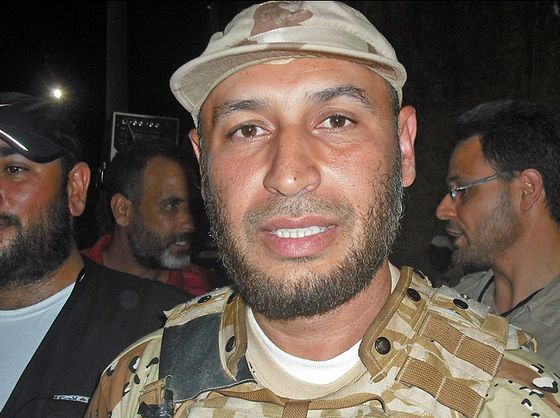
Irish-Libyan military commander Mahdi Al-Harati now leads the Liwa al-Ummah brigade in Syria.
Mary Fitzgerald, foreign affairs correspondent for the Irish Times, writes: In a dusty schoolyard somewhere in Idlib province, several hundred men form neat rows before standing to attention. “Who are we?” bellows one man at the front. “Liwa al-Ummah!” the men reply in unison, pumping their guns in the air. They look different from your average Syrian rebel fighter, typically dressed in a scruffy mismatch of military fatigues and civilian clothes. Most of these men are decked out in identical fatigues, boots, and khaki-colored T-shirts. A handful sport dazzling white T-shirts emblazoned with the Liwa al-Ummah crest: a raised fist set against the tri-starred green, white, and black flag adopted by the Syrian rebels. “Revolutionaries of Sham,” it reads, using the Arabic term for historical greater Syria, above the name Liwa al-Ummah.
Sitting in an empty classroom flanked by several Syrian and Libyan fighters, a soft-spoken Libyan-born Irish citizen named Mahdi al-Harati explains how he came to be the leader of Liwa al-Ummah. The brigade emerged, he says, after several Syrians, aware of his experience as commander of the Tripoli Brigade during the Libyan revolution, approached him about founding a similar outfit in Syria.
The Tripoli Brigade was one of the first rebel units into the Libyan capital in August 2011. Its fighters, who included many Libyan expatriates, had received training from Qatari special forces in Nalut, a town in Libya’s western mountains. After the fall of Tripoli, during which he participated in the battle for Muammar al-Qaddafi’s Bab al-Aziziya compound, Harati was appointed deputy head of the Tripoli Military Council (TMC), serving under Abdel Hakim Belhaj, former leader of the now-defunct Libyan Islamic Fighting Group. Last autumn Harati stepped down as commander of the brigade and as TMC deputy. He made his first trip to Syria shortly afterward for what he says was initially humanitarian work in the country’s northern borderlands. The idea for Liwa al-Ummah came this year.
“There was a sense of increasing frustration among the Syrian thuwar [revolutionaries] over their lack of coordination,” he says. “They asked me if I could help them train and organize, and I agreed.”
According to Harati, more than 6,000 men across Syria have joined Liwa al-Ummah since its establishment three months ago. Most are members of existing rebel battalions or groups who decided to come under the Liwa al-Ummah umbrella; others signed up as individuals.
He says the brigade is separate from the Free Syrian Army, the loosely organized grouping of military defectors and civilian volunteers whose nominal leadership is based just over the border in Turkey. Liwa al-Ummah is also in the process of developing a Syrian-led political wing, as are an increasing number of other brigades.
Recently posted YouTube videos show a number of Syrian rebel factions announcing they have joined Liwa al-Ummah. Harati stresses that Syrians make up over 90 percent of the brigade. The rest are Libyans, most of them former members of the Tripoli Brigade, along with a smattering of other Arabs. Almost all use the honorific title “Sheikh Mahdi” when referring to Harati.
“We’re here to facilitate and train civilian rebels in Syria — many of whom are doctors, engineers, and teachers — using our experience during the Libyan revolution,” Harati says. “We are a group of civilians brought together for a cause. When the Syrians have achieved their revolution, our job will be done.”
With Harati are some of his closest confidants from Ireland and Libya. Back home in Dublin, where he lives with his Irish-born wife and four children, Harati teaches Arabic and is known as an activist who is heavily involved in the Palestinian cause. He took part in the 2010 Gaza-bound flotilla, which was intercepted by Israeli commandos, resulting in the deaths of nine people. [Continue reading…]

Marsha B Cohen writes: The Protocols of the Elders of Zion is probably the most notorious work of anti-Semitic propaganda ever written. First surfacing publicly in 1905 after several years in private circulation, the work was a fabricated transcript of a secret meeting of rabbis plotting to control the world, as Gary Saul Morson explains. Its initial purpose appears to have been to blame the Jews of Russia for the radical activity that was beginning to shake the foundations of the Tsarist Russian Empire. Translated into English, French, German, Polish, Spanish and Arabic, its unfounded claim that a global Jewish conspiracy seeks to rule the world has shaped and seeped into anti-Semitic propaganda for over a century.
The Protocols of the Elder of Las Vegas, on the other hand, is a 21st century work in progress, and it is no hoax. It’s about a casino magnate with an estimated net worth of just under $25 billion (the seventh richest man in the United States) who decides to devote a small portion of his vast wealth to a neoconservative agenda determined to thwart negotiations between the Israeli government and the Palestinians; prevent the reelection of an incumbent U.S. president; engineer the destruction of political liberalism; and reshape the political environments of the U.S. and Israel by funding the election of politicians who serve his own corporate and ideological interests. Following is a rough draft of the plot line so far. [Continue reading…]
When Obama administration officials accuse Hezbollah of advising the Assad regime and the accusation is met with skepticism by Washington’s mainstream reporters, it’s pretty obvious that the U.S. has a credibility problem.
The latest U.S. attack on Hezbollah has the ring of pure political opportunism — a way of currying favor with the Israelis and of offering the Obama campaign some extra snippets of rhetoric that it can use to buttress the president’s tough-on-Iran, tough-on-terrorism posture.
The New York Times reports: The United States accused the Lebanese militant group Hezbollah on Friday of deep involvement in the Syrian government’s violent campaign to crush the uprising there, asserting that Hezbollah has trained and advised government forces inside Syria and has helped to expel opposition fighters from areas within the country.
The American accusations, which were contained in coordinated announcements by the Treasury and State Departments announcing new sanctions against Syria, also accused Hezbollah of assisting operatives of Iran’s Revolutionary Guards Quds Force in training Syrian forces inside Syria. A Treasury statement said the Hezbollah secretary general, Hassan Nasrallah, had overseen those activities, which it called part of the Syria government’s “increasingly ruthless efforts to fight against the opposition.”
The accusations, which went beyond previous American charges about Hezbollah support for Syria’s government, seemed intended to counter critics of the Obama administration who say that the White House is not doing enough to support the Syrian opposition now that diplomatic efforts to resolve the conflict are paralyzed.
Some Hezbollah experts expressed considerable skepticism, however, saying that the accusations should be approached with caution unless more evidence was presented.
The accusations were also part of an effort to further draw attention to the Hezbollah-Iran alliance, which American and Israeli intelligence officials have sought to portray as a subversive collaboration that has not only destabilized the Middle East but has been implicated in terrorist violence elsewhere, including a deadly bus bombing of Israeli tourists in Bulgaria last month.
[…]
American officials would not provide evidence for the new accusations against Hezbollah and avoided specifying whether its operatives were engaged in combat inside Syria, as some anti-Assad fighters have asserted. But the accusations appeared to open a new avenue of American pressure on Syria’s government and to be a way to embarrass Mr. Nasrallah, a powerful figure whose unwavering public support for Mr. Assad has created political strains in his home base of Lebanon.Many Lebanese support the uprising against Mr. Assad and his ruling Alawite minority, and thousands of Syrian refugees from Mr. Assad’s crackdown have fled to Lebanon.
“Hezbollah is actively providing support to the Assad regime as it carries out its bloody campaign against the Syrian people,” David. S. Cohen, the Treasury’s under secretary for terrorism and financial intelligence, told reporters in a telephone conference call. He said the designation of Hezbollah in a Treasury Department sanction makes “clear to parties around the world — both domestically and internationally — the true nature of Hezbollah’s activities.”
The State Department’s coordinator for counterterrorism, Daniel Benjamin, who also participated in the call, said, “Hezbollah’s actions in Syria underscore its fears of a Syria without the Assad regime and the impact that this would have on the group’s capabilities and its strength over the long term.”
Despite repeated questioning, neither official would provide details to support the accusations, or specific evidence of how they had reached their conclusions. “This is not a matter of idle speculation or press reports,” Mr. Benjamin said. “This is based on a great deal of information-gathering that we have done and we’ve synthesized and we’ve put it together in an authoritative document, and we believe that it will be taken seriously by many around the world.”
An American official, who spoke on condition of anonymity, said Hezbollah was using “its specialized skill set and understanding of insurgencies” to aid Syria. “The group’s deep familiarity with the Syrian landscape makes it a nimble and effective military partner,” the official said.
Hassan Nasrallah has made it clear that Hezbollah fears the collapse of the Assad regime and the loss of Syria’s indispensable support, but it doesn’t follow from that that the Lebanese organization can actually do much to save its ally.
When the Syrian Army outnumbers the Free Syrian Army by an estimate of close to five to one, it seems reasonable to ask why the regime appears to have been unwilling to use this numerical advantage so that it can clear rebels out of their strongholds, street by street? Their preference is to opt for the far more destructive tactic of first pulverizing these neighborhoods with heavy weapons, causing the kind of wanton destruction usually inflicted on enemy states (i.e. destroying cities with the callous realism that it will be someone else’s miserable task to rebuild them).
The most plausible explanation I’ve heard is not that the regular forces lack skill in urban warfare (skill that Hezbollah could supposedly enhance) but that Syrian commanders are reluctant to send their troops into positions that make it much easier for them to switch sides.
The Guardian reports: For Fatemeh, the pill she takes twice a day in her home in Iran means the difference between life and death. Earlier this summer when she contacted her friend Mohammad in the US to say she was running out of the medicine due to a shortage, the obvious thing for her fellow Iranian to do was to order it from the chemist next door and have it shipped directly to Iran. To the dismay of Fatemeh and Mohammad, the order was rejected because of US sanctions on trade with Iran.
This week, Standard Chartered bank was accused by US regulators of scheming with Iran to hide transactions, an accusation it denies. While the sanctions focus may currently be on big institutions, in the eyes of ordinary Iranians, it is they who bear the brunt.
“My friend suffers from Brugada syndrome [a heart condition] and has abnormal electrocardiogram and is at risk of sudden death,” said Mohammad, who lives in Moorhead, Minnesota. “There is one drug that is very effective in regulating the electrocardiogram, and hence preventing cardiac arrest. It is called quinidine sulfate and is manufactured in the US.”
Mohammad ultimately circumvented the problem by having the medicine ordered to his home address and sent to Iran through friends. “By the time she got the pills, her own supply was finishing within four days, what if we couldn’t send them in time? Who would be responsible if anything had happened to her?” he asked.
With the latest embargo placed on the importing of Iranian oil, sanctions are now tighter than ever. Western officials argue that sanctions are aimed at punishing the Iranian regime in the hope of forcing it to comply with international rules over its disputed nuclear programme, but many Iranians see things differently.
“Sanctions are affecting the entire country, but it is the people that bear the brunt and have the least ability to protect themselves from this pressure,” said Trita Parsi, president of the National Iranian American Council and the author of the book A Single Roll of the Dice: Obama’s Diplomacy with Iran. “What is most concerning is that it is now increasingly clear that the people are the target,” he said.
According to Parsi, those advocating the punitive measures hope that pressure on the people will translate into pressure on the government. “That works in theory – in democracies. But in a non-democracy, such as Iran, the ability for people to pressure their government is limited,” he said. “Many in Washington acknowledge that we are conducting economic warfare. That means the entire Iranian economy is the battlefield – and ordinary Iranians are [seen as] enemy combatants.”
Issandr El Amrani notes: Inside Egypt, a nascent tug-of-war over who controls policy towards the Palestinians and Israel is starting between the presidency and the intelligence services. The question of national security is still in the army’s hands, and attacks such as these can be very effective wedge issues against an Egyptian-Hamas rapprochement (see for instance the 2009 raid by Gazans on the Rafah border.) The attack has effectively ended efforts to open up the Rafah crossing (eventually towards trade of goods, not just people traffic) for some time to come.