Syria: no-fly-zone moves a step closer as Clinton assesses ‘worst case’ scenario of chemical attack

The Telegraph reports: During a visit to Syria’s neighbour, Turkey, the US secretary of state, Hillary Clinton, said that America and Turkey were creating a formal working group to provide “very intensive operational planning” for the Syria crisis.

The group will coordinate military, intelligence and political responses to the potential fallout in the case of a chemical attack, which could result in huge numbers of casualties and a further influx of refugees into Turkey.

“We have been closely coordinating over the course of this conflict, but now we need to get into the real details of such operational planning. It needs to be across both of our governments,” Mrs Clinton told a news conference on Saturday after a meeting with the Turkish foreign minister, Ahmet Davutoglu.

Asked by a reporter if such discussions included imposing a no-fly zone to protect territory controlled by rebels, Mrs Clinton indicated that it was a possible option. “The issues you posed within your question are exactly the ones the minister and I agreed need greater in-depth analysis,” she said, although she said no decisions were imminent.

Facebooktwittermail

As war widens, Palestinians in Syria are caught in the middle

McClatchy reports: Like many of the approximately half a million Palestinians who live in Syria, Abu Abed tried to avoid taking sides when the uprising against the Syrian government began last year.

“You can’t take a position against the revolution, and you can’t take a position against the regime,” he said.

But after running afoul of the government as a result of a job working with internal refugees from the fighting – he prefers that the event not be described too specifically, as it would make him easy to identify – Abu Abed fled to Beirut, the capital of next-door Lebanon, where he’s lived in ambiguous circumstances since the beginning of the year.

He doesn’t know what he’ll do. He fears that the fall of the Syrian government, which he expects to take place in the next six months, will only lead to a wider civil war as various militias vie for power in the vacuum. Lacking a Syrian passport, he’s applied for a Palestinian one, but few countries recognize the document. He tried to register for assistance or protection with the Office of the United Nations High Commissioner for Refugees, but because he’s Palestinian, he was referred to the United Nations Relief and Works Agency, which administers aid programs for Palestinians in Syria, Jordan and Lebanon.

“They said there was nothing they could do for me,” said Abu Abed, who used a pseudonym that means “father of Abed” to shield his identity.

So now he’s an illegal immigrant to Lebanon, which has been granting Palestinians no more than two-week stays. According to Syrians in Lebanon, a number of Palestinians from Syria were arrested last month and face deportation to Syria.

Syrian activists in Lebanon say that at least 200 Palestinian families have fled here. Others have attempted to flee illegally to Jordan, only to find that they’re separated from other Syrian refugees and sent to a different camp. Human Rights Watch has reported that some Palestinians attempting to flee to Jordan have been turned back.

Before the rebellion against the government of President Bashar Assad began, Palestinians in Syria enjoyed a better quality of life than Palestinians did in any other place in the Middle East. They were given most of the same rights as Syrian citizens. They couldn’t get Syrian passports, but travel documents from the government were easily obtained.

But after the unrest started last year, it wasn’t long before Palestinians were involved. Abu Abed blames Assad for encouraging Palestinians to demonstrate in the Israeli-occupied Golan Heights in May 2011.

“It was to make Israelis and the international community understand that if the regime goes, the situation will be bad for Israel,” Abu Abed said. “The regime for the first time in 60 years opened the borders.”

In June 2011, Israeli soldiers fired on Palestinian demonstrators in Golan, killing more than 30. The event turned some against the Syrian government.

“Palestinians began to feel used,” Abu Abed said.

As fighting against the Syrian government moved to Damascus last month for the first time, Yarmouk, the largest Palestinian camp in the country, became a haven for refugees as the areas around it saw heavy combat between rebel militias and government forces.

As the Syrian military pursued the militias into Yarmouk from the adjacent Damascus neighborhood of Tadamon, tensions flared. Some residents of Yarmouk said that some of the fighting was now being done by a Palestinian unit of the Syrian army that had defected last week from its deployment in southern Syria and returned to Yarmouk to protect the area.

The numbers also suggest that Palestinians are becoming increasingly involved. Activists in Yarmouk said that of the more than 200 Palestinians who’d been killed in Syria since the uprising began 17 months ago, more than half had died in the past month. Other activists put the death toll at twice that number. [Continue reading…]

Facebooktwittermail

Davutoğlu says Turkey not against Kurdish autonomy in post-Assad Syria

Today’s Zaman reports: Foreign Minister Ahmet Davutoğlu has said Turkey would not be opposed to a possible autonomous Kurdish region in Syria following the fall of Syrian President Bashar al-Assad, if all groups in the country can agree on it.

Davutoğlu’s comments came as he spoke to reporters aboard a plane carrying a Turkish delegation to Myanmar on Thursday. Stating that Turkey is not against the improvement of Kurds’ rights in Syria, the foreign minister recalled that he had met with leaders of the Syrian National Council (SNC) and the Kurdish National Council (KNC) during a visit he paid to Arbil.

“I told them, the leader of the SNC chairs the council as a Syrian Kurd. And you [KNC] are sitting here as Syrian Kurds. Sit down and come to terms. What we oppose is the threat of terrorism and the possibility of one of you claiming possession of somewhere. Elections should be held in Syria; a parliament should be formed that includes Kurds, Turkmens and Arabs. You can come together and say we will grant autonomy [to the Kurds]. This is up to you. We would not oppose that,” Davutoğlu said.

Turkey announced it strongly opposes the presence of the terrorist Kurdistan Workers’ Party (PKK) in Syria’s northern cities along the Turkish border following the withdrawal of Assad’s forces from predominantly Kurdish-populated areas to fight opposition forces in Damascus and Aleppo. Prime Minister Recep Tayyip Erdoğan earlier warned that Turkey will intervene if “terrorist formations” emerge along its border.

Facebooktwittermail

Syria’s rebel judges apply merciful Sharia justice

Piotr Zalewski reports: Imam Mohammed Drbal had just received a call from his wife. She was panicking and wanted him to come home, he explained. With shells beginning to rain down again, Drbal figured the day’s caseload would be a light one. “People didn’t sleep well because of last night’s shelling,” he said. “Because of today’s, they’ll be afraid to leave their homes.” The artillery barrage was coming from a nearby airbase, the only regime stronghold between Aleppo and the Turkish border not to be overrun by the rebel Free Syrian Army. The bombardment was unlikely to reach this part of town, according to Drbal. And if it did, he deadpanned, “We’re all here together, and in this together.” His fellow imams jiggled inside their beige thobes, struggling to contain their laughter.

Drbal and his fellow clerics comprise the tribunal that has replace the Assad regime as the law in Tal Rifaat, 20 miles north of Aleppo. Two months ago, after the authorities fled, a pair of imams who had led the town’s anti-regime protests founded a council to resolve local disputes and fill the growing security vacuum, and set up shop in a local school. “We couldn’t have double standards and competing interpretations of Islamic law,” said Drbal. “So scholars, locally respected people, decided to meet in a single council.”

Drbal and his colleagues made no bones about the fact that the post-Assad justice dispensed by their court was based on Islamic sharia law. “We are ruling on the basis of sharia,” explained Seraj al-Halabi, one of the men. “We have lawyers, judges and former army officers,” said al-Halabi, himself a veterinarian, “but all of us are Islamic scholars.” Everyone has the right to have his or her case heard by the council, he added. “We are ruling in every area of the law.”

Still, claimed al-Halabi, theirs was not an ordinary Islamic tribunal; the imams were focused as much on delivering justice as on promoting political reconciliation. “We are not here to practice Islamic law like in Saudi Arabia, cutting off heads and hands, but to help run the city and to restore order,” he said. “Sharia seeks solving problems, not creating them. And we are trying to figure out the best solution, the solution that will be most moderate and merciful.” [Continue reading…]

Facebooktwittermail

In the shadow of Assad’s bombs — ‘death has become a part of our lives’

Some of those who need to read this note and the article that follows perhaps won’t because they are still too busily absorbed in the obscenely foolish idea that Syria is being destroyed not by its own rulers but by powers outside that blood-drenched country.

For many months the world has been witness to images of wholesale destruction — cities reduced to rubble — and yet even now, there are some observers who still find it difficult to unequivocally assign blame for this violence. Assad’s tanks, artillery, bombers, and helicopters pound Aleppo and other cities with shells, bombs, and missiles, and yet there are those who regard this as a legitimate yet regrettable response to provocation and foreign meddling.

Among the ranks of the overt or implicit apologists for Assad, the award for the supreme expression of idiocy probably deserves to go to Amal Saad-Ghorayeb for what she wrote in June:

The Palestinian cause has become deeply etched in the Arab collective subconscious and has even become an increasingly pervasive slogan in western liberal activist discourse. Now the real litmus of Arab intellectuals’ and activists’ commitment to the Palestinian cause is no longer their support for Palestinian rights, but rather, their support for the Assad leadership’s struggle against the imperialist-Zionist-Arab moderate axis’ onslaught against it. [My emphasis]

If to some degree that view resonates with your own, please spare me. I have no interest in your elaboration or in engaging in what would undoubtedly be a fruitless debate. There are other venues where such discussions take place.

That’s it for my little rant. Now read this. It’s a first-hand account by a writer who has an intimate knowledge of Syria because she comes from a prominent Alawite family who — except for her — have remained resolutely loyal supporters of President Bashar al Assad.

Samar Yazbek writes:

It was not yet 5 on Tuesday morning. I was lying on one side of the bed and the two little girls I was watching were on the other. None of us had slept a wink. Snipers’ gunfire rang out from time to time; bombs were crashing all around us. The girls’ frightened mother entered the room. “The bombing is getting worse,” she said.

We ran out, heading downstairs. Women and children and some men had gathered in the shelter. The children were now capable of distinguishing between the sound of bombs and gunfire, between distant and nearby shelling, and they could discern the direction from which it was all coming.

Ever since we had entered the country, running across the border late Sunday night, four young men had gone out of their way to protect me. They cut a hole in the barbed wire fence so that I could scramble through. A bomb fell very close to us as we sped away. Bombs were falling the whole way as the car zoomed along. As we passed through the town of Atarib in the dark, I understood what “extermination” meant. Atarib was a completely decimated city: the streets were cratered by bombs, doors were scorched, houses demolished, streets empty. At night not even the howling of dogs could be heard. It was a ghost town. No life whatsoever. Here and there, on one street or another, lay the charred remains of a government tank.

We should have gone to sleep after our long journey across the border from Turkey. We were exhausted. But in Saraqib, my host’s family had stayed up waiting for us, so we sat together into the wee hours of Monday morning as they told me about their neighbors who had been killed, about the young men who had been summarily executed in the town square.

Saraqib was one of the first towns to come out against the regime. The punishment was severe — siege, bombing, arrests and killing. Now it has five groups of Free Syrian Army battalions to protect it. Still, there are government snipers in the middle of town, with their headquarters inside the state radio and television building. There are nine in all; each works a four-hour shift in the building, which is protected by a tank that shells the town from time to time. Once, when the F.S.A. managed to take out a sniper, the government’s army responded by strafing the town with bombs. The townspeople say the snipers hunt people down and kill them at random.

A few days ago a sniper shot a 4-year-old girl, Diana, wounding her in the back, paralyzing her permanently. She was so small and frail that I couldn’t believe her body wasn’t totally pulverized by the impact of the bullet.

On Monday night, we went to meet a group of Free Syrian Army fighters in the town of Binnish. The oldest one was no more than 35. All were full of vitality and optimism, but also exhaustion. I shook hands with every man, except for one, who placed his hand on his heart and bowed respectfully.

They weren’t Islamic fundamentalists. I’ve encountered very few Islamist groups and have not observed any connection to Al Qaeda or Salafism, a movement based on a rigid, austere interpretation of Islam. The young men there told me that a few Salafi jihadis had started to appear recently, but that they did not constitute a significant number.

As we were sitting out on the balcony overlooking an olive orchard, the bombs started falling all around us. Nearby, the town of Taftanaz was being shelled; we could see it from the balcony. I asked the head of the division, who’d prepared dinner for us, “Aren’t you afraid that a bomb might fall on your heads right now?” He replied: “We aren’t afraid. Death has become a part of our lives.”

As we dined, the main topic of discussion was Aleppo, Syria’s most populous city. A number of the young men present were from the besieged neighborhood of Salaheddin and were getting ready to return. They refused to let me go with them for fear of the looming battle.

Samar Yazbek

I was the only woman among them, and the young F.S.A. men treated me like part of the group. During that meeting it became clear that it’s a mistake to consider the F.S.A. as a single bloc. It is a hodgepodge of battalions, including secularists, moderate Islamists and all-too-ordinary people who joined up to defend their lives and their families.

At the end of our journey back to Saraqib, the commander told me, “We are one people, we and the Alawites are brothers. We had never thought about the sort of things that the regime is trying to stir up.”

I was silent for a moment, until I realized what he was telling me, the daughter of a well-known Alawite family that supports President Bashar al-Assad unconditionally. Some of my relatives have publicly disowned me for turning my back on the regime as many others have, announcing on Facebook that I am no longer considered one of them.

I squeezed the commander’s hand. [Continue reading…]

Facebooktwittermail

Israeli defense minister pushing for war against Iran

Noam Sheizaf writes: The top stories in all Israeli dailies this weekend discuss a coming strike on Iran’s nuclear facilities. Thirty-seven percent of Israelis think President Obama would stop Iran from developing a bomb, while only 29 percent doubt it.

The front page headlines in all major daily papers in Israel deal with the increased likelihood of a war with Iran.

Yedioth Aharonoth has an important expose: the paper’s diplomatic correspondents, Nahum Barnea and Shimon Shifer, report that Defense Minister Ehud Barak has gathered senior army generals twice (the latest meeting took place at Mossad headquarters) in order to obtain their support for a military strike on Iran’s nuclear facilities. He met fierce opposition on both occasions; the army is very reluctant to carry out the attack in the absence of American support, it seems. “Not a single security chief supports the attack,” Barnea and Shiffer write. Yedioth’s headline declares: “Barak and Natanyahu are determined to strike Iran in the autumn.”

The pro-Netanyahu tabloid Israel Hayom claims that “Iran has speed up its effort to gain a bomb.”

Maariv has a poll according to which 37 percent of the public think that an Iranian bomb would mean “a second Holocaust.” Forty percent of the Jewish public – that’s 33 percent of the population – believes that Israel should strike the Iranian nuclear facilities on its own. Forty-one percent think that Israeli should leave the mission of stopping Iran to the United States and the international community.

More Israelis (37 percent) believe that president Obama will prevent Iran from getting a nuclear bomb than those who think he won’t keep his promise (29) percent.

Haaretz cites a senior Israeli official speaking in favor of an Israeli attack on Iran (“Iran nuclear threat bigger than one Israel faced before Six Day War”). It’s not hard to figure out that the official is Defense Minister Ehud Barak. [Continue reading…]

Facebooktwittermail

U.S. still believes Iran not on verge of nuclear weapon

Reuters reports: The United States still believes that Iran is not on the verge of having a nuclear weapon and that Tehran has not made a decision to pursue one, U.S. officials said on Thursday.

Their comments came after Israeli media reports claimed U.S. President Barack Obama had received a new National Intelligence Estimate saying Iran had made significant and surprising progress toward military nuclear capability.

Later, Israeli Defense Minister Ehud Barak suggested that the new U.S. report, which he acknowledged might be something other than a National Intelligence Estimate, “transforms the Iranian situation into an even more urgent one.”

But a White House National Security Council spokesman disputed the Israeli reports, saying the U.S. intelligence assessment of Iran’s nuclear activities had not changed since intelligence officials delivered testimony to Congress on the issue earlier this year.

“We believe that there is time and space to continue to pursue a diplomatic path, backed by growing international pressure on the Iranian government,” the spokesman said. “We continue to assess that Iran is not on the verge of achieving a nuclear weapon.”

U.S. officials would not directly comment on whether there was a new National Intelligence Estimate on Iran, which is a compilation of views of the various U.S. intelligence agencies.

Facebooktwittermail

Northern enclave gives Syrian rebels governance

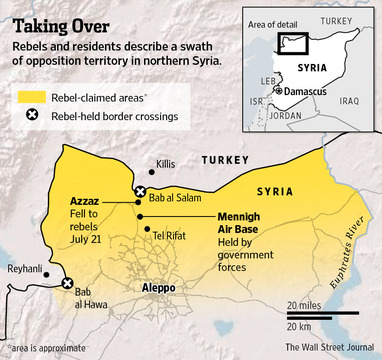
The Wall Street Journal reports: Opposition fighters locked in battle for Syria’s largest city, Aleppo, have a new resource: Rebels now control a swath of territory to their north, including two border crossings with Turkey.

The opposition hopes its first substantial enclave of the 17-month uprising, seized from the government in the past few weeks, will transform a fight that for months has seen no clear victor. A similar enclave allowed Libyan rebels to sustain their fight in Libya last year.

Already, the Syrian enclave has made it easier for rebels to bring fighters, weapons, food, fuel and other logistic needs to Aleppo.
The battle for Syria’s commercial capital could be pivotal. A rebel victory there would deal an unprecedented blow to President Bashar al-Assad’s rule; regime dominance there could free Mr. Assad’s troops to try to regain the north.

Thursday’s fighting in Aleppo brought the latest shift in the unresolved battle: A government offensive drove rebel militias from the southern neighborhood of Salaheddin, amid heavy army shelling of several other neighborhoods on the outskirts of the city of 2.2 million, according to rebel fighters and residents.

Rebels, who had held Salaheddin for more than a week, gave conflicting reports of whether they staged a strategic retreat or were overrun by the ferocity of the government attack.

Mr. Assad’s security forces lost control of the sweep of countryside north of Aleppo in late July, fleeing an offensive by rebel groups from across the rural north. Since then, local village committees that steered the uprising have shifted gears, transforming themselves into interim village governments. Rebel checkpoints now dot the winding single-lane roads between the region’s farming villages and towns.

Except for a lone air base where loyalist soldiers are hunkered down and mostly surrounded by rebel fighters, the countryside stretching from Aleppo to the Turkish border about 30 miles away has been cleared of government forces.

The Syrian border town of Azzaz, to Aleppo’s north, fell to rebel fighters on July 21, and much of the rest of the countryside north of Aleppo fell within days, rebels said. About a week ago, rebel fighters-turned-bureaucrats took up posts at a pair of border crossings with Turkey, one near Azzaz and the other west of Aleppo. Crisply dressed rebels check passports of new arrivals, enter names into computers and extend a welcome hand to “Free Syria.”

Samir Haj Omar, an economist who now heads the local 30-member political council in Azzaz, said Turkish officials have been more willing to deal with him and other rebel leaders now that they are de facto governors.

He has used that newfound heft to convince Turkey to allow cargo trucks to cross the border. On Wednesday, the first new shipments of rice, flour and gasoline arrived in rebel-controlled northern Syria, according to local officials here.

Throughout the north, a region where many civilians had fled or remained locked in their houses to avoid the regime’s crackdown on protests, people now fill village streets. Shops have reopened in recent days for the first time in four months. In the village of Maraa, children flocked to a reopened public swimming pool to cool off on Thursday. Abandoned Syrian Army tanks have been converted to makeshift playgrounds.

For fighters desperately trying to keep up supplies of food, fuel and weapons, the ability to freely cross the Turkish border and move between villages without fear of encountering regime forces is a dramatic change.

Earlier in the conflict, supplies were ferried across the Turkish border by horse, or on foot, by smugglers traversing muddy trails while dodging Turkish and Syrian border guards. A local fighter in Azzaz who said he helped smuggle in local rebels’ first rocket propelled grenades earlier this year said it took them weeks to negotiate the treacherous route through regime-controlled territory for just two RPGs.

Now, such supply shipments can make the run from the Turkish border to the front line in Aleppo in about 90 minutes.

Facebooktwittermail

Assad ally Michel Samaha questioned over alleged plans to cause instability in Lebanon

The Daily Star reports: Hezbollah will not remain silent over the arrest of former Information Minister Michel Samaha on terrorist suspicions, Hezbollah MP Mohammad Raad said Thursday, accusing members of the judiciary of collaborating with “suspicious” security forces against the pro-Syrian ex-official.

“We have long experienced these security fabrications and some judges are connected to suspicious security services,” said Raad, in the party’s first response to the arrest of Samaha.

A pro-Syrian regime official, Samaha was arrested by the Internal Security Forces Information Branch Thursday on suspicion of being involved in a plot to carry out terrorist attacks in Lebanon in collaboration with the Syrian regime.

Samaha – a longtime ally of the Syrian regime, two-time minister and former MP – was taken from his summer residence in Metn’s Khanshara-Juwar Thursday morning to ISF headquarters in Beirut for questioning.

Another police unit stormed his residence in Beirut’s Ashrafieh.

The operations were carried out upon the orders of acting-State Prosecutor Samir Hammoud.

Hammoud told The Daily Star Samaha’s case was part of a wider probe into security threats facing the country.

“There is an ongoing security investigation that has not finished yet and I am personally overseeing it,” said Hammoud, who met with Samaha later Thursday.Samaha’s personal staff, including his driver Fares Barakat, his secretary Gladys Awada and his personal bodyguard Ali Mallah, were also detained and taken in for questioning.

Security sources said Samaha admitted that he was involved in a plot to carry out bomb attacks in Lebanon and that he had personally transferred a number of explosives from Syria into Lebanon.

Facebooktwittermail

Libya celebrates handover of power to elected assembly

Foreign Policy reports: In a ceremony in Tripoli, Libya’s National Transitional Council (NTC) handed over power to the newly elected 200-member general national congress in the first peaceful transfer of power in Libya’s modern history. The NTC took the reins 10 months ago after the ouster and death of Muammar al-Qaddafi. The body has now been dissolved. NTC head Mustafa Abdul Jalil acknowledged the NTC’s inability to restore security in Libya, as fighting continues between militia groups, but noted that the body ruled in “exceptional times.” Violence has particularly increased over the past week, including a car bomb near the military police offices in Tripoli, an explosion at the empty former military intelligence offices in Benghazi, and an attack on a Red Cross compound. Of the 200 seats in the congress, 120 are held by independents, while 39 of the 80 seats available to parties went to wartime opposition Prime Minister Mahmoud Jabrili’s National Forces Alliance. The political wing of the Muslim Brotherhood, the Justice and Building Party, has 17 seats. The new assembly held its first meeting directly after the ceremony. Its first task is to select a prime minister, who will appoint a cabinet. The congress will have legislative powers, but it is uncertain if it will choose a 60-member panel that will draft a new constitution, or if the panel will be directly elected.

Sarah Elmesallati

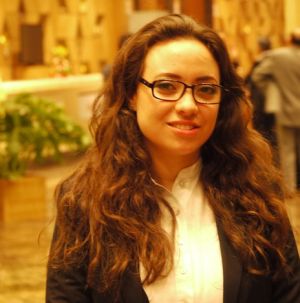
Libya Herald reports: A fierce row broke out in the National Congress this morning, Thursday, after one congressman walked out of the handover ceremony because the young woman hosting the event was not wearing a headscarf.

The controversy deepened further when Mustafa Abdul Jalil, in one of his final acts as NTC Chairman, ordered Sarah Elmesallati to leave the stage midway through her presentation.

“I had finished the welcoming section of my presentation, and as I was walking back onto the stage to announce the national anthem someone emerged from the middle of where the congressmen were sitting and said: “Cover your head! Cover your head!”, Elmesallati told the Libya Herald.

When Elmesallati ignored his demand, Salah Baadi, an independent congressman from Misrata and prominent Islamist, walked out of the handover ceremony in protest.

“After that, an assistant of Jalil came up to me and said ‘please, I’m asking you as a daughter, can you please stop’. I begged him to let me continue, but when I walked back on stage, Jalil caught my eye, pointed at me, and signalled for me to go away, so I did”.

In what would appear to have been an indirect reference to the event, Jalil then used his speech to emphasise the importance of freedom of expression in Libya whilst respecting its Muslim traditions.

The remainder of the ceremony was hosted by a young man, whose presentation passed off without incident.

The spat provoked a fierce reaction amongst both congressmen and others in attendance at the event, as well as a debate about the appropriate extent of freedom of expression in the new Libya.

“Everybody around me condemned this behavior”, said Mukhtar Al-Atrash, an independent candidate from Khoms, in reference to Baadi’s protest. “But you cannot control people. This is a personal taste; it’s an ugly taste, but a personal one.

“I don’t condemn Jalil, however. I think he did this to keep things in order. He didn’t want the disruption”.

Others were less sympathetic to the actions of the NTC chairman. “That’s yet another historic occasion he’s managed to ruin”, said Huda Abu Zaid, a freelance Libyan journalist living in Tripoli. “We were all furious”.

Elmesallati said she was shocked by the incident, but insisted that she would not hold it against Jalil. “He did a lot for this country so I have to forgive him for this; that’s why.

“As for the congressman, I want to speak to him personally about this if I get the chance”.

Facebooktwittermail

Israeli defense minister publicly divulges U.S. intelligence report

Laura Rozen reports: Israel’s Defense Minister raised some eyebrows in the United States when he told Israel Radio Thursday that a new, previously undisclosed U.S. intelligence assessment shares Israel’s sense of heightened urgency about Iran’s nuclear program.

Ehud Barak told Israel Radio that there is “apparently a report by American intelligence agencies – I don’t know if it’s under the title NIE or under another title – which is making the rounds of high offices,” in Washington, CBS News reported.

“As far as we know, it comes very close to our own estimate, I would say, as opposed to earlier American estimates,” Barak continued. “It transforms the Iranian situation to an even more urgent one and it is even less likely that we will know every development in time on the Iranian nuclear program.”

Generally, foreign leaders don’t publicly disclose allied nations’ classified intelligence reports in such a provocative manner, intelligence experts said.

“The rules of the spy game are clear,” former US Navy intelligence analyst John Schindler wrote on his blog. “When intelligence services share information, as they do every day, you don’t pass it to third parties without clearance. Ever. And if you do, eventually you will get burned and nobody will want to play marbles with you.”

A cavalcade of top American officials have traveled to Israel in recent weeks to confer on Iran, and President Obama this month signed a $70 million US military aid package for Israel. Israeli officials have expressed growing impatience with US reluctance to endorse military action on Iran at this time.

Facebooktwittermail

Palestinian Authority says it has asked Swiss expert to examine Yasser Arafat’s remains

The Associated Press reports: Swiss experts have been invited to the West Bank to test Yasser Arafat’s remains for possible poisoning, the chief investigator looking into the 2004 death of the Palestinian leader said Wednesday.

The announcement followed weeks of zigzagging on the autopsy issue by officials in the Palestinian Authority, the self-rule government that Arafat established. Their conflicting positions and hesitation triggered speculation they were trying to quietly kill the investigation.

Last month, Switzerland’s Institute of Radiation Physics said it had detected elevated levels of radioactive polonium-210 on stains on Arafat’s clothing, reviving longstanding rumors in the Arab world that the Palestinian leader was poisoned.

However, the lab said the findings were inconclusive and that only exhuming Arafat’s remains could bring possible clarity. Lab officials also said polonium decays quickly and that an autopsy would need to be done within a few months at most. They also said they needed a formal invitation to proceed with testing.
[…]
Tawfik Tirawi, the chief Palestinian official investigating Arafat’s death said the Palestinians asked the Swiss lab for help. The lab confirmed that.

“We are currently studying how to adequately respond to this demand,” Darcy Christen, a spokesman for the Swiss institute, said Wednesday. “Meanwhile, our main concern is to guarantee the independence, the credibility and the transparency of any possible involvement on our side,” she said.

Facebooktwittermail

Algerian Lakhdar Brahimi ‘to be new UN Syria envoy’

BBC News reports: Veteran Algerian diplomat Lakhdar Brahimi is expected to be appointed as the new UN-Arab League envoy for Syria, according to diplomats.

If confirmed, he would succeed former UN Secretary-General Kofi Annan, who resigned last week saying he could no longer carry out the role.

A six-point peace plan proposed by Mr Annan failed to come into effect, and violence has escalated.

Rebels lost of a key area of Aleppo on Thursday after weeks of fighting.

The rebel Free Syrian Army (FSA) confirmed it had retreated from the strategic Salah al-Din district in the face of a large-scale government offensive launched the previous day.

Facebooktwittermail

An Iranian view of Syria

Ali Akbar Salehi, Iran’s foreign minister, writes: We humans often make the mistake of not learning from history, even when it is recent. Civil war in the Levant is not a thing of the distant past. With Syria descending into worsening violence, the 15-year Lebanese civil war should provide frightening lessons of what happens when the fabric of a society unravels.

When the Islamic Awakening — also known as the Arab Spring — began in December 2010, we all saw people rising up to claim their rights. We have witnessed the emergence of civic movements demanding freedom, democracy, dignity and self-determination.

We in Tehran have watched these developments with delight. After all, a civic movement demanding the same things that many Arabs want today is what led to the emergence of…

… the Green Movement and mass protests across Iran following presidential elections in June 2009 whose outcome appeared to have been rigged.

Even if the protests were eventually crushed, most of the movement’s leaders imprisoned and many tortured, the popular uprising which drew support from all quarters of Iranian society was at that time one of the most impressive demonstrations of people power that the region had ever experienced. While it’s influence might not often be cited in what has been labelled an ‘Arab’ spring, ordinary Iranians surely served as inspiring role models who made it clear that democracy is never a gift from enlightened or benign rulers — it is a demand which eventually cannot be refused.

Oh, and just to make it clear to readers who didn’t follow the link to the rest of Salehi’s commentary: he was not doing the political unthinkable for someone in his position — praising the 2009 protests; he was presenting the 1979 Islamic revolution as a precursor to the Arab Spring. That, in and of itself, does not reveal Iranian hypocrisy. It is in the following three sentences that Assad-backing Iran loses any credibility:

During the past three decades, Iran has consistently underlined that it is the duty of all governments to respect their people’s demands. We have maintained this position as the Islamic Awakening has unfolded, without any lopsided shifts depending on the location of these civic movements. We have been in favor of change to meet people’s demands, whether in Syria or Egypt or anywhere else.

Really? So has the only mistake made by Syrians been that they failed to rely on the appropriate channels for pressing their demands? Any what of the Iranian government’s duty to respect their own people’s demands?

What the last 30 years reveal is how easy it is for revolutionaries to turn into counter-revolutionaries.

Facebooktwittermail

For the record, Russia and China failed Syria

Ian Black writes: Kofi Annan has just three weeks left to serve out his time as the UN envoy for Syria. Understandably disappointed at the failure of what others had called “mission impossible” – a description he came to agree with – he lamented two aspects of the crisis: its increasing militarisation and the disunity of the security council. Earlier, in a Guardian interview, he had deplored the “destructive competition” of the five big powers who still sit round the world’s “top table” on New York’s East river.

It bears repeating that Syria is first of all a human tragedy, with thousands of dead and many thousands more lives ruined in the bloodiest chapter of what in happier or more naive times and circumstances was called the Arab spring. Feelings are running high. For some, however, principled objections to western policy clearly weigh more heavily than the suffering of the Syrian people at the hands of a government that used deadly force from the moment protests erupted in Deraa in March 2011.

It is a moot point whether diplomacy could ever have succeeded in ending the carnage. Syria, it has been wisely observed, is where the Arab uprisings met the cold war and the Sunni-Shia divide. Regional and international rivalries worsened by the Libyan crisis last year, sectarian incitement and a fight to the death for regime survival all make for a toxic mixture.

For most elements of Syria’s fractured opposition, Assad’s acceptance of Annan’s six-point peace plan was only ever a way to buy time, exploit divisions and carry on killing. The regime barely observed a ceasefire that notionally began in April or implemented any of the plan’s other five conditions. The armed opposition accepted it but carried on fighting even as mass peaceful protests continued.

Yet the cartoon book claim that “the west” (conspiring with compliant Arabs) has malevolently blocked an agreement that a principled Russia tirelessly supported does not stand up to scrutiny. (Nor does the closely related and deeply patronising notion that Syrians who are prepared to risk all for freedoms others take for granted are mere puppets in the hands of others.) [Continue reading…]

To focus on Black’s last point, it’s worth underlining the blatant hypocrisy of those who acknowledge the legitimacy of armed resistance when the injustice being challenged is Zionism, yet view armed resistance to the Assad regime as inherently suspect.

Syrians supposedly have the right to peacefully demonstrate yet anyone who picks up a gun suddenly becomes an instrument of imperialism. Indeed, few with this twisted perspective will even acknowledge that it is possible for an individual to make the transition from marching to fighting without having been corrupted in the process. Moreover, protesters and fighters are very often referred to as though they are mutually exclusive categories. Most perplexing is when these anti-resistance voices are raised in the United States.

It makes me wonder: would the proponents of this anti-revolutionary view, had they been alive at that time, have raised similar objections to the American Revolution — that it lost its legitimacy when the revolutionaries took up arms and accepted support from imperial powers?

Facebooktwittermail

Syria rebels claim upper hand as battle for Aleppo grinds towards stalemate

Martin Chulov reports from Aleppo: All the might that the forces loyal to Bashar al-Assad can muster is now camped just over a large bank of land to the east of Salahedin, the suburb of Aleppo that has become the focal point of the conflict. All the men the guerrilla force can assemble are holed up in crumbling buildings, the closest of them only 200m from the nearest regime tank.

Yet the decisive battle that most in Aleppo seemed to have feared is slowly giving way to another – even more dreaded – reality. Stalemate, with neither side willing or able to advance. A new sense is beginning to settle in that neither Salahedin, nor the rest of Syria’s second city, will see an end to the fighting any time soon.

Despite its superior numbers and weaponry, the army appears in no hurry to bring the uprising here to an end. The siege that has crippled the city is likely to get far worse.

“This will be a second Baba Amr,” said Sheikh Salim al-Hoss, as he rested under a mulberry tree in a commandeered schoolyard just outside Aleppo. “They are going to wear us down. They think they have time on their side.”

Hoss was sitting with members of a military council, who were all breaking their daily Ramadan fast on Tuesday night, largely in silence. Snipers had killed two young rebels from their unit in the late afternoon and the rush to bury them before sunset seemed to have numbed the men.

The effect on one of the dead men’s fathers was more profound. He stood trembling and bewildered later in the evening as he received condolences in a hastily erected mourning tent. A tear ran down his face as lines of wellwishers reached for his hand.

Just before noon he had spoken to his 24-year-old son, Ala’a Tamur, by phone in between battles on Salahedin’s main frontline. Just before dinner he buried him.

“Be proud you have a martyr, uncle,” one of the men’s colleagues told the boy’s bereft father. The 73-year-old stared and nodded.

Street 15 in Salahedin now resembles Leningrad in its darkest days, and the suburb itself is in far worse shape than when the Guardian last visited on Saturday. Most streets on the eastern side are now impassable by car. Broken sewage and water pipes and food leftovers have formed a festering stew over the few surfaces that aren’t littered with the flotsam and jetsam of war. And Salahedin has a new arrival – flies, which swarm around anything organic. They are so thick in some parts that rebels look for detours to avoid them. As they do they need to avoid trampling on the only other thing that seems to be living at ground zero of the battle for Syria – kittens.

Rebels have taken in many of them, and it’s not uncommon to find a gnarled, sweaty guerrilla sleeping on the floor of a commandeered flat with an abandoned kitten asleep on his chest.

Two men sleeping in what passes for a first aid clinic in one part of Salahedin had to throw their new pets aside late on Wednesday, when a wounded rebel appeared like a ghost in their darkened doorway. He fell on a foam mattress clutching his left side. “A sniper, haram,” he said. “I was going to meet the defector.”

“Press hard [on the wound], press until it hurts,” one bystander said. The men instead offered caresses and comforting words, then bundled him into the back of a 4×4, which rushed him away.

Snipers continue to filter into Salahedin despite the almost impossible journey to get here. “We had four in this quarter alone today,” said a rebel from Damascus, who himself defected three months ago. “There would be many more if they could find a way.”

Recent senior defectors, among them two colonels from Aleppo who made their way to a nearby town on Tuesday, claimed that the fear of large numbers of defections if a ground attack was launched was shaping regime tactics.

“If they send the army in, they will throw off their clothes and leave,” one of the men said. They want to sit back and bomb, just like they did in Homs.”

The defectors also claimed that jets would bomb Aleppo and the eastern hinterland between 3am and 5am. On cue, the jets arrived. The fulfilled prediction means the two officers will now be asked to help devise tactics to repel the assault.

Whoever can prevail in a war of attrition will prevail in Aleppo and likely in the overall uprising. Though battle-weary and at times despairing, and still underprepared, the rebel forces appear to have the stamina to see the fight to a conclusion.

Facebooktwittermail