CNN reports: There is no guarantee that a sweeping new international agreement on Syria will succeed in ending the conflict there, U.S. Secretary of State Hillary Clinton conceded, as opposition activists said the number of dead had skyrocketed in recent months.
“There is no guarantee that we are going to be successful. I just hate to say that,” Clinton told CNN.
But she expressed optimism that a new agreement hammered out Saturday would help ease President Bashar al-Assad out of power.
The first plan backed by Russia and China as well as the West, it calls for a transitional government as a step towards ending the 16-month uprising.
Opposition activists immediately criticized the deal as leaving open the possibility that al-Assad would remain in power.
“The new agreement provides vague language which is open to interpretation,” the opposition Local Coordination Committees of Syria said in a statement Sunday. “This provides yet another opportunity for the regime’s thugs to play their favorite game in utilizing time in order to stop the popular Syrian Revolution and extinguish it with violence and massacres across Syria.”
Syrian rebel fighters boycott opposition’s push for a united front
AFP reports: Syrian rebel fighters and activists said they would boycott an opposition meeting in Cairo overnight, denouncing it as a “conspiracy” that served the policy goals of Damascus allies Moscow and Tehran.
The two-day meeting, organised by the main exiled opposition bloc, the Syrian National Council, and other smaller groups, was intended to forge a united front for a political transition in Syria and was held as government troops kept up their bombardment of rebel forces in the city of Homs.
“We refuse all kinds of dialogue and negotiation with the killers . . . and we will not allow anyone to impose on Syria and its people the Russian and Iranian agendas,” said a statement signed by the rebel Free Syrian Army and “independent” activists.
The signatories attacked the Cairo talks for “rejecting the idea of foreign military intervention to save the people . . . and ignoring the question of buffer zones protected by the international community, humanitarian corridors, an air embargo on Syria and the arming of rebel fighters”.
The Cairo talks come after world powers meeting in Geneva at the weekend agreed on proposals to transition from the government of President Bashar al-Assad, but the plan was branded a failure by both the rebels and the Syrian state media.
The boycotters claimed the Cairo talks follow the “dangerous decisions of the Geneva conference, which aim to safeguard the regime, to create a dialogue with it and to form a unity government with the assassins of our children”.
“The Cairo conference aims to give a new chance to UN-Arab League envoy Kofi Annan to try again to convince Assad to implement his six-point plan . . . while forgetting that thousands have been martyred since the plan came into force,” they said.
More than 15,800 people have been killed since the uprising against the Assad regime began in March last year at the height of the Arab Spring rebellions across the Middle East and North Africa.
Of these, nearly 4700 have died since the ceasefire brokered by Mr Annan was supposed to have taken effect on April 12, according to the British-based Syrian Observatory for Human Rights.
The Libor scandal and the price of prosperity
Umair Haque writes: To the long, dismal list of fatally broken institutions — GDP, governments, schools, corporations — we can add the mysterious Libor, and its conveniently comfortable calculation. It’s difficult to overstate what a pillar of the global economy Libor is — it’s used in setting interest rates that affect the daily lives of pretty much every citizen of every advanced economy across the globe. And it’s difficult to overstate how troubling it is that this, too, is an institution rigged by the few, for the few; that this institution too, is, corrupted.
This scandal isn’t about price-fixing. It’s not about a bank. It’s not even about power and privilege, corruption and compromise. It’s about life, tragedy, and human potential. It’s about the capacity to create a worthwhile future. It is, in short, about you and I, and the places we seek for ourselves in the world.
Let me couch this for you in the pedestrian terms of financial hydraulics — the tawdry terms which seem to substitute for thinking in what’s become of our thin, shallow economic and political discourse. The most basic function of a financial system is to price money. If a financial system can’t undertake that simple task effectively — if the price of money is fixed like a roulette wheel stuck on red — all else must necessarily fail: investment must become malinvestment, speculation must precede creation, “profit” must become divorced from benefit, and wealth is effectively transferred from poor to rich, in a form of quiet but lethally effective institutionalized theft.
Now, let me couch this for you in the human terms of political economy — the terms in which you and I should rightly conceive of an “economy” as the sum of the enduring human good; not merely as a set of pipes for the grease of finance to be injected into.
Who authors the destiny of nations? Which compact governs the relations between the powerless and the privileged? Whose rights are sacrosanct? How are fortunes earned — and spent? What does “wealth” mean? If money is in a basic sense a currency in which the fruits of enterprise past are safely kept, to seed the soil of prosperity tomorrow — and if the value of that money itself is corrupted — can one be said to be a participant in “an economy”? Or is one more a pawn in a rigged game of self-destruction; a mark in a Ponzi scheme; a dull-eyed pack animal to which the engines of extraction are yoked? Does “freedom” — in the most primitive sense, autonomy from the circumscription of one’s own inalienable rights, those basic liberties which don’t just accrue to us, but inhere in us — still allow one freedom? Who’s who — master and servant, mechanism and operator, principal and agent, sovereign and serf?
These are the terms of the debate we’re not having. These are the words that are left unsaid. These are the concepts and ideas on which prosperity itself was built. These are the unspoken phrases that flit like ghosts through what’s left stammeringly unspoken by the finely-suited pundits and so-called “leaders” too cowering and afraid, too tempted and silenced, too timid and too petrified to challenge the primacy of a system that’s leaving millions to choke on the fumes of the collapse of their own futures. [Continue reading…]
Massive furor in UK over Libor manipulation; where’s the outrage here?
Yves Smith writes: In case it isn’t yet apparent to you, the unfolding scandal over manipulation of Libor and its Euro counterpart Euribor is a huge deal. Even though at this point, only Barclays [the fourth largest bank in the world], the UK bank that was first to settle, is in the hot lights, at least 16 other major financial players, which means pretty much everybody, is implicated.
First, Libor is the basis for pricing over $10 trillion of loans. As the CTFC noted:
US dollar Libor is the basis for the settlement of the three-month Eurodollar futures contract traded on the Chicago Mercantile Exchange, which had a traded volume in 2011 with a notional value exceeding $564 trillion.
The Wall Street Journal puts total in contracts affected at $800 trillion.
Second is that price fixing is a criminal violation under the Sherman antitrust act. The Department of Justice stressed that Barclays had been the first bank to cooperate with the investigation and had been extremely forthcoming, and for that reason it would not be prosecuted if it complied with the settlement terms for two years. The implication is that the DoJ will not be as generous with other banks involved in the price-fixing scheme. This is an overview from the Financial Times of Barclay’s misdeeds:
The bank admitted that it lowballed estimates of its borrowing costs from late 2007 to May 2009 because it wanted to reassure investors of its strength during the financial crisis and it believed other banks were doing the same. It also admitted that its traders improperly influenced the rate submissions from 2005 to 2008 to make money on derivatives.
Note that, according to Barclays, there were two scandals: one is the usual “rogue traders” sort, which took place from 2005 to 2007 (funny how these CEOs take credit for overall performance for bonus purposes and blame inadequately supervised lower level employees whenever real trouble arises?); the second, as we will discuss, is that Barclays submitted lower rates for the daily Libor “fixing” than its actual funding costs to make itself look healthier than it was during the crisis. [Continue reading…]
Will Hutton writes: Investment banking is an organised scam masquerading as a business. It is defined by endemic conflicts of interest, systemic amoral behaviour and extreme avarice. Many of its senior figures should be serving prison sentences or disgraced – and would have been if British regulators had been weaned off the doctrine of ” light touch” regulation earlier and if the Serious Fraud Office’s budget had not been emasculated by Mr Osborne. It is a tax on wealth generation and an enemy of honest endeavour – the beast that is devouring British capitalism.
The scam Wall Street learned from the mafia
Matt Taibbi writes: Someday, it will go down in history as the first trial of the modern American mafia. Of course, you won’t hear the recent financial corruption case, United States of America v. Carollo, Goldberg and Grimm, called anything like that. If you heard about it at all, you’re probably either in the municipal bond business or married to an antitrust lawyer. Even then, all you probably heard was that a threesome of bit players on Wall Street got convicted of obscure antitrust violations in one of the most inscrutable, jargon-packed legal snoozefests since the government’s massive case against Microsoft in the Nineties – not exactly the thrilling courtroom drama offered by the famed trials of old-school mobsters like Al Capone or Anthony “Tony Ducks” Corallo.
But this just-completed trial in downtown New York against three faceless financial executives really was historic. Over 10 years in the making, the case allowed federal prosecutors to make public for the first time the astonishing inner workings of the reigning American crime syndicate, which now operates not out of Little Italy and Las Vegas, but out of Wall Street.
The defendants in the case – Dominick Carollo, Steven Goldberg and Peter Grimm – worked for GE Capital, the finance arm of General Electric. Along with virtually every major bank and finance company on Wall Street – not just GE, but J.P. Morgan Chase, Bank of America, UBS, Lehman Brothers, Bear Stearns, Wachovia and more – these three Wall Street wiseguys spent the past decade taking part in a breathtakingly broad scheme to skim billions of dollars from the coffers of cities and small towns across America. The banks achieved this gigantic rip-off by secretly colluding to rig the public bids on municipal bonds, a business worth $3.7 trillion. By conspiring to lower the interest rates that towns earn on these investments, the banks systematically stole from schools, hospitals, libraries and nursing homes – from “virtually every state, district and territory in the United States,” according to one settlement. And they did it so cleverly that the victims never even knew they were being cheated. No thumbs were broken, and nobody ended up in a landfill in New Jersey, but money disappeared, lots and lots of it, and its manner of disappearance had a familiar name: organized crime.
In fact, stripped of all the camouflaging financial verbiage, the crimes the defendants and their co-conspirators committed were virtually indistinguishable from the kind of thuggery practiced for decades by the Mafia, which has long made manipulation of public bids for things like garbage collection and construction contracts a cornerstone of its business. What’s more, in the manner of old mob trials, Wall Street’s secret machinations were revealed during the Carollo trial through crackling wiretap recordings and the lurid testimony of cooperating witnesses, who came into court with bowed heads, pointing fingers at their accomplices. The new-age gangsters even invented an elaborate code to hide their crimes. Like Elizabethan highway robbers who spoke in thieves’ cant, or Italian mobsters who talked about “getting a button man to clip the capo,” on tape after tape these Wall Street crooks coughed up phrases like “pull a nickel out” or “get to the right level” or “you’re hanging out there” – all code words used to manipulate the interest rates on municipal bonds. The only thing that made this trial different from a typical mob trial was the scale of the crime. [Continue reading…]
Video: Swiss president on the failure of the war on drugs
Send in the Marines? No thanks
Where chaos looms, the Few emerge. Marines move toward the sounds of tyranny, injustice and despair — with the courage and resolve to silence them. Marines face down the threats of our time.
Has the Pentagon learned anything over the past decade? The promise of American boots on the ground to challenge tyranny is not what the world wants to hear. The rest of the world does not want or need to be saved by the U.S. Marines.
Likewise, American kids being recruited for military service should not be told they will be trained to protect humanity. They will be trained to kill people in accordance with the dictates of the U.S. government and the entities whose interests the U.S. government serves.
NATO attacks Syria — on Twitter
Bashar al-Assad might need to take refuge in his cyber-bunker to protect himself from today’s concerted attack by NATO Secretary General AndersFogh Rasmussen. After four laser-guided tweets struck in the space of less than ten minutes, cyber-smoke could be seen rising above Damascus.
Int. Community has duty to end bloodshed in #Syria. Conflict gone on for too long, cost too many lives and can destabilize whole region
— AndersFogh Rasmussen (@AndersFoghR) July 2, 2012
I welcome meeting of Action Group on #Syria in Geneva. International community clearly endorsed plan for democratic transition
— AndersFogh Rasmussen (@AndersFoghR) July 2, 2012
Right response to Syrian regime that lost all humanity/legitimacy remains a political response by international community. #Syria
— AndersFogh Rasmussen (@AndersFoghR) July 2, 2012
Last week @NATO condemned #Syria’s shooting down of Turkish aircraft in strongest possible terms. #Turkey
— AndersFogh Rasmussen (@AndersFoghR) July 2, 2012
Don’t read my jest the wrong way. To mock NATO’s tough stance is not to imply that what it should really be doing is launching real missiles. All I’m saying is, spare us from the posturing. It doesn’t help anyone.
How the Israel lobby erodes U.S. sovereignty
Ahmed Moor writes: The United States is a sovereign country. That is sometimes hard to remember.
Illinois Senator Mark Kirk had a stroke in January. The serious neurological event sent him into surgery, where doctors excised two, tiny, damaged pieces of his brain. By all accounts, the senator is now in great recovery, his office releasing a video in May, which showed him walking on a treadmill and describing his eagerness to “get back to work”. Yet it appears that he has already got back to it.
At the end of last month, Kirk sponsored an amendment to a Senate appropriations bill, seemingly intent on stripping the United Nations Relief and Works Agency of some of its funding. His attempt to re-determine the definition of Palestinian refugees was met by stiff opposition from the State Department, but the senator prevailed – a considerable feat for a recovering patient.
The amendment requires the State Department to distinguish between and report on how many of those Palestinians who receive assistance from UNRWA were personally displaced from their homes as a result of the 1948 war, and those who are their descendants – which the UN agency continues to count as refugees, unable to return to their ancestral homes.
Ha’aretz reported that the senator had some help with his legislative burden, and not only from his deputy chief of staff, Richard Goldberg. It turns out that the amendment to the bill was first written by an Israeli politician. Einat Wilf, a member of the Israeli parliament, reportedly spent months working with current and former AIPAC employees, including Steve Rosen – who was once suspected by FBI agents of obtaining classified US government information and passing it on to Israeli officials – to deliver the language on Palestinian refugees to the US legislature.
In summary: a senator who suffered crippling neurological damage received legislation from an Israeli politician by way of AIPAC before he slipped it into a US bill that eventually became law. In other words, an Israeli politician helped write a US law. Then she boasted about it. [Continue reading…]
A new urban consciousness in the Arab world?
Deen Sharp writes: New York’s built environment is continuously being made and remade. The 1950s and 1960s was a particularly dramatic period for construction in the big apple, and a single man, Robert Moses was responsible for much of the reconstruction. For twenty years, Moses constructed huge highway infrastructure projects and urban renewal projects that dislocated hundreds of thousands of people. In 1961, Jane Jacobs published the book The Death and Life of Great American Cities and led activist campaigns to fight against Moses grandiose projects.
The rise of Jacobs and the activist groups that supported her vision of preserving historic building and the preference for low-rise housing changed the way people and policy planners thought about cities. Good cities, Jacobs argued, encouraged: social interaction at the street level, public transport, pedestrianization and mix development. Jacobs also noted the criticality to the social life a city of old, as well as architecturally significant, buildings.
In the Arab region, the ghost of Robert Moses has cast a large shadow. In the streets of Beirut, Lebanon the evidence of his legacy is evident in the reconstruction process following the civil war. The parallels between Robert Moses and Rafik Hariri are startling. In Cairo, Moses’ legacy is seen through the creation of the multiple desert cities and highways, in addition to the – attempted – dislocation of hundreds of thousands of urban poor. Indeed, if Moses had not died in 1981 it would not be hard to imagine he personally wrote the grandiose Cairo 2050 proposal for the future redevelopment of Cairo.
Activists, architects, social planners and residents of Arab cities have not been quiescent to the onslaught of these large-scale projects. Indeed, some have argued that the Egyptian uprising was fuelled by government attempts to remove the urban poor from downtown Cairo to the desert cities.
In addition to large-scale projects there have also been piecemeal reconstructions by developers and speculators to reshape the urban fabric. Whole districts have been transformed building by building through the tearing down – often illegally – of low-scale buildings and replacing them with high-rises. The economic benefit is simple to understand, but the cost to the social fabric of the city and its inhabitants devastating and complex.
In response, social movements across the Middle East are calling for a new urban consciousness among citizens. [Continue reading…]
For Iran, sanctions are a price worth paying to preserve the Islamic republic
Hadi Kahalzadeh and John Schiemann write: The latest wave of sanctions against Iran comes into effect today. Such measures are largely predicated on a “rational actor model” in which the west hopes Iran’s leaders will eventually find it in their own interests to give up their nuclear programme. The problem with such a strategy is not that Iran’s leaders are irrational but that such a game only works if the west knows how Iran evaluates costs and benefits and the options Iran believes it has available.
After the failure of previous sanctions, the west has imposed a new set of much tougher sanctions while Iran has adopted a more assertive stance vis-a-vis the west, stating that it will respond to economic and military threats with its “own threats”. Why, then, has Iran failed to respond to international pressure?
According to the basic sanctions model, the target of sanctions will alter its behaviour in the desired direction when the costs of defiance become greater than its perceived costs of compliance. Yet despite Iran’s reliance on oil, the structural weakness of its economy, and deep economic costs such as the sharp rise in inflation, negative economic growth and increasing unemployment, it has failed to bend. This should prompt policymakers to ask how Iran evaluates the costs of sanctions and defying the west. [Continue reading…]
Plan to end Syria crisis falls flat
Matt Lee writes: The much-hyped plan to end Syria’s misery and guide its transition to democracy appears to have fallen flat despite the endorsement of Western powers.
Russia’s objections gutted the most stringent conditions on a potential interim leader in Damascus. The Syrian opposition quickly dismissed the proposal as a waste of time and with “no value on the ground.”
The U.S. and its allies insist the plan will force Syrian President Bashar Assad from power. Russia disagrees and Assad is unlikely to acquiesce.
It all leaves U.N. envoy Kofi Annan’s efforts to end 15 months of bloodshed no better off than before.
Western nations needed to win Russia’s backing for the plan at an international conference Saturday in Geneva, so they dropped the demand that “those whose continued presence and participation would undermine the credibility of the transition and jeopardize stability and reconciliation” would be excluded from the process.
That was widely understood to mean Assad and much of his inner circle, and while the West insisted, Assad’s main allies in Moscow resisted intensely.
As a result, the plan contains no criteria for excluding anyone from the transitional government and leaves its composition entirely up to the “mutual consent” of Assad administration and the fractured opposition. Both sides presumably have unlimited veto power over members of the interim government, which could prolong the stalemate and keep Assad in charge.
Video: The Pentagon’s grip on Hollywood
Rise in sea level can’t be stopped: scientists
Reuters reports: Rising sea levels cannot be stopped over the next several hundred years, even if deep emissions cuts lower global average temperatures, but they can be slowed down, climate scientists said in a study on Sunday.
A lot of climate research shows that rising greenhouse gas emissions are responsible for increasing global average surface temperatures by about 0.17 degrees Celsius a decade from 1980-2010 and for a sea level rise of about 2.3mm a year from 2005-2010 as ice caps and glaciers melt.
Rising sea levels threaten about a tenth of the world’s population who live in low-lying areas and islands which are at risk of flooding, including the Caribbean, Maldives and Asia-Pacific island groups.
More than 180 countries are negotiating a new global climate pact which will come into force by 2020 and force all nations to cut emissions to limit warming to below 2 degrees Celsius this century – a level scientists say is the minimum required to avert catastrophic effects.
But even if the most ambitious emissions cuts are made, it might not be enough to stop sea levels rising due to the thermal expansion of sea water, said scientists at the United States’ National Centre for Atmospheric Research, U.S. research organization Climate Central and Centre for Australian Weather and Climate Research in Melbourne.
“Even with aggressive mitigation measures that limit global warming to less than 2 degrees above pre-industrial values by 2100, and with decreases of global temperature in the 22nd and 23rd centuries … sea level continues to rise after 2100,” they said in the journal Nature Climate Change.
‘I am an illegal alien on my own land’
David Shulman writes: In 1949, shortly after Israel’s War of Independence, S. Yizhar—the doyen of modern Hebrew prose writers—published a story that became an instant classic. “Khirbet Khizeh” is a fictionalized account of the destruction of a Palestinian village and the expulsion of all its inhabitants by Israeli soldiers in the course of the war. The narrator, a soldier in the unit that carries out the order, is sickened by what is being done to the innocent villagers. Here he is in Nicholas de Lange and Yaacob Dweck’s translation (Ibis Publications, 2008):
I felt a terrifying collapse inside me. I had a single, set idea, like a hammered nail, that I could never be reconciled to anything, so long as the tears of a weeping child still glistened as he walked along with his mother, who furiously fought back her soundless tears, on his way into exile, bearing with him a roar of injustice and such a scream that—it was impossible that no one in the world would gather that scream in when the moment came….
Still, the narrator goes along with the expulsion without overt protest. Yizhar himself was an intelligence officer during the war; he describes events he may well have seen himself: “We came, we shot, we burned; we blew up, expelled, drove out, and sent into exile. What in God’s name were we doing in this place?”
Somewhat surprisingly, this story was taught for many years in Israeli secondary schools as part of the modern Hebrew canon; even today it is still on the books as an optional text for the matriculation exam (unless the Netanyahu government has secretly removed it). The story embodies the conscience of Israel at the moment of the state’s formation. It also gives voice to a much older Jewish tradition of moral protest and the struggle for social justice. When I was growing up in the Midwest in the 1950s and 1960s, I mistakenly thought that this tradition was at the core of what it meant to be Jewish.
Sixty-three years have passed since Yizhar wrote “Khirbet Khizeh.” I wish I could say that what he described was an ugly exception and that such actions don’t happen any more. It is not, and they do. This week I find myself in Susya, in the South Hebron hills, near the southern corner of the West Bank. Like their counterparts in many other Palestinian villages, Susya’s approximately 300 inhabitants are impoverished, badly scarred, terrified, and defenseless. The week before last the officers of the Civil Administration, that is, the Israeli occupation authority, turned up with new demolition orders in their hands; these orders apply to nearly all the standing structures in the village — mostly tents, ramshackle huts, sheep-pens, latrines, and the wind-and-sun-powered turbine that Israeli activists put up some three years back to generate electricity on this stony, thirsty hilltop in the desert. If the orders are carried out — this could happen at any moment — then it means the nearly complete destruction of an entire village and the violent expulsion of its people. They will be, quite literally, cast into the desert. [Continue reading…]
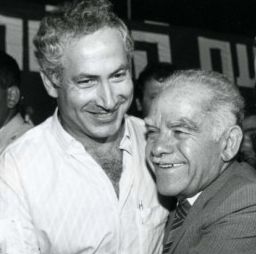
Remembering Yitzhak Shamir, leading Israeli terrorist and former prime minister
The Financial Times reports: Yitzhak Shamir, who has died at the age of 96, is most likely to be remembered as a terrorist against British rule in Palestine during the 1940s and as a man whose aggressive Jewish settlement policy on Arab lands may have stymied Middle East peace for a generation.
Benjamin Netanyahu, Israel’s prime minister, said Shamir “belonged to the generation of giants that established the state of Israel and fought for the freedom of the Jewish people in its land”.
In the New York Times, Joel Brinkley writes: Under [Shamir’s] leadership [in 1942 the Stern Gang] began a campaign of what it called personal terror, assassinating top British military and government officers, often gunning them down in the street.
To the Jewish public, and even to the other Jewish underground groups, Mr. Shamir’s gang was “lacking even a spark of humanity and Jewish conscience,” Israel Rokach, the mayor of Tel Aviv, said in 1944 after Stern Gang gunmen shot three British police officers on the streets of his city.
Years later, however, Mr. Shamir contended that it had been more humane to assassinate specific military or political figures than to attack military installations and possibly kill innocent people, as the other underground groups did. Besides, he once said, “a man who goes forth to take the life of another whom he does not know must believe only one thing: that by his act he will change the course of history.”
Several histories of the period have asserted that he masterminded a failed attempt to kill the British high commissioner, Sir Harold MacMichael, and the killing in Cairo of Britain’s minister of state for the Middle East, Lord Moyne. When Mr. Shamir was asked about these episodes in later years, his denials held a certain evasive tone.
It was during his time in the underground that Mr. Shamir met Shulamit Levy, who was his courier and confidante, he wrote in his autobiography, “Summing Up.” The couple married in 1944, meeting at a location in Jerusalem and gathering people off the street as witnesses, said their daughter, Gilada Diamant. After a hasty ceremony in deep cover, each departed immediately for a separate city.
In addition to his daughter, Mr. Shamir is survived by a son, Yair, five grandchildren and seven great-grandchildren. His wife died last year.
For a brief period after World War II, the three major Jewish underground groups cooperated — until the bombing of the King David Hotel in Jerusalem on July 22, 1946. Scores of people were killed, and Mr. Shamir was among those arrested and exiled to an internment camp in Eritrea. But he escaped a few months later and took refuge in France. He arrived in the newly independent Israel in May 1948.
Mr. Shamir was a pariah of sorts to the new Labor government of Israel, which regarded him as a terrorist. Rebuffed in his efforts to work in the government, he drifted from one small job to another until 1955, when he finally found a government agency that appreciated his past: the Mossad, Israel’s intelligence service.

President Obama: “Yitzhak Shamir dedicated his life to the State of Israel. From his days working for Israel’s independence to his service as Prime Minister, he strengthened Israel’s security and advanced the partnership between the United States and Israel. Our thoughts and prayers are with his family and the people of Israel.”
Video: Can foreign powers determine Syria’s future?
U.S. must arm Syria rebels despite Islamists: opposition
Reuters reports: Syria’s opposition says the United States must overcome its fear of Islamists among the rebels fighting to overthrow President Bashar al-Assad, and start arming the resistance movement to show it wants the entire ruling elite removed.
Islamists are among the most effective fighters against the Syrian leadership, some opposition figures said, and Washington needs to know that while these rebels are conservative Muslims they are a far cry from Afghan-style jihadi militants.
Frustration is growing that the United States will not supply weapons to the rebels, who have largely used small arms during the 16-month uprising against Assad and a state apparatus dominated by members of his Alawite minority.
“We have been kissing the hand of the United States and the rest of the world for the 16 months to intervene. Now, after Assad spared no one in Syria, the United States is surprised that al Qaeda may be operating in the country,” veteran opposition campaigner Fawaz al-Tello said from Istanbul.
Opposition campaigners and Free Syrian Army commanders said the rebels need weapons such as shoulder-fired missiles to destroy the tanks and bring down the helicopters that Assad is using against the uprising. Washington could anyway supply parts of the diverse rebel movement which are more to its liking.
“The U.S. has intelligence on the ground and by clever management it can channel weapons to the right people. First it has to give a clear signal that it really wants an end of the Alawite-dominated police state in Syria and not just the sidelining of Bashar,” said Tello, speaking from Istanbul.

