Netanyahu asked Panetta to approve sale of bunker-busting bombs, U.S. official says

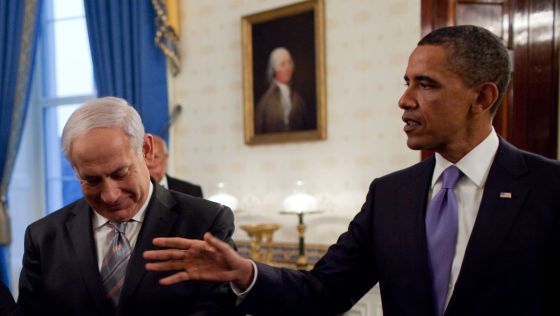
Haaretz reports: Prime Minister Benjamin Netanyahu requested the United States approve the sale of advanced refueling aircraft as well as GBU-28 bunker-piercing bombs to Israel during a recent meeting with Defense Secretary Leon Panetta, a top U.S. official said on Tuesday.

The American official said that U.S. President Barack Obama instructed Panetta to work directly with Defense Minister Ehud Barak on the matter, indicating that the U.S. administration was inclined to look favorably upon the request as soon as possible.

During the administration of former U.S. President George Bush, the U.S. refused to sell bunker-penetrating bombs and refueling aircrafts to Israel, as a result of American estimates that Israel would then use them to strike Iran’s nuclear facilities.

Following Obama’s entrance into the White House, however, the United States approves a string of Israeli requests to purchase advance armament.

Diplomatic cables exposed by the WikiLeaks website exposed discussion concerning advanced weapons shipments. In one cable which surveyed defense discussions between Israel and the United states that took place on November 2009 it was written that “both sides then discussed the upcoming delivery of GBU-28 bunker busting bombs to Israel, noting that the transfer should be handled quietly to avoid any allegations that the USG is helping Israel prepare for a strike against Iran.”

It’s widely assumed that the more bunker buster bombs there are available to the Israelis, the more inclined they will be to use them in a strike on Iran. That might not be the case however if this is a unilateral attack. The weight of the GBU-28 means that only one can be carried by each aircraft and since a significant number would inevitably miss their targets, the Israeli air force may simply be too small to mount an effective attack. Nothing will make Israel look more impotent than if after engaging in a long-threatened attack, the “day after” turns out to be one in which Iran can proudly show off an array of undamaged nuclear facilities.

Facebooktwittermail

Hamas rules out military support for Iran in any war with Israel

The Guardian reports: Hamas will not do Iran’s bidding in any war with Israel, according to senior figures within the militant Islamic group.

“If there is a war between two powers, Hamas will not be part of such a war,” Salah Bardawil, a member of the organisation’s political bureau in Gaza City, told the Guardian.

He denied the group would launch rockets into Israel at Tehran’s request in response to a strike on its nuclear sites. “Hamas is not part of military alliances in the region,” said Bardawil. “Our strategy is to defend our rights”

The stance underscores Hamas’s rift with its key financial sponsor and its realignment with the Muslim Brotherhood and popular protest movements in the Arab world.

Bardawil’s words were echoed by a second senior Hamas figure, who declined to be named. Hamas, he said, “would not get involved” in any war between Iran and Israel.

Facebooktwittermail

Israel’s American absent landlords

To witness the spectacle of an AIPAC conference, one might imagine that nothing warms the heart of the average Israeli more than such an outpouring of affection for the Jewish state. But as Boaz Gaon and no doubt many other Israelis are aware, AIPAC brings together those Americans who don’t belong to Israel but are convinced Israel belongs to them.

I, Boaz Gaon, being of sound mind and body, hereby offer myself for sale to AIPAC. Should the committee decline, I offer the opportunity to Sheldon Adelson. In any event, I offer my internal organs for free, as a confidence-building gesture, to leading right-wingers in America – to all those who view Israel as a kind of political football made out of seven million residents, a football that can be kicked at the wall over and over. After all, we Israelis don’t feel any pain, and we know that our destiny is to be tossed around like a ball in some exclusive gym by Republican lobbyists, before they head off to the sauna and then cocktails.

I’m offering myself for sale even though I was warned by my lawyer that this is an irreversible step, and that in all likelihood I’ll find myself at Israel Hayom newspaper’s next conference, and/or at the next reunion of White House veterans who worked for George W. Bush – persons who are partners of the Israeli right (Daniel Pipes, Elliot Abrams ) – naked and trussed up, with an apple stuffed in my mouth and served on a silver platter that has a likeness of Irving Moskowitz inscribed on it.

I’m doing this because I can read the writing on the wall. I am aware that a high percentage of Israel’s media have already been bought off by right-wing Americans (Ron Lauder, Adelson ), and that a fair share of the right-wingers on the Yesha Council of settlements come from the United States (as in the case of the Central Fund of Israel, directed by the Marcus family, which serves as the funding pipeline for the extremist groups Im Tirtzu and Women in Green ). And I know that Jerusalem is littered with “research institutes” financed by right-wing Americans, and that the goal of these institutes is to provide employment for prominent Israeli right-wingers (Natan Sharansky, Moshe Ya’alon, Moshe Arens ).

More than anything, I am aware that these “lovers of Israel,” those who like to stand next to gigantic blue and white flags, have no interest in improving education in Israel, or bettering the country’s housing or health-care systems, or improving its culture and scientific research. They have no interest in honing the country’s legal system, particularly on matters of religion and state, nor do they care about narrowing gaps between rich and poor, men and women, or Jews and Arabs. In short, they care little about the prosaic realities of daily Israeli life. These realities can’t be seen from the lobby of the King David Hotel in Jerusalem, and they are obscured by the cherry blossoms in the Washington area. These are the realities of my Israel. That’s not the same thing as the Israel that is supported by the Yesha Council, which is, in turn, funded by the evangelical Christian right.

I’m taking this step because I’ve come to understand that my own existence, and that of my children, merely shatters the sweet illusion of Israelis as matchsticks used to build a spectacular model of Noah’s Ark. Our lives belie the illusion that Jerusalem is a composite of Judaica items, each costing $30,000 in Zurich Airport’s duty free store. This is the illusion that allows people to call for the bombing of Iran while they sit in a mansion in Dallas. Or for the eradication of Israel’s democracy while lounging in a winter retreat in Miami. Or the annexation of Judea and Samaria while having a drink at the blackjack table in Las Vegas.

Ah, yes, there’s another reason – the American-Jewish left isn’t going to toss me a nickel. Neither Steven Spielberg, nor Rob Reiner, nor Barbra Streisand, nor any liberal Jewish billionaire. They are busy working for the Democratic Party, and ignoring Israeli issues. As far as they’re concerned, Israel isn’t worth a goddamned penny, as they say.

Facebooktwittermail

Putin offers threadbare blanket for Assad

Sami Moubayed writes: Whenever the world seemed to start caving in around them, Syrian politicians have leaned on the Russians for support. Moscow, both now and during the Soviet era, has always been Syria’s “security blanket”. Syrian leaders, however, have almost equally misjudged how far Russia was willing to go to help them.

In 1956, then-president Shukri al-Quwatli visited Moscow seeking Russian support for Egypt in the infamous Suez War. He roared at the Kremlin: “Syria wants you to send in that big Red Army that defeated [Adolf] Hitler!”

A few years earlier, president Husni al-Za’im threatened at a press conference: “If the Americans continue to provoke me, I will extend my hand to the Russians. Yes, I will do that. I will go to Moscow and let a Third World War erupt from right over here, from Damascus!”

Today, 63 years later, there are many in Damascus who, like Husni al-Za’im, wrongly believe that Moscow would indeed ignite a “Third World War” for the sake of Syria. To show their support for the strongman of Moscow, these same Syrians came out demonstrating in favor of Vladimir Putin, the man behind his country’s strong pro-Syria stance, at the gates the Russian Embassy in Damascus. Carrying photos of Putin, they wished him luck in his bid for re-election to the Russian presidency. A senior Lebanese figure recently returned from Moscow and was quoted saying: “I heard from the Russians that if Putin stays, then [Syrian President Bashar al-] Assad stays.”

These Syrians are waiting for Putin to return to the Kremlin. Others, however, are waiting for him to change his positions on Syria shortly after his re-election. They believe that he has stood behind Syria since disturbances began a year ago for one reason only: to re-establish his country’s image and position as a powerful and influential Middle East broker – as a superpower that can stand up for its allies should the need arise.

It’s not about the Soviet-era supply and maintenance base in the port city of Tartus, dating back to 1971. Russia’s macro-interests are much more strategic. Putin was seemingly telling the world: “No solutions for the Middle East can be reached anymore in complete disregard for Russian interests. If you want things done, you have to do it through us.”

Apart from that, everything is on the table for the Russians, including regime change in Syria.

Facebooktwittermail

Iran ready to push Assad aside?

An email dated December 13, 2011 (part of the intelligence trove newly released by Wikileaks) containing information gathered by Reva Bhalla, Director of Analysis at Stratfor, says that Iran recognizes that Bashar al-Assad will soon lose control of Syria and that it might be in Tehran’s interests to see him go sooner rather than later.

Both Khamenei and Ahmadinejad have concluded that Asad’s regime cannot be rescued. It is perfectly understood that the regime in Damascus will fall along lines similar to the Libyan model. There will have to be a coup in Damascus, be it a military or political one.

One must not dismiss the pragmatism of Khamenei. Iran appears to be willing to use its influence in Syria to stage a coup, provided that it is able to ensure that the new leadership will continue to pursue excellent relations with Tehran. The Iranians have approached the Americans on this. In the past, Iran collaborated with the U.S. on the ouster of Saddam Hussein and Iran won big in Iraq. The Iranians would not mind working again on ousting Asad if they can secure good results in Syria. Syria’s contiguity to Iraq allows Iran to play a direct role in the affairs of Damascus.

The Iranians feel they need to act on Syria soon because the Turks have their own plans for Syria and are not coordinating with the Iranians. He says the Turks are moving slowly but systematically. Iran does not want to allow Turkey to take over Syria. Whereas the Turks are coordinating with the Brotherhood and the FSA, the Iranians prefer a palace coup in damascus in order to maintain their ties with Asad’s successors. What is delaying action in Syria is the fact that the U.S. has not yet decided on the shape of the post-Asad political system. Nevertheless, he insists that Asad’s regime will fall, although the future of Syria after the regime change remains nebulous.

Who is “he”, Stratfor’s source? A member of Hezbollah’s politburo — not someone likely to be cheering Asad’s departure.

The analysis also says:

Alawite officers are aware that Asad is trying to find an asylum for himself and his family should his regime become unslavageable. This is upsetting many Alawites who are coming to realize that Asad will abandon them. If so, they reason that it would be suicidal to continue to win the wrath of the Sunnis.

Facebooktwittermail

How to combat anti-Zionism: defend colonialism

The prominent Israeli Zionist, Rafael Castro, presents an interesting argument in Ynet. (Over at Mondoweiss there’s a discussion on whether this piece should have appeared in Ynet or The Onion — tough call.) And as for who this Castro really is? Who knows, but dafter ideas do with some frequency come from the mouths of Zionists.

Castro notes that anti-Zionists are not anti-Semites. “[They] gladly rally against neo-Nazis and have no qualms about socializing with or marrying Jews.” He neglects to mention (a mere oversight it would seem) that many anti-Zionists are themselves Jews, but this just confirms his point.

Moreover, as Castro correctly observes, anti-Zionism is merely a strand in the broader leftist current: anti-colonialism. This therefore can only point to one logical conclusion for those who want to defend Zionism: they need to restore the unfairly tarnished name of colonialism.

The belief that colonialism was an absolute evil is so deeply engrained in the contemporary Western psyche that all enterprises bearing any parallels to it are automatically censored. This explains why people whose heroes are Bolivar and Gandhi instinctively side with the Palestinians.

To these people, claims that God promised the Land of Israel to the Jews reek of religious fanaticism. To make the argument that Israel is the only liberal democracy in the Middle East invites allegations that it pursues apartheid policies. To counter all these claims is time-consuming and requires a taste for nuances. But why should anyone trade nuances for the facile certainty that colonialism is inherently evil?

Zionism will only cease being demonized in the politically correct corners of the West once our schools and film industry cease to demonize colonialism. The politically correct depiction of the colonialist as a racist and covetous brute must give space to the majority of well-meaning administrators that helped build roads, schools, and hospitals for the natives.

It must be shown that colonialists administered law and justice far more fairly than most pre-colonial chieftains or post-colonial despots. It must be taught that human development indicators plummeted in the majority of African and Asian countries following independence.

Once an honest discussion about colonialism is tabled, hostility to Zionism will wane in leftist circles. Not because they will shed the belief that Zionism is a form of colonialism, but because it will be possible for them to appreciate the merits of Zionism.

This is an ambitious enterprise and time is running out, but if organizations like the Emergency Committee for Israel are serious about their mission they should start working on a new video series. Go out and start interviewing citizens in former colonies who can still remember the good old days when they were natives and they could rely on upstanding white men, such as officers of the British empire, to help them build railways and make the trains run on time. Imperial nostalgia! I’m sure it’s still out there. It just needs to be captured on film and then spliced together with images of IDF soldiers politely guiding elderly Palestinians through checkpoint turnstiles.

But there is one catch with Castro’s argument. Zionism is not just any old form of colonialism; it’s colonialism of the most brutal pedigree. It’s worse than apartheid South Africa, as Nelson Mandela and Desmond Tutu have both noted. Restoring the good name of brutality? That’s going to be even tougher, but hey, anything’s worth a try.

Facebooktwittermail

Attorney General Holder defends execution without charges

Glenn Greenwald writes: In a speech at Northwestern University yesterday, Attorney General Eric Holder provided the most detailed explanation yet for why the Obama administration believes it has the authority to secretly target U.S. citizens for execution by the CIA without even charging them with a crime, notifying them of the accusations, or affording them an opportunity to respond, instead condemning them to death without a shred of transparency or judicial oversight. The administration continues to conceal the legal memorandum it obtained to justify these killings, and, as The New York Times‘ Charlie Savage noted, Holder’s “speech contained no footnotes or specific legal citations, and it fell far short of the level of detail contained in the Office of Legal Counsel memo.” But the crux of Holder’s argument as set forth in yesterday’s speech is this:

Some have argued that the president is required to get permission from a federal court before taking action against a United States citizen who is a senior operational leader of Al Qaeda or associated forces. This is simply not accurate. “Due process” and “judicial process” are not one and the same, particularly when it comes to national security. The Constitution guarantees due process, not judicial process.

When Obama officials (like Bush officials before them) refer to someone “who is a senior operational leader of Al Qaeda or associated forces,” what they mean is this: someone the President has accused and then decreed in secret to be a Terrorist without ever proving it with evidence. The “process” used by the Obama administration to target Americans for execution-by-CIA is, as reported last October by Reuters, as follows:

American militants like Anwar al-Awlaki are placed on a kill or capture list by a secretive panel of senior government officials, which then informs the president of its decisions . . . There is no public record of the operations or decisions of the panel, which is a subset of the White House’s National Security Council . . . Neither is there any law establishing its existence or setting out the rules by which it is supposed to operate.

As Leon Panetta recently confirmed, the President makes the ultimate decision as to whether the American will be killed: “[The] President of the United States obviously reviews these cases, reviews the legal justification, and in the end says, go or no go.”

So that is the “process” which Eric Holder yesterday argued constitutes “due process” as required by the Fifth Amendment before the government can deprive of someone of their life: the President and his underlings are your accuser, your judge, your jury and your executioner all wrapped up in one, acting in total secrecy and without your even knowing that he’s accused you and sentenced you to death, and you have no opportunity even to know about, let alone confront and address, his accusations; is that not enough due process for you? At Esquire, Charles Pierce, writing about Holder’s speech, described this best: “a monumental pile of crap that should embarrass every Democrat who ever said an unkind word about John Yoo.” [Continue reading…]

Facebooktwittermail

Eastern Libya seeks semi- autonomy

Al Jazeera reports: Tribal leaders and militia commanders in oil-rich eastern Libya have declared their intention to seek semi-autonomy, raising fears that the country might disintegrate following the overthrow of Muammar Gaddafi.

Thousands of representatives of major tribal leaders, militia commanders and politicians made the declaration on Tuesday in a ceremony held in Benghazi.

They promised to end decades of marginalisation under Gaddafi and named a council to run the affairs of the newly created region, extending from the central coastal city of Sirte to the Egyptian border in the east.

Al Jazeera’s Nicole Johnston, reporting from the capital, Tripoli, said the announcement in Benghazi was only the beginning of a process.

“It is certainly significant, but we need to put it into context: first of all, they have announced the formation of a new regional council, and this will actually take a couple weeks to form,” she said.

“At this stage, they say they would like independence, but they have not declared independence. At this stage they haven’t even declared a degree of semi autonomy.”

The gathering in Benghazi also rejected an election law which allocated 60 seats for the eastern region out of 200-member assembly set to be elected in June.

Libya’s National Transitional Council (NTC), the interim central government based in Tripoli, has repeatedly voiced its opposition to the creation of a partly autonomous eastern region, saying it could eventually lead to the break-up of the country.

Reacting to Tuesday’s declaration, Waheed Burshan, a senior NTC representative, said the tribal leaders were looking for political power, whereas ordinary people of the east wanted a unified Libya.

Facebooktwittermail

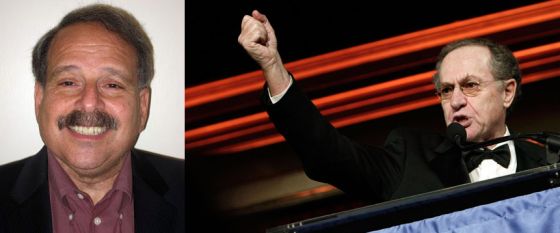
Dershowitz doth protest too much, and he’s at it again

Cases of spontaneous human combustion, though rare, have been documented. At this point no one seems to think rage could be the cause of ignition, but to hear him rant, Alan Dershowitz sounds like he might be at risk of setting himself on fire.

He’s certainly mad as hell — or at least that’s how he’s acting. But for a trial lawyer who so often craves media attention, it’s never really clear whether he’s as hot on the inside as he is on the outside.

Dershowitz doth protest too much, and he’s at it again. The object of his rage this time is the avuncular M.J. Rosenberg.

Rosenberg’s “sin” is that he has used — and despite severe admonishment persists in using — the unconscionable phrase Israel Firster — at least it’s a phrase that’s unconscionable in the eyes of Israel Firsters like Dershowitz.

The Magnes Zionist writes:

For years I have been waiting for Alan Dershowitz to meet his Edward R. Murrow, and I believe that he has met him in M.J. Let me tell you something about M.J. Rosenberg – to call him “anti-Israel” is as absurd as calling the New Israel Fund, J Street, the Meretz party, B’Tselem, anti-Israel – which, of course, is done everyday by the New Zealots, those self-appointed guardians of the Jewish state. M.J. has is a life-long liberal Zionist and supporter of the State of Israel, even when – especially when — he has criticized its government.

M.J. accused AIPAC of being an Israel-firster organization, and that aroused the ire of Dershowitz? M.J. worked for AIPAC for years, and he knows whereof he speaks. I can tell you that many AIPAC people I know, including relatives and friends, not only place Israel’s interests above American’s interest, they delude themselves into thinking that Israel’s interests are by definition identical with America’s interests.

M.J. allegedly tweeted in response to Dershowitz’s threats that he can go to hell. Dershowitz has responded by going nuclear. Because of his fury at Rosenberg, he is willing to attempt to cost Obama the election if the White House doesn’t publicly distance itself from Media Matters, or if Media Matters doesn’t fire Rosenberg, such is his fervor of the heresy hunter scorned. This time he has set the bar high, and, optimist that I am, I trust that he will fail.

Liberal Zionists, I am talking to you! Stand up for M.J. and you are standing up for your own against the like of those who delude themselves into thinking they are liberal Zionists. Otherwise you will end up by saying:

I was silent when Dershowitz went after Norman Finkelstein because I am not Norman Finkelstein. I was silent when he came for Matar, Giora, and Sand because, well, I had never heard of them. I was silent when he came for a liberal Zionist like M.J. Rosenberg because I don’t tweet. Then when he went after me, nobody was there to help me….

Perhaps there is a ray of light in all this. The Israeli Reut Institute last year outlined an Israel advocacy strategy of driving a wedge between the liberal Zionist and the extreme left in Israel and abroad. For the most part, it hasn’t worked. There is indeed a gap, but it is between the real liberal Zionists like M.J., Peter Beinart, Naomi Hazan, Larry Derfner, Michael Lerner, Leibel Fein, David Grossman, Amos Oz, as well as the activist groups in Israel like B’Tselem, Rabbis for Human Rights, Breaking the Silence, on the one hand, and the faux liberal Zionists like Dershowitz, Abe Foxman, Benny Morris, Ari Shavit, and all those members of the so-called “disappointed left” in Israel, on the other.

How do you distinguish between the genuine and the fake liberal Zionist? After all, both kinds say that they are for two states, oppose settlements and settlers, support territorial compromise, etc. It’s very simple: if they publicly criticize Israel’s human rights violations; if they support groups that expose such violations; if they call out Israel’s elected leaders on matters of policy and morality — in short, if they adopt the stance of moral critic because that is deep in their Jewish and mentshlich soul – then they are true liberal Zionists. All the others are deluded into thinking they are.

And no one is more deluded into thinking he is a liberal Zionist than Alan Dershowitz, who never ceases to remind his readers that he opposes the settlements and supports the two-state solution. Sorry, Professor, that is not enough to qualify. You also have to support harsh measures against the state if the settlements continue. You can’t be a liberal Zionist and support Binyamin Netanyahu, the arch-enemy of liberal Zionists. If you care about Israel as Jewish and democratic, to borrow the language of the liberal Zionists, you will – like M.J. and the others – have to fight against those Israeli government policies that are destroying the democratic nature of the state. You will join hands with human right activists, Jewish and Palestinian, who are fighting for justice. You will support, like M.J., Peter Beinart, David Grossman, and Amos Oz, boycotts against the settlers and the settlements. You will support pressure from the Americans and the European states to stop Israel’s slide into a Putin-style democracy.

Facebooktwittermail

When the U.S. government can kill you, explained

Adam Serwer writes: On Monday, the Obama administration explained when it’s allowed to kill you.

Speaking to students and faculty at Northwestern University law school, Attorney General Eric Holder laid out in greater detail than ever before the legal theory behind the administration’s belief that it can kill American citizens suspected of terrorism without charge or trial. In the 5,000-word speech, the nation’s top law enforcement official directly confronted critics who allege that the targeted killing of American citizens violates the Constitution.

“‘Due process’ and ‘judicial process’ are not one and the same, particularly when it comes to national security.” Holder said. “The Constitution guarantees due process, not judicial process.”

Who decides when an American citizen has had enough due process and the Hellfire missile fairy pays them a visit? Presumably the group of top national security officials—that, according to Defense Secretary Leon Panetta, decides who is targetable and forwards its findings to the president, who gives final approval.

There won’t be any drone strikes in Denver anytime soon. But you might want to be careful when traveling abroad, because Holder made it clear that there are no geographical limits in the fight against Al Qaeda. “Neither Congress nor our federal courts has limited the geographic scope of our ability to use force to the current conflict in Afghanistan,” Holder said. “We are at war with a stateless enemy, prone to shifting operations from country to country.”

Holder’s speech did outline some concrete limits to when the US government is allowed to target its own citizens. The target has to pose an “imminent threat of violent attack” to the US and be beyond the ability of American authorities to capture, and the strike can’t violate international standards governing the use of force by killing too many civilians or noncombatants.

But don’t assume that when Holder says “imminent threat of violent attack,” he means that you’re actually part of a specific plot threatening American lives. “The Constitution does not require the president to delay action until some theoretical end stage of planning when the precise time, place, and manner of an attack become clear,” Holder said. That would introduce an “unacceptably high risk of failure.” When he refers to “failure,” Holder presumably means failing to kill the target before the attack or plan for an attack materializes, not the possibility that the government might accidentally kill an innocent person.

If the standards for when the government can send a deadly flying robot to vaporize you sound a bit subjective, that’s because they are. Holder made clear that decisions about which citizens the government can kill are the exclusive province of the executive branch, because only the executive branch possess the “expertise and immediate access to information” to make these life-and-death judgments.

Facebooktwittermail

Report denounces weapons to Israel as AIPAC assembles

The US Campaign to End the Israeli Occupation just released its first policy paper, “U.S. Military Aid to Israel: Policy Implications & Options,” [PDF] which calls for the United States to end military aid to Israel.

The paper highlights the following facts, among others:

  • From 2000 to 2009, the United States appropriated $24.1 billion of military aid to Israel, transferring more than 670 million weapons, rounds of ammunition, and related equipment.
  • From 2000 to 2009, Israel killed at least 2,969 unarmed Palestinians, including 1,128 children, often with U.S. weapons in violation of the Foreign Assistance Act and Arms Export Control Act.
  • From 2009 to 2018, the United States is scheduled to give Israel $30 billion in military aid, a 25 percent annual average increase over previous levels of military aid, despite its negative political and strategic ramifications.
  • From the Eisenhower to Bush, Sr. Administrations, at least 10 times the United States conditioned aid to Israel, threatened to cut off aid to Israel, or sanctioned Israel for violating U.S. laws and/or working against foreign policy objectives.
  • Since 2000, Members of Congress and/or the State Department have investigated or requested investigations into Israel’s potential misuse of U.S. weapons at least five times; however, no public action has been taken to hold Israel accountable for its violations of U.S. laws.
  • With the same amount of money that the United States gives each year to fund weapons for Israel, the federal government could instead fund affordable housing vouchers for 350,000 low-income families, or green jobs training for 500,000 unemployed workers, or early reading programs for 900,000 at-risk students, or primary health care to 24 million people without insurance.
Facebooktwittermail

Former CIA officials say Iran’s hardliners want to goad Israel into an attack

The Daily Beast reports: Benjamin Netanyahu, in Washington today, is laying more political groundwork for a possible preemptive Israeli airstrike against Iran’s nuclear sites.

But as Netanyahu rallies his American supporters and discourages diplomatic engagement with Tehran, some intelligence officials and Iran experts tell The Daily Beast that an Israeli attack may be exactly what Tehran’s most hard-line leaders have been trying to provoke.

Marty Martin, a former senior officer in the CIA, ran the unit that hunted Al Qaeda terrorists from 2002 to 2004. Iran’s most militant leaders “are goading the Israelis,” he tells The Daily Beast, “because a bombing will help them put their internal problems aside.”

Martin, who spent most of his 25-year career at the CIA in the Middle East, argues that some clerics and Islamic Revolutionary Guard Corps commanders, confronted with a discontented and restless population, are looking for ways to solidify public support. “The way they see it, if Israel bombs them it relieves the internal pressure,” says Martin. “Amid this turmoil, its always good to have an outside enemy.”

Iran’s internal troubles include a 12 percent unemployment rate, a shattered economy (due in part to international sanctions), resentment over the oppressive regime, and widespread disgust over corruption.

Martin, who retired from the agency in 2007, now works as an independent consultant. He was prominent inside the agency not just for his leadership against Al Qaeda but also for his expertise on the Middle East: his Louisiana drawl disguises the fact that he speaks fluent Arabic.

“If you are an Iranian,” he says, “there is actually a benefit to an Israel strike—an Israel strike which won’t be successful completely militarily, but will be successful for saying ‘game on’!”

Paul Pillar, the former national intelligence officer for the Middle East, agrees, though he emphasizes that only part of the Iranian leadership is likely plotting this way. “It’s quite rational,” he said, “from the perspective of the specific elements in the regime that believe it would work to their political advantage.” Pillar, who spent 28 years at the CIA, is now a professor at Georgetown University. “I strongly believe that the net political effect of an attack would be to help the hardliners,” he says.

Facebooktwittermail

Avi Shlaim: Obama must stand up to Netanyahu

By Avi Shlaim, War in Context, March 5, 2012

It is clear what kind of Israeli prime minister President Obama will be receiving at the White House today. Benjamin Netanyahu is a bellicose, right-wing Israeli nationalist, a rejectionist on the subject of Palestinian national rights, and a reactionary who is deeply wedded to the status quo. Nationalism has an in-built tendency to go to extremes and Netanyahu’s brand is no exception. A nation has been defined as ‘a group of people united by a mistaken view about the past and a hatred of their neighbours’. This definition fits the Likud leader on both counts: he has a selective and self-righteous view of his own country’s history and he is driven by distrust and disdain, if not outright hatred towards the Arabs in general and the Palestinians in particular. This hostility towards Arabs is the central thread that runs through his public utterances, books, and policies as prime minister.

Netanyahu does not believe in peaceful co-existence between equals. He views Israel’s relations with the Arab world as one of permanent conflict, as a never-ending struggle between the forces of light and the forces of darkness. In his 1993 book – A Place among the Nations: Israel and the World – the image he presents of the Arabs is consistently and comprehensively negative. Nor does he admit any possibility of diversity or change. The book does not contain a single positive reference to the Arabs, their history or their culture. Autocracy, violence, and terrorism are said to be the ubiquitous facts in the political life of all the Arab countries. A democratic shift on the Arab side is a precondition to genuine peace with Israel, wrote Netanyahu, in the confident expectation that such a shift is beyond the realm of possibility. The Arab Spring has proved him wrong.

The coalition government headed by Netanyahu is the most aggressively right-wing, diplomatically intransigent, and overtly racist government in Israel’s history. His Foreign minister is Avigdor Lieberman, the leader of the far-right party Yisrael Beiteinu, Israel is Our Home. Lieberman has set his face against any compromise with the Palestinians and he also favours subjecting Israel’s 1.5 million Palestinian citizens to an oath of loyalty to Israel as a Jewish state. Netanyahu’s Defence Minister is Ehud Barak who destroyed and then defected from the Labour Party to form a small break-away faction called Independence. A former chief-of-staff, Barak suffers from a déformation professionelle: he regards diplomacy as the extension of war by other means. Barak is a bitkhonist, a security-ist who wants 100 per cent security for Israel which means zero security for the Palestinians.

The ideological make-up of this coalition government militates against a land-for-peace deal with the Palestinians. It is a government of militant nationalists whose aim is to redraw unilaterally the borders of Greater Israel. The government is democratically elected but by putting nationalism above morality and international legality, and by relying on military power to subjugate another people, it is in danger of drifting towards fascism. And it is already drifting away from the common values that constitute the foundation of the special relationship between the United States and the State of Israel.

On 14 June 2009, Netanyahu gave a speech at Bar-Ilan University in which, under strong American pressure, he grudgingly endorsed a ‘Demilitarized Palestinian State’. This was hailed as a reversal of his government’s opposition to an independent Palestinian state. But the change was more apparent than real. Judged by his deeds rather than rhetoric, Netanyahu remained the relentless rejectionist that he had been throughout his singularly undistinguished political career. The litmus test of commitment to a two-state solution is a freeze of settlement expansion on the West Bank and in East Jerusalem, the capital of the future Palestinian state. Under Netanyahu’s leadership, however, settlement expansion has gone ahead at full tilt, especially in and around Jerusalem.

Jerusalem is the most sensitive issue in this tragic, hundred year-old conflict. By putting Jerusalem at the forefront of his expansionist agenda, Netanyahu knowingly and deliberately blocks progress on any of the other ‘permanent status issues’ such as borders and refugees. Netanyahu is not a peace-maker; he is a land-grabber who rides roughshod over Palestinian rights. It is he who has turned the so-called peace process into an exercise in futility. He is like a man who pretends to negotiate the division of a pizza while continuing to gobble it up.

Barrack Obama reiterates at regular intervals that the bond between America and Israel is ‘unbreakable’. If anyone can break this bond, it is Benjamin Netanyahu. Early on in his presidency, Obama identified a settlement freeze as the essential precondition for progress in the American-sponsored peace process. During his Cairo speech, on 4 June 2009, he made it clear that ‘The United States does not accept the legitimacy of continued Israeli settlements’. Obama had three confrontations with Netanyahu over the demand for a settlement freeze and he backed down each time. Moreover, Obama has all but turned over to Netanyahu the American veto on UN Security Council. Since 1978 America has used the veto forty-two times to defeat resolutions critical of Israel. The most egregious abuse of this power happened in February 2011 when a resolution condemning Israeli settlement expansion was supported by fourteen members and killed by America. That was a veto of America’s own foreign policy.

How can a jimcrack politician from a small country defy the most powerful man in the world and get away with it? At least part of the answer lies in the enduring power of the Israel lobby. Ever since 1967 the lobby has opposed every international plan for resolving the Palestinian-Israeli dispute that was not to Israel’s liking. But any proposal for a military strike against Israel’s enemies can count on the support of Israel’s friends in Washington, Iraq in 2003 and Iran today being the most obvious examples. In the case of Iran, Netanyahu is the war-monger in chief and he is doing his utmost to drag America into a dangerous confrontation that cannot possibly serve American interests. The region is like a tinder box and one spark could set off a major conflagration.

On 5 March, President Obama is due to receive the Israeli prime minister in the White House. At their first meeting, on 19 May 2009, Obama’s priority was Palestine whereas Netanyahu only wanted to talk about the Iranian threat. Subsequently, Netanyahu succeeded in imposing his agenda on his ally. Today the peace process is in tatters and the war hysteria against Iran is gathering force. The challenge for Obama is to reign in his reckless junior ally and to reorder American priorities in the Middle East. The main threat to regional stability is not Iran but the Israeli occupation of the Palestinian territories. And the main source of hostility towards America throughout the Arab and Muslim lands is Israel’s oppression of the Palestinian people and America’s complicity in this oppression. If Obama cannot stand up to Bibi Netanyahu in defence of vital American interests, who will he stand up to? His own credibility as the leader of the free world is on the line.

Avi Shlaim is an Emeritus Professor of International Relations at Oxford University and the author of Israel and Palestine: Reappraisals, Revisions, Refutations (Verso).

An edited version of this op-ed appears in The Independent today. The complete version is published here with the author’s permission.

Facebooktwittermail

America and the imperialism of ignorance

Rory Stewart reviews America and the Imperialism of Ignorance: US Foreign Policy Since 1945, by Andrew Alexander.

What was the Cold War? For Professor John Lewis Gaddes, it was a conflict between two incompatible systems, democracy and communism, each with a different vision of liberty and human purpose. The result was a potential third world war, in which we risked being crushed by dictators or destroyed by nuclear weapons. And the US saved us. ‘The world,’ he writes, ‘I am quite sure, is a better place for the conflict having been fought in the way that it was and won by the side that won it. For all its dangers, atrocities, costs, distraction and moral compromises, the Cold War was a necessary contest.’

Andrew Alexander disagrees. And Alexander — who has long exposed the myopia and self-deception of the establishment — should be taken seriously. He argued against the Vietnam War, took on prices and incomes policy, the fixed exchange rate and the ERM [European Exchange Rate Mechanism], and continued by opposing the interventions in Iraq and Afghanistan. In almost every case, he stood against the received wisdom of the Financial Times, the Economist, the CBI [Confederation of British Industry], and (though they always printed his pieces) his editors at the Daily Mail.

In almost every case he was right. Now, he argues, in relation to the Cold War, that ‘the world is a much more dangerous place, as a result of America’s determination to save it.’ It is difficult to imagine a more important thesis. As he writes:

If the world came close to nuclear Armageddon on half a dozen occasions, and expended so much blood and treasure for 40 years against a threat that was never real, this raises serious doubt about the integrity and basic intelligence of a whole succession of Western governments and the political institutions for which they make such high claims.

Alexander argues that communism never posed an existential threat to the security of the West. Stalin’s primary aim was the preservation of his regime, and his only objective in Eastern Europe was to create a defensive buffer against any German advance. Not only did he lack the resources, the plans or the will to conquer Western Europe: he actively opposed communist revolutions around the world. If Western Europe was safe from Soviet attack, the United States — thousands of miles further away — was even safer. Nevertheless, an entire US policy industry emerged to argue the opposite, and to produce the most ingenious explanations of why a country like distant Vietnam could be, as Ronald Reagan claimed in 1963, ‘the greatest threat that ever faced humankind in its climb from the swamp to the stars.’

Alexander offers no single explanation for this obsession. Instead he patiently illustrates a dozen factors in the hypnotising, extravagant project. His account of Woodrow Wilson’s peculiar rigidities and self-defeats at the Paris Peace Conference in 1919, and the US involvement in the Philippines and Cuba, suggests that US foreign policy was, for a century, less an instrument of democracy and more a form of eccentric imperialism. Unlike British policy, which was based on unwritten assumptions about the joy, responsibility and honour of imperial government, the US approach reflected a distaste for empire, and a worship of its own written constitution, and law, enlivened by acts of startling gangsterism.

Unlike British political officers, US officers were obsessed with the idea of human equality and freedom, but had little interest in, or attraction to alien cultures. Generals had a disproportionate influence on policy and frequently became presidents or secretaries of state. The resulting policy, from Vietnam to Iraq, could be both high-minded and bluntly brutal.

The Cold War fears of Russia were elaborated by the defence industry, and the military, to justify their programmes, their budgets, and their losses. And they were further intensified by electoral politics, and the temptation in Senator Vandenberg’s advice to Truman to sell international aid by ‘scaring the hell out of the American people’. But it was not simply a conspiracy of defence contractors: as Alexander, (whose time as a parliamentary sketch-writer has left him with a singular sensitivity to the character of politicians) observes: ‘The effect of propaganda … is often greater on those who propound it than on the public which receives it. The messengers become prisoners of their own propaganda.’

In Alexander’s view, the US fight against this misconceived and exaggerated threat was harmful. US leaders assumed that any ‘appeasement’ would encourage Soviet expansion, whereas, in fact, the most dangerous Soviet actions were provoked by US assertiveness. The Soviet Politburo, for example, preferred a non-communist Afghanistan, and was keen not to get involved on the ground. But the apparently strong US position in Pakistan and Iran, and the CIA ties to the Afghan president, ultimately convinced the Soviets that they had no alternative other than nervously to embark on the catastrophic invasion, which ultimately led, via a million deaths, to the horrors that continue to define Afghanistan today. It was not over-confidence but fear of US ambitions which drove Soviet policy. And, as Alexander demonstrates, almost every element of US policy for decades — including the Marshall plan, the Berlin airlift and its defence investment — further intensified the paranoia and aggression.

Alexander builds his case through quotes from primary sources, from National Security Council documents, speeches, telegrams, presidential letters and Soviet archives. His patient, understated discoveries are shocking. Here is a general, commenting on the Japanese: ‘When we knew we didn’t need to do it and they knew we didn’t need to do it, we used them as an experiment for two atomic bombs.’ [Continue reading…]

Simon Jenkins adds:

The cold war consumed trillions of dollars. Hundreds of thousands died in surrogate wars around the globe. The opportunity cost in poverty and disease, in growth foregone and democracy postponed, was awesome. The embattlement of eastern Europe, like that of today’s Islamist states, retarded its passage into economic and political maturity. The cold war was not a war of good against evil. It was ignorance so pernicious as to question “the integrity and basic intelligence” of those democratic institutions persuaded that they were under existential threat.

Where Alexander goes for broke is in showing how this ignorance is ongoing. With the end of the cold war – and the west’s later inept handling of Russia – the west’s craving for a necessary enemy has revived. For a decade after 1990, defence chiefs resorted to genocidal autocrats, drug lords and Balkan separatists to maintain their budgets, which duly dwindled. Then came 9/11 and a “clash of civilisations”. Bush and Blair won elections. Bankers lent money to generals, and the military-industrial complex refloated on an ocean of myth and mendacity.

The brainwashing was ubiquitous. No book, no argument, no evidence could dissuade any British cabinet from the belief that only a giant defensive armoury stood between it and a communist takeover, and now stands against an Islamist Armageddon. Hence the need to keep nuclear-armed submarines at sea, somehow to deter an unnamed “terrorist state”. Likewise, five of the original six Republican candidates for US president recently called for war with Iran for “posing a threat to the American people”. What threat?

I believe Alexander is right to seek explanation not in the realpolitik of international relations, but in the motives of democratic leaders. America’s belief in itself as the “greatest superpower the world has ever seen” led Lyndon B Johnson to impotent fury at being thrashed by “a raggedy-ass little country” – Vietnam. It led Washington lobbyists to protect defence spending, as Truman was advised, by “scaring the hell out of the American people”. Today, a similar self-delusion leads Washington and London to claim the right to drop bombs on anyone they find “unacceptable”.

Facebooktwittermail

What Russia taught Syria

Robert Young Pelton writes: It was a star-filled night in Chechnya’s besieged capital of Grozny. The snow crunched under my feet as I walked with the Chechen rebel commander away from the warmth of our safe house. When we entered a bombed-out neighborhood 15 minutes away, I put the battery in my Iridium satellite phone and waited for the glowing screen to signal that I had locked on to the satellites.

I made my call. It was short. Then the commander made a call; he quickly hung up and handed me back the phone. “Enough,” he said, motioning for me to remove the battery.

As we walked briskly back to the safe house, it was exactly 10 minutes before the cascade of double wa-whumps announced the Grad rocket batteries pounding the vacant neighborhood we had just left.

It was December 1999, and the Russian assault on Grozny was unfolding in all its gruesome detail. After the dissolution of so much of the former Soviet empire, Chechnya was one country that the newly minted prime minister, Vladimir Putin, refused to let go of. His boss, Boris Yeltsin, and the Russian army had been defeated and then humiliated in the media by Chechen forces in the first war. Five years later, Russia was back. And Putin’s new strategy was unbending: silence, encircle, pulverize, and “cleanse.” It was a combination of brutal tactics — a Stalinist purge of fighting-age males plus Orwellian propaganda that fed Russians a narrative wherein Chechen freedom fighters were transformed into Islamist mercenaries and terrorists. More than 200,000 civilians were to die in this war, the echoes of which continue to this day.

This time, journalists were specifically targeted to prevent sympathetic or embarrassing reports from escaping the killing zone. As such, you can’t find a lot of stories about the second Chechen war. One of the few and best accounts was written by Marie Colvin, who described her terrifying escape from Grozny for the Sunday Times. Last month, Colvin thought she could roll the dice and enter the besieged Syrian city of Homs to defy yet another brutal war of oppression. This time she lost.

It’s impossible to know whether Syrian President Bashar al-Assad — a longtime ally of Russia — studied the success of the last Chechen war before launching his own assault on the restive city of Homs. However, his Russian military advisors surely know the tactics well. The crackdown in Homs carries a grim echo of Grozny, both in its use of signals intelligence to track down and silence the regime’s enemies and in its bloody determination to obliterate any opposition, including Western journalists.

Facebooktwittermail

Libyan militia says UK journalists are ‘spies’

BBC News reports: Two British journalists detained in Libya are suspected of spying, the militia that is holding them says.

Faraj al-Swehli, commander of a Misrata brigade, said the men had entered Libya illegally and were carrying “incriminating evidence”.

He said the activities of reporter Nicholas Davies and cameraman Gareth Montgomery-Johnson were being investigated.

The men had been working for Iran’s English-language TV station Press TV.

Rights groups have called for their release.

The BBC’s Gabriel Gatehouse in Tripoli says that at a hastily convened press conference in the capital, reporters were shown video footage of what was purported to be the two journalists test-firing weapons.

Members of the militia also produced a field dressing that they said they had found in the journalists’ possession.

It was of a type, they said, used by the Israeli military.

I dare say these two journalists are not the only ones in Libya who thought it might be prudent to include the widely used, easily available Israeli battle dressing in their first aid kit. If this was supposed to be incriminating evidence, were the militia members not pressed to explain this improbable combination: journalists carrying Israeli supplies while working for an Iranian news outlet? Not only can anyone buy these bandages online; they also happen to be used by the US military.

Facebooktwittermail