Khamenei praises Obama for ‘taking distance from illusion’

The Associated Press reports: Iran’s top leader Thursday welcomed comments by President Barack Obama advocating diplomacy and not war as a solution to Tehran’s nuclear ambitions, a rare positive signal in long-standing hostile transactions between Tehran and Washington.

The report on Iran’s state television quoted Ayatollah Ali Khamenei as praising a recent statement by the U.S. president saying he saw a “window of opportunity” to use diplomacy to resolve the nuclear dispute.

Khamenei, who has final say on all state matters in Iran, told a group of clerics: “This expression is a good word. This is a wise remark indicating taking distance from illusion.”

It is one of the rare cases in which Iran’s top leader praised an American leader.

Facebooktwittermail

Most Israelis oppose a unilateral strike on Iran

Haaretz reports: Most Israelis believe that if the United States does not attack Iran’s nuclear facilities, Israel must no try to do so alone, according to a Haaretz poll.

The Haaretz-Dialog poll, conducted under the supervision of Prof. Camil Fuchs of Tel Aviv University on Sunday and Monday during Prime Minister Benjamin Netanyahu’s visit to Washington, also showed that the prime minister’s Likud party would win big in the next election, taking between 35 and 37 seats.

Likud, the rest of the right wing and the ultra-Orthodox parties would get between 71 and 74 mandates. Under such a scenario, only Netanyahu would be able to form a government.

However, Netanyahu, who returned to Israel on Wednesday, is facing a complex political situation.

On the one hand, he and his party seem to be in top political form. On the other, 58 percent of those polled opposed an Israeli strike on Iran, without U.S. backing.

Thus it seems Netanyahu has not convinced those for whom he has been repeatedly threatening Tehran.

Facebooktwittermail

Israeli attack would only delay Iran’s nuclear plans

AFP reports: An Israeli attack on Iran’s nuclear facilities would only set back Tehran’s programme by a couple of years, the head of a respected London-based think-tank said Wednesday.

International Institute for Strategic Studies (IISS) head John Chipman said an Israeli attack against Iran was unlikely this year, following US assurances this week to Israel that it would not rule out military action.

Only the United States could conduct a serious campaign against Iran’s nuclear facilities, he said.

Furthermore, a pre-emptive Israeli strike could backfire because it is likely to push the Tehran regime to accelerate its nuclear ambitions, warned the IISS director-general at the release of its annual “Military Balance” report.

Western powers suspect Iran is seeking to build a nuclear bomb, a charge denied by Tehran which says its atomic programme is for purely civilian purposes.

“My judgment is that an Israeli attack on Iran of an overt kind is unlikely this year,” Chipman told a news conference on the annual assessment of the global military power balance.

“Both Israel and the United States are conscious that Israel can conduct a raid; only the United States can conduct a campaign.

“I think that it’s the latter that would be necessary in order to delay, in any meaningful way, the acquisition of a confirmed Iranian nuclear military capability.

“The judgement of most military experts is that any attack — whether a raid or a campaign — would only delay such acquisition and could, of course, incentivise the regime, once it reorganises itself, to move ever quicker towards that goal.”

Facebooktwittermail

Bibi’s bunker-busters

Is this a denial or a non-denial that Netanyahu will be supplied with more bunker-busters?

Haaretz reports: President Barack Obama and Israeli Prime Minister Benjamin Netanyahu did not discuss in their meetings this week a reported Israeli request for advanced U.S. military technology that could be used against Iran, the White House said on Thursday.

“In meetings the president had there was no such agreement proposed or reached,” White House press secretary Jay Carney told reporters. Obama and Netanyahu meet in the Oval office for two hours on Monday and then had lunch together.

Carney’s comment came after an Israeli official quoted by the Maariv newspaper earlier on Thursday indicated that Israel has asked the United States for advanced “bunker-buster” bombs and refueling planes that could improve its ability to attack Iran’s underground nuclear sites.

On Tuesday, Haaretz quoted a U.S. official as indicating that Netanyahu had asked Defense Secretary Leon Panetta for the GBU-28 bunker busting bombs as well as for advanced refueling aircraft.

The source added that Obama then instructed Panetta to start work on a request to work directly with Defense Minister Ehud Barak on the matter, indicating that the U.S. administration was inclined to look favorably upon the request as soon as possible.

However, Carney’s comments on Thursday seemed to specifically relate to those meetings participated by Obama and Netanyahu, while failing to comment about the content of other lower-level talks.

Facebooktwittermail

Did Obama postpone war only to make it inevitable?

Robert Malley says that even if President Obama won this week’s argument in his ongoing struggle with Benjamin Netanyahu over how to confront Iran (a struggle that has already stymied any serious diplomacy), Obama appears to have narrowed his options so much that war may eventually be unavoidable.

For now at least, most commentators in the United States and in Israel have handed this round to Obama. He had two overriding objectives: to deflect Israeli pressure to conduct, or acquiesce in, a premature war; and to neutralize Republican criticism that he is too soft on Iran and too hard on Israel. On those fronts, one might say, mission accomplished.

But victory came at a price. In the longer run, Obama’s nuanced view and the arguments he marshaled on behalf of diplomacy may be less significant than the broader narrative in which, in order to prevail, he felt compelled to embed them. More openly than in the past, he took containment of a nuclear-armed Iran off the table — even before any serious discussion of this option has taken place and just as influential U.S. voices had begun making the case for it. More clearly than previously, he recognized Israel’s right to its own decisions; Netanyahu took the bait — or rather, grabbed it with enthusiasm, turning a banal acknowledgment of reality into an implicit license for Israel to unilaterally initiate action that will have broad and possibly dire consequences for all. And, more forcefully than before, Obama committed America to military action to halt Iran if other means fail to do so.

That day of reckoning may have been delayed. But short of a fundamental shift in U.S.-Iranian relations, it looks as though it will yet come. Israelis, not for the first time, likely are exaggerating the Iranian threat and its imminence. Yet they almost certainly are right in one respect: that sanctions could work and nonetheless fail, inflicting harsh economic pain yet incapable of producing a genuine change in Tehran’s calculus. There is no evidence that Iran’s leadership will yield to economic hardship; the outlook of its Supreme Leader rests on the core principle that the only thing more dangerous than experiencing pressure is surrendering to it. Seen through the regime’s eyes, such stubbornness is easy to understand. From its perspective, measures taken by its foes, including attacks on its territory, bolstering the arsenal of its Gulf enemies, and economic warfare, have a single purpose: namely, to topple the Islamic Republic. Under such conditions, why would the regime volunteer a concession that arguably would leave it weaker in a hostile environment? Even as he fought off the prospect of an imminent confrontation, Obama might therefore have bought himself — or his eventual successor — one down the road. For if and when sanctions fail, what alternative will there be to turn to?

Facebooktwittermail

Why Hamas is not Iran’s proxy

Tareq Baconi writes: Hamas officials have said that in the event of a war between Iran and Israel, they will not become involved on Tehran’s side. While this is not surprising, other officials within the movement were quick to deny such reports.

Historically, Hamas has always gone to great lengths to assert its independence from any foreign influence. It is widely recognised that it receives support from powers such as Syria (until recently) and Iran. Yet this has never been worn as a badge of honour by the movement.

Rather, its leadership has consistently asserted that the movement cannot be influenced or directed by any external power. It has insisted that it charts its course based on the will of the people – in stark contrast to Fatah and its leadership, who have frequently been portrayed as the pawns of western powers and Israel.

Hamas, which governs Gaza, is also territorialised, limiting its resistance to historic Palestine. Unlike the Palestine Liberation Organisation, and perhaps because of lessons learned from it, Hamas has rarely if ever meddled in regional or global affairs, either rhetorically or through acts of resistance.

Even its sporadic bouts of tension with Jordan were more due to the regime’s discomfort at having an active Islamic party in its backyard and less about Hamas carrying out resistance activities from the kingdom.

Being territorialised also meant that Hamas limited its war to a well-defined battle: that of liberating Palestine from “Zionist occupation”.

Siding with Iran in the much-hyped potential conflict with Israel would act against all these long-standing principles. It would flagrantly present the movement as an entity which is being influenced by an external player. More importantly however, it would demonstrate that the movement is fighting a tangential battle rather than what it sees as its historic one.

Facebooktwittermail

Libyan leader vows to keep nation together by force

The Guardian reports: The Libyan leader, Mustafa Abdul Jalil, has vowed to use force to stop the country breaking up after leaders in an eastern region declared autonomy.

“We are not prepared to divide Libya,” he said, blaming infiltrators and pro-Gaddafi elements for backing the autonomy plan. “We are ready to deter them, even with force.”

His comments come amid mounting evidence that Libya is slowly splintering into a series of rival fiefdoms controlled by competing militias, who increasingly follow their own agendas rather than acting in the national interest.

In February, the city of Misrata, which suffered a brutal siege by pro-Muammar Gaddafi forces, forged ahead with its own municipal elections, while the militia in Zintan is still holding Gaddafi’s son Saif.

Misrata has established a security zone that prohibits many Libyans from entering. It held the first city council elections in Libya last month, without the involvement of the ruling National Transitional Council (NTC).

The sense of growing instability in Libya was compounded by a recent Amnesty International report that the hundreds of militias vying for power in the country were out of control and increasingly behaving like mafia organisations.

Facebooktwittermail

NSA whistle-blower: Obama ‘worse than Bush’

Matthew Harwood writes: Thomas Drake, the whistle-blower whom the Obama administration tried and failed to prosecute for leaking information about waste, fraud and abuse at the National Security Agency, now works at an Apple store in Maryland. In an interview with Salon, Drake laughed about the time he confronted Attorney General Eric Holder at his store while Holder perused the gadgetry on display with his security detail around him. When Drake started asking Holder questions about his case, America’s chief law enforcement officer turned and fled the store.

But the humor drained away quickly from Drake’s thin and tired face as he recounted his ordeal since 2010 when federal prosecutors charged him with violating the Espionage Act for retaining classified information they believed he would pass on to then Baltimore Sun reporter Siobhan Gorman. While Drake never disclosed classified information, he did pass on unclassified information to Gorman revealing that the NSA had wasted billions of taxpayers’ dollars on Trailblazer, a contractor-heavy intelligence software program that failed to find terrorist threats in the tsunami of digital data the agency was sucking up globally — and sometimes unconstitutionally. While Trailblazer burned through cash, in the process enriching many NSA employees turned contractors, Drake found that another software program named ThinThread had already met the core requirements of a federal acquisition regulation that governed the proposed system at a sliver of the cost, all while protecting American civil liberties at the code level. The NSA leadership, however, had already bet their careers on Trailblazer. So Drake blew the whistle, first to Congress, then to the Department of Defense Inspector General’s Office, and finally, and fatefully, to Gorman.

Last June, the government’s case collapsed. On the eve of trial, all 10 counts were dropped. In a Kafkaesque turn of events, Drake actually helped the government find a misdemeanor to charge him with — exceeding authorized use of an NSA computer — so federal prosecutors could save face. Once facing 35 years behind bars, Drake pled guilty to the misdemeanor charge and was sentenced to one year of probation and 240 hours of community service, what he sardonically calls “his penance.”

But his legal battles haven’t ended. Currently, Drake, along with the four other whistle-blowers he worked with to expose NSA waste, fraud and abuse, are fighting to get their property back that the FBI confiscated during its criminal investigations. Once a registered Republican and now a self-described “free-speech absolutist,” Drake describes the NSA as a rogue agency that operates in a black box that the public cannot penetrate.

Drake, along with his attorney Jesselyn Radack of the Government Accountability Project, sat down for a three-hour interview with Salon. Here are some excerpts from our conversation. [Continue reading…]

Facebooktwittermail

Syria’s currency plunges, raising fears of economic chaos and poverty

Joshua Landis writes: The exchange rate of the Syrian Pound has reportedly plunged to the 103 range against the dollar at mid-day Wednesday, March 7th, 2012 in Damascus. This is a loss of over 100% since the beginning of the uprising. Over the last month, the pound has begun to weaken significantly which has received little attention. The 100 mark is an important psychological barrier.

Syrian businessmen are taking large losses. Most rely on account receivables when they sell their goods. This means that traders who have sold goods over the last half year in Syrian pounds are taking heavy losses when they are paid back.

One businessman I spoke to this morning reports that he sold three-hundred thousand dollars of car parts several months ago in Syrian pounds. He is to be paid at the end of this month. Due to the decline of the pound over this time period from 57 to 100 pounds per dollar, he will lose close to $150,000 dollars. This is a crushing blow to business.

No one is trading the Syrian pound today because its price is decreasing every hour. No one has any idea where this might end.

The Central Bank had continually threatened that it would punish black market speculators by intervening in support of the Syrian currency, but it has not actually done this over the last few months. People have come to understand that Central Bank threats are empty. Hence the currency is collapsing. The Central Bank has not committed its reserves to defend the pound.

Most of the savings of Syrians were in Syrian pounds because the Central Bank offered high interest rates compared to the more liquid currencies which were offering rates near zero. Syrians placed confidence in the pound because it had been stable for many years. The public has been hit hard by the decline of the pound. Most Syrians are losing their life savings. Many have neglected to move out of Syrian pounds because it is against the law and because they calculated that the political climate might improve.

Facebooktwittermail

Syria’s deputy oil minister announces defection from Assad regime

Rime Allaf, associate fellow at Chatham House, says that the importance of the defection of Syria’s deputy oil minister, Abdo Hussameddin, is being greatly exaggerated.

“There’s very little chance that the regime is going to manage the level of repression for much longer. Something’s going to give — it’s going to be financial, maybe economic, military, maybe somebody in the regime high enough up, high up, will manage to get people around them to say, this is where it stops. But something will break the camel’s back… but we just don’t know yet what it will be,” but in Allaf’s opinion, Hussameddin’s defection is not that significant.

Allaf spoke to Matthew Weaver on Skype:

We are making way too much of Syrian oil ministry defection, argues @rallaf (mp3)

Facebooktwittermail

Now or never: a negotiated transition for Syria

In its latest Middle East Briefing, the International Crisis Group says:

One year into the Syrian uprising, the level of death and destruction is reaching new heights. Yet, outside actors – whether regime allies or opponents – remain wedded to behaviour that risks making an appalling situation worse. Growing international polarisation simultaneously gives the regime political space to maintain an approach – a mix of limited reforms and escalating repression – that in the longer run is doomed to fail; guarantees the opposition’s full militarisation, which could trigger all-out civil war; and heightens odds of a regional proxy war that might well precipitate a dangerous conflagration. Kofi Annan’s appointment as joint UN/Arab League Special Envoy arguably offers a chance to rescue fading prospects for a negotiated transition. It must not be squandered. For that, Russia and others must understand that, short of rapidly reviving a credible political track, only an intensifying military one will remain, with dire consequences for all.

Annan’s best hope lies in enlisting international and notably Russian support for a plan that:

  • comprises an early transfer of power that preserves the integrity of key state institutions;
  • ensures a gradual yet thorough overhaul of security services; and
  • puts in place a process of transitional justice and national reconciliation that reassures Syrian constituencies alarmed by the dual prospect of tumultuous change and violent score-settling.

Such a proposal almost certainly would be criticised by regime and opposition alike. But it would be welcomed by the many Syrians – officials included – who long for an alternative to the only two options currently on offer: either preserving the ruling family at all costs or toppling the regime no matter the consequences.

Read the complete briefing, “Now or Never: A Negotiated Transition for Syria” [PDF].

Facebooktwittermail

Netanyahu — guided by tales of genocide (updated)

After Benjamin Netanyahu’s meeting at the White House with Barack Obama on Monday, Haaretz reported:

The Iran issue was the focus of the talks. It permeated everything from the agenda of the one-on-one meeting to Netanyahu’s gift to Obama: a decorated copy of the Book of Esther, which will be read tomorrow night and Thursday morning at Purim services around the world. It recounts the story of the evil Persian King Ahasuerus and his viceroy, Haman, who tried but failed to annihilate the Jewish people.

“Then, too, they wanted to wipe us out,” Netanyahu told the president.

Robert Wright points out that not every Biblical reference to the Persians is negative.

Netanyahu could choose to emphasize a part of the Hebrew Bible that depicts Persians in a more flattering light. For example, the part that calls Cyrus the Great, the Persian king, the “messiah” because he delivered the exiled Israelites back to their home. (Yes, the only non-Hebrew called messiah in the entire Hebrew Bible is a Persian!)

To be sure, Esther is a book of special significance for Jews this week and so was in that sense an appropriate gift. But it’s not as if diplomatic protocol demands that you give the President a religious text when visiting him. Had Netanyahu not been inclined to cast Persians in a bad light, he could have just given Obama, say, a paperweight or a nice fountain pen.

Of course, those things wouldn’t have had quite the same emotional impact on conservative American Jews and conservative American evangelicals as a Bible story that, by Netanyahu’s reading, depicts Iranians as eternal enemies.

This idea that the Bible can shed light on contemporary Israeli-Iranian relations seems to figure prominently in Netanyahu’s thinking.

In May, 2009, Daniel Lubin wrote:

Jeffrey Goldberg’s latest op-ed in the New York Times contains the following interesting passage:

I recently asked one of his advisers to gauge for me the depth of Mr. Netanyahu’s anxiety about Iran. His answer: “Think Amalek.”

“Amalek,” in essence, is Hebrew for “existential threat.” Tradition holds that the Amalekites are the undying enemy of the Jews. They appear in Deuteronomy, attacking the rear columns of the Israelites on their escape from Egypt. The rabbis teach that successive generations of Jews have been forced to confront the Amalekites: Nebuchadnezzar, the Crusaders, Torquemada, Hitler and Stalin are all manifestations of Amalek’s malevolent spirit.

If Iran’s nuclear program is, metaphorically, Amalek’s arsenal, then an Israeli prime minister is bound by Jewish history to seek its destruction, regardless of what his allies think.

Strangely, Goldberg does not mention what is perhaps the most striking and well-known fact about the Amalekites: they were the targets of divinely sanctioned genocide. As related in 1 Samuel 15, God instructed the Israelite king Saul to “go and smite Amalek, and utterly destroy all that they have, and spare them not; but slay both man and woman, infant and suckling, ox and sheep, camel and ass.” Saul “utterly destroyed all the people with the edge of the sword,” but spared their king Agag and the best of Amalek’s livestock, for which he was punished by God. When Saul’s successor David attacked the Amalekites (along with the Geshurites and Gezrites), he “smote the land, and left neither man nor woman alive.” (1 Samuel 27:9).

Unsurprisingly, these passages have been the subject of a great deal of commentary in the millenia since, and a number of rabbis have offered interpretations that seek (with varying degrees of success) to mitigate the apparent brutality of God’s command. But as Christopher Hitchens noted a few months ago, Amalek has also in recent decades become a rhetorical touchstone on the right-wing fringes of Israeli society, as rabbis such as Schmuel Derlich and Israel Hess have promoted the idea that the Palestinians are the new Amalekites and must be dealt with accordingly. Apparently Netanyahu has altered this line of thinking to identify the Amalekites with the Iranians rather than the Palestinians.

Goldberg clearly does not wish to rattle his right-thinking liberal New York Times audience, so he conveniently omits all this from his account of Amalek. However, if Netanyahu’s advisors are right to say that Bibi sees Iran as the new Amalek, this is a fact with profoundly disturbing implications. After all, the biblically ordained way to deal with the Amalekites is not through “smart but tough” diplomacy, “crippling” sanctions, or even precise and targeted military strikes. Rather, it is through root-and-branch extermination — that is, wiping Iran off the map.

UpdateMarsha Cohen provides some scholarly analysis which shows why the Book of Ester (like the rest of the Bible) should not be viewed as a record of history:

Although many apologists for the Book of Esther have claimed its author was familiar with the intimate details of life at the Persian court, such claims don’t hold up in light of what we now know of Persian history (559-331 BC), apart from the copious Greek propaganda produced during the Greco-Persian Wars (492-449 BC).

A Persian king sleeping with a virgin every night? This sounds remarkably like premise of the tale of Sharazad in Hezar Afsaneh, a collection of ancient Persian folk tales. According to Elias Bickerman, a highly respected scholar on Jewish literature of the Achaemenid Persian period, “We have here a typical tale of palace intrigue that could as well find a place in the Persian histories of Herodotus and Ctesias, or in the Arabian Nights. The only Jewish element of the tale is that, according to the author, Mordecai is a Jew.” “Mordecai” was not a Jewish name in ancient times (it is now); nor was “Esther.” In fact, it has been noted numerous times that the two names bear a remarkably close resemblance to those of the Babylonian deities Marduk and Ishtar.

A Persian king marrying a mysterious Jewess who kept her origins secret for five years (especially with her known to be Jewish cousin/uncle lurking around outside, exchanging messages with her through courtiers)? No way! A Persian king’s marriages, as Maria Brosius explains, were alliances with the daughters of foreign potentates and the leading families of the Persian empire for reasons of statecraft. The Achaemenid Persian tradition seems to have been postponing the designation of any of the king’s wives as what might best be translated as “queen” until after she had given birth to his designated heir. Neither Esther nor Vashti is mentioned as having been the mother of Ahasuerus’ children. Furthermore, a Persian monarch’s mother and his wife were entitled to see him whenever they wished.

Finally, there is no historical record of any King Ahasuerus or a Queen Vashti, and, most significantly, no record of a plot to ethnically cleanse the Achaemenid Persian Empire of its Jews. Nor is there any account by any ancient historian of vengeful Jewish mobs slaughtering nearly 76,000 residents of the Persian Empire.

Facebooktwittermail

We can live with a nuclear Iran

Paul Pillar writes: Those in the United States who genuinely yearn for war are still a neoconservative minority. But the danger that war might break out—and that the hawks will get their way—has nonetheless become substantial. The U.S. has just withdrawn the last troops from one Middle Eastern country where it fought a highly costly war of choice with a rationale involving weapons of mass destruction. Now we find ourselves on the precipice of yet another such war—almost purely because the acceptable range of opinion on Iran has narrowed and ossified around the “sensible” idea that all options must be pursued to prevent the country from acquiring nuclear weapons.

Given the momentousness of such an endeavor and how much prominence the Iranian nuclear issue has been given, one might think that talk about exercising the military option would be backed up by extensive analysis of the threat in question and the different ways of responding to it. But it isn’t. Strip away the bellicosity and political rhetoric, and what one finds is not rigorous analysis but a mixture of fear, fanciful speculation, and crude stereotyping. There are indeed good reasons to oppose Iranian acquisition of nuclear weapons, and likewise many steps the United States and the international community can and should take to try to avoid that eventuality. But an Iran with a bomb would not be anywhere near as dangerous as most people assume, and a war to try to stop it from acquiring one would be less successful, and far more costly, than most people imagine.

What difference would it make to Iran’s behavior and influence if the country had a bomb? Even among those who believe that war with the Islamic Republic would be a bad idea, this question has been subjected to precious little careful analysis. The notion that a nuclear weapon would turn Iran into a significantly more dangerous actor that would imperil U.S. interests has become conventional wisdom, and it gets repeated so often by so many diverse commentators that it seldom, if ever, is questioned. Hardly anyone debating policy on Iran asks exactly why a nuclear-armed Iran would be so dangerous. [Continue reading…]

Facebooktwittermail

Obama derides Republican ‘posturing’ over use of force against Iran

The Guardian reports: Barack Obama has accused Republican presidential candidates of casually “beating the drums of war” over Iran without having the political courage to directly advocate a military attack or considering the human cost of battle.

In his first press conference of the year on Tuesday, Obama turned on the Republican politicians who for days have been accusing him of weakness and naiveté over Iran, ramped up by the visit of the Israeli prime minister, Binyamin Netanyahu, and a meeting of the US’s most powerful pro-Israel lobby group.

The president said his policy of sanctions has united much of the international community to pressure Iran and that “we have a window of opportunity where this can still be resolved diplomatically”.

“That’s my track record. Now, what’s said on the campaign trail – those folks don’t have a lot of responsibilities. They’re not commander-in-chief. And when I see the casualness with which some of these folks talk about war, I’m reminded of the costs involved in war,” he said.

“I’m reminded that the decision that I have to make in terms of sending our young men and women into battle, and the impacts that has on their lives, the impact it has on our national security, the impact it has on our economy. This is not a game. There’s nothing casual about it.”

Facebooktwittermail

Washington’s undignified relationship with Israel

As a duel national born in a country fond of trumpeting its special relationship with the United States, I’m familiar with the ways foreign leaders can often embarrass themselves (and those they represent) by going too far in their expressions of affection for Uncle Sam. During his brief tenure as British prime minister, Gordon Brown for instance was no less gushing than his predecessors in saying how much he admired the United States. It didn’t do him much good though when it came to improving his access to the White House.

The one exception in special relationships, as James Fallows notes, is that between the United States and Israel and in this case the starry-eyed lover is the one that on all other occasions maintains the dignity of a great power.

In the diplomatic tone from which Fallows never strays, he referred to the “oddity” of the AIPAC appearances by U.S. politicians.

Of course politicians aspiring to any office, including the presidency, plead for support from any number of groups. Even sitting presidents, with all their augustness and power, do something similar, especially at re-election time. Barack Obama would be crazy not to remind everyone in Michigan how he pushed for the auto-bailout bill — or not to tell an AARP convention or a university crowd, respectively, about what he has done on Social Security and student-loan programs. I have seen Bill Clinton in front of black organizations, arguing that he had been their dependable tribune.

What I found odd about the AIPAC performance is that an American president was expected to make similar pleas about his reliability in support of another country’s government. Let’s imagine that Barack Obama’s next big speech is to the National Council of La Raza. We would expect him to remind the crowd what he has done on immigration and affirmative-action issues, and to contrast that with the Republicans. We would not expect him to say that he has stood with the government of Mexico “every single time.” Before a Korean-American group, we would expect him to talk about what he has done for peace on the Korean peninsula, for trade agreements, against the North Korean threat, and so on. We would never hear him say that his policies have been indistinguishable from the Republic of Korea’s. So on down a list of foreign states.

My premise is that sovereign nations are sometimes bound by formal alliances (as the US is with its NATO partners, but is not with Israel), and other times by values, ethnicity, heritage, interests, and ideals (a combination of which usually binds the U.S. to Israel, and to many other states). But their interests are not identical — a point that is obvious, and that Prime Minister Netanyahu himself made in his latest AIPAC speech. Therefore to me it seems undignified to put an American president in a setting where he is expected to proclaim “every single time” adherence to the interests and policies of another state.

Facebooktwittermail

By conjuring the Holocaust, Netanyahu brought Israel closer to war with Iran

Aluf Benn writes: In his speech to the AIPAC conference Monday night Prime Minister Benjamin Netanyahu moved closer than ever to the point of no return en route to war with Iran.

Netanyahu compared Iran to Nazi Germany, its nuclear facilities to death camps, and his current trip to the White House to a desperate plea to former U.S. President Franklin Roosevelt by the U.S. Jewish community to bomb Auschwitz.

The request, as Netanyahu told a sympathetic AIPAC crowd, was denied, using justifications similar to those used today by those who object to a military strike against Iran.

“Israel has patiently waited for the international community to resolve this issue. We’ve waited for diplomacy to work, we’ve waited for sanctions to work. None of us can afford to wait much longer,” Netanyahu warned, adding that, as Israeli premier, he would “never let Israel live under the shadow of annihilation.”

It was the same reason former Prime Minister Menachem Begin used to bomb the Iraqi nuclear reactor in 1981: preventing the possibility that Jewish children would face the peril of another Holocaust. Now it’s the turn of his successor, Netanyahu, to remove the danger hovering over the heads of Jewish children.

Netanyahu was in the habit of comparing the Iranian nuclear threat to the Holocaust back when he was opposition leader, claiming that the western powers were not doing enough to thwart it. But, since coming back to power, three years ago, he has refrained from making these kinds of statements, opting for a vaguer rhetoric and asking his ministers to keep the fervor down. That vagueness dissipated on Monday. In his speech to AIPAC, coming mere hours after his meeting with U.S. President Barack Obama in the White House, Netanyahu escalated the tone, both in his reference to a clock that was running out, and in his expressed disappointment from U.S.-led diplomatic sanctions.

The Holocaust talk has but one meaning: they force Israel to go to war and strike the Iranians. The justifications against an attack, weighty as those may be, turn to fumes when put up against the Warsaw Ghetto, Auschwitz, and Treblinka. No calculus of missiles falling on Tel Aviv, rising oil prices and economic crisis can hold water when compared to genocide. If that’s the situation, the option of sitting quietly, expecting the “world” to neutralize Iran, or of a stable balance of terror, becomes nonexistent. If Netanyahu doesn’t act and Iran achieves nuclear weapons capabilities, he’ll go down in history as a pathetic loud mouth. As a poor man’s Churchill.

But Netanyahu booby-trapped himself back when he was still making his way to Washington, when he presented Iran with a public ultimatum: dismantle the underground enrichment facility near Qom, cease all enrichment activity, and remove the medium-grade uranium from Iranian territory. He realizes that the Iranian government will never agree to those terms, which seems more like setting up a casus belli that a reasonable diplomatic demand. But Netanyahu’s Holocaust speech at the AIPAC conference went much further than that.

Obama asked Netanyahu to avoid inflammatory statements in regards to Iran, to keep gas prices down in America’s gas station. It’s an important issue when trying to rebuild the American economy as well as, of course, his reelection bid. And while Obama’s thinking may seem reasonable, he’s living in an entirely different world than that of Israel’s prime minister. From the White House, Iran looks like a strategic problem, not as a Holocaust. Thus, time isn’t of the essence, and diplomacy and sanctions should still be given a chance. Netanyahu is motivated by other things.

It’s possible to detect enough loopholes that would allow Netanyahu to escape an imminent decision to go to war. Netanyahu has a political interest to aid his Republican friends against Obama, so his statement that “there wasn’t a decision to attack” seems more like an attempt to stir things up ahead of the U.S. presidential elections than a command to Israel Air Force units. There are those who believe he’s just a second-guessing coward who would never take it upon himself to initiate a war. It could be that all those interpretations are true. Nevertheless, Netanyahu took on a public obligation on Monday that would make it very hard for him to back away from the path of war with Iran.

Facebooktwittermail

Netanyahu: Israel has acted against U.S. advice before

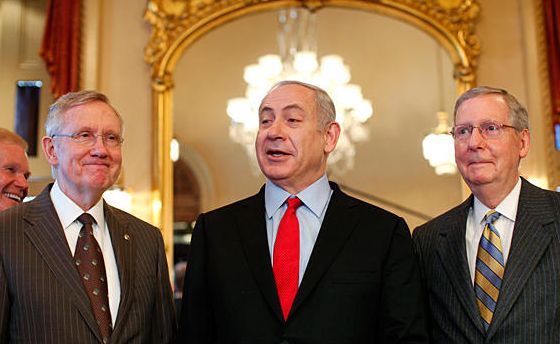
Benjamin Netanyahu flanked by Congressional courtiers

The Jerusalem Post reports: Citing historical precedents in which the US and Israel did not see eye-to-eye and Israel acted according to its own perception of its interests, Prime Minister Binyamin Netanyahu told congressional leaders Tuesday that Israel viewed things differently than the US did at times, because it was not a global power and was more vulnerable.

Israeli sources said Netanyahu, meeting congressional leaders before flying back to Israel Tuesday evening, noted that David Ben-Gurion declared independence against the advice of the US; Levi Eshkol launched a preemptive attack in 1967, against Washington’s counsel; and Menachem Begin decided to bomb the Iraqi nuclear reactor in 1981 despite US opposition.

America has global interests, while Israel is “on the ground and more vulnerable,” Netanyahu said in reference to Iran, saying that this made for a very different perspective.

Netanyahu followed up his meeting at the White House Monday with meetings on Capitol Hill on Tuesday, as leaders of both parties pledged commitment to a robust policy to keep Iran from getting nuclear arms.

Facebooktwittermail