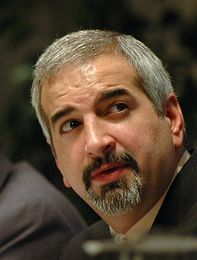
Remembering Anthony Shadid

Quil Lawrence writes: I met Anthony Shadid on a ruined airstrip in western Afghanistan in the winter of 2001-’02. He was sporting a beard and longer hair in those days that made him look a little like a crusading Arab warrior. We spoke briefly and exchanged a few bits of useful news about the place. As I recall his face now, I realize Anthony’s secret: His sincerity was piercing, disarming and infectious.

Over the next decade, I got to watch Anthony’s genuine curiosity overcome the suspicions of refugees, ambassadors and warlords, as he soaked up their stories and rendered them with great generosity of spirit. His writing could inspire kinship between Americans from his native Oklahoma and the terrified people of Baghdad, the demonstrators in Cairo, the rebel fighters in Libya and Syria.

The year after we met in Afghanistan, I saw Anthony in Washington, D.C. — he was just back from a stint in Israel and the Palestinian territories. I asked him how it went, and he replied with unfeigned nonchalance, “Not that good. I got shot.”

Anthony had been reporting in Ramallah in 2002 and took a bullet in the back of his shoulder. He believed it was fired by Israeli Defense Forces. The wound was complicated because Anthony refused to leave Ramallah unless his Palestinian colleague could cross the checkpoint with him. Over the years, Anthony was beaten and abducted while covering the news. He knew he was taking risks. But he also knew (though his unassuming nature would have never let him say it) that he was fulfilling his life’s mission, explaining the Arab world to Americans with a fluency and empathy perhaps no other reporter could match.

Steve Coll writes: Anthony Shadid’s third book, “House of Stone,” is due to be published in several weeks. It is described by the publisher as a “a memoir of home, family and a lost Middle East.” The project, when Shadid talked about it occasionally, was more personal than that sort of subtitle can easily convey. Shadid grew up in Oklahoma, in a family of Lebanese origin. He attended the University of Wisconsin and went into newspaper work. Like many American writers whose families arrived here from somewhere else, he was drawn gradually to the landscape of his family’s origins. “House of Stone” tells the story of Shadid’s efforts to rebuild — and excavate the history of — a family property in Lebanon. When he spoke about that project, and the life he had forged in Lebanon to carry it out, he mentioned a theme that was always present in his newspaper correspondence: that the “zone of crisis” frame that so often surrounded reporting from the Middle East was frustrating and inadequate. The Arab world, like any other, was not best understood by focusing exclusively on its wars and conflicts (although he did not shy away from any of those, or whitewash their ugliness) but through its longer, subtler narratives of family, time, and transition. “House of Stone” is such a narrative.

Shadid, who died on Thursday at the age of forty-three, while covering the conflict in Syria for the Times, apparently of an asthma attack, was, over the last decade or more, the most intrepid, empathetic, fully engaged correspondent working in the Middle East for American audiences. He had many gifts and was an exceptionally graceful, easy, and generous man, but among the qualities that distinguished his work was the sheer commitment of it. When he came to the Washington Post about a decade ago to serve as a correspondent, I was working as an editor at the paper. I asked a standard job interview question about his goals in the years ahead, and he provided one of the most striking, emphatic answers I can recall from countless discussions of that type: He intended to move to the Middle East, to chronicle in every dimension possible the upheavals in Arab societies that would inevitably follow the September 11th attacks, and to do nothing else, professionally. If we, the Post, would facilitate this ambition, he would be grateful, but that was the only job he was interested in or would be for years to come, he said. It is rare for anyone — never mind a writer — to possess such clarity. And Shadid carried out his plan exactly as he said he would, just not for the full measure of years that we would have wished.


Facebooktwittermail

Remembering Anthony Shadid: In Assad’s Syria, there is no imagination

On November 8, 2011, Anthony Shadid wrote: The House of Assad evokes an imperial sense of power, or at least its trappings, with iconography that one scholar described as infused with “laudatory slogans and sempiternal images.”

But my first impression of Rami Makhlouf, President Bashar al-Assad’s cousin and one-time confidante, was of his unassuming quality. Here was a tycoon, a figure as rich as he was loathed, who eschewed formalities and ceremony. I had seen it before, in men like Saad Hariri, a former prime minister in Lebanon, lavished with so much privilege and so much wealth that pretensions become unnecessary. Even his most brazen threats seemed more pleading than menacing, as if I should understand the logic behind them. Don’t the Israelis know that they will suffer if we do; don’t the Europeans; don’t the Americans realize that we are the bulwark before forces that they can’t imagine — Islamists, chaos, wars roiling an already combustible region?

By the end of several hours interviewing Makhlouf in May, it was not pomp, not imagery and not detachment that denoted the imperium. It was the pronouns. The way he used them said much about how power has been exercised in the Arab world and why it has finally begun to crumble.

“We believe there is no continuity without unity,” he told me. “As a person, each one of us knows we cannot continue without staying united together.”

He echoed an Arabic proverb – alaya wa ala aadai’i ya rab.

Translated loosely, it means that we won’t go down alone.

“We will not go out, leave on our boat, go gambling, you know,” he told me at his plush, wood-paneled headquarters in Damascus. “We will sit here. We call it a fight until the end.” He added later: “They should know when we suffer, we will not suffer alone.”

What Makhlouf, a businessman with no title, no official capacity save his membership in the president’s family, suggested was that Syria belonged to them: its property and people, their aspirations and fate, their history and their future. In essence, consciously or not, he gave voice to the sign that has long marked the crossing for visitors across the rocky wadis dividing Lebanon and Syria.

“Assad’s Syria,” it reads. [Continue reading…]

Facebooktwittermail

Remembering Anthony Shadid: In Iraq — A boy who was ‘like a flower’

From Baghdad on March 30, 2003, Anthony Shadid wrote: On a cold, concrete slab, a mosque caretaker washed the body of 14-year-old Arkan Daif for the last time.

With a cotton swab dipped in water, he ran his hand across Daif’s olive corpse, dead for three hours but still glowing with life. He blotted the rose-red shrapnel wounds on the soft skin of Daif’s right arm and right ankle with the poise of practice. Then he scrubbed his face scabbed with blood, left by a cavity torn in the back of Daif’s skull.

The men in the Imam Ali mosque stood somberly waiting to bury a boy who, in the words of his father, was “like a flower.” Haider Kathim, the caretaker, asked: “What’s the sin of the children? What have they done?”

In the rituals of burial, the men and their families tried, futilely, to escape the questions that have enveloped so many lives here in fear and uncertainty. Beyond some neighbors, family, and a visitor, there were no witnesses; the funeral went unnoticed by a government that has eagerly escorted journalists to other wartime tragedies. Instead, Daif and two cousins were buried in the solitude of a dirt-poor, Shiite Muslim neighborhood near the city limits.

The boys were killed at 11 a.m. today when, as another relative recalled, “the sky exploded.” Daif had been digging a trench in front of the family’s concrete shack that could serve as a shelter during the bombing campaign that continues day and night. He had been working with Sabah Hassan, 16, and Jalal Talib, 14. The white-hot shrapnel cut down all three. Seven other boys were wounded.

The explosion left no crater, and residents of the Rahmaniya neighborhood struggled to pinpoint the source of the destruction. Many insisted they saw an airplane. Some suggested Iraqi antiaircraft fire had detonated a cruise missile in the air. Others suggested rounds from antiaircraft guns had fallen back to earth and onto their homes.

Whoever caused the explosion, the residents assigned blame to the United States, insisting that without a war, they would be safe. “Who else could be responsible except the Americans?” asked Mohsin Hattab, a 32-year-old uncle of Daif.

“This war is evil. It’s an unjust war,” said Imad Hussein, a driver and uncle of Hassan. “They have no right to make war against us. Until now, we were sitting in our homes, comfortable and safe.”

As he spoke, the wails of mourners pouring forth from homes drowned out his words. He winced, turning his head to the side. Then he continued. “God will save us,” he said softly.

At the mosque, hours after the blast, Kadhim and another caretaker prepared Daif’s body for burial — before sundown, as is Islamic custom.

Bathed in the soft colors of turquoise tiles, the room was hushed, as the caretakers finished the washing. They wrapped his head, his gaze fixed, with red and yellow plastic. They rolled the corpse in plastic sheeting, fastening it with four pieces of white gauze — one at each end, one around his knees and one around his chest.

Kadhim worked delicately, his gestures an attempt to bring dignity to the corpse. He turned Daif’s body to the side and wrapped it in a white sheet, secured with four more pieces of gauze. Under their breaths, men muttered prayers, breaking the suffocating silence that had descended. They then moved toward the concrete slab and hoisted the limp body into a wood coffin.

“It’s very difficult,” said Kadhim, as the men closed the coffin.

On Friday, he had gone to another mosque, Imam Moussa Kadhim, to help bury dozens killed when a blast ripped through a teeming market in the nearby neighborhood of Shuala. The memories haunted him. He remembered the severed hands and heads that arrived at the Shiite mosque. He recalled bodies, even that of an infant, with gaping holes.

“It was awful and ugly,” he said. “This is the first time I’ve ever seen anything like this.” [Continue reading…]

Facebooktwittermail

New York Times loses an indispensable correspondent

The New York Times reports: Anthony Shadid, a gifted newspaper correspondent whose graceful dispatches for both The New York Times and The Washington Post covered nearly two decades of Middle East conflict and turmoil, died, apparently of an asthma attack, on Thursday while on a reporting assignment in eastern Syria. Tyler Hicks, a Times photographer who was with Mr. Shadid, carried his body across the border to Turkey.

Mr. Shadid, 43, had been reporting inside Syria for a week, gathering information on the Free Syrian Army and other armed elements of the resistance to the government of President Bashar al-Assad, whose military forces have been engaged in a harsh repression of the political opposition in a conflict that is now nearly a year old.

The Syrian government, which tightly controls foreign journalists’ activities in the country, had not been informed of his assignment by The Times.

The exact circumstances of Mr. Shadid’s death and his precise location inside Syria when it happened were not immediately clear.

But Mr. Hicks said that Mr. Shadid, who had asthma and had carried medication with him, began to show symptoms as both of them were preparing to leave Syria on Thursday, and the symptoms escalated into what became a fatal attack. Mr. Hicks telephoned his editors at The Times, and a few hours later he was able to take Mr. Shadid’s body into Turkey.

Jill Abramson, the executive editor, informed the newspaper’s staff Thursday evening in an e-mail. “Anthony died as he lived — determined to bear witness to the transformation sweeping the Middle East and to testify to the suffering of people caught between government oppression and opposition forces,” she wrote.

The assignment in Syria, which Mr. Shadid arranged through a network of smugglers, was fraught with dangers, not the least of which was discovery by the pro-government authorities in Syria. The journey into the country required both Mr. Shadid and Mr. Hicks to travel at night from Turkey to a mountainous border area adjoining Syria’s Idlib Province, where the demarcation line is a barbed-wire fence. Mr. Hicks said they squeezed through the fence’s lower portion by pulling the wires apart, and guides on horseback met them on the other side. It was on that first night, Mr. Hicks said, that Mr. Shadid suffered an initial bout of asthma, apparently set off by an allergy to the horses, but he recovered after resting.

On the way out a week later, however, Mr. Shadid suffered a more severe attack — again apparently set off by proximity to the horses of the guides, Mr. Hicks said, as they were walking toward the border. Short of breath, Mr. Shadid leaned against a rock with both hands.

“I stood next to him and asked if he was O.K., and then he collapsed,” Mr. Hicks said. “He was not conscious and his breathing was very faint and very shallow.” After a few minutes, he said, “I could see he was no longer breathing.”

Mr. Hicks said he administered cardiopulmonary resuscitation for 30 minutes but was unable to revive Mr. Shadid.

The death of Mr. Shadid, an American of Lebanese descent who had a wife and two children, abruptly ended one of the most storied careers in modern American journalism. Fluent in Arabic, with a gifted eye for detail and contextual writing, Mr. Shadid captured dimensions of life in the Middle East that many others failed to see. Those talents won him a Pulitzer Prize for international reporting in 2004 for his coverage of the American invasion of Iraq and the occupation that followed, and a second Pulitzer in 2010, also for his Iraq reporting. He also was a finalist in 2007 for his coverage of Lebanon, and has been nominated by The Times for his coverage of the Arab Spring uprisings that have transfixed the Middle East for the past year.

In December, during a brief break from reporting in the Middle East, Shadid was interviewed by Terry Gross and reflected on the Arab Spring.

Facebooktwittermail

Israelis prepare for war with Iran

Larry Derfner reports: After bombs went off near Israeli embassies in New Delhi and Tbilisi, and a man with an Iranian passport accidentally blew himself up in Bangkok, Israeli Prime Minister Binyamin Netanyahu couldn’t let the opportunity pass. Yediot Aharonot, the country’s most widely read newspaper, reported Wednesday:

An updated list of talking points distributed by the national advocacy desk in the Prime Minister’s Office sought to connect the wave of terror with the international community’s efforts at tightening sanctions on Iran, and also to prepare the ground for a military option to stop Iran’s nuclear program.

According to Yediot, the new talking points read: “Iran and Hizbullah are behind these terror attempts. If this is what Iran is doing now, imagine what it will do if its nuclear arms project reaches the goal.” The tabloid’s story was headlined “Iran’s long arm,” and the subhead read, “Israel to the world: ‘Terror acts show nuclear Iran cannot be allowed.’” The story’s ominous tone meshed perfectly with the talking points.

Israel’s whole body politic – politicians, media, influential public figures and public at large – is now leaning into a war with Iran. Defense Secretary Leon Panetta’s recently reported opinion that Israel would likely strike between April and June is shared, give or take a month or two, by countless others.

The consequences of such an attack range from a bilateral missile war and intensified international terror attacks, to a regional war involving weapons of mass destruction. Israel may not pull the trigger, of course. But at this point, that seems the only realistic working assumption.

Israeli talking points are coming faster and sharper. Iran’s nuclear project is marching toward the “zone of immunity,” says Defense Minister Ehud Barak. “It is our duty to rely on ourselves when we are concerned with a threat to our very existence,” says Netanyahu. Their apparent aim is to create an aura of inevitability around an imminent Israeli strike. Leading the drive, Netanyahu and his one-time army commando unit leader, Barak, want full support at home and no serious opposition from the U.S. if and when they send the jet bombers on their mission. Naturally, they would prefer that the U.S. do the job – inflicting lasting damage on Iran’s nuclear infrastructure could well be beyond Israel’s military capability – but from here, at least, the American military option looks unlikely, certainly within a time frame Israel accepts.

Some skeptics think Netanyahu and Barak may just be engaging in psychological warfare aimed at keeping Western economic pressure on Iran, the goal being to force or scare the Tehran regime into giving up its pursuit of nuclear weapons, which it denies pursuing. But it’s hard to imagine anything short of visibly destroyed hardware on a massive scale that might convince Israel’s leadership that the nuclear threat had been lifted.

Yet while there is skepticism about the leadership team’s true intentions, there is virtually none being expressed here about the wisdom of going to war. The paucity of dissent is remarkable, not to say depressing, in a country that prides itself on being a “vibrant democracy.”

At the end of last week, the media were talking about which towns had good bomb shelters and air raid sirens and which didn’t. The likelihood that Israel would soon be attacking Iran had begun to sink in. An antiwar demonstration was held across the boulevard from the Defense Ministry compound in Tel Aviv. About 25 people showed up. They held signs that read, “Don’t bomb – talk” to the evening rush hour traffic going past. One driver honked. [Continue reading…]

Facebooktwittermail

New NYT Jerusalem bureau chief guilty of not being a Zionist

Since the departing New York Times Jerusalem bureau chief Ethan Bronner clearly is a Zionist, I guess some observers thought that being a Zionist must have become a job requirement.

The Washington Free Beacon thus reports with deep concern:

The New York Times’ incoming Jerusalem bureau chief, Jodi Rudoren, won’t say if she is a Zionist.

“I’m going to punt on that question,” Rudoren, who is Jewish, told the Washington Free Beacon in an interview yesterday. “I’m not really interested in labels about who I am and what I think.”

Rudoren, formerly the paper’s education editor, has come under fire in recent days for sending out a series of sympathetic tweets to some of Israel’s fiercest non-terrorist critics. Some pro-Israel observers are questioning Rudoren’s ability to remain neutral, as well as her qualifications, as she covers one of the Middle East’s most volatile and fraught conflicts.

Asked point-blank if she considers herself a Zionist, Rudoren demurred.

“I describe myself as a journalist. I don’t describe myself in political terms on any subject,” she said. “I see my role in the world as an observer of what’s going on, so I don’t take on labels that have, sort of, ideological or just activist positions.”

Rudoren added: “I don’t know that I’ve ever described myself as a Zionist in the past. I certainly think that right now in my job, and where Zionism is a subject of discussion, I don’t have any interest in being one or not being one. I’m not a Zionist or anti-Zionist.”

For most observers, Rudoren’s declaration that she is neither a Zionist nor an anti-Zionist would put her in the perfect position of neutrality. But if pro-Israel observers claim to be questioning her neutrality, what they really seem to be expressing is their own inability to trust anyone who is not a Zionist.

In the eyes of the Zionists, Rudoren’s most egregious mistake in her new position was to exchange tweets with Ali Abunimah, one of the most prominent Palestinian activists in the U.S.. She also tweeted with Mondoweiss. There were clear signs that the sky might be about to fall.

Former AIPAC spokesman, Josh Block, told the Beacon:

“These are not people you engage like this, especially your first day as Jerusalem Bureau Chief for the paper of record. You really don’t even want to be seen in public with them — it’s just a mistake.”

The Washington Free Beacon might be a publication you’ve never heard of — I hadn’t. So you might wonder: why is it that they have such a keen interest in Rudoren’s tweets? Turns out it’s a project of Center for American Freedom which itself seems to be an offshoot of the neoconservative Weekly Standard. William Kristol is on its three-person board and Michael Goldfarb is its chairman.

So the Beacon’s interest in Rudoren should be viewed less as journalism and more as a kind of Zionist police action. Rudoren just got given a ticket — since she’s a Jew but not a card-carrying Zionist, does she, the police officer wonders, have any business reporting in Israel?

Facebooktwittermail

Can Obama avert war with Iran?

Gareth Porter writes: President Barack Obama has finally begun in recent months to signal to Israel that the United States would not get involved in a war started by Binyamin Netanyahu without US approval. If it is pursued firmly and consistently through 2012, the approach stands a very good chance of averting war altogether. If Obama falters, however, the temptation for Netanyahu to launch an attack on Iran, indulging in what one close Israeli observer calls his “messianism” toward the issue of Iran.

Netanyahu, like every previous Israeli prime minister, understands that an Israeli strike against Iran depends not only on US tolerance, but direct involvement against Iran, at least after the initial attack. In May 2008, his predecessor, Ehud Olmert, had requested the approval of George W Bush for an air attack on Iran, only to be refused by Bush.

Netanyahu apparently feels, however, that he can manipulate right-wing Israeli influence on American politics to make it impossible for Obama to stay out of an Israeli war on Iran. He has defied the Obama administration by refusing to assure Washington that he would consult them before making any decision on war with Iran.

The Obama administration’s warning signal on the danger of an Israeli attack began flashing red after Secretary of Defence Leon Panetta came back empty-handed from a trip to Israel in September.

US officials then came up with a new strategy for pulling Israel back from the precipice of war by letting Netanyahu know that, if the US were denied a full role in coordinating military policy toward Iran, it would not come to Israel’s aid in such a war.

The first step in the strategy came when Panetta was answering questions after a talk at the Saban Centre of Brookings Institution on December 2. He not only expressed clear disapproval of an Israeli attack as counter-productive – something the administration had avoided in 2009 and 2010 – but went on to indicate that the US was concerned that it “could possibly be the target of retaliation from Iran, striking our ships, striking our military bases”.

Without saying so directly, that remark hinted that the US would take steps to avoid that situation, if necessary. It was evidently aimed at planting the seed of doubt in Netanyahu’s mind that Obama would be willing to respond to Iranian retaliation against Israel in the event of an Israeli strike.

Facebooktwittermail

Iran seems an unlikely culprit for the attacks on Israeli diplomats

Arshin Adib-Moghaddam writes: Let’s assume that sections of the military and security apparatus in Iran are responsible for the string of bombings in Georgia, Thailand and India. What would be the motive? The argument that Iran is retaliating for the murder of five civilian nuclear scientists in Iran is not plausible. If Iran wanted to target Israeli interests, it has other means at its disposal. It is hard to imagine that the Iranian government would send Iranian operatives to friendly countries, completely equipped with Iranian money and passports – making the case against them as obvious as possible.

If the Iranian Revolutionary Guards are as professional, highly trained and politically savvy as we have been told repeatedly by Israeli politicians themselves, if they have successfully trained and equipped the cadres of Hezbollah and other movements with paramilitary wings in the region, then why would they launch such a clumsy and self-defeating operation?

And why India, Georgia and Thailand, three countries that Iran has had cordial relations with during a period when Iran is facing increasing sanctions spearheaded by the United States? A few days ago, India agreed a rupee-based oil and gas deal with Iran and resisted US pressures to join the western boycott of the Iranian energy sector. As a net importer of 12% of Iranian oil, India’s total trade with Iran amounted to $13.67bn in 2010-2011. What would be the motive for damaging relations with one of Iran’s major trading partners and regional heavyweights?

For Iran it doesn’t make sense to risk alienating India by launching an assassination attempt in the capital of the country. Similarly, Iran has good economic and political relations with Georgia and Thailand. Why would the leadership in Tehran risk a major crisis with these countries during this sensitive period when IAEA inspectors are moving in and out of Iran to investigate the country’s nuclear programme?

Facebooktwittermail

One Libyan in three wants return to authoritarian rule

The Independent reports: Almost a year after the start of the Libyan uprising that led to the ousting and killing of Colonel Muammar Gaddafi, new research suggests more than a third of its citizens would rather return to being ruled by a strongman than embrace democracy.

Despite thousands of deaths in the revolt against Colonel Gaddafi’s 40-year rule, fewer than a third of Libyans would welcome democracy, according to the study published by the Institute of Human Sciences, at the University of Oxford, and Oxford Research International.

Libya is traditionally a tribal society and there are concerns that the vacuum created by Colonel Gaddafi’s removal in October could lead to clashes between the factions that toppled him. In recent weeks, medical and human-rights groups have complained that the situation in parts of country is getting out of control.

The deaths of 12 detainees who lost their lives after being tortured by the various militias running law and order in towns and cities across country are documented in an Amnesty International report released today. The study follows last month’s decision by Médecins sans Frontières to halt operations in Misrata after being asked by officials to treat prisoners midway through torture sessions, allowing authorities to abuse the victims again.

Still, the survey found 35 per cent would still like a strong leader in five years’ time, although more than two-thirds wanted some say in future governance.

Facebooktwittermail

Egypt’s constitution: it’s not really about the religious clauses

Nathan J Brown writes: As Egypt’s parliament prepares to designate the drafters of a new constitution, the country is embarking on an unprecedented and difficult journey. This is not the first time a constitution has been written for Egypt but it is the first time so many Egyptians will be focused on writing one. Previous constitutions have been authored by small committees serving existing rulers; now a wide range of voices insist on being heard.

In the year since the vast celebration in Tahrir Square marking Mubarak’s departure, Egyptians have come to discover how many differences they harbour. Class, faith, degree of religiosity, ideology and gender lead them to see their society very differently and develop deeply contrasting ideas about the best political course for the country. Egyptians continue to demand that the military leave politics; others show dismay at the disruption that the revolution has brought to Egyptian society; some relish the opportunity to implant Islamic practices more deeply in daily life; others fear that pockets of secularist society will be endangered.

And all these various orientations must now work together to build the fundamental structures of political life by writing a constitution. This will hardly be Egypt’s first such document, but all past efforts have been spearheaded by rulers or narrow elites surrounding them. For the first time, a diverse and politicised society will be watching and participating in setting down the basic rules of politics. What will they need to do to accomplish this goal in a democratic, just, and stable manner?

Most international eyes – and many domestic ones – will go straight to the clauses that concern religion. Since 1980, Egyptians have been governed by a clause that proclaims “the principles of the Islamic sharia are the main source of legislation”. Debate has already begun on whether to modify, tighten, or loosen that phrase. But for all the emotion that such debate generates, the real focus of attention should be directed elsewhere. What so many observers miss is that these formulas are extremely general. Whatever specific meaning they carry will rest not so much on what the words say as on who is empowered to interpret and implement them.

Facebooktwittermail

Iran already has the bomb — according to Newsweek — updated

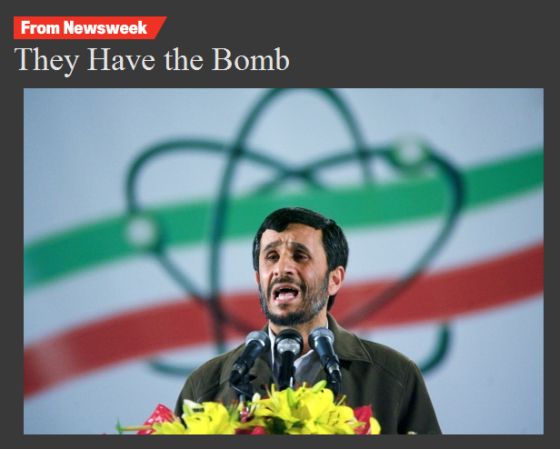
That’s a misleading headline. And so is this:

This is the first image in a Newsweek/Daily Beast gallery on "Nations in the nuclear club".

The caption to the right of this photo of Iran’s President Mahmoud Ahmadinejad reads: “At left, the the [sic] reactor building of the Bushehr nuclear power plant in October 2010.” But in order to see the image of Bushehr, the reader needs to click to the next image and then click back to the previous. So, when readers click through to the gallery from the Newsweek feature article, “Obama’s Dangerous Game With Iran,” the first image they are presented with is Ahmadinejad under the headline, “They Have the Bomb.”

Update: Without any explanation for the earlier presence of the Ahmadinejad photo shown above, Newsweek now has Bushehr as the opening image in this gallery. Nevertheless, the headline, “They Have the Bomb,” and beneath that an image of an Iranian nuclear reactor, is still misleading.

Facebooktwittermail

Which way goes the Obama-Netanyahu ‘trust deficit’?

According to Newsweek’s Daniel Klaidman, Eli Lake, and Dan Ephron, Benjamin Netanyahu has a hard time trusting Barack Obama. They report that a key moment in the breakdown in trust came in late May last year.

From the get-go, Obama had a frosty relationship with Israeli Prime Minister Netanyahu. “There’s no question that tension grew between the two, because we felt like … they had a different estimation [of the timeline for Iran to get nuclear-weapons capability],” says the Pentagon source, “and we felt like some of their [kinetic] activities undermined what we were trying to do. Obama’s view was, why would you remove the opportunity for a diplomatic solution for something that was so incrementally significant [as killing a scientist]?”

That trust deficit was exacerbated in May of last year when Obama delivered a landmark speech outlining his wider Middle East policy. Netanyahu was preparing to fly to Washington at the time and was surprised when he heard the president state that the 1967 borders should be a basis for negotiating the final frontiers of a Palestinian state. Netanyahu believed he had an understanding with Obama that some Jewish settlements built in areas occupied by Israel in the 1967 war would remain inside Israel, a position detailed in a 2004 letter from President Bush to then-prime minister Ariel Sharon. When Netanyahu finally arrived at the Oval Office, he was furious. At a photo op with the two leaders, Netanyahu began to lecture the president on Israel’s security needs before the gathered journalists.

That incident was treated as a small blip in U.S.-Israel relations at the time. Obama soon clarified his position at the annual conference of the American Israel Public Affairs Committee, the most powerful pro-Israel lobby in Washington, stating that negotiated borders should be based on the 1967 lines “with mutually agreed swaps.” [My emphasis.] But resentment persisted. In June Israeli intelligence and military officers stopped discussing any details of their planning, analysis, and training cycles for a possible attack on Iran. Until then cooperation had been close: a regular video teleconference between U.S. and Israeli national-security advisers to discuss Iran was established during the first Netanyahu visit to Washington, in 2009. As one senior Israeli official puts it, “We … both wanted no surprises.”

But there’s a rather glaring problem with this account — a problem about which any journalist in Washington who had been half awake at the time would have been fully aware. Obama could hardly have later “clarified” his position by referring to “mutually agreed swaps.” Why? Because the very statement that had supposedly so enraged Netanyahu was this: “We believe the borders of Israel and Palestine should be based on the 1967 lines with mutually agreed swaps, so that secure and recognized borders are established for both states.” [My emphasis.] That’s what Obama said in his May 19 speech. But Netanyahu — and much of the Washington press corps that chooses to march in lockstep with Israel — chose to ignore Obama’s reference to mutually agreed territorial swaps.

Commenters, letter writers or someone must have brought this to the attention of Newsweek’s editors leading them to bury “correct” the “mistake.” In the online version of the article, this sentence:

Obama soon clarified his position at the annual conference of the American Israel Public Affairs Committee, the most powerful pro-Israel lobby in Washington, stating that negotiated borders should be based on the 1967 lines “with mutually agreed swaps.”

has been replaced with this:

Obama soon clarified his position at the annual conference of the American Israel Public Affairs Committee, the most powerful pro-Israel lobby in Washington, emphasizing that a negotiated border between Israel and a new Palestinian state would by definition be “different than the one that existed on June 4, 1967.”

This is what one might call a cover-your-ass correction. The article’s misrepresentation of the facts is no longer quite as glaring, yet the core accusation — that Obama had undermined Netanyahu’s confidence — remains. It remains, because the whole thrust of the article is about the degree to which Netanyahu has a hard time trusting Obama and that would be a hard argument to sustain if one of its key elements was bogus.

Netanyahu’s tantrum was not the result of a trust deficit. It was a piece of political theater from a man who knows how to push around American presidents. In 2001 he declared: “I know what America is. America is something that can easily be moved.”

Newsweek, instead of honestly portraying the duplicity of the Israeli prime minister, would rather have its readers believe that Netanyahu is burdened by the angst of wondering whether he can trust the White House.

Facebooktwittermail

Q&A: Nir Rosen on Syria’s armed opposition

Al Jazeera: Who were the first to take up arms?

NR: The armed phenomenon began in rural areas, known in Arabic as the reef, and in the working class urban shaabi areas. Men there were more likely to own guns and were known as qabaday – “tough” men more likely to have the courage (and potential for violence) that one needs to respond violently to security forces. They had more grievances – and less to lose – than middle or upper class activists with university degrees.

AJ: Who do the armed groups target?

NR: From an early stage of the uprising, suspected informants for the regime have been intimidated, expelled and often killed.

These are called mukhbir [“sources”], or in colloquial Syrian awayneh or fasfus. Executions of those suspected of spying for the regime take place regularly all throughout Syria, including in Damascus. By the summer there were regular ambushes of security officers on the roads, as well as attacks against shabiha [“thugs”], as the civilian paramilitary or militia forces of the security agencies are known.

AJ: What methods and weapons do the fighters use?

NR: Initially, individuals responded to the violent crackdown on demonstrations by using any weapons they had at home to take pot shots at security forces. Then groups of demonstrators used rocks, Molotov cocktails, dynamite sticks, knives, shotguns, hunting rifles, pistols and the occasional automatic rifle to defend demonstrations when security forces attacked.

This escalated into attacks on buses, or gatherings of security forces believed to be on their way to attack demonstrations, and evolved into a classic insurgency. In some places, demonstrators also responded to attacks by security forces by attacking buildings belonging to the ruling Baath Party, the police, the security forces or courthouses – and ridding these of any state presence.

The armed groups generally operate secretly and in small groups, conducting ambushes on targets of opportunity using light arms and, increasingly, improvised explosive devices. For the past few months, insurgents have been using improvised explosive devices such as those found in Iraq, Afghanistan or southern Lebanon. Unlike in Iraq, however, the explosives used in these IEDs are fertiliser-based. These have been used in Idlib, Hama and Homs. In addition, rocket-propelled grenades – such as LAW anti-tank shells – have also more recently been used as shoulder-fired anti-armour missiles. The fighters have access to some sniper rifles as well.

I have seen evidence of complex attacks, involving several IEDs followed by heavy machine-gun fire.

AJ: How do armed groups get their arms?

NR: The Syrian insurgency is not well-armed or well-funded. Fighters purchase their weapons locally on the black market, from arms dealers and smugglers who are profiting from the violence in Syria. I have been with insurgents purchasing weapons and seen how they arrange to do so via smugglers from Iraq, Lebanon and Turkey.

They also capture weapons from security forces in attacks on regime arms depots. One armed group in Idlib captured several dozen Kornet anti-tank missiles. Sometimes they even purchase them from corrupt officers within the security apparatus.

AJ: How do the groups finance their arms purchases?

NR: Many fund their arms purchases by turning to their savings or selling what valuables they have, or the products of their shops or farms. Others borrow money from friends. Much of the financing comes from Syrian businessmen inside or outside the country. Some Syrian opposition activists and politicians in exile are sending money to people inside. In addition, diaspora Syrians tied to Islamist movements, such as the Muslim Brotherhood, or to conservative clerics in the Gulf, also send money to certain groups.

The fighters usually belong to small cadres, such as “Abu Muhamad’s Group”, where Abu Muhamad may have access to some money with which he supports his band of fighters. Some groups give their “companies” or “brigades” names – often after “martyrs” or those with “heroic” religious connotations. This creates the false impression in much of the foreign media that there is some national leader, a chain of command, a structure or order of battle and divisions.

The fighters arm themselves and fund themselves as individuals or small groups, not as the “Free Syrian Army”. Nor are they funded directly by any state actor or intelligence agency. Indirectly, however, some Syrian exile religious movements or opposition political figures might be channelling funding from various countries to groups inside Syria.

AJ: How much impact do army defections have?

NR: There is a steady stream of army defectors, and to a lesser extent from the security agencies. Some defect with their weapons.

The regime is in a quandary. Its security agencies alone cannot clear or hold a village or a neighbourhood or a city. They need the Syrian army to back them up. But Syrian conscripts are often from the Sunni majority – and so is most of the opposition – from all over Syria, including from hotspots of the revolution. So it is soldiers’ own brothers and cousins who are demonstrating. Moreover, when the poorly paid Syrian soldiers are deployed to an area, they fraternise with the local population. Locals feed them and let them use their mobile phones to call home. Local activists persuade them to defect and arrange for their safe haven.

Meanwhile, Sunni members of the army are coming under increasing suspicion by the security agencies, and there have been cases of security men killing soldiers for refusing to obey orders to shoot. Hundreds of soldiers and officers have also been arrested.

AJ: What is the rank of the defecting officers?

NR: I did not meet any more senior than lieutenants, but some majors and colonels have also defected.

Local opposition leaders will say that they need fighters more than officers. They are also suspicious of officers who have waited so long to defect. They will ask: “What have they been waiting for?” They are worried that some defecting officers are double agents who would inform on them, which has already happened.

Additionally, opposition leaders claim they are in touch with senior officers who have “made their allegiance to the revolution clear” and who provide them with intelligence – and are thus more valuable to their cause if they remain inside the system. Finally, defecting officers face a logistical challenge. They must arrange for a safe place to flee – and they must arrange protection for their families.

AJ: To what extent is the Syrian uprising a peaceful one?

NR: The debate over whether or not it is peaceful is not based on empirical research but on propaganda from both sides. The pro-regime media wants to portray the revolutionaries as nothing more than armed criminals and terrorist gangs. In response, opposition supporters have, until recently, denied all violence – fetishising the notion of a peaceful revolution – which has hurt not only their credibility, but the credibility of foreign media which often uncritically report their accounts.

The debate is also largely irrelevant. On the ground it was clear that by the end of Ramadan (late August), that there was a growing consensus on the part of opposition supporters that only an armed struggle could overthrow the regime. [Continue reading…]

Facebooktwittermail

U.S. media pushing for war against Iran

Glenn Greenwald writes: Many have compared the coordinated propaganda campaign now being disseminated about The Iranian Threat to that which preceded the Iraq War, but there is one notable difference. Whereas the American media in 2002 followed the lead of the U.S. government in beating the war drums against Saddam, they now seem even more eager for war against Iran than the U.S. government itself, which actually appears somewhat reluctant. Consider this highly illustrative, one-minute report yesterday from the nightly broadcast of NBC News with Brian Williams, by the network’s Chief Pentagon Correspondent Jim “Mik” Miklaszewski, which packs multiple misleading narratives into one short package:

We’re told that if the U.S. ends up in a war with Iran, then “the U.S. Navy’s Fifth Fleet would be the world’s first line of defense“: because Iran is threatening the entire world, and the U.S. would be defending “the world” from this grave Persian menace. Then there’s the ominous claim that “Iranian leaders have threatened all-out war”: but that’s “if Israel launches air strikes against Iran’s nuclear program,” which would already itself be “all-out war.” The NBC story — which begins with video shots of Iranians in lab coats lurking around complex, James-Bond-villain-like nuclear-ish machines — ends with twenty seconds of scary video footage of Iranian missiles being launched, accompanied with this narration: “U.S. officials warn that Iran’s massive stockpile of ballistic missiles is the more serious threat”; after all, “within just the past few days, Iranian leaders [cue video of a scary, ranting Ahmedinijad] have threatened that if attacked, they would launch those missiles at U.S. targets.”

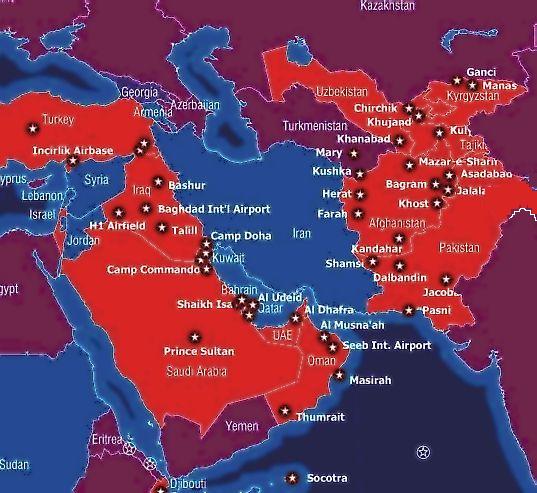
It’s just remarkable to watch the American media depict Iran as the threatening, aggressive party here. Literally on a daily basis, political and media figures in both the U.S. and Israel openly threaten to attack Iran and debate how the attack should happen with a casualness that most people use to contemplate what to have for lunch. The U.S. has orchestrated devastating and always-escalating sanctions which, by design, are wrecking the Iranian economy, collapsing its currency, and generating serious hardship for its 75 million citizens. The U.S. military has that country almost completely encircled. The U.S. military behemoth, and Israel’s massive nuclear stockpile and sophisticated weaponry, make the Iranian military by comparison look almost as laughable as Saddam’s. Iran’s scientists have been serially murdered on its own soil, their facilities bombarded with sophisticated cyber attacks, and dissident groups devoted to the overthrow of their government (ones even the U.S. designates as Terrorists) have been armed, trained and funded by Israel while leading American politicians openly shill for them in exchange for substantial payments. [Continue reading…]

Iran under siege: Each star represents a U.S.-manned beacon of hope -- the only thing that stands between us and Armageddon.

Facebooktwittermail

For Iraqis, aid to rebels in Syria repays a debt

The New York Times reports: Not so long ago, Syrians worked to send weapons and fighters into Iraq to help Sunnis fighting a sectarian conflict; suddenly, it is the other way around.

A belated celebration of the Prophet Muhammad’s birthday on the outskirts of this western Iraqi city on Saturday quickly took on the trappings of a rally for Syria’s rebels. Young boys waved the old green, black and white flag Syria adopted in the 1930s after declaring independence from the French. Others collected money to send aid and weapons to the fighters opposing President Bashar al-Assad’s government across the border.

“I wish I could go there with my gun and fight,” said Sheik Hamid al-Hais, a tribal leader interviewed at his compound in Ramadi, the capital of Anbar Province.

It is increasingly clear that Syria’s sectarian war is becoming the regional conflict that analysts have long feared. The rush of recent events — including bombings and assassinations in Damascus and Aleppo, and intensifying violence in northern Lebanon coming directly out of the sectarian hostilities in Syria — suggest that the Assad government now also faces antagonists across its borders.

Like Iraq and Afghanistan before it, analysts say, Syria is likely to become the training ground for a new era of international conflict, and jihadists are already signing up. This weekend, Al Qaeda’s ideological leadership and, more troublingly, the more mainstream Jordanian branch of the Muslim Brotherhood, called for jihadists around the world to fight Mr. Assad’s government.

Nowhere is the cross-border nature of sectarian hostilities more clear than in Iraq’s western desert, where Sunni Arabs are beginning to rally to the cause of the Syrian opposition and, in the process, perhaps strengthen their hand in dealings with an antagonistic Shiite-led national government in Baghdad.

A weapons dealer who operates in Anbar, who said he goes by the alias Ahmed al-Masri, said, “Five months ago I was told that the Syrian brothers are in need of weapons. I started to buy the weapons from the same guys that I previously sold to — the fighters of Anbar and Mosul. I used to bring them from Syria; now it’s the other way around.”

Facebooktwittermail