Charles Hugh Smith writes: Social fractals and social control myths help explain the complete corruption of America.
Correspondent Kathy K. recently elucidated a powerful concept: social fractals. We typically think of fractals–structures that are scale-invariant–as features of Nature or finance. For example, a coastline has the same characteristically ragged appearance from 100 feet, 1,000 feet and 10,000 feet in altitude. It is scale-invariant, i.e. its characteristics remain constant whether it is viewed on a small, medium or large scale.
This is how Kathy described social fractals:
This dishonest, self-serving individual behavior is a fractal of what is happening in our society at large: dishonest and self-serving people are extending and pretending, and their complicity keeps the system going.
The concept of social fractals can be illustrated with a simple example. If the individuals in a family unit are all healthy, thrifty, honest, caring and responsible, then how could that family be dysfunctional, spendthrift, venal and dishonest? It is not possible to aggregate individuals into a family unit and not have that family manifest the self-same characteristics of the individuals. This is the essence of fractals.
If we aggregate healthy, thrifty, honest, caring and responsible families into a community, how can that community not share these same characteristics? And if we aggregate these communities into a nation, how can that nation not exhibit these same characteristics?
If this is so, then how do we explain the complete corruption of America’s financial and political Elites? What else can you call a nation that passively accepts financial predation, looting, robosigning, etc. by protected cartels as the Status Quo but thoroughly corrupt?There are three distinct but highly interactive dynamics in America’s social and financial fractals that have led to the nation’s corruption. We can think of these dynamics as feedback loops: positive feedback is self-reinforcing, negative feedback offers restraint and opposition. From Wikipedia:
Negative feedback is used to describe the act of reversing any discrepancy between desired and actual output. A simple and practical example is a thermostat. Biological examples include regulating body temperature and blood glucose levels.
Positive feedback is feedback in which the system responds so as to increase the magnitude of any particular perturbation, resulting in amplification of the original signal instead of stabilization. Any system where there is a net positive feedback will result in a runaway situation.
These dynamics also share certain characteristics of the dialectic method in philosophy, a system of reasoning through arguments and counter-arguments (thesis and antithesis) to reach a synthesis or new understanding. The Socratic method is to show that a given hypothesis leads to a contradiction that forces the withdrawal of the hypothesis as a candidate for truth.
The social fractal element is individual behavior: the actions we choose based on our internal values, emotions, worldview and goals, and our belief in social control myths. [Continue reading…]
Music: Jun Miyake
Hamas drifting away from patron Iran
SAPA reports: Hamas appears to be drifting away from its longtime patron Iran – part of a shift that began with last year’s Arab Spring and accelerated over Tehran’s backing of the pariah regime in Syria.
The movement’s top leader in exile, Khaled Mashaal, wants Hamas to be part of the broader Islamist political rise triggered by the popular uprisings sweeping across the Arab world. For this, Hamas needs new friends like the wealthy Gulf states that are at odds with Iran.
For now, Hamas won’t cut ties with Iran or close its headquarters-in-exile in the Syrian capital of Damascus, officials in the movement said.
However, relations have become increasingly strained.
Hamas has reduced its presence in Iran-allied Damascus in response to Syrian President Bashar Assad’s brutal crackdown on a popular uprising against him.
Hamas also rejected Iran’s demand that the group publicly side with Assad, standing firm even when Tehran delayed the monthly support payments Hamas needs to govern the Gaza Strip, according to a senior Hamas official who insisted on anonymity because he was not authorised to discuss internal deliberations.
At the same time, Hamas is increasingly relying on political and financial support from the Gulf, particularly tiny Qatar, which also has close ties to the West.
This week, Qatar brokered a breakthrough unity deal between Mashaal and his longtime rival, internationally backed Palestinian President Mahmoud Abbas.
After five years of separate Palestinian governments in the West Bank and Gaza, Abbas is now to head an interim unity government and lead the Palestinians to elections.
Qatar promised to help in case the international community will withdraw support for a transition government that – though headed by Abbas – would also be supported from the outside by Hamas.
The movement is still widely shunned in the West and is considered a terrorist group by the United States and Europe – a legacy of the years in which it regularly claimed suicide bombings and other attacks on civilians in Israel.
“Of course, the safety net is there,” Ahmed Yousef, a Gaza-based Hamas intellectual and Mashaal confidant, said of Qatar’s pledges of support. “The financial support will be there. … They will be generous to help the Palestinians, to rebuild Gaza and cover the shortage. If there is a financial problem, they will help.”
Even as Qatar was mediating the unity deal, the Hamas prime minister of Gaza, Ismail Haniyeh, was leading his own tour through wealthy Gulf states Qatar, Bahrain and Kuwait.
His tone was far more CEO than anti-Israel firebrand as he met Gulf rulers and investment groups about pumping money into struggling Gaza.
U.S. officials: Al Qaeda behind Syria bombings
McClatchy reports: The Iraqi branch of al Qaida, seeking to exploit the bloody turmoil in Syria to reassert its potency, carried out two recent bombings in the Syrian capital, Damascus, and likely was behind suicide bombings Friday that killed at least 28 people in the largest city, Aleppo, U.S. officials told McClatchy.
The officials cited U.S. intelligence reports on the incidents, which appear to verify Syrian President Bashar Assad’s charges of al Qaida involvement in the 11-month uprising against his rule. The Syrian opposition has claimed that Assad’s regime, which has responded with massive force against the uprising, staged the bombings to discredit the pro-democracy movement calling for his ouster.
The international terrorist network’s presence in Syria also raises the possibility that Islamic extremists will try to hijack the uprising, which would seriously complicate efforts by the United States and its European and Arab partners to force Assad’s regime from power. On Friday, President Barack Obama repeated his call for Assad to step down, accusing his forces of “outrageous bloodshed.”
The U.S. intelligence reports indicate that the bombings came on the orders of Ayman al Zawahiri, the Egyptian extremist who assumed leadership of al Qaida’s Pakistan-based central command after the May 2011 death of Osama bin Laden. They suggest that Zawahiri still wields considerable influence over the network’s affiliates despite the losses the Pakistan-based core group has suffered from missile-firing CIA drones and other intensified U.S. counterterrorism operations.
U.S. officials said that al Qaida in Iraq, or AQI, began pushing to become involved in Syria as Assad’s security forces and gangs of loyalist thugs launched a vicious crackdown on opposition demonstrations, igniting large-scale bloodshed. Growing numbers of lightly armed army deserters and civilians have joined an armed insurrection, and perhaps thousands of people have been killed.
Zawahiri finally authorized AQI to begin operations in Syria, the officials said, in what’s believed to be the first time that the branch has operated outside of Iraq.
“This was Zawahiri basically taking the shackles off,” said a U.S. official with access to the intelligence reports. Like others interviewed for this story, he spoke on condition of anonymity because the issue involves classified information.
U.S. officials believe that the Sunni Muslim AQI was looking to expand beyond Iraq, where it has been stepping up attacks on majority Shiites. In Syria, Assad heads a regime dominated by Alawites, a minority Shiite Muslim sect that has ruthlessly ruled the Sunni Muslim-majority country since Assad’s father seized power in a 1963 coup.
While the extent of AQI’s presence in Syria is unknown, U.S. officials believe that it’s too small to have a decisive effect on the conflict. Although al Qaida and its affiliates may have sought to play roles in other Arab Spring uprisings, this appeared to be the first time that the network had successfully done so.
“This has less to do with the targets and more to do with the opportunity,” the U.S. official said.
To explain al Qaeda’s entry into the conflict in Syria as “opportunism” is really to offer no explanation — unless one believes al Qaeda’s ranks are filled with young men simply looking for an opportunity to blow themselves up.
Neither should a recognition of al Qaeda’s involvement draw the simplistic retort (but no doubt it will) that this is a confirmation of Bashir’s claim that his government is facing a challenge from terrorists.
Assuming that the intelligence being reported here is accurate, then it would seem more likely that AQI’s activity in Syria has more to do with its ambitions in Iraq than in lending support to the cause of Sunni majority rule in Syria.
In Iraq, Nouri al-Maliki is showing no restraint in his effort to wipe out AQI. This week, 14 people were executed on a single day — most of them AQI members according to government officials.
AQI’s emergence in Syria may simply be a way of declaring its continued existence. And it may also hope to consolidate its foothold in its last remaining safe haven by compounding the instability on which it thrives.
An SOS from Baba Amr, Homs
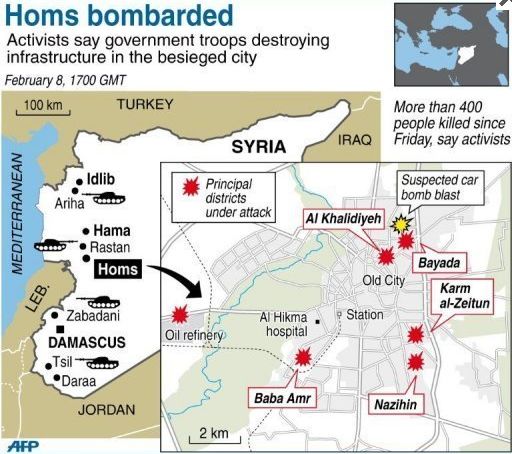
Amal Hanano writes: Another early morning in Baba Amr, another late night here. My plan is to write a simple post from a few reports on the day’s events in Homs, the fifth consecutive day of shelling in Baba Amr. Keeping an eye on Skype and Twitter and my ears tuned in to Omar Shakir’s livestream broadcast, I begin, intending to finish quickly with the goal of sleeping earlier than the last four nights. Omar’s livestream is calm. The quiet moments before dawn are punctuated by chirping birds and soon after by the crowing rooster of Baba Amr, whose crows have now been heard across the world. I hear a booming noise in the distance every now and then. They have become part of Baba Amr’s everyday soundtrack, as normal as the calls of the rooster.
People tweet that it seems more peaceful, that the sounds of shelling are less intense. Then I notice Omar’s latest tweets, in Arabic with no hashtags, just cries of pure desperation. I sense this is Omar the person speaking not the citizen journalist. I know something was terribly wrong. A few moments later, we find out what it was. A different livestream camera had been targeted with a missile. People watched as the screen turned gray with smoke then black. The feed is dead. So are the five people who were manning the camera, including two women. I realize that Omar had been tweeting about witnessing the explosion of his friends, “A street strewn with limbs. People have become limbs. We have no one but you, God.”
Five dead quickly become twenty-nine and another fifty-five wounded. My fresh reports from an hour ago are now obsolete. Baba Amr is under attack. Again.
As I read Omar’s tweets and watch his videos, Jaafar, an activist in Daraa, messages me on Skype, “I need you to connect me to someone from the media to speak to a doctor in Homs.” I tweet, many kind people retweet, and we wait. He sends me another message, “I want television coverage not an article.” I wasn’t about to start arguing or tell him that beggars can’t be choosers. But truth is, no one is contacting me. So I call him and tell him I want to speak to the people in Baba Amr myself. He says reluctantly, “For an article?” “Yes, Jaafar,” I say, holding my tongue, “For an article.” He says, “Okay.” Moments later we’re on the call.
I speak to Yousef (whose name has been changed for his protection), an activist in Baba Amr who was assisting the doctor. The doctor was at another makeshift field hospital taking care of the wounded. Yousef recounts this morning’s events.
“The shelling started at 5 a.m. There are four families buried under the rubble of their homes. The rockets tear through one side of a house and penetrate through the walls into the next. At night, the shelling is less frequent but the snipers are everywhere, targeting every moving object. If people leave their homes to get food or anything, the snipers are ready. Almost fifty percent of the homes in Baba Amr are destroyed. Four days before the shelling, Baba Amr was cut off from the rest of the city. Cut off from bread and food. There is no food. When the Red Crescent entered, the army took all their supplies before letting them in. And they didn’t allow them to take any wounded out. What did we get out of the Red Crescent without supplies?” As we speak I can hear the pounding explosions in the background. Planes are circling over Baba Amr, launching missiles into buildings filled with people.
Journalists are responding now. I connect each one to Jaafar. He’s like a media traffic controller, efficient and precise. I listen to him typing while he talks, ordering activists to be ready to speak, in English and Arabic. Each time I send him a name of someone who is interested in an interview, he messages me within one second, “television or newspaper?” He says, “I want people to listen to the explosions, to see with their eyes, not just read about it. Reading about it is not good enough.” I smile to myself and respond dutifully: newspaper, newspaper, radio. The radio interview makes him happier, and for some reason that makes me as well.
I listened in to the calls with the journalists. I could tell Yousef was getting frustrated. When they ask for the number of dead, Yousef repeats, “Twenty-nine. No, not in the last twenty-four hours, the last four hours.” Later, a reporter asks, “What is the condition of the hospital?” He answers, “There are no hospitals. We’ve made our homes into hospitals. We are treating our wounded in the mosque.” She asks again, “Where is the hospital?” He replies in a clipped tone, “It’s not a hospital. It’s a mosque.”

Pakistan’s spy agency ISI faces court over disappearances
The Guardian reports: Pakistan’s all-powerful military will this week face a rare challenge by the courts over the case of 11 men who were allegedly abducted and tortured by the Inter-Services Intelligence spy agency.
The case, due to be heard on Friday, will offer a window into the workings of the ISI and its sister agency, Military Intelligence, and charges that they have made hundreds of Pakistanis disappear.
Four of the 11 men kidnapped from the high security Adiala jail in Rawalpindi in May 2010 have turned up dead in recent months. The families of the rest are petitioning the court for their return. Although apparently terrorist suspects, they have not been charged with any crime.
Before the hearing, the military stated in a written response to the court that they would not bring the remaining men before the judges, as had been ordered by the court, arguing that some were in such poor health that they could not be produced. Critics said this only confirmed the allegations of mistreatment.
The case is also a test for the supreme court, which is accused of pursuing a single-minded campaign against President Asif Zardari and his government, an agenda that plays into the hands of the military.
“This is a historic case. It is the first time the ISI has confessed to holding people,” said Amina Janjua, chairperson of Defence of Human Rights, a group that campaigns for Pakistan’s disappeared. “The courts are nothing in front of the agencies. The agencies think they are the masters. The ones who were killed did not die natural deaths. Their bodies were blue and black.”
The intelligence agencies are allegedly responsible for over 1,000 disappearances since 2001, of whom about 500 are still missing, while in the western province of Baluchistan, dumped bodies of dissidents are regularly found.
Muslim Brotherhood demands military cede power in Egypt
The New York Times reports: The Muslim Brotherhood demanded Thursday that Egypt’s military rulers cede control of the government, stepping closer to a long-anticipated confrontation between the ruling generals and the Islamist-dominated Parliament.
In a statement on its Web site and a television interview with one of its senior leaders, the Brotherhood called for the military to allow the replacement of the current prime minister and cabinet with a new coalition government formed by Parliament, which would amount to an immediate handover of power.
The Brotherhood, the formerly outlawed Islamist group, now dominates Parliament. It had previously said it was content to wait until June, when the generals had said they would hand over the power they seized at the ouster of President Hosni Mubarak last year. And signs were accumulating of a general accord between the military and the Brotherhood over the terms of a new constitution expected to be ratified before the handover. The Brotherhood’s shift comes on the eve of the Feb. 11 anniversary of Mr. Mubarak’s downfall, when other activists around the country have called for a general strike to demand the end of military rule — a call the Brotherhood has previously resisted.
But the group is also changing its position at a time when the military-controlled government appears overwhelmed by domestic and foreign crises, including a deadly soccer riot last week followed by five days of violent protests, a standoff with Washington that has imperiled billions of dollars in United States aid and international loans, and an economy teetering on collapse.
“We must start the formation of a coalition government immediately, to deal in particular with the economic situation and the state of lawlessness in this homeland,” Khairat el Shater, deputy to the Brotherhood’s Supreme Guide and one of its most influential figures, said in the online statement, which quoted an interview he gave to Al Jazeera.
Video: Egypt’s political fractures
Iraq: 65 executions in first 40 days of 2012
Iraqi authorities should halt all executions and abolish the death penalty, Human Rights Watch said today. Since the beginning of 2012, Iraq has executed at least 65 prisoners, 51 of them in January, and 14 more on February 8, for various offenses.
“The Iraqi government seems to have given state executioners the green light to execute at will,”said Joe Stork, deputy Middle East director at Human Rights Watch. “The government needs to declare an immediate moratorium on all executions and begin an overhaul of its flawed criminal justice system.”
Human Rights Watch is particularly concerned that Iraqi courts admit as evidence confessions obtained under coercion. The government should disclose the identities, locations, and status of all prisoners on death row, the crimes for which they have been convicted, court records for their being charged, tried, and sentenced, and details of any impending executions, Human Rights Watch said.
A Justice Ministry official confirmed to Human Rights Watch on February 8 that authorities had executed 14 prisoners earlier in the day. “You should expect more executions in the coming days and weeks,” the official added.
According to the United Nations, more than 1,200 people are believed to have been sentenced to death in Iraq since 2004. The number of prisoners executed during that period has not been revealed publicly. Iraqi law authorizes the death penalty for close to 50 crimes, including terrorism, kidnapping, and murder, but also including such offenses as damage to public property.
Human Rights Watch opposes capital punishment in all circumstances because of its inhumane nature and its finality. International human rights law requires that, where it has not been abolished, the death penalty be imposed only in cases for the most serious crimes in which the judicial system has scrupulously complied with fair trial standards, including the rights of the defendant to competent defense counsel, to be presumed innocent until proven guilty, and not to be compelled to confess guilt.
Criminal trials in Iraq often violate these minimum guarantees, Human Rights Watch said. Many defendants are unable to pursue a meaningful defense or to challenge evidence against them, and lengthy pretrial detention without judicial review is common.
Rick Santorum — Iran Man
Rick Santorum, who wrested some momentum from Mitt Romney this week by winning primary contests in Colorado, Minnesota, and Missouri, likes to cast himself as something of an expert on Iran, which has arguably become the top foreign-policy issue in the campaign. From making clear that he’d take care of Iran’s nuclear problem if Tehran refuses to do so to warning of jihadists lurking in the Gulf of Mexico — he’s not shy about his obsession with the Iranian threat, or his hawkish stance.
In a November radio ad, for example, the Republican presidential contender asserted that he was the only GOP candidate discussing the Iranian threat. “Even Newt Gingrich said ‘no one has done more than Santorum to alert America to the dangers posed by Iran,'” the narrator crowed. Santorum’s campaign website boasts that he “has recognized the looming threat of Iran’s nuclear ambitions for nearly a decade — standing tall against both Republicans and Democrats who have discounted and dismissed the reality that this radical theocracy is intent on destroying Israel and Western civilization.” Forget “nearly a decade” — in Iowa, he told voters, “I spent ten years focused like a laser beam when I was in the Senate on the country of Iran.”
There may be no better window into Santorum’s views on Iran than his writings as a fellow at the Ethics and Public Policy Center (EPPC) — a position he held between losing his Pennsylvania Senate seat in 2006 and entering the presidential race in June 2011. He joined the Washington, D.C.-based think tank, which aims to apply the “Judeo-Christian moral tradition to critical issues of public policy,” back in 2007 to establish and direct the “America’s Enemies” program — an initiative that, unlike America’s adversaries, folded after Santorum’s departure, according to the EPPC. And, for Santorum, Iran was Public Enemy No. 1. “I know that I’m not the foremost scholar in the world, but I can offer a lot of ideas,” he told National Review as he settled in at the think tank.
So, just what were those ideas, and how do they compare to Santorum’s rhetoric on the campaign trail today? Under the disquieting rubric “The Gathering Storm,” Santorum penned roughly 40 articles on Iran during his EPPC stint, scrupulously aggregating news and commentary to paint a picture of the multidimensional Iranian threat facing the United States. Here’s a look at some of what Santorum had to say on the subject, in between posts on Latin American Regression, Extradition, and Alligators and Religious Freedom: A Pluralist Street with No Address in Saudi Arabia.
India explores economic opportunities in Iran, denting Western sanctions plan
The New York Times reports: India emerged as a major new irritant on Thursday in Western efforts to isolate Iran, announcing that it was sending a large trade delegation there within weeks to exploit opportunities created by the American and European antinuclear sanctions that are increasingly disrupting Iran’s economy.
The trade delegation announcement coincided with new reports that India, an important consumer of Iranian oil, had eclipsed China for the first time as Iran’s No. 1 petroleum customer last month, subverting efforts by the United States to persuade other countries to find non-Iranian sources for their energy needs or risk onerous penalties under a new American sanctions law.
The announcement also came ahead of a planned visit to India by Herman Van Rompuy, the European Union president, who was quoted in an interview with The Times of India as saying that he intended to seek the Indian government’s help in pressing Iran to give up its nuclear program.
It was unclear whether Mr. Rompuy knew at the time of the interview that India’s commerce secretary, Rahul Khullar, was about to announce a big economic push into Iran that could serve to counteract the effects of the very sanctions Mr. Rompuy has helped to promote.
“We will be mounting a mission to Iran at the end of the month to promote our own exports,” Mr. Khullar told reporters in New Delhi, according to Indian and Western accounts of his news conference. “A huge delegation will be going.”
In what amounted to a rejection of an underlying motive in the American-European sanction effort, Mr. Khullar said India already was honoring the four rounds of United Nations sanctions aimed at dissuading Iran from its uranium enrichment program. Those sanctions, he told reporters, do not apply to “a vast range of products which India can export to Iran.”
Even if the United States and European Union wished to shun business with Iran, Mr. Khullar said, “Tell me why I should follow suit?”
“Why shouldn’t I take up that business opportunity?” he asked.
How to engage Iran
Hossein Mousavian writes: Since the 1979 Islamic Revolution, two major schools of thought have influenced Iran’s foreign policy toward the United States. The first maintains that Iran and the United States can reach a compromise based on mutual respect, noninterference in domestic affairs, and the advancement of shared interests. Those who hold this view acknowledge the animosity and historical grievances between the two countries but argue that it is possible to normalize their relations. The second school is more pessimistic. It deeply distrusts the United States and believes that Washington is neither ready nor committed to solving the disputes between the two countries.
Having worked within the Iranian government for nearly 30 years, and having sat on the secretariat of Iran’s Supreme National Security Council for much of the decade before 2005, I was involved in discussions about both of these two approaches. My first personal experience in these matters dates to the late 1980s, when the critical issue facing the United States and Europe was the release of Western hostages in Lebanon. During that period, Iran received dozens of messages from Washington proposing that each side, echoing U.S. President George H. W. Bush’s 1989 inaugural address, show “goodwill for goodwill.”
That year, Bush offered then Iranian President Ali Akbar Hashemi Rafsanjani a deal: If Iran assisted in securing the release of U.S. and Western hostages in Lebanon, the United States would respond with a gesture of its own. In response, Tehran emphasized its expectation that the United States would unfreeze and return billions of dollars in Iranian assets that were being held in the United States. The Iranian leadership also came away from discussions believing that Israel would reciprocate by releasing some Lebanese hostages, specifically Sheikh Abdul Karim Obeid, the leader of Hezbollah.
Then the two schools of thought came into play. Rafsanjani believed that this deal could be a confidence-building measure that would lead to rapprochement with the United States. Ayatollah Ali Khamenei, Iran’s supreme leader, warned against trusting the United States and thought it naive to expect Washington to repay Tehran’s efforts in kind. Then, as now, he believes that the United States is after nothing less in Iran than regime change. Ultimately, Iran decided to play a key role in securing the release of all Western hostages in Lebanon. But the United States neither released Iranian assets nor facilitated the release of Lebanese hostages.
Tehran can limp along under sanctions, but ordinary Iranians are bearing the brunt
Michael Theodoulou reports: International sanctions targeting Iran’s oil exports are inflicting economic pain but may well fail to force Tehran to compromise on its nuclear ambitions and could even make the regime more intransigent, analysts said.
The unprecedented measures could also boomerang by driving up oil prices, hitting the jittery global economy, they said.
“In the process of hunting for alternative sources to Iranian oil, it’s virtually certain that the price of oil is going to rise,” said Gary Sick, an Iran expert and former White House policy adviser at Columbia University in New York.
Ordinary Iranians complain that they, rather than their defiant and resilient regime, are bearing the brunt of sanctions that are compounding problems caused by the government’s economic mismanagement.
US financial sanctions imposed at the beginning of this year are playing havoc with Iran’s ability to receive payments for its oil exports. But they are also causing serious disruption to Tehran’s imports, with a real effect on the Iranian street where prices for basic foodstuffs are soaring. Malaysian exporters of palm oil, critical to Iran’s food industry, have halted sales to Tehran because they could not get paid.
A margarine factory owner in Iran told Reuters: “The way things are going, I predict that over the next three to four months our edible oil will run out because of sanctions.”
A default by Iranian buyers on purchases of 200,000 tonnes of Indian rice is potentially more crippling, and imports of tea from India, Iran’s favourite beverage, are facing similar payment hurdles. Iran, meanwhile, is reportedly seeking to close grain purchases using gold and oil as payment.
The Iranian rial has lost half its value against the dollar in recent weeks. The official inflation rate stands at 20 per cent but it is thought to be much higher, and the same applies to the official unemployment rate of 14.6 per cent.
With the rial plummeting, the price of rice, a main dietary staple of Iran’s 74 million people, has more than doubled in a year to $5 a kilo. The cost of meat has almost tripled to about $30 a kilo, beyond the budget of many middle-class families.
Palestinian intellectuals to Syrian regime: Not in our name!
Muhammad Idrees Ahmad writes: This is an English translation, courtesy of Wadiqratiya, of a joint statement by Palestinian intellectuals offering their solidarity to the Syrian people and applying for for membership to the newly established Syrian Writers Union.
It is our honor, as Palestinian writers and signatories to this statement, to request as a group to be inducted into the Syrian Writers Union, which has been recently established by the free Syrian writers and intellectuals who stand with the people as they climb the ladder of freedom which has been smeared with blood by the hand of the tyrant. The establishment of the Syrian Writers Union constitutes an essential pillar of the Syrian revolution and places the true intellectual in his or her rightful place beside the people as an effective partner in building a new Syria free of dynastic authoritarianism–a diverse, democratic, civil system based on the rights of the citizen, one that embraces the rights of expression and creation, a system incapable of falsifying the free Syrian intellectual’s will through hollow structures that arrogate the potentials of culture, usurp the role of the intellectual and falsify his or her will, always a device in the hand of the tyrant and his apparatuses.
Now more than ever, Syria needs a mature voice that speaks from its very heart, a voice which strengthens national unity and derives strength from the diversity and richness of Syrian society […] [which will serve as] the basis for building a democracy.
We have recently heard a representative of the Syrian regime at the UN Security Council use the Palestinian cause and its painful and honorable course as cover for its terrifying crimes in Syria. We say to the Syrian regime and its representatives: not in our name, not in Palestine’s name, will these crimes be committed in our beloved Syria, oh killers. Do not make our just cause a mask for your inhumane crimes against our Syrian brothers and sisters. It is the Syrian people who have historically adopted our cause, and sacrificed martyrs for its sake, not your regime, of which we have painful memories. We will never forget its role in the massacre of Tel Az-Zaatar in 1976, nor in the terrible assault on the Nahr al Bared camp near Tripoli in 1983, nor the siege of the camps in Beirut in 1985, nor any of the other acts which have bitterly weakened Palestinian national unity. Do not use Palestine’s name, for it is no longer your winning card.
A unified, free and democratic Syria is what Palestine needs, and this is the Syria that is being born today from the womb of a bloody revolution ignited by a great people. We are confident that Palestine’s name will remain in the heart of this courageous, revolutionary people and of its cultural elite.
Mourid Barghouti (poet and writer)
Taher Riyad (poet)
Ghassan Zaqtan (poet)
Zuhair Abu Shayib (poet)
Azmi Bishara (intellectual)
Mahmoud Ar-Rimawi (writer)
Ma’an al-Biyari (writer and journalist)
Youssef Abu Laouz (poet)
Najwan Darwish (poet)
Rub’i al-Madhoun (novelist)
Adel Bishtawi (writer, novelist and researcher)
Antoine Shalhat (writer and critic)
Fakhri Salih (critic)
Hussein Shaweesh (writer)
Huzama Habayeb (writer and novelist)
Nasr Jamil Shaath (poet)
Ahmed Abu Matar (academic critic, researcher and activist)
Mohammad Khalil (writer)
Youssef Abdel Aziz (poet)
Moussa Barhouma (writer)
Issa Ash-Shu’aibi (writer)
Moussa Hawamdeh (poet)
Na’il Balaawi (poet)
Khalil Qandeel (writer)
Ghazi at-Theeba (poet)
Wissam Joubran (poet and musician)
Omar Shabana (poet)
Qusai al-Labadi (poet)
Ali al-Aamari(poet)
Jihad Hudeib (poet)
Ziad Khaddash (writer)
Nasr Rabah (poet)
Bassem Al Nabrees (poet and writer)
Raji Bathish (writer)
Shaher Khadra (poet)
Raed Wahish (poet)
Asma Azaiza (poet)
Mahmoud Abu Hashhash (poet)
Khodr Mahjaz (novelist, poet, researcher, academic critic)
Bassel Abu Hamda (writer)
Ibrahim Jaber Ibrahim (writer)
Abdullah Abu Bakr (poet)
Osama al-Rantisi (writer)
Issam As-Saadi (poet)
Khalid Juma (poet)
Naim al-Khatib (writer)
Akram Abu Samra (poet)
Hanin Juma Takrouri (writer)
Najwa Chamoun (poet)
Mohamad As-Salimi (poet)
Hani As-Salimi (novelist)
Bilal Salameh (poet)
Osama Abu Awad (writer)
Jaber Sha’at (poet)
Youssef al-Qadra (poet)
Nesma al-Aklouk (writer)
Othman Hussein (poet)
Rizk al-Biyari (poet)
Yasser al-Wiqaad (poet)
Subhi Hamdan (writer)
Imad Mohsen (writer)
Leila Violet (poet)
Tayseer Muheisen (writer, critic, and political activist)
Fayez As-Sirsawi (visual artist and poet)
Rajab Abu Sirriyeh (writer)
Fuad Hamada (academic critic, researcher, and political activist)
Mai Nayif (academic critic, researcher, and gender activist)
Yusri Al-Ghul (writer and critic)
Hussein Abu An-Najja (writer and academic researcher)
Nasr Aliwa (novelist and critic)
Abdel Karim Aliyan (writer and education researcher)
Walaa Tamraz (researcher and political writer)
Omar Sha’aban (writer and researcher)
Hassan Mai (writer and academic critic)
Ma’an Samara (poet and journalist)
Mohamad Hassouna (academic and critic)
Aoun Abu Safia (novelist)
Atif Hamada (poet and academic critic)
Ghiath al-Madhoun (poet)
Rajaa Ghanem (poet)
Tariq al-Karmi (poet)
Ahmed al-Ashqar (poet)
Ali Abu Khitab (poet and writer)
Dunia al-Amal Ismail (poet)
Isra Kalash (writer)
Moussa Abu Karash (poet and writer)
Abdel Fitah Shihada (poet and novelist)
Yasser Abu Jalala (poet and visual artist)
Khalil Hassouna (poet and novelist)
Muheeb al-Barghouti (poet)
Abdel Nasr Aamer (poet, visual artist)
Nidal al-Hamarna (writer)
Ashraf Amro (writer)
Asma Nasr Abu Ayyesh (writer and journalist)
Maya Abu al-Hiyaat (writer)
Zeinat Abu Shaweesh (writer)
Suzanne Salameh (poet)The original Arabic text can be found here. I’ve taken a few small liberties for the sake of clarity and flow in English, but tried to remain as faithful to the text as possible. I have also taken the liberty of adding “his or her,” which is generally not used in Arabic for stylistic reasons but I feel is in the spirit of the statement since the signatories include women.
Afghan-Pakistan cricket match a break from war

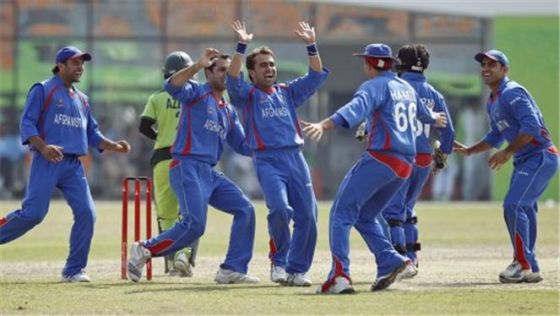
AFP reports: Excitement was building in cricket-loving parts of Afghanistan ahead of their historic one-day international against Pakistan in Sharjah on Friday – even among Taliban insurgents.
“I am personally a fan of cricket, I will follow this match closely,” Taliban spokesman Zabiullah Mujahid told AFP.
Asked which side he would support, given reported backing for the insurgents from within Pakistan, he replied: “I pray that Afghans come out as winners.”
Mujahid, who usually speaks to the media on his mobile phone about the state of the war, made the point that he was speaking in his personal capacity, not on behalf of the Taliban.
Afghanistan have played 18 one-day internationals since gaining status in 2009 but all their matches were against associate and affiliate teams Canada, the Netherlands, Ireland, Kenya and Scotland.
Now they face their first game against their neighbour, one of the world’s great cricketing nations.
Friday’s match in Sharjah Stadium is fitting because most of the Afghan players learnt the game in Pakistan while staying as refugees after the Soviet invasion of their country in 1979.
The game has a limited following in the capital Kabul but a strong following mainly in the south and east of the country, near the Pakistan border.
“Everybody loves cricket here,” said Masoom, the owner of TV and satellite dish store in the southern provincial capital of Kandahar.
“I have sold a dozen dish sets in recent days because people are concerned the local TVs will not have a live broadcast.”
“Whenever there is a cricket match here, people all forget about war, poverty or other miseries,” said a customer who gave his name as Sami.
“Everybody looks so happy that you’d think there is no war in this country.”
U.S. officials confirm Israel is sponsoring terrorism in Iran
While the following report focuses on Israel’s ties to the Iranian terrorist group, Mujahideen-e Khalq (MEK), it also indicates these links mean that Israel is indirectly tied to al Qaeda. Ramzi Yousef, mastermind of the first attack on the World Trade Center in 1993 and nephew of 9-11 mastermind Khalid Sheikh Mohammad, was employed by the MEK as a bomb-maker.
NBC News reports: Deadly attacks on Iranian nuclear scientists are being carried out by an Iranian dissident group that is financed, trained and armed by Israel’s secret service, U.S. officials tell NBC News, confirming charges leveled by Iran’s leaders.
The group, the People’s Mujahedin of Iran, has long been designated as a terrorist group by the United States, accused of killing American servicemen and contractors in the 1970s and supporting the takeover of the U.S. Embassy in Tehran before breaking with the Iranian mullahs in 1980.
The attacks, which have killed five Iranian nuclear scientists since 2007 and may have destroyed a missile research and development site, have been carried out in dramatic fashion, with motorcycle-borne assailants often attaching small magnetic bombs to the exterior of the victims’ cars.
U.S. officials, speaking on condition of anonymity, said the Obama administration is aware of the assassination campaign but has no direct involvement.
The Iranians have no doubt who is responsible – Israel and the People’s Mujahedin of Iran, known by various acronyms, including MEK, MKO and PMI.
“The relation is very intricate and close,” said Mohammad Javad Larijani, a senior aide to Ayatollah Ali Khamenei, Iran’s supreme leader, speaking of the MEK and Israel. “They (Israelis) are paying … the Mujahedin. Some of their (MEK) agents … (are) providing Israel with information. And they recruit and also manage logistical support.”
Moreover, he said, the Mossad, the Israeli secret service, is training MEK members in Israel on the use of motorcycles and small bombs. In one case, he said, Mossad agents built a replica of the home of an Iranian nuclear scientist so that the assassins could familiarize themselves with the layout prior to the attack.
Much of what the Iranian government knows of the attacks and the links between Israel and MEK comes from interrogation of an assassin who failed to carry out an attack in late 2010 and the materials found on him, Larijani said.
The U.S.-educated Larijani, whose two younger brothers run the legislative and judicial branches of the Iranian government, said the Israelis’ rationale is simple. “Israel does not have direct access to our society. Mujahedin, being Iranian and being part of Iranian society, they have … a good number of … places to get into the touch with people. So I think they are working hand-to-hand very close. And we do have very concrete documents.”
Two senior U.S. officials confirmed for NBC News the MEK’s role in the assassinations, with one senior official saying, “All your inclinations are correct.” A third official would not confirm or deny the relationship, saying only, “It hasn’t been clearly confirmed yet.” All the officials denied any U.S. involvement in the assassinations.
[…]
The U.S. suspicion of the MEK doesn’t end there. Law enforcement officials have told NBC News that in 1994, the MEK made a pact with terrorist Ramzi Yousef a year after he masterminded the first attack on the World Trade Center in New York City. According to the officials, who spoke on condition of anonymity, Yousef built an 11-pound bomb that MEK agents placed inside one of Shia Islam’s greatest shrines in Mashad, Iran, on June 20, 1994. At least 26 people, mostly women and children, were killed and 200 wounded in the attack.That connection between Yousef, nephew of 9-11 mastermind Khalid Sheikh Mohammad, and the MEK was first reported in a book, “The New Jackals,” by Simon Reeve. NBC News confirmed that Yousef told U.S. law enforcement that he had worked with the MEK on the bombing.
Syria: The ‘arm the FSA’ bandwagon
Marc Lynch enumerates some of the pitfalls in the proposals for providing Western military support for Syria’s opposition: First, who exactly would be armed? The perennial, deep problem of the Syrian opposition is that it remains fragmented, disorganized, and highly localized. This has not changed. The “Free Syrian Army” remains something of a fiction, a convenient mailbox for a diverse, unorganized collection of local fighting groups. Those groups have been trying to coordinate more effectively, no doubt, but they remain deeply divided. For all their protestations of solidarity, the Syrian National Council and the FSA show few signs of working well together, while repeated splits and conflicts have emerged in the media within the FSA. So to whom would these weapons be provided, exactly? I expect that what will happen is that foreign powers will rush to arm their own allies and proxies (or are already doing so); which ones are the United States meant to choose? While claims about the role of Salafi jihadists in the armed opposition are likely exaggerated, the reality is that we know very little about the identities, aspirations, or networks of the people who would be armed.
Second, how would the provision of weapons affect the Syrian opposition? Access to Western guns and equipment will be a valuable resource that will strengthen the political position of those who gain control of the distribution networks. Competition for those assets does not seem likely to encourage the unification of the fragmented opposition, and it could easily exacerbate their divisions. What’s more, fighting groups will rise in political power, while those who have advocated nonviolence or who advance political strategies will be marginalized. Fighting groups’ political aspirations will likely increase along with their military power. The combination of militarization and more ambitious goals will make any political solution that much less likely. And it could increase the fears of Syrian fence-sitters who have stayed with Assad out of fear for their future.
Third, what will the weapons be intended to achieve? I can see at least three answers. Perhaps they’ll be meant to be purely defensive, to stop the regime’s onslaught and protect civilians. But this relatively passive goal does not seem a likely stable endpoint once the weapons start flooding in. A second possibility is that they’ll be meant to give the rebels the power to defeat the regime on the battlefield and overthrow it. But that does not seem realistic, since it would require far more fire power than would likely be on offer to reverse the immense imbalance in favor of regime forces. A third possibility is that they’ll be meant to even the balance of power sufficiently to force Assad to the bargaining table once he realizes that he can’t win. But the violence of the escalating civil war will make such talks very difficult politically. The provision of arms probably won’t be intended to create a protracted, militarized stalemate — but that does seem the most likely outcome. Is that the goal we hope to achieve?
Radical U.S. Muslims little threat, study says
The New York Times reports: A feared wave of homegrown terrorism by radicalized Muslim Americans has not materialized, with plots and arrests dropping sharply over the two years since an unusual peak in 2009, according to a new study by a North Carolina research group.
The study, to be released on Wednesday, found that 20 Muslim Americans were charged in violent plots or attacks in 2011, down from 26 in 2010 and a spike of 47 in 2009.
Charles Kurzman, the author of the report for the Triangle Center on Terrorism and Homeland Security, called terrorism by Muslim Americans “a minuscule threat to public safety.” Of about 14,000 murders in the United States last year, not a single one resulted from Islamic extremism, said Mr. Kurzman, a professor of sociology at the University of North Carolina.
The report also found that no single ethnic group predominated among Muslims charged in terrorism cases last year — six were of Arab ancestry, five were white, three were African-American and two were Iranian, Mr. Kurzman said. That pattern of ethnic diversity has held for those arrested since Sept. 11, 2001, he said.
Forty percent of those charged in 2011 were converts to Islam, Mr. Kurzman found, slightly higher than the 35 percent of those charged since the 2001 attacks. His new report is based on the continuation of research he conducted for a book he published last year, “The Missing Martyrs: Why There Are So Few Muslim Terrorists.”