Syria: Assad’s support comes with a price tag

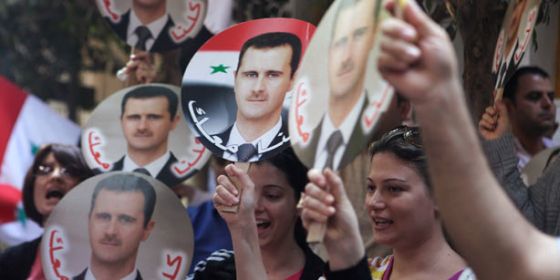
Al Ayyam reports: Pro-Assad rallies. The epitome of a civilized rally. The balloons, the flags, the dancing everyone happy and singing their praises to a supreme leader, denouncing violence and sectarianism. It’s a utopia of free speech and unwavering support. It is the example the Assad regime points to for proof of their success at ruling the country. It is a far cry from the tear gas, bullets and indeed heavy artillery that rain down on protests in other parts of the country. Proof, the government says, that these other protests are not peaceful at all, that they are, in fact, armed gangs paid for and financed from a number of external forces.

Activists have long claimed pro-Assad rallies are fabricated, that if one were to look closer the crowds are made up of the secret police or moukhabarat and a few die-hard loyalists. That these are planned in advance, funded by the regime no less and are not, as the government claims, spontaneous showcases of love and adoration.

It seems the devil truly is in the detail. The hacktivist syndicate Anyonymous recently dumped emails from MOPA, the Ministry of Presidential Affairs, President Assad’s personal office. Emails uncovered sent to Presidential aid Akram Issa, detail billings and accounts and efforts made in advance to create these spontaneous rallies in support of the President.

The email in question marked SPAM in the subject header, states Governors involved offered their verbal commitment to pay the supplier of these protests yet have not paid up their dues as per the Minister’s request. Attachments in the email detail itemized descriptions of the outstanding balance, which reach a total of 1.1 Million SYP in October 2011 (before the inflation of the SYP) at the time equaling $20,000.

The rally in Lattakia province alone cost the administration 315,000 SYP the bare minimum, the supplier writes, to make the rally seem like an acceptable turnout.

An attachment titled “Details of the Flag Raising Rally in Lattakia” [PDF] includes 45,000 SYP ($800) spent on 60 kg of confetti to be thrown in the air the moment the Syrian flag is raised. One hundred sweaters for the flag raising crew in the colors of the flag totaling 2,500 SYP ($580) and sound system rental for the rally at 500,000 SYP ($9000).

In another attachment titled “Detailed billings to the personal account of Monhal Zeitoun” [PDF] costs for rallies held in Damascus, Sweida and Hasakeh province are itemized. The supplier writes under the header for Damascus “Campaign: Our martyrs, your blood runs in our veins” and details expenditures of 150,000 SYP ($2,600) to cover sound and broadcast of the event including another 49,000 SYP ($875) for printed t-shirts. A miscellaneous amount of 57,000 SYP includes costs for ironing clothes, supply of water, taxi cabs and a refrigerator and its transport.

At a time when cities and towns were surrounded by regime tanks and protesters died on the streets by army bullets, when heating oil in Homs was scarce and when international opinion towards the regime came into question the President’s office was gearing up for a fanfare of pomp and circumstance in an effort almost too bureaucratic to believe to prove their support is indeed a spontaneous act of love sheltered in the heart of every Syrian.

Facebooktwittermail

A former U.S. diplomat’s view of Syria

Sharmine Narwani shares an email she received from a former US diplomat with service experience in Syria who has asked to remain unnamed. The email appears to have been written a week ago.

I have serious problems with all the talk about military intervention in Syria. Everyone, especially the media, seems to be relying solely on anti-regime activists for their information. How do we know 260 people were killed by the regime in Homs yesterday? That number seems based solely on claims by anti-regime figures and I seriously doubt its accuracy.

I served over three years in Damascus at the US Embassy and I know how difficult it is to sort fact from rumor in that closed political society. We were constantly trying to verify rumors that we had heard about assassinations, regime arrests, etc., and that included the Agency, which was just as much in the dark as everyone else. Today, we have a skeleton embassy which I am sure is under constant surveillance and with very few personnel to go out and report on what is happening. When I was in Damascus over two years ago, I was less than impressed with the Embassy’s sources and with its understanding of the dynamics of what was going on Syria. And the same is true when I talk to officials at the State Department.

The media, and to an extent the Administration, have personalized the conflict in Syria as being about Bashar Assad and his family. They have consistently underestimated the sectarian nature of the conflict there. It is not just Bashar Assad and his family that are hanging onto power at all costs, it is the entire Alawi system of control of the country, including the military, the security services and the Baath Party. I believe that Alawites firmly think that if they lose power, the Sunnis will slaughter them, That was one reason Hafez and his brother Rifaat were so ruthless in Hama thirty years ago. And everyone in the West conveniently forgets the campaign of assassinations and suicide bombings carried out in the three or four years before Hama by the Muslim Brotherhood throughout the country. I personally witnessed the aftermath of such bombings in which several hundred people were killed. While the State Department, the CIA and other organs of government may have short historical memories, the people in Syria do not.

There have been few good analyses of the conflict in Syria. With the exception of the journalist Nir Rosen and the International Crisis Group, most reporting has been superficial and biased in favor of opponents of the regime. This is no basis on which to base policy, especially if officials in Washington are contemplating some form of military intervention. We would be opening a Pandora’s box of sectarian conflict that could easily spread to Lebanon, Israel, Kurdish areas of Iraq and elsewhere.

One irony of the current situation compared to thirty years ago is Iraq’s role. Then, we had reasonably good information that Saddam Hussein was supporting the Brotherhood with arms, explosives and facilitating the smuggling of both across the Syrian-Iraqi border. Today, the Maliki government in Baghdad appears to be supporting the Assad regime. And thirty years ago, we also had information that the Brotherhood leadership was given sanctuary in Jordan by King Hussein and in Saudi Arabia.

I don’t think we know how to play in this arena, just as we don’t understand how to play in the Afghanistan-Pakistan arena. US military intervention, whether under the guise of NATO or some other umbrella, could have serious unforeseen consequences for the US, Europe and the region. Officials in Washington should have the law of unforeseen consequences hammered into their heads every morning.

Facebooktwittermail

Tibetan acts of self-immolation rise amid the battle for hearts and minds

The Guardian reports: On the roof of the world, Chinese paramilitaries are trying to snuff out Tibetan resistance to Beijing’s rule with spiked batons, semi-automatic weapons and fire extinguishers.

Every 20 metres along the main road of Aba, the remote town on the Tibetan plateau in that is at the heart of the current wave of protests, police officers and communist officials wearing red armbands look out for potential protesters. Dozens more paramilitaries sit in ranks outside shops and restaurants in an intimidating show of force.

At the nearby Kirti monastery, Chinese officers in fire trucks keep a close eye on pilgrims prostrating themselves, in case their devotion turns to immolation.

Outsiders are not supposed to see this. The Chinese authorities have gone to great lengths to block access to Aba, in north-western Sichuan, which is home to more than half the 23 monks, nuns and lay Buddhists who have set fire to themselves in acts of defiance aimed at the Chinese Communist party in the past two years.

The authorities have blocked internet and mobile phone signals. Checkpoints have been set up on surrounding roads to keep outside observers, particularly foreign journalists, away.

But after a 10-hour drive through mountain valleys and snow-covered plains, the Guardian was able to get into Aba and witness how the authorities are trying to quell dissent with security, propaganda and “re-education” campaigns. These tactics have had little success. Despite flooding Aba with security personnel, the protests continue.

The latest occurred on Saturday. Tenzin Choedron, an 18-year-old nun, shouted anti-Chinese protests as she ignited her petrol-soaked body in Aba, exile groups said. Her whereabouts and condition are now unknown.

Three days earlier, a former Kirti monk sacrificed himself in similarly horrific fashion. Rinzin Dorje, was taken to a hospital but his whereabouts and wellbeing are also unclear.

Facebooktwittermail

The new anti-science assault on U.S. schools

Katherine Stewart writes about the latest chapter in the campaign to keep Americans stupid — which is to say, efforts to guard fragile minds from the truth about evolution — and notes that there are “six bills aimed at undermining the teaching of evolution before state legislatures this year: two each in New Hampshire and Missouri, one each in Indiana and Oklahoma. And it’s only February.”

Most of these bills aren’t likely to get anywhere. The Indiana bill, which specifically proposes the teaching of “creation science”, so obviously falls foul of the supreme court’s 1987 ruling that it’s hard to imagine it getting out of committee. The same could be said for the Missouri bill, which calls for the “equal treatment” of “biological evolution and biological intelligent design”.

Still, it’s worth asking: why is this happening now? Well, in part, it’s just that anti-evolution bills are an indicator of the theological temperature in state houses, and there is no question that the temperature has been rising. New Hampshire, Indiana, Oklahoma, and Missouri turned deeper shades of red in the 2010 elections, as did the US Congress.

But there are a couple of new twists that make this same-old story more interesting than usual. One has to do with the temperature in a less metaphorical sense. The Oklahoma bill isn’t properly speaking just an “anti-evolution” bill; it is just as opposed to the “theory” of “global warming”. A bill pending in Tennessee likewise targets “global warming” alongside “biological evolution”. These and other bills aim their rhetoric at “scientific controversies” in plural, and one of the New Hampshire bills does not even bother to specify which controversies it has in mind.

The convergence here is, to some degree, cultural. It just so happens that the people who don’t like evolution are often the same ones who don’t want to hear about climate change. It is also the case that the rhetoric of the two struggles is remarkably similar – everything is a “theory”, and we should “teach the controversy”. But we also cannot overlook the fact is that there is a lot more money at stake in the climate science debate than in the evolution wars. Match those resources with the passions aroused by evolution, and we may have a new force to be reckoned with in the classroom.

Facebooktwittermail

Music: Bheki Mseleku

Just in case it isn’t already obvious: I select these music videos for the music — not the videos! This was a particularly uninspired and often irrelevant collection of images someone selected to run alongside Bheki Mseleku’s wonderful piece “Angola”. Mseleku died young at 53 and never achieved the fame he greatly deserved as a truly outstanding musician and composer. In his obituary, John Fordham wrote: “It was almost as if Mseleku wanted to become music itself, rather than a practitioner of it.”

Facebooktwittermail

Interpol accused after journalist arrested over Muhammad tweet

The Guardian reports: Interpol has been accused of abusing its powers after Saudi Arabia used the organisation’s red notice system to get a journalist arrested in Malaysia for insulting the Prophet Muhammad.

Police in Kuala Lumpur said Hamza Kashgari, 23, was detained at the airport “following a request made to us by Interpol” the international police cooperation agency, on behalf of the Saudi authorities.

Kashgari, a newspaper columnist, fled Saudi Arabia after posting a tweet on the prophet’s birthday that sparked more than 30,000 responses and several death threats. The posting, which was later deleted, read: “I have loved things about you and I have hated things about you and there is a lot I don’t understand about you … I will not pray for you.”

More than 13,000 people joined a Facebook page titled “The Saudi People Demand the Execution of Hamza Kashgari”.

Clerics in Saudi Arabia called for him to be charged with apostasy, a religious offence punishable by death. Reports suggest that the Malaysian authorities intend to return him to his native country.

Kashgari’s detention has triggered criticism by human rights groups of Malaysia’s decision to arrest the journalist and of Interpol’s cooperation in the process.

Facebooktwittermail

Is this how Newsweek hopes to get raised from the dead?

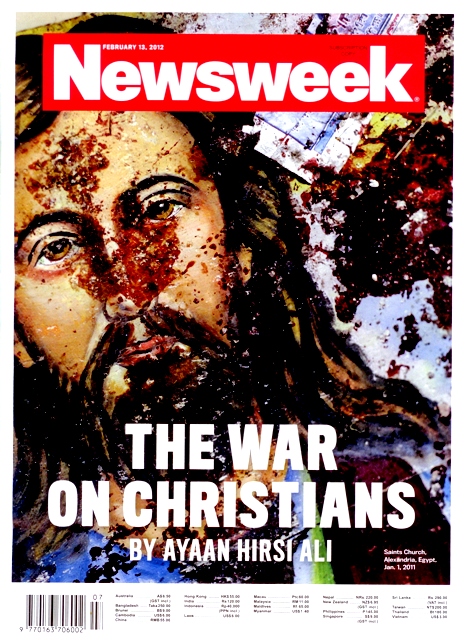
Newsweek’s current cover looks like a promotion for a Glenn Beck special: The War on Christians. No doubt the magazine’s editors thought they could get away with such a provocative headline because the byline lends it a token of authority.

Were this declaration to come from Beck or anyone of his ilk, it would be dismissed by Newsweek’s editors and many of its readers as conservative hysteria, but spouted by a celebrity former Muslim it suddenly demands serious attention. There also comes a side benefit — “The War on Christians” is a conservative mantra, from their lips referring to a war supposedly being fought by President Obama against Christians, so perhaps Newsweek felt like it might be doing some useful and surreptitious rebranding, decoupling Obama from this slur.

At GetReligion.org, Terry Mattingly observes that Newsweek these days is short on news.

As a rule, under super-editor Tina Brown, it has been an at times lively but ultimately confusing mixture of commentary, commentary and more commentary…

And the NEWS in Newsweek? That’s the strange part. The goal of the magazine seems to be to handle serious news topics (mixed with entertainment topics, of course) but in a way that it is impossible to take seriously as journalism. Newsweek is becoming the land of the unattributed fact.

To see this process at work, please read the Ayaan Hirsi Ali cover story discussing “The War on Christians in the Muslim World.” In this case, the cover’s zinger quality is provided by the author’s identity as a Muslim apostate, atheist, militant secularist and defender of old-fashioned human rights — such as religious liberty and free speech. Ali is so liberal that she is now considered, by many, to be a conservative.

In an interview with MSNBC, Newsweek executive editor Justine Rosenthal draws on one of the unattributed “facts” provided by Hirsi Ali: “In Egypt, for example, 200,000 Coptic Christians have fled their homes and very little is being done to stop that sort of violence.”

On what does Hirsi Ali base her claim that 200,000 Copts have fled?

The only reference I can find to this number of Copts fleeing is a Washington Times report in October last year which said:

A report released last month by an Egyptian nongovernmental organization estimated that 93,000 Christians already had fled the country since March, a figure some are predicting could top 200,000 by the end of year.

It would appear that this prediction made by persons unknown got turned into a “fact” by Hirsi Ali and now Newsweek is happy to cite this as a piece of evidence upon which it wants to buttress its cover story.

As for the cover itself, no doubt the magazine’s editorial team found the blood-stained image of Christ an irresistible piece of iconography, but I wonder whether they delved at all into the story behind the photograph.

On New Year’s Day, 2011, the Coptic al-Qiddissin (Saints) Church in Alexandria, where the photo was taken, was the target of a bombing that killed 23 people, Christians and Muslims, while 97 more were injured. The attack was internationally condemned and widely perceived as evidence of sectarian tension. The Interior Ministry blamed “foreign elements,” and the Alexandria governor accused al Qaida of being responsible, yet in a foretaste of the nationwide protests that were to erupt three weeks later, Christians unleashed their rage not at their Muslim neighbors but at the authorities.

Former Interior Minister Habib el-Adly in the U.S.-backed Mubarak government was later accused of having instigated the bombing.

In the following days, fearing that Churches might face similar attacks, Muslims formed human shields in order to defend Copts going to worship.

There’s no question that in Egypt and elsewhere Christians have been the targets of sectarian violence, but what Newsweek is doing is shamelessly promoting the view that Christianity is under attack by Islam. We’re back in the territory of a clash of civilizations — but no mention of another phenomenon: the attacks upon Christians that occur daily in Israel.

How does Hirsi Ali want to see “Christophobia” addressed?

As for what the West can do to help religious minorities in Muslim-majority societies, my answer is that it needs to begin using the billions of dollars in aid it gives to the offending countries as leverage.

It might be hard for the U.S. to apply such leverage since there is only one country to which the U.S. actually gives billions of dollars of aid each year: Israel.

Facebooktwittermail

Iran warns Hamas against any ‘compromise’ with Israel

AFP reports: Iran’s Supreme Leader Ayatollah Ali Khamenei has warned Palestinian movement Hamas against any “compromise” in its fight against Tehran’s nemesis Israel, his official website reported.

“Always be wary of infiltration by compromisers in a resistance organisation, which will gradually weaken it,” Khamenei told the visiting Hamas Gaza prime minister Ismail Haniya, according to the leader.ir website.

“We have no doubt about your resistance and that of many of your brothers, and the people only have this expectation of you,” said Khamenei, reaffirming that Iran “will always be alongside the Palestinian resistance”.

Khamenei’s comments come as divisions within Hamas have emerged on a possible overhaul of the organisation’s strategy. Hamas leader Khaled Meshaal signed an agreement with Palestinian president Mahmud Abbas earlier this month placing Abbas at the head of an interim government charged with organising elections later this year.

The agreement struck by Meshaal’s foreign-based leadership with Abbas’ Fatah faction has run into serious opposition from Hamas members inside the Gaza Strip, which the movement has controlled since ousting the president’s loyalists in 2007.

In November, Meshaal called for “peaceful popular resistance,” which would represent a shift in the movement away from armed struggle.

Facebooktwittermail

U.S. government looks to mine social media to combat terrorist attacks, uprisings

The Associated Press reports: The U.S. government is seeking software that can mine social media to predict everything from future terrorist attacks to foreign uprisings, according to requests posted online by federal law enforcement and intelligence agencies.

Hundreds of intelligence analysts already sift overseas Twitter and Facebook posts to track events such as the Arab Spring. But in a formal “request for information” from potential contractors, the FBI recently outlined its desire for a digital tool to scan the entire universe of social media — more data than humans could ever crunch.

The Department of Defense and the Office of the Director of National Intelligence also have solicited the private sector for ways to automate the process of identifying emerging threats and upheavals using the billions of posts people around the world share every day.

“Social media has emerged to be the first instance of communication about a crisis, trumping traditional first responders that included police, firefighters, EMT, and journalists,” the FBI wrote in its request. “Social media is rivaling 911 services in crisis response and reporting.”

The proposals already have raised privacy concerns among advocates who worry that such monitoring efforts could have a chilling effect on users. Ginger McCall, director of the open government project at the Washington, D.C.-based Electronic Privacy Information Center, said the FBI has no business monitoring legitimate free speech without a narrow, targeted law enforcement purpose.

“Any time that you have to worry about the federal government following you around peering over your shoulder listening to what you’re saying, it’s going to affect the way you speak and the way that you act,” McCall said.

Facebooktwittermail

Myth debunked: Palestinian textbooks don’t teach hatred

Daoud Kuttab writes: Apologists for Israel’s continued occupation and control over Palestinian lives have long contended Israel is more interested in peace than the Palestinians. One exaggerated argument, repeatedly put forward to justify military rule, is that Palestinians teach their children to hate Jews.

Politicians in the U.S., especially during election campaigns, find that bashing Palestinians has no downside and yields a vote (and donation) jackpot.

Palestinian textbooks are scrutinized for any hostile reference to Israel — or praise for Palestinian nationalism — and every frame broadcast on Palestinian television stations is analyzed by experts to see if it contains any incitement to violence.

Palestinian-Israeli committees spent hours researching these issues and concluded that there is no textbook glorification of violence or hate. European and bipartisan American committees reached similar conclusions. But the anti-Palestinian attacks never stopped. All the efforts to respond scientifically and comprehensively to the unsubstantiated barrage of attacks failed to change the narrative that anti-Palestinian forces, especially in the United States, were keen on perpetuating.

Facebooktwittermail

We can’t stop the bloodshed in Syria without talking to Assad

In a revised version of an op-ed that appeared earlier in the New York Times, Nicholas Noe writes: With Syria rapidly descending into civil war and UN action blocked by recent Russian and Chinese vetoes, opponents of the murderous Bashar al-Assad regime face a critical turning point in their almost one-year long struggle to unseat him.

Unfortunately, though, in western capitals, among supportive regional states and within the Syrian opposition itself, practically the only approach to the crisis being seriously discussed revolves around one question: how best to ratchet up the pressure in order to bring about a “controlled collapse” of the whole structure.

In this often simplistic approach, the underlying logic invariably rests on two core ideas. First, Iran and Lebanon’s Hezbollah will not come to the aid of their staunch ally in the event of an impending fall. Second, any violence committed by a dying, isolated Assad regime could be reasonably contained.

Both projections are, however, unlikely. The fall of Assad would deliver a huge, strategic blow to both Iran and its “junior partner”, Hezbollah. It simply does not follow, then, that these actors will simply bite their tongues and absorb the disaster for their mutual position in the Middle East.

As key leaders in Tehran and Beirut have made publicly and privately clear, Assad anchors their tripartite “Resistance Axis”. As a result, both countries have only increased their support of Assad personally – even as his regime acts with more violence and irrationality.

But what if this dominant view were correct and Iran and Hezbollah do not see it in their interests to act? Even in that case, things would be unlikely to turn out as the west would like. A collapse will probably not replicate the eastern Europe experience of the late 1980s or Hosni Mubarak’s fall in Egypt. This is largely because Assad and his supporters control formidable military capabilities, which include, unlike in Iraq or Libya, chemical weapons and ballistic missile systems. Together with the sectarian support that the Alawite Assad regime will likely retain over time against an increasingly mobilised and violent Sunni majority, as well as any continuing military and elite support, the regime is fairly well positioned to prolong what many in the west have confidently projected as an “inevitable” demise wreaked by history.

This slow denouement will mean an extremely violent civil war that will burn for quite some time, with vast humanitarian consequences and multiple unintended effects. [Continue reading…]

Facebooktwittermail

Music: Nusrat Fateh Ali Khan

I’m no serious scholar of religion, least of all of Islam, but I’m inclined to believe that herein lies Islam’s greatest gift to the world: that by refraining from any visual representation of God it forced human expression of the divine to become concentrated and distilled in sound — never more so than in the voice of one such as Nusrat Fateh Ali Khan, the King of Kings of Qawwali, one of the greatest singers who ever lived.

Facebooktwittermail

42 reasons to dismiss Susan Rice’s rage

Rami G. Khouri writes: I chuckled softly to myself last week when I followed the news coverage of how angrily the U.S. ambassador to the United Nations, Susan Rice, condemned the Russian and Chinese vetoes of a Security Council resolution that sought to end the escalating conflict in Syria. The media emphasized that Rice was really, really angry, as only a righteous American ambassador can be when condemning moves by other great powers to use their veto to stop collective action by the council in the service of applying the rule of law.

Rice said that she was “disgusted” by the double veto, and added that, “A couple of members of this council remain steadfast in their willingness to sell out the Syrian people and shield a craven tyrant.”

She was correct, of course, and we should all share her anger at the double veto, because the ongoing killings by all sides in Syria are unacceptable by any standards. We should take her position seriously because displays of public anger by ambassadors are noteworthy in themselves, and this is especially true for ambassadors of powerful countries like the United States that send their army around the world at will, usually at great cost to all involved.

Yet I chuckle nevertheless, because am not sure whether we should assess Ms. Rice’s outburst at the level of Russian and Chinese policy, conditions in Syria, the work of the U.N. Security Council, or the foreign policy consistency or duplicity of the United States.

Each of these domains is significant. Yet try as I may, I cannot take Rice and the U.S. seriously here, because the U.S. sets the world’s gold standard on using vetoes in the Security Council to shield criminal activity, by Israel in particular. I am not sure if Rice and the U.S. government think the world is stupid or merely perpetually servile to American swagger.

Facebooktwittermail

Israel: Hunger striker’s life at risk

Israeli military authorities should immediately charge or release a Palestinian detained since December 17, 2011, without charge on the basis of secret evidence that he is not allowed to see or contest, Human Rights Watch said today. Khader Adnan Mousa went on hunger strike on December 18 to protest his administrative detention.

Adnan’s family, his lawyer, and doctors from an Israeli rights group, who visited Adnan this week told Human Rights Watch that his health has deteriorated seriously and that Israeli authorities had shackled him to his hospital bed.

“Israel should immediately end its unlawful administrative detention of Adnan and charge or release him,” said Sarah Leah Whitson, Middle East director at Human Rights Watch. “He may be approaching death from his hunger strike, and yet Israel is chaining him to his hospital bed without bothering to even charge him with any wrongdoing.”

Adnan, 33, has been on hunger strike for 55 days. According to a 2006 study by the British Medical Association, “during the 1980 and 1981 hunger strikes in Northern Ireland […] death generally occurred between 55 and 75 days.” In general, “the final stage” of a hunger strike occurs between 45 to 75 days “due to cardiovascular collapse or severe arrhythmias,” the study said.

Adnan’s sister and his wife told Human Rights Watch that Israeli forces arrested him at 3:30 a.m. on December 17 at their home in Arrabeh, near Jenin, in the northern West Bank. They said the soldiers did not inform the family of the reason for his arrest. His wife, Randa, said he has been arrested nine times, first in 1999, sometimes under administrative detention, and that he had also been convicted and sentenced by military courts for advocating on behalf of Islamic Jihad, an organization banned by the Israeli authorities.

Human Rights Watch has condemned attacks by the armed wing of Islamic Jihad against Israeli civilians as war crimes and crimes against humanity. However, Israel has not claimed that Adnan has participated in such attacks or charged him with any other crime, his lawyer said, and is holding him on the basis of secret evidence that he and his lawyer are not allowed to see or challenge. Adnan’s lawyer said the only known allegation against him arose when Adnan was questioned after his detention about his participation in a graduation ceremony for a kindergarten that was allegedly funded by Islamic Jihad.

On December 25, military authorities ordered Adnan’s remand in detention until January 8, when they ordered his administrative detention for four months. His first military court hearing was on January 30. During a second hearing on February 1, Adnan said he was placed in solitary confinement four days after his arres, and had been subjected to physical abuse, threats of assault, insults, prolonged interrogation, and unsanitary conditions of detention, his lawyer told Human Rights Watch.

Adnan’s family has been able to see him twice since his arrest: during the hearing on December 30, where they were not able to speak with him, and for 45 minutes at a hospital on February 7.Adnan’s wife told Human Rights Watch that he used to weigh 90 kilograms but that as of February 7 he appeared to have lost a third of his body weight and that he said had not bathed or changed clothes for a long time.

“His fingernails were very long,” she said, “and an Israeli prison guard was with him and one of his arms and both legs were chained to the hospital bed.”The visit occurred in Ziv hospital in Safed, inside Israel, where Adnan was transferred on February 6.

Adnan’s lawyer, as well as doctors from Physicians for Human Rights, an Israeli group, visited him at Ziv hospital separately and also stated that Israeli authorities kept Adnan shackled to his hospital bed during the visits. The Israeli physicians’ group stated that a guard from the Israel Prison Service refused to leave the area to permit the doctor to examine Adnan in private.

The Israeli doctors’ group told Human Rights Watch that Israeli authorities previously allowed their doctors to examine Adnan once, on January 29, when he was transferred from prison to the Assaf Ha-Rofeh hospital. Adnan stated that he would allow further examination and treatment only by the group’s doctors, but the Israel Prison Service transferred him to five different medical institutions during the following eight days, making it difficult for doctors and family members to visit him, according to the doctor’s group and his lawyer.

On February 6, an Israeli military judge, Dalya Kaufman, approved his administrative detention on the basis of an assessment by a physician for the Israel Prison Service, rejecting Adnan’s petition for release due to his deteriorating condition. However, Adnan has refused to allow prison service medics to perform medical examinations and has requested that medical examinations be conducted in private, rather than in the immediate presence of prison guards, and that the results be confidential, rather than shared with prison and security services, the physicians’ group said. Israeli authorities have not allowed the Israeli doctors to carry out examinations under such circumstances.

The military judge also ruled out alternatives to administrative detention on the basis of secret evidence that Adnan is a risk to Israeli security.

Adnan was shackled to his bed again at an appeals hearing against his continued detention, held at Ziv hospital on February 9. A military appeals court judge, Moshe Tirosh, did not reach a decision on the appeal but said he would do so within a week; the details of the hearing were not public, said Addameer, a Palestinian prisoners’ group.

Under Israeli military law, detainees considered a threat to Israeli security may be held without charge or trial for periods of up to six months, which can be renewed indefinitely. Administrative detainees are not told the reason for their detention or the specific allegations against them. A military judge must approve the detention order, but most of the material submitted by the prosecution is classified and not shown to the detainee or his lawyer, because Israeli military authorities claim it cannot be revealed for security reasons.

Israel’s international legal obligations, however, require it to inform those arrested of the reasons for the arrest at the time, to promptly inform them of any charges against them and to bring them before a judge, and in criminal cases, to provide a fair and public trial in which the defendant may challenge any witnesses against them.

Palestinian prisoners in Ofer, Megiddo, and Ramon prisons began a hunger strike in support of Adnan on February 2, Addameer said.

Israeli authorities were holding 307 Palestinians in administrative detention as of December 31, up from 219 administrative detainees at the beginning of 2011, according to the Israel Prison Service.

“Israel should end, today, before it’s too late, its almost two-month-long refusal to inform Adnan of any criminal charge or evidence against him,” Whitson said.

Facebooktwittermail

Righteous indignation rant of the day

Glenn Greenwald writes: During the Bush years, Guantanamo was the core symbol of right-wing radicalism and what was back then referred to as the “assault on American values and the shredding of our Constitution”: so much so then when Barack Obama ran for President, he featured these issues not as a secondary but as a central plank in his campaign. But now that there is a Democrat in office presiding over Guantanamo and these other polices — rather than a big, bad, scary Republican — all of that has changed, as a new Washington Post/ABC News poll today demonstrates:

The sharpest edges of President Obama’s counterterrorism policy, including the use of drone aircraft to kill suspected terrorists abroad and keeping open the military prison at Guantanamo Bay, Cuba, have broad public support, including from the left wing of the Democratic Party.

A new Washington Post-ABC News poll shows that Obama, who campaigned on a pledge to close the brig at Guantanamo Bay and to change national security policies he criticized as inconsistent with U.S. law and values, has little to fear politically for failing to live up to all of those promises.

The survey shows that 70 percent of respondents approve of Obama’s decision to keep open the prison at Guantanamo Bay. . . . The poll shows that 53 percent of self-identified liberal Democrats — and 67 percent of moderate or conservative Democrats — support keeping Guantanamo Bay open, even though it emerged as a symbol of the post-Sept. 11 national security policies of George W. Bush, which many liberals bitterly opposed.

Repulsive liberal hypocrisy extends far beyond the issue of Guantanamo. A core plank in the Democratic critique of the Bush/Cheney civil liberties assault was the notion that the President could do whatever he wants, in secret and with no checks, to anyone he accuses without trial of being a Terrorist – even including eavesdropping on their communications or detaining them without due process. But President Obama has not only done the same thing, but has gone much farther than mere eavesdropping or detention: he has asserted the power even to kill citizens without due process. As Bush’s own CIA and NSA chief Michael Hayden said this week about the Awlaki assassination: “We needed a court order to eavesdrop on him but we didn’t need a court order to kill him. Isn’t that something?” That is indeed “something,” as is the fact that Bush’s mere due-process-free eavesdropping on and detention of American citizens caused such liberal outrage, while Obama’s due-process-free execution of them has not.

Beyond that, Obama has used drones to kill Muslim children and innocent adults by the hundreds. He has refused to disclose his legal arguments for why he can do this or to justify the attacks in any way. He has even had rescuers and funeral mourners deliberately targeted. As Hayden said: ”Right now, there isn’t a government on the planet that agrees with our legal rationale for these operations, except for Afghanistan and maybe Israel.” But that is all perfectly fine with most American liberals now that their Party’s Leader is doing it:

Fully 77 percent of liberal Democrats endorse the use of drones, meaning that Obama is unlikely to suffer any political consequences as a result of his policy in this election year. Support for drone strikes against suspected terrorists stays high, dropping only somewhat when respondents are asked specifically about targeting American citizens living overseas, as was the case with Anwar al-Awlaki, the Yemeni American killed in September in a drone strike in northern Yemen.

The Post‘s Greg Sargent obtained the breakdown on these questions and wrote today:

The number of those who approve of the drone strikes drops nearly 20 percent when respondents are told that the targets are American citizens. But that 65 percent is still a very big number, given that these policies really should be controversial.

And get this: Depressingly, Democrats approve of the drone strikes on American citizens by 58-33, and even liberals approve of them, 55-35. Those numbers were provided to me by the Post polling team.

It’s hard to imagine that Dems and liberals would approve of such policies in quite these numbers if they had been authored by George W. Bush.

Indeed: is there even a single liberal pundit, blogger or commentator who would have defended George Bush and Dick Cheney if they (rather than Obama) had been secretly targeting American citizens for execution without due process, or slaughtering children, rescuers and funeral attendees with drones, or continuing indefinite detention even a full decade after 9/11? Please. How any of these people can even look in the mirror, behold the oozing, limitless intellectual dishonesty, and not want to smash what they see is truly mystifying to me.

As Greenwald’s regular readers know, he never holds back in screaming his indignation. It’s guaranteed to be a crowd please. But to go on a rant about the hypocrisy of Obama’s supporters and then stall by saying that it is mystifying, seems to me like a cop-out.

That critics of Bush’s counter-terrorism policies would refrain from criticizing Obama as he extends the reach of many of those policies is indeed hypocritical, but where does the hypocrisy come from?

From what I can tell, it is rooted in America’s collective response to 9/11. What the attacks demonstrated was the ease with which Americans can be terrorized. The willingness with which Americans of all political stripes swallowed the terrorism narrative from that day onwards was the license that guaranteed to whoever was in power, the ability to expand government power with minimal challenges so long as this was done in the name of combating terrorism.

Democrats have no more interest in questioning the imputed entities, terrorism and terrorists, than do their Republican counterparts. Why? Because to do so is to lower a barrier whose strength must be maintained if Americans want to persist in avoiding coming to terms with the humiliation of 9/11. Terrorism, we would rather believe, is a mighty force which must be boldly challenged.

The affront to American pride on that day came not from the force of the attacks but from the fact that this country could be brought to its knees by a small bunch of somewhat ordinary young men.

This is not to deny that what those young men did on that day was indeed terrible, inhumane and unjustifiable, but the massive overreaction they provoked revealed the political and social breadth and depth of American cowardice.

It is cowardice that sanctions wars, torture, assassinations, indefinite detention, and the suspension of civil liberties and that cowardice has never been less evident among Democrats than among Republicans.

But here’s one of the biggest ironies: the revival of the truism that one man’s terrorist is another man’s freedom fighter is now coming from Republicans.

After this week’s revelation that Israel is training and deploying terrorists from Mujahideen-e Khalq (MEK) in Iran, Commentary’s Jonathan Tobin responds:

The MEK are allies of convenience and, just like many wartime allies in other conflicts, share only a common enemy with Israel. But however nasty they may be, Israel need not blush about using them. For a democracy at war, the only truly immoral thing to do would be to let totalitarian Islamists like those in Tehran triumph.

Those who look favorably on this particular alliance of convenience also have a convenient solution for the political problem of being seen to support a designated terrorist organization — they argue the designation should simply be removed.

I would go one much larger and more radical step further and argue that the designation “terrorist” has no play in law.

The function of law is to regulate behavior — not ontological status. No one gets convicted of being a murderer. They can only be found guilty of murder, attempted murder, or conspiracy to commit murder. These are all actions — not mere thoughts, intentions, or affiliations.

It’s time that more individuals in this country stood up and expressed a truth that has long been widely understood: terrorism is nothing more than a political technique employed for a psychological effect. If we separate security from politics, all we do is ensure that the political causes for the use of violence will neither be thoroughly examined nor effectively addressed.

Facebooktwittermail