Iran’s nuclear program has yet to violate international law

Yousaf Butt writes: Olli Heinonen is alarmed that Iran has begun producing 20 percent enriched uranium at a new, deeply buried site, and calculates that Iranian scientists could further purify the material to the 90 percent enrichment needed for a bomb in about six months’ time. This prediction, however, is based on unsubstantiated assumptions regarding Iranian intentions, and only serves to provide ammunition for hawks in Washington that would rush the United States into another destructive war in the Middle East.

If Tehran enriched uranium to 90 percent, it would be forced to break its four decade-long adherence to the Nuclear Non-Proliferation Treaty (NPT) — a momentous step that would likely prompt swift military action from the United States or Israel. Furthermore, Heinonen fails to mention that, according to the International Atomic Energy Agency, “All nuclear material in the facility remains under the Agency’s containment and surveillance.” The IAEA considers 20 percent enriched uranium to be low-enriched uranium and “a fully adequate isotopic barrier” to weaponization.

This isn’t the first time that hawks have raised the alarm about Iran’s nuclear program, claiming that the sky is falling. Breathless, hypothetical timelines to an Iranian bomb have continued almost unabated since the time of the shah. For instance, in 1992, Israeli Foreign Minister Shimon Peres said that Iran would have nuclear warheads by 1999. By casting the worst-case scenario as a realistic possibility, such timelines invite overly tough policies that may, in turn, actually provoke a hard-line Iranian response — creating a self-fulfilling cycle of escalation.

In reality, however, Iran is not doing anything that violates its legal right to develop nuclear technology. Under the NPT, it is not illegal for a member state to have a nuclear weapons capability — or a “nuclear option.” If a nation has a fully developed civilian nuclear sector — which the NPT actually encourages — it, by default, already has a fairly solid nuclear weapons capability. For example, like Iran, Argentina, Brazil, and Japan also maintain a “nuclear option” — they, too, could break out of the NPT and make a nuclear device in a few months, if not less. And like Iran, Argentina and Brazil also do not permit full “Additional Protocol” IAEA inspections.


Facebooktwittermail

Pakistan prime minister Gilani refuses to give in to court order

The Guardian reports: Pakistan’s prime minister, Yousaf Raza Gilani, has appeared before judges in a battle of wills between the government and the judiciary, and refused to accept court orders targeting the president.

The supreme court had called Gilani before it on contempt of court proceedings after the Islamabad government persistently ignored court orders to write to Swiss authorities and ask for a dormant money laundering case to be reopened against President Asif Ali Zardari.

It had been suggested that Gilani might apologise to the court, or even offer his resignation, but he came out fighting on behalf of the president.

“He has complete immunity inside and outside the country,” Gilani told the court on Thursday, making clear he would not write the letter.

“In the constitution, there is complete immunity for the president. There is no doubt about it.”

Gilani’s tone was characteristically soft and polite as he said he could “never think of ridiculing or defaming the court”, but the message was uncompromising.

The stakes are high. Gilani risks being convicted of contempt of court, which could mean jail and disqualification from office. Zardari, leader of the ruling Pakistan Peoples party, would also be barred from office if convicted of a crime.

Standing before the judges in a dark suit, Gilani pointed to other leaders of his coalition government, sitting in a row behind him, and said they were all present to show respect to the court.

In a move seemingly designed to show he was appearing humbly before the judges, Gilani drove the short distance from his official residence to the court with his lawyer, the legal heavyweight Aitzaz Ahsan, in the passenger seat.

In court, however, he reminded the judiciary they were proceeding against an elected leader. “I’m the longest serving democratically elected prime minister in the history of Pakistan,” he said.

Facebooktwittermail

Interview with Kalle Lasn, publisher, Adbusters magazine

Canadian Business: Do you think the movement will gather momentum or fizzle out in 2012?
Kalle Lasn: After Mayor Bloomberg, in his military-style operation, took out Zuccotti Park [protesters], a lot of pundits pronounced the end of the movement. But I think it has just begun. Last month, we saw the young people of Russia suddenly rise up in a totally unexpected way. You’d think Putin had the game sewn up there, yet all of a sudden we have tens of thousands of people showing the same kind of fervour that we saw in Greece and Spain and, of course, in Tunisia and Egypt. To me, the core impulse behind this movement is the feeling among young people all over the world that the future doesn’t compute, that their lives will be full of ecological, political and financial crises, and that they will never have a life like their parents did. And unless they stand up and fight for a different kind of a future, they’re not going to have a future. When I see even the Russians rising up, then I have the feeling this movement—especially if the global economy keeps on tanking—could well morph into a full-fledged global revolution.

CB: Does this movement have the chance of making real change?
KL: This revolution is the revolution of the Internet. People are talking to each other intensely, all the time. Whenever anybody does anything interesting in Spain or Italy or Greece or Russia, the word goes out immediately and globally, so this truly is a global phenomenon. That’s why I think the possibility of a global uprising against the current status quo is possible. I think we will be able to influence the way the global economy works and implement things like Robin Hood taxes [on financial market transactions] and ban high-frequency flash trading and dismantle this global casino. I think this Internet generation can have a huge influence on how business is done in the future.

CB: What does success mean for the Occupy movement?
KL: Basically to keep on going. The political left has had a long history of fizzling out. In 1968, it fizzled out. The Battle of Seattle and all those global marches fizzled out. And the political left has been kind of a loony left—an ineffective, whiny political force—for a long, long time. There’s still a danger that the Occupy movement will meet that same kind of fate. So our biggest success will be keeping our spirits high and occupying campuses and coming out next spring and starting myriad projects. The big challenge is to just keep the movement together.

CB: What might the movement look like in 2012?
KL: I think the first phase that was all done in this beautiful, horizontal, magical way is over. There will be occupations in 2012, but I think the focus of the movement will move into surprise occupations of banks and corporate headquarters and economics departments of universities. Here in B.C., we’re planning a major occupation of the economics department of the University of British Columbia for early this year. [We’ll do] things like moving your money from big banks into credit unions. Surprise moves. The slogan that seems to be catching the imagination is something we put out in a tactical briefing recently: “Float like a butterfly, sting like a bee.” I think that’s a beautiful way to describe the future of the movement, because it’s going to be swarms of occupiers.

Facebooktwittermail

A new tipping point on climate change

It’s widely assumed that the lack of will from governments and industry to take the radical steps required to tackle climate change result from the difficulties the non-scientific community has in grasping the science behind the dire warnings we have all been hearing for decades. But maybe the most significant shift in attitudes is about to happen and it won’t be because of a burgeoning wider understanding of the scientific data. Instead it will be because financial markets are becoming worried that fossil fuels are destined to turn into toxic assets — toxic not because their combustion is poisoning the planet but because they are going to plummet in value.

The Guardian reports: The huge reserves of coal, oil and gas held by companies listed in the City of London are “sub-prime” assets posing a systemic risk to economic stability, a high-profile coalition of investors, politicians and scientists has warned Bank of England’s governor, Sir Mervyn King.

In an open letter on Thursday, they tell King that the global drive to reduce carbon emissions could mean billions of pounds of fossil fuel reserves will rapidly lose value and cause a “major problem” for institutional investors and pension funds.

At the most recent UN climate change summit in December, 194 of the world’s nations agreed to enact legally binding curbs on greenhouse gas emissions within three years to limit global warming to 2C. But meeting this limit would mean just 20% of existing fossil fuel reserves could be burned, according to recent research.

“These high-carbon assets pose significant strategic challenges for the future prosperity of Britain that just can’t be ignored,” said investment manager James Cameron, who is a member of the prime minister’s business advisory group. “Investors continue to pour cash into unsustainable assets without understanding the risks associated with these investments, such as climate change, local pollution, fossil fuel price volatility, political risk and catastrophes such as Deepwater Horizon.”

The letter is also signed by the government’s former chief scientific adviser Sir David King, Zac Goldsmith MP, former environment minister John Gummer and 17 others. It urges action to investigate the risk of the “carbon bubble”.

Facebooktwittermail

The very real danger of genetically modified foods

Ari LeVaux writes: Chinese researchers have found small pieces of ribonucleic acid (RNA) in the blood and organs of humans who eat rice. The Nanjing University-based team showed that this genetic material will bind to proteins in human liver cells and influence the uptake of cholesterol from the blood.

The type of RNA in question is called microRNA, due to its small size. MicroRNAs have been studied extensively since their discovery ten years ago, and have been linked to human diseases including cancer, Alzheimer’s, and diabetes. The Chinese research provides the first example of ingested plant microRNA surviving digestion and influencing human cell function.

Should the research survive scientific scrutiny, it could prove a game changer in many fields. It would mean that we’re eating not just vitamins, protein, and fuel, but information as well.

That knowledge could deepen our understanding of cross-species communication, co-evolution, and predator-prey relationships. It could illuminate new mechanisms for some metabolic disorders and perhaps explain how some herbal medicines function. And it reveals a pathway by which genetically modified (GM) foods might influence human health.

Monsanto’s website states, “There is no need for, or value in testing the safety of GM foods in humans.” This viewpoint, while good for business, is built on an understanding of genetics circa 1950. It follows what’s called the “Central Dogma” (PDF) of genetics, which postulates a one-way chain of command between DNA and the cells DNA governs.

The Central Dogma resembles the process of ordering a pizza. The DNA knows what kind of pizza it wants, and orders it. The RNA is the order slip, which communicates the specifics of the pizza to the cook. The finished and delivered pizza is analogous to the protein that DNA codes for.

We’ve known for years that the Central Dogma, though basically correct, is overly simplistic. For example: Pieces of microRNA that don’t code for anything, pizza or otherwise, can travel among cells and influence their activities in many other ways. So while the DNA is ordering pizza, it’s also bombarding the pizzeria with unrelated RNA messages that can cancel a cheese delivery, pay the dishwasher nine million dollars, or email the secret sauce recipe to WikiLeaks.

Monsanto’s claim that human toxicology tests are unwarranted is based on the doctrine of “substantial equivalence.” This term is used around the world as the basis of regulations designed to facilitate the rapid commercialization of genetically engineered foods, by sparing them from extensive safety testing.

According to substantial equivalence, comparisons between GM and non-GM crops need only investigate the end products of DNA translation: the pizza, as it were. “There is no need to test the safety of DNA introduced into GM crops. DNA (and resulting RNA) is present in almost all foods,” Monsanto’s website reads. “DNA is non-toxic and the presence of DNA, in and of itself, presents no hazard.”

The Chinese RNA study threatens to blast a major hole in that claim. It means that DNA can code for microRNA, which can, in fact, be hazardous.

Facebooktwittermail

The Middle East didn’t really get any freer in 2011

Max Fisher reports: The societies of the Middle East and North Africa are not much freer than they were one year ago, according to the new annual report by Freedom House on global trends in freedom. The 2012 Freedom in the World report, out today, finds that political rights and civil liberties in the region were pulled back almost as much as they were advanced. It seems that, although the popular democracy movements of the Arab Spring ejected three dictators and altered the region, perhaps forever, Middle Eastern autocrats and monarchs are fighting back, nearly to a draw.

The people of the Middle East and North Africa are still the least free in the world, according to Freedom House’s authoritative data. Their annual report characterizes 85 percent of Middle Easterners as “not free,” 13 percent as “partly free,” and only 2 percent as “free.” (By comparison, 39 percent of Sub-Saharan Africans — half the rate of the Middle East — are considered “not free.”) That didn’t really change this year. Middle Easterners may be organizing, protesting, fighting, and often dying for freedom, but they have by and large still not gotten it.

Freedom House describes a country’s freedom on a one-to-seven scale, with seven as the least free, for political rights and for civil liberties. For example, the U.S. receives a “one” for both political rights and civil liberties, while North Korea has a “seven” for each. According to this metric, political rights changed in only one of the region’s 21 countries and territories: Tunisia, where peaceful revolution brought the score down from a Stalinist seven to an Eastern European-style three. Civil liberties actually got worse in the aggregate. Revolution and reform brought one-point drops in Tunisia, Libya, and Lebanon; but fearful dictators and bloody crackdowns saw the scores rise by a point each in six countries: Saudi Arabia, Syria, Yemen, the United Arab Emirates, Bahrain, and the Western Sahara.

Facebooktwittermail

Anti-Semitism today

Never forget, has been the admonition from those who rightly insist that the world should never forget the horror of the Holocaust. Strange then that the term which describes the hatred that gave rise to the Holocaust should have been turned into a cheap political weapon whose primary purpose is to stifle criticism of Israel. It seems that those who say we should never forget, have themselves forgotten the meaning of anti-Semitism.

One of the most compelling illustrations of this fact is Yoav Shamir’s brilliant documentary, Defamation, currently viewable on YouTube (though it has a habit of periodically getting pulled down) and if not watched there, also now available for instant viewing at Netflix.

Glenn Greenwald writes about the latest ruckus kicked up by the Israel lobby and the efforts of former AIPAC spokesmen Josh Block, to silence those who dare criticize Israel or even question the existence of an Iranian nuclear weapons program. (And note, as I pointed out earlier, Block — like many others — treats “nuclear program” and “nuclear weapons program” as synonyms.

Look at what Josh Block told Politico about what makes someone an anti-Semite:

As a progressive Democrat, I am convinced that on issues as important as the US-Israel alliance and the threat posed by Iran’s nuclear program, there is no room for uncivil discourse or name calling, like ‘Israel Firster or ‘Likudnik’, and policy or political rhetoric that is hostile to Israel, or suggests that Iran has no nuclear weapons program, has no place in the mainstream Democratic party discourse. I also believe that when it occurs, progressive institutions, have a responsibility not to tolerate such speech or arguments.

So according to Block, you are not allowed (unless you want to be found guilty of anti-Semitism) to use “policy rhetoric that is hostile to Israel” or — more amazingly — even to “suggest that Iran has no nuclear weapons program.” Those ideas are strictly off limits, declares the former AIPAC spokesman. Apparently, then, America’s National Intelligence Estimates of 2007 and 2010 are both anti-Semitic, since they both concluded that Iran ceased work on developing a nuclear weapon back in 2003 and that there is no conclusive evidence demonstrating it resumed; to cite those reports and to embrace their conclusions makes you an anti-Semite, since you’re not allowed to “suggest that Iran has no nuclear weapons program.” Israel’s government is also evidently suffused with anti-Semites, given that Haaretz reported this week that “the Israeli view is that while Iran continues to improve its nuclear capabilities, it has not yet decided whether to translate these capabilities into a nuclear weapon.” Make certain, though, not to mention that because, according to Block, that expression of anti-semitism “has no place in the mainstream Democratic party discourse.” To avoid being an anti-Semite, you must quietly and gratefully accept the most extreme claims about the state of Iran’s nuclear weapons program: it is not permissible to debate it.

Then there’s Jason Issacson of the American Jewish Congress, who told The Jerusalem Post that “references to Israeli ‘apartheid’ . . . are so false and hateful they reveal an ugly bias no serious policy center can countenance.” Make sure to write that down: unless you want to stand revealed as an anti-Semite, you’re not allowed to point out the stark and tragic similarities between South African bantustans and the way in which residents of the West Bank are walled off into tiny enclaves and Gazans are forcibly confined to ghettos. Those guilty of anti-Semitism on this ground not only include the President of Turkey, the Foreign Minister of Finland, and a former American President – all of whom have made that comparison – but also the publisher of Haaretz, who last year repeatedly compared Israeli treatment of the Palestinians to South African apartheid; the Israeli writer Yitzhak Loar, who has argued that the situation in the occupied territories is actually worse than South African apartheid in material ways; and also, once again, Israel’s own Defense Minister (and former Prime Minister), who last year warned that the only alternative to peace is apartheid: “If this bloc of millions of Palestinians cannot vote, that will be an apartheid state.

But the most revealing decree comes from Abe Foxman’s Anti-Defamation League, which said this when arguing that these anti-Semitism smears against CAP and MM are warranted:

Most of their blogs come from a perspective of blaming Israel for the lack of progress in Israeli-Palestinian affairs and minimizing or rationalizing the Iranian threat.

So Israel has been brutally occupying Palestinian land for 45 years, and continues to aggressively expand settlements that all but foreclose any possibility of a two-state resolution. But as an American taxpayer — contributing to the billions of dollars of annual aid sent to Israel and affected in all sorts of ways by this conflict — you are not allowed to opine that Israel is primarily at fault for the lack of a peace agreement. If you do so opine, you’re not merely wrong, but you’ve exposed yourself as an anti-Semite. That opinion regarding the assignment of fault in the Israel-Palestinian conflict is strictly off limits.

Facebooktwittermail

PIPA support collapses, with 18 new Senators opposed

Ars Technica reports: Members of the Senate are rushing for the exits in the wake of the Internet’s unprecedented protest of the Protect IP Act (PIPA). At least 13 members of the upper chamber announced their opposition on Wednesday. In a particularly severe blow for Hollywood, at least five of the newly-opposed Senators were previously co-sponsors of the Protect IP Act. (Update: since we ran this story, the tally is up to 18 Senators, of which seven are former co-sponsors. See below.)

The newly-opposed Senators are skewed strongly to the Republican side of the aisle. An Ars Technica survey of Senators’ positions on PIPA turned up only two Democrats, Ben Cardin (D-MD) and Jeff Merkley (D-OR), who announced their opposition on Wednesday. The other 11 Senators who announced their opposition on Wednesday were all Republicans. These 13 join a handful of others, including Jerry Moran (R-KS), Rand Paul (R-KY), Mark Warner (D-VA), and Ron Wyden (D-OR), who have already announced their opposition.
[…]
The partisan slant of the defections is surprising because copyright has not traditionally been considered a partisan issue. Before Wednesday’s protests, PIPA had 16 Republican co-sponsors and 23 Democratic ones. The bill lost a quarter of its Republican co-sponsors on Wednesday, while we know of only one Democrat, Ben Cardin (D-MD), who dropped his support.

Those who dropped their support were most likely bolstered by strong opposition from conservative think tanks and blogs. On Tuesday, the influential Heritage Foundation announced that it would include SOPA and PIPA as a key issue on its voter scorecard. And the popular conservative blog redstate.com, whose founder threatened to mount primary challengers to SOPA supporters last month, has been hailing Senators who come out in opposition.

Neither side is close to having a majority. A whip count by OpenCongress found 35 supporters (including 34 co-sponsors), 18 opponents, and 12 more Senators leaning toward opposition. About 35 Senators have not committed to a position, perhaps reluctant to do so for fear of angering either deep-pocketed Hollywood campaign contributors or their constituents back home.

The Los Angeles Times reports: When Google speaks, the world listens.

And today, when Google asked its users to sign a petition protesting two anti-piracy laws circulating in Congress, millions responded.

A spokeswoman for Google confirmed that 4.5 million people added their names to the company’s anti-SOPA petition today.

When he was about to leave the Senate, Chris Dodd predicted he would not pass through Washington’s revolving door and become a lobbyist. Earlier, in an interview with Glenn Greenwald in 2007, he had scoffed at the idea that anyone would want to become president of a trade association. He’s now “Hollywood’s chief lobbyist“.

Apparently, the person Chris Dodd scorned back then as someone “who wants to be president of a trade association” was . . . Chris Dodd, who is now President of Hollywood’s trade association. Back then, Dodd was running around inducing large numbers of people (including me) to cheer on his presidential campaign by venerating Constitutional freedoms as the supreme value. Now, a mere three years later, he is peddling his influence in Washington — assembled during his 35 years in Congress — on behalf of a bill that, as several law professors in The Stanford Law Review recently wrote, “not only violates basic principles of due process by depriving persons of property without a fair hearing and a reasonable opportunity to be heard, it also constitutes an unconstitutional abridgment of the freedom of speech protected by the First Amendment” (Constitutional law professor Laurence Tribe has argued the same).

Furthermore, one of the bill’s chief Senate sponsors is a liberal Democrat from Vermont, Pat Leahy, who during the Bush years flamboyantly depicted himself as a stalwart defender of Constitutional liberties — and whosetop 3 campaign contribution sources [are] lawyers, entertainment industry, lobbyists.” Those industries are, of course, also major donors to Leahy’s House GOP counterpart. It’s all redolent of how Howard Dean quickly converted himself from a righteous presidential candidate who inspired large numbers of young Americans into little more than a paid shill who exploits his political celebrity by reciting the script of whichever political interests are paying him the most.

In the face of pervasive, sleazy conduct like this, it’s not only tempting to be jaded about partisan activism: it’s rational. Watching Chris Dodd and Pat Leahy join equally compromised Republicans in crusading for an Internet censorship bill — not even out of sincerely held authoritarian impulses but just base, corrupted subservience to industry — reveals most of what one needs to know about how the political class functions and who owns and controls it.

Facebooktwittermail

Dear Andrew Sullivan: Why focus on Obama’s dumbest critics?

Conor Friedersdorf writes: After reading Andrew Sullivan’s Newsweek essay about President Obama, his critics, and his re-election bid, I implore him to ponder just one question. How would you have reacted in 2008 if any Republican ran promising to do the following?

(1) Codify indefinite detention into law; (2) draw up a secret kill list of people, including American citizens, to assassinate without due process; (3) proceed with warrantless spying on American citizens; (4) prosecute Bush-era whistleblowers for violating state secrets; (5) reinterpret the War Powers Resolution such that entering a war of choice without a Congressional declaration is permissible; (6) enter and prosecute such a war; (7) institutionalize naked scanners and intrusive full body pat-downs in major American airports; (8) oversee a planned expansion of TSA so that its agents are already beginning to patrol American highways, train stations, and bus depots; (9) wage an undeclared drone war on numerous Muslim countries that delegates to the CIA the final call about some strikes that put civilians in jeopardy; (10) invoke the state-secrets privilege to dismiss lawsuits brought by civil-liberties organizations on dubious technicalities rather than litigating them on the merits; (11) preside over federal raids on medical marijuana dispensaries; (12) attempt to negotiate an extension of American troops in Iraq beyond 2011 (an effort that thankfully failed); (14) reauthorize the Patriot Act; (13) and select an economic team mostly made up of former and future financial executives from Wall Street firms that played major roles in the financial crisis.

I submit that had Palin or Cheney or Rumsfeld or Rice or Jeb Bush or John Bolton or Rudy Giuliani or Mitt Romney proposed doing even half of those things in 2008, you’d have declared them unfit for the presidency and expressed alarm at the prospect of America doubling down on the excesses of the post-September 11 era. You’d have championed an alternative candidate who avowed that America doesn’t have to choose between our values and our safety.

Yet President Obama has done all of the aforementioned things.

Pretend that you knew, circa 2008, that President Cheney or Palin or Rice or Rumsfeld or Giuliani would do all those things — but that, on the bright side, they’d refrain from torturing anyone else, end Don’t Ask, Don’t Tell, sign a bank bailout, and pass a health-care bill that you regard as improving on the status quo starting in 2014. Would you vote for them on that basis?

I submit that you would not. And if they were elected, and four years later were running for re-election, would you focus on the stupidity of the least persuasive attacks on their tenure? Or would you laud their most incisive critics? I believe that you’d be among their most incisive critics.

Facebooktwittermail

Can Iraq survive its own politics?

Reuters reports: Iraq’s political crisis shows no sign of easing a month after the Shi’ite-led government sought the arrest of a Sunni vice president, triggering fears that Iraq, without the buffer of U.S. troops, could return to sectarian conflict.

Accused of running death squads, Vice President Tareq al-Hashemi is holed up in Iraqi Kurdistan as a guest of Iraq’s Kurdish president. The government of the semi-autonomous region has not responded to requests from Baghdad to hand him over.

The move against Hashemi, and Prime Minister Nuri al-Maliki’s attempt to fire his Sunni deputy, Saleh al-Mutlaq, prompted a boycott of parliament and cabinet by the Sunni-backed Iraqiya bloc.

This has put stress on the fragile coalition of Shi’ite, Sunni and Kurdish parties forming Maliki’s power-sharing government.

Some of the worst militant attacks against Shi’ites in the past year followed quickly on the heels of the political crisis, which threatens to unravel Iraq’s hard-won coalition government and to worsen the country’s sectarian divide.

Facebooktwittermail

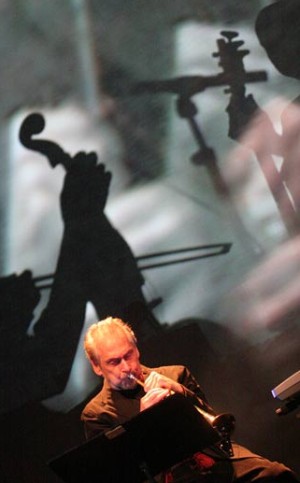
The Fourth World music of Jon Hassell

“Jon Hassell is more than a superb musician, and more even than a gifted composer. He is an inventor of new forms of music — of new ideas of what music could be, and how it might be made. His work is drawn from his whole being, and, by implication, from his whole cultural experience without fear or prejudice. It is an optimistic, global vision that suggests not only possible musics but possible futures.” — Brian Eno

The creator of “Fourth World” music described his ambition in this way: “My aim was to make a music that was vertically integrated in such a way that at any cross-sectional moment you were not able to pick a single element out as being from a particular country or genre of music.”

The following pieces, “Last Night the Moon Came”, and “Blue Period/Light on Water”, performed live in Lausanne, Switzerland, in 2009, come from his most recent album, “Last Night the Moon Came Dropping Its Clothes in the Street” (a line from Rumi).

On Public Radio International, Hassell describes the process, the allusions, and the musical theory that underpins his Fourth World music.

To learn more, visit Jon Hassell’s web site.

Facebooktwittermail

Study reveals the Web isn’t as polarized as we thought

Farhad Manjoo writes: Today, Facebook is publishing a study that disproves some hoary conventional wisdom about the Web. According to this new research, the online echo chamber doesn’t exist.

This is of particular interest to me. In 2008, I wrote True Enough, a book that argued that digital technology is splitting society into discrete, ideologically like-minded tribes that read, watch, or listen only to news that confirms their own beliefs. I’m not the only one who’s worried about this. Eli Pariser, the former executive director of MoveOn.org, argued in his recent book The Filter Bubble that Web personalization algorithms like Facebook’s News Feed force us to consume a dangerously narrow range of news. The echo chamber was also central to Cass Sunstein’s thesis, in his book Republic.com, that the Web may be incompatible with democracy itself. If we’re all just echoing our friends’ ideas about the world, is society doomed to become ever more polarized and solipsistic?

It turns out we’re not doomed. The new Facebook study is one of the largest and most rigorous investigations into how people receive and react to news. It was led by Eytan Bakshy, who began the work in 2010 when he was finishing his Ph.D. in information studies at the University of Michigan. He is now a researcher on Facebook’s data team, which conducts academic-type studies into how users behave on the teeming network.

Bakshy’s study involves a simple experiment. Normally, when one of your friends shares a link on Facebook, the site uses an algorithm known as EdgeRank to determine whether or not the link is displayed in your feed. In Bakshy’s experiment, conducted over seven weeks in the late summer of 2010, a small fraction of such shared links were randomly censored—that is, if a friend shared a link that EdgeRank determined you should see, it was sometimes not displayed in your feed. Randomly blocking links allowed Bakshy to create two different populations on Facebook. In one group, someone would see a link posted by a friend and decide to either share or ignore it. People in the second group would not receive the link—but if they’d seen it somewhere else beyond Facebook, these people might decide to share that same link of their own accord.

By comparing the two groups, Bakshy could answer some important questions about how we navigate news online. Are people more likely to share information because their friends pass it along? And if we are more likely to share stories we see others post, what kinds of friends get us to reshare more often—close friends, or people we don’t interact with very often? Finally, the experiment allowed Bakshy to see how “novel information”—that is, information that you wouldn’t have shared if you hadn’t seen it on Facebook—travels through the network. This is important to our understanding of echo chambers. If an algorithm like EdgeRank favors information that you’d have seen anyway, it would make Facebook an echo chamber of your own beliefs. But if EdgeRank pushes novel information through the network, Facebook becomes a beneficial source of news rather than just a reflection of your own small world.

That’s exactly what Bakshy found. His paper is heavy on math and network theory, but here’s a short summary of his results. First, he found that the closer you are with a friend on Facebook—the more times you comment on one another’s posts, the more times you appear in photos together, etc.—the greater your likelihood of sharing that person’s links. At first blush, that sounds like a confirmation of the echo chamber: We’re more likely to echo our closest friends.

But here’s Bakshy’s most crucial finding: Although we’re more likely to share information from our close friends, we still share stuff from our weak ties—and the links from those weak ties are the most novel links on the network. Those links from our weak ties, that is, are most likely to point to information that you would not have shared if you hadn’t seen it on Facebook. The links from your close ties, meanwhile, more likely contain information you would have seen elsewhere if a friend hadn’t posted it. These weak ties “are indispensible” to your network, Bakshy says. “They have access to different websites that you’re not necessarily visiting.” [Continue reading…]

Facebooktwittermail

Keystone XL decision is a big win — for now

Bill McKibben writes: Last spring, almost no one outside of Nebraska had heard of the Keystone XL pipeline. As late as October, when the National Journal surveyed 300 “energy insiders” in D.C., 91 percent predicted that the Obama administration would approve the permit for the pipeline. TransCanada stacked 1,700 miles of pipe along the proposed route, so confident was the company of victory.

Today, the State Department and the president denied the permit for the pipeline. It’s one of the rare days in the 20-year climate fight when scientists can smile and Big Oil has to frown. Because citizen activists around the country were willing to put their bodies on the line, and because the environmental movement worked with rare unity and coordination, a done deal has come spectacularly undone.

There are no permanent environmental victories, certainly not this one. TransCanada (or any other company) is free to reapply for a new permit, though I imagine this time the State Department process will be conducted with more transparency and less favoritism. And of course the biggest caveat of all: Even if every drop of tar-sands oil remained safely in the ground, we’ve still got more than enough coal and gas and oil to crash the climate system.

Facebooktwittermail

Israel: Iran still mulling whether to build nuclear bomb

Haaretz reports: Iran has not yet decided whether to make a nuclear bomb, according to the intelligence assessment Israeli officials will present later this week to Gen. Martin Dempsey, chairman of the U.S. Joint Chiefs of Staff.

Dempsey will be arriving on his first visit here since being appointed chairman of the Joint Chiefs of Staff in September. He will meet with various senior defense officials, including Defense Minister Ehud Barak and Israel Defense Forces Chief of Staff Benny Gantz.

The Israeli view is that while Iran continues to improve its nuclear capabilities, it has not yet decided whether to translate these capabilities into a nuclear weapon – or, more specifically, a nuclear warhead mounted atop a missile. Nor is it clear when Iran might make such a decision.

Israel also believes the Iranian regime now faces an unprecedented threat to its stability, which for the first time combines both external and internal pressure: from abroad, increasingly harsh sanctions and threats of military action, and at home, economic distress and worries about the results of the parliamentary election scheduled for March.

Israeli intelligence sees signs that the regime in Tehran is genuinely worried about the possibility of an opposition victory in March. Should that happen, the regime will have to choose between conceding the loss or falsifying results – as it apparently did in the 2009 presidential election – which could incite anti-regime protests thanks to the tailwind provided by the Arab Spring, which toppled the regimes in Egypt, Tunisia and Libya.

Moreover, the country’s economic woes are already hitting ordinary Iranians in their pockets. Tighter sanctions have caused the Iranian currency to depreciate by dozens of percent; the regime is having trouble amassing as much foreign currency as it needs; and now, it faces the prospect of new sanctions by the United States and the European Union against its central bank and its oil industry.

The regime is also being confronted by two distinct ideological challenges. On one hand, a growing camp that includes supporters of Iranian President Mahmoud Ahmadinejad is challenging the authority of the ruling clerics, and especially that of the supreme leader, Ayatollah Ali Khamenei. On the other, the Iranian model of a strict Islamic regime run by clerics is being called into question by Islamist ruling parties in Turkey, Tunisia and perhaps also Egypt, which either are or will soon be offering more democratic, modern and moderate models of Islamic governance.

Lastly, Tehran’s chief ally, Syrian President Bashar Assad, is in real danger of being toppled as well.

Altogether, therefore, “2011 was a very bad year for the regime in Tehran,” a senior defense official told Haaretz. Israeli analysts believe 2012 will promise more of the same: more pressure, including the tougher public line now being taken by U.S. President Barack Obama, and also more uncertainty and instability, in both the region as a whole and Iran in particular.

All this makes it increasingly hard to predict what Iran will do.

Facebooktwittermail