U.S. warns Israel against military strike on Iran

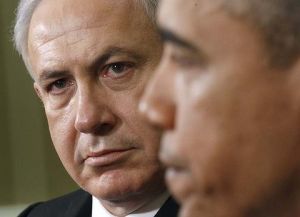
The Wall Street Journal reports: U.S. defense leaders are increasingly concerned that Israel is preparing to take military action against Iran, over U.S. objections, and have stepped up contingency planning to safeguard U.S. facilities in the region in case of a conflict.

President Barack Obama, Defense Secretary Leon Panetta and other top officials have delivered a string of private messages to Israeli leaders warning about the dire consequences of a strike. The U.S. wants Israel to give more time for the effects of sanctions and other measures intended to force Iran to abandon its perceived efforts to build nuclear weapons.

Stepping up the pressure, Mr. Obama spoke by telephone on Thursday with Israeli Prime Minister Benjamin Netanyahu, and U.S. Gen. Martin Dempsey, chairman of the Joint Chiefs of Staff, will meet with Israeli military officials in Tel Aviv next week.

The high-stakes planning and diplomacy comes as U.S. officials warn Tehran, including through what administration officials described Friday as direct messages to Iran’s leaders, against provocative actions.

Tehran has warned that it could retaliate to tightened sanctions by blocking oil trade through the Strait of Hormuz. On Thursday, Iran’s Supreme Leader Ayatollah Ali Khamenei vowed to punish the perpetrators of the assassination—blamed by Iran on the U.S. and Israel—of an Iranian scientist involved in the nuclear program.

The U.S. denied the charge and condemned the attack. Israel hasn’t commented.

The U.S. and Iran, however, have taken steps in recent days apparently designed to ease tensions. Iran has agreed to host a delegation of United Nations nuclear inspectors this month. The U.S., meanwhile, has twice this month rescued Iranian sailors in the region’s seas.

Covert efforts by Israel’s intelligence service to prevent Tehran from developing nuclear weapons have been credited with slowing the program without the high risk of military conflict that could be sparked by an airstrike. Iran says its nuclear program is for peaceful uses.

But Israel has declined to rule out a strike, as has the U.S.

“It is the policy of the Israeli government, and the Obama administration, that all options remain on the table. And it is crucial that the ayatollahs in Tehran take this policy seriously,” said Michael Oren, Israel’s ambassador to the U.S.

Mr. Netanyahu said in a recent interview that Iran has begun to “wobble,” a signal some U.S. officials believe suggests he is willing to follow the current U.S. strategy, which seeks to avoid a military confrontation with Iran.

“Recent comments by the Israelis show they understand how tough the sanctions we’ve put in place are and are giving them time to work,” said a senior Obama administration official.

The U.S. military is preparing for a number of possible responses to an Israeli strike, including assaults by pro-Iranian Shiite militias in Iraq against the U.S. Embassy in Baghdad, according to U.S. officials.

The U.S. believes its embassy and other diplomatic outposts in Iraq are more vulnerable following the withdrawal of U.S. forces last month. Up to 15,000 U.S. diplomats, federal employees and contractors are expected to remain in Iraq.

Facebooktwittermail

Mossad agents posing as CIA ‘apparently didn’t give a damn what we thought’

Mark Perry’s explosive report on Israel intelligence agents posing as CIA agents, recruiting terrorists to strike Iran, is headline news — at least in Israel.

In the United States the mainstream media has so far remained mute. Perhaps this isn’t surprising, though yet again it reflects the sickeningly servile relationship between the U.S. establishment and Israel’s supporters.

Imagine if the story in Foreign Policy had been that the CIA was recruiting terrorists. There would have been wall-to-wall coverage in print and on the cable networks. But since this is a story about the duplicity of Mossad there remains a hushed silence among those who dread the thought of upsetting the Israel lobby.

“It’s amazing what the Israelis thought they could get away with,” a U.S. intelligence officer told Perry, but maybe it really isn’t so amazing. After all, Israel’s political leaders, knowing that they essentially own the U.S. Congress and will never be severely challenged in the U.S. media, regard Washington as a malleable tool. Why would Mossad agents view their American counterparts any differently?

That the CIA does not regard Mossad as a stalwart friend, was made perfectly clear in a report by Jeff Stein a year and a half ago.

The CIA took an internal poll not long ago about friendly foreign intelligence agencies.

The question, mostly directed to employees of the clandestine service branch, was: Which are the best allies among friendly spy services, in terms of liaison with the CIA, and which are the worst? In other words, who acts like, well, friends?

“Israel came in dead last,” a recently retired CIA official told me the other day.

Not only that, he added, throwing up his hands and rising from his chair, “the Israelis are number three, with China number one and Russia number two,” in terms of how aggressive they are in their operations on U.S. soil.

Israel’s undercover operations here, including missions to steal U.S. secrets, are hardly a secret at the FBI, CIA and other U.S. intelligence agencies. From time to time, in fact, the FBI has called Israeli officials on the carpet to complain about a particularly brazen effort to collect classified or other sensitive information, in particular U.S. technical and industrial secrets.

At Gawker, John Cook notes:

Spies are horrible and lie all the time and we do the same thing to other countries and down is up and up is down. But just remember next time you hear someone talking about our special relationship with Israel: They are taking some of the $3 billion a year we give them in military aid and using it to fund a program where they pay terrorists to kill Iranians and blame it on us.

And blame it on us so that when Israel’s covert war turns into full-scale war it will become our war.

Facebooktwittermail

How Israel is sponsoring terrorism and betraying its American allies

In an exclusive report for Foreign Policy magazine, Mark Perry reveals that Mossad agents have been posing as CIA officers and recruiting members of the terrorist organization Jundallah to fight Israel’s covert war against Iran.

Buried deep in the archives of America’s intelligence services are a series of memos, written during the last years of President George W. Bush’s administration, that describe how Israeli Mossad officers recruited operatives belonging to the terrorist group Jundallah by passing themselves off as American agents. According to two U.S. intelligence officials, the Israelis, flush with American dollars and toting U.S. passports, posed as CIA officers in recruiting Jundallah operatives — what is commonly referred to as a “false flag” operation.

The memos, as described by the sources, one of whom has read them and another who is intimately familiar with the case, investigated and debunked reports from 2007 and 2008 accusing the CIA, at the direction of the White House, of covertly supporting Jundallah — a Pakistan-based Sunni extremist organization. Jundallah, according to the U.S. government and published reports, is responsible for assassinating Iranian government officials and killing Iranian women and children.

But while the memos show that the United States had barred even the most incidental contact with Jundallah, according to both intelligence officers, the same was not true for Israel’s Mossad. The memos also detail CIA field reports saying that Israel’s recruiting activities occurred under the nose of U.S. intelligence officers, most notably in London, the capital of one of Israel’s ostensible allies, where Mossad officers posing as CIA operatives met with Jundallah officials.

The officials did not know whether the Israeli program to recruit and use Jundallah is ongoing. Nevertheless, they were stunned by the brazenness of the Mossad’s efforts.

“It’s amazing what the Israelis thought they could get away with,” the intelligence officer said. “Their recruitment activities were nearly in the open. They apparently didn’t give a damn what we thought.”

Interviews with six currently serving or recently retired intelligence officers over the last 18 months have helped to fill in the blanks of the Israeli false-flag operation. In addition to the two currently serving U.S. intelligence officers, the existence of the Israeli false-flag operation was confirmed to me by four retired intelligence officers who have served in the CIA or have monitored Israeli intelligence operations from senior positions inside the U.S. government.

The CIA and the White House were both asked for comment on this story. By the time this story went to press, they had not responded. The Israeli intelligence services — the Mossad — were also contacted, in writing and by telephone, but failed to respond. As a policy, Israel does not confirm or deny its involvement in intelligence operations.

There is no denying that there is a covert, bloody, and ongoing campaign aimed at stopping Iran’s nuclear program, though no evidence has emerged connecting recent acts of sabotage and killings inside Iran to Jundallah. Many reports have cited Israel as the architect of this covert campaign, which claimed its latest victim on Jan. 11 when a motorcyclist in Tehran slipped a magnetic explosive device under the car of Mostafa Ahmadi Roshan, a young Iranian nuclear scientist. The explosion killed Roshan, making him the fourth scientist assassinated in the past two years. The United States adamantly denies it is behind these killings.

According to one retired CIA officer, information about the false-flag operation was reported up the U.S. intelligence chain of command. It reached CIA Director of Operations Stephen Kappes, his deputy Michael Sulick, and the head of the Counterintelligence Center. All three of these officials are now retired. The Counterintelligence Center, according to its website, is tasked with investigating “threats posed by foreign intelligence services.”

The report then made its way to the White House, according to the currently serving U.S. intelligence officer. The officer said that Bush “went absolutely ballistic” when briefed on its contents.

“The report sparked White House concerns that Israel’s program was putting Americans at risk,” the intelligence officer told me. “There’s no question that the U.S. has cooperated with Israel in intelligence-gathering operations against the Iranians, but this was different. No matter what anyone thinks, we’re not in the business of assassinating Iranian officials or killing Iranian civilians.”

Israel’s relationship with Jundallah continued to roil the Bush administration until the day it left office, this same intelligence officer noted. Israel’s activities jeopardized the administration’s fragile relationship with Pakistan, which was coming under intense pressure from Iran to crack down on Jundallah. It also undermined U.S. claims that it would never fight terror with terror, and invited attacks in kind on U.S. personnel. [Continue reading…]

Facebooktwittermail

How might Iran strike back?

Paul Pillar writes: The killing of an individual foreigner overseas, if carried out for a political or policy purpose by either a nonstate actor or clandestine agents of a state, is an act of international terrorism. At least that is how U.S. law defines it, for purposes such as the State Department’s annual reports on terrorism. This form of terrorism is part of what put Iran on the list of state sponsors of terrorism. Through the 1980s and into the 1990s, the Iranian regime perpetrated numerous assassinations of exiled Iranian political dissidents, in Europe as well as in other countries of southwest Asia. The Iranians effectively ended this assassination campaign about a decade and a half ago, largely to improve relations with the European countries on whose soil many of the assassinations occurred and perhaps also because by then Iran had bumped off nearly all of the people on its hit list. We should assume, however, that Iran retains the capability to assassinate far-flung targets again, and that it would consider doing so if searching for ways to strike back at adversaries that are striking it.

Iran itself has been a victim of this form of terrorist violence. This has included some instances, such as the killing of Iranian diplomats in Afghanistan, in which Iranian interests have paralleled those of the United States. It has included during the past two years the killing in Iran of several nuclear scientists, the most recent of whom died this week from an explosive placed on his vehicle. Actions are more important than nomenclature, so if you prefer not to apply the T-word to these killings then just imagine what the reaction would be if something similar were occurring in the United States. Imagine the response if even just one scientist (let alone four or five) who was employed, say, at one of the U.S. national laboratories had been been similarly assassinated and a foreign hand was suspected. There would be screams of “act of war” and the U.S. president would be hard-pressed to hold back impulses to strike back forcefully. Now put yourselves in the Iranians’ place. Not only do they face the serial assassination of their scientists, but they face it amid an environment filled with numerous other indications of foreign hostility, including the economic warfare, the saber rattling and the contest among American politicians to see who can shoot the most rhetorical venom at Iran. From this perspective, aptly described by Vali Nasr, it should hardly be surprising if Iran strikes back while it sees more reason than ever before to develop a nuclear weapon in the hope of deterring U.S.-led aggressiveness.

A former senior Israeli security official tells the New York Times that uncertainty about who was responsible for the latest assassination is useful. “It’s not enough to guess,” he says. “You can’t prove it, so you can’t retaliate. When it’s very, very clear who’s behind an attack, the world behaves differently.”

How true that might be really depends on the form of retaliation. As Nasr and Pillar note, the rationale for Iran to want nuclear weapons in order to deter foreign aggression, has never been more compelling. So why should Tehran slow itself down in pursuit of that goal by allowing itself to rise to an Israeli bait?

Indeed, the longer Iran exercises restraint and the more reckless Israeli antagonism becomes, the more reason there is to ask: whose nuclear weapons in the Middle East should we fear the most?

Israel maintains a policy of nuclear ambiguity, which is to say that although it has a nuclear arsenal estimated to include as many as 400 weapons, it refuses to accept the international treaty obligations imposed on most other nuclear powers. Moreover, according to some observers it has its own version of “mutually assured destruction”. Unlike the original MAD doctrine which constrained the Soviet Union and the United States, Israel has the “Samson Option,” which is to say Israel won’t allow itself to go down without destroying human civilization in the process.

This is how Professor David Perlmutter articulated this apocalyptic vision ten years ago:

Israel has been building nuclear weapons for 30 years. The Jews understand what passive and powerless acceptance of doom has meant for them in the past, and they have ensured against it. Masada was not an example to follow — it hurt the Romans not a whit, but Sampson in Gaza? With an H-bomb? What would serve the Jew-hating world better in repayment for thousands of years of massacres but a Nuclear Winter. Or invite all those tut-tutting European statesmen and peace activists to join us in the ovens?

For the first time in history, a people facing extermination while the world either cackles or looks away — unlike the Armenians, Tibetans, World War II European Jews or Rwandans — have the power to destroy the world. The ultimate justice?

That might be the ultimate justice if everyone on the planet posed a threat to Israel, but Israel’s enemies are in truth far less numerous. So really, the image being evoked here is not one of justice but of the ultimate form of vengeance.

Individuals and nations can be at their most dangerous when cornered. As Israel continues its slide away from democratic principles and becomes increasingly strident in asserting itself as a Jewish theocratic state, the world has more reason to fear a nuclear threat in the Middle East that does not lurk somewhere over the horizon but is already a clear and present danger.

Avner Cohen, author of Israel and the Bomb and The Worst-Kept Secret: Israel’s Bargain with the Bomb, is the foremost scholar on the subject of Israel’s policy of nuclear ambiguity, and as he notes, Israel’s nuclear arsenal is only of value if Israel can remain the sole nuclear power in the Middle East.

On the one hand, the bomb’s purpose was clear: Ben-Gurion, who remained so helpless throughout the Holocaust period, wanted an ‘insurance policy’ to protect against a recurrence of such a tragedy. If you have the capability of threatening Hiroshima, you stave off Auschwitz. On the other hand, the other side could try to attain the same status. And if it were to succeed, then, suddenly, all of the calculations would be altered, moving from one extreme to the other. This was not like the Americans and the Russians, who found themselves more or less in a situation of parity. When both sides in the Arab-Israeli dispute have the bomb, Israel is trapped in an awful situation, worse than at the starting point. Thus, Israel’s real interest is for nobody to have the bomb.

Yet rather than pursue that goal of regional disarmament and the creation of a nuclear-weapon-free Middle East, those who are gunning for a war against Iran only have one ambition: that Israel must retain its regional military dominance.

Facebooktwittermail

Iran to let in U.N. atomic inspectors

The Wall Street Journal reports: Iran agreed to host a high-level team of United Nation’s nuclear inspectors later this month, Western diplomats said, a surprise development that could help to curb building tensions with the West.

The diplomats on Thursday said Iran had tentatively agreed to receive a delegation from the United Nation’s International Atomic Energy Agency headed by the agency’s chief weapons inspector, Herman Nackaerts. The diplomats, who are based in Vienna, said the visit was tentatively set for Jan. 28.

Unclear, said the diplomats, was whether Tehran would let the inspectors visit key nuclear sites and interview the Iranian official the U.S. and the U.N. agency believe may head a nuclear-weapons program.

Facebooktwittermail

Why not to attack Iran

Elbridge Colby and Austin Long write: The pressure for an attack on Iran is building. Media reports suggest that the Obama administration is under pressure to take action and may even be considering action itself, and Foreign Affairs published an article in its opening 2012 issue by nuclear expert Matthew Kroenig forthrightly stating that it is “time to attack Iran.” Many argue that strikes against Iran’s nuclear program are the only responsible course. Defense Secretary Leon Panetta declared on December 18 that if the United States receives “intelligence that [the Iranians] are proceeding with developing a nuclear weapon, then we will take whatever steps necessary to stop it.” And former White House Middle East chief Dennis Ross suggested in a December 23 op-ed that, if pressure fails, the military option is the only sensible recourse. The United States cannot live with a nuclear Iran, he argues.

The reality, however, is that attacking Iran without provocation is a dangerous course. The arguments for avoiding military strikes are well known: deterrence, while neither easy nor cheap, can work; the costs of likely Iranian retaliation outweigh the likely benefits, perhaps markedly; and the United States (and its allies) have considered preventive attacks against adversary nuclear programs before, thought the better of it and come out tolerably.

But perhaps the most important argument against attacking Iran has received less attention. That is that none of the attack proponents can give a sensible answer to the question General David Petraeus posed at the beginning of the Iraq war: “How does this end?” Kroenig and other advocates for war note, correctly, that a strike against Iran could do substantial damage to Iran’s program. But they fail to explain how the United States will prevent Iran from simply restarting its program, this time in deadly earnest. Moreover, they don’t explain why such strikes won’t contribute to the immediate rallying of the Iranian people around the otherwise reviled regime.

Facebooktwittermail

All the lies fit to print

Clay Shirky writes: Thursday, Arthur Brisbane, the public editor of the New York Times, went to his readers with a question:

“I’m looking for reader input on whether and when New York Times news reporters should challenge ‘facts’ that are asserted by newsmakers they write about.”

Brisbane (who, as public editor, speaks only for himself, not the Times) referred to two recent stories: the claim that Clarence Thomas had “misunderstood” a financial reporting form when he left out key information, and Mitt Romney’s assertion that President Obama gives speeches “apologising” for America. Brisbane asked whether news reporters should have the freedom to investigate and respond to those comments.

The reaction from readers was swift, voluminous, negative and incredulous.

“Is this a joke? THIS IS YOUR JOB.”

“If the purpose of the NYT is to be an inoffensive container for ad copy, then by all means continue to do nothing more than paraphrase those press releases.”

“I hope you can help me, Mr Brisbane, because I’m an editor, currently unemployed: is fecklessness now a job requirement?”

Brisbane had clearly not been expecting this excoriating and one-sided a reaction. Brisbane has since tried to clarify his views twice. The first was on the media blog JimRomenesko.com:

“What I was trying to ask was whether reporters should always rebut dubious facts in the body of the stories they are writing. I was hoping for diverse and even nuanced responses to what I think is a difficult question.”

The second was on the NY Times site:

“My inquiry related to whether the Times, in the text of news columns, should more aggressively rebut ‘facts’ that are offered by newsmakers when those ‘facts’ are in question. I consider this a difficult question, not an obvious one.”

This only added fuel to the fire.

Now, it’s worth noting that Brisbane’s question makes perfect sense, considered from the newsroom’s perspective. Romney’s claim that Obama makes speeches “apologising” for America isn’t readily amenable to fact-checking. Instead, Romney relied on what are sometimes called “weasel words”, in which an allegation is alluded to, without being made head-on. (Romney, for instance, never quotes any of the president’s speeches when making this assertion.) For Brisbane, the open question was whether a hard news reporter should be calling out those kinds of statements, or should simply quote the source accurately.

This is what was so extraordinary about his original question: he is evidently so steeped in newsroom culture that he does not understand – literally, does not understand, as we know from his subsequent clarifications – that this is not a hard question at all, considered from the readers’ perspective. Readers do not care about the epistemological differences between lies and weasel words; we want newspapers to limit the ability of politicians to make dubious assertions without penalty. Judging from the reactions to his post, most of us never understood that this wasn’t the newspapers’ self-conceived mission in the first place.

Facebooktwittermail

Unexpected road block to Afghanistan peace: prisoners of war

Spencer Ackerman reports: Negotiating a peace deal with the Taliban after 10 years of war in Afghanistan is hard enough. But the stalemated politics of the Guantanamo Bay detention facility risk effectively killing the negotiations before they even have the chance to end the war.

The Taliban leadership has evidently decided it wants to talk peace terms. Among the things it wants as a gesture of good faith from its U.S. adversaries: the release of five detainees from Guantanamo.

Provisions in the defense bill recently signed into law by President Obama make it difficult to transfer detainees out of Guantanamo Bay, the terrorism detention complex that turns 10 years old this week. But they’re a symptom of a greater obstacle to a peace deal: Congress’ broad, bipartisan allergy to releasing any detainees from Gitmo at all.

The calendar actually makes it worse than that. 2012 is an election year. Opening Guantanamo Bay’s doors as a gesture to the Taliban is a narrative practically begging for a political attack ad.

An administration official, who requested anonymity to discuss the super-sensitive proposition, tells Danger Room that Obama hasn’t actually made a decision — except to rule out a straight detainee release. “We would never consider an outright release,” the official says. “The only thing we’d consider is a transfer into third-party custody.” And that might actually provide the administration with a way to get the talks going, get the detainees out of Gitmo without freeing them, and keep Congress on board.

Outside analysts, however, aren’t convinced. “Politically,” says Karen Greenberg, who directs Fordham Law School’s Center for National Security, “it’s a nonstarter.”

Facebooktwittermail

The Earth is one among a trillion planets in the Milky Way

PopSci reports: Each star in the Milky Way shines its light upon at least one companion planet, according to a new analysis that suddenly renders exoplanets commonplace, the rule rather than the exception. This means there are billions of worlds just in our corner of the cosmos. This is a major shift from just a few years ago, when many scientists thought planets were tricky to make, and therefore special things. Now we know they’re more common than stars themselves.

“Planets are like bunnies; you don’t just get one, you get a bunch,” said Seth Shostak, a senior astronomer at the SETI Institute who was not involved in this research. “So really, the number of planets in the Milky Way is probably like five or 10 times the number of stars. That’s something like a trillion planets.”

Of course there’s no way to know, at least not yet, how many of these worlds could be hospitable to forms of life as we know it. But the odds alone are tantalizing, Shostak said.

“It’s not unreasonable at this point to say there are literally billions of habitable worlds in our galaxy, probably as a lower limit,” he said. “Maybe they’re all sterile as an autoclave, but it doesn’t seem very likely, does it? That would make us very odd.”

Facebooktwittermail

Netanyahu’s war against Obama

Max Blumenthal writes:

The US presidential election campaign that kicked off January 3 with the Iowa caucuses was the subject of a curious article attacking President Barack Obama in the mass circulation Israeli daily newspaper, Israel Hayom.

“US President Barack Obama is ‘naïve’ and needs to face up to the threat presented by the rise of the Muslim Brotherhood across the Middle East, Israel’s National Security Council concluded during a strategic discussion several days ago,” Israel Hayom reported.

The Israeli National Security Council consists of Benjamin “Bibi” Netanyahu’s closest advisers. And Israel Hayom is not just another right-leaning Israeli tabloid. Referred to by Israelis as the “Bibiton,” or Bibi’s mouthpiece, the paper is an instrument that gives him extraordinary political leverage. The obviously planted article in Israel Hayom rang like a bell sounding the start of Netanyahu’s own campaign in helping the Republican Party oust Obama from the White House.

Israel Hayom’s genesis demonstrates the depth of Netanyahu’s connections in Republican circles. It was created by one of Netanyahu’s top financial supporters, a Las Vegas-based casino tycoon named Sheldon Adelson, who is also a major donor to the conservative wing of the Republican Party. Adelson’s closest relationship is with former Speaker of the House Newt Gingrich, a longtime ally of Netanyahu who has been running a rancorous campaign for the Republican presidential nomination.

Netanyahu’s less than subtle intervention has become an open issue in Israeli politics. Opposition leader Tzipi Livni of the Kadima Party has criticized Netanyahu for damaging the US-Israeli relationship. “Netanyahu spoke about consensus,” Livni said in May, “and if there is a consensus in Israel, it’s that the relationship with the US is essential to Israel, and a prime minister that harms the relationship with the US over something unsubstantial is harming Israel’s security and deterrence.”

But Livni’s warning has been ignored. Rather than hesitating, the prime minister and his inner circle are moving full steam ahead in their political shadow campaign whose ultimate goal is to remove Obama. Bibi’s war against Obama is unprecedented. While Israeli prime ministers have tried to help incumbent presidents, none have ever waged a full-scale campaign to overthrow them. [Continue reading…]

Facebooktwittermail

The Imran Khan phenomenon

Arif Rafiq writes: In 1992, with his cricket career at its twilight, an aging Imran Khan boldly pledged that the Pakistani national team would win the World Cup for the first time. In March of that year, before a packed stadium in Melbourne, Pakistan defeated former colonial master England, taking the cup and shocking the world of cricket. Khan returned home with a trophy in his hands, enshrined forever as a national hero.

These days, Khan leads another group of underdogs: a political party known as the Pakistan Tehreek-e Insaf (PTI). Last September, Khan made a familiarly bold prediction: PTI, which has only won a single National Assembly seat in its 15-year history, will sweep the next general elections. PTI, Khan says without a semblance of doubt, will rid Pakistan of corruption, endemic poverty, and violence — and eventually bring the country to what he sees as its rightful place on the world stage.

Since his retirement from cricket, Khan has been devoted to social work and politics. Inspired by his mother’s death, he founded the world-class Shaukat Khanum Memorial Cancer Hospital and Research Center, trusted and respected by Pakistanis of all stripes. Khan’s political career, however, has been another story. PTI, despite the initial hype and fanfare, never really took off. Its founding members left the scene early on, and Khan was regularly outsmarted by wilier politicos.

A solitary Khan would regularly lambast the political class on Pakistan’s many talk shows. Critics dismissed him as the darling of the country’s television anchors and the electorally irrelevant “burger-baby” and “mummy-daddy” types (i.e. coddled, Westernized, rootless, upper-middle class youth). Political satire shows lampooned him as a raving, repetitive political loser.

In 2005, Sheikh Rashid Ahmad, then a backer of military ruler Pervez Musharraf, mocked Khan and patronizingly offered to help him win a seat “anywhere he wants.” Fast forward six years ahead, and Sheikh Rashid, seated next to Khan on live television, was ingratiatingly referring to the ex-cricketer as a “brother” and meekly asking him for help in winning a few seats in the next elections.

Once an electoral non-entity, Khan’s PTI could potentially win dozens of National Assembly seats in the next polls — hence the Pauline conversion of opportunists like Sheikh Rashid. Already, PTI has upended the détente between the two major political powers — the Pakistan Peoples Party (PPP) and the Pakistan Muslim League-Nawaz (PML-N) — and put both on the defensive. PTI might become the country’s third-largest party, giving it the power to determine who heads Pakistan’s next coalition government. Khan, no longer a political joke, is a potential kingmaker positioned to prove the doubters wrong once again.

Facebooktwittermail

‘Memogate’ scandal deepens as American accuser threatens to tell all

The Guardian reports: The controversial American businessman at the centre of the “Memogate” scandal threatening to bring down the government of Pakistan has told the Guardian he plans to fly into the country to tell what he describes as the “unaltered truth” before the courts.

The allegations made by Mansoor Ijaz reach all the way up to President Asif Zardari, and could end up with treason charges against the country’s former US ambassador, Husain Haqqani, or even the president himself. But critics say that the charges are a fantastical and thinly-veiled attempt by the military to hound the government from power, aided by the hostile courts that have taken up the case with alacrity.

Ijaz claims that in May, just after Osama bin Laden was found in Pakistan, Haqqani, whom he described as a friend, dictated to him an explosive memo that he was to deliver to the US military leadership. Haqqani allegedly told Ijaz that he was acting on the instructions of “the boss”, whom Ijaz took to mean Zardari.

The anonymous missive pleaded for American help against the Pakistan army, offering to rein in the military and in particular its Inter-Services Intelligence spy agency, which has ties to the Taliban and other jihadist groups.

Ijaz later revealed the existence of the document in a newspaper column, igniting the firestorm that has been raging in Pakistani politics.

“The memo issue has brought the schism between the military and the civilians out into the open,” said Arif Nizami, editor of Pakistan Today.

“You could say what we’re seeing is a slow and gradual coup taking place, eating into the moral authority of the civilian government.”

Facebooktwittermail

Nuclear scientists are not terrorists

In an op-ed for the New Scientist, Debora MacKenzie writes: Attempts to derail a country’s nuclear programme by killing its scientists “are products of desperation”, says [William] Tobey [of the Belfer Center for Science and International Affairs at Harvard University] – citing a US effort to kill legendary physicist Werner Heisenberg during the second world war, abandoned at the last minute only when the would-be assassin decided Heisenberg was not involved in a Nazi nuclear effort after all.

“Nuclear scientists are not terrorists,” says Tobey in the BAS this week. Killing them at best delays bomb development, by removing key people and perhaps deterring young scientists from careers in nuclear science. But it will not stop bomb development.

These slim advantages are far outweighed, Tobey says, by the downsides: possible retaliation, reduced chances for diplomacy, tighter security around nuclear installations and a pretext for Iran to hamper IAEA monitoring.

Iran has already accused the IAEA of abetting the assassinations by publicising confidential Iranian lists of key nuclear scientists and engineers.

The IAEA needs such information, as talks with nuclear personnel are considered essential for verifying safeguards against diverting uranium to bombs, says Tobey. Making this process harder only makes sense if the people behind the assassinations think it is too late for safeguards and that slowing bomb R&D by killing scientists is therefore more expedient.

The Israeli columnist Ron Ben-Yishai writes: The most curious question in the face of these incidents is why Iran, which does not shy away from threatening the world with closure of the Hormuz Straits, has failed to retaliate for the painful blows to its nuclear and missile program? After all, the Revolutionary Guards have a special arm, Quds, whose aim (among others) is to carry out terror attacks and secret assassinations against enemies of the regime overseas.

Moreover, if the Iranians do not wish to directly target Western or Israeli interests, they can prompt their agents, that is, Hezbollah, Islamic Jihad and other groups, to do the job. In the past, Iran did not shy away from carrying out terror attacks in Europe (in Paris and Berlin) and in South America (in Buenos Aires,) so why is it showing restraint now?

The reason is apparently Iran’s fear of Western retaliation. Any terror attack against Israel or another Western target – whether it is carried out directly by the Quds force or by Hezbollah – may prompt a Western response. Under such circumstances, Israel or a Western coalition (or both) will have an excellent pretext to strike and destroy Iran’s nuclear and missile sites.

This sounds like a confirmation that Israel is indeed wanting to provoke Iran in order to start a war.

But here’s the paradox: if Iran is intent on developing nuclear weapons then it has ever incentive to continue keeping its powder dry. Why should it jeopardize its nuclear program by succumbing to provocation?

On the other hand if Israel’s covert war does indeed succeed in triggering a full-scale war, this may be an indication that Iran never intended to go further than develop a nuclear break-out capacity.

At the same time, the idea that Iran can only strike back through some form of violence, ignores the economic and psychological levers that it can pull much more easily.

The question may not be how much provocation Iran can withstand but rather how high can the price for oil rise before the global economy buckles?

Facebooktwittermail

Killing of Iranian scientist imperils former Marine

The Washington Post reports: The assassination Wednesday of an Iranian nuclear scientist in northern Tehran increases the peril for an Iranian American who was sentenced to death Monday, analysts said.

Iranian officials quickly blamed the scientist’s killing on the United States, ratcheting up tensions between the two countries and making it less likely that Amir Mirzaei Hekmati, a 28-year-old former U.S. Marine arrested in August and accused of spying for the CIA, will be released anytime soon.

“Unfortunately, the greater the escalation is, the greater the likelihood that the perceived costs of executing him decline,” said Trita Parsi, president of the National Iranian American Council and author of a new book about the Obama administration’s dealings with Iran.

In recent years, there has been an increase in mysterious explosions at military and industrial sites in Iran. Three scientists involved in Iran’s nuclear program have been assassinated, and a computer virus called Stuxnet wreaked havoc on the program.

As Tehran faces tighter international sanctions, a faltering economy and continued scrutiny of its nuclear program, the country’s justice system has turned its attention to Iranian Americans.

There has been a string of arrests of dual nationals in recent years. Typically, Iran charges them with espionage and sometimes shows them on state-run television making “confessions,” under what the detainees later say was duress. Negotiations have usually led to the detainees’ release after several months, sometimes after the announcement of a lengthy prison sentence.

But even analysts who believe Hekmati is being used as a bargaining chip say they were taken aback by the swiftness and harshness of his sentence.

The U.S. government, which does not have diplomatic relations with Iran, has said that Hekmati is not a spy. The CIA has declined to comment on the case, but Art Keller, a former CIA case officer, said Hekmati does not fit the profile of an undercover agent.

“I have a hard time believing that we would send someone over under his true name with his military affiliation well known,” he said. “That’s what you have alias documents for.”

Facebooktwittermail