The threat of solidarity — when power becomes afraid of the people

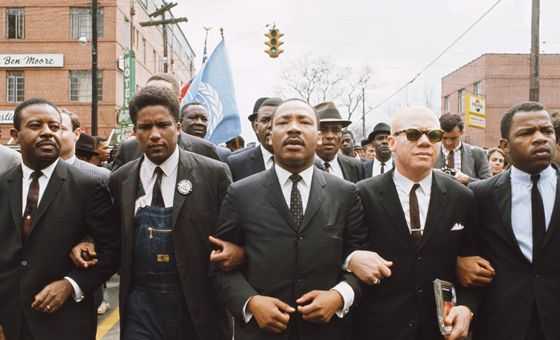
Martin Luther King Jr leading civil rights march from Selma to Montgomery, 1965
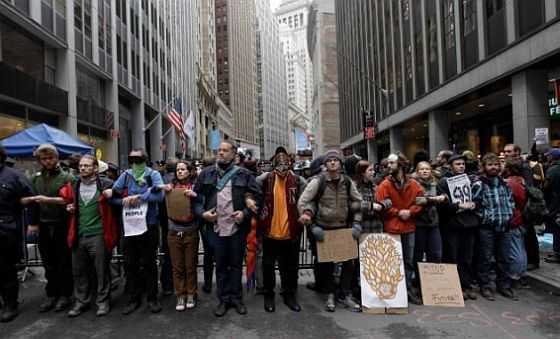
The 99% shut down Wall Street, November 17, 2011

Students lock arms before police assault, University of California at Berkeley, November 9, 2011

After a police assault (shown in the video above) on non-violent student protesters — whose only arms were the ones they interlocked — Robert Birgeneau, the chancellor at Berkeley, issued a statement saying:

It is unfortunate that some protesters chose to obstruct the police by linking arms and forming a human chain to prevent the police from gaining access to the tents. This is not non-violent civil disobedience. By contrast, some of the protesters chose to be arrested peacefully; they were told to leave their tents, informed that they would be arrested if they did not, and indicated their intention to be arrested. They did not resist arrest or try physically to obstruct the police officers’ efforts to remove the tent. These protesters were acting in the tradition of peaceful civil disobedience, and we honor them.

What Birgeneau objects to is resistance in any form and interlocking arms in defiance of an advancing line of police is indeed an act of resistance.

But more than that, it is an act of solidarity and nothing threatens institutional power more than unity among ordinary people.

When burly police officers thrust night sticks into the chests of young students, this is not simply what is euphemistically called a “show of force,” but instead seems to be a display of “forward panic.”

In the kind of police violence that sociologist Randall Collins has dubbed forward panic, a cauldron of pent up tension suddenly erupts. Among Collins’ insights is that because people (including police and soldiers) universally have high-threshold inhibitions that restrain them from becoming violent, when those inhibitions suddenly fall away, the targets of violence will most often be those who are perceived as weak, unwilling or incapable of hitting back. Fear targets the easiest opponent.

This is the micro-social context in which the police lash out, but at the same time there is a broader context that fuels the fear of those who have been invested with the power of the state.

In the face of mass resistance, the primary line of defense for the police is not their weapons or shields — it is an idea already under challenge: that the state is more powerful than the people. And once the fault-lines in that idea have been exposed, the power equation is in jeopardy of suddenly being reversed.

Over the last twelves months, in the Middle East, in Europe, and now in the United States, the seeds have already been planted which could grow into the most dangerous idea that ever swept the world: that we have a greater interest in uniting than we do in being set apart; that what we might gain together will far exceed what we can achieve alone.

Human solidarity — this is what now threatens governments, corporations and every concentration of power.

* * *

Protesters in New York today were joined by one former police officer who sees that it his duty to stand with the people: Retired Police Captain Raymond Lewis from Philadelphia.

This afternoon, Captain Lewis was marched away in cuffs after being arrested by the NYPD.

Facebooktwittermail

Mother of two gets jail for food-stamp fraud; Wall Street fraudsters get bailouts

Matt Taibbi writes: Last week, a federal judge in Mississippi sentenced a mother of two named Anita McLemore to three years in federal prison for lying on a government application in order to obtain food stamps.

Apparently in this country you become ineligible to eat if you have a record of criminal drug offenses. States have the option of opting out of that federal ban, but Mississippi is not one of those states. Since McLemore had four drug convictions in her past, she was ineligible to receive food stamps, so she lied about her past in order to feed her two children.

The total “cost” of her fraud was $4,367. She has paid the money back. But paying the money back was not enough for federal Judge Henry Wingate.

Wingate had the option of sentencing McLemore according to federal guidelines, which would have left her with a term of two months to eight months, followed by probation. Not good enough! Wingate was so outraged by McLemore’s fraud that he decided to serve her up the deluxe vacation, using another federal statute that permitted him to give her up to five years.

He ultimately gave her three years, saying, “The defendant’s criminal record is simply abominable …. She has been the beneficiary of government generosity in state court.”

Compare this court decision to the fraud settlements on Wall Street. Like McLemore, fraud defendants like Citigroup, Goldman Sachs, and Deutsche Bank have “been the beneficiary of government generosity.” Goldman got $12.9 billion just through the AIG bailout. Citigroup got $45 billion, plus hundreds of billions in government guarantees.

All of these companies have been repeatedly dragged into court for fraud, and not one individual defendant has ever been forced to give back anything like a significant portion of his ill-gotten gains. The closest we’ve come is in a fraud case involving Citi, in which a pair of executives, Gary Crittenden and Arthur Tildesley, were fined the token amounts of $100,000 and $80,000, respectively, for lying to shareholders about the extent of Citi’s debt.

Neither man was forced to admit to intentional fraud. Both got to keep their jobs.

Anita McLemore, meanwhile, lied to feed her children, gave back every penny of her “fraud” when she got caught, and is now going to do three years in prison. Explain that, Eric Holder!

Facebooktwittermail

America’s new robber barons

Jeff Madrick writes: With early Tuesday’s abrupt evacuation of Zuccotti Park, the City of New York has managed—for the moment—to dislodge protesters from Wall Street. But it will be much harder to turn attention away from the financial excesses of the very rich—the problems that have given Occupy Wall Street such traction. Data on who is in the top 1 percent of earners further reinforces their point. Here’s why.

Though the situation is often described as a problem of inequality, this is not quite the real concern. The issue is runaway incomes at the very top—people earning a million and a half dollars or more according to the most recent data. And much of that runaway income comes from financial investments, stock options, and other special financial benefits available to the exceptionally rich—much of which is taxed at very low capital gains rates. Meanwhile, there has been something closer to stagnation for almost everyone else—including even for many people in the top 20 percent of earners.

This may seem counterintuitive at first. After all, analysts have long painted a picture of growing inequality over the past few decades in which the top quintile’s share of the national income has risen while the share of the other 80 percent has fallen. But almost all the gains for the top 20 percent was for the top 1 percent. And half of that is accounted for by a tiny group within the top percent—those earners in the top 0.1 percent. Meanwhile, for the four quintiles below the 80 percent level, the share of total income fell significantly. For those from the 80th to the 99th percentile, the share rose only slightly (a little more rapidly as you go higher up).

In other words, Occupy Wall Street’s claim that “We are the 99 percent” is dead on right.

Facebooktwittermail

Fake terror plots, paid informants: the tactics of FBI ‘entrapment’ questioned

The Guardian reports: David Williams did not have an easy life. He moved to Newburgh, a gritty, impoverished town on the banks of the Hudson an hour or so north of New York, at just 10 years old. For a young, black American boy with a father in jail, trouble was everywhere.

Williams also made bad choices. He ended up going to jail for dealing drugs. When he came out in 2007 he tried to go straight, but money was tight and his brother, Lord, needed cash for a liver transplant. Life is hard in Newburgh if you are poor, have a drug rap and need cash quickly.

His aunt, Alicia McWilliams, was honest about the tough streets her nephew was dealing with. “Newburgh is a hard place,” she said. So it was perhaps no surprise that in May, 2009, David Williams was arrested again and hit with a 25-year jail sentence. But it was not for drugs offences. Or any other common crime. Instead Williams and three other struggling local men beset by drug, criminal and mental health issues were convicted of an Islamic terrorist plot to blow up Jewish synagogues and shoot down military jets with missiles.

Even more shocking was that the organisation, money, weapons and motivation for this plot did not come from real Islamic terrorists. It came from the FBI, and an informant paid to pose as a terrorist mastermind paying big bucks for help in carrying out an attack. For McWilliams, her own government had actually cajoled and paid her beloved nephew into being a terrorist, created a fake plot and then jailed him for it. “I feel like I am in the Twilight Zone,” she told the Guardian.

Lawyers for the so-called Newburgh Four have now launched an appeal that will be held early next year. Advocates hope the case offers the best chance of exposing the issue of FBI “entrapment” in terror cases. “We have as close to a legal entrapment case as I have ever seen,” said Susanne Brody, who represents another Newburgh defendant, Onta Williams.

Some experts agree. “The target, the motive, the ideology and the plot were all led by the FBI,” said Karen Greenberg, a law professor at Fordham University in New York, who specialises in studying the new FBI tactics.

But the issue is one that stretches far beyond Newburgh. Critics say the FBI is running a sting operation across America, targeting – to a large extent – the Muslim community by luring people into fake terror plots. FBI bureaux send informants to trawl through Muslim communities, hang out in mosques and community centres, and talk of radical Islam in order to identify possible targets sympathetic to such ideals. Or they will respond to the most bizarre of tip-offs, including, in one case, a man who claimed to have seen terror chief Ayman al-Zawahiri living in northern California in the late 1990s.

That tipster was quickly hired as a well-paid informant. If suitable suspects are identified, FBI agents then run a sting, often creating a fake terror plot in which it helps supply weapons and targets. Then, dramatic arrests are made, press conferences held and lengthy convictions secured.

But what is not clear is if many real, actual terrorists are involved.

Facebooktwittermail

U.S. warns Egypt as military stalls transition to democracy

The New York Times reports: Brazen attempts by Egypt’s interim military rulers to hold on to power long after elections have elicited a sharp reaction domestically and for the first time have prompted Washington to warn about the potential for new unrest.

After months of mixing gentle pressure with broad support for the ruling military council, the Obama administration has sharpened its tone, senior administration officials say, expressing concern that the failure to move to civilian control could undermine the defining revolt of the Arab Spring.

The shift in tone is part of a difficult balancing act for Washington, which is keen to preserve its ties to the military and its interests in the region, chiefly Egypt’s role in maintaining peace with Israel. But Washington also hopes to win favor with Egypt’s newly empowered political opposition while avoiding the appearance of endorsing the military’s stalled transition to democracy. All things considered, some here have suggested, the change in tone may be intended to placate Egyptian public opinion rather than actually press the military to give up power.

Facebooktwittermail

Palestinian ‘Freedom Riders’ arrested on bus to Jerusalem

The Washington Post reports: Evoking the nonviolent tactics of the American civil rights movement, six Palestinian activists boarded an Israeli commuter bus linking Jewish settlements in the West Bank to Jerusalem on Tuesday and were arrested as they tried to ride through an Israeli checkpoint on the outskirts of the city.

The group, part of a loose network of independent activists in the West Bank, called themselves “Freedom Riders,” taking the name of civil rights activists who in the 1960s challenged segregation on interstate buses in the southern United States and were attacked by violent mobs.

The Palestinian activists said they were demanding the right to travel freely to Jerusalem, to which access from the West Bank is restricted by Israel, and protesting against bus companies running lines serving Jewish settlements. Israel tightened restrictions on entry of Palestinians to Jerusalem after a string of suicide bombings in the city during a violent uprising that erupted in 2000.

“We are using civil disobedience to disrupt the status quo,” Fadi Quran, one of the activists, said before boarding a bus operated by the Israeli Egged company at a stop serving settlements several miles north of Jerusalem. An Arab headscarf on his shoulders, Quran wore a T-shirt that said: “We shall overcome.”

“As part of our struggle for freedom, justice and dignity, we demand the ability to be able to travel freely on our roads, on our own land, including the right to travel to Jerusalem,” said a statement read by Hurriyah Ziada, a spokeswoman for the activists, in Ramallah before the group set out for the bus stop on back roads to avoid army checkpoints.

At the Hizma checkpoint on Jerusalem’s northern outskirts, Israeli police boarded the bus for identity checks and asked one of the Palestinians, Badia Dweik of Hebron, whether he had a permit to enter Jerusalem.

“Why don’t you ask the settlers for a permit?” Dweik replied, referring to the Israeli passengers. “It’s my right to ride the bus. This is racism. I’m just like them.”

“No permit, no entry,” a military policewoman told him. After Dweik refused to get off the bus, a group of officers tried to drag him off, but he went limp at the narrow doorway, thwarting the initial attempt to arrest him.

Nadim Sharabati from Hebron, sitting next to Dweik, was also told to get off. “Do you demand permits from settlers who come to our area?” he asked. A policeman replied, “Those are the laws.”

“Those are racist laws,” Sharabati said. “Tell me, isn’t this racist discrimination between me and the settlers?”

After a standoff, a larger police contingent boarded the bus and hauled off the activists, arresting them for trying to enter Jerusalem without permits.

The bus protest, which organizers said would be followed by more, drew responses ranging from indifference to hostility from Israeli passengers on board.

“Terrorists!” snapped one man.

Esther Cohen, from the settlement of Maaleh Levonah, said that allowing Palestinians on Israeli buses in the West Bank was a security risk and that she feared one could get off and carry out an attack in a Jewish settlement. Tapping her finger on the bulletproof window of the armored bus, she said, “When we can ride in an ordinary bus, then they can get on as well.”

Watching the activists and a crowd of journalists gather at the bus stop near his settlement, a man who gave his name as Hananel said that Palestinians should ride their own buses. “This is a Jewish state here,” he said.

Facebooktwittermail

Will Congress vote to crash Iran’s civilian aircraft?

MJ Rosenberg writes: The Republican candidates for president are not the only politicians who use Iran and its nuclear program as a magnet for campaign dollars. The same dynamic is at play in Los Angeles, where two Democratic House members, Howard Berman and Brad Sherman, are trying to out-hawk each other on Iran in preparation for a June 2012 primary. (Their districts are being merged.)

To be fair, both Sherman and Berman, who is a former chair of the House Foreign Affairs Committee and now its ranking Democrat, are AIPAC stalwarts and were hardliners on Iran long before being pitted against each other in a primary.

They have both promoted “crippling” sanctions bills, which supporters argue are specifically targeted at Iranians involved in the country’s nuclear program and not at Iranians in general.

But that claim cannot be made for Brad Sherman’s latest AIPAC-inspired legislation, which would prevent the president from permitting the inspection and repair of U.S.-manufactured engines on Iranian civilian aircraft.

The planes in question were sold to the Iranians back in the 1970s (when the Shah was in power) and are now dangerously out of date. Current sanctions laws ban the sale of new planes and parts to Iran, but a humanitarian exception in the law permits repairs and the replacement of parts necessary to prevent civilian air crashes. It is that exception that Sherman is hell-bent on removing.

On March 16, President Obama informed Congress that he would use his authority under the law to allow Iran to repair fifteen General Motors engines used in civilian planes that were recently deemed a safety risk by the Federal Aviation Administration.

Sherman went ballistic, immediately firing off a letter to the president demanding that he not permit the planes to be repaired. He wrote:

There is no reason we should be helping the Iranians keep these planes in the air. … Fixing these aircraft is in 180 degree opposition to our sanctions policy, which if properly implemented, would provide for Iran’s increased economic and political isolation.

Sherman either overlooks or doesn’t care about the one reason the United States should permit the repair of those planes: saving lives.

Facebooktwittermail

Was the New York Times embedded with the NYPD prior to the #OWS raid?

Yves Smith at Naked Capitalism writes: A longstanding NC reader and lower Manhattan resident e-mailed me:

I was curious about the first couple of pictures in this set from the NY Times. How were they able to get pictures of the NYPD gathering by South Street Seaport, before the raid?

I was following the events closely on Twitter last night. the first notice of the pending love came from a tweet by the muscian Questo, who announced he had just driven by thousands of police in riot gear by South Street.

Various tweets among #OWS folks debated the significance of this and then the NYPD was spotted moving, the emergency #OWS tweet went out and I also got an email on it. At that point, no press were anywhere near Zuccotti Park nor were any covering it on Twitter. After the #OWS emergency notice, all sorts of people rushed to the scene, including the press.

Seems strange, then, that the NY Times photographer knew to be at this secret location.

Also strange, this article by the NY Times on the chain of events leading up to the raid includes a number of factual details that don’t appear to come from any quotes or press conferences, such as the secret planning that only the top brass knew about. This article has details about where the NYPD gathered pre-raid and details about the status of the park as the raid was beginning. How did the report get this information? Was he or she there? Were they tipped off before any of the other press?

If so, what does this say about the relationship between the NY Times and the Bloomberg administration, as well as the independence of the NY Times reporting?

In the photo series, the high resolution image from South Street Seaport is indeed a bit sus, unless the NYPD has started memorializing its operations for the benefit of posterity and favored media outlets. And in the background story on the raid, I was troubled by how fawning it was, a classic example of stenography masquerading as reporting. The brilliant tactical execution by New York’s finest! And the only people who were manhandled clearly deserved it! This characterization of a raid deliberately staged well out of public view, where there have been reports of the use of tear gas, pepper spray, and unnecessary roughing up, was indirectly confirmed by the punching of a woman on camera today whose offense seemed to be demanding access to the park loudly and having court papers to back her stance.

Facebooktwittermail

When government no longer prizes liberty, no one is safe

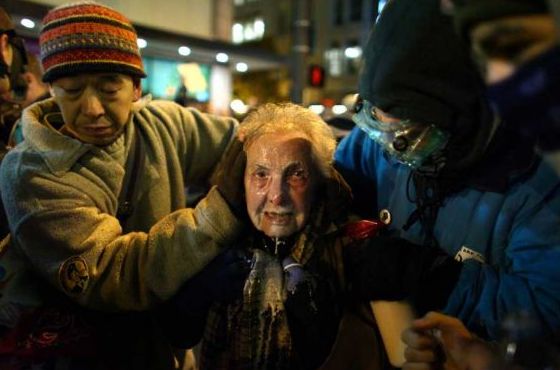
After 84-year-old Occupy Seattle participant Dorli Rainey was pepper sprayed by Seattle Police yesterday, she wrote: 'This is what democracy looks like. It certainly left an impression on the people who rode the No. 1 bus home with me. In the women's movement there were signs which said: Screw us and we multiply.'

When officials from 40 cities across America participated in conference calls on tackling the Occupy protests, they said their goal was to make the camps safe.

It sounds like the infamous attack on Ben Tre in the Vietnam War: “We had to destroy the village to save it.”

On a National Police Radio news bulletin yesterday afternoon, New York correspondent Robert Smith, reporting on the ongoing legal fight to reconstruct the camp at Ziccotti Park, said of the dispute: one person’s trash is another person’s free speech — overlooking the fact that what he referred to as “trash” were the personal belongings of others.

Likewise, when NPR reports on the destruction of camps, they happily parrot the police by using the term “dismantle” — as though officers take pains to find matching bags into which they can slip neatly folded sleeping bags, all the while making sure every item gets carefully tagged so later it can safely be returned to its owner.

In truth the camps have been dismantled in much the same way that Israeli soldiers “dismantle” Bedouin villages that the authorities deem illegal.

In many ways, the real clash is between those who cling to the anti-democratic powers that the state grabbed after 9/11, and those who dare to declare that we should no longer be governed by fear.

Tellingly, the authorities in New York planned the assault on Occupy Wall Street like a counterterrorism operation.

“From the beginning, I have said that the city had two principal goals: guaranteeing public health and safety, and guaranteeing the protesters’ first amendment rights. But when those two goals clash, the health and safety of the public and our first responders must be the priority,” Mayor Bloomberg said, asserting that “safety” is more important than liberty.

The New York Times reported:

[T]he police operation to clear Zuccotti Park of protesters unfolded after two weeks of planning and training. Officials had prepared by watching how occupations in other cities played out. A major disaster drill was held on Randalls Island, with an eye toward Zuccotti. Officials increased so-called disorder training — counterterrorism measures that involve moving large numbers of police officers quickly — to focus on Lower Manhattan.

The last training session was on Monday night, on the Manhattan side of the East River. The orders to move into the park came down at the “last minute,” said someone familiar with the orders, which referred to the assignment only as “an exercise.”

“The few cops that I know that were called into this thing, they were not told it was for going into Zuccotti Park,” said the person, who spoke on the condition of anonymity. “The only people who were aware of them going into Zuccotti Park were at the very highest levels of the department.”

Once the operation began, the area around the park was declared a “frozen zone”.

What gets frozen in a frozen zone? The U.S. Constitution — no more freedom of assembly, free speech, or free press.

The Associated Press reports on the spontaneously coordinated assault on Occupy camps across America:

As concerns over safety and sanitation grew at the encampments over the last month, officials from nearly 40 cities turned to each other on conference calls, sharing what worked and what hasn’t as they grappled with the leaderless movement.

In one case, the calls became group therapy sessions.

While riot police sweeping through tent cities in Portland, Ore., Oakland, Calif. and New York City over the last several days may suggest a coordinated effort, authorities and a group that organized the calls say they were a coincidence.

“It was completely spontaneous,” said Chuck Wexler, director of the Police Executive Research Forum, a national police group that organized calls on Oct. 11 and Nov. 4. Among the issues discussed: safety, traffic and the fierceness of demonstrations in each city.

“This was an attempt to get insight on what other departments were doing,” he said.

From Atlanta to Washington, D.C., officials talked about how authorities could make camps safe for protesters and the community.

Has the United States really become a country where we are supposed to be afraid of freedom and nervous about democracy?

Facebooktwittermail

Economic segregation divides America

The New York Times reports: The portion of American families living in middle-income neighborhoods has declined significantly since 1970, according to a new study, as rising income inequality left a growing share of families in neighborhoods that are mostly low-income or mostly affluent.

The study, conducted by Stanford University and scheduled for release on Wednesday by the Russell Sage Foundation and Brown University, uses census data to examine family income at the neighborhood level in the country’s 117 biggest metropolitan areas.

The findings show a changed map of prosperity in the United States over the past four decades, with larger patches of affluence and poverty and a shrinking middle.

In 2007, the last year captured by the data, 44 percent of families lived in neighborhoods the study defined as middle-income, down from 65 percent of families in 1970. At the same time, a third of American families lived in areas of either affluence or poverty, up from just 15 percent of families in 1970.

The study comes at a time of growing concern about inequality and an ever-louder partisan debate over whether it matters. It raises, but does not answer, the question of whether increased economic inequality, and the resulting income segregation, impedes social mobility.

Much of the shift is the result of changing income structure in the United States. Part of the country’s middle class has slipped to the lower rungs of the income ladder as manufacturing and other middle-class jobs have dwindled, while the wealthy receive a bigger portion of the income pie. Put simply, there are fewer people in the middle.

But the shift is more than just changes in income. The study also found that there is more residential sorting by income, with the rich flocking together in new exurbs and gentrifying pockets where lower- and middle-income families cannot afford to live.

The study — part of US2010, a research project financed by Russell Sage and Brown University — identified the pattern in about 90 percent of large and medium-size metropolitan areas for 2000 to 2007. Detroit; Oklahoma City; Toledo, Ohio; and Greensboro, N.C., experienced the biggest rises in income segregation in the decade, while 13 areas, including Atlanta, had declines. Philadelphia and its suburbs registered the sharpest rise since 1970.

Facebooktwittermail

A Raid on the First Amendment: New York’s assault on press freedom

John Nichols writes: The dark-of-night raid on New York City’s Zuccotti Park was not merely an assault on the Occupy Wall Street movement. It was an assault on the underpinnings of the First Amendment to the Constitution, an amendment that was outlined and approved by the First Congress of the United States at No. 26 Wall Street in 1789.

That amendment, which was written to empower citizens to challenge and prevent the rise of a totalitarian state, recognized basic freedoms that were essential to the defense of liberty. Among these are, of course, the right to speak freely and to embrace the religious ideals of one’s choice.

But from a standpoint of pushing back against power, however, the rights to assemble and to petition for the redress of grievances are fundamental. And those rights were clearly assaulted early Tuesday morning.

So, too, was another right: the right to a free press.

Why does the right to a free press matter so much? Because, as the founders knew, no experiment in democracy could ever be anything more than that—an experiment—if the people don’t know what is being done in their name by those in positions of authority. “A popular Government without popular information or the means of acquiring it,” observed James Madison, “is but a Prologue to a Farce or a Tragedy or perhaps both.”

Facebooktwittermail

Groundhog Day in Palestine/Israel

Michael Hudson writes: For an unforgettable “Groundhog Day” experience, there is nothing better than a trip to Palestine and Israel. We’ve experienced multiple revolutions over the past six decades in information technologies, social mores and political upheavals.

The Soviet empire collapsed, democracy advanced around the globe, Asia began to rise and the West began to decline. It is all quite disorienting. But one thing remains constant: The Arab-Israeli conflict. It just grinds on and on.

For those of us who have been studying it professionally, there is something oddly reassuring about that. For most others not directly involved, it has just become boring. Too bad, because, like a smoldering peat fire, the Palestine problem helps keep the entire Middle East on the boil.

Here are some verbal snapshots from a recent visit to Palestine and Israel.

Getting out of Fortress Israel into the promised land of Palestine is not nearly as difficult as getting back in. Ramallah has become a boom town, far different from the sleepy metropolis it used to be.

“There’s lots of money here,” my taxi driver observed, “but not so much anywhere else in the West Bank.” A lot of that money comes from Western donors to support that sickly enterprise known as the Palestinian Authority. Other money is coming in from the Gulf. Land prices are out of sight.

The Palestinian prime minister, Salam Fayyad, darling of Washington and the World Bank, is building small city that would aspire to be Dubai or Singapore. But Ramallah, like the other main towns of the West Bank, is hemmed in by Israeli checkpoints. And for a Palestinian to get from Ramallah to Bethlehem requires a two-hour (or more, depending on delays at checkpoints) journey down into the Jordan valley and back up again, which could be done via Jerusalem in a half-hour were there no Israeli obstacles.

Arab Jerusalem (the east side including the Old City) is languishing economically and socially because it is now effectively cut off from its natural hinterland – Bethlehem and Hebron to the south, Ramallah, Nablus and Jenin to the north.

If you want to contemplate the possibilities of the two-state solution, there is no better place to do so than on a drive between Ramallah and Nablus. Where is this other state going to be, anyway? I got a ride with a friend who has been making the trip regularly for some years. She said the pace of settlement construction has dramatically increased under Netanyahu’s regime.

At every crossroads there are signs and roads to new Israeli settlements, and on virtually every hilltop there is a new “outpost”. Settlers continue to seize the agricultural lands belonging to Palestinian villages. By any conception of a genuine state, with territorial contiguity, these settlements would have to go. But is there any Israeli government, hawkish or dovish, that could make that happen?

Facebooktwittermail

Syrian army defectors attack intelligence complex

The Daily Telegraph reports: Syrian army defectors attacked an intelligence complex on the edge of the capital Damascus early on Wednesday, following reports the country will boycott today’s Arab League meeting.

Wednesday’s attack was the first such reported assault on a major security facility in the eight-month uprising against Assad, activists said.

Members of the Free Syrian Army fired shoulder-mounted rockets and machineguns at a large Air Force Intelligence complex situated on the northern edge of the capital on the Damascus-Aleppo highway at about 2:30 a.m. (0030 GMT).

A gunfight ensued and helicopters circled the area, the sources said.

Meanwhile the rebel Free Syrian Army announced on Wednesday the creation of a temporary military council with the aim of ousting the regime of President Bashar al-Assad and protecting civilians from his forces.

“Based on the requirements of this phase and the demands of the Syrian revolution, the Free Syrian Army is establishing a temporary military council,” a statement said.

Facebooktwittermail