The Associated Press reports: For generations, immigrants have shed their ancestral identities and taken new, Americanized names as they found their place in the melting pot. For Muslims in New York, that rite of assimilation is now seen by police as a possible red flag in the hunt for terrorists.
The New York Police Department monitors everyone in the city who changes his or her name, according to interviews and internal police documents obtained by The Associated Press. For those whose names sound Arabic or might be from Muslim countries, police run comprehensive background checks that include reviewing travel records, criminal histories, business licenses and immigration documents.
All this is recorded in police databases for supervisors, who review the names and select a handful of people for police to visit.
The program was conceived as a tripwire for police in the difficult hunt for homegrown terrorists, where there are no widely agreed upon warning signs. Like other NYPD intelligence programs created in the past decade, this one involved monitoring behavior protected by the First Amendment.
Since August, an Associated Press investigation has revealed a vast NYPD intelligence-collecting effort targeting Muslims following the terror attacks of September 2001. Police have conducted surveillance of entire Muslim neighborhoods, chronicling daily life including where people eat, pray and get their hair cut. Police infiltrated dozens of mosques and Muslim student groups and investigated hundreds more.
Monitoring name changes illustrates how the threat of terrorism now casts suspicion over what historically has been part of America’s story. For centuries, foreigners have changed their names in New York, often to lose any stigma attached with their surname.
The Roosevelts were once the van Rosenvelts. Fashion designer Ralph Lauren was born Ralph Lifshitz. Donald Trump’s grandfather changed the family name from Drumpf.
Occupy Oakland – rally & march – 10/25/11
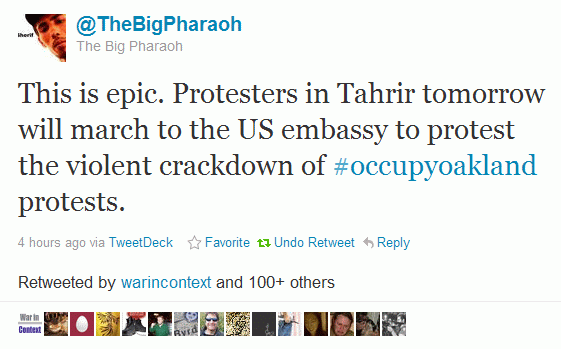
Global Awakening: Egypt’s revolutionaries will march to support #OccupyOakland
Egypt’s local revolutions
Denunciation and disruption: the vision that drives Occupy Wall Street
Christopher Ketcham writes: It’s 4:45 p.m. on Saturday, Oct. 15, the day Occupy Wall Street went global. The march in Manhattan is twin pronged on 6th Avenue, several blocks long on the east and west sidewalks of the street. It flows as juggernautish and loud and flashing as a flood in a canyon. The police don’t know what to do except keep it on the sidewalk, barricade it off the street with a line of scooters and hundreds of foot cops and dozens of cop vans directed by the dreaded White Shirts. These latter are the captains, the field commanders, feared because in the five weeks the occupiers have been at Zuccotti Park, clawing into the financial district with no intention of departure, the White Shirts have done the most cawing into bullhorns, have seemed the most pissed off about the occupation, and have shown the most willingness to bust heads and punch kids and break out the mace and the pepper spray when faced with the threat of young women.
I get swept in the boiling mass on the east sidewalk next to a man in a white linen suit coat who chews on a cigar and is chiding the cops mercilessly. “What’s next, officers? How about planting season? Time to plant drugs on these people!”
“Keep tawkin,” says a detective.
“Randy Credico,” says the man in the linen suit, turning to me. “Activist, political comedian. Ran against Chuck Schumer in 2010.” A little guy, spry, a cynic who likes to dress up in public as Diogenes, a New Yorker with one of those sinewy New York accents. We shake hands. Then the drums are upon us, the banners—“Revolt” and “Generation Revolution” and “Wall Street: The Enemy of Humanity”—and the shouting: “We! Are! The 99 percent!”
The goal today is the convergence at Times Square, where it’s said 20,000 people are already waiting.
The goal tomorrow is the toppling of the 1 percenters—the Wall Streeters, the socially useless financiers, the bankers, the hedge funders, the derivatives traders, the corporate lawyers, the big-moneyed class that, in a more muscular age of progressivism, say, a hundred years ago, would be denounced as the parasite class. The parasites in New York, at last count in 2007, took for themselves close to 45 percent of all income in the city. Forty-five percent of all income going to roughly 34,000 households. The occupiers know their addresses, and in recent weeks have visited their doors in a most disrespectful manner to make known that the parasite class is not welcome anymore.
That’s a good start, the act of shaming and ridicule. How the toppling of the parasites is functionally to be accomplished, the machinations needed to smash their power and put them on a rocket ship to an airless planet, is as yet unknown. Nor does anyone here much care that it’s unknown. What matters on a day like this is morale, and to find morale means to gather en masse to make a mess of the normal state of affairs—the politics of disruption for its own sake. The Occupy Wall Street movement has collaborators in dozens of cities—Occupy Chicago and Occupy Los Angeles and Occupy Seattle—but it is the occupation in New York, the most regressive city in the nation, to which Occupiers nationwide look for inspiration. The enemy is nested in New York, and it is here the battle is to be joined.
Glenn Greenwald on two-tiered U.S. justice system, Obama’s assassination program & the Arab Spring
Assange: Battle bigger than Wikileaks
Al-Akhbar English reports: Wikileaks, the international whistle-blowing website responsible for revealing thousands of secret political and diplomatic documents over the past six years, announced Monday that it was suspending publishing operations in an emergency effort to raise money.
The decision came after what Wikileaks founder Julian Assange calls an “arbitrary and unlawful financial blockade” by American banks, including Bank of America, Visa, MasterCard, PayPal and Western Union.
“The issue is bigger than Wikileaks. It’s an issue of sovereignty. Is it right, for example, in Lebanon that Visa card holders are controlled by Washington, even though their accounts are in local banks?” Assange said in a phone interview with Al Akhbar. “We have to show the world that cards and PayPal…are instruments of Washington power. They’re all in service for political corruption, it’s literally a conspiracy.”
“Our fight can be summed up in three parts,” Assange said. “First, to fight against censorship. Second, to fight to protect people’s right for knowledge. And third, to fight for unbiased media to truly report what’s going on in the regimes.”
For Assange, Wikileaks’ crisis is especially relevant in the Middle East. “With the changes occurring in the Arab world, it’s not the time to relax, but to make sure democracies are established fully. To do that it is necessary to make sure they are not implicated with the old regimes. Egypt’s battle is ongoing,” Assange said. “[We’re] making sure the battle for democratic regimes is established, [fighting] for the peoples right to communicate.”
U.S. warns Israel: New Jerusalem construction will aid Palestinian bid at UN
Haaretz reports: The United States urged Israel on Wednesday to halt a plan that would approve new construction in a contentious Jerusalem neighborhood, saying that such a move would harm U.S. efforts to thwart the Palestinian bid for statehood at the United Nations.
The Jerusalem District Planning Committee announced late last month that it would approve the construction of 1,100 new housing units in Gilo, despite past U.S. objections concerning any work that would expand the neighborhood further beyond the Green Line.
The proposal would allot 20 percent of the units in the neighborhood to young couples, in compliance with a directive given by Interior Minister Eli Yishai. The plan also includes the construction of a boardwalk, public structures, and a commercial center.
U.S. envoy to Israel, Dan Shapiro, met with Yishai on Wednesday, and urged him to shelf the Gilo construction plan, warning it could push international support in favor of the Palestinians in their move for UN recognition.
Yishai reportedly rejected Shapiro’s request, saying that construction in Jerusalem has never stopped – even during left-wing governments – and that it would not stop now.
Israel’s plan for Gilo has already drawn considerable international criticism. Earlier this month, German Chancellor Angela Merkel took Prime Minister Benjamin Netanyahu harshly to task over the move, precipitating an unprecedented diplomatic crisis.
A senior Israeli official said the plan greatly angered Merkel, after she had enlisted massive support of Israel over the past few weeks to help in thwarting a Security Council vote approving Palestinian membership in the United Nations.
Senior German officials told their Israeli counterparts that Merkel was “furious” and “does not believe a word [Netanyahu] says.”
At Netanyahu’s request, Merkel had also put major pressure on Palestinian President Mahmoud Abbas to accept the Quartet’s initiative and renew peace talks immediately, the Israeli official said, adding that Germany may now reconsider and support upgrading the PA’s status to that of a non-member state in the UN General Assembly.
Netanyahu rejected criticism against the construction plan, saying that Gilo is not a settlement, but rather a Jerusalem neighborhood five minutes from the center of the capital. He noted that all Israeli governments built in such neighborhoods.
Why the SEC won’t hunt big dogs
Jesse Eisinger writes: After years of lengthy investigations into collateralized debt obligations, the mortgage securities at the heart of the financial crisis, the S.E.C. has brought civil actions against only two small-time bankers. But compared with the Justice Department, the S.E.C. is the second coming of Eliot Ness. No major investment banker has been brought up on criminal charges stemming from the financial crisis.
To understand why that is so pathetic and — worse — corrupting, we need to briefly review what went on in C.D.O.’s in the years before the crisis. By 2006, legions of Wall Street bankers had turned C.D.O.’s into vehicles for their own personal enrichment, at the expense of their customers.
These bankers brought in savvy (and cynical) investors to buy pieces of the deals that they could not sell. These investors bet against the deals. Worse, they skewed the deals by exercising influence over what securities went into the C.D.O.’s, and they pushed for the worst possible stuff to be included.
The investment banks did not disclose any of this to the investors on the other side of the deals, or if they did, they slipped a vague, legalistic disclosure sentence into the middle of hundreds of pages of dense documentation. In the case brought last week, Citigroup was selling the deal, called Class V Funding III, while its own traders were filling it up with garbage and betting against it.
By the S.E.C.’s own investigations of and settlements with Goldman Sachs, JPMorgan Chase and Citigroup, and by reporting like my ProPublica work with Jake Bernstein and early stories by The Wall Street Journal, we know that these breaches were anything but isolated. This was the Wall Street business model. (Goldman, JPMorgan and Citigroup were all able to settle without admitting or denying anything, which, of course, is part of the problem.)
Neither the Citigroup settlement nor any of the others come close to matching the profits and bonuses that these banks generated in making these deals. And low-level bankers did not, and could not, act alone. They were not rogues, hiding things from their bosses.
Same weapons of mass suppression used by Israelis and Oakland police
Max Blumenthal writes: With the rise of the Occupy Wall Street, a new generation of mostly middle class Americans is learning for the first time about the militarization of their local police forces. And they are learning the hard way, through confrontations with phalanxes of riot cops armed with the latest in “non-lethal” crowd control weaponry. Yesterday’s protests in Oakland, California were the site of perhaps the harshest police violence leveled against the Occupy movement so far. Members of the Oakland Police Department and the California Sheriff’s Department attacked unarmed protesters with teargas canisters, beanbag rounds, percussion grenades, and allegedly with rubber bullets, leaving a number of demonstrators with deep contusions and bloody head wounds. It is not difficult to imagine such scenes becoming commonplace as the Occupy protests intensify across the country.
The police repression on display in Oakland reminded me of tactics I witnessed the Israeli army employ against Palestinian popular struggle demonstrations in occupied West Bank villages like Nabi Saleh, Ni’lin and Bilin. So I was not surprised when I learned that the same company that supplies the Israeli army with teargas rounds and other weapons of mass suppression is selling its dangerous wares to the Oakland police. The company is Defense Technology, a Casper, Wyoming based arms firm that claims to “specialize in less lethal technology” and other “crowd management products.” Defense Tech sells everything from rubber-coated teargas rounds that bounce in order to maximize gas dispersal to 40 millimeter “direct impact” sponge rounds to “specialty impact” 12 gauge rubber bullets.
Defense Tech’s literature concedes that “information is somewhat difficult to obtain” on the damage its weapons can do to the human body. However, company researchers were able to determine that a beanbag round fired from a 12 gauge shotgun exerts the same kinetic impact as a .22 caliber bullet. “The result is blunt trauma with no penetration,” Defense Tech researchers wrote. Wounds suffered yesterday by protesters in Oakland provided vivid confirmation of the conclusion.
Can Islamism and feminism mix?
Monica Marks writes: In May, Tunisia passed an extremely progressive parity law, resembling France’s, which required all political parties to make women at least half of their candidates. As a long-repressed party, Ennahda enjoyed more credibility than other groups. It also had a greater number of female candidates to run than any other party, and strongly supported the parity law as a result.
Many Tunisian women developed a political consciousness in reaction to Mr. Ben Ali’s severe oppression of Ennahda in the 1990s. While their husbands, brothers and sons were in jail — often for reasons as simple as attending dawn prayers — these women discovered that they had a personal stake in politics and the strength to stand alone as heads of families. When the party was legalized in March, it found a widespread base of public sympathy and grass-roots support.
As the big winner in Sunday’s elections, Ennahda will send the largest single bloc of female lawmakers to the 217-member constituent assembly. The question now is how Ennahda women will govern. Are they unwitting dupes of Islamic patriarchy, or are they merely feminist activists who happen to wear head scarves?
After interviewing 46 female activists and candidates from Ennahda, I found that many turned to politics after experiencing job discrimination, arrests, or years in prison merely because they chose to wear the head scarf or because their families were suspected of Ennahda sympathies. For some of them, this election is as much about freedom of religious expression as anything else.
“I have a master’s degree in physics but I wasn’t allowed to teach for years because of this,” said a 43-year-old woman named Nesrine, tugging the corner of her floral-print hijab, a veil banned under Mr. Ben Ali but legalized since his departure. According to Mounia Brahim and Farida Labidi, 2 of the 13 members of Ennahda’s Executive Council, the party welcomes strong, critical women in its ranks. “Look at us,” Ms. Brahim said. “We’re doctors, teachers, wives, mothers — sometimes our husbands agree with our politics, sometimes they don’t. But we’re here and we’re active.”
NTC asks NATO to extend Libya presence
The New York Times reports: Libya’s interim leader said Wednesday that he had asked NATO to prolong its air patrols through December and add military advisers on the ground, despite his official declaration on Sunday of the country’s liberation after the killing of Col. Muammar el-Qaddafi.
“We have asked NATO to stay until the end of the year, and it certainly has the international legitimacy to remain in Libya to protect the civilians from Qaddafi loyalists,” the interim leader, Mustafa Abdel-Jalil, chairman of the National Transitional Council, said in an interview with the pan-Arab news channel Al Jazeera.
“Qaddafi still has supporters in neighboring countries and we fear those loyalists could be launching attacks against us and infiltrating our borders,” he said. “We need technical support and training for our troops on the ground. We also need communications equipment and we need aerial intelligence to monitor our borders.”
Mr. Abdel-Jalil was interviewed while attending a Libya aid conference in Doha, Qatar. He spoke as NATO was preparing within days to formally end its operations in Libya and as the country enters a treacherous new phase in its post-Qaddafi transformation.
Inside Story – End of Gaddafi, start of investigation
Yemeni women burn veils to protest regime
CNN reports: Yemeni women defiantly burned their traditional veils Wednesday in protest of President Ali Abdullah Saleh’s brutal crackdown on anti-government demonstrations.
Thousands of women gathered in the capital, Sanaa, said witnesses. They carried banners that read: “Saleh the butcher is killing women and is proud of it” and “Women have no value in the eyes in Ali Saleh.”
They collected their veils and scarves in a huge pile and set it ablaze — an act that is highly symbolic in the conservative Islamic nation, where women use their veils to cover their faces and bodies. It’s the first time in the nine months of Yemen’s uprising that such an event has occurred.
Inspired by Yemeni activist Tawakkol Karman’s Nobel Peace Prize this month, more and more Yemeni women have taken to the streets and escalated their campaign for help from the international community.
More than 60 women were attacked in October alone by the government, said protester Ruqaiah Nasser. Government forces are raiding homes and also killing children, she said.
Iraq veteran in critical condition after being shot in face by police in Oakland
Adam Gabbatt reports: I’ve just spoken to Keith Shannon, roommate of Scott Olsen, the Iraq veteran who is in hospital after apparently having been hit in the head by a police projectile.
Shannon said doctors told him Olsen has a “skull fracture and swelling of the brain”. A neurosurgeon will assess Olsen later today to determine whether he needs surgery, Shannon said.
Olsen, 24, was in 3rd Battalion, 4th Marines, before leaving the military last year. He had been opposed to the Iraq war even before his first tour to the country, Shannon said. Shannon and Olsen met in November or December 2005, and share an apartment in Daly City, south of San Francisco.
“It’s really hard,” Shannon said. “I really wish I had gone out with him instead of staying home last night.”
Shannon, who is also 24, said he had seen the video footage showing Olsen lying on the floor as a police officer throws an explosive device near him.
“It’s terrible to go over to Iraq twice and come back injured, and then get injured by the police that are supposed to be protecting us,” he said.
Shannon said Olsen was hit in the head by a tear gas canister or smoke canister shot by a police officer. He said Olsen had a curved scar on his forehead consistent with a canister.
Israeli government backs Jewish terrorism
Yossi Gurvitz writes: Brigadier General Nitzan Alon, who left the command of the AYOSH (West Bank) Division yesterday, spoke candidly during his replacement ceremony, and called the “price tag” actions by their true name: Jewish terrorism. Alon, who was repeatedly harassed by the settlers, demanded that more be done in the battle against it (Hebrew). One could, of course, ask why didn’t Alon himself (who as the “military commander” in the West Bank wields the combined powers of a British occupying general and a Turkish pasha) commence this battle; why didn’t he order the destruction of the houses of suspected Jewish terrorists as the IDF destroys the houses of the families of Palestinian suspects; why didn’t he put rebellious settlements under curfew, as many Palestinians towns and villages have been so often?
But this is just me being ornery. The questions answer themselves. The apartheid regime Israel created in the West Bank over decades, and the political power of the terrorists and their supporters, prohibits an effective fight against them. The apartheid system, the double legal system – military for the natives, Israeli for the invaders – has been described often enough. Let’s focus on the fact that many prefer to avoid: Jewish terrorism in the territories is directly supported by the Israeli government, and to a large extent is also funded by it.
The Unpatriotic Act: ten years later
Stephen Rohde writes: The USA Patriot Act became law ten years ago today. Bearing the awkward name, Uniting and Strengthening America by Providing Appropriate Tools Required to Intercept and Obstruct Terrorism Act, it passed the US Senate by an overwhelming vote of 96-1, with only Sen. Russ Feingold (D-Wisconsin) in dissent, voicing deep concerns about the impact the new law would have on civil liberties and privacy rights.
During the debate over the Patriot Act, Senator Feingold observed that the “founders who wrote our Constitution and Bill of Rights exercised that vigilance even though they had recently fought and won the Revolutionary War. They did not live in comfortable and easy times of hypothetical enemies. They wrote a Constitution of limited powers and an explicit Bill of Rights to protect liberty in times of war, as well as in times of peace.”
He traced the dark periods in our nation’s history when civil liberties took a back seat to what appeared at the time to be the legitimate exigencies of war, including the Alien and Sedition Acts, the suspension of habeas corpus during the Civil War, the internment of Japanese-Americans, German-Americans, and Italian-Americans during World War II, the blacklisting of alleged communist sympathizers during the McCarthy era, and the surveillance and harassment of antiwar protesters, including Dr. Martin Luther King Jr., during the Vietnam War.
Where does Occupy go from here?
Justin Elliot talks to Michael Kazin, professor of history at Georgetown and author of “American Dreamers: How the Left Changed a Nation” about where Occupy Wall Street is heading.
We’re now a month-plus into this. Does Occupy Wall Street remind you of any past movements or does it seem like a fundamentally new type of thing?
This is the first time in a long time, perhaps since the 1930s, that the left — and I think this protest does belong to the left, though a lot of people who are involved in it wouldn’t call themselves that — has focused on economic injustice as a central issue. That is both new and of course harks back to the beginnings of the New Deal. At that time, most activists on the left were primarily targeting economic inequality — in the form of wages, the lack of democracy at work, and resistance by industrial corporations to recognizing unions. What’s obviously different now is that Occupy Wall Street has been put together by people who are proud of being children of the Internet age: with horizontal organization, leaderlessness and consensus decision-making. The main tactic is about hanging out with and learning from one another. There is no sense of how the tactic will lead to either taking political power or having a big share of political power. This movement seems to think from tactic to tactic, rather than tactic to strategy.
Is there precedent for this kind of form and structure?
Many a protest campaign begins this way. The sit-ins at Woolworth lunch counters beginning in February 1960 had an end — desegregation of public facilities — but they weren’t quite sure of where it was going after that. They just thought, “This is a neat tactic that will draw attention.” And it did. That began with four students in Greensboro, N.C. But it soon blossomed, and now their lunch counter is in the Smithsonian. The movement against the Vietnam War also began with very small protests in 1964, and then grew into ones with hundreds of thousands of demonstrators. So protests can grow and become catalysts for larger and more diverse movements.
The two examples you just mentioned had obvious, discrete goals they were trying to accomplish. In contrast, Occupy Wall Street has only a broad theme. Are there precedents for this?
There was Coxey’s Army in 1894, which was the first group to march on Washington. They were mostly unemployed people with a vague demand for public jobs. But they were basically just pissed off about the widespread depression of that era, and they were determined to compel Congress and the president to do something. Like Occupy, they did not have a well-worked-out agenda. Historians disagree about what effect the march had. But it certainly dramatized the situation of the poor and the unemployed, much as Occupy Wall Street is trying to do. People marched from around the country on Washington; they took freight trains, and hitchhiked on wagons, and walked a lot, too. It was very dramatic and the press covered it very widely. But the depression continued until 1897.
What can Occupy learn from history about how to sustain itself beyond the initial burst of interest and energy?
I think protests like this have to progress from tactic to strategy if they are going to endure. They have to either start their own organization — as the sit-in movement started SNCC — or link up with other organizations. The problem with that strategy is that what’s gotten people’s attention is the clever, somewhat novel tactic Occupy is using — and the participatory, very small-d democratic nature of it. The next step will inevitably not be that clever and novel. But for it to go anywhere, the Occupiers have to figure out, to some degree, what kind of demands they want to make. That doesn’t mean they need a 12-point program, but maybe a three-point program. They have to figure out what sort of relationship they want to have with existing groups on the left. But with no leaders and everything run by consensus, how do you make these decisions?
What’s more likely to happen — and I think to some extent already is happening — is that this will become a catalyst for other people to do other kinds of things about economic inequality. I think it’s likely that Occupy Wall Street will be seen as a spark. I think it’s unlikely that people are going to stay in the park for month upon month unless they are homeless. Most people eventually will want to get on with their lives. In the end, a tactic, no matter how successful, is just a tactic.
Micah Sifry writes: Overall interest in the Occupy Wall Street movement appears to be cresting at the moment, with affiliation through the nearly 500 Facebook pages that we’ve been tracking starting to top out and organic interest in the topic also showing signs of calming down on Google search. At the same time, the movement–which deliberately has avoided appointing leaders and spokespeople–continues to expand its networked base. Nearly 250 of those Facebook groups have at least 1,000 members. Another 70 “Occupy X” Twitter accounts also have at least 1000 followers. And in a fascinating development noticed by Shane Castlen, who is tracking all of these metrics on his CollectiveDisorder.com website, while the main Reddit community for OWS now has more than 10,000 members, a number of local Occupy groups are slowly building their own “subreddits” focused on the news and debates occurring around their own encampments. Boston, Los Angeles, Austin, Chicago, DC, Orlando, Philadelphia, Seattle, Richmond, Omana, Columbus, South Dakota and Boise are all active there.