



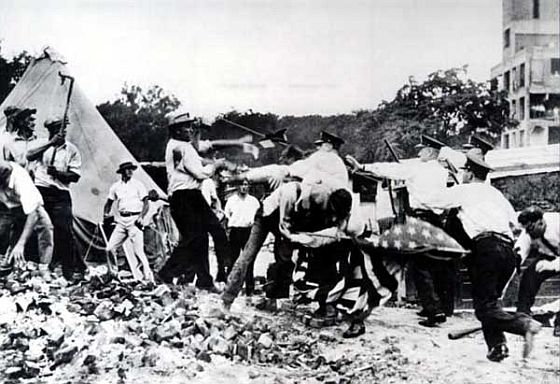
Bonus Army marchers confront the police, Washington DC, July 28, 1932.
David Woolner writes: The violence that broke out in Oakland earlier this week and the wounding of Scott Olsen, a Marine veteran, recalls a similar “occupy movement” involving veterans that took place in Washington at the onset of the Great Depression.
In 1932, thousands of unemployed World War I veterans, desperate from lack of work, converged on Washington, mostly by riding the rails, in support of a bill that would have allowed them to receive immediate cash payment of the war service “bonus” they were due in 1945. The veterans called themselves the “Bonus Army” or “Bonus Expeditionary Force.” By the end of May of that year, more than 20,000 had occupied a series of abandoned buildings near the Washington Mall and a sprawling shantytown they built on the Anacostia Flats not far from the Capitol. On June 15, 1932, the House of Representatives passed a bill in favor of the veteran payments, but as both President Hoover and a majority in the Senate opposed it, the “Bonus bill” went down to defeat two days later.
In the wake of this defeat, roughly 15,000 members of the Bonus Army decided that they would continue their occupation as a protest against the government’s decision. By late July, President Hoover decided it was time to clear the city of the protesters, using four troops of cavalry under the command of General Douglas MacArthur. Late in the afternoon of July 28, General MacArthur’s troops — with sabers drawn — cleared the buildings near the Mall. They then fired tear gas among the men, women, and children encamped in Anacostia (many veterans were accompanied by their families); stormed the area on horseback, driving them out; and intentionally burned the shantytown to the ground in the process. More than 1,000 people were injured in the incident and two veterans and one child died.
In attacking the shantytown, MacArthur had exceeded his orders, which were simply to clear the buildings and surround the camp so as to contain it. But this meant little to the public, who were outraged at the treatment the veterans had received at the hands of the government and furious at Hoover for ordering the operation. Hoover, nevertheless, remained publically unrepentant and refused to apologize to the veterans — moves that contributed greatly to his massive loss to Franklin Roosevelt a few months later.

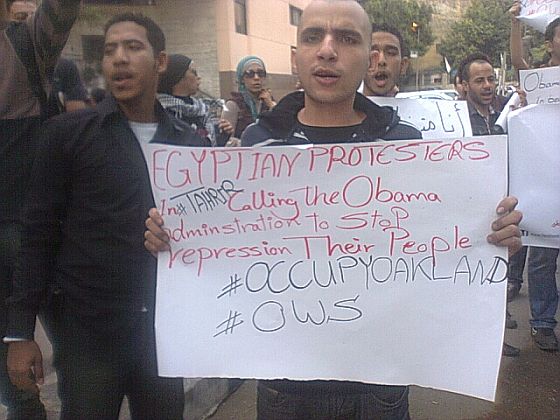
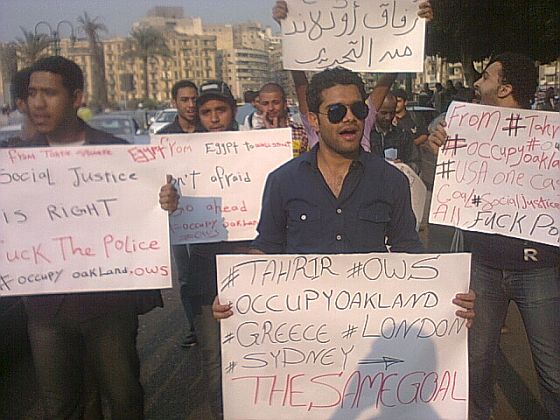
Xeni Jardin writes: As they vowed earlier this week to do, Egyptian pro-democracy protesters marched from Tahrir square to the U.S. Embassy today to march in support of Occupy Oakland—and against the type of police brutality witnessed in Oakland on Tuesday night, and commonly experienced in Egypt.
In this post, photos from Egyptian blogger Mohammed Maree, who is there at the march live-tweeting these snapshots. He is a journalist with Egytimes.org, a human rights activist, and a veterinarian; all photos are his.
Meanwhile, the New York Times reports on questions being raised about the violent tactics used by police in Oakland where the weapons being used are the same as those used lethally by Israeli soldiers against non-violent Palestinian protesters in the West Bank and by Egyptian security services against non-violent Egyptian protesters in Tahrir Square.
Two days after an Iraq war veteran suffered a serious head wound at a protest in Oakland, Calif., questions are being asked about the way police officers tried to disperse Occupy Oakland protesters with tear gas and other “less-lethal” munitions.The condition of the wounded veteran, Scott Olsen, was upgraded to fair from critical at Highland Hospital in Oakland on Thursday The San Francisco Chronicle reported. On Friday morning, Mr. Olsen’s roommate, Keith Shannon, who served with him in the Marines, told CNN that doctors expect him to make a full recovery, although he is still unable to speak and still has some trouble writing.
Oakland’s mayor, Jean Quan, visited Mr. Olsen in the hospital to apologize for his injuries and promised an investigation, a hospital spokesman told The Chronicle. The mayor also tried to address protesters near City Hall late Thursday night but was “greeted with cries of ‘Go home!’ and ‘Citizen’s Arrest,’” The Bay Citizen, a local news site, reported.
Another spokesman told reporters that Mr. Olsen “responded with a very large smile” to a visit from his parents on Thursday.
As The Lede reported on Wednesday, Mr. Olsen is a 24-year-old former Marine and a member of two veterans peace groups. He works at a San Francisco software firm.
Video uploaded to YouTube on Thursday appeared to show that Mr. Olsen was standing peacefully in front on police lines just before he was struck in the head. This edit of clips from various sources by a video blogger named Raleigh Latham shows Mr. Olsen standing still as projectiles were fired into the crowd of protesters on Tuesday night:

The Guardian reports: Egyptian officials have tortured a 24-year-old prisoner to death, provoking accusations that the increasingly unpopular junta is failing to dismantle Hosni Mubarak’s brutal security apparatus.
Essam Ali Atta, a civilian serving a two-year jail term in Cairo’s high-security Tora prison following his conviction in a military tribunal earlier this year for an apparently “common crime”, was reportedly attacked by prison guards after trying to smuggle a mobile phone sim card into his cell.
According to statements from other prisoners who witnessed the assault, Atta had large water hoses repeatedly forced into his mouth and anus on more than one occasion, causing severe internal bleeding. An officer then transferred Atta to a central Cairo hospital, but he died within an hour.
The death occurred less than 24 hours after two police officers in Alexandria were each sentenced to seven years in jail for their part in the murder of Khaled Said, a young businessman beaten to death by security forces in broad daylight last year. That incident led to the creation of the Facebook group “We are all Khaled Said” and helped mobilise a wave of protests which eventually toppled Mubarak in February.
On Friday, a new Facebook page entitled We are all Essam Atta appeared online, and quickly attracted thousands of supporters. Activists and human rights campaigners flocked to social media sites to express their fury at Egypt’s ruling generals, whom many now view as indistinguishable from the Mubarak regime they replaced.
In an interview with the Egyptian English-language daily, Al-Masry Al-Youm, Robert Springborg, who has written extensively on the Egyptian military and the politics and political economy of the Middle East, spells out some of the reasons the military ended up supporting the ouster of Hosni Mubarak. They were not siding with the Egyptian people; instead they saw an opportunity to consolidate their own interests.
Al-Masry Al-Youm: A trend in the economy during the transitional phase is the re-nationalization of companies privatized under the Mubarak regime. How much is this in the military economy’s interests?
Robert Springborg: The military opposed privatization that intensified in 2004 under the government of former Prime Minister Ahmed Nazif, and that was overseen by former Investment Minister Mahmoud Mohie Eddin. It was upset at the increased pace of privatization. That said, the military was happy with privatization as long as it ended up [gaining from it]. It didn’t want the government to sell state-owned enterprises to Gamal Mubarak’s cronies. So under the Nazif government, some of the privatization in state-owned enterprises went to the military to mollify its leadership. Its interests in strategic areas, such as port facilities, ship repair and building, increased. The Alexandria Shipyard, for example, is owned by the military, and under Nazif they acquired a competitor company. There was also an unwritten rule under Mubarak that mid-ranking officers and generals would get senior positions within privatized companies. Aviation companies and construction companies do have senior generals working in them.
Al-Masry: How important are their business holdings given that strategic industries, such as cement, are not within their control?
Springborg: Well, they are unhappy about that state of affairs. The military is not strongly represented in energy-intensive industries. The compensation to that is that they do control a lot of land. The total asset value of their land holdings is not clear, but we know that much of the land allocated to the construction and tourism sectors was or remains under military control. Starting from the 1980s, under Mubarak, the military got the land and crony capitalists got the energy intensive production industries.
The military’s biggest interest is in the construction industry. This is because the military has its own, internal construction capacities; because of its influence over the allocation of land; and because construction depends heavily on relations with government, either because it is paying for it or because it must authorize it. Military officers have the governmental connections that facilitate contracts and approvals.
Al-Masry: From the perspective of protecting the military economy, is the military threatened by the upcoming parliamentary and presidential elections?
Springborg: Yes. What it wants is a weak parliament and a presidency that will not challenge its authority. As it now looks the parliament will be weak because it will be divided among various political forces and because it will not be based on any definitive constitutional authority. So it will not be strong enough to oversee the military, such as by examining its finances. So, any civilian control of the military by default will fall to the president.
That is why the apparent thinking now of the military is for the president to be someone from the military. The delay of the presidential election is due in part probably to the attempt to prepare the ground for a candidate either from the military or absolutely subordinate to it. In the meantime the military will look to expand its role in the economy, either through acquiring more companies or by assisting officer-owned companies gain more business.
The Washington Times reports: In the eight months since the overthrow of President Hosni Mubarak, Egypt’s ruling military has postponed presidential elections, extended a controversial emergency law, cracked down on peaceful demonstrators and arrested critics.
Pro-democracy activists and Middle East analysts worry that the Supreme Council of the Armed Forces (SCAF) is reversing a revolution that toppled the autocratic Mubarak regime after 30 years in power.
“We, the revolution, are not governing Egypt now,” said Ahmed Maher, co-founder of the April 6 Youth Movement, a Facebook group, and a prominent participant in the anti-Mubarak demonstrations
“The SCAF is governing Egypt. I think they want to keep the power, and they want to make a new regime … depending on the same behavior of the Mubarak regime,” Mr. Maher told the Arab American Institute on a visit to Washington last week.
The ruling council has accused Mr. Maher’s group of being foreign agents.
“The SCAF has made a number of very troubling moves that suggest it is not serious about giving up power,” Shadi Hamid, director of research at the Brookings Institution’s center in Doha, Qatar, said in a phone interview with The Times.
“It has become so clear as to be entirely self-evident that the SCAF is an autocratic force and, in my view, the foremost danger to Egyptian democracy right now.”
Reuters reports: Tunisian electoral officials confirmed the Islamist Ennahda party as winner of the North African country’s election, setting it up to form the first Islamist-led government in the wake of the Arab Spring uprisings.
But the election, which has so far confounded predictions it would tip the country into crisis, turned violent when protesters angry their fourth-placed party was eliminated from the poll set fire to the mayor’s office in a provincial town.
Ennahda has tried to reassure secularists nervous about the prospect of Islamist rule in one of the Arab world’s most liberal countries by saying it will respect women’s rights and not try to impose a Muslim moral code on society.
The Islamists won power 10 months after Mohamed Bouazizi, a Tunisian vegetable seller in the town of Sidi Bouzid, set fire to himself in an act of protest that led to the fall of Tunisia’s leader and inspired uprisings in Egypt and Libya.
“We salute Sidi Bouzid and its sons who launched the spark and we hope that God will have made Mohamed Bouazizi a martyr,” said Ennahda leader Rachid Ghannouchi, a soft-spoken Islamic scholar who spent 22 years in exile in Britain.
“We will continue this revolution to realize its aims of a Tunisia that is free, independent, developing and prosperous in which the rights of God, the Prophet, women, men, the religious and the non-religious are assured because Tunisia is for everyone,” Ghannouchi told a crowd of cheering supporters.
Announcing the results, election commission members said Ennahda had won 90 seats in the 217-seat assembly, which will draft a new constitution, form an interim government and schedule new elections, probably for early 2013.
The Islamists’ nearest rival, the secularist Congress for the Republic, won 30 seats, the commission members told a packed hall in the capital, ending a four-day wait since Sunday’s poll for the painstaking count to be completed.
Issandr El Amrani writes: Initially, Tunisia’s transition was extremely fragile. Ministers associated with the old regime remained in place, chaos was sown by remnants of the old ruling party, and a million grievances were expressed at the same time, overwhelming a fragile government. Over time, after revolutionary forces exercised concerted pressure, things stabilized: more acceptable ministers were appointed, a transition roadmap was agreed upon, and major political forces forged a consensus. At the same time, institutions of the state — old and new — maintained order and, most notably, prepared the ground for the election administratively and politically. This included months of preparations and training for election officials and putting together a remarkable get-out-the-vote campaign with the help of international election specialists.
Why Tunisia’s election is such a resounding success, in other words, is no mystery: the Tunisians worked very hard to ensure that it would be. The result is that while there are still cynics and some who are unhappy with the result, most Tunisians have bought into the new system and feel confident that, if the new assembly does not meet their aspirations, they will be able to pressure it on the street or through the ballot box at the next poll.
In comparison, the way the Egyptian elections have been handled is a disaster. The authorities repeatedly ignored the desire of the vast majority of political forces for a fully proportional, list-based system. They finally offered an agreement on a system that was two-thirds list-based and one-third single-winner-based, only two months before the poll, which was only reluctantly accepted by parties. The final delimitation of districts was still uncertain as candidate registration opened, making the parties’ electoral planning difficult, to say the least.
Moreover, the SCAF has continued the Mubarak-era policy of opposing foreign monitoring missions, despite this being a widespread practice around the world. In Tunisia, thousands of international monitors did not undermine national sovereignty; they added to the credibility of a well-run process. The concession made in Egypt to the Carter Center and other missions to allow “observers” rather than “monitors” is simply not good enough; it is only by beginning their work long before the actual poll is held and having unfettered access to the organizing agencies and every step of the voting process that monitoring agencies can truly certify the legitimacy of an election. It does not help that the international community currently seems to be placing more emphasis on the elections happening then on them being credible.
The Daily Telegraph reports: Saif al-Islam Gaddafi, Muammar Gaddafi’s fugitive son, who is wanted for crimes against humanity has established indirect contacts with the International Criminal Court on his surrender, the court’s chief prosecutor said.
The prosecutor said that his office was in “informal contact” with Muammar Gaddafi’s son through intermediaries regarding his surrender to the war crimes court.
“Through intermediaries, we have informal contact with Saif. The office of the prosecutor has made it clear that if he surrenders to the ICC, he has the right to be heard in court, he is innocent until proven guilty. The judges will decide,” prosecutor Luis Moreno-Ocampo said in a statement.
Mr Moreno-Ocampo would not say with whom the court is talking. He also said the court does not know al-Islam’s whereabouts.
If Saif is brought before the court, Mr Moreno-Ocampo said, he will “have all the rights and be protected,” and will be allowed to present his defence.
David Lepeska writes: One morning in late September, as Libyan rebels launched their final advance on Sirte, Muammar Qaddafi’s hometown, Hisham Matar explained to a small, rapt audience at the century-old Chicago Club why the removal of repressive long-time dictators, though great, had not been the most meaningful achievement of the Arab Spring. “Our collective imagination – a whole array of expectations about our governments, our institutions, our dreams – has just shifted,” he said. “The horizon has moved much further than even the most audacious of us would have suggested.”
Matar speaks softly, but with confidence and precision. “You can see it on people’s bodies, in their eyes and their faces, hear it in their voices,” he adds during an interview in the lobby of his downtown hotel later that morning. “It’s as if these regimes were sitting literally on top of us. There’s a new ease, a new optimism, a new sense of ownership of the future. That tiresome record of complaining with resignation at the end of it – that’s gone, and it’s quite an extraordinary thing to lose so quickly.”
***
Little-known outside literary circles before this year, Matar seems to have surfaced at precisely the right moment to herald a new Arab modernity. Born in New York City in 1970, he moved with his family to Tripoli three years later when his father, Jaballa, resigned from a United Nations posting in objection to the Qaddafi regime. In 1979, Jaballa found himself on a Libyan government watch list and again moved the family, this time to Cairo. He wrote articles calling for democracy, and became a leader of the National Front for the Salvation of Libya. In the mid-80s, Matar was sent to boarding school in the UK, where he stayed to study architecture at university.
On the afternoon of March 12, 1990, Jaballa was taken from the family’s Cairo home by Egypt’s mukhabarat, handed over to the Libyan government and deposited in Abu Salim prison. Two letters, smuggled out by fellow prisoners in 1992 and 1995, relayed stories of interrogation and torture. The family has not heard from Jaballa since. His fate remains unknown.
Helena Cobban writes: What a whirlwind nine months it’s been for the Arab world. As I wrote at a much earlier point in this phenomenon called the ‘Arab Spring’, it is as if some tremor in the long-frozen tectonic plates of the region’s political geography had suddenly burst through all those plates, freeing up waves of long-frozen political energy that have ricocheted– and continue to ricochet– through all the region’s countries.
This is a phenomenon of an almost Biblical 40-year periodicity: After all, it was back in around 1970 that the Arab world’s political shape settled into broadly the same pattern that it then retained until January of this year.
(As it happens, I made my first visit to the region– to Beirut– in 1970. This is, I realize, neither here nor there… Mainly, it makes me feel old.)
It was in 1969 that a young colonel called Muammar Qadhafi had toppled “King” Idris in Libya… The political shifts that occurred in the Arab world the following year were more closely related to Palestine since they stemmed in good part from the tragic battles of 1970’s ‘Black September’. In those battles, Jordan’s U.S.-backed (and discreetly Israeli-backed) King Hussein reimposed an oppressive system of total control on his kingdom (and on its national population which then as now included a numerical majority of ‘West Bank’ Palestinians) by chasing out the Palestinian guerrillas who had become well established there over the preceding three years… Provocatively well established, one could say. The king’s Black September campaign was, indeed, directly precipitated by an action in which the PLO-affiliated Popular Front for the Liberation of Palestine hijacked four international aircraft and landed them at an airstrip in northern Jordan…
During Black September, the Cairo-based Arab League worked hard to try to negotiate a settlement between Hussein and the Palestinians. On September 27, Egypt’s iconic, strongly Arab-nationalist president Gamal Abdel-Nasser convened an emergency summit meeting of Arab leaders in Cairo in an attempt to hammer out an agreement. The next day, he suffered a heart attack and died. (Five million Egyptians flocked to the streets to witness the passing of his cortege.)
Nasser was succeeded in the presidency by his vice-president, Anwar Sadat, a man who shared Nasser’s military background but not his commitment to a broadly ‘non-aligned’ form of Arab nationalism. Throughout Sadat’s eleven years in office, his main goal was to steer Egypt into a close alliance with Washington; and he seemed more than willing to enter into the bilateral peace agreement with Israel that was the entry-fee for that alliance. The Egyptian-Israeli peace of 1979 decoupled mighty Egypt from the Palestinians’ long-running quest for national liberation. After Sadat was assassinated in 1981, his vice-president, Hosni Mubarak, succeeded him. Mubarak hewed just as closely to the pro-American path as his predecessor. His longevity and the hyper-alertness of his ever-repressive mukhabarat gave him the time in office that neither Nasser nor Sadat had, in which to build the basis of dynastic rule..
Notably, in all the time Mubarak was president, he never named a vice-president… He also increasingly evidently started to groom his son Gamal to succeed him.
Meantime, back in the Black September of 1970, the conflict in Jordan soon enough made its effects felt on Syria, as well. The ‘leftist’ wing of the Baath Party, which until then was in power in Syria, had sent tanks into northern Jordan to help the Palestinians. But when those tanks came under threat of serious attack from Hussein’s tanks, the ground forces commanders in Damascus begged for air support from Syria’s air force. The air force commander, Hafez al-Asad, turned down their request. Without any air support, the Syrian tanks retreated speedily back to Syria; and amidst the political chaos and bouts of recriminations that ensued he undertook a swift coup in Damascus that brought his much more cautious, centrist wing of the Baath Party into power…
Where it has stayed until today.
The New York Times reports: Once one of Syria’s closest allies, Turkey is hosting an armed opposition group waging an insurgency against the government of President Bashar al-Assad, providing shelter to the commander and dozens of members of the group, the Free Syrian Army, and allowing them to orchestrate attacks across the border from inside a camp guarded by the Turkish military.
The support for the insurgents comes amid a broader Turkish campaign to undermine Mr. Assad’s government. Turkey is expected to impose sanctions soon on Syria, and it has deepened its support for an umbrella political opposition group known as the Syrian National Council, which announced its formation in Istanbul. But its harboring of leaders in the Free Syrian Army, a militia composed of defectors from the Syrian armed forces, may be its most striking challenge so far to Damascus.
On Wednesday, the group, living in a heavily guarded refugee camp in Turkey, claimed responsibility for killing nine Syrian soldiers, including one uniformed officer, in an attack in restive central Syria.
Turkish officials describe their relationship with the group’s commander, Col. Riad al-As’aad, and the 60 to 70 members living in the “officers’ camp” as purely humanitarian. Turkey’s primary concern, the officials said, is for the physical safety of defectors. When asked specifically about allowing the group to organize military operations while under the protection of Turkey, a Foreign Ministry official said that their only concern was humanitarian protection and that they could not stop them from expressing their views.
Eli Clifton reports: The New York Times Jerusalem Bureau Chief, Ethan Bronner, has stirred up controversy over recent speaking engagements. But an announcement on the 92nd St. Y’s website shows that Bronner is now scheduled to appear on a panel hosted by the Clarion Fund, an Islamophobic organization, to discuss the “threat of a nuclear Iran.”
The invitation, as it appears on the Clarion Fund’s website, reads:
On Monday, November 7, 2011, at 7:30 PM, the 92nd Street Y in Manhattan, NY will host a panel discussion about the threat of a nuclear Iran, interspersed with clips from the award-winning documentary Iranium. The panel will be moderated by the film’s director, Alex Traiman, and will be simultaneously broadcasted in over 20 communities throughout the U.S. (details below).
Panelists include:
John R. Bolton, former U.S. Ambassador to the United Nations
Ethan Bronner, Jerusalem Bureau Chief, The New York Times
Nazie Eftekhari, Director, Iran Democratic Union
Richard Green, Executive Director, Clarion Fund
Richard Perle, former Chairman of the Defense Policy Board, Bush administrationClick HERE for details and to order tickets.
Bronner and the 92nd Street Y are free to associate themselves with whatever organizations they choose. But the fact that the Times’ Jerusalem bureau chief is lending his name to a Clarion Fund event, and the promotion of a film which advocates for military action against Iran, raises further questions about Bronner’s growing record of engaging in activities which could produce the appearance of a conflict of interest or undermine the impartiality of his reporting.
The Clarion Fund, which was profiled in the Center for American Progress’ Islamophobia report, “Fear, Inc.,” distributed the inflammatory anti-Muslim documentary Obsession: Radical Islam’s War Against The West to 28 million swing state voters before the 2008 presidential election.
Electronic Intifada reports: In a news segment broadcast Wednesday night by ABC 7 News in Chicago, reporter Chuck Goudie claims that there is “a vein of anti-Semitism flowing through the movement that has Jewish leaders concerned.”
I and other activists have responded to this vile smear attack on the Occupy Wall Street (OWS) movement, and the Palestine solidarity movement more generally…
In his report, Goudie purports to expose the “ugly underbelly of Occupy Wall Street” and cherry-picks unrepresentative, isolated cases of anti-Semitic speech to make it seem that anti-Jewish sentiment is a pervasive problem in the OWS movement.
Goudie also attempts to prove his point by saying that Hatem Abudayyeh, a Palestinian-American community leader in Chicago, gave a speech at an Occupy Chicago rally in which Goudie claims Abudayyeh “spoke about destroying Israel.”
The short broadcast includes a seconds-long clip from a YouTube video of Abudayyeh’s speech — which was actually given at a rally held on the anniversary of the US invasion of Afghanistan, not at an OWS rally. Abudayyeh states in the clip “they [the Palestinians] will win their freedom and independence from Israel and from the United States” — a far cry from calling for the destruction of Israel, as Goudie states in his ad hominem attack. [See a call to action at Electronic Intifada.]
Cleveland Leader reports: Last Friday night, members of the group Occupy Cleveland, which have been demonstrating on Public Square in downtown Cleveland since early October, were told that they must vacate the premises as the permit they had been granted by the city expired at 10pm. Without a permit, city law prohibits camping out between the hours of 10pm and 5am. Several arrests were made, all while the demonstrators peacefully explained that they were expressing their 1st amendment rights to free speech and peaceful assembly. On Wednesday, the group scored huge victory when a federal judge issued an injunction that would allow them to occupy the Tom Johnson quadrant of Public Square at all hours of the day for an indefinite period of time.
The success of the Occupy Cleveland participants in establishing their right to freely assemble and speak may serve as an example for groups facing similar situations in cities across the United States that are also participating in the global Occupy Wall Street movement. Oakland, Cincinnati, and Atlanta, to name a few, may be especially interested in this lawsuit and the subsequent agreement as their “occupations” of public areas were also raided and broken up by police, essentially halting their freedom of speech and assembly.
Slavoj Žižek writes: What to do after the occupations of Wall Street and beyond – the protests that started far away, reached the centre and are now, reinforced, rolling back around the world? One of the great dangers the protesters face is that they will fall in love with themselves. In a San Francisco echo of the Wall Street occupation this week, a man addressed the crowd with an invitation to participate as if it was a happening in the hippy style of the 60s: “They are asking us what is our programme. We have no programme. We are here to have a good time.”
Carnivals come cheap – the true test of their worth is what remains the day after, how our normal daily life will be changed. The protesters should fall in love with hard and patient work – they are the beginning, not the end. Their basic message is: the taboo is broken; we do not live in the best possible world; we are allowed, obliged even, to think about alternatives.
In a kind of Hegelian triad, the western left has come full circle: after abandoning the so-called “class struggle essentialism” for the plurality of anti-racist, feminist, and other struggles, capitalism is now clearly re-emerging as the name of the problem. So the first lesson to be taken is: do not blame people and their attitudes. The problem is not corruption or greed, the problem is the system that pushes you to be corrupt. The solution is not “Main Street, not Wall Street”, but to change the system where Main Street cannot function without Wall Street.
There is a long road ahead, and soon we will have to address the truly difficult questions – not questions of what we do not want, but about what we do want. What social organisation can replace the existing capitalism? What type of new leaders do we need? What organs, including those of control and repression? The 20th-century alternatives obviously did not work.
While it is thrilling to enjoy the pleasures of the “horizontal organisation” of protesting crowds with egalitarian solidarity and open-ended free debates, we should also bear in mind what GK Chesterton wrote: “Merely having an open mind is nothing; the object of opening the mind, as of opening the mouth, is to shut it again on something solid.” This holds also for politics in times of uncertainty: the open-ended debates will have to coalesce not only in some new master-signifiers, but also in concrete answers to the old Leninist question, “What is to be done?“
Matt Stoller writes: It’s been a little over a month since this bolt of political lightning known as Occupy Wall Street jolted through the political establishment. It’s time to assess just what Occupy Wall Street has gotten done. That it has accomplished a great deal is beyond dispute. Franklin Foer in the New Republic and John Nichols in the Nation have both noted that Occupy Wall Street profoundly challenged President Obama and the Republicans. But what an odd challenge. A few thousand people camped out in parks around the country? Really?
Yet this challenge has completely changed the dominant theme in Washington. Less than a year ago, JP Morgan’s Bill Daley was the glad-handling centrist du jour, praised by everyone from Howard Dean to Bob Reich. The “austerity class,” as Ari Berman so nicely put it, was in control of the debate, with the Tea Party waiting in the wings ready to slash and burn.
Fast forward to October 2011. Obama is increasingly taking on a populist tone and using executive orders to attempt stimulating the economy, with Democrats smacking around Mitt Romney for encouraging foreclosures as a way to clear the market (a policy Obama administration officials like HUD Secretary Shaun Donovan agree with. The centrists are losing, perhaps not power, but certainly the debate. Third Way, the political brain behind this centrist White House and Senate, is one of the few groups warning Democrats away from Occupy Wall Street, but few are listening.
There’s a reason; the themes put out by the protesters are overwhelmingly popular. The poll numbers are out. If Occupy Wall Street were a national candidate for president, it would be blowing away every other candidate on the stage, including Barack Obama and Mitt Romney. Fifty-four percent of Americans agree with the protesters, versus 44 percent who think President Obama is doing a good job. Seventy-three percent of Americans want prosecutions for Wall Street executives for the crisis. Seventy-nine percent think the gap between rich and poor is too large. Eighty-six percent say Wall Street and its lobbyists have too much power in Washington. Sixty-eight percent think the rich should pay more in taxes. Twenty-five percent of the public considers itself upset, 45 percent is concerned about the country and 25 percent is downright angry.
That these themes are dominating establishment debates now is somewhat bizarre. It’s not as if people didn’t hate banks in 2008, 2009 or 2010. And when you think about it, camping out in various cities isn’t a particularly radical act, in and of itself. Occupy Wall Street can’t project political power, at least not in any traditional sense. It can’t make decisions about how to relate to the police, or politicians. It is ideologically incoherent. It can’t even stop drum circles from drumming at night, because drummers don’t recognize the legitimacy of the general assemblies that try to cut deals with the neighborhood. There are increasing reports of medical and safety problems in parks around the country. One person at the protests told me the World War I disease called trenchfoot is making an appearance due to damp conditions. The protests are a ball of raw energy, with one basic message: The 1 percent on Wall Street have taken advantage of the 99 percent of the rest of us.