Assad sticks to the Mubarak survival plan

Israelis are quietly confident that Bashar al-Assad can survive the unrest in Syria but fear what might follow if he falls. Assad himself seems confident he can use the same tactics as Mubarak, but with the opposite outcome.

The Guardian reports from Damascus:

The Syrian president, Bashar al-Assad, has blamed foreign conspirators and satellite television channels for two weeks of widespread unrest that has challenged his regime, but in a highly anticipated speech he offered none of the reforms that protesters had hoped for.

The address to the Syrian parliament, which was seen as the most critical of his 11 years as president, left observers bemused and is unlikely to placate protesters who have taken to the streets across the country demanding democratic freedoms and more accountability from the government.

Assad said “conspirators” were pushing an “Israeli agenda”, but offered no further details. “There is chaos in the country under the pretext of reform,” he said.

He said changes to governance in Syria could be considered, but only after the country became more stable and economic conditions improved. However, he offered no timeframe for change, or specific details about what his government would offer.

“We tell those asking for reform that we were late in implementing it but we will start now. Priorities are stability and improving economic conditions,” he said.

Assad had been widely expected to revoke a four-decade-old emergency law, which was put in place by his father and used by security forces to crush dissent ever since. He was also thought to be preparing to lift restraints on the media, which are largely government-controlled.

On Wednesday morning the al-Watan newspaper, which is close to the regime, predicted Assad would “reassure all Syrians and draw clear features for the coming phase”.

Nicholas Blanford reports:

Looking relaxed and smiling and chuckling frequently, Assad delivered his hour-long address to the Syrian parliament in a customary conversational tone. His statements were interrupted every few minutes by parliamentarians standing up and offering individual messages of support and loyalty. He entered and exited to a standing ovation, and was frequently interrupted with coordinated applause.

“Only God, Syria, and Bashar!” chanted the parliamentarians.

“I am talking to you at an exceptional time. It is a test that happened to be repeated due to conspiracies against the country,” said Assad, who became president in 2000 on the death of his father, Hafez al-Assad. “God willing, we will overcome [this conspiracy].”

He acknowledged that reforms have been slow in coming, but he blamed the delay on traumatic distractions over the past decade, including the 2000-2005 Palestinian intifada, the September 2001 attacks, the invasions of Afghanistan and Iraq, and the Hezbollah-Israel war of 2006.

“We know we haven’t addressed many of the people’s aspirations,” he said, adding that not all those that have taken to the streets since March 15 were “conspirators.”

He said that Syria was heading toward “another phase” and admitted that proceeding without reforms “destroys the country.” He said that there would be new measures to combat corruption and “enhance national unity” and that the new government would announce them later. The previous government of Prime Minister Najib Ottari resigned Tuesday, and a new premier is yet to be named.

Patrick Seale writes:

By all accounts, the debate about how to deal with the growing protests has led to increasingly violent confrontations inside the regime between would-be reformers and hard-liners. The outcome of this internal contest remains uncertain.

What is certain, however, is that what happens in Syria is of great concern to the whole region. Together with its two principal allies, the Islamic Republic of Iran and the Lebanese Shiite resistance movement Hezbollah, Syria is viewed with great hostility by Israel and with wary suspicion by the United States. The Tehran-Damascus-Hezbollah axis — of which Syria is the linchpin — has long been seen by many leaders in the region as the lone bulwark against Israeli and American hegemony. With backing from Washington, Israel has sought to smash Hezbollah (notably through its 2006 invasion of Lebanon) and detach Syria from Iran, a country Israel views as its most dangerous regional rival. Neither objective has so far been realized. But now that Syria has been weakened by internal problems, the viability of the entire axis is in danger — which could encourage dangerous risk-taking behavior by its allies as they seek to counter perceived gains by the United States and Israel.

If the Syrian regime were to be severely weakened by popular dissent, if only for a short while, Iran’s influence in Arab affairs would almost certainly be reduced — in both Lebanon and the Palestinian territories. In Lebanon, it would appear that Hezbollah has already been thrown on the defensive. Although it remains the most powerful single movement, both politically and on account of its armed militia, its local enemies sense a turning of the tide in their favor. This might explain a violent speech delivered earlier this month by the Sunni Muslim leader and former prime minister Saad Hariri, in which he blatantly played the sectarian card.

Cheered by his jubilant supporters, he charged that Hezbollah’s weapons were not so much a threat to Israel as to Lebanon’s own freedom, independence, and sovereignty — at the hand of a foreign power, namely Iran. The Syrian uprisings may have already deepened the sectarian divide in Lebanon, raising once more the specter of civil war and making more difficult the task of forming a new government, a job President Michel Suleiman has entrusted to the Tripoli notable, Najib Mikati. If Syria were overrun with internal strife, Hezbollah would be deprived of a valuable ally — no doubt to Israel’s great satisfaction.

Meanwhile, Turkey is deeply concerned by the Syrian disturbances: Damascus has been the cornerstone of Ankara’s ambitious Arab policy. Turkey-Syria relations have flourished in recent years as Turkey-Israel relations have grown cold. Prime Minister Recep Tayyip Erdogan and his foreign minister, Ahmet Davutoglu, have actively sought to mediate local conflicts and bring much-needed stability to the region by forging close economic links. One of their bold projects is the creation of an economic bloc comprising Turkey, Syria, Lebanon, and Jordan — already something of a reality by the removal of visa requirements as well as by an injection of Turkish investment and technological know-how. A power struggle in Syria could set back this project; and regime change in Damascus would likely put a serious dent in further Turkish initiatives.

The Los Angeles Times reports:

As popular unrest threatens to topple another Arab neighbor, Israel finds itself again quietly rooting for the survival of an autocratic yet predictable regime, rather than face an untested new government in its place.

Syrian President Bashar Assad’s race to tamp down public unrest is stirring anxiety in Israel that is even higher than its hand-wringing over Egypt’s recent regime change. Unlike Israel and Egypt, Israel and Syria have no peace agreement, and Syria, with a large arsenal of sophisticated weapons, is one of Israel’s strongest enemies.

Though Israel has frequently criticized Assad for cozying up to Iran, arming Lebanon’s Hezbollah movement and sheltering leaders of the Palestinian militant group Hamas, many in Israel think their country might be better off if Assad keeps the reins of power.

“You want to work with the devil you know,” said Moshe Maoz, a former government advisor and Syria expert at Hebrew University’s Harry S. Truman Institute for the Advancement of Peace.

Several Israeli government and military officials declined to speak in depth about Assad, fearing any comments could backfire given the strong anti-Israel sentiments in the Arab world. That’s what happened when some Israeli officials attempted to bolster Egyptian President Hosni Mubarak before he resigned Feb. 11.

“Officially it’s better to avoid any reaction and watch the situation,” said Maj. Gen. Amos Gilad, the Defense Ministry’s policy director. He predicted Assad’s regime would survive the unrest.

David W. Lesch notes:

When I met with him during the Syrian presidential referendum in May 2007, he voiced an almost cathartic relief that the people really liked him. Indeed, the outpouring of support for Mr. Assad would have been impressive if he had not been the only one running, and if half of it wasn’t staged. As is typical for authoritarian leaders, he had begun to equate his well-being with that of his country, and the sycophants around him reinforced the notion. It was obvious that he was president for life.


Facebooktwittermail

The myth of tribal Libya

The Interim Transitional National Council has presented its “vision of a democratic Libya.”

Simon Tisdall offers a cynical review:

The two-page declaration, published to coincide with the international conference on Libya’s future hosted in London by David Cameron, aspires to all that is correct, admirable, and fashionable in the booming nation-building and nation-shaping business.

Key words such as “transparent”, “green”, “empowerment”, “tolerance” and “rights” litter its elegantly turned paragraphs. Wholesome sentiments about the social contract, civil society, political obligation, and the true awfulness of discrimination (in any shape or form) inform its ineffably do-gooding intent.

There will be those who see here further evidence that Libya’s rebels — or at least their self-appointed leaders — are politically suspect.

Libya, we have often been told, is different. It is not Tunisia or Egypt. It’s poster boys haven’t been Google executives, but youth brandishing AK-47s. If we know the name Shabaab — which just means youth — it’s most likely been in reference to Somalia.

If Egypt came to symbolize the good revolution, the Libya for those most disturbed by Western involvement has in many ways become the bad revolution — or no revolution at all, but a civil conflict whose roots are tribal.

Like warnings issued to nineteenth century European missionaries about the perils of advancing into darkest Africa, the word “tribal” is used to signal no-go territory and a cause that will inevitably turn sour.

Alaa al-Ameri,” a British-Libyan economist and writer, explains why this tribal analysis is an insult to the Libyan people.

In the last few weeks, the word “tribalism” has been used extensively in the context of the Libyan democratic uprising – a spectre looming over the country, embodying the devil we don’t know. This was first introduced into the public mind by Saif al-Islam Gaddafi during his address last month in which he threatened the bloodshed and destruction that his father’s regime has let loose on the Libyan people.

Disappointingly, this image of Libya as a backward tribal society with no real national identity has been picked up and amplified by many western pundits and politicians – often as part of their reasoning why military and material support for the Libyan revolution is a bad idea.

The regime has two main aims for this repeated yet baseless claim. First, people in western Libya are largely cut off from outside media and so the assertion that the Gaddafi regime has the allegiance of regional leaders is intended to crush the confidence of those wishing to rise up in their own cities. Second, it aims to confuse outsiders into believing that the Gaddafi regime is all that’s holding together a fractured and disunited people. Images of Iraq are the desired effect. Among some in the international press and anti-interventionist movements, Gaddafi’s aims seem to have been met without much resistance.

So what is the reality and importance of tribes in modern Libya? For much of Libyan history, tribal groupings were indeed a prevalent social phenomenon. However, when we refer to tribes in today’s Libya we are simply talking about a historical structuring of regional communities in a massive country. These are not the same as distinct sub-national groupings that supersede people’s national identity as Libyans – an identity defended at great cost against fascist Italy and postwar attempts by the British to divide the country.

Tribal leaders traditionally served more or less as local magistrates, arbitrating disputes over land and commerce and presiding over family law. Once Gaddafi came to power, he introduced the revolutionary councils, which he used as a means of incentivising splits between regions and even families. Whereas previously your tribal identity was unlikely to make you rich or powerful, it could now be used as a stepping stone to a position of national authority, wealth and power through election to a revolutionary council.

The big picture, therefore, is not one of long-established tribal conflict. Most recent instances of disputes based on tribal loyalty have been fomented and engineered by Gaddafi’s national policy of divide and conquer. As long as people squabbled among themselves, they were far less likely to unite against him. Well, now they have, and in a desperate attempt to survive, Gaddafi, his son and his close circle are repeatedly attempting to raise the ghost of a rejected system of patronage which they used to maintain power for decades.

Some of those opposed to the international military intervention seem to have unwittingly taken up this call as the defining characteristic of modern Libya. This handy bit of received wisdom, however, needs to be tested against actual events. If there is any genuine tribal separatism among the democratic movement, why are they still fighting to liberate the west of the country? They now have air cover, they control oil-producing areas and have an interim government with international recognition and support.

If tribalism were at the heart of this effort, why risk it all to liberate towns in the west? Why have towns such as Misrata, Zawiya and Zintan, all a short drive from Tripoli, chosen to join the National Transitional Council – a fledgling government on the other side of the country that has so far been powerless to support them or come to their aid?

Is this a tribal act or the brave statement of people taking a stand against a tyrant in solidarity with their fellow Libyans?

One must also remember who sparked this revolution – it was young people, mostly under 30 years of age, who’ve lived their entire lives in urban centres. How many Glaswegians under 30 know or care from which clan they originated? On what basis, other than cultural stereotyping, do commentators presume that the young people of Benghazi, Misrata and Tripoli are any different? Which tribal allegiance was Mohammad Nabbous – a citizen journalist who established the independent internet television station Libya Alhurra in the early days of the revolution – serving when he was shot dead by a sniper at the age of 28 while reporting on the bogus ceasefire cynically announced by the Gaddafi regime on 19 March?

I’d like to ask those who are regurgitating and magnifying the “tribal” propaganda of the Gaddafi regime through the international press – how many Libyans have you consulted about this? How many Libyans who are not members of the Gaddafi regime, not in the middle of a pro-Gaddafi rally in Green Square or some fortified suburb of Tripoli, not under the watchful eye of a pro-Gaddafi minder, have expressed the views you’re repeating in your articles and interviews? As we struggle to liberate ourselves from this horrific regime, you brand us with names hastily acquired from last-minute reading. Tripolitania and Cyrenaica – find me a Libyan who’s ever used those terms to describe their country.

By labelling us as “tribal” you effectively dismiss the notion that our uprising has anything to do with freedom, democracy or human dignity. Do you place narrow regional loyalties above these values? I’m sure you would reject any such characterisation, and naturally so. Please do us, as Libyans, the courtesy of allowing us the same human characteristics you attribute to yourselves.

Facebooktwittermail

The single demand that can unite the Palestinian people

Karma Nabulsi writes:

After another week of breathtaking demonstrations from Jordan to Yemen heralding dramatic revolutionary change, in occupied Palestine things appear much the same. The repetitions of bombing, air attacks on civilians, muted international protests, and dubious gestures towards a bankrupted peace process: all lend an air of futility and hopelessness to the trajectory of Palestinian freedom. Palestinians urgently need their voice to be represented at this historical moment in which unrepresentative rulers are being toppled by popular movements, and citizens are reclaiming their public squares and political institutions on the age-old principle of popular sovereignty.

Since January Palestinians in the refugee camps and under military occupation have all been asking the same question: is this not our moment too? Yet how are we to overcome the entrenched system of external colonial control and co-optation, the repression, the internal divisions and the geographical fragmentation that have until now kept us divided and unable to unify? The situation appears a thousand times more complex than Bahrain, or Egypt, or Libya, or Syria.

The solution to this fierce dilemma lies in a single claim now uniting all Palestinians: the quest for national unity. Although the main parties might remain irreconciled, the Palestinian people most certainly are not. Their division is not political but geographic: the majority are refugees outside Palestine, while the rest inside it are forcibly separated into three distinct locations. The demand is the same universal claim to democratic representation that citizens across the Arab world are calling for with such force and beauty: each Palestinian voice counts.

Facebooktwittermail

Egypt is still Mubarakstan

Amira Nowaira writes:

More than two months after the start of the popular uprising that overthrew President Hosni Mubarak, Egyptians are increasingly fearful that although he is gone, his regime is still alive and kicking.

Egyptians now realise that Mubarakstan, the virtual edifice created by Mubarak and his coterie to ensure the continued dominance of a closed circle of politicians and businessmen, hasn’t collapsed along with the fall of its head and protector.

It is also distressingly evident that Mubarak was nothing more than the visible tip of an iceberg of corruption, for Mubarakstan is in fact a full-fledged state – a colonial power in every sense of the word, a state with its own colonial discourse, its propaganda machine and its brutal militia. It even has its own capital in the city of Sharm el-Sheikh, where the ruling elite eat their imported dinners and lounge on sumptuous sandy beaches.

In Sharm el-Sheikh a parallel universe has been created, a lavish and elaborate underwater tank where the noises of the people can’t filter through. That’s why it has become the emblem of the rift between the decision-makers, whose decisions were taken only in support of their own interests, and the population they governed, whose angry shouts remained totally muted.

Mubarakstan has created its little Sharm el-Sheikhs in many other locations, small enclaves of gated communities in the most spectacular places in the country, leaving the rest of the “natives”, 40% of whom live way below any recognisable poverty line, to languish in a huge country-wide ghetto.

The state of Mubarakstan even boasts its own bank. The Arab International Bank, which stands on Egyptian soil, is nonetheless an offshore business enterprise that is completely outside the Egyptian government’s jurisdiction.

This was where Egypt’s billionaires deposited their loot without the possibility of ever being found out. How and when was such a bank established? Why is it still operating? These are questions that nobody is answering at the moment.

Facebooktwittermail

Pakistan’s secret dirty war

Declan Walsh reports:

The bodies surface quietly, like corks bobbing up in the dark. They come in twos and threes, a few times a week, dumped on desolate mountains or empty city roads, bearing the scars of great cruelty. Arms and legs are snapped; faces are bruised and swollen. Flesh is sliced with knives or punctured with drills; genitals are singed with electric prods. In some cases the bodies are unrecognisable, sprinkled with lime or chewed by wild animals. All have a gunshot wound in the head.

This gruesome parade of corpses has been surfacing in Balochistan, Pakistan’s largest province, since last July. Several human rights groups, including Amnesty International, have accounted for more than 100 bodies – lawyers, students, taxi drivers, farm workers. Most have been tortured. The last three were discovered on Sunday.

If you have not heard of this epic killing spree, though, don’t worry: neither have most Pakistanis. Newspaper reports from Balochistan are buried quietly on the inside pages, cloaked in euphemisms or, quite often, not published at all.

The forces of law and order also seem to be curiously indifferent to the plight of the dead men. Not a single person has been arrested or prosecuted; in fact, police investigators openly admit they are not even looking for anyone. The stunning lack of interest in Pakistan’s greatest murder mystery in decades becomes more understandable, however, when it emerges that the prime suspect is not some shady gang of sadistic serial killers, but the country’s powerful military and its unaccountable intelligence men.

This is Pakistan’s dirty little war. While foreign attention is focused on the Taliban, a deadly secondary conflict is bubbling in Balochistan, a sprawling, mineral-rich province along the western borders with Afghanistan and Iran. On one side is a scrappy coalition of guerrillas fighting for independence from Pakistan; on the other is a powerful army that seeks to quash their insurgency with maximum prejudice. The revolt, which has been rumbling for more than six years, is spiced by foreign interests and intrigues – US spy bases, Chinese business, vast underground reserves of copper, oil and gold.

Facebooktwittermail

Does the US have a strategic interest in the success of the Arab democratic revolution?

One of the most pernicious effects of the Bush era was that the neocons succeeded in turning so many progressives into realists.

Before Bush, “the national interest” was correctly viewed as the abiding concern of insular conservatives. It meant that Americans should be concerned with the rest of the world only in as much as anything going on out there could impact American interests — above all this meant American economic interests.

Now we have liberals and progressives who seem to have somehow discovered their William F Buckley Jr within — their preeminent concern has become the national interest. It’s all well and good to go and intervene in Libya, but does this serve United States’ national interests?

If realism was meant to be the antidote to neoconservatism, it’s definitely been overrated.

A neoconservative looks into a mirror and thinks he’s looking at the future. A realist looks into the future and can only see the past.

The neocon’s preeminent thinker, Robert Kagan, gave Obama this rave review after his speech on Libya last night:

With his speech tonight, President Obama placed himself in a great tradition of American presidents who have understood America’s special role in the world. He thoroughly rejected the so-called realist approach, extolled American exceptionalism, spoke of universal values and insisted that American power should be used, when appropriate, on behalf of those values. I was particularly pleased to see him place Libya in the context of the Arab Spring. This is the part of the equation that the self-described realists have missed. While in isolation acting to defend the people of Libya against Moammar Gaddafi might not seem imperative, it is in the broader context of the revolutionary moment in the Middle East that U.S. actions take on greater significance. Tonight the president began to place the United States on the right side of the unfolding history in the region.

The president also deserves credit for showing, once again, how bold and effective U.S. leadership can pave the way for multilateral efforts. He has been right to insist that others take their fair share of the burden, but he has also made clear that American leadership was essential, even indispensable.

This was a Kennedy-esque speech.

Meanwhile, Fred Kaplan at Slate was equally enthusiastic — but for different reasons:

President Barack Obama’s speech on Libya Monday night was about as shrewd and sensible as any such address could have been.

Some of his critics hoped he would outline a grand strategy on the use of force for humanitarian principles. Some demanded that he go so far as to declare what actions he would or would not take, and why, in Syria, Bahrain, and other nations where authoritarian rulers fire bullets at their own people. Still others urged him to spell out when the air war will stop, how we’ll exit, who will help the Libyan people rebuild their country after Qaddafi goes, and what we’ll do if he doesn’t go.

These are all interesting matters, but they evade the two main questions, which Obama confronted straight on. First, under the circumstances, did the United States really have any choice but to intervene militarily? Second, for all the initial hesitations and continuing misunderstandings, would the actions urged by his critics (on the left and right) have led to better results? For that matter, have any presidents of the last couple of decades dealt with similar crises more wisely?

The answers to all those questions: No.

Curiously, Obama left out any mention of the rebel fighters. They could be forgiven for now wondering whether this is mostly because Washington is reluctant to place itself alongside images of young (and not so young) men wearing keffiyehs, carrying AK-47s and RPGs.

The closest Obama came to clearly delineating the relationship between the US intervention and the Libyan revolution was here:

… America has an important strategic interest in preventing Gaddafi from overrunning those who oppose him. A massacre would have driven thousands of additional refugees across Libya’s borders, putting enormous strains on the peaceful – yet fragile – transitions in Egypt and Tunisia. The democratic impulses that are dawning across the region would be eclipsed by the darkest form of dictatorship, as repressive leaders concluded that violence is the best strategy to cling to power. The writ of the UN Security Council would have been shown to be little more than empty words, crippling its future credibility to uphold global peace and security. So while I will never minimize the costs involved in military action, I am convinced that a failure to act in Libya would have carried a far greater price for America.

Now, just as there are those who have argued against intervention in Libya, there are others who have suggested that we broaden our military mission beyond the task of protecting the Libyan people, and do whatever it takes to bring down Gaddafi and usher in a new government.

Of course, there is no question that Libya – and the world – will be better off with Gaddafi out of power. I, along with many other world leaders, have embraced that goal, and will actively pursue it through non-military means. But broadening our military mission to include regime change would be a mistake.

The US and its allies have taken sides in Libya, but holding back from making regime change the coalition’s military goal shouldn’t be seen as merely a PR gambit designed to protect the mission’s chosen branding: “humanitarian intervention”.

The rebels now have a fighting chance of winning, but the revolution itself cannot be completely outsourced to foreign powers.

As for the idea that the US has a strategic interest in the success of the wider revolution, I’m not about to claim that having previously displayed such a lack of interest in the rights of ordinary people across the region, the US has now been reborn as the indispensable champion of democracy that the neocons claim. But the emerging democracies across the Arab world will be keenly aware of the role that the US has had in advancing or obstructing this historic trend.

An effort to get on the right side of history has less to do with demonstrating America’s moral character than diminishing the depth of its untrustworthiness in the eyes of those it has long abused.

Facebooktwittermail

The fight for Libya

Al Jazeera reports:

World powers meeting in London have agreed to set up a contact group to lead international efforts to map out Libya’s future, with the first meeting to take place in Qatar, Britain has said.

“Participants of the conference agreed to establish the Libya Contact Group,” said a statement issued by William Hague, the British foreign minister, who chaired the meeting of more than 40 countries plus the UN and NATO.

The group would provide “leadership and overall political direction to the international effort in close co-ordination with the UN, AU (African Union), Arab League, OIC (Organisation of the Islamic Conference) and EU (European Union) to support Libya”, the statement said.

Hague said that “Qatar has agreed to convene the first meeting of the group as soon as possible”.

After the first meeting in Doha, Qatar, the chairmanship will rotate between the countries of the region and beyond it, the statement said.

Following London talks, Hague held a news conference with Hamad Bin Jassim Al Thani, the Qatari prime minister.

Qatar’s prime minister urged Muammar Gaddafi, the Libyan leader, to step down to halt bloodshed and said that he might only have a few days to negotiate an exit.

Al Jazeera reports:

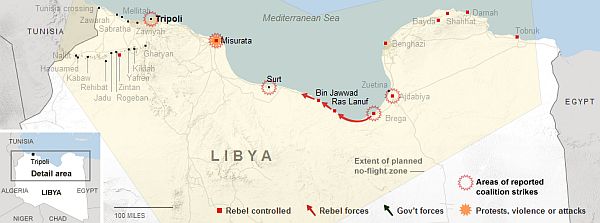
Troops loyal to longtime Libyan leader Muammar Gaddafi have shelled pro-democracy forces heading west on the main coastal highway, pushing them out of Bin Jawad, a small town around 150 kilometres east of Sirte, Gaddafi’s hometown.

The reversal on Tuesday for Libya’s nascent opposition came after their forces made a speedy, two-day advance from Ajdabiya.

Ajdabiya is a crossroads town that Gaddafi’s troops had held for two weeks before an international military intervention allowed pro-democracy fighters to take it back.

On Monday, the pro-democracy forces moved as far west as Nawfaliya, another small town around 20 kilometres past Bin Jawad, before making a hasty evening retreat in the face of artillery fire from Gaddafi’s troops.

A spokesman in the eastern opposition stronghold of Benghazi had announced earlier that day that Sirte itself had fallen, a rumour that turned out to be untrue.

The Guardian reports:

The US has been giving the impression that it has backed away from the bombing campaign in Libya. It has now emerged that while the initial intensity of the high-altitude air strikes and cruise missile attacks has diminished, the US has not let up. In a dramatic and significant escalation of the assault on Gaddafi’s forces, the US has deployed low-flying, heavily-armed aircraft against Libyan armour.

It is a deployment far removed from the initial concept of a “no-fly” zone.

The Pentagon has revealed that AC-130 gunships and A10 tankbusters, of the kind used in Iraq and Afghanistan, have been deployed in Libya. “We have employed A10s and AC-130s over the weekend,” Vice-Admiral Bill Gortney, said.

The aircraft are better suited than high-flying fighter bombers to attack targets in built-up areas without so much risk of civilian casualties, defence officials say.

However, their sheer firepower can lead to civilian deaths as their attacks on the Iraqi city of Falluja after the 2003 invasion of Iraq demonstrated.

On Sunday, The Guardian reported:

The Turkish prime minister Recep Tayyip Erdogan has signalled that Turkey is ready to act as a mediator to broker an early ceasefire in Libya, as he warned that a drawn-out conflict risked turning the country into a “second Iraq” or “another Afghanistan” with devastating repercussions both for Libya and the Nato states leading the intervention.

In an exclusive interview with the Guardian, Erdogan said that talks were still under way with Muammar Gaddafi’s government and the Transitional National Council. He also revealed that Turkey is about to take over the running of the rebel-held Benghazi harbour and airport to facilitate humanitarian aid, in agreement with Nato.

Speaking in Istanbul at the weekend, Erdogan said Gaddafi had to “provide some confidence to Nato forces right now” on the ground if there was to be progress towards the ceasefire the Libyan leader wanted and an “end to the blood being spilled in Libya”.

Eman al-Obeidi, the woman who accused Gaddafi’s men of raping her, now faces criminal charges, according to the Libyan Government. A spokesman told Channel 4 News the “accuser was now the accused”.

Facebooktwittermail

Syrian revolution

The New York Times reports:

President Bashar al-Assad accepted the resignation of his cabinet on Tuesday as thousands of government supporters took to the streets of the capital in an effort to counter a rising tide of pro-democracy protests in several cities, news agencies reported.

The cabinet resignation, announced on state television, appeared to be a concession to protesters and came as the political crisis in Syria deepened on Monday, with the armed forces in the restive southern city of Dara’a firing live ammunition in the air to disperse hundreds of pro-democracy demonstrators.

The unrest in Syria poses a serious challenge to President Assad and his Baath Party. Mr. Assad was expected to announce as early as Tuesday the repeal of the country’s emergency law, in place since 1963, which effectively allows security forces to detain citizens without charges. Whether the repeal — or the cabinet resignations — would quell the protests remains unclear; other laws restrict freedoms and give immunity to the secret police.

Joshua Landis writes:

Ammar Abdulhamid has emerged as the “unofficial spokesman” and most visible face of the Syrian revolutionary movement.

One of the great weaknesses of the protest movement sweeping Syria has been the absence of any recognizable leadership. Syrians have been asking, “Shoo al-Badiil? – What is the alternative [to Bashar al-Assad]?” Today, one of the faces behind the extraordinary revolutionary movement sweeping the Middle East and driving the social media protest movement has emerged in an extended profile by Eli Lake in the Washington Times.

The Syrian regime has stated that the protest movement centered in Deraa is driven by Islamists, an accusation that scares the moderate middle of Syrian society. No one in Syria wants to see a return to the dark days of the early 1980s, when the Muslim Brotherhood led an insurgency movement in Syria that nearly dragged the country into civil war and ended with the regime’s brutal suppression of an Islamist uprising centered in the city of Hama. Thousands were killed.

Ammar Abdulhamid is no Islamist. He did flirt with Islam and the notion of going to Afghanistan during a difficult period of introspection after dropping out of University of Wisconsin-Stevens Point, but pulled away from the lures of fundamentalism. “It gave my life structure, but it enslaved the hell out of me,” he told the Washington Post’s Nora Boustany. Eventually he abandoned Islam for atheism and ultimately became an “agnostic.”

James Denselow writes:

The modern Syrian republic is a chimera whose mothballed constitution hides the true face of an authoritarian monarchy that legislates through powers granted through a vicious and all consuming emergency law. While Syria appeared initially immune to the revolutionary shockwaves spreading through the region, unrest in Deraa and a cack-handed government response of rotten carrots and bloody sticks has simply served to rally a momentum that has spread across the country.

Before he inherited control of Syria Bashar al-Assad trained as an eye surgeon and he should really have seen these protests coming. His response, communicated so far only through underlings, has been to promise the raising of living standards and the abolition of the 1963 Emergency Law, only in Syria could a state of emergency lead to discussion of abolishing the emergency law.

Unsurprisingly in a country where it is estimated that there is a member of the intelligence service for every 153 citizens, the silent majority are hedging their bets, unsure whether the regime will be willing to resort to the levels of repression that characterized the clampdowns in the 1980s.

The International Crisis Group says:

The regime faces three inter-related challenges. First is a diffuse but deep sense of fatigue within society at large, combined with a new unwillingness to tolerate what Syrians had long grown accustomed to — namely the arrogance of power in its many forms, including brutal suppression of any dissent, the official media’s crude propaganda and vague promises of future reform. As a result of events elsewhere in the region, a new awareness and audacity have materialised over the past several weeks in myriad forms of rebelliousness, large and small, throughout the country.

Secondly, at the heart of virtually any locality in the nation is a long list of specific grievances. These typically involve a combination: rising cost of living, failing state services, unemployment, corruption and a legacy of abuse by security services. In a number of places, religious fundamentalism, sectarianism or Kurdish nationalism also form an integral part of the mix. In others, the depletion of water resources and devastation of the agriculture sector add to the tensions.

The third challenge relates to the regime’s many genuine enemies, all of whom undoubtedly will seek to seize this rare opportunity to precipitate its demise. Authorities have ascribed much of the strife to the exiled opposition, home-grown jihadi elements, local “aliens” (notably residents of Palestinian and Kurdish descent) and hostile foreign parties (notably U.S., Israeli, Lebanese and Saudi).

As a result, the regime claims to be fighting critical threats to national unity, such as foreign interference, ethnic secessionism and sectarian retribution. It also stresses the illegitimacy of exiled Syrians they accuse of stirring unrest — some of whom, in fairness, are suspected of crimes no less deserving of investigation than those of the officials they seek to replace.

The Economist reports:

The situation in Syria is becoming increasingly messy. This weekend the unrest shaking the southern city of Deraa spread to Latakia, a port in the north. The sunny metropolis, dotted with palm trees, is the heartland of president Bashar Assad’s Alawite sect. Most of its inhabitants, however, are Sunni mixed in with a few are Christians. Security forces in other parts of the country have been shooting at civilians for the past ten days. Protesters in Latakia say people there have been shot at and attacked by gunmen and thugs. A journalist allowed into the city on Sunday night reported rampaging by armed hardmen.

For once, this seems to tally with the government’s account of the protests; it released a statement saying that gangs were responsible for the violence. But this may be misleading. Some say they have been sent onto the streets by the government or the ruling family itself. Quite who these gangs are, and who they are loyal to, no one is sure. But at least some of the troublemakers are believed to belong to the Shabiha, a notorious group of Alawite ruffians and smugglers, most of whom are members of the extended Assad family. Residents of Latakia barely dare to whisper the name. Many Syrians believe the Shabiha have been told to stir up trouble. Almost all, including many Alawites, dislike them. But their attacks are stirring up deep-seated Syrian fears of sectarian strife, and the government is playing on this.

This has sparked further questions about who is co-ordinating the regime’s violent response to the protests. Many do not believe it is the president. Mr Assad has cracked down on the Shabiha before. In the 1990s, while being groomed for power, he pulled many of them into line, curbing their tendency to tramp around the city extorting money. Instead, many believe they currently answer to Mr Assad’s younger brother, Maher, head of the 4th division, part of the Syrian elite forces. But while rumours of internecine splits are rife in Damascus, there is a strong feeling that Bashar remains the best chance of the regime’s survival. Elite, metropolitan and foreign-educated, regime insiders may not see him as tough, but he has the most public appeal.

Bloomberg reports:

Secretary of State Hillary Clinton said the U.S. won’t enter into the internal conflict in Syria the way it has in Libya, where the international effort to protect civilians from Muammar Qaddafi is progressing.

“No,” Clinton said when asked on the CBS program “Face the Nation” if the U.S. would intervene in Syria’s unrest. Syrian President Bashar Al-Assad’s security forces clashed with protesters in several cities over the weekend after his promises of freedoms and pay increases failed to prevent dissent from spreading across the country.

Clinton said the elements that led to intervention in Libya — international condemnation, an Arab League call for action, a United Nations Security Council resolution — are “not going to happen” with Syria, in part because members of the U.S. Congress from both parties say they believe Assad is “a reformer.”

Facebooktwittermail

Gaddafi’s campaign of disappearances

Libya: detainees, disappeared and missing,” a newly released report from Amnesty International, describes Colonel Gaddafi’s campaign to silence his critics which has targeted government critics, writers, journalists, pro-democracy activists — even children.

    He is in their (the forces of Colonel Mu’ammar al-Gaddafi) hands and we have no idea where he is being held and what kind of treatment he is being subjected to. We are very worried that he is being tortured and if we speak about his case they may further punish him, and that the safety of his wife and children in Tripoli may be endangered.
    — Relatives of a man arrested from his home in Tripoli, in the late afternoon of 22 February 2011, in front of his wife and children.

Many people have been subjected to enforced disappearance1 by forces loyal to Colonel Mu’ammar al-Gaddafi since the current unrest began in Libya in mid-February 2011, including dozens who were arrested and detained in eastern Libya and are believed to have been transferred to the Tripoli area that are controlled by al-Gaddafi forces. These detainees and disappeared persons are at grave risk of torture and other serious human rights abuses. The true number is impossible to calculate as the authorities in Tripoli generally do not divulge information about people they are detaining and because many areas of the country are not accessible for independent reporting; indeed, a number of Libyan and international journalists have been detained and ill-treated for seeking to report from areas in which al-Gaddafi forces have carried out arrests and attacks against civilians, and some are also still missing and unaccounted for having been detained by al-Gaddafi forces. Other journalists who have been released as a result of international pressure, including journalists from the BBC and The New York Times, have reported that they were tortured or otherwise ill-treated. Some were subjected to mock executions.

An Amnesty International fact-finding team has been in eastern Libya since 26 February 2011. The team has visited several towns and interviewed relatives and friends of disappeared and missing persons. Some have been unaccounted for since early January 2011, although most have been subjected to enforced disappearance since mid-February 2011, the beginning of peaceful protests against Colonel al-Gaddafi’s government.

Cases of recently disappeared or missing persons documented by Amnesty International fall into three broad categories:

  • government critics, pro-democracy activists, writers and others detained in the lead-up to the peaceful demonstrations held on 17 February 2011 in various cities throughout Libya. They appear to have been arrested by the authorities as a pre-emptive strike in an effort to nip the protests in the bud following the public protests that had caused the downfall of longstanding repressive governments in Tunisia and Egypt, two of Libya’s neighbours. Amnesty International has documented cases of people arrested in Tripoli, Benghazi, al-Bayda and Misratah whose fate and whereabouts currently remain unknown. They include some detainees who were initially allowed access to their families or lawyers until such contacts were cut by the authorities once the public protests began. Relatives believe that these and other detainees held when the protests got underway were then transferred to Tripoli by security forces loyal to Colonel al-Gaddafi.
  • anti-government protestors and youths who went missing on the evening of 20 February at a time when a special forces unit loyal to Colonel al-Gaddafi – the “Kateeba al-Fadheel” (hereafter, the Kateeba) – were forced to evacuate from a military compound in Benghazi after clashes with protestors opposed to Colonel al-Gaddafi, with some using petrol bombs and other improvised weapons. These violent clashes occurred after the Kateeba or other forces had opened fire on, killing and injuring peaceful protestors. Amnesty International has documented the cases of nine men and boys who have not been seen since they went to the Kateeba compound area on evening of 20 February 2011, including four teenagers under 18. They are believed to have been arrested or abducted by members of the Kateeba unit or other forces brought in from outside Benghazi as reinforcements to the Kateeba before they evacuated their military compound and withdrew from Benghazi.
  • individuals reported to have been captured in or near the town of Ben Jawad where there had been intermittent fighting between Colonel al-Gaddafi’s forces and those engaged in armed opposition to his government. Amnesty International has obtained information about a number of individuals who went missing in the area between Ajdebia and Ben Jawad, west of Benghazi. Some are believed to have been fighters, others to be civilians who went to the area in order to assist the wounded, and still others people who may have been onlookers. Currently, many are unaccounted for and it is not known where they are being held or in what conditions, prompting serious concern for their safety.

Reports from Tripoli, and other parts of the country that remain under the control of Colonel al-Gaddafi’s forces or have been subject to attack by those forces indicate that the number of those now subject to enforced disappearance is much greater than the number of cases that Amnesty International – which does not have direct access to Tripoli or other areas controlled by Colonel al-Gaddafi’s forces, and where the authorities maintain tight control over information – has so far been able to document.

All across Libya, families report that they live in daily fear of reprisals against their disappeared relatives and many are unwilling for their names to be disclosed publicly, believing that this will expose their detained relatives to even greater risk.

Facebooktwittermail

Diplomats discuss Libya’s future as Italy plots Gaddafi’s escape route

The Guardian reports:

Efforts appear to be under way to offer Muammar Gaddafi a way of escape from Libya, with Italy saying it is trying to organise an African haven for him, and the US signalling it will not try to stop the dictator from fleeing.

The move came as diplomatic and military pressure on Gaddafi mounts as Britain tries to assemble a global consensus demanding he surrender power while intensifying air strikes against his forces.

Britain will be hosting an international conference including the UN, Arab states, the African Union, and more than 40 foreign ministers, focused on coordinating assistance in the face of a possible humanitarian disaster, and building a unified international front in condemnation of the Gaddafi regime and in support of a Nato-led military action in Libya.

On the eve of the London conference, Italy offered to broker a ceasefire deal in Libya, involving asylum for Gaddafi in an African country. “Gaddafi must understand that it would be an act of courage to say: ‘I understand that I have to go’,” said the Italian foreign minister, Franco Frattini. “We hope that the African Union can find a valid proposal.”

A senior American official signalled that a solution in which Gaddafi flee to a country beyond the reach of the International Criminal Court (ICC), which is investigating war crimes charges against him, would be acceptable to Washington, pointing out that Barack Obama had repeatedly called on Gaddafi to leave.

Facebooktwittermail

Libya’s decisive battle looms as Gaddafi troops head east

The Guardian reports:

Libya’s army is pouring reinforcements into Muammar Gaddafi’s strategic hometown of Sirte against rebels advancing from the east under cover of UN-mandated air strikes.

Units of regular soldiers in jeeps mounted with heavy machine guns were driving towards the town on Monday as the frontline moved ominously closer to a key regime stronghold for what could turn out to be the decisive battle of the war.

On Sunday night at least 18 large explosions were heard in or near Sirte, apparently part of the coalition’s campaign of attacking air defences and other military targets. But reports that the city had fallen to the Benghazi-based rebels were evidently wrong – and fuelled Libyan fury at the satellite TV channels that claimed it had.

It was firmly in government hands and its people defiant. “I saw death with my own eyes,” said Fawzi Imish, whose house and every other in his seafront street had its windows shattered by a Tomahawk missile strike in the early hours of the morning. “It was just intended to terrify people. And if the rebels come here, we will receive them with bullets.”

Sirte, where the young Gaddafi was educated, is halfway between the rebel east and the area controlled by the regime along the Mediterranean coastal highway. In the 1980s the Libyan leader famously drew a “line of death” across the Gulf of Sirte in brazen challenge to the US.

If the rebels took the city it would be a severe blow, weakening Gaddafi’s position in the centre of Libya and the road would be open for an advance on Tripoli 280 miles away.

Facebooktwittermail

Is Bahrain back to normal?

Khuloud at Jadaliyya writes:

“Your remarkable and unflinching efforts have protected the lives of innocent people, restored order and maintained security and stability across Bahrain,” Crown Prince Salman bin Hamad al-Khalifa praised security forces on Friday March 25th for bringing life in Bahrain back to “normal.” As he thanked his dedicated forces for “creating conditions that are favorable for a national dialogue,” riot police were being deployed to put down some twenty-five small, peaceful protests that took place across the country on what may be the last Bahraini “day of rage.” One man, 71-year old Issa Mohamed, was killed inside his home due to asphyxiation caused by teargas fumes being used to disperse unarmed protesters outside. Telling of the general mood in large parts of Bahrain, the protesters in one of the demonstrations were chanting: “baltagiyya baltagiyya ya hukuma ya gabiyya” [you are thugs, you are thugs, oh government oh fools].

The Bahraini regime may speak of having “cleansed the streets” and “restored order” all it and its supporters want, but facts on the ground speak a different truth. Innocent citizens and residents of all but a few areas of Bahrain have lived in a state of terror since March 15th, 2011. Far from “protecting people’s lives,” police brutality and pro-government thug violence have wreaked havoc on the streets of otherwise peaceful residential neighborhoods. The attendant physical and psychological traumas, as well as material damage to private and public property, have yet to be officially addressed or accounted for. The Bahraini regime’s undercover intelligence services have also continued to unleash an arsenal of intimidation tactics against opposition activists, spokespersons, and supporters. To date, over a hundred Bahrainis have been reported missing, their families left in the dark as to their whereabouts. Several have been released and allowed to return to their loved ones, with a few actually reuniting with their families only at hospital morgues. Several hundred civilians have been severely injured.

Facebooktwittermail

The fight for Libya

The New York Times reports:

As rebel forces backed by allied warplanes pushed toward one of Col. Muammar el-Qaddafi’s most crucial bastions of support, the American military warned on Monday that the insurgents’ rapid advances could quickly be reversed without continued coalition air support.

“The regime still vastly overmatches opposition forces militarily,” Gen. Carter F. Ham, the ranking American in the coalition operation, warned in an email message on Monday. “The regime possesses the capability to roll them back very quickly. Coalition air power is the major reason that has not happened.”

Why make this point now? Because those outside Libya who believe that Western powers have stepped outside the terms of UN Res 1973 are eager to call for a timeout, insisting that the only legal conclusion to this war will come from a negotiated settlement.

Tony Karon writes:

The rebels’ own military capabilities, by measure of weaponry, training, organization and command remain distinctly limited. So, as NATO powers and others involved in the campaign convene in London on Tuesday to plot their next steps, they face the question of whether to use their military leverage to assault the regime on its “home” turf and effectively bomb it out of existence. There are good reasons to believe they’re unlikely to go that far.

NATO Secretary General Anders Fogh Rasmussen said Sunday that the alliance’s actions would be limited to implementing U.N. Security Council Resolution 1973, “nothing more, nothing less.”

And that resolution mandates foreign powers to protect Libya’s civilians through imposing no-fly zone and an arms embargo, and destroying armor and other heavy weaponry that menaces civilian population centers. But it says nothing about regime-change; on the contrary, it requires member states to work for an immediate cease-fire and a democratic political solution to Libya’s civil conflict.

If this is really a “civil conflict,” why hasn’t Gaddafi handed out weapons to all his loyal supporters? He said he’d arm a million civilians, but the fact that he hasn’t probably indicates that there are nowhere near that many Libyans he can trust.

If the Obama administration can be derided for using Orwellian language when calling this war a “time-limited, scope-limited military action,” the Gaddafi government’s own language should be viewed just as critically.

With good reason “civil conflict” is the exact term they have adopted in the hope that observers who find the intervention objectionable will help promote a narrative that legitimizes Gaddafi’s rule. The revolution is aimed at toppling a despotic regime, but if this is a civil war, who are we to take sides?

Brian Whitaker writes:

Amid repeated claims that Libya could turn into another Iraq or Afghanistan, there are growing calls for a negotiated solution. Such talk at the moment serves no purpose, apart from throwing a lifeline to the Gaddafi family and helping them maintain their grip on the country, or at least some of it.

Calls for negotiation are predicated on the idea that the situation in Libya will reach a political/military impasse. It might do, but it hasn’t yet – so there is no need to start behaving as if it had.

A more likely scenario, though, is that the Gaddafi regime will implode suddenly and fairly soon – in a matter of weeks rather than months or years. We should at least wait to see if that is what happens. Hardly anyone in Libya seriously believes in the leader’s eccentric Green Book ideology, and most of those who currently support him can be expected to abandon him once they perceive that he is on the way out.

So the effect of negotiations at this stage would be to help the Gaddafis salvage something. That certainly seems to be the aim of the leader’s son, Saif al-Islam, who has reportedly been trying to interest the US, Britain and Italy in a “transition plan”. Not surprisingly, Saif’s plan envisages Saif taking over from his father for a period of two to three years, while Libya is transformed from a revolutionary jamahiriyya into a liberal democracy. In the meantime, all the Gaddafis – despite their crimes over the years – would be granted immunity from prosecution.

The Guardian reports:

Rebel Libyan forces were halted about 50 miles from Sirte on Monday as reinforcements loyal to Muammar Gaddafi were seen moving towards the strategically vital city.

Revolutionary forces had advanced more than 150 miles in two days, helped by coalition air strikes, breaking the stalemate at Ajdabiya and paving the way for hundreds of men to stream forward along Libya’s coastal road.

But despite a Libyan rebel claim that Sirte had been captured, there was no sign on Monday that the opposition was in control of the city, which marks the boundary between the east and west of Libya and has great symbolic importance as Gaddafi’s home city.

Instead, pro-Gaddafi troops in Sirte were being rallied by forces travelling east from Tripoli and other strongholds in 4×4 vehicles with light weaponry mounted on the rear, a break from the heavier artillery used so far by Gaddafi’s forces, which has been picked off with relative ease by coalition air strikes.

Facebooktwittermail

Juan Cole: An open letter to the Left on Libya

Juan Cole writes:

As I expected, now that Qaddafi’s advantage in armor and heavy weapons is being neutralized by the UN allies’ air campaign, the liberation movement is regaining lost territory. Liberators took back Ajdabiya and Brega (Marsa al-Burayqa), key oil towns, on Saturday into Sunday morning, and seemed set to head further West. This rapid advance is almost certainly made possible in part by the hatred of Qaddafi among the majority of the people of these cities. The Buraiqa Basin contains much of Libya’s oil wealth, and the Transitional Government in Benghazi will soon again control 80 percent of this resource, an advantage in their struggle with Qaddafi.

I am unabashedly cheering the liberation movement on, and glad that the UNSC-authorized intervention has saved them from being crushed. I can still remember when I was a teenager how disappointed I was that Soviet tanks were allowed to put down the Prague Spring and extirpate socialism with a human face. Our multilateral world has more spaces in it for successful change and defiance of totalitarianism than did the old bipolar world of the Cold War, where the US and the USSR often deferred to each other’s sphere of influence.

The United Nations-authorized intervention in Libya has pitched ethical issues of the highest importance, and has split progressives in unfortunate ways. I hope we can have a calm and civilized discussion of the rights and wrongs here.

On the surface, the situation in Libya a week and a half ago posed a contradiction between two key principles of Left politics: supporting the ordinary people and opposing foreign domination of them. Libya’s workers and townspeople had risen up to overthrow the dictator in city after city– Tobruk, Dirna, al-Bayda, Benghazi, Ajdabiya, Misrata, Zawiya, Zuara, Zintan. Even in the capital of Tripoli, working-class neighborhoods such as Suq al-Jumah and Tajoura had chased out the secret police. In the two weeks after February 17, there was little or no sign of the protesters being armed or engaging in violence.

The libel put out by the dictator, that the 570,000 people of Misrata or the 700,000 people of Benghazi were supporters of “al-Qaeda,” was without foundation. That a handful of young Libyan men from Dirna and the surrounding area had fought in Iraq is simply irrelevant. The Sunni Arab resistance in Iraq was for the most part not accurately called ‘al-Qaeda,’ which is a propaganda term in this case. All of the countries experiencing liberation movements had sympathizers with the Sunni Iraqi resistance; in fact opinion polling shows such sympathy almost universal throughout the Sunni Arab world. All of them had at least some fundamentalist movements. That was no reason to wish the Tunisians, Egyptians, Syrians and others ill. The question is what kind of leadership was emerging in places like Benghazi. The answer is that it was simply the notables of the city. If there were an uprising against Silvio Berlusconi in Milan, it would likely unite businessmen and factory workers, Catholics and secularists. It would just be the people of Milan. A few old time members of the Red Brigades might even come out, and perhaps some organized crime figures. But to defame all Milan with them would be mere propaganda.

Then Muammar Qaddafi’s sons rallied his armored brigades and air force to bomb the civilian crowds and shoot tank shells into them. Members of the Transitional Government Council in Benghazi estimate that 8000 were killed as Qaddafi’s forces attacked and subdued Zawiya, Zuara, Ra’s Lanuf, Brega, Ajdabiya, and the working class districts of Tripoli itself, using live ammunition fired into defenseless rallies. If 8000 was an exaggeration, simply “thousands” was not, as attested by Left media such as Amy Goodman’s Democracy Now! As Qaddafi’s tank brigades reached the southern districts of Benghazi, the prospect loomed of a massacre of committed rebels on a large scale.

The United Nations Security Council authorization for UN member states to intervene to forestall this massacre thus pitched the question. If the Left opposed intervention, it de facto acquiesced in Qaddafi’s destruction of a movement embodying the aspirations of most of Libya’s workers and poor, along with large numbers of white collar middle class people. Qaddafi would have reestablished himself, with the liberation movement squashed like a bug and the country put back under secret police rule. The implications of a resurgent, angry and wounded Mad Dog, his coffers filled with oil billions, for the democracy movements on either side of Libya, in Egypt and Tunisia, could well have been pernicious.

Facebooktwittermail