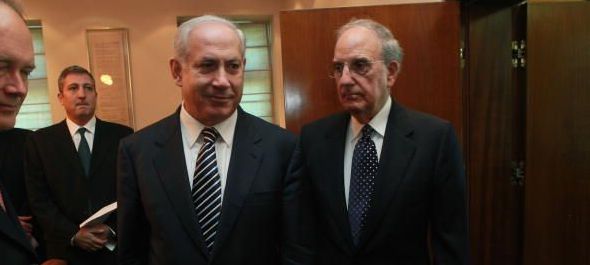
To a great extent, Netanyahu and his cabinet are representative of Israeli society today. Public opinion polls point to increasing extremism, bordering on racism, in Jews’ opinion of Arabs, as well as to alienation and a distrust of the other side’s goals and intentions. Given these circumstances, it’s no wonder there is no public pressure on the government to advance the peace process and that there was no significant public response to the dramatic announcement that the talks had been suspended.
When it comes to peace, Israel’s position today is similar to its position after the wars of 1948 and of 1967: The potential for negotiations was there, but the cost was considered too high. Now, too, maintaining the status quo appears to be preferable to making changes that Israelis perceive as threatening, even if they do not necessarily pose a genuine danger.
In the past decade, Israel has faced a number of Arab initiatives: the Arab League peace plan, Syrian offers to negotiate, Palestinian willingness to move forward and even moderate declarations from Hamas. Successive Israeli governments responded to all of them with restraint and icy indifference (with the exception of the waning days of Ehud Olmert’s term as prime minister ).
Israel’s listless response to these proposals cannot be understood as coincidental or circumstantial; it is a pattern of behavior. And Israel has never proffered its own initiative that would indicate a desire for peace. This leads us to the unhappy conclusion that Israel – both its government and its people – are not really interested in peace; at most, they make the sounds of peace, but that is not enough.
The House Judiciary Committee is holding a hearing this morning on WikiLeaks and the Espionage Act, the law that has been touted as opening up a possible route to prosecute Julian Assange. But the most interesting part of the hearing has been listening to a prominent congressional Democrat, committee chairman John Conyers of Michigan, argue strongly against prosecuting WikiLeaks in haste — or at all.
“As an initial matter, there is no doubt that WikiLeaks is very unpopular right now. Many feel that the WikiLeaks publication was offensive. But being unpopular is not a crime, and publishing offensive information is not either. And the repeated calls from politicians, journalists, and other so-called experts crying out for criminal prosecutions or other extreme measures make me very uncomfortable,” Conyers said, according to his prepared remarks.
“Indeed, when everyone in this town is joined together calling for someone’s head, that is it a pretty strong sign we need to slow down and take a closer look,” he continued.
How dangerous is a man in a wheelchair? British police officers attempting to restore order on the streets of London during recent student protests, decided they couldn’t take any chances when facing the threat posed by 20-year-old Jody McIntyre who suffers from cerebral palsy and is a self-described revolutionary.
In an interview, the BBC’s Ben Brown challenged McIntyre, saying: “There’s a suggestion that you were rolling towards the police in your wheelchair. Is that true?”
McIntyre turns the table on his interviewer by asking: “Do you think that I could have in any way posed a physical threat from the the seat of my wheelchair to an army of police officers armed with weapons?”
On the BBC’s Breakfast News, McIntyre faced similar treatment by interviewers who seemed inclined to believe the police must have been reacting to some form of provocation.
At Open Democracy, Ryan Gallagher notes that the tone of these interviews is:
… typical of how the mainstream media have responded to protests and the policing of them both past and present. Their automatic assumption is that the police are protectors of our best interests, defenders of public order, righteous upholders of the law. Protesters, on the other hand, are automatically perceived as a threat and a potential destructive force – they are folk devils: outsiders, troublemakers and vandals of decency.
The police are therefore at an immediate advantage in the media realm, for they are always given the benefit of the doubt. Officers may have had to crack a few skulls during the fees protests, however only because they were provoked by what [Prime Minister] David Cameron described as “feral thugs”. And it is for this same reason that McIntyre was repeatedly placed on the back foot throughout his BBC interview. Was he a “cyber-radical?” Did he want to build a “revolutionary movement?” The police would never just attack a defenceless disabled man in a wheelchair, would they?
Kira Cochrane spoke to McIntyre about his treatment by the BBC.
Was he surprised by the tone of Brown’s interview? “Not at all,” he says, “because it’s state television. Why do we so heavily criticise state television in other countries and then suggest that our state television would be impartial? I was at a demonstration against the government, and I’m then interviewed on television that works for the government. Why would they question me fairly?”
I ask whether he was scared at any point during the demonstration, and he suggests he has seen much worse recently. At 18, straight after his A-levels, and inspired by Che Guevara, McIntyre decided to travel through South America for three months; after that, he went to Palestine to live in areas including Gaza and Bil’in. “I had Israeli soldiers invading one village every night, shooting at us with live bullets, so a Metropolitan police officer is really not going to pose much of a worry to me. But it was quite humiliating, obviously, to be dragged from my wheelchair.” Was he surprised by the incident? “No, and I don’t know why other people are. To me, it’s as if people must have been asleep all their lives if they don’t realise this is the police’s role at demonstrations – to protect the interests of the government and the state.”
He has been on a lot of protests, on a wide range of issues, and says he has always had a political outlook, which he chronicles on his blog, Life on Wheels (“One man’s journey on the path to revolution”). He isn’t a student himself, but says he cares deeply about the issue both because “acceptance into university should be based on the merit of your grades, not the size of your wallet” and because “education is simply the first target. These cuts, this axe that the government is wielding, is going to affect everyone.”
The truly fascinating aspect of McIntyre’s story is what it reveals about how the British understand disability: namely, that ‘real’ disabled people are not whole human beings. The attitude is that there are two types of disabled person: there are ‘real’ disabled people, who are quiet and grateful and utterly incapable of any sort of personal agency whatsoever, and ‘fake’ disabled people, people like Jody McIntyre, who are disqualified from being truly disabled by virtue of having personality, ambition, outside interests and, in this case, the cojones to stand up to a corrupt and duplicitous government.
This remarkable Catch-22 clause, whereby the authorities can claim that any disabled person who criticises them on disability issues or any other issues must de facto not actually be disabled, does not only affect how individuals like McIntyre are treated. It directly influences policymaking in the most clinical and ruthless of ways. Bear in mind that, alongside its highly publicised cuts to secondary and higher education funding, this government is also taking away benefits from disabled people: housing benefit, income support, the mobility component of Disability Living Allowance and other vital sources of funding are being decimated or removed entirely.
Britain’s high court today decided to grant bail to Julian Assange, the WikiLeaks founder who is wanted in Sweden for questioning over allegations of rape.
Justice Duncan Ouseley agreed with a decision by the City of Westminister earlier in the week to release Assange on strict conditions: £200,000 cash deposit, with a further £40,000 guaranteed in two sureties of £20,000 and strict conditions on his movement.
Federal prosecutors, seeking to build a case against the WikiLeaks leader Julian Assange for his role in a huge dissemination of classified government documents, are looking for evidence of any collusion in his early contacts with an Army intelligence analyst suspected of leaking the information.
Justice Department officials are trying to find out whether Mr. Assange encouraged or even helped the analyst, Pfc. Bradley Manning, to extract classified military and State Department files from a government computer system. If he did so, they believe they could charge him as a conspirator in the leak, not just as a passive recipient of the documents who then published them.
Among materials prosecutors are studying is an online chat log in which Private Manning is said to claim that he had been directly communicating with Mr. Assange using an encrypted Internet conferencing service as the soldier was downloading government files. Private Manning is also said to have claimed that Mr. Assange gave him access to a dedicated server for uploading some of them to WikiLeaks.
Bradley Manning, the 22-year-old U.S. Army Private accused of leaking classified documents to WikiLeaks, has never been convicted of that crime, nor of any other crime. Despite that, he has been detained at the U.S. Marine brig in Quantico, Virginia for five months — and for two months before that in a military jail in Kuwait — under conditions that constitute cruel and inhumane treatment and, by the standards of many nations, even torture. Interviews with several people directly familiar with the conditions of Manning’s detention, ultimately including a Quantico brig official (Lt. Brian Villiard) who confirmed much of what they conveyed, establishes that the accused leaker is subjected to detention conditions likely to create long-term psychological injuries.
Since his arrest in May, Manning has been a model detainee, without any episodes of violence or disciplinary problems. He nonetheless was declared from the start to be a “Maximum Custody Detainee,” the highest and most repressive level of military detention, which then became the basis for the series of inhumane measures imposed on him.
In an age where the newspaper editorial has become an anachronism, few are worth reading. This, from The Guardian, is an exception and for that reason I include the whole piece.
The Middle East peace process died a quiet, undramatic death with the statement last week that the US had given up trying to persuade Binyamin Netanyahu to stop building on occupied land as a prerequisite to direct talks with the Palestinians. Few, however, are interested in burying the corpse.
The rightwing coalition under Mr Netanyahu is relaxed about the failure to restart the talks, because half the cabinet do not accept that they are occupying any land other than their own. And anyway, every day without a final status agreement is another day when the cement mixers can whirl and the cranes swivel. Palestinian leaders who recognise Israel are also reluctant to make good their pledges to resign, because they, too, would lose position, power and political meaning. Fatah has still legitimacy, but where would the Palestinian Authority be in Palestinian eyes other than as a surrogate for Israeli soldiers?
The US is unwilling to set a date for the funeral, because to recognise that a death had taken place would entail an inquest and an examination of 18 fruitless years of failed attempts. And that is the last thing a US president fighting re-election will do. The radical part of Barack Obama’s Middle East strategy has already been and gone. He has spent his political capital and needs to conserve the dimes in his pocket. All of these are compelling short-term reasons for doing nothing, for saying, as if this has not been said often enough in the past, that the time is not ripe, the leaders are too weak, the sides are not ready. But they are dreadful long-term ones. Israel will continue to impose its own one-state solution, with separate roads, and separate governance for Jew and Arab. The Palestinian leadership will continue weak and divided. The argument that Hamas and other militant groups use, that Israel makes territorial concessions only when it is forced to, will grow in resonance. And, inch by inch, the next conflict – be it in the form of a strike on Iran, or a third Palestinian uprising – will come closer. Doing nothing is not just the counsel of despair. In the asymmetry of relations between the growing state of Israel and the shrinking non-state of Palestine, doing nothing is a deeply partisan act.
There are political moves that could release the log jam. Israel’s Labour party could pull out of the coalition, making good on frequent threats to do so. If its leader, Ehud Barak, was right when he said that there is a contradiction between the structure of the government and the chance of promoting negotiations, and he is, then Labour should pull out. President Mahmoud Abbas should also consider steps that would end the current sham. If, in his words, he is presiding over an authority without any authority, and if he is right when he says that the PA’s very existence has made Israel’s occupation the cheapest ever, it is time to end this state of affairs. What exactly is there to lose? Disbanding the PA would mean a return to direct occupation, and seeking UN recognition of a Palestinian state, or handing over responsibility for the Palestinian territories to the UN, would attract a US veto. But if this US president or any future US president were pushed to the point at which the US could abstain in such a vote, all bets would be off.
The contradiction at the heart of US policy is that its support for Israel is unconditional. Even the offer of billions of dollars of aid did not turn Mr Netanyahu’s head, because he knew, if he refused, the flow of US money and weaponry would continue unabated. Any future US president, not just the current one, must calibrate the relationship with Israel as the US does with any other ally. The cost of each new housing unit built in occupied territory should be deducted off US aid. The realities that make such a measure inconceivable today do not lessen the case for such moves tomorrow. They make them compelling.
“I don’t want to just end the war,” Barack Obama said in January 2008, “but I want to end the mindset that got us into war in the first place.”
That was a line which seduced many a progressive across America during the presidential campaign and it’s one reason so many now feel betrayed. Either Obama later had a change of heart, or he knew at the time that he was cynically making a vacuous statement for the sole purpose of hooking a slice of the electorate — one that might be sufficiently inspired to provide useful foot soldiers in his campaign.
Reflecting some of that sense of betrayal, David Bromwich writes:
It has lately become usual for right-wing columnists, bloggers, and jingo lawmakers to call for the assassination of people abroad whom we don’t like, or people who carry out functions that we don’t want to see performed. There was nothing like this in our popular commentary before 2003; but the callousness has grown more marked in the past year, and especially in the past six months. Why? A major factor was President Obama’s order of the assassination of an American citizen living in Yemen, the terrorist suspect Anwar al-Awlaki. This gave legal permission to a gangster shortcut Americans historically had been taught to shun. The cult of Predator-drone warfare generally has also played a part. But how did such remote-control killings pick up glamor and legitimacy? Here again, the president did some of the work. On May 1, at the White House Correspondents dinner, he made an unexpected joke: “Jonas Brothers are here tonight. Sasha and Malia are huge fans. But boys, don’t get any ideas. Two words: predator drones. You will never see it coming.” The line caught a laugh but it should have caused an intake of breath. A joke (it has been said) is an epigram on the death of a feeling. By turning the killings he orders into an occasion for stand-up comedy, the new president marked the death of a feeling that had seemed to differentiate him from George W. Bush. A change in the mood of a people may occur like a slip of the tongue. A word becomes a phrase, the phrase a sentence, and when enough speakers fall into the barbarous dialect, we forget that we ever talked differently.
I’m not sure about Bromwich’s claim that the turning point was 2003.
Relatively early in America’s expansionist history, the slogan, “Wanted: Dead or Alive,” positioned extra-judicial killing at the center of a conception of justice in which the gun was elevated to the status of a sacred instrument.
It should have come as no surprise a week after the September 11 attacks, that a cowboy in the White House would try shaping the American mindset into one necessary for war, by employing those words.
President Bush said yesterday that he wanted Osama bin Laden, the Saudi exile, “dead or alive” in some of the most bellicose language used by a White House occupant in recent years.
“I want justice,” he said after a meeting at the Pentagon, where 188 people were killed last Tuesday when an airliner crashed into the building. “And there’s an old poster out West that says, ‘Wanted: Dead or Alive.’ ”
He then seemed to temper his remarks by adding: “All I want and America wants is to see them brought to justice. That’s what we want.”
Almost nine years later, Obama’s Attorney General Eric Holder confirmed that the same mindset was still at work — in spite of the Democratic president’s campaign promise — and assured Congress that bin Laden “will never appear in an American courtroom.”
The clichéd phrase, “bring to justice,” even if it might seem to preclude the justice of extrajudicial killing, nevertheless connotes justice as the exercise of power — not the enactment of a legal process that should by definition have an unpredictable outcome.
Which brings us to the American wrath now being directed at Julian Assange. His “crime” — the fact that most Americans wouldn’t be able to say what crime he might have committed hasn’t dampened their desire to see him punished — has I believe less to do with national security or legal statutes than the simple fact that he and WikiLeaks have embarrassed America. How dare a scruffy Australian have the audacity to do that?
Imperial power has no humor and responds to the smallest affront with fierce indignation.
insideIRAN.org reports on the sudden removal of Iran’s foreign minister on Monday.
Mohammad Reza Heidari, a former high-ranking Iranian diplomat in Norway, announced in December 2009 that he was quitting the foreign ministry and not returning to Tehran. He now lives in Oslo, where he spoke with Arash Aramesh of insideIRAN.org about Mottaki’s firing.
Q: Iran’s Minister of Foreign Affairs Manouchehr Mottaki was suddenly removed today. Did this surprise you and your friends in Iran’s diplomatic community?
A: In recent months, a number of events took place, which were interpreted by President Ahmadinejad as defeats for Mottaki. Mottaki was blamed for failing to prevent the passage of the UN resolution condemning Iran’s violation of human rights. He was blamed for failing to lead Iran to obtaining a seat in the UN Women’s Rights Panel. Then came the embarrassing story of sending illegal weapons to Nigeria. Mottaki traveled to Nigeria to minimize the damage but he failed there too. And the final blow came when UNESCO did not see Iran fit for holding a conference on philosophy. This was embarrassing to the Islamic Republic. The president tied these so-called defeats together so, if necessary, he would be able to convince the Supreme Leader that Mottaki had to go. Some of my friends and former colleagues in Tehran have told me that the Supreme Leader was not really involved in this and Ahmadinejad made this decision on his own.
He was suddenly removed. This is against diplomatic norms. It is very odd for the country’s top diplomat to be fired like this when the Foreign Minister is on an official visit delivering President Ahmadinejad’s message to the Senegalese government. This is very surprising.
Q: The Minister of Foreign Affairs has always been handpicked by the Supreme Leader. How could the president remove the Minister of Foreign Affairs without Ayatollah Khamenei’s knowledge or consent? Is this a show of power by President Ahmadinejad and sign that the Leader’s position has weakened?
A: There are rumors that Mr. Khamenei is very ill and some decision makers on the top have begun to exclude him from the decision-making process on some issues. It seems that Ahmadinejad’s supporters are stronger now. Mr. Mottaki had the backing of the Leader. Just months ago, the Leader wrote a letter asking Iranian officials to put aside their differences. The Leader specified that the country’s diplomatic affairs must be handled by the foreign minister.
Q: What is the main reason behind Mottaki’s removal?
A: Ahmadinejad wants to homogenize the government and make the nuclear issue the main pillar of his government. I have heard from my friends in the Ministry that Ahmadinejad has expressed his dissatisfaction with Mottaki. Ahmadinejad appointed Ali-Akbar Salehi, the current director of Iran’s Atomic Energy Agency, as acting minister. Salehi is trusted by the Leader as well.
This is also a signal to the world: the person in charge of Iranian diplomacy is the head of Iran’s nuclear program. This implies that the Iranian foreign policy is nothing but the nuclear issue; they are the same thing. The president wants to silence dissenting voices in the ministry. He wants to silence dissent in the Supreme National Security Council, headed by Saeed Jalili, Iran’s chief nuclear negotiator. Ahmadinejad wants a confrontational policy and does not like what moderates like Jalili and Mottaki have to say.
Supporters of Ahmadinejad do not want to talk about stopping enrichment. They want to be recognized as a nuclear power to satisfy their fantasy of being a power. Moderate conservatives are cautious and do not like this. The president has been constantly fighting with the parliament. He has had issues with his own conservative camp.
The U.S. Air Force is blocking its personnel from using work computers to view the websites of the New York Times and other major publications that have posted classified diplomatic cables, people familiar with the matter said.
Air Force users who try to view the websites of the New York Times, Britain’s Guardian, Spain’s El Pais, France’s Le Monde or German magazine Der Spiegel instead get a page that says, “ACCESS DENIED. Internet Usage is Logged & Monitored,” according to a screen shot reviewed by The Wall Street Journal. The notice warns that anyone who accesses unauthorized sites from military computers could be punished.
The Air Force said it had blocked more than 25 websites that contained the documents, originally obtained by the website WikiLeaks and published starting late last month, in order to keep classified material off unclassified computer systems.
Major Toni Tones, a spokeswoman for Air Force Space Command, wouldn’t name the websites but said they might include media sites. Removing such material after it ends up on a computer could require “unnecessary time and resources,” Major Tones said.
There’s too much freedom, a few constitutional amendments need tossing out and the government needs greater powers — this would seem to sum up the views of the majority of Americans… if the latest polling is reliable.
The American public is highly critical of the recent release of confidential U.S. diplomatic cables on the WikiLeaks Web site and would support the arrest of WikiLeaks founder Julian Assange by U.S. authorities, a new Washington Post-ABC News poll finds.
Most of those polled – 68 percent – say the WikiLeaks’ exposure of government documents about the State Department and U.S. diplomacy harms the public interest. Nearly as many – 59 percent – say the U.S. government should arrest Assange and charge him with a crime for releasing the diplomatic cables.
Assange was scheduled to appear in a London courtroom Tuesday to formally contest an extradition order on sexual assault charges in Sweden. U.S. federal authorities are reportedly investigating whether Assange could be charged with violating the Espionage Act by releasing the documents, but his potential extradition to Sweden could significantly complicate any U.S. attempt to quickly try him.
A generational gap was evident among those polled, with younger Americans raised in the Internet age expressing distinct views on the matter. Nearly a third of those ages 18 to 29 say the release of the U.S. diplomatic cables serves the public interest, double the proportion of those older than 50 saying so. When it comes to Assange, these younger adults are evenly split: Forty-five percent say he should be arrested by the United States; 46 percent say it is not a criminal matter. By contrast, those age 30 and older say he should be arrested by a whopping 37-point margin.
As always, the polling information is frustrating as much because of what it doesn’t show as by what it reveals. The answers to these follow-up questions might have helped clarify who was dumber — the pollsters or those being polled:
1. If you believe the release of the cables damaged the public interest, can you list the top five most damaging revelations?
2. If you believe the release of the cables damaged the public interest, can you explain whether you see any distinction between the interests of the American people and the interests of the US government?
3. If you would like to see Julian Assange arrested, can you explain what crime you think he committed?
4. If you think he committed a crime, do you believe that the same charges should be brought against the editors of the New York Times and other newspapers that published the cables?
5. The First Amendment protects freedom of speech and freedom of the press. Can you explain your understanding of these freedoms and do you believe that the US Constitution can be set aside whenever the government says that national security is at stake?
Terrorist blacklisting has been a central plank of the “war on terror” pursued by western states since 9/11. The idea is simple. International or regional bodies (such as the UN and EU) and states (such as the UK) designate individuals and groups thought to be terrorists or “associated with” terrorism, freeze their assets, impose travel bans, criminalise their membership and prevent others from supporting them. Yet after almost 10 years – following a plethora of successful legal challenges, the failure of reforms that have tried to render listing procedures compliant with human rights, and widespread criticism by judges and other officials – the policy of blacklisting is now facing a fundamental crisis of legitimacy.
The evolution of this crisis, and the possible ways of moving beyond it, are detailed in a critical report launched today by the European Centre for Constitutional and Human Rights (ECCHR), which suggests that the time has come for radically rethinking the policy of blacklisting. Following the recent recommendations of Martin Scheinin, the outgoing UN special rapporteur on the promotion and protection of human rights while countering terrorism, it calls for the two key security council resolutions underpinning the blacklisting system to be abolished.
Resolution 1267 (and the resolutions that amended it) created the UN sanctions committee, comprised of all members of the security council, to compile a list of individuals and groups “associated with” Osama bin Laden, al-Qaida and the Taliban and compel states to bring proceedings or penalise those designated. Resolution 1373 requires states to criminalise the support and financing of terrorism while giving them the autonomy to set up their own domestic blacklists. The EU has used it to set up its own list criminalising groups such as the PKK and the LTTE as terrorist organisations.
The most persistent criticism of both regimes is that they breach fundamental rights. Most listing decisions are based on secret intelligence material that neither blacklisted individuals nor the courts responsible for reviewing the implementation of the lists will ever see. As courts have repeatedly affirmed, one cannot oppose allegations against them (and exercise their right to judicial review) if they are prevented from knowing what the allegations actually are. Such treatment is a fundamental breach of the right to a fair trial. Yet it is an ongoing Kafkaesque reality for the majority of those who are placed on the blacklists.
Like every year-end, once again they’re promising that the next 12 months will be “a decisive year.” Fact: Even Palestinian President Mahmoud Abbas has said that in August 2011, when Prime Minister Salam Fayyad finishes building institutions in the West Bank, the United Nations will recognize the Palestinian state.
Brazil and Argentina have already recognized a Palestinian state within the 1967 borders. And most importantly, U.S. Secretary of State Hillary Clinton said clearly that the status quo is unacceptable to the United States; she insisted that the Israeli government put forth a map with permanent borders as soon as possible. As for me, I’ll bet that next year the conflict will remain at a standstill. That’s the best-case scenario. Meanwhile, the settlements will grow like mushrooms and Hamas will continue striking roots.
Fostering the illusion that the conflict is ending doesn’t bring a solution closer; in fact, the focus on the final-status talks offers an alibi for deepening the occupation. The high and mighty words about two states for two peoples silence the protest voices of a nation that for more than 43 years has lived under the occupation of another nation. The testimonies of 101 discharged soldiers who served in the West Bank over past decade and collected their comments in a book published by Breaking the Silence show that even the status quo Clinton referred to doesn’t reflect the situation.
Contrary to the impression that government spokesmen are trying to create – that Israel is gradually withdrawing from the territories based on the necessary caution dictated by security needs – the soldiers describe a steadfast effort to tighten Israel’s hold on the West Bank and the Palestinian population.
It says in the book that the continued construction in the settlements is not only about stealing land whose future the two sides are meant to decide through negotiations. The increased presence of a Jewish population brings with it an increase in security measures such as the policy of “separation.” The testimonies show that this policy practically serves to control, plunder and annex the territories. It funnels the Palestinians through the Israeli control mechanism and establishes new borders on the ground through a policy of divide and rule.
The real story is not the one reported. The real story we can only imagine — but it’s buried in here somewhere.
The Washington Post reports that Richard Holbrooke’s final words before entering surgery in which he died yesterday evening, were these: “You’ve got to stop the war in Afghanistan.”
Did Obama’s Af-Pak envoy go seriously off-message in the last moments of his life and reveal his abhorrence for what has become President Obama’s war? And more to the point, was the White House disturbed that this might be Holbrooke’s legacy — right at the moment that the administration was ready to wheel out its stay-on-course message about the war’s progress?
The Washington Post — at who’s behest we’ll probably never know — now provides some clarification. Holbrooke was just joking around while engaged in pre-surgery banter.
In the following account, the Post uses a phrase beloved by its reporters and those at the New York Times: emerged.
News pops up like mushrooms from an invisible mycelium. For a reporter to report on how a story emerges — well that would be unseemly and unnecessary, a distraction from the narrative that is supposedly the reader’s sole interest.
What possible concern could we have in understanding the chain of events that led to an anti-war death-bed story getting airbrushed out of the record?
Thank goodness we now know that Holbrooke was not eager to end the war.
As friends and colleagues from four decades of diplomatic life reflected on the intensity of Richard C. Holbrooke’s dedication, many were not surprised to learn that concerns about the Afghanistan war were apparently among his final thoughts.
Following Holbrooke’s death, The Washington Post, citing his family members, reported that the veteran diplomat had told his physician just before surgery on Friday to “stop this war.”
But on Tuesday a fuller account of the tone and contents of his remarks emerged.
As Dr. Jehan El-Bayoumi was attending to Holbrooke in the emergency room at George Washington University Hospital, she told him to relax and asked what she could do to comfort him, according to an aide who was present. Holbrooke, who was in severe pain, said jokingly that it was hard to relax because he had to worry about the difficult situation in Afghanistan and Pakistan.
El-Bayoumi, an Egyptian-American internist who is Secretary of State Hillary Rodham Clinton’s physician, replied that she would worry for him. Holbrooke responded by telling her to end the war, the aide said.
The aide said he could not be sure of Holbrooke’s exact words. He emphasized Tuesday that the comment was made in painful banter, rather than as a serious exhortation about policy. Holbrooke also spoke extensively about his family and friends as he awaited surgery by Farzad Najam, a thoracic surgeon of Pakistani descent.
Hmmm… Holbrooke’s surgeon was of Pakistani descent… No, I promise, I won’t go there.
During the Bush era, I frequently wrote about escalating attacks by the U.S. Government on press freedoms. The Bush DOJ vowed to prosecute whistleblowers while steadfastly refusing to do the same for the high-level criminals they exposed. Alberto Gonzales openly threatened that the DOJ could prosecute editors and reporters of The New York Times for revealing the illegal NSA spying program. CIA Director Porter Goss vowed to subpoena journalists who publish classified information in order to compel them to disclose their sources or go to prison.
And, worst of all, Bush officials sought for the first time in American history to obtain an espionage conviction — under the Espionage Act of 1917 — against non-government-employees who had received and disseminated classified information. About that case — brought against two AIPAC officials who had passed classified information they received from a Pentagon official to the Government of Israel (the Pentagon official pled guilty) — I wrote about “the Bush Administration’s broader, unprecedented assault on a free press of which the AIPAC prosecution is but a part,” and argued that “the Bush Administration is seeking to criminalize the very act which defines what an investigative journalist does and has always done in America.” The Washington Post‘s Walter Pincus reported at the time, quoting a legal expert, that “administration officials ‘want this case as a precedent so they can have it in their arsenal’ and added: ‘This is a weapon that can be turned against the media’.” After a series of adverse judicial rulings against the Government, the DOJ finally abandoned that AIPAC prosecution.
Amazingly, the Obama administration is surpassing its predecessor when it comes to assaults on whistle-blowing and a free press. As Politico’s Josh Gerstein reported, “President Barack Obama’s Justice Department has taken a hard line against leakers. . . .’They’re going after this at every opportunity and with unmatched vigor,’ said Steven Aftergood of the Federation of American Scientists.” The New York Times similarly documented: “the Obama administration is proving more aggressive than the Bush administration in seeking to punish unauthorized leaks.” The Obama DOJ has launched nothing less than a full-on war against whistleblowers; its magnanimous “Look Forward, Not Backward” decree used to shield high-level Bush criminals from investigations is manifestly tossed to the side when it comes to those who reveal such criminality. And they even revitalized an abandoned Bush-era subpoena issued to The New York Times‘ James Risen, demanding that he disclose his source for an article in which he revealed an embarrassingly botched attempt to infiltrate and sabotage Iran’s nuclear program.
I stood with hundreds of thousands of rebellious Czechoslovakians in 1989 on a cold winter night in Prague’s Wenceslas Square as the singer Marta Kubišová approached the balcony of the Melantrich building. Kubišová had been banished from the airwaves in 1968 after the Soviet invasion for her anthem of defiance, “Prayer for Marta.” Her entire catalog, including more than 200 singles, had been confiscated and destroyed by the state. She had disappeared from public view. Her voice that night suddenly flooded the square. Pressing around me were throngs of students, most of whom had not been born when she vanished. They began to sing the words of the anthem. There were tears running down their faces. It was then that I understood the power of rebellion. It was then that I knew that no act of rebellion, however futile it appears in the moment, is wasted. It was then that I knew that the Communist regime was finished.
“The people will once again decide their own fate,” the crowd sang in unison with Kubišová.
I had reported on the fall of East Germany before I arrived in Prague. I would leave Czechoslovakia to cover the bloody overthrow of the Romanian dictator Nicolae Ceausescu. The collapse of the Communist regimes in Eastern Europe was a lesson about the long, hard road of peaceful defiance that makes profound social change possible. The rebellion in Prague, as in East Germany, was not led by the mandarins in the political class but by marginalized artists, writers, clerics, activists and intellectuals such as Vaclav Havel, whom we met with most nights during the upheavals in Prague in the Magic Lantern Theater. These activists, no matter how bleak things appeared, had kept alive the possibility of justice and freedom. Their stances and protests, which took place over 40 years of Communist rule, turned them into figures of ridicule, or saw the state seek to erase them from national consciousness. They were dismissed by the pundits who controlled the airwaves as cranks, agents of foreign powers, fascists or misguided and irrelevant dreamers.
I spent a day during the Velvet Revolution with several elderly professors who had been expelled from the Romance language department at Charles University for denouncing the Soviet invasion. Their careers, like the careers of thousands of professors, teachers, artists, social workers, government employees and journalists in our own universities during the Communist witch hunts, were destroyed. After the Soviet invasion, the professors had been shipped to a remote part of Bohemia where they were forced to work on a road construction crew. They shoveled tar and graded roadbeds. And as they worked they dedicated each day to one of the languages in which they all were fluent—Latin, Greek, Italian, French, Spanish or German. They argued and fought over their interpretations of Homer, Virgil, Dante, Goethe, Proust and Cervantes. They remained intellectually and morally alive. Kubišova, who had been the most popular recording star in the country, was by then reduced to working for a factory that assembled toys. The playwright Havel was in and out of jail.
The long, long road of sacrifice, tears and suffering that led to the collapse of these regimes stretched back decades. Those who made change possible were those who had discarded all notions of the practical. They did not try to reform the Communist Party. They did not attempt to work within the system. They did not even know what, if anything, their protests would accomplish. But through it all they held fast to moral imperatives. They did so because these values were right and just. They expected no reward for their virtue; indeed they got none. They were marginalized and persecuted. And yet these poets, playwrights, actors, singers and writers finally triumphed over state and military power. They drew the good to the good. They triumphed because, however cowed and broken the masses around them appeared, their message of defiance did not go unheard. It did not go unseen. The steady drumbeat of rebellion constantly exposed the dead hand of authority and the rot and corruption of the state.
A ‘peace process’ that, from its inception, took Israel’s self-definition of its own security needs as the sole determinate of the walls within which any solution for Palestinians was to be conducted, has reached exhaustion. Based on such a reductive premise, its arrival at this deathly nadir, with no more than a prospect of disjointed alleviated occupation, possessing the most hollow trappings of statehood as its final security-led outcome, should evoke no surprise.
The non-solution to which such a premise would take us would defuse nothing: indeed, it might well prove to be the spark that could exacerbate or explode simmering regional animosities — even if these animosities were not ostensibly linked directly to the Palestinian issue.
Any thought that such a hollowed-out solution — alleviated occupation, posing as statehood — will defuse anti-American sentiment in the Muslim world is likely to prove to be resoundingly misplaced. On this, the critics from the political Right are correct: a flawed Israeli-Palestinian agreement, per se, will not drain-off anti-western regional sentiment; it will exacerbate it. It will feed it. But the corollary the Right pushes in its place, that defeating Iran somehow precisely is that elusive magic bullet the West so ardently desires (the key to soothing regional tensions and defusing hostility towards the West) represents an even greater pathology and disassociation from reality. It is one that is no less illusory for having the apparent endorsement of America’s Arab clients, whose talk is no more than a reflection back into the looking-glass of American diplomacy, as it stares at its own face.
What these American protégés really fear is the growing groundswell of scorn — scorn towards the western élites on whom these interlocutors wholly depend — but more precisely it is fear of the parallel disdain, directed towards these pro-American, self-enriching élites, themselves. Any show of western muscularity indirectly gives these anxious oligarchs, feeling their authority decay beneath them, a further lease on survival. Thus they speak their deeper fears into the American looking-glass in its own thinking. All these worrying, popular stirrings can only be Iranian: for they fear they carry the gene of revolution.
The peace process solution-phantasm has not only divided the Palestinians; but also shaped the political structure for the region for the last decades: polarizing the region — on the false premise — between those who were ‘opposed’ to peace and those who ‘supported’ peace. Many of those who were termed opposed to peace in reality were opposed more to Israel’s self-referencing security-led paradigm — than to a peaceful solution per se.
Contrary to general western expectations, there will be many in the region who welcome evidence of the clinical death of ‘the process’. They will see its passing away as a welcome and necessary catharsis that opens new possibilities; new politics. Already the polarized cold war architecture of the peace process has begun to dissolve: Turkey’s shift of orientation is one example of the shifts taking place — as the former regional division into two sculptural solids, spoilers versus supporters of peace, melts into a much more fluid and mobile regional mass. [Continue reading]
To the President of the United States: Mr. President, We have been engaged and working inside Afghanistan, some of us for decades, as academics, experts and members of non-governmental organisations. Today we are deeply worried about the current course of the war and the lack of credible scenarios for the future. The cost of the war is now over $120 billion per year for the United States alone.
This is unsustainable in the long run. In addition, human losses are increasing. Over 680 soldiers from the international coalition – along with hundreds of Afghans – have died this year in Afghanistan, and the year is not yet over. We appeal to you to use the unparalleled resources and influence which the United States now brings to bear in Afghanistan to achieve that longed-for peace.
Despite these huge costs, the situation on the ground is much worse than a year ago because the Taliban insurgency has made progress across the country. It is now very difficult to work outside the cities or even move around Afghanistan by road. The insurgents have built momentum, exploiting the shortcomings of the Afghan government and the mistakes of the coalition. The Taliban today are now a national movement with a serious presence in the north and the west of the country. Foreign bases are completely isolated from their local environment and unable to protect the population. Foreign forces have by now been in Afghanistan longer than the Soviet Red Army.
Politically, the settlement resulting from the 2001 intervention is unsustainable because the constituencies of whom the Taliban are the most violent expression are not represented, and because the highly centralised constitution goes against the grain of Afghan tradition, for example in specifying national elections in fourteen of the next twenty years.
The operations in the south of Afghanistan, in Kandahar and in Helmand provinces are not going well. What was supposed to be a population-centred strategy is now a full-scale military campaign causing civilian casualties and destruction of property. Night raids have become the main weapon to eliminate suspected Taliban, but much of the Afghan population sees these methods as illegitimate. Due to the violence of the military operations, we are losing the battle for hearts and minds in the Pashtun countryside, with a direct effect on the sustainability of the war. These measures, beyond their debatable military results, foster grievance. With Pakistan’s active support for the Taliban, it is not realistic to bet on a military solution. Drone strikes in Pakistan have a marginal effect on the insurgency but are destabilising Pakistan. The losses of the insurgency are compensated by new recruits who are often more radical than their predecessors.
Richard Holbrooke died this evening. The Washington Post looked back at his career.
Mr. Holbrooke was sent to Vietnam in 1963, assigned to the lower Mekong Delta as a field officer for the U.S. Agency for International Development, a post that would later give him unique perspective on reconstruction efforts and provincial stabilization in Afghanistan.
His insights drew the attention of the U.S. Embassy in Saigon, and he was soon moved there to serve as a staff assistant to two ambassadors, Maxwell D. Taylor and Henry Cabot Lodge Jr.
In 1966, he joined the Vietnam staff in the Johnson White House, where had a front-row seat for what came to be considered an unwise escalation of U.S. military forces based on deceptive assessments.
“Our beloved nation sent into battle soldiers without a clear determination of what they could accomplish and they misjudged the stakes. And then we couldn’t get out,” he said that year at a State Department conference on the American experience in Southeast Asia. “. . . We fought bravely under very difficult conditions. But success was not achievable. Those who advocated more escalation or something called ‘staying the course’ were advocating something that would have led only to a greater and more costly disaster afterwards.”
September 24 began like any other Friday for Joe Iosbaker and Stephanie Weiner. Then, at 7 a.m., FBI agents knocked on the door of the Chicago couple’s house in the city’s North Side.
Armed with a search warrant, more than 20 agents examined the couple’s home, photographing every room and combing through notebooks, family videos and books, even their children’s drawings. Some items were connected to their decades of anti-war and international solidarity activism, but others were not. “Folders were opened, letters were pulled out of envelopes,” says Weiner, an adult education professor at Wilbur Wright College. “They had rubber gloves and they went through every aspect of our home.”
Ten hours after their arrival, as television news crews filmed and activist supporters stood on the sidewalk, the agents drove away with nearly 30 boxes of material, including t-shirts and a photograph of Malcolm X. By that time, Iosbaker and Weiner had been served subpoenas to appear before a grand jury investigating “material support” for “foreign terrorist organizations.” And they knew theirs wasn’t the only home invaded that day. More than 70 FBI agents had raided seven residences in Chicago and Minneapolis and questioned activists in Michigan, California and North Carolina, serving subpoenas to 11 people. A few days later, the Justice Department subpoenaed members of the Minnesota Anti-War Committee (AWC), whose office was also raided on September 24, raising the number to 14. (Editor’s note: five additional Chicago-area activists were subpoenaed in early December; see update below.)
The grand jury and FBI are looking for evidence that connects the 14 activists and their “potential co-conspirators” to two organizations: the Revolutionary Armed Forces of Colombia (FARC) and the Popular Front for the Liberation of Palestine (PFLP), which are both on the State Department’s “Foreign Terrorist Organizations” list. None of the 14 has been charged with a crime, and all deny providing “material support,” including money, to any foreign organization.
Citing the Fifth Amendment, all 14 are refusing to testify before the grand jury, which they say is a secretive arm of a government intent on silencing critics.
This website or its third-party tools use cookies, which are necessary to its functioning. By closing this banner, you agree to the use of cookies.