The Genesis 2.0 Project

The Genesis 2.0 Project

Among the defining attributes of now are ever tinier gadgets, ever shorter attention spans, and the privileging of marketplace values above all. Life is manically parceled into financial quarters, three-minute YouTube videos, 140-character tweets. In my pocket is a phone/computer/camera/video recorder/TV/stereo system half the size of a pack of Marlboros. And what about pursuing knowledge purely for its own sake, without any real thought of, um, monetizing it? Cute.

And so in our hyper-capitalist flibbertigibbet day and age, the new Large Hadron Collider, buried about 330 feet beneath the Swiss-French border, near Geneva, is a bizarre outlier.

The L.H.C., which operates under the auspices of the European Organization for Nuclear Research, known by its French acronym, cern, is an almost unimaginably long-term project. It was conceived a quarter-century ago, was given the green light in 1994, and has been under construction for the last 13 years, the product of tens of millions of man-hours. It’s also gargantuan: a circular tunnel 17 miles around, punctuated by shopping-mall-size subterranean caverns and fitted out with more than $9 billion worth of steel and pipe and cable more reminiscent of Jules Verne than Steve Jobs.

The believe-it-or-not superlatives are so extreme and Tom Swiftian they make you smile. The L.H.C. is not merely the world’s largest particle accelerator but the largest machine ever built. At the center of just one of the four main experimental stations installed around its circumference, and not even the biggest of the four, is a magnet that generates a magnetic field 100,000 times as strong as Earth’s. And because the super-conducting, super-colliding guts of the collider must be cooled by 120 tons of liquid helium, inside the machine it’s one degree colder than outer space, thus making the L.H.C. the coldest place in the universe. [continued…]

Facebooktwittermail

Of ants and men

Of ants and men

In The Superorganism: The Beauty, Elegance, and Strangeness of Insect Societies, Bert Holldobler and E.O. Wilson survey the last 15 years of myrmecological research. Picking up where their Pulitzer Prize-winning The Ants left off, The Superorganism is a completely wonderful book. It is packed with astonishing findings and beautiful illustrations, and, happily, it also contains enough information about ant civilization to set up a few ants-vs.-humans scenarios. Let us skip lightly over the fact that to compare ants and humans is to pit thousands of species against just one. Rather, let’s start with the idea that we begin the contest evenly matched—at 6.6 billion humans and approximately 5 million billion ants, humans and ants have roughly the same biomass. What if a global disaster struck? Who would come out on top?

We won’t be able to declare one species smarter or better—each is wildly successful in its own niche, and at any rate, that would make as much sense as saying one is better-looking than the other. Still, we can wonder about how robust life is at such extreme ends of the genes-mind spectrum. What if, for example, you hammered the Earth with a volcano or a big rock from space? Who would survive? Or think about that classic of speculative fiction—mass sterility. Imagine that both ants’ and humans’ biological clocks sputter and stop, and reproduction just doesn’t work as it used to. Is life as we know it over? Perhaps a mysterious plague has moved unnoticed among us until one morning we awake and 70 percent of both populations has disappeared? Could civilization recover? Either one? [continued…]

Facebooktwittermail

Iraqis express dismay over Blackwater ruling

Iraqis express dismay over Blackwater ruling

Cars breezed by the trimmed green hedges and flowers of Baghdad’s Nisoor Square on Friday, while pedestrians strolled past billboards of smiling men and women promoting national elections. Little trace was left of the September 2007 day when Blackwater security guards opened fire on the crowded intersection, killing 17 civilians.

On Thursday, a judge in a U.S. federal court had thrown out the criminal prosecution of five Blackwater guards involved in the shootings. The consequences of that decision were still being felt Friday by survivors of the attack, politicians and ordinary Iraqis, who expressed feelings of helplessness at the hands of the United States.

The Iraqi government vowed to seek an appeal. Victims and others said they doubted they would ever see justice, convinced the American government considers their blood cheap.

U.S. District Judge Ricardo Urbina ruled that prosecutors of the five security guards had wrongly relied on statements the defendants made to State Department investigators under the promise of immunity. The guards, who were facing counts of manslaughter and firearms violations, maintained they opened fire in response to an attack. Iraqis dispute that. [continued…]

Iraq to sue ex-Blackwater guards

Iraq said Friday that it will file a lawsuit against five Blackwater security guards cleared of manslaughter charges in the 2007 killing of 17 Iraqi civilians, an act a government official called murder.

The Iraqi government also will ask the U.S. Justice Department to appeal a federal judge’s “unfair and unacceptable” dismissal of the charges Thursday, spokesman Ali al-Dabbagh said.

An Iraqi man wounded in the 2007 incident also voiced his anger Friday, saying U.S. District Judge Ricardo Urbina’s dismissal of the charges showed “disregard for Iraqi blood.” [continued…]

Facebooktwittermail

PULSE: 20 Top Global Thinkers of 2009

PULSE: 20 Top Global Thinkers of 2009

On 30 November 2009 Foreign Policy magazine published its ’Top 100 Global Thinkers’ list. We were naturally skeptical since the selection included Dick Cheney, General Petraeus, Larry Summers, Thomas Friedman, Bernard-Henri Lévy, David Kilcullen, Ayaan Hirsi Ali, Salam Fayyad, The Kagan Family (yes, all of them) and Ahmed Rashid among others. We don’t consider any of these people thinkers, let alone having global significance, and we couldn’t help but notice that the main thrust of all their work aligns with the global military and economic agenda of the US government. In response we asked twelve of our writers and editors to nominate their Top 20 global thinkers of 2009. Our criteria included choosing those who inspire critical thinking, as well as those who have been able to buck received wisdom and shape public debate. Always agreeing with their statements and positions was not a requisite, but in all cases our selections involved nominating those who have spurred people to challenge or enhance their own thinking in different ways. The following is our unranked list. [continued…]

PULSE: 20 Top Global Media Figures of 2009

After we published our list of 20 Top Global Thinkers, we thought we would be remiss if we did not also honor those media figures and institutions who bring these voices to us in the first place. With the goal of recognizing those individuals and institutions responsible for exemplary reportage and awareness-raising in 2009, we asked our editors and writers to name their choices for the top 20 media figures, be they journalists, publications or publishers. We aggregated these nominations into the following list. Like our 20 Top Global Thinkers, our criteria for choosing media figures included people/publications/publishers who have shown a commitment to challenging power, holding it accountable, highlighting issues pertaining to peace and social justice and producing output that encourages critical thinking and questions conventional wisdom. [continued…]

Facebooktwittermail

Muslim profiling is a recipe for insecurity

Muslim profiling is a recipe for insecurity

Here we go again. Another botched terrorist attack, and a much-needed excuse for some agenda-driven American ideologues to demand opening “new fronts” in the “war on terror”, with “profiling” of Muslims at airports expected to be at the core of the airport security review announced yesterday by Gordon Brown. I am sorry, but that thinking is wrong, flawed, and will make matters worse.

Yemen is not a willing home to al-Qaeda – it is victim to an ideology exported from neighbouring Saudi Arabia. In our desire to blame and, eventually, bomb, let us not forget the other Yemen: one of the last bastions of traditional, serene Islam. Yemeni Sufis have been imparting their version of normative Islam for centuries through trade and travel. Hundreds of British Muslims have been studying in Yemen’s pristine Islamic institutions. They have returned to Britain connected to an ancient chain of spiritual knowledge and now lead several Muslim communities with the Sufi spirit of love for humans, dedication to worship, and service to Islam. [continued…]

Obama blames al-Qaeda for Christmas Day jet ‘bomb’

U.S. President Barack Obama has for the first time publicly accused an offshoot of al-Qaeda over the alleged Christmas Day bomb plot to blow up a US plane.

He said it appeared Yemen-based al-Qaeda in the Arabian Peninsula had armed and trained the accused, 23-year-old Nigerian Umar Farouk Abdulmutallab. [continued…]

Charm of student linked to jet attack

Mr Abdulmutallab’s story demonstrates how difficult it is to build a stereotype of the radical Islamist willing to give his life for the jihadist cause.

Students who shared classrooms and accommodation with Mr Abdulmutallab in Yemen and Britain describe a young man who befits the image portrayed in the photograph – smiling, intelligent and good-looking. He was devoutly religious – in the picture he dons a white Muslim skullcap – but did not display outward signs of extremism, they say. Rather, he was quiet and kept to himself – more introvert than fanatic.

Other Africans, from Comoros, Kenya and Somalia, who have been involved in al-Qaeda activities, have come from humbler backgrounds. But Mr Abdulmutallab was born into Nigeria’s elite, and there is little in his African background to suggest he was a terrorist in the making. [continued…]

Facebooktwittermail

‘Israel resembles a failed state’

‘Israel resembles a failed state’

One year has passed since the savage Israeli attack on the Gaza Strip, but for the people there time might as well have stood still.

Since Palestinians in Gaza buried their loved ones – more than 1,400 people, almost 400 of them children – there has been little healing and virtually no reconstruction.

According to international aid agencies, only 41 trucks of building supplies have been allowed into Gaza during the year.

Promises of billions made at a donors’ conference in Egypt last March attended by luminaries of the so-called “international community” and the Middle East peace process industry are unfulfilled, and the Israeli siege, supported by the US, the European Union, Arab states, and tacitly by the Palestinian Authority (PA) in Ramallah, continues. [continued…]

Editor’s Comment — Ali Abunimah, who has just left Cairo after attending the thwarted Gaza Freedom March, adds on his blog:

To talk about the siege of Gaza in the abstract is one thing, but to actually come to Egypt and find that Gaza is harder to visit than a prison is like a bucket of cold water. The Egyptian government may be efficient at few things, but it is highly efficient at maintaining the siege. Buses hired to take all the marchers to Gaza were prevented from showing up. Those who tried to get to Gaza under their own steam were turned back or detained at their hotel in Al Arish. It was very very frustrating. But whatever frustration we felt is one millionth of the frustration of the besieged Palestinian people in Gaza. So perhaps in some way it is better then that we did not get in, because Egypt gave us a small taste of what it serves every day to people in Gaza — and a small taste of what Egyptians face when they challenge their government’s policies.

Report from Gaza: One student’s question to the world – ‘Why the Palestinians? Why are we the only ones suffering?’

The question was like an electric shock to the six or so Palestine solidarity activists, including myself, as we were standing inside a classroom at a school in Gaza City.

“Why the Palestinians? Why are we the only ones suffering?” asked a Palestinian girl who was probably about nine or ten-years-old. And then the enormity of what the people of Gaza go through every day hit me.

Most of us were Americans and one was Canadian, and we were delivering some of the $17,000 in school supplies that Jessica Campbell and Julia Hurley, two members of the Gaza Freedom March student delegation, had brought and raised on their own. [continued…]

Israel’s 10 worst errors of the decade

…there is perhaps no better time than this to review Israel’s 10 Worst Mistakes of the Last 10 Years:

1. The Siege of Gaza – The stated goal of the siege was to undermine Hamas and to goad Gazans into rejecting Hamas rule. The effect of the siege has been to focus and intensify Palestinian anger against Israel, increase Gazans’ dependency on Hamas social welfare arms, enrich Hamas coffers through tunnel taxation and foreign donations, and sap Palestinian support for Fatah, which, through its back-channel encouragement for the siege, is seen as a betrayer and a boot-licker in the eyes of many Palestinians.

2. The Siege of Gaza – The blockade was ostensibly a means to stem the influx of weaponry into Gaza. In practice, with shipments the size of automobiles flowing through the tunnels, the Hamas arsenal has grown ever more sophisticated, now believed to include Iranian-manufactured rockets capable of striking Tel Aviv and Ben-Gurion Airport from the Strip.

3. The Siege of Gaza – In the eyes of the world community, the overwhelming collective punishment – and the relative silence of Israelis in response – has gutted Israeli claims to the moral high ground. It has undercut sympathy for Israelis living within Qassam range. It has kept open the moral wounds of the Gaza War, cramping rebuilding efforts, enshrining universal unemployment, and ensuring agonizing homelessness as the coastal winter gathers full force. Israeli officials have quietly take steps of astounding insensitivity, arbitrarily barring such goods as school supplies.

4. The Siege of Gaza – The siege has been presented in the past as a means of pressing Hamas to release Gilad Shalit. Not only does he remain captive, the terms of a prospective deal appear not to include lifting the siege. The siege has been presented in the past as a means of pressuring Gazans to end rocket fire. But rocket fire only increased after the siege was put in place. Finally, Cast Lead, the Gaza war a year ago, might have been prevented altogether, had Israel adhered more closely to the Egyptian-brokered Hamas-Israel truce agreement of June, 2008, and lifted the siege more completely in response to a drop in rocket fire.

5. The Siege of Gaza – The siege works to the detriment of U.S. support for Israel. In February, Secretary of State Hillary Clinton signaled anger at Israel over obstacles to humanitarian aid entering the strip. The message came soon after Senate Foreign Relations Committee Chairman John Kerry, visiting Gaza, learned that Israel had blocked shipments of pasta, ruling it off the list of permitted humanitarian aid items.

6. The Siege of Gaza – The fact that the siege has failed so completely in achieving its stated aims, reinforces the impression that its real purpose is punitive.

7. The Siege of Gaza – The siege places Israeli officials in jeopardy of being charged with violating the Fourth Geneva Convention and other international codes, as outlined in detail in the Goldstone Report. Referring to the siege, paragraph 1335 of the report states that: “From the facts available to it, the Mission is of the view that some of the actions of the Government of Israel might justify a competent court finding that crimes against humanity have been committed.”

8. The Siege of Gaza – With the siege under the direct aegis of Defense Minister Ehud Barak and his deputy, Matan Vilnai, the moral failings of the siege could prove the coup de grace to an already foundering Labor Party.

9. The Siege of Gaza – The siege threatens to destabilize the rule of Hosni Mubarak in Egypt, posing a potential threat to Israeli-Egyptian peace and Israeli security.

10. The Siege of Gaza – The siege corrupts the moral values of all Israelis, who, whether or not they are aware of what is being done to the people of Gaza, bear ultimate responsibility for all acts being carried out in their name. [continued…]

A year ago: Yonatan Schapira, a former Captain in the Israeli Air Force, speaks out on Israel’s war crimes

Facebooktwittermail

Mousavi defiant after new threats

Iran’s opposition leader defiant after new threats

Iran’s opposition leader on Friday pledged to remain defiant in the face of new threats — including calls by hard-liners for his execution — and said he was ready to sacrifice his life in defense of the people’s right to protest peacefully against the government.

Mir Hossein Mousavi’s remarks come after the worst unrest since the immediate aftermath of the disputed June presidential election. At least eight people died during anti-government protests on Sunday, including Mousavi’s nephew.

In one of his strongest statements to date, Mousavi said he was “ready for martyrdom” — the sacrifice of one’s life for a higher cause — and lashed out at the bloody crackdown the authorities are waging against the opposition. [continued…]

Israel seeks ‘crippling’ Iran sanctions

As the deadline for Iran to respond to the international community’s offer regarding its nuclear program passed Thursday, the US has toughened its rhetoric and is looking increasingly to sanctions rather than diplomacy.

That has pleased Israel, which wants strong action against the Islamic Republic as it continues to enrich uranium in defiance of international demands and has rejected US President Barack Obama’s outstretched hand.

The next step, according to Ambassador to the US Michael Oren, should be “imposing crippling sanctions” on the Teheran regime, which is in keeping with the pledge Oren said Obama made to Prime Minister Binyamin Netanyahu in May that the US would end the engagement phase toward Iran if it were unsuccessful by year’s end.

Oren told The Jerusalem Post that “there isn’t an Israeli view and an American view” on the Iranian question, but rather “one view.” [continued…]

Editor’s Comment — Israel is desperate to sustain the myth that Israeli and American interests are indistinguishable from one another, yet Israel’s insistence on pushing for crippling sanctions at this moment exposes the ugly truth: Israel regards the Iranian opposition movement as a threat.

If the Islamic Republic’s regime collapses, Israel will lose its indispensable enemy. An Israel that can no longer drum up support on the basis that it faces a so-called existential threat will find it much harder to cloak its own brutality.

The advance of democracy in Iran means the advance of Israel’s international status as a pariah state. If they could now secretly send advisers to coach Ayatollah Khamenei on how to most effectively suppress the uprising, I have little doubt the Israelis would gladly do so.

Facebooktwittermail

The nameless years

Decade in review: the nameless years

In a sign that this was a decade that many people would sooner forget, the 2000s came to an end without finding a name.

For Alan Philips, writing in The National: “The defining characteristic of the past 10 years is how much we have been deceived – by political leaders, economic gurus and indeed by ourselves. It has been a decade of deception.”

Time magazine declared under a headline reading Goodbye (at last) to the Decade from Hell: “Bookended by 9/11 at the start and a financial wipeout at the end, the first 10 years of this century will very likely go down as the most dispiriting and disillusioning decade Americans have lived through in the post-World War II era.” [continued…]

Facebooktwittermail

YEAR IN REVIEW: When will it be our time?

YEAR IN REVIEW: When will it be our time?

I have lived my entire adult life under occupation, with Israelis holding ultimate control over my movement and daily life.

When young Israeli police officers force me to sit on the cold ground and soldiers beat me during a peaceful protest, I smolder. No human being should be compelled to sit on the ground while exercising rights taken for granted throughout the West.

It is with deepening concern that I recognize the Obama administration is not yet capable of standing up to Israel and the pro-Israel lobby. Our dream of freedom is being crushed under the weight of immovable and constantly expanding Israeli settlements.

Days ago, the State Department spokesman, Ian Kelly, managed only to term such illegal building “dismaying.” The Israeli foreign minister, Avigdor Lieberman, stands up and walks out on the U.S. envoy, George Mitchell, every time the American envoy mentions East Jerusalem.

And Javier Solana, just prior to completing his stint as European Union foreign policy chief, claimed Palestinian moves toward statehood “have to be done with time, with calm, in an appropriate moment.” He adds: “I don’t think today is the moment to talk about that.”

When, precisely, is a good time for Palestinian freedom? I call on Mr. Solana’s replacement, Catherine Ashton, to take concrete actions to press for Palestinian freedom rather than postpone it.

If Israel insists on hewing to antiquated notions of determining the date of another people’s freedom then it is incumbent on Palestinians to organize ourselves and highlight the moral repugnance of such an outlook.

Through decades of occupation and dispossession, 90 percent of the Palestinian struggle has been nonviolent, with the vast majority of Palestinians supporting this method of struggle. Today, growing numbers of Palestinians are participating in organized nonviolent resistance.

In the face of European and American inaction, it is crucial that we continue to revive our culture of collective activism by vigorously and nonviolently resisting Israel’s domination over us. [continued…]

Facebooktwittermail

YEAR IN REVIEW: To beat al Qaeda, look to the east

YEAR IN REVIEW: To beat al Qaeda, look to the east

Al Qaeda’s main focus is harming the United States and Europe, but there hasn’t been a successful attack in these places directly commanded by Osama bin Laden and company since 9/11. The American invasion of Afghanistan devastated Al Qaeda’s core of top personnel and its training camps. In a recent briefing to the Senate Foreign Relations Committee, Marc Sageman, a former C.I.A. case officer, said that recent history “refutes claims by some heads of the intelligence community that all Islamist plots in the West can be traced back to the Afghan-Pakistani border.” The real threat is homegrown youths who gain inspiration from Osama bin Laden but little else beyond an occasional self-financed spell at a degraded Qaeda-linked training facility.

The 2003 invasion of Iraq encouraged many of these local plots, including the train bombings in Madrid in 2004 and London in 2005. In their aftermaths, European law and security forces stopped plots from coming to fruition by stepping up coordination and tracking links among local extremists, their friends and friends of friends, while also improving relations with young Muslim immigrants through community outreach. Morocco, Saudi Arabia and Turkey have taken similar steps.

Now we need to bring this perspective to Afghanistan and Pakistan — one that is smart about cultures, customs and connections. The present policy of focusing on troop strength and drones, and trying to win over people by improving their lives with Western-style aid programs, only continues a long history of foreign involvement and failure. Reading a thousand years of Arab and Muslim history would show little in the way of patterns that would have helped to predict 9/11, but our predicament in Afghanistan rhymes with the past like a limerick.

A key factor helping the Taliban is the moral outrage of the Pashtun tribes against those who deny them autonomy, including a right to bear arms to defend their tribal code, known as Pashtunwali. Its sacred tenets include protecting women’s purity (namus), the right to personal revenge (badal), the sanctity of the guest (melmastia) and sanctuary (nanawateh). Among all Pashtun tribes, inheritance, wealth, social prestige and political status accrue through the father’s line.

This social structure means that there can be no suspicion that the male pedigree (often traceable in lineages spanning centuries) is “corrupted” by doubtful paternity. Thus, revenge for sexual misbehavior (rape, adultery, abduction) warrants killing seven members of the offending group and often the “offending” woman. Yet hospitality trumps vengeance: if a group accepts a guest, all must honor him, even if prior grounds justify revenge. That’s one reason American offers of millions for betraying Osama bin Laden fail.

Afghan hill societies have withstood centuries of would-be conquests by keeping order with Pashtunwali in the absence of central authority. When seemingly intractable conflicts arise, rival parties convene councils, or jirgas, of elders and third parties to seek solutions through consensus.
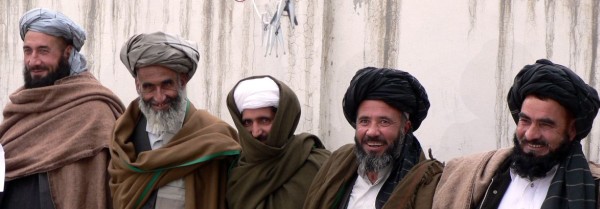
After 9/11, the Taliban leader, Mullah Omar, assembled a council of clerics to judge his claim that Mr. bin Laden was the country’s guest and could not be surrendered. The clerics countered that because a guest should not cause his host problems, Mr. bin Laden should leave. But instead of keeping pressure on the Taliban to resolve the issue in ways they could live with, the United States ridiculed their deliberation and bombed them into a closer alliance with Al Qaeda. Pakistani Pashtuns then offered to help out their Afghan brethren.

American-sponsored “reconciliation” efforts between the Afghan government and the Taliban may be fatally flawed if they include demands that Pashtun hill tribes give up their arms and support a Constitution that values Western-inspired rights and judicial institutions over traditions that have sustained the tribes against all enemies.

The secretary of state, Hillary Clinton, and the special envoy to the region, Richard Holbrooke, suggest that victory in Afghanistan is possible if the Taliban who pursue self-interest rather than ideology can be co-opted with material incentives. But as the veteran war reporter Jason Burke of The Observer of London told me: “Today, the logical thing for the Pashtun conservatives is to stop fighting and get rich through narcotics or Western aid, the latter being much lower risk. But many won’t sell out.”

Why? In part because outsiders who ignore local group dynamics tend to ride roughshod over values they don’t grasp. My research with colleagues on group conflict in India, Indonesia, Iran, Morocco, Pakistan and the Palestinian territories found that helping to improve lives materially does little to reduce support for violence, and can even increase it if people feel such help compromises their most cherished values.

The original alliance between the Taliban and Al Qaeda was largely one of convenience between a poverty-stricken national movement and a transnational cause that brought it material help. American pressure on Pakistan to attack the Taliban and Al Qaeda in their sanctuary gave birth to the Pakistani Taliban, who forged their own ties to Al Qaeda to fight the Pakistani state.

While some Taliban groups use the rhetoric of global jihad to inspire ranks or enlist foreign fighters, the Pakistani Taliban show no inclination to go after Western interests abroad. Their attacks, which have included at least three assaults near nuclear facilities, warrant concerted action — but in Pakistan, not in Afghanistan. As Mr. Sageman, the former C.I.A. officer, puts it: “There’s no Qaeda in Afghanistan and no Afghans in Qaeda.”

Pakistan has long preferred a policy of “respect for the independence and sentiment of the tribes” that was advised in 1908 by Lord Curzon, the British viceroy of India who established the North-West Frontier Province as a buffer zone to “conciliate and contain” the Pashtun hill tribes. In 1948, Pakistan’s founder, Muhammad Ali Jinnah, removed all troops from brigade level up in Waziristan and other tribal areas in a plan aptly called Operation Curzon.

The problem today is that Al Qaeda is prodding the Pakistani Taliban to hit state institutions in the hopes of provoking a full-scale invasion of the tribal areas by the Pakistani Army; the idea is that such an assault would rally the tribes to Al Qaeda’s cause and threaten the state. The United States has been pushing for exactly that sort of potentially disastrous action by Islamabad. [continued…]

Stretching out an ugly struggle

Many decades ago as a fledgling C.I.A. officer in the field, I was naïvely convinced that if the facts were reported back to Washington correctly, everything else would take care of itself in policymaking. The first loss of innocence comes with the harsh recognition that “all politics are local” and that overseas realities bear only a partial relationship to foreign-policy formulation back home.

So in looking at President Obama’s new policy directions for Afghanistan, what goes down in Washington politics far outweighs analyses of local conditions.

I had hoped that Obama would level with the American people that the war in Afghanistan is not being won, indeed is not winnable within any practicable framework. But such an admission — however accurate — would sign the political death warrant of a president to be portrayed as having snatched defeat out of the jaws of “victory.”

The “objective” situation in Afghanistan remains a mess. Senior commanders acknowledge that we are not now winning hearts and minds in Afghanistan; indeed, we never can, and certainly not at gunpoint. Most Pashtuns will never accept a U.S. plan for Afghanistan’s future. The non-Pashtuns — Tajiks, Uzbeks, Hazaras, etc. — naturally welcome any outside support in what is a virtual civil war.

America has inadvertently ended up choosing sides in this war. U.S. forces are perceived by large numbers of Afghans as an occupying army inflicting large civilian casualties. The struggle has now metastasized into Pakistan — with even higher stakes. [continued…]

Facebooktwittermail

YEAR IN REVIEW: Obama’s bloody re-election calculus

YEAR IN REVIEW: Obama’s bloody re-election calculus

Obama’s new “strategy” is no strategy at all. It is a cynical and politically motivated rehash of Iraq policy: Toss in a few more troops, throw together something resembling local security forces, buy off the enemies, and get the hell out before it all blows up. Even the dimmest bulb listening to the president’s speech could not have missed the obvious link between the withdrawal date for combat troops from Iraq (2010), the date for beginning troop reductions in Afghanistan (2011), and the domestic U.S. election cycle.

So we are faced with a conundrum. Obama is one of the most intelligent men ever to hold the U.S. presidency. But no intelligent person could really believe that adding 30,000 troops to Afghanistan, a country four times larger than Vietnam, for a year or two, following the same game plan that has resulted in dismal failure there for the past eight years, could possibly have any impact on the outcome of the conflict.

Arthur Conan Doyle’s character Sherlock Holmes used to say that “when you have eliminated the impossible, whatever remains, however improbable, must be the truth.” The only conclusion one can reach from the president’s speech, after eliminating the impossible, is that the administration has made a difficult but pragmatic decision: The war in Afghanistan is unwinnable, and the president’s second term and progressive domestic agenda cannot be sacrificed to a lost cause the way that President Lyndon B. Johnson’s was for Vietnam. The result of that calculation was what we heard on Dec. 1: platitudes about commitment and a just cause; historical amnesia; and a continuation of the exact same failed policies that got the United States into this mess back in 2001, concocted by the same ship of fools, many of whom are still providing remarkably bad advice to this administration. [continued…]

Facebooktwittermail

YEAR IN REVIEW: The European minaret-missile threat

YEAR IN REVIEW: The European minaret-missile threat

Bigotry is on the rise in “the westerly excrescence of the continent of Asia.”

That unpoetic but topographically-precise description of Europe comes from the Oxford archeologist, Barry Cunliffe.

Whenever voices declaring that European culture is under threat are at their most strident, it’s always worth remembering the actual nature of Europe’s physical form.

As a continent it is nothing more than a malleable contrivance with its ambiguous, historically shifting eastern edge. As a result, it is and always has been, an ethnic and cultural melting pot.

Thus the irony when Europe’s self-appointed protectors take a firm stand in the name of its defense: they so often lack a real appreciation for the very thing to which they have pledged their allegiance.

Why is it that the people who most easily become possessed by ideas about cultural purity are themselves so often culturally impoverished?

Because culture in its richness and complexity is not the real issue.

This is about how individuals respond to the other.

Does the unfamiliar prompt interest and curiosity?

Or does it provoke fear?

Fear in response to the other says more about the fearful than it says about the objects they fear.

The fear of the foreign is at its root a fear of becoming foreign. It is a fear of becoming a stranger in one’s own land.

* * *

In the latest outbreak of European xenophobia, the minaret has become a missile in a campaign to ban their construction — that is, the construction of minarets, not missiles.
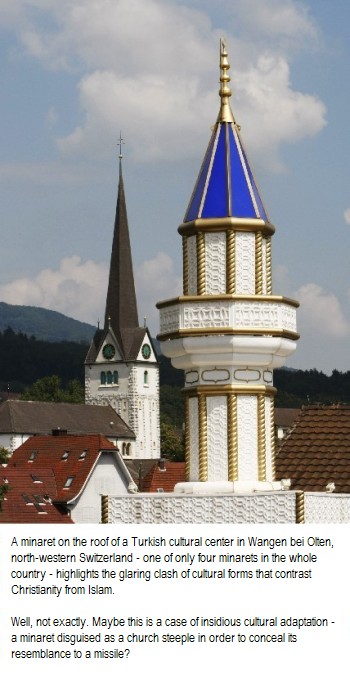
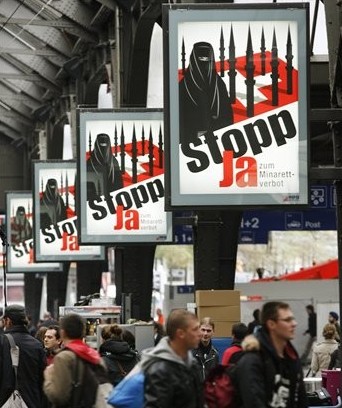
This is a curious iconic transformation. Is the Swiss People’s Party suggesting that Switzerland, in which currently there are only four minarets, is at risk of becoming a missile-minaret launching pad threatening the rest of Europe with Islamization? (After all, their posters depict missile-minarets ready for launch — not incoming missile-minarets about to explode.)

By Sunday it became apparent that Swiss voters had little interest in dissecting the visual absurdity of the campaign poster — a majority seemed to have bought the implicit message: Islam = violence, death and destruction.

The campaign’s final week of fear-mongering managed to raise support for the ban from 37% up to 57.5%, with passage in the majority of cantons meaning that a constitutional amendment will follow.

As The Guardian reported:

The controversial referendum on Sunday, accompanied by a prohibition campaign denounced as racist and in violation of human rights, is the latest tussle in Europe over the limits of multiculturalism and immigrant lifestyles.

Pushed by anti-immigrant rightwing populists, it has triggered months of debate in a country that uses direct democracy for single-issue politics. The referendum has turned into much more than a vote on architecture and urban planning.

“The minaret has got nothing to do with religion. It’s a symbol of political power, a prelude to the introduction of sharia law,” argued Ulrich Schlüer, of the rightwing Swiss People’s party, an architect of the campaign.

Two years ago the SPP became the strongest party in Switzerland, with an anti-immigrant election campaign that featured posters of three white sheep kicking a black sheep off a red and white Swiss flag. UN experts and human rights activists condemned the campaign as overtly racist.

This time the SPP has plastered the country with posters showing the same flag as a base for several black minarets, portrayed as missiles, alongside a woman clad in a black burqa. Church leaders, the Jewish community and Muslim leaders have all opposed the campaign. The foreign minister, Micheline Calmy-Rey, warned that a vote in favour risked turning Switzerland into “a target for Islamic terrorism”. The city of Basel and other towns have proscribed the incendiary posters.

Amnesty International said: “Freedom of religious belief is a basic human right and changing the Swiss constitution to ban the construction of minarets would clearly breach the rights of the country’s Muslims.”

UN human rights experts have said the proposed ban violates freedom of religion and liberty. The Swiss justice minister, Eveline Widmer-Schlumpf, has agreed, declaring that it would breach anti-discrimination laws and rights to free religious observance, raising the question of why the campaign has been allowed.

Tariq Ramadan, Switzerland’s most famous Muslim, suggests that what his country’s Muslim population is being told is that the only good Swiss Muslim is an invisible Muslim.

Ramadan was recently interviewed by the Swiss magazine, L’illustré, where Arnaud Bédat asked him to comment on the fears of his fellow citizens. (Translation by Rashed Chowdhury.)

Tariq Ramadan: One must respect the fear of ordinary citizens, while one also must resist in civic fashion populist parties which are instrumentalising fear in order to win elections. The majority of our fellow Swiss citizens are not racists: they are afraid and they would like to understand. Swiss people of the Muslim faith have a real responsibility to communicate and explain…. At the same time, one must refuse to allow populism to install itself. The problem is that the UDC [the Democratic Union of the Centre, another name for the Swiss People’s Party] initiative is using the symbol of the minaret to target Islam as a religion. I have had debates with Mr. Freysinger. [Oskar Freysinger is a parliamentarian in the Swiss People’s Party and a driving force in the campaign.] What does he say? That “Islam is not integratable into Swiss society.” So he says to me, to me, and I am Swiss like him, that “You are not a good Swiss person, you cannot be one, since your quality of being a Muslim prevents you from being a good Swiss person.” That is the foundation of the debate: the problem is Islam, not minarets.

Arnaud Bédat: But the minaret, you write so yourself, is not a pillar of Muslim faith.

TR: Yes, but is that a reason to say “Since it is not an obligation, you don’t need it”?… Does it have to be that the only good Swiss Muslim is an invisible Muslim? Is this the future of our pluralism and of our living together?

AB: Numerous Islamic countries forbid other religions on their territory — there are no churches or synagogues in Saudi Arabia, for example. Is it not ultimately logical that part of the West reject Islam on its territory?

TR: This is the oft-repeated argument of reciprocity. It is untenable. Respect for the rights and dignity of people is not a question of trade. It falls to us, to us in Switzerland, to preserve our principles of respect, and to not allow ourselves to be colonised by the unacceptable practices of other societies. Let us say first of all that it is wrong to say that religious minorities are always discriminated against in Muslim-majority societies. There are synagogues, churches and temples [there]. However, one should not deny the fact that discrimination and the denial of rights do occur, as in Saudi Arabia. One cannot hold Swiss citizens and residents of Muslim faith responsible for the actions of certain dictatorial governments from which they have often, by the way, fled for political or economic reasons. What one can expect from them [Swiss Muslims], nevertheless, from a moral point of view, is a denunciation of discrimination and ill treatment. That is something I do not stop doing, which has closed the doors of several countries, such as Saudi Arabia, to me.

AB: Do you dream, as you detractors claim, of a world that is entirely Muslim?

TR: No. I was born, have lived and have studied in Switzerland; my whole philosophical education comes from that. I have always believed that those who do not share my beliefs allow me to be more myself. The absolute power or uniformisation of a religion on earth would mean corruption and death. The worst that could happen to Muslims is if the whole world became Muslim! That is not even what God’s project is. There has to be diversity and difference. Because difference teaches us humility and respect.

To which I would add: The cultural ecosystem, or the ethnosphere as Wade Davis has named it, thrives on diversity.

Monoculture is inherently unstable because it lacks the strength that comes from constant adaptation necessitated by complexity and constant change.

Think about it. What would Europe be had it never been open to the influence of foreign cultures?

Christianity wasn’t born in Zurich — it came from the Middle East!

Facebooktwittermail

GAZA UPDATE

A taboo question for Israelis

There’s a question we Israelis won’t ask ourselves about the Palestinians, especially not about Gaza. The question is taboo. Not only won’t anyone ask it out loud, but very, very few people will dare ask it in the privacy of their own minds.

However, I think it’s time we start asking it, privately and in public. If we don’t, I think there’s going to be Operation Cast Lead II, then Operation Cast Lead III, and each one is going to be worse than the last, and the consequences for Palestinians and Israelis are going to be unimaginable.

The question we have to ask ourselves is this: If anybody treated us like we’re treating the people in Gaza, what would we do?

We don’t want to go there, do we? And because we don’t, we make it our business not to see, hear or think about how, indeed, we are treating the people in Gaza. [continued…]

Update from protests in Gaza and at the Erez checkpoint

Word from Gaza is that 6,000 marched — the maximum allowed by Hamas in absence of international shield — civil society march under Palestinian flag only. Govt felt march route too exposed and too narrow for more to march if Israeli attack was possible. [continued…]

Press release: Protesters are being brutalized in Tahir Square right now – 500+ protesters violently forced into pens, others barricaded in their hotels

From a Gaza Freedom March press release:

Members of the Gaza Freedom March are being forcibly detained in hotels around town (Lotus, Liala) as well as violently forced into pens in Tahir Square by Egyptian police and additional security forces. Reports of police brutality are flooding a delegate legal hotline faster than the legal support team can answer the calls. The reports span from women being kicked, beaten to the ground and dragged into pens, at least one confirmed account of broken ribs, and many left bloody. The assault is ongoing, legal team and other spokespeople can be reached at the Nile Hotel or by contacting the phone numbers listed above. [continued…]

Cairo meets the movement, with tears and chaos and exaltation

Today the Gaza Freedom March fragmented slightly when in the face of stern opposition from their fellows about 80 people headed off to Gaza on buses, the rest staying in Cairo.

But wait, weren’t you trying to go to Gaza? Yes, but it has been quite a drama. How to state this clearly…

Over the last week, as the international marchers arrived in Egypt, the Egyptian Foreign Ministry made it very clear that it did not want them going into Gaza, and it would arrest them short of that goal. But these 1400 are not tourists or milquetoasts, they are activists; and they were not going to be stopped by any old Ministry, even the ministry of a police state. Many set out by bus and taxi to the Sinai desert, while the 300 members of the French group camped out in front of the French Embassy across from the Cairo Zoo, demanding to go even as they were ringed by riot police. [continued…]

Facebooktwittermail

Report: US pressing Israel not to free Barghouti

Report: US pressing Israel not to free Barghouti

s the US trying to prevent the release of two senior prisoners whose freedom Hamas is demanding in return for Shalit? Palestinian sources have told the London-based Arabic-language al-Hayat newspaper that the United States has pressured Israel not to release Secretary-General of the Popular Front for the Liberation of Palestine Ahmed Saadat and former Fatah leader in the West Bank Marwan Barghouti.

There was also pressure not to release prisoners from east Jerusalem and Arab citizens of Israel, the report said.

The sources told the newspaper that Israel has gone back on agreements reached earlier regarding the deal aimed at securing the release of kidnapped IDF soldier Gilad Shalit. [continued…]

Facebooktwittermail

US Jewish community leaders favor bonehead approach with Iran

US Jewish community leaders don’t want to “try to become too smart” dealing with Iran

As anti-government protests — and government repression — flare in Iran, Jewish groups remain focused on the issue of nuclear proliferation there, prioritizing this problem over concern for the country’s opposition movement.

In interviews, Jewish leaders voiced sympathy for the cause of democracy backed by the protesters. But even as the administration is reportedly considering a shift to a strategy of narrow, targeted sanctions toward Iran — in part to take account of the surging protest movement — the Jewish community remains committed to more sweeping sanctions that Iran’s democracy activists decry as harmful to their cause.

The proliferation issue, Jewish activists say, should come first.

“For us, this was always the primary concern, because a nuclear Iran is an existential threat to Israel,” said Meagan Buren, director of research and training at The Israel Project, a pro-Israel group active on the Iranian issue. [continued…]

In the face of protests, Iran’s leaders are at an impasse

The mayhem that has swept over Iran in the past few days is once more calling into question the Islamic Republic’s longevity. Recent events are eerily reminiscent of the revolution that displaced the monarchy in 1979: A fragmented, illegitimate state led by cruel yet indecisive men is suddenly confronting an opposition movement that it cannot fully apprehend. It is premature to proclaim the immediate demise of the theocratic regime. Iran may well be entering a prolonged period of chaos and violence. In the aftermath of recent disturbances, however, it is obvious that the lifespan of the Islamic Republic has been considerably shortened.

In retrospect, the regime’s most momentous, and disastrous, decision was its refusal to offer any compromises to an angered nation after the fraudulent presidential election in June. The modest demands of establishment figures such as Ali Akbar Hashemi Rafsanjani, including for the release of political prisoners and restoring popular trust (via measures such as respecting the rule of law and opening up the media), was dismissed by an arrogant regime confident of its power.

Disillusioned elites and protesters who had taken to the streets could have been unified, or their resentment assuaged, by a pledge by Supreme Leader Ayatollah Ali Khamenei for the next election to be free and fair, for government to become more inclusive or for limits to be imposed on President Mahmoud Ahmadinejad’s prerogatives. Today, such concessions would be seen as a sign of weakness and would embolden the opposition. The regime no longer has a political path out of its predicament. Ironically, this was the shah’s dilemma, as he made concessions too late to fortify his power and broaden the social base of his government. [continued…]

Iran regime drums up its own crowds to oppose Green Movement

On Wednesday, the Islamic Republic of Iran reacted to last Sunday’s violent demonstrations by marshaling supporters in countrywide demonstrations and launching a media offensive against the opposition Green Movement.

At least 37 people were killed Sunday on the deadliest day of rioting since June’s disputed presidential election, which saw hard-line President Mahmoud Ahmadinejad returned to office amid widespread elections of fraud. For the first time, demonstrators switched from nonviolent tactics to engage the police with stones and batons. In response, the police fired tear-gas and bullets.

Government-funded newspapers lashed out Wednesday at the thousands of demonstrators who fought running battles with security forces during Shiite Islam’s major festival, labeling them “apostates” and calling for their “arrest and execution.” [continued…]

Regime wages a quiet war on ‘star students’ of Iran

Behind the drama unfolding in the streets of Iran, the regime is quietly clamping down on some of the nation’s best students by derailing their academic and professional careers.

On Wednesday, progovernment militia attacked and beat students at a school in northeastern Iran. Since last Sunday’s massive protests nationwide, dozens of university students have been arrested as part of an aggressive policy against what are known as Iran’s “star students.”

In most places, being a star means ranking top of the class, but in Iran it means your name appears on a list of students considered a threat by the intelligence ministry. It also means a partial or complete ban from education.

The term comes from the fact that some students have learned of their status by seeing stars printed next to their names on test results.

Mehrnoush Karimi, a 24-year-old law-school hopeful, found out in August that she was starred. She ranked 55 on this year’s national entrance exam for law schools, out of more than 70,000 test-takers. That score should have guaranteed her a seat at the school of her choice. Instead, the government told her she wouldn’t be attending law school due to her “star” status. [continued…]

Facebooktwittermail

Afghanistan suicide bombing kills 8 CIA officers

Afghanistan suicide bombing kills 8 CIA officers

A bomber slipped into a U.S. base in eastern Afghanistan on Wednesday and detonated a suicide vest, killing eight CIA officers in one of the deadliest days in the agency’s history, current and former U.S. officials said.

The attack took place at Forward Operating Base Chapman in Khowst province, an area near the border with Pakistan that is a hotbed of insurgent activity. An undisclosed number of civilians were wounded, the officials said. No military personnel with the U.S. or North Atlantic Treaty Organization forces were killed or injured, they said.

A U.S. official who spoke on condition of anonymity said the CIA had a major presence at the base, in part because of its strategic location. [continued…]

In year-end message, Taliban calls 2009 ‘successful’

In a written statement, the Taliban calls 2009 “a successful year for mujahedeen” and says it is determined to drive coalition forces out of Afghanistan in 2010.

“Last year the guerrilla warfare, frontline war, attacks and road mines against the invaders increased as the enemy began to cry out for reconciliation,” said the statement, obtained by CNN on Wednesday.

“The enemy does not have a constant policy,” the unsigned statement said. “Sometimes they talk about sending more soldiers and other times they speak of an early withdrawal. Their thinking is irrational.” [continued…]

Facebooktwittermail

Threats to Yemen prove America hasn’t learned the lesson of history

Threats to Yemen prove America hasn’t learned the lesson of history

We are the Awaleq

Born of bitterness

We are the nails that go into the rock

We are the sparks of hell

He who defies us will be burned

This is the tribal chant of the powerful Awaleq tribe of Yemen, in which they bid defiance to the world. Its angry tone conveys the flavour of Yemeni life and it should give pause to those in the US who blithely suggest greater American involvement in Yemen in the wake of the attempt to destroy a US plane by a Nigerian student who says he received training there.

Yemen has always been a dangerous place. Wonderfully beautiful, the mountainous north of the country is guerrilla paradise. The Yemenis are exceptionally hospitable, though this has its limits. For instance, the Kazam tribe east of Aden are generous to passing strangers, but deem the laws of hospitality to lapse when the stranger leaves their tribal territory, at which time he becomes “a good back to shoot at”.

The Awaleq and Kazam tribes are not exotic survivals on the margins of Yemeni society but are both politically important and influential. The strength of the central government in the capital, Sanaa, is limited and it generally avoids direct confrontations with tribal confederations, tribes, clans and powerful families. Almost everybody has a gun, usually at least an AK-47 assault rifle, but tribesmen often own heavier armament. [continued…]

Yemen ‘can handle al-Qaeda menace’

The Yemeni government has vowed to deal with the “menace of al-Qaeda in Yemen” after the group claimed responsibility for a plot to bring down an aircraft bound for the US city of Detroit on Christmas.

Saying his government would not authorise or co-operate with any potential US strike on its soil, Abdullah Alsaidi, Yemen’s permanent representative to the United Nations, told Al Jazeera that his country “is capable of taking care of its own problems”.

Alsaidi welcomed co-operation with and assistance from the US “with respect to intelligence information”, saying it was necessary to Yemen’s battle against al-Qaeda.

But he added that “we are not encouraging US attacks, we are saying that Yemen will take care of this problem on its own”. [continued…]

Facebooktwittermail