NEWS & VIEWS ROUNDUP & EDITOR’S COMMENTS: November 20

Judge orders five detainees freed from Guantánamo

In the first hearing on the government’s justification for holding detainees at the Guantánamo Bay detention camp, a federal judge ruled Thursday that five Algerian men were held unlawfully for nearly seven years and ordered their release.

The judge, Richard J. Leon of Federal District Court in Washington, also ruled that a sixth Algerian man was being lawfully detained because he had provided support to the terrorist group Al Qaeda.

The case was an important test of the Bush administration’s detention policies, which critics have long argued swept up innocent men and low-level foot soldiers along with high-level and hardened terrorists. [continued…]

Al Qaeda coldly acknowledges Obama victory

In a propaganda salvo by Al Qaeda aimed at undercutting the enthusiasm of Muslims worldwide about the American election, Osama bin Laden’s top deputy condemned President-elect Barack Obama as a “house Negro” who would continue a campaign against Islam that Al Qaeda’s leaders said was begun by President Bush.

Appealing to the “weak and oppressed” around the world, the Qaeda deputy, Ayman al-Zawahri, said in a video released Wednesday that the “new face” of America only masked a “heart full of hate.”

For years, the terrorist network sought to fuel anti-Americanism with prolific audio and video recordings vilifying President Bush as the leading American “crusader” against Muslim nations. The election of Mr. Obama, a black man who spent part of his childhood in Indonesia and whose father was from a Muslim family, has muddied Al Qaeda’s message. [continued…]

Editor’s Comment — So, the big story is that Ayman al-Zawahiri insulted Obama by calling him a “house negro.”

The best retort to that I’ve come across was from Mary Mitchell: “Obama isn’t going to the White House to serve the man. He is the man.”

But as everyone has glommed on to the race element in the al Qaeda missive, there’s another part that seemed to get missed: Zawahiri played the Muslim card straight down the GOP line.

He said of Obama:

    You were born to a Muslim father, but you chose to stand in the ranks of the enemies of the Muslims, and pray the prayer of the Jews, although you claim to be Christian, in order to climb the rungs of leadership in America.

Just as some scare-mongering Obama critics suggested, al Qaeda appears to be casting Obama as an apostate.

Hillary Clinton justifiably got jumped on when she said Obama was not a Muslim “as far as I know.” Zawahiri seems to be using an even more thinly-veiled insinuation when he says “you claim to be a Christian.” Likewise, Zawahiri compares Obama with Malcolm X not just to make an unfavorable contrast between one black leader and another but to imply that one was being a true Muslim and the other not. In other words, that Obama has betrayed both his race and his faith.

My guess is that Adam Pearlman had a hand in drafting this message, not simply because of the English subtitles but because in part it seems to have been aimed at those white Americans who still believe Obama is a secret Muslim.

Giving up on God

As Republicans sort out the reasons for their defeat, they likely will overlook or dismiss the gorilla in the pulpit.

Three little letters, great big problem: G-O-D.

I’m bathing in holy water as I type.

To be more specific, the evangelical, right-wing, oogedy-boogedy branch of the GOP is what ails the erstwhile conservative party and will continue to afflict and marginalize its constituents if reckoning doesn’t soon cometh.

Simply put: Armband religion is killing the Republican Party. And, the truth — as long as we’re setting ourselves free — is that if one were to eavesdrop on private conversations among the party intelligentsia, one would hear precisely that. [continued…]

Editor’s Comment — Even though I’m neither a Republican nor a Christian, I can’t resist pointing out that Kathleen Parker seems to have got it the wrong way around: the GOP doesn’t need to dump God; the evidence — at least if one accepts Rev Arnold Conrad’s impeccible reasoning — is that God already dumped the GOP.

“You raise up leaders and you pull them down,” Rev Conrad solemnly said to God while praying at a McCain rally in early October. No doubt Conrad has since pulled out that universal escape clause — God works in mysterious ways — but I’d like to know what he (Conrad, not God) is really thinking now.

O Lord, what made you make McCain pick Sarah Palin? And why couldn’t the financial crisis have come in November instead of September? You liked Bush well enough to get him elected twice, so why are you now casting us out into the wilderness? O Lord, why have you forsaken the GOP?

I guess the only council I can offer is to say, when it comes to politics, don’t bet your life on a swing voter — especially the ultimate swing voter. He’s clearly the most capricious of them all.

Did U.S. push detention of American without charges?

An American Muslim subjected to several years of intense FBI scrutiny and questioning about links to terrorism has been held without charges, access to a lawyer or contact with his family for nearly three months by the security services of the United Arab Emirates.

The case of Naji Hamdan, coupled with FBI interrogations of an American citizen secretly detained without charges in East Africa, raises the question of whether the Bush administration has asked other nations to hold Americans suspected of terrorism links whom U.S. officials lack the evidence to charge.

That allegation is central to a lawsuit that the American Civil Liberties Union was planning to file Tuesday in federal court in Washington against President Bush, Attorney General Michael Mukasey and FBI Director Robert Mueller.

“If the U.S. government is responsible for this detention and we believe it is, this is clearly illegal because our government can’t contract away the Constitution by enlisting the aid of other governments that do not adhere to the Constitution’s requirements,” said Ahilan Arulanantham of the ACLU’s southern California office. [continued…]

Iran said to have nuclear fuel for one weapon

Iran has now produced roughly enough nuclear material to make, with added purification, a single atom bomb, according to nuclear experts analyzing the latest report from global atomic inspectors.

The figures detailing Iran’s progress were contained in a routine update on Wednesday from the International Atomic Energy Agency, which has been conducting inspections of the country’s main nuclear plant at Natanz. The report concluded that as of early this month, Iran had made 630 kilograms, or about 1,390 pounds, of low-enriched uranium.

Several experts said that was enough for a bomb, but they cautioned that the milestone was mostly symbolic, because Iran would have to take additional steps. Not only would it have to breach its international agreements and kick out the inspectors, but it would also have to further purify the fuel and put it into a warhead design — a technical advance that Western experts are unsure Iran has yet achieved. [continued…]

Twenty reasons why we’re not consuming

This week’s news about October retail sales (-2.8% relative to the previous month and now down in real terms for five months in a row) confirm that the U.S. has entered its most severe consumer-led recession in decades. At this rate of free fall in consumption, real gross domestic product growth could be a whopping 5% negative or even worse in the fourth quarter of 2008. And this is not a temporary phenomenon: Almost all of the fundamentals driving consumption are heading south on a persistent and structural basis.

Consider the many severe negative factors affecting consumption. One can count at least 20 separate or complementary causes that will sharply reduce consumption in the next several years: [continued…]

The Pentagon’s argument of last resort on Iraq

It’s the ultimate argument, the final bastion against withdrawal, and over these last years, the Bush administration has made sure it would have plenty of heft. Ironically, its strength lies in the fact that it has nothing to do with the vicissitudes of Iraqi politics, the relative power of Shiites or Sunnis, the influence of Iran, or even the riptides of war. It really doesn’t matter what Iraqi Prime Minister Nouri al-Maliki or oppositional cleric Muqtada al-Sadr think about it. In fact, it’s an argument that has nothing to do with Iraq and everything to do with us, with the American way of war (and life), which makes it almost unassailable.

And this week Chairman of the Joint Chiefs Mike Mullen — the man President-elect Obama plans to call into the Oval Office as soon as he arrives — wheeled it into place and launched it like a missile aimed at the heart of Obama’s 16-month withdrawal plan for U.S. combat troops in Iraq. It may not sound like much, but believe me, it is. The Chairman simply said, “We have 150,000 troops in Iraq right now. We have lots of bases. We have an awful lot of equipment that’s there. And so we would have to look at all of that tied to, obviously, the conditions that are there, literally the security conditions… Clearly, we’d want to be able to do it safely.” Getting it all out safely, he estimated, would take at least “two to three years.” [continued…]

Facebooktwittermail

NEWS & VIEWS ROUNDUP: November 19

How the war on terror pushed Somalia into the arms of al-Qaeda

As President Bush prepares to leave office, the pundits will start to produce their balance sheets. It is hard to know what they will list under “achievements”, but easy to predict their “disasters”: Iraq, Afghanistan, economic meltdown, soaring debt and America’s loss of global stature.

One other debacle should feature prominently in that second column, but probably won’t because it has occurred in a faraway country that most Westerners know only through the film Black Hawk Down – or from recent reports of rampant piracy including the seizure early on Sunday of a Saudi tanker, carrying more than two million barrels of oil, which had an immediate effect on crude prices.

I am referring to the Bush Administration’s intervention in Somalia in the name of the War on Terror. It has helped to destroy that wretched country’s best chance of peace in a generation, left more than a million Somalis dead, homeless or starving, and achieved the precise opposite of its original goal. Far from stamping out an Islamic militancy that scarcely existed, the intervention has turned Somalia into a breeding ground for Islamic extremists and given al-Qaeda a valuable foothold in the Horn of Africa.

Rewind to the early summer of 2006. For 15 years, since the fall of the dictator Mohamed Siad Barre, feuding warlords had made Somalia a byword for anarchy and terrorism – the archetypal failed state. A tenth of its population had been killed. A million had fled abroad. At that point the warlords were finally routed, despite covert CIA backing, by a remarkable public uprising in support of the so-called Islamic Courts movement that promised to end the lawlessness.

Somalia had always practised a mild form of Islam, but the Courts received a bad press in the West, being widely portrayed as a new Taleban determined to impose the most draconian forms of Sharia on a terrified populace. That was certainly what I expected when I visited Mogadishu in early December 2006. But what I actually found was a people still celebrating the return of peace and security. [continued…]

The pirates of Somalia

A Chatham House report last month on the pirates of Somalia said: “At present it seems that scaling the high sides of large oil tankers is beyond their capabilities.” With the capture of the Saudi-owned supertanker Sirius Star this week it became clear that the pirates are rapidly extending their capabilities.

“Both the size of the vessel and the distance from the coast where the hijackers struck is unprecedented,” Commander Jane Campbell, a spokeswoman for the US Fifth Fleet, told The Guardian. “It shows how quickly the pirates are adapting.”

In the space of just five days this month the International Maritime Bureau recorded 11 incidents in the waters off Somalia and in the Gulf of Aden which involved ships coming under armed attacks including fire from rocket-propelled grenades. [continued…]

India ‘sinks Somali pirate ship’

An Indian navy warship has destroyed a suspected Somali pirate vessel after it came under attack in the Gulf of Aden….

The Indian navy said the Tabar spotted the pirate vessel while patrolling 285 nautical miles (528km) south-west of Salalah in Oman on Tuesday evening. The navy said the pirates on board were armed with guns and rocket propelled grenade launchers. When it demanded the vessel stop for investigation, the pirate ship responded by threatening to “blow up the naval warship if it closed on her”, the statement said. Pirates then fired on the Tabar, and the Indians say they retaliated and that there was an explosion on the pirate vessel, which sank. [continued…]

Obama’s cabinet candidates: Harvard rules and wisdom wanes

Americans seem mesmerized by the emerging list of potential cabinet members being interviewed for jobs. Brilliant! Assertive! “The Genius Cabinet” gushes Slate writer Jacob Weisberg. Larry Summers? Wow! Joel Klein? Whew!

Calm down, folks. What’s wanted in anyone’s cabinet is not brilliance but judgment. Not genius but wisdom. And the former is a lousy predictor of the latter. Like Summers and Klein, a number of the wannabes are arrogant and unlistening. Known for what they know and where they went to school (like Harvard and Yale).

Summers folded as Harvard’s President not because he said something politically incorrect about women (too baby-obsessed to be good scientists) or tried to tell one of America’s leading public intellectuals (Cornel West) how to be a “good” scholar, but because he was seen as dismissive of faculty, indifferent to contrarian ideas and unwilling to listen to others – traits he had shown during his tenure with the Clinton administration.

Joel Klein’s career as chief education honcho for New York City has been marked by a similar disrespect for teachers and parents, and a techno-corporate approach to education that, while putatively wedded to equal opportunity, has been completely tone-deaf to the communities he supposedly serves. He knows a lot and knows it. But he lacks elementary judgment.

President Obama will be in need of counselors with wisdom as well as smarts, and will quickly learn that arrogance isn’t merely a “defect of a superior mind” (as Weisberg puts it), but a form of deafness that incapacitates the hubristic for leadership. Oedipus was smart as they come, but, as I recall, made a terrible king. [continued…]

The end

To this day, the willingness of a Wall Street investment bank to pay me hundreds of thousands of dollars to dispense investment advice to grownups remains a mystery to me. I was 24 years old, with no experience of, or particular interest in, guessing which stocks and bonds would rise and which would fall. The essential function of Wall Street is to allocate capital—to decide who should get it and who should not. Believe me when I tell you that I hadn’t the first clue.

I’d never taken an accounting course, never run a business, never even had savings of my own to manage. I stumbled into a job at Salomon Brothers in 1985 and stumbled out much richer three years later, and even though I wrote a book about the experience, the whole thing still strikes me as preposterous—which is one of the reasons the money was so easy to walk away from. I figured the situation was unsustainable. Sooner rather than later, someone was going to identify me, along with a lot of people more or less like me, as a fraud. Sooner rather than later, there would come a Great Reckoning when Wall Street would wake up and hundreds if not thousands of young people like me, who had no business making huge bets with other people’s money, would be expelled from finance.

When I sat down to write my account of the experience in 1989—Liar’s Poker, it was called—it was in the spirit of a young man who thought he was getting out while the getting was good. I was merely scribbling down a message on my way out and stuffing it into a bottle for those who would pass through these parts in the far distant future.

Unless some insider got all of this down on paper, I figured, no future human would believe that it happened.

I thought I was writing a period piece about the 1980s in America. Not for a moment did I suspect that the financial 1980s would last two full decades longer or that the difference in degree between Wall Street and ordinary life would swell into a difference in kind. I expected readers of the future to be outraged that back in 1986, the C.E.O. of Salomon Brothers, John Gutfreund, was paid $3.1 million; I expected them to gape in horror when I reported that one of our traders, Howie Rubin, had moved to Merrill Lynch, where he lost $250 million; I assumed they’d be shocked to learn that a Wall Street C.E.O. had only the vaguest idea of the risks his traders were running. What I didn’t expect was that any future reader would look on my experience and say, “How quaint.” [continued…]

The perils of efficiency

This spring, disaster loomed in the global food market. Precipitous increases in the prices of staples like rice (up more than a hundred and fifty per cent in a few months) and maize provoked food riots, toppled governments, and threatened the lives of tens of millions. But the bursting of the commodity bubble eased those pressures, and food prices, while still high, have come well off the astronomical levels they hit in April. For Americans, the drop in commodity prices has put a few more bucks in people’s pockets; in much of the developing world, it may have saved many from actually starving. So did the global financial crisis solve the global food crisis?

Temporarily, perhaps. But the recent price drop doesn’t provide any long-term respite from the threat of food shortages or future price spikes. Nor has it reassured anyone about the health of the global agricultural system, which the crisis revealed as dangerously unstable. Four decades after the Green Revolution, and after waves of market reforms intended to transform agricultural production, we’re still having a hard time insuring that people simply get enough to eat, and we seem to be more vulnerable to supply shocks than ever.

It wasn’t supposed to be this way. Over the past two decades, countries around the world have moved away from their focus on “food security” and handed market forces a greater role in shaping agricultural policy. Before the nineteen-eighties, developing countries had so-called “agricultural marketing boards,” which would buy commodities from farmers at fixed prices (prices high enough to keep farmers farming), and then store them in strategic reserves that could be used in the event of bad harvests or soaring import prices. But in the eighties and nineties, often as part of structural-adjustment programs imposed by the I.M.F. or the World Bank, many marketing boards were eliminated or cut back, and grain reserves, deemed inefficient and unnecessary, were sold off. In the same way, structural-adjustment programs often did away with government investment in and subsidies to agriculture—most notably, subsidies for things like fertilizers and high-yield seeds.

The logic behind these reforms was simple: the market would allocate resources more efficiently than government, leading to greater productivity. Farmers, instead of growing subsidized maize and wheat at high cost, could concentrate on cash crops, like cashews and chocolate, and use the money they made to buy staple foods. If a country couldn’t compete in the global economy, production would migrate to countries that could. It was also assumed that, once governments stepped out of the way, private investment would flood into agriculture, boosting performance. And international aid seemed a more efficient way of relieving food crises than relying on countries to maintain surpluses and food-security programs, which are wasteful and costly. [continued…]

Premier of Iraq is quietly firing fraud monitors

The government of Prime Minister Nuri Kamal al-Maliki is systematically dismissing Iraqi oversight officials, who were installed to fight corruption in Iraqi ministries by order of the American occupation administration, which had hoped to bring Western standards of accountability to the notoriously opaque and graft-ridden bureaucracy here.

The dismissals, which were confirmed by senior Iraqi and American government officials on Sunday and Monday, have come as estimates of official Iraqi corruption have soared. One Iraqi former chief investigator recently testified before Congress that $13 billion in reconstruction funds from the United States had been lost to fraud, embezzlement, theft and waste by Iraqi government officials.

The moves have not been publicly announced by Mr. Maliki’s government, but word of them has begun to circulate through the layers of Iraqi bureaucracy as Parliament prepares to vote on a long-awaited security agreement. [continued…]

Israeli military intelligence chief: U.S. can halt Iran nuclear program with dialogue

Barack Obama’s election as U.S. president and the world financial crisis present an opportunity to halt the Iranian nuclear drive through diplomacy, Military Intelligence head Amos Yadlin said Monday.

Iran, for example, has been stung by lower global oil prices in recent months.

Obama’s election also sets the stage to apply international pressure on Iran to abandon its nuclear aspirations, Yadlin said. He stressed that he is not opposed to direct talks between the United States and Iran, saying that “dialogue is not appeasement.”

“Iran will do anything not to be cornered into the position of Iraq or North Korea,” he said at an annual lecture in honor of late Israel Defense Forces chief of staff Moshe Dayan. “Iran is also very susceptible to international pressure because of the crisis.” [continued…]

UN rights chief calls for end to Gaza blockade

The UN’s top human rights official has called on Israel to end its blockade of the Gaza Strip, saying it breaches humanitarian law.

UN High Commissioner for Human Rights Navi Pillay said in Geneva Tuesday that 1.5 million Palestinians “have been forcibly deprived of their most basic human rights for months” by the blockade.

She said that Israel should allow aid goods such as food, medicines and fuel into the Hamas-controlled territory and restore electricity and water supplies. [continued…]

Israeli tanks rumble into Gaza, raze farmlands

Israeli tanks pushed into the southern Gaza Strip on Tuesday, drawing mortar fire from Palestinian militants and intensifying violence that has chipped away at a tenuous cease-fire.

Israel and Gaza’s ruling Islamic militant Hamas movement have been trading fire for two weeks after nearly five months of relative quiet. The violence comes as the Egyptian-negotiated truce that began June 19 is due to expire next month, and both sides might be trying to dictate more favorable terms in anticipation of the agreement’s renewal.

Backed by a bulldozer and military jeep, the tanks rumbled about a quarter-mile into the tiny seaside strip, residents and Gaza security officials said. Residents said they leveled lands along the border east of the city of Rafah near the Egyptian border. [continued…]

Facebooktwittermail

NEWS & VIEWS ROUNDUP & EDITOR’S COMMENT: November 18

Is Obama a Middle East ‘splitter’?

Historians are sometimes divided into lumpers and splitters. The splitters like to chop problems up into lots of small bits. The lumpers like to link them altogether.

Would-be Middle East peacemakers can be categorised in the same way. The lumpers want a “comprehensive peace settlement” that links together all the problems in the region – Iraq, Lebanon, Syria, Israel-Palestine, even Iran. The splitters want to deal with all these problems separately….

I think, as a matter of practical politics, Mr Obama will have to be a splitter. The state of the American economy is going to eat up most of his working day. When he turns to foreign policy, the Israeli-Palestinian problem will come fairly low down his list of priorities – behind, in rough order of urgency, Iraq, Afghanistan, climate change, Iran, international economics and Russia. He will see the Iranian nuclear issue as too important to await progress on Israel-Palestine. Withdrawal from Iraq is a central pledge of his administration, regardless of what is happening with Israel. If an Obama administration sees chances to make progress on Lebanon, or with Syria, it will take them as they arise.

European diplomats who have dealt with the new American team say that they have been assured that Mr Obama does regard the Israel-Palestine problem as a priority and something that the new administration intends to start work on quickly. (It is generally held that President Bill Clinton left the Middle East peace process until too late in his second term and that this mistake has been repeated by President George W. Bush.) A “serious” commitment by Mr Obama need not mean launching immediately into an important global conference. Simply appointing a high-profile envoy would be regarded as a good earnest of intent.

Mr Obama may well oblige on the envoy front. But I doubt he will want to spend much political capital and time on the Middle East peace process when there are so many other priorities clamouring for his attention.

A decision to put the Israeli-Palestinian question on the back burner would, however, be a shame. That is not because it necessarily holds the key to solving all the other problems of the Middle East. It is because the situation – although relatively quiet at the moment – remains dangerous, unstable and a disaster for the population. Ignore the Palestinian problem when things are quiet and it is liable to force its way back on to the agenda – by blowing up at an even more inconvenient time. [continued…]

Top Obama aide denies report president-elect will back Arab peace plan

A senior adviser to Barack Obama on Sunday denied reports that the U.S. president-elect plans to throw his weight behind the 2002 Arab peace plan, which calls for Israel to withdraw from all territories captured during the 1967 Six-Day War in exchange for normalized ties with the Arab world.

The British Sunday Times said Obama expressed this sentiment during his visit to Israel and the Palestinian territories last July.

Dennis Ross, Obama’s adviser on Middle East policy, issued a statement Sunday, saying “I was in the meeting in Ramallah. Then-senator Obama did not say this, the story is false.” The Times cited a senior adviser who quoted Obama as telling Palestinian President Mahmoud Abbas: “The Israelis would be crazy not to accept this initiative. It would give them peace with the Muslim world from Indonesia to Morocco.”

According to the Times, Obama, who is due to take office as the U.S. president on January 20, has been urged by leading bipartisan figures in the American foreign policy establishment to embrace the plan, which was first proposed by Saudi King Abdullah in an interview with New York Times columnist Thomas Friedman. [continued…]

Editor’s Comment — The multipronged lobbying effort that is clearly underway right now is not necessarily aimed at trying to push the Middle East peace process to the top of Obama’s foreign policy agenda — a goal that would be unrealistic when Iraq and Afghanistan require so much attention. Rather, this seems like an attempt to grasp the opportunity to set aside Oslo, the Road Map, and Annapolis and reframe the peace process in terms of a comprehensive solution. In and of itself, this is a useful exercise because it implicitly acknowledges that the current process is dead without undiplomatically declaring its failure.

Hamas, Israel trying to rewrite truce

A June truce between Israel and Gaza’s Hamas rulers comes up for renewal next month and it looks like both sides are trying to dictate more favorable terms.

That would explain why Israel and Hamas have been trading rocket fire and air strikes for two weeks, even as they keep saying they’re interested in a continued cease-fire. But the attempt to establish new ground rules could easily spin out of control, especially if there are civilian casualties.

Domestic concerns further complicate the situation.

Israel is holding general elections Feb. 10 and the cross-border violence has become campaign fodder. [continued…]

When will Obama give up the Bin Laden ghost hunt?

In a talk to the Atlantic Council this week CIA Director Gen. Michael Hayden said Osama bin Laden is alive. I’ll take his word for it. But bin Laden’s strange disappearance makes one wonder what exactly happened to him. The last relatively reliable bin Laden sighting was in late 2001. A video that he appears in last year shows him with a dyed beard. More than a few Pakistani intelligence operatives who knew bin Laden scoff at the idea he would ever dye his beard. They think the tape was manipulated from old footage, and that bin Laden is in fact dead. But then again, they would have an interest in making us believe bin Laden is dead, since it would relieve American pressure to find him by any means necessary, including going into Pakistani territory.

And what about all the other audiotapes bin Laden has put out since 9/11? Experts will tell you that off-the shelf digital editing software could manipulate old bin Laden voice recordings to make it sound as if he were discussing current events. Finally, there’s the mystery why bin Laden didn’t pop up during the election. You would think a narcissistic mass murderer who believes he has a place in history would find it impossible to pass up an opportunity to give his opinion at such a momentous time, at least dropping off a DVD at the al Jazeera office in Islamabad.

I asked a half dozen of my former CIA colleagues who have been on bin Laden’s trail since 9/11. What surprised me was that none would say for certain whether he is alive or dead. Half assumed he is dead, the other half assumed he is alive. I suppose a lot of their timidity has to do with the still open wounds about the CIA’s missing an event like Saddam’s destruction of Iraq’s weapons of mass destruction. It would be so much easier to miss the death of a single man. [continued…]

Russia to cut oil export duty by third

Russia plans to cut its oil export duties by a third next month, offering much-needed relief to companies that have been making a loss on their crude exports.

Exporting oil from Russia, the world’s second biggest producer, has become unprofitable as a result of the fall in the price of crude and heavy taxation.

Oil companies had been warning they were being forced to cut their exports, intensifying the financial crisis engulfing Russia.

The Russian government has been calling on the companies to sustain their exports, and indicated on Monday that there would be a steep cut in oil duty to reflect the fall in oil prices. [continued…]

The tribal fallacy

The Pakistani government has flirted with divide-and-conquer tactics in the past by taking sides in internecine squabbles in the tribal areas. But rather than siding with tribes against the Taliban, Pakistan often tries to play one Taliban faction off another. It distinguishes between “good” and “bad” Taliban: the “good” ones focus on fighting U.S. and NATO forces in Afghanistan, and the “bad” ones target Pakistani troops and politicians. Baitullah Mehsud and Maulana Fazlullah of Tehrik-e-Taliban Pakistan are both “bad.” In April 2007, a mini-civil war in South Waziristan pitted “good” Taliban fighters from the Ahmadzai Wazir tribe, under the command of Maulvi Nazir, against several hundred “bad” Uzbek militants belonging to the Islamic Movement of Uzbekistan and to al-Qaeda. The Uzbeks had killed scores of Pakistani tribal chiefs. When the fighting began, the Pakistani army sided with the Taliban and provided helicopter- and artillery-fire. The ranking general later told me that he ordered soldiers to strip off their uniforms, don a shalwar kameez, and lead the “good” Taliban to victory. (The incident, while encouraging, highlighted the degree to which Washington and Islamabad’s security priorities are mismatched. Among the rash of recent drone attacks in the tribal areas, several missiles have targeted “good” Talib Maulvi Nazir and his associates in South Waziristan.)

Meanwhile, the Pakistanis have had little success enlisting ordinary tribesmen to rebel against the Taliban. Their failure should be worrying. Without the support of ordinary tribesmen in Iraq, the Anbar Awakening and the defeat of al-Qaeda in Iraq would have been unthinkable. The same holds true in northwestern Pakistan. Yet the Pashtun tribes have been understandably reluctant to join the government. During Musharraf’s regime, sporadic, overhyped military offensives failed to dislodge the Taliban, and any malik, or tribal chief, suspected of sympathizing with the government was branded a spy and slaughtered. Khalid Aziz, a former political agent in North Waziristan, told me that, in the past, “If a malik or his family was attacked, we used to do everything to redeem the malik’s honor. The current administration has unfortunately disowned these policies.” [continued…]

A pact with the devil

The big bang is not that Prime Minister Nuri al-Maliki’s majority Shi’ite/Kurdish 37-member cabinet in Baghdad has approved the draft of a security pact with the George W Bush (and Barack Obama) administrations allowing the US military to stay in Iraq for three more years; it’s that the 30-strong Sadrist bloc will move heaven and Earth – including massive nationwide protests – to bloc the pact in the Iraqi National Assembly.

The proposed Status of Forces Agreement not only sets a date for American troop withdrawal – 2011 – but also puts new restrictions on US combat operations in Iraq starting on January 1 and requires a military pullback from urban areas by June 30. The pact goes before parliament in a week or so.

Sadrist spokesman Ahmed al-Masoudi stressed this Sunday that the pact “did not mean anything” and “hands Iraq over on a golden platter and for an indefinite period”.

Masoudi is right on the money when he says the overwhelming majority of popular opinion is against it and the Sadrists and many Sunni parties insist a popular referendum to approve it is essential. [continued…]

Iraqi and American critics of security pact speak up

Iraqi and American critics of a security agreement governing American troops in Iraq voiced their objections on Monday, a day after the Iraqi cabinet approved the pact and sent it to Parliament for ratification.

In Iraq, opposition has created an unlikely association between the followers of the anti-American Shiite cleric Moktada al-Sadr, who rejected the agreement out of hand, and some Sunni politicians, including ones who support the deal but are trying to wrest concessions from the Iraqi government.

Ghufran al-Saadi, a Sadrist lawmaker, said opponents had collected 115 signatures, primarily from Sadr supporters and members of the Sunni Iraqi Islamic Party, demanding that Prime Minister Nuri Kamal al-Maliki and several cabinet members appear in Parliament to answer questions about the agreement, which governs the presence of American troops in Iraq through 2011. Parliament has 275 members. [continued…]

Government near to collapse, says Somalia leader

President Abdullahi Yusuf of Somalia has admitted that his government is on the verge of collapse and that Islamist groups now control most of the country.

In a speech to Somali MPs gathered in the Kenyan capital Nairobi at the weekend, Yusuf said that the government only had a presence in the capital Mogadishu and in Baidoa, “and people are being killed there every day. Islamists have taken over everywhere else.”

His frank admission confirms what is known but seldom publicly acknowledged by those with a stake in Somalia’s future, from Ethiopia, whose continued occupation unites the different Islamist groups against a common enemy, to the UN and western countries, which have backed the warlord-heavy government for years. [continued…]

Turkey could be good mediator with Iran: Erdogan

Turkish Prime Minister Recep Tayyip Erdogan said on Friday Ankara could play a positive part if it were to act as a mediator in the stalled negotiations with Iran over its suspect nuclear program.

“If Turkey plays such a role, it could have a positive impact on the process,” Erdogan told a press conference in Washington after arriving to take part in the summit of G20 leaders on the economic crisis.

He said Turkey would be able to exert some influence on the dragging dossier because it was Iran’s neighbor. [continued…]

Bill’s $500,000 Kuwait lecture

The National Bank of Kuwait (NBK) has paid $500,000 to Bill Clinton for a single lecture he delivered in Kuwait City on Sunday on his assessment of Barack Obama’s foreign and economic policies. It was delivered the day after the Kuwaiti stock market resumed trading after it was suspended by order of a Kuwaiti court on Thursday to avoid a total collapse.

Without mentioning reports that Clinton’s finances were coming under close scrutiny as his wife, Hillary Clinton, is being vetted for the job of secretary of state, the Arab-language Kuwaiti newspaper Awan published a front-page story under the headline “Clinton’s lecture at NBK cost $500,000.” [continued…]

Cabinet post for Clinton roils Obamaland

Barack Obama’s serious flirtation with his one-time rival, Hillary Clinton, over the post of secretary of State has been welcomed by everyone from Henry Kissinger to Bill Clinton as an effective, grand gesture by the president-elect.

It’s not playing quite as well, however, in some precincts of Obamaland. From his supporters on the progressive wing of the Democratic Party, to campaign aides of the soon-to-be commander-in-chief, there’s a sense of ambivalence about giving a top political plum to a woman they spent 18 months hammering as the compromised standard-bearer of an era that deserves to be forgotten.

“These are people who believe in this stuff more than Barack himself does,” said a Democrat close to Obama’s campaign. “These guys didn’t put together a campaign in order to turn the government over to the Clintons.” [continued…]

Facebooktwittermail

NEWS & VIEWS ROUNDUP & EDITOR’S COMMENT: November 17

Study finds ex-Guantanamo prisoners broken

The first extensive study of prisoners released from the U.S. detention center at Guantanamo Bay, Cuba, finds that many of them are physically and psychologically traumatized, debt-ridden and shunned in their communities as terrorist suspects.

“I’ve lost my property. I’ve lost my job. I’ve lost my will,” said an Afghan man, one of 62 former inmates in nine countries interviewed anonymously by UC Berkeley researchers for a newly released report.

Another man, jobless and destitute, said his family kicked him out after he returned, and his wife went to live with her relatives. “I have a plastic bag holding my belongings that I carry with me all the time,” he said. “And I sleep every night in a different mosque.”

The report, “Guantanamo and its Aftermath,” also found that two-thirds of former prisoners interviewed between July 2007 and July 2008 suffered from psychological problems, including nightmares, angry outbursts, withdrawal and depression. [continued…]

Obama on 60 Minutes


Watch CBS Videos Online

US acknowledges it held 12 juveniles at Guantanamo

The U.S. has revised its count of juveniles ever held at Guantanamo Bay to 12, up from the eight it reported in May to the United Nations, a Pentagon spokesman said Sunday.

The government has provided a corrected report to the U.N. committee on child rights, according to Navy Cmdr. Jeffrey Gordon. He said the U.S. did not intentionally misrepresent the number of detainees taken to the isolated Navy base in southeast Cuba before turning 18. [continued…]

Why Guantanamo must be closed: advice for Barack Obama

On Sunday, in his first television interview since winning the Presidential election, Barack Obama repeated his campaign pledge to close the prison at Guantánamo Bay and to ban the use of torture by US forces. Speaking on 60 Minutes, he explained, “I have said repeatedly that I intend to close Guantánamo, and I will follow through on that. I have said repeatedly that America doesn’t torture. And I’m going to make sure that we don’t torture. Those are part and parcel of an effort to regain America’s moral stature in the world.”

Ever since Obama began meeting with his transition team, leaks, gossip and rumors concerning the new administration’s plans to close Guantánamo, and the hurdles they will have to surmount, have been filling the airwaves and the front pages of newspapers. In an attempt to separate fact from fiction and to provide useful information to the President-Elect, I’d like to offer my advice, based on the three years I have spent studying Guantánamo in unprecedented detail, as the author of The Guantánamo Files, the first book to tell the stories of all the prisoners, and as a commentator and analyst responsible for numerous articles on Guantánamo in the last 18 months. [continued…]

The audacity of patience

The conventional wisdom about the presidency is very much the same as the advice Obama was given in the primaries: Move quickly. Overwhelm the forces of the establishment. Use the momentum of the election to achieve the biggest things possible. You’ll never be more powerful than on Jan. 21.

If Obama ignores this conventional wisdom, he will not do so because he’s crazy or lazy but because he’s taking the same approach to governing as he took to the election. It will mean he’s taking the long view, gambling on patience, and carefully putting into place the pieces that win lasting majorities for progressive policies, just as he won a majority of delegates and a majority of votes in the election.

On the day after the 2004 election, George W. Bush declared, “I earned capital in the campaign, political capital, and now I intend to spend it.” He announced that he would privatize Social Security and revamp the tax system by the following spring. In Bush’s version of the conventional wisdom, the presidency was a rapidly depreciating financial asset, and he had to act quickly.

But Bush was wrong. The error was fatal. The collapse of his own presidency, the Republican brand, and the McCain candidacy can be traced to that moment of macho strutting as surely as to the “Mission Accomplished” moment on the USS Abraham Lincoln. The fact was Bush had earned no political capital; he had no mandate for the policies he now intended to pursue. All he had won was the raw institutional power of the presidency and control of Congress. He pushed that power further than any president before him, including Richard Nixon. And in doing so, Bush found its limits. The institutional power of the presidency, combined with a compliant one-party Congress, can start wars, enrich predatory capitalism, and destroy long-established norms, but alone it cannot do what Karl Rove aspired to, which was to build a new and lasting political order. That work requires patience and diligence. [continued…]

The case for putting a Mideast peace agreement first

The list of crises facing Obama starts with the economic collapse, Iraq, and Afghanistan. But as he’s said, “A president has to be able to do more than one thing at a time.”

Immediate, high-profile engagement with Israel and the Palestinians would be the clearest proof to frustrated American allies in the Middle East and elsewhere in the world that the Bush years of American unilateralism are over. Reaching an agreement would end the tension between American support for Israel and maintaining warm ties with moderate Arab regimes. It would eliminate one of the main causes of anti-Western resentment in the Arab world, reducing the influence both of Iran and of radical Sunni Islamicists.

By acting quickly — addressing the issue before he formally takes office and perhaps in his inaugural address, and by visiting the region early next year — Obama can exploit the awe that his election inspires. A small example: The daily Ha’aretz, normally a frighteningly staid newspaper, covered its entire front page on Nov. 4 with a photo of Obama, one hand held high, facing what looked like a pillar of cloud in the distance, as if he were Moses leading the Israelites out of Egypt. The headline, in English, was “Yes We Can.” In January, Obama will still be a symbol of transformation. If he waits two or three years, he will be a shopworn president. [continued…]

Editor’s Comment — Anyone who read this article in The Sunday Times would conclude that the decision has already been made. The article opens:

    Barack Obama is to pursue an ambitious peace plan in the Middle East involving the recognition of Israel by the Arab world in exchange for its withdrawal to pre-1967 borders, according to sources close to America’s president-elect.
    Obama intends to throw his support behind a 2002 Saudi peace initiative endorsed by the Arab League and backed by Tzipi Livni, the Israeli foreign minister and leader of the ruling Kadima party.

Unfortunately, like a lot of the other headline-grapping reports that The Times comes up with, this seems like a case of reporting possibility as fact.

Tzipi Livni, far from doing what would genuinely be news — backing the Arab peace plan — on Sunday had this message for the incoming administration and its approach to the Middle East: “You don’t need now to do nothing dramatic about it. The situation is calm. We have these peace talks.”

Report suggests Obama press Israel over nuke program

The Middle East is in danger of accumulating large stocks of nuclear material over the next decade that could be used to produce over 1,700 nuclear bombs, a U.S. research center has projected in a newly released report.

The Institute for Science and International Security, headed by David Albright, one the world’s top experts on nuclear weapons and the prevention of nuclear proliferation, recently released its report urging president-elect Barack Obama to take a number of measures to avoid such an outcome, including convincing Israel to halt production of its nuclear weapons.

“The Obama administration should make a key priority of persuading Israel to join the negotiations for a universal, verified treaty that bans the production of plutonium and highly enriched uranium for nuclear explosives, commonly called the Fissile Material Cutoff Treaty (FMCT),” the institute argued. “As an interim step, the United States should press Israel to suspend any production of fissile material for nuclear weapons. Toward this goal, the United States should change its relatively new policy of seeking a cutoff treaty that does not include verification. The Bush administration’s rejection of the long-standing U.S. policy of requiring verification was a mistake that the incoming administration needs to rectify.” [continued…]

Hillary vetting includes look at Bill

President-elect Barack Obama’s advisers have begun reviewing former President Bill Clinton’s finances and activities to see whether they would preclude the appointment of his wife, Hillary Rodham Clinton, as secretary of state, Democrats close to the situation said Sunday. [continued…]

Depression 2009: What would it look like?

Over the past few months, Americans have been hearing the word “depression” with unfamiliar and alarming regularity. The financial crisis tearing through Wall Street is routinely described as the worst since the Great Depression, and the recession into which we are sinking looks deep enough, financial commentators warn, that a few poor policy decisions could put us in a depression of our own.

It’s a frightening possibility, but also in many ways an abstraction. The country has gone so long without a depression that it’s hard to know what it would be like to live through one.

Most of us, of course, think we know what a depression looks like. Open a history book and the images will be familiar: mobs at banks and lines at soup kitchens, stockbrokers in suits selling apples on the street, families piled with all their belongings into jalopies. Families scrimp on coffee and flour and sugar, rinsing off tinfoil to reuse it and re-mending their pants and dresses. A desperate government mobilizes legions of the unemployed to build bridges and airports, to blaze trails in national forests, to put on traveling plays and paint social-realist murals.

Today, however, whatever a depression would look like, that’s not it. We are separated from the 1930s by decades of profound economic, technological, and political change, and a modern landscape of scarcity would reflect that.

What, then, would we see instead? And how would we even know a depression had started? It’s not a topic that professional observers of the economy study much. And there’s no single answer, because there’s no one way a depression might unfold. But it’s nonetheless an important question to consider – there’s no way to make informed decisions about the present without understanding, in some detail, the worst-case scenario about the future. [continued…]

How to ground The Street

President-elect Barack Obama will soon face the extraordinary task of saving capitalism from its own excesses, much as Franklin D. Roosevelt had to do 76 years ago. Up until this point in the crisis, policymakers have appropriately applied the rules of triage — Band-Aids and tourniquets, then radical surgery — to keep the global financial system alive. Capital infusions, bailouts, mega-mergers, government guarantees of unimaginable proportions — all have been sought and supported by officials and corporate chief executives who had until now opposed any government participation in the marketplace. But put aside for the moment the ideological cartwheel we have seen and look at the big picture: The rules of modern capitalism have been re-written before our eyes.

The new president’s team must soon get to the root causes of the mistakes that have brought us to the economic precipice. Yes, we have all derided the explosion of leverage, the failure to regulate derivatives, the flood of subprime lending that was bound to default and the excesses of CEO compensation. But these are all mere manifestations of three deeper structural problems that require greater attention: misconceptions about what a “free market” really is, a continuing breakdown in corporate governance and an antiquated and incoherent federal financial regulatory framework.

First, we must confront head-on the pervasive misunderstanding of what constitutes a “free market.” For long stretches of the past 30 years, too many Americans fell prey to the ideology that a free market requires nearly complete deregulation of banks and other financial institutions and a government with a hands-off approach to enforcement. “We can regulate ourselves,” the mantra went. [continued…]

Karzai offers passage to Taliban leader for talks

Afghanistan’s president, Hamid Karzai, said Sunday that he would guarantee the safety of the Taliban leader Mullah Mohammad Omar if Mr. Omar agreed to negotiate for a peaceful settlement of the worsening conflict in the country.

Mr. Omar, a fugitive with a $10 million American bounty on his head, has been in hiding since the Taliban were toppled from power in 2001, and is believed by Western intelligence agencies to be living somewhere in the region of Quetta in western Pakistan. [continued…]

On the front line in war on Pakistan’s Taliban

Ali Hussein, a sergeant in the Sindh Regiment of the Pakistani Army, peers over the lip of his sandbagged machinegun pit to see the following: a muddy patch of farmland divided into a chaos of individual fields, a row of slender birch trees, a dry river valley and, almost invisible among the trees half a mile away, a village called Khusar. Over his head, shells screech through the air towards its half-dozen mud-walled houses.

A rocket-propelled grenade cracks out in solitary, futile response, leaving a trail of spiralling smoke in the chill dawn air. There is the continual crackle of small-arms fire, the distant thud of a mortar.

Khusar lies in Bajaur, a 500-square- mile jumble of valleys and hills high on Pakistan’s north-western border with Afghanistan. Few outside Pakistan had heard of Bajaur until recently. But now the fighting here – the biggest single clash of conventional forces and Islamic militants anywhere – is being watched closely around the globe.

The battle of Bajaur has huge local and international implications. Locally, it is a critical test for the new Pakistani civilian government of Asif Ali Zardari, the controversial widower of Benazir Bhutto. The recent bombing of the Marriott Hotel in Islamabad is thought to be a response to the Bajaur offensive. Regionally, the battle is a chance for the Pakistani Army to rebut allegations that it is dragging its feet in the fight against international extremism. Internationally, the fight is crucial for the 40-nation coalition fighting in Afghanistan. Not only will its result determine who controls the supply route that crosses the Khyber Pass just to its south – where militants hijacked a 60-vehicle Nato convoy last week – but it will also show if the semi-autonomous ‘tribal agencies’ that line the mountainous zones on the Pakistan side of the frontier can be stabilised. It is there that al-Qaeda and the Afghan Taliban leadership are hiding. Peace in Afghanistan will remain a distant prospect until the frontier is calmed. [continued…]

Operation enduring disaster

Afghanistan has been almost continuously at war for 30 years, longer than both World Wars and the American war in Vietnam combined. Each occupation of the country has mimicked its predecessor. A tiny interval between wars saw the imposition of a malignant social order, the Taliban, with the help of the Pakistani military and the late Benazir Bhutto, the prime minister who approved the Taliban takeover in Kabul.

Over the last two years, the U.S./NATO occupation of that country has run into serious military problems. Given a severe global economic crisis and the election of a new American president — a man separated in style, intellect, and temperament from his predecessor — the possibility of a serious discussion about an exit strategy from the Afghan disaster hovers on the horizon. The predicament the U.S. and its allies find themselves in is not an inescapable one, but a change in policy, if it is to matter, cannot be of the cosmetic variety.

Washington’s hawks will argue that, while bad, the military situation is, in fact, still salvageable. This may be technically accurate, but it would require the carpet-bombing of southern Afghanistan and parts of Pakistan, the destruction of scores of villages and small towns, the killing of untold numbers of Pashtuns and the dispatch to the region of at least 200,000 more troops with all their attendant equipment, air, and logistical support. The political consequences of such a course are so dire that even Dick Cheney, the closest thing to Dr. Strangelove that Washington has yet produced, has been uncharacteristically cautious when it comes to suggesting a military solution to the conflict. [continued…]

War on Taliban sparks refugee crisis

Hundreds of thousands of once prosperous Pakistani villagers are stranded in freezing tented refugee camps after being compelled to leave home by their own forces in a ferocious battle against the Taliban along the Afghan border.

Yesterday 300,000 Pakistani men, women and children, many of them driven from farms in the Bajaur region, were sheltering in eight makeshift camps on the outskirts of their nearest city, Peshawar. [continued…]

Pakistan and U.S. have tacit deal on airstrikes

The United States and Pakistan reached tacit agreement in September on a don’t-ask-don’t-tell policy that allows unmanned Predator aircraft to attack suspected terrorist targets in rugged western Pakistan, according to senior officials in both countries. In recent months, the U.S. drones have fired missiles at Pakistani soil at an average rate of once every four or five days.

The officials described the deal as one in which the U.S. government refuses to publicly acknowledge the attacks while Pakistan’s government continues to complain noisily about the politically sensitive strikes. [continued…]

The climate in Pakistan

About three weeks ago, militants in Pakistan delivered a copy of a Pashtu-language jihadi magazine called Tora Bora to the Peshawar office of the Daily Times, a newspaper, headquartered in Lahore, that is run by two friends of mine, a husband and wife team, Najam Sethi and Jugnu Mohsin. The magazine’s lead article, Jugnu wrote to me this week, lists five Pakistani journalists as “C.I.A. enemies of jihad,” and it exhorted readers to silence the offenders. Najam was first on the list; the others named included Ahmed Rashid, the intrepid journalist and chronicler of the Taliban, whose recent book, “Descent Into Chaos,” lays out a detailed history of the Taliban’s recent revival. Najam and Ahmed already live under police protection in Lahore, being recipients of repeated threats of this character. Some of the threats have come from vigilantes describing themselves as the “mujaheddin of Waziristan,” who have attached photographs of beheaded journalists to illustrate their warning letters. [continued…]

An African crisis for Obama

While world leaders gathered here to unleash soothing words on the financial tsunami swamping their economies, the daring “responsibility to protect” doctrine adopted by U.N. members three years ago was being buried in the killing fields of eastern Congo.

For the sake of your bank account, hope that the international community can protect dollars, euros and yen more successfully than it protects the lives and safety of people who happen to live in failed or rogue states.

In three years, “never again” has become “sorry about that.” Humanitarian intervention — proudly proclaimed as a universal mission by Bill Clinton, Tony Blair and other Third Way leaders and eventually adopted at the 2005 U.N. summit — has fallen into serious disrepair. [continued…]

Five million dead and counting

In the North Kivu province of eastern Congo, people are living in ditches along the sides of roads. They’re filling up the floors of churches and schools. Displaced people are surrounding the compounds of bewildered U.N. peacekeepers. Young boys and men are hiding in the forest to avoid being killed or forced into armed groups.

“There are only girls left in the schools in my village,” one 13-year-old boy told me. The day before, he and three friends had run from rebel soldiers who’d come to kidnap them.

There are now more than 1 million displaced people scattered throughout the province. In the last 10 years of fighting, more than 5 million people have died in the Congolese conflict—mostly civilians who haven’t had access to enough food or health care because of the fighting. And let’s be clear: That’s 5 million and counting. [continued…]

Congo’s riches, looted by renegade troops

Deep in the forest, high on a ridge stripped bare of trees and vines, the colonel sat atop his mountain of ore. In track pants and a T-shirt, he needed no uniform to prove he was a soldier, no epaulets to reveal his rank. Everyone here knows that Col. Samy Matumo, commander of a renegade brigade of army troops that controls this mineral-rich territory, is the master of every hilltop as far as the eye can see.

Columns of men, bent double under 110-pound sacks of tin ore, emerged from the colonel’s mine shaft. It had been carved hundreds of feet into the mountain with Iron Age tools powered by human sweat, muscle and bone. Porters carry the ore nearly 30 miles on their backs, a two-day trek through a mud-slicked maze to the nearest road and a world hungry for the laptops and other electronics that tin helps create, each man a link in a long global chain.

On paper, the exploration rights to this mine belong to a consortium of British and South African investors who say they will turn this perilous and exploitative operation into a safe, modern beacon of prosperity for Congo. But in practice, the consortium’s workers cannot even set foot on the mountain. Like a mafia, Colonel Matumo and his men extort, tax and appropriate at will, draining this vast operation, worth as much as $80 million a year.

The exploitation of this mountain is emblematic of the failure to right this sprawling African nation after many years of tyranny and war, and of the deadly role the country’s immense natural wealth has played in its misery. [continued…]

Iraq cabinet approves troop agreement with U.S.

Iraq’s cabinet today approved a security pact that calls for Americans to withdraw from the country within three years. That action sets up a final vote on the agreement in Iraq’s parliament.

Prime Minister Nouri al Maliki built political momentum for the agreement through the weekend, declaring his support and helping persuade leading Shiite Grand Ayatollah Ali al Sistani to give it the green light on Saturday.

Representatives of Maliki’s Dawa party framed the deal as a means to end America’s occupation of Iraq while phasing out the assistance coalition forces provide. He reportedly bargained for concessions late last week before endorsing it Friday.

The agreement faces an uncertain outlook in parliament. [continued…]

A new twist in Iraq’s Shi’ite power struggle

Eighteen months after the U.S. troop surge aimed at creating the security necessary for Iraqis to resolve their political conflicts, those political conflicts are threatening to become even more complicated. Besides the Arab-Kurd and Sunni-Shi’ite divides, there has long been a struggle among rival political parties for supremacy among the Shi’ites. Shi’ite Prime Minister Nouri al-Maliki recently called for amendments to Iraq’s constitution to strengthen the central government’s power at the expense of the country’s 18 provinces. This week, Maliki’s rivals in the southern Shi’ite bastion of Basra submitted a petition demanding a referendum in the oil-soaked province aimed to turning it into a semi-autonomous federal region akin to Kurdistan. [continued…]

Al-Sadr throws down the gauntlet on US-Iraq talks

The terms and timetable for a U.S. withdrawal from Iraq are as much a matter of politics in Baghdad as they are in Washington. As the Iraqi cabinet prepares for Sunday’s discussion of the vexing draft of the Status of Forces Agreement (SOFA), which provides a legal basis for U.S. military operations in Iraq after Dec. 31, firebrand Shi’ite cleric Muqtada al-Sadr on Friday threw down the gauntlet: he threatened to resume attacks against U.S. troops if they don’t leave Iraq “without retaining bases or signing agreements.” Al-Sadr’s unilateral cease-fire, declared more than a year ago, has been generally acknowledged as a key factor in tamping down violence in Iraq over the period, but it remains unclear whether his Mahdi Army militia has the means to make good on his threat. [continued…]

Holocaust’s unholy hold

Even today, when economic storms are shaking markets around the world, posing a threat to the stability of entire countries and societies, Israel continues to conduct its business far from the turmoil, as if swimming in a private ocean of its own. True, the headlines are alerting the public here about the crisis, and the politicians are hastily recalculating their budgets. But none of this is dramatically changing the way we think about ourselves.

To Israelis, these issues are mundane. What really matters here is the all-important spirit of Trauma, the true basis for so many of our country’s life principles. In Israel, the darkest period in human history is always present. Regardless of whether the question at hand is of the future relations between Israel and our Palestinian neighbors in specific and the Arab world in general, or of the Iranian atomic threat and Mahmoud Ahmadinejad, it always comes down to the same conversation. Every threat or grievance of major or minor importance is dealt with automatically by raising the biggest argument of them all — the Shoah — and from that moment onward, every discussion is disrupted.

The constant presence of the Shoah is like a buzz in my ear. In Israel, children are always, it seems, preparing for their rite-of-passage “Auschwitz trip” to Poland. Not a day passes without a mention of the Holocaust in the only newspaper I read, Haaretz. The Shoah is like a hole in the ozone layer: unseen yet present, abstract yet powerful. It’s more present in our lives than God.

It is the founding experience not just of our national consciousness but of more than that. Army generals discuss Israeli security doctrine as “Shoah-proof.” Politicians use it as a central argument for their ethical manipulations. [continued…]

Facebooktwittermail

EDITORIAL: Who comes first?

Who comes first?

The tribal areas of western Pakistan along with the least developed parts of southern and eastern Afghanistan have become the epicenter of international handwringing.

On one level, “the problem” revolves around government military forces being constrained by an international boundary, while their opponents can use that constraint to their advantage. On another level, there’s a struggle to find a suitable balance between bullying and helping as Nato pursues its bomb and build strategy.

The one constant is that no one seems to think that the indigenous population has the preeminent right to determine its own future.

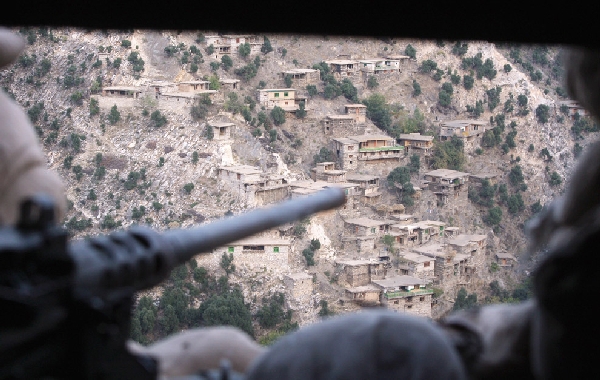
Consider the Korengal Valley in eastern Afghanistan and the people who inhabit this rugged terrain. A fascinating photographic essay in the Boston Globe last week sheds light on some of the inherent contradictions in western efforts to impose a military solution on a topographical reality.

Look at the human craft in the physical structure of this mountainside settlement — something that might not be immediately apparent when viewing this hamlet down the barrel of a gun:

Note, there are no roads. To the western eye, this is a development problem.

At the same time it is also an extraordinary indigenous accomplishment. Men and women and donkeys alone did all the heavy lifting. But instead of admiring the ability of people to master the art of survival in a challenging environment, we regard them as living in a state of deprivation. With a road, life would be better — or so we think.

But do they want a road? Apparently not. The report says: “U.S. and Afghan officers tried to convince the [Korengal Valley] elders to accept a new paved road through the Korengal Valley as part of a large American development project. The elders refused the road, however, saying that they would prohibit anyone in their valley from working on the project.”

What would a road provide for the people of Korengal? Most predictably, the means for Americans to establish larger and more heavily equipped military bases. Beyond that, a road would provide the means to tame a harsh environment. It would diminish the value of the resilience of those who for centuries have survived without a road.

Where a people invest their pride, we see their backwardness and then are perplexed when they spurn our goodwill. We suffer from the burden that dogs every evangelist: how can you insult someone and help them at the same time?

Meanwhile, the narrative that drives out all others is that Afghanistan is now in a downward spiral with the Talilban having established control over a substantial portion of the country.

Counterinsurgency expert, David Kilcullen, tells The New Yorker:

We have built the Afghan police into a less well-armed, less well-trained version of the Army and launched them into operations against the insurgents. Meanwhile, nobody is doing the job of actual policing—rule of law, keeping the population safe from all comers (including friendly fire and coalition operations), providing justice and dispute resolution, and civil and criminal law enforcement. As a consequence, the Taliban have stepped into this gap; they currently run thirteen law courts across the south, and ninety-five per cent of the work of these courts is civil law, property disputes, criminal matters, water and grazing disputes, inheritances etc.—basic governance things that the police and judiciary ought to be doing, but instead they’re out in the countryside chasing bad guys. Where governance does exist, it is seen as corrupt or exploitative, in many cases, whereas the people remember the Taliban as cruel but not as corrupt. They remember they felt safer back then. The Taliban are doing the things we ought to be doing because we are off chasing them instead of keeping our eye on the prize—securing and governing the people in a way that meets their needs.

Kilcullen could have said, “The Taliban have established law and order across much of southern Afghanistan. What can we learn from their success?”

Most importantly, in a war that was originally billed as being driven by a moral imperative, how has it come to pass that in this “good war” our allies are corrupt while our opponents are able to establish some system of justice?

To ask such a question is not to excuse the brutality of the Taliban, but merely underline how utterly lost we have become in a country and a region we insist on trying to reshape even while it still eludes our understanding.

Facebooktwittermail

NEWS & VIEWS ROUNDUP: November 16

Sadr calls for resistance to U.S. presence in Iraq

As the Iraqi cabinet prepares to vote on a security agreement for American troops, the anti-American Shiite cleric Moktada al-Sadr called Friday for armed resistance against any agreement that allowed a continued United States presence in Iraq.

“I repeat my demand to the occupier to leave our land without keeping bases or signing agreements,” Mr. Sadr said in a statement read to thousands of supporters at Friday Prayer. “If they keep bases, then I would support honorable resistance.”

Tension is rising here over the agreement as the vote nears, even if few oppose it to the extremes of Mr. Sadr and his followers. An aide to Grand Ayatollah Ali al-Sistani, the most revered Shiite cleric in Iraq, also indicated that he would intervene in some way if the draft did not enjoy the full support of the Iraqi people. But Ayatollah Sistani, who far outranks Mr. Sadr, has consistently advocated nonviolence. [continued…]

Maliki tells Bush he now backs new U.S. troop deal

After months of tough negotiations and multiple revisions, Prime Minister Nouri al Maliki has decided to back the controversial U.S.-Iraq security agreement that calls for the complete withdrawal of American troops by the end of 2011, Iraqi and U.S. officials said Friday.

Maliki informed President George W. Bush in the last 24 hours that he’s “satisfied” with what Iraqi officials now are calling the “withdrawal agreement,” a Bush administration official said in Washington. Earlier, Maliki informed the Iraqi Presidency Council that he’d back it, Sami al Askari, a Shiite Muslim legislator who’s close to the premier, said Friday.

At Maliki’s meeting with the Presidency Council last week, President Jalal Talabani and Shiite Vice President Adil Abdul Mehdi responded that they and their political blocs also supported the draft, but the Sunni Muslim vice president, Tariq al Hashimi, declined to give his endorsement, Askari said. [continued…]

Obama’s biggest Guantanamo dilemma may lie in Yemen

President-elect Barack Obama’s pledge to close the prison camp at Guantanamo Bay, Cuba, faces a major obstacle: Yemen.

The Bush administration has transferred hundreds of Guantanamo prisoners to the custody of their home countries, but it’s been unable to win assurances from Yemen — whose approximately 100 prisoners are the largest group still jailed at Guantanamo — that the men, if they’re returned, won’t pose a threat to the United States.

By striking similar deals with nations such as Afghanistan and Saudi Arabia, Bush administration officials have dramatically reduced Guantanamo’s population over the past three years. Yemen, however, which has failed to stop homegrown militants from staging major attacks on American targets in the past decade, says it can’t continue to hold prisoners without charges. [continued…]

Post-Guantánamo: a new detention law?

As a presidential candidate, Senator Barack Obama sketched the broad outlines of a plan to close the detention center at Guantánamo Bay, Cuba: try detainees in American courts and reject the Bush administration’s military commission system.

Now, as Mr. Obama moves closer to assuming responsibility for Guantánamo, his pledge to close the detention center is bringing to the fore thorny questions under consideration by his advisers. They include where Guantánamo’s detainees could be held in this country, how many might be sent home and a matter that people with ties to the Obama transition team say is worrying them most: What if some detainees are acquitted or cannot be prosecuted at all?

That concern is at the center of a debate among national security, human rights and legal experts that has intensified since the election. Even some liberals are arguing that to deal realistically with terrorism, the new administration should seek Congressional authority for preventive detention of terrorism suspects deemed too dangerous to release even if they cannot be successfully prosecuted. [continued…]

This endless savagery is the Congo’s colonial legacy

Western media like to describe the conflict in the Congo as Africa’s First World War. Certainly, five million people have died in the Congo since 1997 and as many as six African countries have been involved in its war, but there the similarities end.

The 1914-1918 war in Europe was fought between sovereign nation states; although the warring factions in the Congo bear the trappings of sovereignty, they are little more than self-serving warlord formations organised on ethnic or tribal lines, seeking to control territory to sustain themselves, and for profit. Civilians are as terrified of the “national” army supposedly fighting on their behalf as they are of the rebel “invaders,” having learnt that either side is capable of unleashing murder, rape and pillage.

There is no nation-state in eastern Congo beyond the rag-tag formations who fight in the name of the government in Kinshasa, when they’re not extorting money from civilians or collaborating on lucrative secret mining deals with some of the very “enemies” they’re meant to be fighting. The state provides no healthcare or education: the brave souls of the NGOs do their best to feed the hungry and extend lives that are usually nasty, brutish and short.

War is not just good for business in eastern Congo: war is business. For the warlord commanders, control of land means ownership of its resources – the gold, diamonds, coltan and other minerals for which mining companies are willing to pay anyone capable of delivering security. [continued…]

Facebooktwittermail

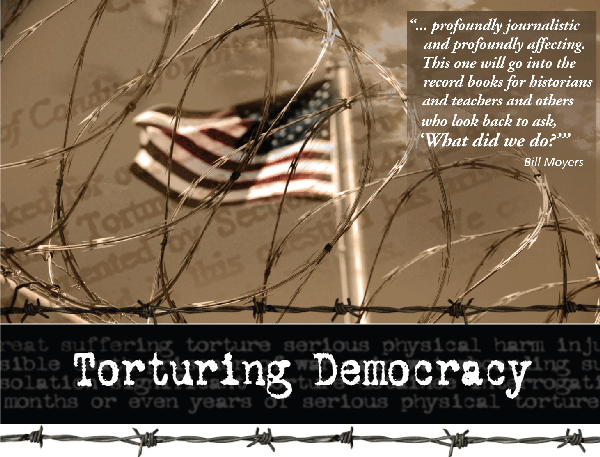
Torturing Democracy


Torturing Democracy, a major documentary film more than 18 months in the making, has been airing on individual public television stations around the US since October — although PBS has been reluctant to air it nationally.

The 90-minute film, from Emmy and DuPont awarding-winning producer Sherry Jones, relies on the documentary record to connect the dots in an investigation of interrogations of prisoners in U.S. custody that became “at a minimum, cruel and inhuman treatment and, at worst, torture,” in the words of the former general counsel of the United States Navy.

Up to date with the latest revelations, Torturing Democracy details how the government set aside the rule of law in its pursuit of harsh interrogations of suspected terrorists. It features in-depth interviews with numerous senior military and government officials.

Former Deputy Secretary of State Richard Armitage describes – for the first time on-camera – being waterboarded during military training before he was sent to Vietnam. When producer Jones asked Mr. Armitage if he considered waterboarding to be torture, he answered, “Absolutely. No question.” He added: “There is no question in my mind – there’s no question in any reasonable human being, that this is torture. I’m ashamed that we’re even having this discussion.”

Torturing Democracy can be viewed in three parts (part one, part two, part three).

Facebooktwittermail

NEWS & VIEWS ROUNDUP & EDITOR’S COMMENTS: November 14

The choice for Obama lies on the road to Jerusalem

[The Israeli-Palestinian conflict] is the issue that more than any other shapes attitudes in the [Middle East] towards the US. On almost everything else, probably the best the incoming president can hope for is to damp the fires. A deal between Israel and the Palestinians would change the game.

Yet here Mr Obama has promised least. True, he has made the right noises about throwing his authority behind a two-state solution. There is talk of the appointment of a special US envoy to take a permanent seat at the negotiating table. As yet, however, Mr Obama has given little sign that he is ready to invest the energy and political capital to broker a deal.

You can see why. The Annapolis process, the belated effort by the Bush administration to secure an accord, has gone nowhere slowly. This week the outgoing administration all but abandoned hopes of progress before Mr Bush leaves the White House.

Tony Blair, the United Nations’ special envoy to the region, displayed all his trademark optimism by insisting that a “platform” was in place for a final settlement. We have heard that one before.

The polls suggest that the Israeli elections are unlikely to deliver a coalition with the authority to strike a land-for-peace bargain with the Palestinians. Benjamin Netanyahu, the hawkish Likud leader, may emerge as prime minister. During his last spell in office Mr Netanyahu sought to derail the Oslo accords. I have heard it said that the one meeting that went badly during Mr Obama’s tour of the Middle East and Europe this year was his encounter with Mr Netanyahu.

For their part, the Palestinians remain divided in spite of the best efforts of Egyptian mediation. Hamas has so far refused to offer the recognition of Israel demanded by the international community. In the absence of a committed interlocutor on the Israeli side, it is hard to see what would prompt Fatah and Hamas to settle their differences.

So why should Mr Obama risk his reputation in such a cause? The answer comes in several parts.

The early years of his presidency will be his best, and quite possibly the last, chance to broker a two-state solution. Facts on the ground – demography, the West Bank barrier, Israeli settlements across swaths of the West Bank, Palestinian radicalism in Gaza – are steadily undermining the bargain that would give Israel security and the Palestinians a state.

For all the formidable obstacles to an agreement, Mr Obama’s heritage and the nature of his victory has bestowed as much authority among Israelis, Palestinians and in the wider Arab world as any US president can ever expect. This precious political capital will diminish over time.

A serious and even-handed effort to promote peace between Israel and the Palestinians would disarm the most serious charge against US policy in the region: that everything it does is rooted in double standards.

A deal would not settle all the problems and conflicts. Nor, of itself, would it repair the relationship between the west and much of the Islamic world. Al-Qaeda and its affiliates would find plenty of other reasons to attack America. Yet the creation of a Palestinian state would change profoundly the dynamics of the Middle East. It would make possible much that now seems beyond all reasonable reach.

Brokering such an accord would be tough and thankless. Mr Obama might well fail in the attempt. But there lies the existential choice for Mr Bush’s successor. Does he want to patch things up? Or does he want to redraw the strategic map of the Middle East and thereby set a new direction for America’s role in the world? That, in the final analysis, is what will mark out the difference between a competent and a transformational presidency. [continued…]

Settlers who long to leave the West Bank

Surrounded by hostility, living on land most of the world wants turned over to Palestinians for a state, they meet quietly in Jewish settlements like this one, plotting the future. But these besieged West Bank settlers, widely viewed as an obstacle to peace, want only one surprising thing: to get out.

While the vast majority of settlers vow never to abandon the heart of the historic Jewish homeland — these ancient and starkly beautiful hills whose biblical names are Judea and Samaria — thousands of other settlers say they want to move back to within the pre-1967 borders of Israel.

They say the West Bank settlement enterprise — at least that part beyond the barrier of wall and fence Israel has been building — is doomed and their lives are at risk. Many say something else as well: The Israeli occupation of land claimed by the Palestinians is wrong and they want no part of it. But their houses are worthless, and they are stuck. They want help. [continued…]

Islamists continue advance through Somalia

Islamist militias in Somalia on Thursday continued their steady and surprisingly uncontested march toward the capital, Mogadishu, capturing a small town on the outskirts of the city.

Several dozen Islamist fighters poured into Elasha Biyaha, which is 11 miles southwest of Mogadishu, after government-allied militias fled. No shots were fired, but residents feared it was only a matter of time.

“Many people are now on the verge of fleeing,” said Yusuf Abdi Nur, a shopkeeper in Elasha Biyaha.

The tense but bloodless capture of Elasha Biyaha was a carbon copy of what happened in Merka, a strategic port town, on Wednesday, when hundreds of heavily armed Islamist militants took over the town after government-allied troops beat a hasty retreat. [continued…]

Editor’s Comment — Somalia represents one of the most glaring failures of the war on terrorism. In the name of opposing terrorism, the Bush administration helped undermine the first sign of stability that had appeared in that grief stricken state in over a decade — the prospect of the end of civil war was of no inherent value in the eyes of Washington if Somalia’s government was going to be Islamist. But the result of opposing the Islamic Courts Union was to strengthen the more extreme wing, the Shabab.

Just before the election, Nicholas Kristof wrote in the New York Times:

    During the cold war, the American ideological fear of communism led us to mistake every muddle-headed leftist for a Soviet pawn. Our myopia helped lead to catastrophe in Vietnam.

    In the same way today, an exaggerated fear of “Islamofascism” elides a complex reality and leads us to overreact and damage our own interests. Perhaps the best example is one of the least-known failures in Bush administration foreign policy: Somalia.

    Today, Somalia is the world’s greatest humanitarian disaster, worse even than Darfur or Congo. The crisis has complex roots, and Somali warlords bear primary blame. But Bush administration paranoia about Islamic radicals contributed to the disaster.

    Somalia has been in chaos for many years, but in 2006 an umbrella movement called the Islamic Courts Union seemed close to uniting the country. The movement included both moderates and extremists, but it constituted the best hope for putting Somalia together again. Somalis were ecstatic at the prospect of having a functional government again.

    Bush administration officials, however, were aghast at the rise of an Islamist movement that they feared would be uncooperative in the war on terror. So they gave Ethiopia, a longtime rival in the region, the green light to invade, and Somalia’s best hope for peace collapsed.

    “A movement that looked as if it might end this long national nightmare was derailed, in part because of American and Ethiopian actions,” said Ken Menkhaus, a Somalia expert at Davidson College. As a result, Islamic militancy and anti-Americanism have surged, partly because Somalis blame Washington for the brutality of the Ethiopian occupiers.

    “There’s a level of anti-Americanism in Somalia today like nothing I’ve seen over the last 20 years,” Professor Menkhaus said. “Somalis are furious with us for backing the Ethiopian intervention and occupation, provoking this huge humanitarian crisis.”

    Patrick Duplat, an expert on Somalia at Refugees International, the Washington-based advocacy group, says that during his last visit to Somalia, earlier this year, a local mosque was calling for jihad against America — something he had never heard when he lived peacefully in Somalia during the rise of the Islamic Courts Union.

    “The situation has dramatically taken a turn for the worse,” he said. “The U.S. chose a very confrontational route early on. Who knows what would have happened if the U.S. had reached out to moderates? But that might have averted the disaster we’re in today.”

    The greatest catastrophe is the one endured by ordinary Somalis who now must watch their children starve. But America’s own strategic interests have also been gravely damaged.

    The only winner has been Islamic militancy. That’s probably the core reason why Al Qaeda militants prefer a McCain presidency: four more years of blindness to nuance in the Muslim world would be a tragedy for Americans and virtually everyone else, but a boon for radical groups trying to recruit suicide bombers.

CIA chief says Qaeda is extending its reach

Even as Al Qaeda strengthens its hub in the Pakistani mountains, its leaders are building closer ties to regional militant groups in order to launch attacks in Africa and Europe and on the Arabian Peninsula, the director of the Central Intelligence Agency said Thursday.

The director, Michael V. Hayden, identified North Africa and Somalia as places where Qaeda leaders were using partnerships to establish new bases. Elsewhere, Mr. Hayden said, Al Qaeda was “strengthening” in Yemen, and he added that veterans of the fighting in Iraq and Afghanistan had moved there, possibly to stage attacks against the government of Saudi Arabia.

He said the “bleed out” from the wars in Iraq and Afghanistan also extended to North Africa, raising concern that the countries there could be used to stage attacks into Europe. Mr. Hayden delivered his report in a speech to the Atlantic Council of the United States in Washington, and it offered a mixed assessment of Al Qaeda’s ability to wage a global jihad.

He drew a contrast between what he described as growing Islamic radicalism in places like Somalia and what he said had been the “strategic defeat” of Al Qaeda in Mesopotamia — the network’s affiliate group in Iraq. [continued…]

Editor’s Comment — Al Qaeda is as strong as the policies of the Bush administration helped make it. If Hayden had not been such a willing party to the administration’s strategic and tactical mistakes he might now have the honesty and humility to acknowledge that America will soon be free from the threat posed by its greatest security liability — the current administration. And had the director of the CIA a broader mind he might also acknowledge that the threats posed to America by climate change and economic turmoil, dwarf those posed by a few thousand violent fundamentalists.

The worst is not behind us

It is useful, at this juncture, to stand back and survey the economic landscape–both as it is now, and as it has been in recent months. So here is a summary of many of the points that I have made for the last few months on the outlook for the U.S. and global economy, as well as for financial markets:

–The U.S. will experience its most severe recession since World War II, much worse and longer and deeper than even the 1974-1975 and 1980-1982 recessions. The recession will continue until at least the end of 2009 for a cumulative gross domestic product drop of over 4%; the unemployment rate will likely reach 9%. The U.S. consumer is shopped-out, saving less and debt-burdened: This will be the worst consumer recession in decades.

–The prospect of a short and shallow six- to eight-month V-shaped recession is out of the window; a U-shaped 18- to 24-month recession is now a certainty, and the probability of a worse, multi-year L-shaped recession (as in Japan in the 1990s) is still small but rising. Even if the economy were to exit a recession by the end of 2009, the recovery could be so weak because of the impairment of the financial system and the credit mechanism that it may feel like a recession even if the economy is technically out of the recession.

–Obama will inherit an economic and financial mess worse than anything the U.S. has faced in decades: the most severe recession in 50 years; the worst financial and banking crisis since the Great Depression; a ballooning fiscal deficit that may be as high as a trillion dollars in 2009 and 2010; a huge current account deficit; a financial system that is in a severe crisis and where deleveraging is still occurring at a very rapid pace, thus causing a worsening of the credit crunch; a household sector where millions of households are insolvent, into negative equity territory and on the verge of losing their homes; a serious risk of deflation as the slack in goods, labor and commodity markets becomes deeper; the risk that we will end in a deflationary liquidity trap as the Fed is fast approaching the zero-bound constraint for the Fed funds rate; the risk of a severe debt deflation as the real value of nominal liabilities will rise, given price deflation, while the value of financial assets is still plunging. [continued…]

Depression economics returns

The economic news, in case you haven’t noticed, keeps getting worse. Bad as it is, however, I don’t expect another Great Depression. In fact, we probably won’t see the unemployment rate match its post-Depression peak of 10.7 percent, reached in 1982 (although I wish I was sure about that).

We are already, however, well into the realm of what I call depression economics. By that I mean a state of affairs like that of the 1930s in which the usual tools of economic policy — above all, the Federal Reserve’s ability to pump up the economy by cutting interest rates — have lost all traction. When depression economics prevails, the usual rules of economic policy no longer apply: virtue becomes vice, caution is risky and prudence is folly….

To pull us out of this downward spiral, the federal government will have to provide economic stimulus in the form of higher spending and greater aid to those in distress — and the stimulus plan won’t come soon enough or be strong enough unless politicians and economic officials are able to transcend several conventional prejudices.

One of these prejudices is the fear of red ink. In normal times, it’s good to worry about the budget deficit — and fiscal responsibility is a virtue we’ll need to relearn as soon as this crisis is past. When depression economics prevails, however, this virtue becomes a vice. F.D.R.’s premature attempt to balance the budget in 1937 almost destroyed the New Deal.

Another prejudice is the belief that policy should move cautiously. In normal times, this makes sense: you shouldn’t make big changes in policy until it’s clear they’re needed. Under current conditions, however, caution is risky, because big changes for the worse are already happening, and any delay in acting raises the chance of a deeper economic disaster. The policy response should be as well-crafted as possible, but time is of the essence.

Finally, in normal times modesty and prudence in policy goals are good things. Under current conditions, however, it’s much better to err on the side of doing too much than on the side of doing too little. The risk, if the stimulus plan turns out to be more than needed, is that the economy might overheat, leading to inflation — but the Federal Reserve can always head off that threat by raising interest rates. On the other hand, if the stimulus plan is too small there’s nothing the Fed can do to make up for the shortfall. So when depression economics prevails, prudence is folly. [continued…]

Facebooktwittermail

NEWS & VIEWS ROUNDUP & EDITOR’S COMMENT: November 13

Obama on faith

BARACK OBAMA:
Alongside my own deep personal faith, I am a follower, as well, of our civic religion. I am a big believer in the separation of church and state. I am a big believer in our constitutional structure. I mean, I’m a law professor at the University of Chicago teaching constitutional law. I am a great admirer of our founding charter, and its resolve to prevent theocracies from forming, and its resolve to prevent disruptive strains of fundamentalism from taking root ion this country.

As I said before, in my own public policy, I’m very suspicious of religious certainty expressing itself in politics.

Now, that’s different form a belief that values have to inform our public policy. I think it’s perfectly consistent to say that I want my government to be operating for all faiths and all peoples, including atheists and agnostics, while also insisting that there are values that inform my politics that are appropriate to talk about.

A standard line in my stump speech during this campaign is that my politics are informed by a belief that we’re all connected. That if there’s a child on the South Side of Chicago that can’t read, that makes a difference in my life even if it’s not my own child. If there’s a senior citizen in downstate Illinois that’s struggling to pay for their medicine and having to chose between medicine and the rent, that makes my life poorer even if it’s not my grandparent. And if there’s an Arab American family that’s being rounded up by John Ashcroft without the benefit of due process, that threatens my civil liberties.

I can give religious expression to that. I am my brother’s keeper, I am my sister’s keeper, we are all children of God. Or I can express it in secular terms. But the basic premise remains the same. I think sometimes Democrats have made the mistake of shying away from a conversation about values for fear that they sacrifice the important value of tolerance. And I don’t think those two things are mutually exclusive.

FALSANI:
Do you think it’s wrong for people to want to know about a civic leader’s spirituality?

OBAMA:
I don’t’ think it’s wrong. I think that political leaders are subject to all sorts of vetting by the public, and this can be a component of that.

I think that I am disturbed by, let me put it this way: I think there is an enormous danger on the part of public figures to rationalize or justify their actions by claiming God’s mandate.

I think there is this tendency that I don’t think is healthy for public figures to wear religion on their sleeve as a means to insulate themselves from criticism, or dialogue with people who disagree with them.

FALSANI:
The conversation stopper, when you say you’re a Christian and leave it at that.

OBAMA:
Where do you move forward with that?

This is something that I’m sure I’d have serious debates with my fellow Christians about. I think that the difficult thing about any religion, including Christianity, is that at some level there is a call to evangelize and proselytize. There’s the belief, certainly in some quarters, that people haven’t embraced Jesus Christ as their personal savior that they’re going to hell.

FALSANI:
You don’t believe that?

OBAMA:
I find it hard to believe that my God would consign four-fifths of the world to hell.

I can’t imagine that my God would allow some little Hindu kid in India who never interacts with the Christian faith to somehow burn for all eternity.

That’s just not part of my religious makeup. [continued…]

Obama’s plans for probing Bush torture

With growing talk in Washington that President Bush may be considering an unprecedented “blanket pardon” for people involved in his administration’s brutal interrogation policies, advisors to Barack Obama are pressing ahead with plans for a nonpartisan commission to investigate alleged abuses under Bush.

The Obama plan, first revealed by Salon in August, would emphasize fact-finding investigation over prosecution. It is gaining currency in Washington as Obama advisors begin to coordinate with Democrats in Congress on the proposal. The plan would not rule out future prosecutions, but would delay a decision on that matter until all essential facts can be unearthed. Between the time necessary for the investigative process and the daunting array of policy problems Obama will face upon taking office, any decision on prosecutions probably would not come until a second Obama presidential term, should there be one.

The proposed commission — similar in thrust to a Democratic investigation proposal first uncovered by Salon in July — would examine a broad scope of activities, including detention, torture and extraordinary rendition, the practice of snatching suspected terrorists off the street and whisking them off to a third country for abusive interrogations. The commission might also pry into the claims by the White House — widely rejected by experienced interrogators — that abusive interrogations are an effective and necessary intelligence tool. [continued…]

Editor’s Comment — If Bush grants a blanket preemptive pardon to everyone who might have committed a crime while conducting the war on terrorism, all well and good. The truth is worth more than convictions and having been pardoned, the guilty will not be able to hide behind the Fifth Amendment when they are called to testify.

When the vice president alerted this nation to the fact that it’s government would move to “the dark side,” everyone who said, “OK, we’ve got to do what we’ve got to do,” became complicit. Dick Cheney, John Yoo and David Addington might have been the leading criminal conspirators, but everyone who felt safer not knowing what was being done in their name needs to understand that America as a nation — not just those at the top — has been stained by the crimes of the war on terrorism.

An independent public inquiry needs to be conducted and those questioned should not just include the principals inside the Bush administration, but also those members of Congress who were briefed about interrogation procedures, along with the tortured, the torturers, guards, medical and legal counselors. The goal should not be to hold individuals with ultimate responsibility but rather to expose in all its intricacy the web of complicity.

In this matter, a sense of collective responsibility will be of greater political consequence and more lasting value to society, than the satisfaction that so many of us would feel if we were to see Cheney and his cohorts thrown in jail.

Bush, out of office, could oppose inquiries

When a Congressional committee subpoenaed Harry S. Truman in 1953, nearly a year after he left office, he made a startling claim: Even though he was no longer president, the Constitution still empowered him to block subpoenas.

“If the doctrine of separation of powers and the independence of the presidency is to have any validity at all, it must be equally applicable to a president after his term of office has expired,” Truman wrote to the committee.

Congress backed down, establishing a precedent suggesting that former presidents wield lingering powers to keep matters from their administration secret. Now, as Congressional Democrats prepare to move forward with investigations of the Bush administration, they wonder whether that claim may be invoked again.

“The Bush administration overstepped in its exertion of executive privilege, and may very well try to continue to shield information from the American people after it leaves office,” said Senator Sheldon Whitehouse, Democrat of Rhode Island, who sits on two committees, Judiciary and Intelligence, that are examining aspects of Mr. Bush’s policies. [continued…]

Facebooktwittermail

NEWS & VIEWS ROUNDUP: November 12

Don’t let Barack Obama break your heart

If Iraq remains a sorry tale of American destruction and dysfunction without, as yet, a discernable end in sight, Afghanistan may prove Iraq squared. And there, candidate Obama expressed no desire to wind the war down and withdraw American troops. Quite the opposite, during the election campaign he plunked hard for escalation, something our NATO allies are sure not to be too enthusiastic about. According to the Obama plan, many more American troops (if available, itself an open question) are to be poured into the country in what would essentially be a massive “surge strategy” by yet another occupant of the Oval Office. Assumedly, the new Afghan policy would be aided and abetted by those CIA-run UAVs directed toward Pakistan to hunt down Osama bin Laden and pals, while undoubtedly further destabilizing a shaky ally.

When it comes to rising civilian casualties from U.S. air strikes in their countries, both Afghan President Hamid Karzai and Pakistani President Asif Ali Zardari have already used their congratulatory phone calls to President-elect Obama to plead for an end to the attacks, which produce both a profusion of dead bodies and a profusion of live, vengeful enemies. Both have done the same with the Bush administration, Karzai to the point of tears.

The U.S. military argues that the use of air power is necessary in the face of a spreading, ever more dangerous, Taliban insurgency largely because there are too few boots on the ground. (“If we got more boots on the ground, we would not have to rely as much on airstrikes” was the way Army Brig. Gen. Michael Tucker, deputy commander of NATO forces in Afghanistan, put it.) But rest assured, as the boots multiply on increasingly hostile ground, the military will discover it needs more, not less, air power to back more troops in more trouble.

So, after January 20th, expect Obama to take possession of George Bush’s disastrous Afghan War; and unless he is far more skilled than Alexander the Great, British empire builders, and the Russians, his war, too, will continue to rage without ever becoming a raging success. [continued…]

Guantanamo closure called Obama priority

The Obama administration will launch a review of the classified files of the approximately 250 detainees at Guantanamo Bay immediately after taking office, as part of an intensive effort to close the U.S. prison in Cuba, according to people who advised the campaign on detainee issues.

Announcing the closure of the controversial detention facility would be among the most potent signals the incoming administration could send of its sharp break with the Bush era, according to the advisers, who spoke on the condition of anonymity because they are not authorized to speak for the president-elect. They believe the move would create a global wave of diplomatic and popular goodwill that could accelerate the transfer of some detainees to other countries.

But the advisers, as well as outside national security and legal experts, said the new administration will face a thicket of legal, diplomatic, political and logistical challenges to closing the prison and prosecuting the most serious offenders in the United States — an effort that could take many months or longer. Among the thorniest issues will be how to build effective cases without using evidence obtained by torture, an issue that attorneys for the detainees will almost certainly seek to exploit. [continued…]

Battle in Bush administration over interrogation techniques

As the clock runs down on the Bush administration, moderates within the government are mounting what may be one last drive to roll back many of the harsh detention and interrogation policies pushed through by Vice President Dick Cheney.

The effort, led by officials at the State Department, represents the latest battle in a war between hard-liners and moderates that has raged though most of the Bush administration.

In the early years of George W. Bush’s presidency, Cheney and his allies won most of the internal contests over the Guantanamo Bay prison, the CIA’s interrogation program, domestic spying, military commissions and other contentious issues.

But internal critics — including the State Department’s legal advisor, John B. Bellinger III — fought against those efforts. Buoyed by congressional action and court rulings, the moderates in recent years have helped break down administration resistance to international agreements and standards. The latest push underscores how deeply unpopular the most hawkish White House stances have proved to be even within the administration itself. [continued…]

Obama will have to go where no other president has dared

Most Americans understand that Barack Obama will be confronted by a host of foreign policy challenges immediately upon taking office. What is less understood is how few options are available to the new President.

Iraq presents the most obvious test, and it is one that Obama will have trouble passing. If he continues Bush administration policy and negotiates a long-term agreement over bases with the Iraqi government, he will be viewed as having betrayed the anti-war, “bring the troops home” rhetoric that catapulted him to the front ranks of presidential contenders. Yet it is equally clear that a decision to withdraw all US forces from the country – rather than just combat forces as he advocated during the campaign – will be strenuously opposed by the military establishment, precipitating a conflict far more severe than the struggle over gays in the military that roiled President Clinton’s first year in office.

Obama’s second big quandary surrounds US policy towards the Israeli-Palestinian conflict. Professor Obama might have befriended a Palestinian academic or two, but during his candidacy, Senator Obama demonstrated little of the political vision or will necessary to revivify a comatose peace process.An aggressive negotiating agenda is needed, one that couples pressure on Hamas to renounce violence with equal pressure on Israel to withdraw from most settlements, accept East Jerusalem as the Palestinian capital, and allow the return to Israel of a small but significant number of Palestinian refugees. [continued…]


Obama’s transition team will employ 450, have $12 million budget

At a briefing before well over 100 reporters, John Podesta, the co-chair of Barack Obama’s White House transition, announced three priorities for the interim period and laid out just how comprehensive the effort would be.

The transition team will operate off a budget of $12 million ($5.2 million has been appropriated by Congress, the rest will be raised separately through individual donations of under $5,000), employ 450 people and operate out of offices in Washington D.C. and Chicago. Already, Podesta reiterated, the team has granted 100 interim security clearances.

As for the priorities – they resembled the same major interests Obama announced repeatedly on the campaign trail. [continued…]

The US can quit Iraq, or it can stay. But it can’t do both

If it ever comes to court it should be one of the more interesting libel cases of the decade. The Iraqi National Intelligence Service is threatening to sue Ahmed Chalabi, the Iraqi politician, for asking who pays for it.

“It is somewhat curious,” says Mr Chalabi, “that the intelligence service of a country which is sovereign – that no one really knows who is funding it.”

In fact there are very few Iraqis who do not believe they have a very clear idea of who funds Iraq’s secret police. Its director is General Mohammed Abdullah Shahwani, who once led a failed coup against Saddam Hussein, and was handpicked by the CIA to run the new security organisation soon after the invasion of 2003. He is believed to have been answering to them ever since.

The history of the Iraqi intelligence service is important because it shows the real distribution of power in Iraq rather than the spurious picture presented by President Bush. It explains why so many Iraqis are suspicious of the security accord, or Status of Forces Agreement, that the White House has been pushing the Iraqi prime minister Nouri al-Malki to sign. It reveals the real political landscape where President-elect Barack Obama will soon have to find his bearings. [continued…]

Afghan security conference focusing on whether to talk to Taliban

Delegates from Central and South Asia have gathered in Dushanbe — together with a senior official from the U.S. State Department — for talks on how regional cooperation can improve Afghanistan’s security situation.

The talks, hosted by Tajik President Emomali Rahmon, have included a debate on whether the Afghan government should negotiate with Taliban fighters — and possibly bring some former Taliban into the central government.

As delegates discussed the merits and shortcomings of such a policy, an official from the U.S. State Department was able to gauge the views of representatives from Iran, Pakistan, Afghanistan, India and the former Soviet republics of Central Asia.

Indeed, the two-day conference in Dushanbe is a timely event. It comes as advisers to U.S. President-elect Barack Obama consider a possible new regional strategy for the war in Afghanistan. [continued…]

Pakistanis mired in brutal battle to oust Taliban

When Pakistan’s army retook this strategic stronghold from the Taliban last month, it discovered how deeply Islamic militants had encroached on — and literally dug into — Pakistani territory.

Behind mud-walled family compounds in the Bajaur area, a vital corridor to Afghanistan through Pakistan’s tribal belt, Taliban insurgents created a network of tunnels to store arms and move about undetected.

Some tunnels stretched for more than half a mile and were equipped with ventilation systems so that fighters could withstand a long siege. In some places, it took barrages of 500-pound bombs to break the tunnels apart.

“These were not for ordinary battle,” said Gen. Tariq Khan, the commander of the Pakistan Frontier Corps, who led the army’s campaign against the Taliban in the area.

After three months of sometimes fierce fighting, the Pakistani Army controls a small slice of Bajaur. But what was initially portrayed as a paramilitary action to restore order in the area has become the most sustained military campaign by the Pakistani Army against the Taliban and its backers in Al Qaeda since Pakistan allied itself with the United States in 2001. [continued…]

For Pakistan’s tribesmen, a difficult, deadly choice

The sign above the bed in the surgical ward at Lady Reading Hospital was simple and discreet: Patient #247, Bomb Blast. Beneath the sign lay a man swaddled from the waist down in dirty bandages. His face was pocked with black scars from a suicide bomb attack on a meeting of tribal elders who had decided to fight the Taliban. The man had been in the hospital for nearly a month but was barely conscious.

In that time, more than 120 tribal leaders who decided to take up arms against the Taliban at the Pakistani government’s urging have been killed in suicide bombings. Scores more have been injured in firefights with insurgents. Burned by blasts, wounded by artillery fire and hit by bullets, most have received only first aid from the government. A few have been lucky enough to survive the long ride to the hospital in Peshawar.

Many of the injured tribal leaders at Lady Reading were supposed to form the front line in a government campaign to tame the Taliban insurgency in northwest Pakistan. As the army’s efforts to stamp out the insurgency in the rugged areas along the border with Afghanistan have faltered, Pakistani officials have turned to tribal militias to make up ground in an increasingly complex conflict.

But, so far at least, the tribal militias have been no panacea. Instead, the use of the militias, known as lashkars, has set off a debate over whether such a strategy will contribute to a civil war in the northwest that could engulf all of Pakistan. Yet some tribal leaders say they have little choice but to fight their brothers, cousins and neighbors: The Pakistani military, they say, has threatened to bomb their villages if they do not battle the Taliban. [continued…]

Saudis step into Pakistan’s quagmire

General David Petraeus, the new head of US Central Command with responsibility for the wars in Iraq and Afghanistan, has turned to Saudi Arabia to act as an middleman between Washington and Pakistan.

Previously, Washington dealt directly with former president General Pervez Musharraf. A London-based Pakistani diplomatic told Asia Times Online on condition of anonymity, “All aid packages will be routed through Saudi Arabia as a result of Pakistan’s performance in the ‘war on terror’. The Saudis will deal directly with Pakistan to resolve disputes, and that’s why Pakistan’s Chief of Army Staff General Pervez Ashfaq Kiani visited Saudi Arabia. These kinds of visits will be seen frequently in the near future.”

The envoy continued, “You can see a new campaign emerging of fatwas [religious decrees] against terrorism [recently, one of the most influential and prestigious seminaries in South Asia, the Darool uloom Deoband of India, issued a policy statement condemning terrorism]. This debate will be enhanced by Saudi Arabia for damage control in Muslim countries as well as to safeguard Western interests.”

This week, the United Nations General Assembly held a session entitled “Culture of Peace” to promote a global dialogue about religions, cultures and common values. This was at the initiative of King Abdullah bin Abdul-Aziz al-Saud of Saudi Arabia as a followup to an interfaith conference staged in Madrid that was organized in collaboration with King Juan Carlos of Spain in July.

Clearly, Washington has accepted that militancy, at least in Pakistan and Afghanistan, can’t be tamed only through the barrel of the gun, especially given its resurgence in these countries – something that promises to make next year very tough for security forces. [continued…]

Row over claims of Syrian nuclear find

Claims that traces of uranium were found at the site of an alleged Syrian nuclear reactor which was bombed by Israel last year prompted a row about politically-motivated leaks yesterday.

Mohamed ElBaradei, head of the International Atomic Energy Agency, said the UN body was taking very seriously allegations that Syria has a hidden atomic programme. But he declined to confirm that uranium had been detected.

Unnamed diplomats said on Monday that samples taken by UN inspectors from Kibar in northern Syria contained traces of uranium combined with other elements. The uranium was processed, suggesting some kind of nuclear link.

“It isn’t enough to conclude or prove what the Syrians were doing, but the IAEA has concluded this requires further investigation,” said a diplomat with links to the Vienna-based watchdog. [continued…]

Why did the West ignore the truth about the war in Georgia?

Thank goodness, they might be thinking at the US State Department and the British Foreign Office, for the financial crisis. Were it not for the ever-blacker news about the Western world’s economy, another scandal would be vying for the headlines – and one where the blame would be easier to apportion. It concerns our two countries’ relations with Russia and the truth about this summer’s Georgia-Russia war.

Over the past couple of weeks, a spate of reports has appeared in the American and British media, questioning many assumptions about that war, chief among them that Russia was the guilty party. Journalists from the BBC, The New York Times and Canada’s Embassy magazine, among others, travelled to South Ossetia, the region at the centre of the conflict, in an effort to establish the facts.

Not the “facts” as told by the super-slick Georgian PR machine at the time, nor the “facts” as eventually dragged from the hyper-defensive and clod-hopping communicators of the Kremlin. But the facts as experienced on the ground by those who were there: civilians, the local military commander, and the small number of unarmed monitors stationed in the region by the Organisation for Security and Cooperation in Europe.

The journalists travelled to the region separately and by different routes. They spoke to different people. But their findings are consistent: Georgia launched an indiscriminate military assault on South Ossetia’s main town, Tskhinvali. The hospital was among the buildings attacked; doctors were injured even as they operated. [continued…]

Greenhouse gases imperil oceans’ web of life

Corals, lobsters, clams and many other ocean creatures — including some at the bottom of the food chain — may be unable to withstand the increasing acidity of the oceans brought on by growing global-warming pollution, according to a report Tuesday from the advocacy group Oceana.

Based on scientific findings of the past several years, Oceana’s report “Acid Test” examines the far-reaching consequences of the accumulation of heat-trapping gases, particularly carbon dioxide, in the world’s oceans.

A high level of carbon dioxide in seawater depletes the carbonate that marine animals need for their shells and skeletons. Creatures who are at risk if trends continue include corals, which provide habitats for about a quarter of the world’s fish; things many people like to eat, including shrimp and lobster; and pteropods, or swimming sea snails, which are an important part of the base of polar and sub-polar food chains. [continued…]

The Bretton Woods sequel will flop

I blame it all on Dean Acheson. The long-dead American statesman was a big figure at the original Bretton Woods conference in 1944 and later helped invent Nato. Acheson gave his memoirs the modest title Present at the Creation and, in so doing, he inadvertently fed the grandiose fantasies of the leaders of the Group of 20 leading economies who will assemble in Washington next weekend. Perhaps they too can achieve near God-like status by reordering the institutions of the world?

Some of the leaders who are heading for Washington are surprisingly frank about the fun they are having. Nicolas Sarkozy, France’s dynamic president, has congratulated himself on his “luck” in having the chance to remake the global financial system. Gordon Brown, Britain’s prime minister, has visibly revelled in the idea that he is a global intellectual leader.

But like most sequels, Bretton Woods II is not going to be nearly as good as the original. The first conference gave birth to the World Bank and the International Monetary Fund. Its successor will be duller and less consequential. [continued…]

The New York Times’s lonely war

Today, the narrative of Iraq has evolved into a complex one of a society taking tentative steps toward some sort of dimly glimpsed future—instead of just bombings and armed combat, the story these days more often involves army units trying to coordinate services with nascent town councils. The differences between hard-liners and insurgents, to say nothing of those between Sunnis and Shiites, can be dizzyingly difficult to understand and explain, and many readers have stopped paying attention.

Add to this an unprecedented decline in the financial condition of the news media and severe restrictions on photographers by the military and it’s no surprise that Iraq has all but disappeared from the front pages. A study conducted earlier this year by the Pew Research Center for the People & the Press found that the war occupied just 3 percent of the mainstream media’s news hole. Compare that with 2003, when 9 out of 10 Americans said they were closely following the situation in Iraq—a higher percentage than were following any other topic—and there were, by some estimates, more than 1,000 Western reporters covering the conflict. There’s an ongoing chicken-and-egg debate about whether lack of interest has led to a decline in coverage or vice versa. For whatever reason, today there are only a few dozen Western reporters in Iraq, which is not many more than were there during Saddam Hussein’s last days in power, when staying in the country meant risking detention, or worse.

The Times is being whipsawed by the same economic woes battering the rest of the industry—earlier this year, the paper eliminated more than 100 editorial positions, which was about 8 percent of the newsroom’s total workforce. (So much for the suit of armor.) But unlike virtually every other news organization on the planet, it has not significantly cut back on the number of staff it has on the ground in Iraq, a commitment which costs upwards of $3 million a year. “You can’t cover a story only when interest peaks,” says Bill Keller, the paper’s executive editor. “You have to walk the beat all the time. This is so integral to what readers expect in The New York Times that if we stopped covering the war in Iraq we should just go out of business.” [continued…]

The Iraq math war

In early 1999, Les Roberts traveled to Bukavu, a city of more than 200,000 in the Democratic Republic of the Congo (drc). The country’s brutal civil war was in full swing, and a nearby region, Katana, had been largely cut off from the outside world for nearly a year. Roberts, a former Centers for Disease Control (cdc) epidemiologist who’d taken over as director of health policy for the International Rescue Committee, wanted to see how the locals were faring.

Every morning for weeks, Roberts and his team rode into the jungle. After finding a spot they’d selected randomly on a map, they approached the people living in the area and asked them about recent deaths in their households. When Roberts finally crunched the numbers, he determined that the mortality rate in Katana was two and a half times the peacetime rate. The next year, using a similar approach, he concluded that the war’s overall death toll in eastern drc at the time wasn’t 50,000, as widely reported, but a staggering 1.7 million.

Roberts’ results helped boost the reputation of conflict epidemiology, a fledgling discipline that applies the tools of public health research to the surprisingly difficult question of how many civilians die in war zones. Historically, soldiers and journalists have been the main sources of real-time casualty estimates, leaving the truth somewhere between propaganda and a best guess. Researchers are still revising death tolls for wars that ended decades ago; estimates of civilian deaths in Vietnam even now range from 500,000 to 2 million or more. The methods Roberts helped pioneer aimed to end some of that uncertainty. [continued…]

Facebooktwittermail

NEWS & VIEWS ROUNDUP & EDITOR’S COMMENTS (updated): November 11

Obama to explore new approach in Afghanistan war

The incoming Obama administration plans to explore a more regional strategy to the war in Afghanistan — including possible talks with Iran — and looks favorably on the nascent dialogue between the Afghan government and “reconcilable” elements of the Taliban, according to Obama national security advisers.

President-elect Barack Obama also intends to renew the U.S. commitment to the hunt for Osama bin Laden, a priority the president-elect believes President Bush has played down after years of failing to apprehend the al-Qaeda leader. Critical of Bush during the campaign for what he said was the president’s extreme focus on Iraq at the expense of Afghanistan, Obama also intends to move ahead with a planned deployment of thousands of additional U.S. troops there.

The emerging broad strokes of Obama’s approach are likely to be welcomed by a number of senior U.S. military officials who advocate a more aggressive and creative course for the deteriorating conflict. Taliban attacks and U.S. casualties this year are the highest since the war began in 2001. [continued…]

Editor’s Comment — The one phrase in this report that is encouraging is “regional strategy.” As for the rest, it simply demonstrates that campaign rhetoric provides a lousy foundation for crafting a policy that may never lend itself to populist language.

There’s a simplistic logic to the idea that if Iraq was a “distraction” and resulted in military forces being pulled out of Afghanistan too quickly, then the corrective is to pull troops out of Iraq and send them back to Afghanistan. The problem is that for as long as there are Western troops propping up a weak government in Kabul, that government will naturally be perceived as a puppet regime — especially when it can do so little to prevent those forces from killing civilians. Moreover, when it comes to a contest over which side can drive the other to exhaustion, the home side always has an inherent advantage. In addition to that they are now able to claim that America’s economic decline is the product of its military misadventures. In every respect, the Taliban is now in the strongest position it has been since 2001. No wonder there is little sign that they are eager to sit down and negotiate.

What the Obama administration needs to do is look east and west with the goal of creating a coalition between Iran, Pakistan and India. An indispensable step in that process would be a US-brokered resolution to the conflict in Kashmir — and prior to that every effort to make sure that the Pakistani economy does not collapse.

If an alliance can be forged between these three regional powers, then they rather than Nato, could serve as much more durable protectors for a gradually strengthening Afghan government.

If Osama bin Laden is alive — and that’s a big if — the goal of hunting him down is not one that’s worth trumpeting. If he can be caught — all well and good. But to imagine that the fact that he has not be found so far is the result of the Bush administration’s lack of focus, seems — at least to me — to be a bit naive.

POSTSCRIPT: What might be a more constructive policy regarding bin Laden would be — so long as their is no hard intelligence indicating otherwise — to publicly declare the al Qaeda chief is “presumed dead.”

If he is dead, the US government should not be assisting al Qaeda by perpetuating the myth that he has outsmarted the Americans. And since proving that someone is dead is much harder than proving that they are alive, the onus should be on al Qaeda to prove that they are not hiding an inconvenient truth.

Presuming that bin Laden is dead does nothing to diminish the importance of shutting down al Qaeda. What it most likely does is undercut the propaganda value of allowing him to be seen as having successfully eluded capture.

Absent an authentic video in which OSB has something to say about Barack Obama winning the election, I for one think it’s safe to assume (as does former CIA operative Robert Baer) that America’s number one nemesis is gone for good.

On the other hand, if presuming him dead becomes the official position of the US government yet the presumption is wrong, it might still serve the useful purpose of forcing him into public view.

Obama leans toward asking Gates to remain at Pentagon for a year

President-elect Barack Obama is leaning toward asking Defense Secretary Robert Gates to remain in his position for at least a year, according to two Obama advisers. A senior Pentagon official said Mr. Gates would likely accept the offer if it is made.

No final decision has been made, and Obama aides said other people are also under serious consideration for the defense post, one of the most highly coveted in any new cabinet. Several prominent Democrats, including former Clinton Navy Secretary Richard Danzig and former Clinton Deputy Secretary of Defense John Hamre, are also being considered. [continued…]

Editor’s Comment — Keep Gates for a year and then replace him with someone willing to ruthlessly slash the Pentagon’s budget beginning by scrapping the missile defense program and suspending upgrades to nuclear weapons.

Can we save the planet and rescue the economy at the same time?

These are times in the history of our nation when our very way of life depends upon dispelling illusions and awakening to the challenge of a present danger. In such moments, we are called upon to move quickly and boldly to shake off complacency, throw aside old habits, and rise, clear-eyed and alert, to the necessity of big changes. Those who, for whatever reason, refuse to do their part must either be persuaded to join the effort or asked to step aside. This is such a moment. The survival of the United States as we know it is at risk. And even more—if more should be required—the future of human civilization is at stake.

Our economy is in terrible shape and getting worse. Gasoline prices have been increasing. Jobs are being outsourced. Home mortgages are in trouble. Banks, automobile companies, and other institutions we depend upon are under growing pressure. The war in Iraq continues, and now the war in Afghanistan appears to be getting worse.

Meanwhile, the climate crisis is growing more dire—much faster than predicted. Scientists with access to data from Navy submarines traversing beneath the north polar ice cap have warned that there is now a good chance that within five years it will completely disappear during the summer months. And by the way, our weather sure is getting strange, isn’t it?

Yet when we look at these seemingly intractable challenges, we can see the common thread running through them. Our dangerous overreliance on carbon-based fuels is at the core of all of these challenges—the economic, environmental, and national security crises. We’re borrowing money from China to buy oil from the Persian Gulf to burn it in ways that destroy the planet. Every bit of that’s got to change. [continued…]

Bush spy revelations anticipated when Obama is sworn in

When Barack Obama takes the oath of office on January 20, Americans won’t just get a new president; they might finally learn the full extent of George W. Bush’s warrantless domestic wiretapping.

Since The New York Times first revealed in 2005 that the NSA was eavesdropping on citizens’ overseas phone calls and e-mail, few additional details about the massive “Terrorist Surveillance Program” have emerged. That’s because the Bush administration has stonewalled, misled and denied documents to Congress, and subpoenaed the phone records of the investigative reporters.

Now privacy advocates are hopeful that President Obama will be more forthcoming with information. But for the quickest and most honest account of Bush’s illegal policies, they say don’t look to the incoming president. Watch instead for the hidden army of would-be whistle-blowers who’ve been waiting for Inauguration Day to open the spigot on the truth. [continued…]

Fed defies transparency aim in refusal to disclose

The Federal Reserve is refusing to identify the recipients of almost $2 trillion of emergency loans from American taxpayers or the troubled assets the central bank is accepting as collateral.

Fed Chairman Ben S. Bernanke and Treasury Secretary Henry Paulson said in September they would comply with congressional demands for transparency in a $700 billion bailout of the banking system. Two months later, as the Fed lends far more than that in separate rescue programs that didn’t require approval by Congress, Americans have no idea where their money is going or what securities the banks are pledging in return.

“The collateral is not being adequately disclosed, and that’s a big problem,” said Dan Fuss, vice chairman of Boston- based Loomis Sayles & Co., where he co-manages $17 billion in bonds. “In a liquid market, this wouldn’t matter, but we’re not. The market is very nervous and very thin.”

Bloomberg News has requested details of the Fed lending under the U.S. Freedom of Information Act and filed a federal lawsuit Nov. 7 seeking to force disclosure. [continued…]

Kremlin opts for charm over strong arm on missile defence

Russia switched deftly from threats to charm yesterday in an effort to exploit indications that Barack Obama could be persuaded to scrap Bush administration plans to deploy a missile defence shield in Poland and the Czech Republic.

Speaking after meeting the US secretary of state, Condoleezza Rice, in Sharm el-Sheikh, the Russian foreign minister, Sergey Lavrov said Moscow was expecting a more flexible approach from the US once Obama took office.

“We have paid attention to the positions that Barack Obama has published on his site. They inspire hope that we can examine these questions in a more constructive way,” the RIA Novosti news agency quoted Lavrov as saying.

Although consultations with the Bush administration on missile defence and the renewal of the 1991 Strategic Arms Reduction Treaty would continue, Lavrov suggested new agreements were unlikely until after Obama entered the White House. [continued…]

Obama planning US trials for Guantanamo detainees

President-elect Obama’s advisers are quietly crafting a proposal to ship dozens, if not hundreds, of imprisoned terrorism suspects to the United States to face criminal trials, a plan that would make good on his promise to close the Guantanamo Bay prison but could require creation of a controversial new system of justice.

During his campaign, Obama described Guantanamo as a “sad chapter in American history” and has said generally that the U.S. legal system is equipped to handle the detainees. But he has offered few details on what he planned to do once the facility is closed.

Under plans being put together in Obama’s camp, some detainees would be released and many others would be prosecuted in U.S. criminal courts. [continued…]

“As President, I will close Guantánamo, reject the Military Commissions Act, and adhere to the Geneva Conventions” — Barack Obama

Dear President-elect Obama,

Nothing would make me prouder than to see you act on your first day in office to restore America’s moral leadership in the world.

With one stroke of your pen, you can close Guantánamo Bay prison, shut down military commissions, and ban torture.

The restoration of American freedom is in your hands. Give us back the America we believe in. [continued…]

Facebooktwittermail

NEWS & VIEWS ROUNDUP: November 10

Franklin Delano Obama?

Suddenly, everything old is New Deal again. Reagan is out; F.D.R. is in. Still, how much guidance does the Roosevelt era really offer for today’s world?

The answer is, a lot. But Barack Obama should learn from F.D.R.’s failures as well as from his achievements: the truth is that the New Deal wasn’t as successful in the short run as it was in the long run. And the reason for F.D.R.’s limited short-run success, which almost undid his whole program, was the fact that his economic policies were too cautious.

About the New Deal’s long-run achievements: the institutions F.D.R. built have proved both durable and essential. Indeed, those institutions remain the bedrock of our nation’s economic stability. Imagine how much worse the financial crisis would be if the New Deal hadn’t insured most bank deposits. Imagine how insecure older Americans would feel right now if Republicans had managed to dismantle Social Security.

Can Mr. Obama achieve something comparable? Rahm Emanuel, Mr. Obama’s new chief of staff, has declared that “you don’t ever want a crisis to go to waste.” Progressives hope that the Obama administration, like the New Deal, will respond to the current economic and financial crisis by creating institutions, especially a universal health care system, that will change the shape of American society for generations to come.

But the new administration should try not to emulate a less successful aspect of the New Deal: its inadequate response to the Great Depression itself. [continued…]

The new liberalism

In September, 1932, Franklin Delano Roosevelt, the Democratic nominee for President, was asked by a reporter for his view of the job that he was seeking. “The Presidency is not merely an administrative office,” Roosevelt said. “That’s the least of it. It is more than an engineering job, efficient or inefficient. It is preëminently a place of moral leadership. All our great Presidents were leaders of thought at times when certain historic ideas in the life of the nation had to be clarified.” He went down the list of what we would now call transformative Presidents: Washington, Jefferson, Jackson, Lincoln, Theodore Roosevelt, Wilson. (He also included Grover Cleveland, who hasn’t aged as well.) Then Roosevelt asked, “Isn’t that what the office is, a superb opportunity for reapplying—applying in new conditions—the simple rules of human conduct we always go back to? I stress the modern application, because we are always moving on; the technical and economic environment changes, and never so quickly as now. Without leadership alert and sensitive to change, we are bogged up or lose our way, as we have lost it in the past decade.”

When the reporter pressed Roosevelt to offer a vision of his own historical opportunity, he gave two answers. First, he said, America needed “someone whose interests are not special but general, someone who can understand and treat the country as a whole. For as much as anything it needs to be reaffirmed at this juncture that the United States is one organic entity, that no interest, no class, no section, is either separate or supreme above the interests of all.” But Roosevelt didn’t limit himself to the benign self-portrait of a unifying President. “Moral leadership” had a philosophical component: he was, he said, “a liberal.” The election of 1932 arrived at one of those recurring moments when “the general problems of civilization change in such a way that new difficulties of adjustment are presented to government.” As opposed to a conservative or a radical, Roosevelt concluded, a liberal “recognizes the need of new machinery” but also “works to control the processes of change, to the end that the break with the old pattern may not be too violent.” [continued…]

The climate for change

The inspiring and transformative choice by the American people to elect Barack Obama as our 44th president lays the foundation for another fateful choice that he — and we — must make this January to begin an emergency rescue of human civilization from the imminent and rapidly growing threat posed by the climate crisis.

The electrifying redemption of America’s revolutionary declaration that all human beings are born equal sets the stage for the renewal of United States leadership in a world that desperately needs to protect its primary endowment: the integrity and livability of the planet.

The world authority on the climate crisis, the Intergovernmental Panel on Climate Change, after 20 years of detailed study and four unanimous reports, now says that the evidence is “unequivocal.” To those who are still tempted to dismiss the increasingly urgent alarms from scientists around the world, ignore the melting of the north polar ice cap and all of the other apocalyptic warnings from the planet itself, and who roll their eyes at the very mention of this existential threat to the future of the human species, please wake up. Our children and grandchildren need you to hear and recognize the truth of our situation, before it is too late. [continued…]

Obama’s toughest challenge

Of all the challenges facing President Barack Obama next January, none is likely to prove as daunting, or important to the future of this nation, as that of energy. After all, energy policy — so totally mishandled by the outgoing Bush-Cheney administration — figures in each of the other major challenges facing the new president, including the economy, the environment, foreign policy, and our Middle Eastern wars. Most of all, it will prove a monumental challenge because the United States faces an energy crisis of unprecedented magnitude that is getting worse by the day.

The U.S. needs energy — lots of it. Day in and day out, this country, with only 5% of the world’s population, consumes one quarter of the world’s total energy supply. About 40% of our energy comes from oil: some 20 million barrels, or 840 million gallons a day. Another 23% comes from coal, and a like percentage from natural gas. Providing all this energy to American consumers and businesses, even in an economic downturn, remains a Herculean task, and will only grow more so in the years ahead. Addressing the environmental consequences of consuming fossil fuels at such levels, all emitting climate-altering greenhouse gases, only makes this equation more intimidating. [continued…]

Mini nuclear plants to power 20,000 homes

Nuclear power plants smaller than a garden shed and able to power 20,000 homes will be on sale within five years, say scientists at Los Alamos, the US government laboratory which developed the first atomic bomb.

The miniature reactors will be factory-sealed, contain no weapons-grade material, have no moving parts and will be nearly impossible to steal because they will be encased in concrete and buried underground.

The US government has licensed the technology to Hyperion, a New Mexico-based company which said last week that it has taken its first firm orders and plans to start mass production within five years. ‘Our goal is to generate electricity for 10 cents a watt anywhere in the world,’ said John Deal, chief executive of Hyperion. ‘They will cost approximately $25m [£13m] each. For a community with 10,000 households, that is a very affordable $2,500 per home.’ [continued…]

China unveils sweeping plan for economy

China announced a huge economic stimulus plan on Sunday aimed at bolstering its weakening economy, a sweeping move that could also help fight the effects of the global slowdown.

At a time when major infrastructure projects are being put off around the world, China said it would spend an estimated $586 billion over the next two years — roughly 7 percent of its gross domestic product each year — to construct new railways, subways and airports and to rebuild communities devastated by an earthquake in the southwest in May.

The package, announced Sunday evening by the State Council, or cabinet, is the largest economic stimulus effort ever undertaken by the Chinese government. [continued…]

Brazil’s Lula urges ‘global solutions’

Brazilian President Luiz Inácio Lula da Silva told international finance ministers Saturday that developing countries must be given a greater role in finding solutions to the world’s financial crisis.

“This is a global crisis and demands global solutions,” Lula said in opening remarks at a meeting of the Group of 20, an organization of major industrialized and developing nations. “The crisis started in advanced economies. It is a result of the blind belief in the market’s self-regulation capacity and, by and large, of the lack of control of the activities of financial agents.”

During the two-day gathering in Sao Paulo, officials are expected to discuss how the economic downturn has affected their countries and how governments can coordinate responses and stimulus efforts. Lula called on the group to come up with proposals for “substantial change of the world’s financial architecture,” saying the global credit crunch is hurting the world’s poor. [continued…]

Shell secures 25-year access to Iraq’s oil, gas

A joint venture between Royal Dutch Shell and Iraq’s state-owned South Gas Co. could give Shell a 25-year monopoly on production and exports of natural gas in much of southern Iraq – the biggest foreign role in Iraq’s oil and gas sector in four decades.

The planned venture, spelled out in a 16-page document obtained by United Press International, goes well beyond descriptions provided by Iraqi and Shell officials on Sept. 22, when they held a public signing ceremony in Baghdad. [continued…]

Secret order lets U.S. raid Al Qaeda in many countries

The United States military since 2004 has used broad, secret authority to carry out nearly a dozen previously undisclosed attacks against Al Qaeda and other militants in Syria, Pakistan and elsewhere, according to senior American officials.

These military raids, typically carried out by Special Operations forces, were authorized by a classified order that Defense Secretary Donald H. Rumsfeld signed in the spring of 2004 with the approval of President Bush, the officials said. The secret order gave the military new authority to attack the Qaeda terrorist network anywhere in the world, and a more sweeping mandate to conduct operations in countries not at war with the United States.

In 2006, for example, a Navy Seal team raided a suspected militants’ compound in the Bajaur region of Pakistan, according to a former top official of the Central Intelligence Agency. Officials watched the entire mission — captured by the video camera of a remotely piloted Predator aircraft — in real time in the C.I.A.’s Counterterrorist Center at the agency’s headquarters in Virginia 7,000 miles away. [continued…]

Hamas willing to accept Palestinian state with 1967 borders

The Hamas leader in Gaza, Ismail Haniyeh, said on Saturday his government was willing to accept a Palestinian state within the 1967 borders.

The Hamas leader spoke at a meeting with 11 European parliamentarians who sailed from Cyprus to the Gaza Strip to protest Israel’s naval blockade of the territory. Haniyeh told his guests Israel rejected his initiative.

Clare Short, who served in the cabinet of former British prime minister Tony Blair, asked Haniyeh to repeat his offer. He said the Hamas government had agreed to accept a Palestinian state that followed the 1967 borders and to offer Israel a long-term hudna, or truce, if Israel recognized the Palestinians’ national rights.

In response to a question about the international community’s impression that there are two Palestinian states, Haniyeh said: “We don’t have a state, neither in Gaza nor in the West Bank. Gaza is under siege and the West Bank is occupied. What we have in the Gaza Strip is not a state, but rather a regime of an elected government. A Palestinian state will not be created at this time except in the territories of 1967.” [continued…]

Al-Qaida wrongfooted

You can almost hear the groans in the caves on the Afghan-Pakistan border. “What’s going on?! Why can’t they just keep rendering and torturing people?!”

A couple of years ago, the battle between American and al-Qaida propagandists for the Muslim world’s hearts and minds was an easy one for Osama Bin Laden’s men. The group didn’t have to do much apart from point out all those instances of death, destruction and torture that showed how what America said bared little resemblance to what it did.

Barack Obama’s victory challenges the perceptions that form the foundation of al-Qaida’s worldview, and it has left its supporters a little confused. The group’s propaganda plays up the idea that the US is run by a coalition of rich, white, self-serving businessmen and politicians who use the word “freedom” to persuade the poor to fight for them. [continued…]

Deprogramming jihadists

The sunset prayer had just ended, and Sheik Ahmad al-Jilani was already calling his class to order. When the latecomers slipped into the front row, Jilani nodded at them briskly. “Young men,” he began, “who can tell me why we do jihad?”

The members of the class were still new and a bit shy. Jilani clasped his hands and smiled encouragingly. Before him, sitting in school desks, were a dozen young Saudi men who had served time in prison for belonging to militant Islamic groups. Now they were inmates in a new rehabilitation center, part of a Saudi government initiative that seeks to deprogram Islamic extremists.

Jilani has been teaching his class, which is called Understandings of Jihad, since the center was established early last year. A stout man who makes constant, self-deprecating references to his weight, the sheik is an avuncular figure, popular with his students. On this chilly evening he had on a woolly, brocade-trimmed bisht, the cloak that Saudi men wear on formal occasions or in cool weather, which gave him a slightly imposing air. But behind his thick glasses, his eyes shone warmly as he surveyed the classroom.

Finally, someone answered: “We do jihad to fight our enemies.”

“To defeat God’s enemies?” another suggested.

“To help weak Muslims,” a third offered.

“Good, good,” Jilani said. “All good answers. Is there someone else? What about you, Ali?” Ali, in the second row, looked away, then faltered: “To . . . answer . . . calls for jihad?”

Jilani frowned slightly and wrote Ali’s answer up on the white board behind him. He read it out to the class before turning back to Ali. “All right, Ali,” the sheik said. “Why do we answer calls for jihad? Is it because all Muslim leaders want to make God’s word highest? Do we kill if these leaders tell us to kill?”

Ali looked confused, but whispered, “Yes.”

“No — wrong!” Jilani cried as Ali blushed. “Of course we want to make God’s word highest, but not every Muslim leader has this as his goal. There are right jihads and wrong jihads, and we must examine the situation for ourselves. For example, if a person wants to go to hajj now, is it right?”

The class chuckled obligingly at Jilani’s little joke. The month for performing hajj, the holy pilgrimage to Mecca that observant Muslims hope to complete at least once in their lives, had ended five weeks earlier, and the suggestion was as preposterous as throwing a Fourth of July barbecue in November.

“Well, just as there is a proper time for hajj, there is also a proper time for jihad,” Jilani explained. [continued…]

Facebooktwittermail

NEWS & VIEWS ROUNDUP & EDITOR’S COMMENTS: November 9

Obama’s new Middle East? Don’t hold your breath

Barack Obama’s stunning election victory represented a profound revolution in America’s self-identity, but many abroad seem to have mistaken it for a portent of profound changes in the foreign posture of the US. I was flabbergasted, for example, by an e-mail from a South African friend wondering if Obama would free the five Cubans currently serving long prison terms for spying on the US (in fact, he probably won’t even end the US embargo of Cuba).

Obama was propelled to victory by a broad popular antiwar movement, and that sense of the consummate outsider (a black man) running an insurgent campaign against the political establishment (John McCain and, before him, Hillary Clinton) that had backed the Iraq war has encouraged people to project all sorts of fantasies on to a man whose own stated policy positions are decidedly centrist.

Obama’s first appointment helped to douse fevered expectations of any revolutionary change, You could hear the collective groan of anguish from the Middle East when Obama named Rahm Emanuel as his chief of staff. Emanuel’s father was a member of Israel’s Irgun militia in the 1940s, and he himself served as a volunteer on an Israeli military base in 1991. Moreover, as a Congressman, Emanuel had written letters to the Bush Administration accusing it of being too tough on Israel (a view not widely shared in the Middle East). In Washington, his appointment drew wry comments from Republicans, who noted that the legendary political brawler hardly epitomised the new politics of civility promised in Obama’s “change” rhetoric. The response from an Obama insider is worth noting: “Obama is the change,” the official said, referring to his being the first black President. “Right now what America is looking for in a cabinet is competence, expertise and credibility.” In other words, continuity.

And continuity is exactly what the Middle East should expect from a President Obama, at least initially. Asked about Iran during his first press conference as President-elect, he reiterated US talking points about preventing Iran from acquiring nuclear weapons and demanding that it end support for terrorism. For the rest, he’ll wait to formulate a new approach – presumably until after next year’s Iranian presidential election. [continued…]

Editor’s Comment — In assessing the significance of Rahm Emanuel’s appointment as chief of staff, what is likely to count for more? The fact that he served in the IDF and his father was in Irgun, or the fact that he and Obama are close friends, know each other from Chicago and that he has a lot of power in Congress? (That’s meant to be a rhetorical question.)

When it comes to predicting how Obama’s Middle East approach is likely to shape up, we should be paying more attention to whether he appoints a Middle East envoy, who that is, and how much authority he is given. With the right pick, with sufficient authority and a clear mission, it could turn out that the fact that Obama had already placed an Israeli (Emanuel) in such an influential position inside the White House is a way of buttressing the president from attacks from the Israel lobby. Rather than Emanuel being the Israel lobby’s Trojan Horse inside the White House, he may turn out to be Obama’s envoy inside the lobby.

Most of all, despite the extent to which Obama will be hemmed in by circumstances and despite his mild manner, I have no doubt that he will assume a role that for President Bush was more of a posture: he will be the decider. As a decision-maker who has availed himself of all the facts and who has the intellect required for making sound judgments, he understands that as president he will be fully accountable. But among all those whose support for him was contingent upon the expectation that he would emphatically stand behind their particular agenda, the fact that he is someone who does not like “ideology overriding fact,” will no doubt be cause for a string of disappointments.

‘He tried his best to veil it, but Obama is an intellectual’

On Tuesday, dodging the hubbub of election parties, I watched the results come in with two close friends and my teenage daughter. We might have been patients showing up at a hospital for a surgical procedure, nervously joking over the early returns from Vermont (predictably, Barack Obama) and Kentucky (predictably, John McCain). When, at 8:01pm, Pacific time, CNN called the race for Obama, we collapsed in one another’s arms. Even my dry tear ducts did their job, and, for a few moments, the room swam out of focus. The champagne, whose presence in the fridge I had thought to be ominously bad karma, was opened. No toast. Just “Thank God, thank God, thank God”, spoken by four devout atheists. There was little triumph in our emotion, only an overpowering wave of relief that, after eight years of manic derangement, America had at last come to its senses.

Inevitably, Wednesday’s headlines were all about Obama’s skin colour and the historic milestone of the first black presidency. For the United States and the rest of the world, that is a fact of huge symbolic importance, but it is the least of Obama’s true credentials. What America has succeeded in doing, against all the odds, and why we cried when it happened, is to elect the most intelligent, canny and imaginative candidate to the presidential office in modern times – someone who’ll bring to the White House an extraordinary clarity of thought and temperate judgment. [continued…]

Obama adviser: No commitment on defense shield

US President-elect Barack Obama has made “no commitment” to plans for a missile defense program in eastern Europe, despite a report on the Polish president’s Web site, an Obama adviser said Saturday.

Obama spoke to President Lech Kaczynski over the phone about continuing military and political cooperation between the two countries and possibly meeting in person soon, both sides said.

Obama “had a good conversation with the Polish president and the Polish prime minister about the important U.S.-Poland alliance,” said Denis McDonough, Obama’s senior foreign policy adviser.

However, Kaczynski’s office says on its Web site that during the same conversation, Obama told Kaczynski that he intends to continue plans for a missile shield in eastern Europe.

Obama’s adviser denied the report.

“President Kaczynski raised missile defense, but President-elect Obama made no commitment on it. His position is as it was throughout the campaign: that he supports deploying a missile defense system when the technology is proved to be workable,” McDonough said. [continued…]

Editor’s Comment — If Obama wants to really grasp what should be a budgetary imperative — scrapping a defense program that has amounted to one of the grossest waste of tax dollars in history — the first step is to underline what the Bush administration has always been eager to obscure: that missile defense technology has yet to convincingly demonstrate it can work.

Just suppose that three decades after Kennedy had announced his mission to land a man on the Moon, it hadn’t happened and NASA was saying, “we’re working on it and we’re making great strides — we just need a few billion more dollars.” The program would rightly be seen as a farce and be cut back or suspended.

Missile defense deserves no more credibility, but shifting the narrative from “indispensable” to “white elephant”, merely requires stating the obvious: it doesn’t work. But not only that, even if all the technical obstacles could be overcome, the risk of nuclear weapons being delivered by missiles should really be among the least of our fears.

Obama is not about to make a bold move but at least he seems to be inching in the right direction.

Obama positioned to quickly reverse Bush actions

Transition advisers to President-elect Barack Obama have compiled a list of about 200 Bush administration actions and executive orders that could be swiftly undone to reverse White House policies on climate change, stem cell research, reproductive rights and other issues, according to congressional Democrats, campaign aides and experts working with the transition team.

A team of four dozen advisers, working for months in virtual solitude, set out to identify regulatory and policy changes Obama could implement soon after his inauguration. The team is now consulting with liberal advocacy groups, Capitol Hill staffers and potential agency chiefs to prioritize those they regard as the most onerous or ideologically offensive, said a top transition official who was not permitted to speak on the record about the inner workings of the transition.

In some instances, Obama would be quickly delivering on promises he made during his two-year campaign, while in others he would be embracing Clinton-era policies upended by President Bush during his eight years in office. [continued…]

‘Do what you got elected to do’

Asked what Barack Obama was elected to do, and what legislation he’s likely to find on his Oval Office desk soonest, Mr. Emanuel didn’t hesitate. “Bucket one would have children’s health care, Schip,” he said. “It has bipartisan agreement in the House and Senate. It’s something President-elect Obama expects to see. Second would be [ending current restrictions on federally funded] stem-cell research. And third would be an economic recovery package focused on the two principles of job creation and tax relief for middle-class families.”

The last time a Democratic president’s party also ran Congress was 1992. Just two years later, however, voters changed their mind about that arrangement and gave the GOP control of the House and Senate. Mr. Emanuel said he’s not at all concerned that the party will overplay its hand this time. He insisted that his caucus is mindful of what happened to Democrats in 1994 and the Republican Congress in 2006.

Not surprisingly, Mr. Emanuel defended President Clinton’s decision to push through a tax increase in 1993 — “a tough call” — after having campaigned on a middle-class tax cut. He also denied that it had much impact in the midterm elections a year later. Instead, he cited issues like “gays in the military” as more damaging politically. “It’s not what we campaigned on,” said Mr. Emanuel. And as an example of Republicans losing their way, he cited the Terri Schiavo episode in 2005, where President Bush and the Republican-controlled congress intervened in a case involving a brain-damaged woman’s feeding tube.

In both instances, “the lesson is to do what you got elected to do,” said Mr. Emanuel. “Do what you talked about on the campaign. If you got elected, that’s what people expect. Don’t go off on tangents where part of your party is demanding an ideological litmus test. Neither of those things was part of the campaign.” [continued…]

CEO in chief

Americans like to put governors in the White House – Carter, Reagan, Clinton, Bush. Unlike U.S. Senators, governors have experience running large, complex organizations. The only major organization Obama has ever run is his own campaign.

By all accounts it was an impressive enterprise – consistent yet innovative, disciplined yet nimble, and strung together with one overriding rule: No jerks allowed. With egos expected to be checked at the door, there was little of the dissension and drama that typically dog presidential campaigns. Senior aides who helped the candidate craft all those policy proposals he campaigned on say he likes to hear from a range of experts before reaching a decision.

“He really questions his advisors aggressively,” says Harvard’s Liebman. “He wants to see disagreements aired in front of him. He likes to have the actual experts in the room.”

Obama told Fortune last June, “I don’t like ideology overriding fact. I like facts, then determining what we need to do. I believe in a strong feedback loop. Companies that are successful do that.” Obama has said the one book, besides the Bible, that would be a staple of his White House is Doris Kearns Goodwin’s Team of Rivals. The book chronicles President Lincoln’s decision to include political opponents on his White House team, the better to keep his enemies close and eavesdrop on the sound of dissenting voices. [continued…]

The U.S. has power. What it needs is authority.

Moral authority.

What is it? Do you have any? Would you like to lend some to the U.S. government?

Because that will be the holy grail for President Barack Obama: Finding moral authority — the quicker, the better.

The rap against the United States is well known by now: Over the past eight years, we have embraced a reckless unilateral posture of action over analysis, discarding the “good process” of prudent, evidence-based policy debate in favor of the Nike Doctrine — just do it, and clean up the mess later.

But seven years later, glorious victories, from Iraq to Afghanistan, have been slow in coming. Secret prisons, torture, putting U.S. citizens and foreigners under surveillance — or sending armies into civilian populations to tease out friend from foe at the muzzle of a gun — don’t work very well. That’s why, over the centuries, they’ve been discarded one by one.

But what happens next? If ever there were a president who could credibly claim to signify a clean break from his predecessor, that commander in chief is Obama. But the United States also needs a plan that shows that what’s coming won’t be business as usual.

The core conundrum: How does a nation with so much power, both military and economic, go about restoring moral energy, the source of true clout in the world? [continued…]

‘Muts like me’

It was surely meant as a wry aside when, speaking about his daughters’ search for a puppy, Barack Obama observed that most shelter dogs are “mutts like me.” My first thought, however, was: “Ain’t I a mutt, too?”

In fact, of course, we’re all mutts. As humans, we’re all descended from a common African ancestor, and have been mixing it up ever since. And as Americans, we’ve been mixing it up faster and more thoroughly than anyplace on earth. At the same time, we live in a state of tremendous denial about the rambunctiousness of our recent lineage. The language by which we assign racial category narrows or expands our perception of who is more like whom, tells us who can be considered marriageable or untouchable. [continued…]

U.S. acknowledges 37 Afghan civilians killed in fighting last week

The U.S. military acknowledged Saturday that 37 civilians were killed and 35 injured during fighting last week in Kandahar province between insurgents and coalition forces.

Although the American statement stopped short of taking direct blame for civilian casualties in a southern province that is one of the country’s most active battlefields, it demonstrated an unusually swift public response to claims of mass casualties made by Afghan officials.

The finding came just three days after provincial officials and the Afghan president’s office asserted that three dozen people had died in an errant U.S. airstrike on a wedding party in a village outside the city of Kandahar. [continued…]

Israeli spies linked to murder of Hezbollah chief

Two brothers held in Lebanon as Israeli spies are linked to a team responsible for the assassination of a notorious terrorist leader, Lebanese security sources have claimed.

Ali Jarrah, 50, a Lebanese citizen, and his brother Youssef, from Marj in the Bekaa valley, were arrested last week by the Lebanese army, which charged them with espionage. A third suspect has also been held, sources close to the investigation said. All three face the death penalty.

The spy ring has been linked to the assassination of Imad Mughniyeh, a leading figure in Hezbollah, the Lebanese Shi’ite militia, who was killed in a bomb blast in Damascus in February. Hezbollah’s leader, Sheikh Hassan Nasrallah, blamed Israel for the attack and vowed to take revenge. [continued…]

Georgia claims on Russia war called into question

Newly available accounts by independent military observers of the beginning of the war between Georgia and Russia this summer call into question the longstanding Georgian assertion that it was acting defensively against separatist and Russian aggression.

Instead, the accounts suggest that Georgia’s inexperienced military attacked the isolated separatist capital of Tskhinvali on Aug. 7 with indiscriminate artillery and rocket fire, exposing civilians, Russian peacekeepers and unarmed monitors to harm.

The accounts are neither fully conclusive nor broad enough to settle the many lingering disputes over blame in a war that hardened relations between the Kremlin and the West. But they raise questions about the accuracy and honesty of Georgia’s insistence that its shelling of Tskhinvali, the capital of the breakaway region of South Ossetia, was a precise operation. Georgia has variously defended the shelling as necessary to stop heavy Ossetian shelling of Georgian villages, bring order to the region or counter a Russian invasion.

President Mikheil Saakashvili of Georgia has characterized the attack as a precise and defensive act. But according to observations of the monitors, documented Aug. 7 and Aug. 8, Georgian artillery rounds and rockets were falling throughout the city at intervals of 15 to 20 seconds between explosions, and within the first hour of the bombardment at least 48 rounds landed in a civilian area. The monitors have also said they were unable to verify that ethnic Georgian villages were under heavy bombardment that evening, calling to question one of Mr. Saakashvili’s main justifications for the attack. [continued…]

Facebooktwittermail

EDITORIAL: Will Obama be able to raise the dead?

Will Obama be able to raise the dead?

Anyone who tuned in on time for the president-elect’s first news conference yesterday and who happened to be watching it on a live feed was in for a wait. Those who, like me, hoped that punctuality might signal the creation of a wonderfully efficient administration were in for a disappointment since it was close to 3pm before the scheduled 2.30 briefing kicked off. Even so, the wait was worth watching if only to witness so many journalists fuss and fidget. Instead of being late, maybe Obama was off stage waiting for a signal that the press was ready.

First, Obama’s heavyweight team of economic advisers filed out. (Note to Rahm Emanuel: If you’re going to position yourself as Obama’s left hand man in the future and you want to avoid looking like an elf, make sure you’re not standing in front of Paul Volcker.)

Then Obama’s statement about the economy. Hot damn! This president is going to be serious. Is everyone ready?

Most of all, is the press ready?

Everyone assembled had hours to pick and carefully phrase their prepared question in the event that they might be lucky enough to fire it off. One such was the Chicago Sun-TimesLynn Sweet. She managed to pack four questions into one and with this scattershot approach managed to solicit what in the eyes of our illustrious media must have been deemed the most valuable gleanings of the day. And as she pitched for the human interest angle, as well as asking about dogs and schools and reading material, she asked:

Have you spoke to any living ex-presidents?

Why specify “living”? you could hear Obama thinking. But whereas President Bush in a situation like this would have probably come out with a condescending quip designed to humiliate the questioner, Obama, while unable to stop himself from calling attention to the question’s clumsy phrasing, simply made light of it with his own somewhat clumsy joke:

In terms of speaking to former presidents, I have spoken to all of them that are living. Obviously, President Clinton. I didn’t want to get into a Nancy Reagan thing about, you know, doing any seances.

Oh my god! The president-elect in his first news conference made a boo-boo. What does this portend for the next four years?

Hopefully, plenty of others — levity might be in short supply.

The release of a statement on a swift apology to Nancy Reagan seemed like an unnecessary campaign-mode piece of damage control. In this case, an apology could simply have been offered in private and Mrs Reagan at her discretion could have chosen whether to make the communication public.

More importantly, Obama needs to challenge the press. Rather than fastidiously trying to rectify every trivial mistake, he should make press access commensurate with the value extracted from his time. The better the quality of questioning, the longer the press conference.

If there are gaffes along the way, let’s just enjoy them. After all, the conviviality that distinguishes as social animals depends on our ability to playfully laugh at one another.

But while the seriousness and intelligence of our newly elected president are beyond dispute, what seems far less certain is whether the press corps has an interest and capacity to meet Obama on his own turf by asking intelligent questions.

Facebooktwittermail

EDITORIAL: America’s first Buddhist president

America’s first Buddhist president

Pssst! Did you hear? Obama’s not a secret Muslim — he’s a Buddhist.

No, this isn’t the latest internet rumor, nor is it intended to become one, but if it turned out that our next president had a secret identity, the discovery that he was a Buddhist would merely seem like confirmation of so many tell-tale signs.

A practitioner of the “Middle Way” who mindfully treads the path between extremes; someone who understands that clear-eyed awareness requires an inner stillness, unruffled by turbulent emotions; someone who discerns truth in the complex web of inter-dependent relations; someone who recognizes that individual well being and our collective destiny are inextricably bound together — you don’t need to know much about Buddhism as a doctrine or a religion to see that in the psychological, social, and philosophical outline I just described, there’s a familiar ring. It sounds a great deal like you-know-who.

How is it that at the end of one of the longest of political campaigns, after a relentless struggle during which attacks rained down like showers of arrows and then finally at a moment that marks a turning point not only in the history of this nation but for the whole world — how is it that such a moment could be met with the equanimity that Barack Obama displayed on the night of November 4, 2008?
To say that Obama is “cool” is to invest that phrase with way more meaning than it was meant to carry.

Calm, serene, self-assured — none of these phrases quite captures the poise that Obama has displayed over the arc of his presidential campaign or in its fulfillment.

His deft maneuver is that he knows how to reach into the future without stretching out of the present. His understanding of possibility interlocks with his experience of actuality.

This is a perspective and way of being that most people stumble around. It requires a depth of self-knowledge or psychological groundedness sufficient to allay self-doubt. And it requires a fluid form of confidence that has not settled into the mold of a rigid personal identity.

Obama knows his own mind without being confined by it.

*

The fact that Obamamania has produced supporters who seem more like devotees is a phenomenon which understandably raised concerns among many observers during the campaign. At the same time it provided another window into Obama’s character.
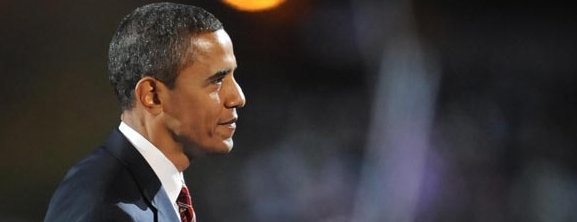
In a real personality cult, adulation and self-aggrandizement feed upon one another. The beloved and his lovers participate in a collective narcissistic feedback loop.

The only way someone can remain impervious to the insidious effects of the idealized projections of others is by being convinced that in spite of all appearances to the contrary, being at the center of massive attention does not place one at the center of the universe.

When Obama says this is not about me, it’s about you, he really means it. Were it not so, the corrupting effect of so much unalloyed admiration would by now be all too evident.

The paradox of Obama’s arrival at the pinnacle of power is that while so many around him are reveling in a giddy mix of elation, relief, anticipation and amazement, the man at the center of what has become a global fascination is fully engaged yet quietly detached.

Even though Obama is no saint and is just as vulnerable as anyone else to the intoxicating effect of power, he has managed to get this far without being seduced by a mania that, in part, helped elevate him to the presidency.

As he said on the night of his election:

I was never the likeliest candidate for this office. We didn’t start with much money or many endorsements. Our campaign was not hatched in the halls of Washington — it began in the backyards of Des Moines and the living rooms of Concord and the front porches of Charleston.

It was built by working men and women who dug into what little savings they had to give five dollars and ten dollars and twenty dollars to this cause. It grew strength from the young people who rejected the myth of their generation’s apathy; who left their homes and their families for jobs that offered little pay and less sleep; from the not-so-young people who braved the bitter cold and scorching heat to knock on the doors of perfect strangers; from the millions of Americans who volunteered, and organized, and proved that more than two centuries later, a government of the people, by the people and for the people has not perished from this Earth. This is your victory.

I know you didn’t do this just to win an election and I know you didn’t do it for me. You did it because you understand the enormity of the task that lies ahead. For even as we celebrate tonight, we know the challenges that tomorrow will bring are the greatest of our lifetime — two wars, a planet in peril, the worst financial crisis in a century. Even as we stand here tonight, we know there are brave Americans waking up in the deserts of Iraq and the mountains of Afghanistan to risk their lives for us. There are mothers and fathers who will lie awake after their children fall asleep and wonder how they’ll make the mortgage, or pay their doctor’s bills, or save enough for college. There is new energy to harness and new jobs to be created; new schools to build and threats to meet and alliances to repair.

The road ahead will be long. Our climb will be steep. We may not get there in one year or even one term, but America — I have never been more hopeful than I am tonight that we will get there. I promise you — we as a people will get there.

*

Does all of this add up to evidence that the president-elect is a secret Buddhist? Of course not. Let’s simply say we just elected a leader whose understanding of himself brings a rounded intelligence and rooted vision rarely seen in a position of such extraordinary power.

Facebooktwittermail

NEWS & VIEWS ROUNDUP & EDITOR’S COMMENT: November 7

Time to appoint a Middle East envoy

In speech after spell-binding speech, Barack Obama made clear throughout his campaign his intention to restore America’s reputation in the world; that, as he told the vast crowd at his Chicago victory rally, “America’s beacon still burns as bright”. In the Middle East and throughout broad swathes of the Muslim world, that beacon is invisible after eight years of the Bush administration’s bungling. President-elect Obama has a unique chance to rekindle it.

He should signal his intent by naming soon a special envoy for the Middle East with plenipotentiary powers to mediate and negotiate on behalf of his incoming administration. That would be change and it would quickly be perceived as such. Bill Clinton, the former president, is probably the best man for the job.

The debacles of the Bush era, from the invasion of Iraq, through the reckless Anglo-American support of Israel’s 2006 Lebanon war, to the US adoption of an attitude rather than a policy towards Iran, have created a dangerous political vacuum in the region. True, the past year has seen limited conflict resolution managed by Qatar, Saudi Arabia, Egypt and Turkey. While all this should be viewed positively as “local ownership” of regional strategic problems, these efforts may turn out to be band-aids.

The US really is indispensable to the resolution of the region’s most intractable problems – as long as it rediscovers the transformative power of hard-nosed diplomacy.

That means an even-handed final effort to secure a two-states solution offering security to Israelis and justice to the Palestinians. And that can only be obtained through the creation of a viable Palestinian state on nearly all the occupied West Bank with Arab east Jerusalem as its capital, with agreed and equal land swaps, and fair treatment for 4.4m Palestinian refugees, largely through compensation.

That is the essence of the 2002 Arab League peace plan put forward by King Abdullah – who will be in New York and Washington next week with a top-level Saudi delegation – as well as the “parameters” drawn up by Mr Clinton in December 2000, after the collapse of that summer’s Camp David summit.

The Obama team should make clear now that this is also its vision of how to resolve this conflict, at the heart of the region’s combustibility. It might even tilt Israeli voters towards the peace camp in February’s elections. They did, after all, throw out the irredentist Yitzhak Shamir in 1992 after he incurred the displeasure of George H.W. Bush. Yitzhak Rabin, the slain peacemaker, was elected in his stead. [continued…]

Editor’s Comment — Whether or not Bill Clinton would be the best pick as Middle East envoy is questionable, but the suggestion that now is the time to push the 2002 peace plan should be firmly grasped. The Israelis are on the brink of being ready. The real challenge — and the one that all Western powers have so far ducked — is to play a constructive role in rebuilding Palestinian political unity.

Grasping that nettle would probably easier for someone whose ego and public profile would be much less likely to get into the way. This is a job for a professional diplomat with a deep understanding of the region. If throwing a big name at the task held much promise, you’d think by now we would have heard a bit more from The Quartet’s illustrious envoy, Tony Blair.

Evangelical foreign policy is over

With Barack Obama’s election to the presidency, the evangelical moment in US foreign policy has come to an end. The United States remains a nation of believers, with Christianity the tradition to which most Americans adhere. Yet the religious sensibility informing American statecraft will no longer find expression in an urge to launch crusades against evil-doers.

Like our current president, Obama is a professed Christian. Yet whereas George W. Bush once identified Jesus Christ himself as his favorite philosopher, the president-elect is an admirer of Reinhold Niebuhr, the renowned Protestant theologian.

Faced with difficult problems, conservative evangelicals ask WWJD: What would Jesus do? We are now entering an era in which the occupant of the Oval Office will consider a different question: What would Reinhold do?

During the middle third of the last century, Niebuhr thought deeply about the complexities, moral and otherwise, of international politics. Although an eminently quotable writer, his insights do not easily reduce to a sound-bite or bumper sticker.

At the root of Niebuhr’s thinking lies an appreciation of original sin, which he views as indelible and omnipresent. In a fallen world, power is necessary, otherwise we lie open to the assaults of the predatory. Yet since we too number among the fallen, our own professions of innocence and altruism are necessarily suspect. Power, wrote Niebuhr, “cannot be wielded without guilt, since it is never transcendent over interest.” Therefore, any nation wielding great power but lacking self-awareness – never an American strong suit – poses an imminent risk not only to others but to itself. [continued…]

Obama’s victory: a change the world should believe in

The world did not have a vote in the US election. It understood, though, that it had a vital interest in the outcome. John McCain had earned the respect of many leaders around the world. But among most electorates, a victory for the Republican candidate would have been greeted with a collective cry of anguish. Instead, many scores of millions have celebrated America’s choice.

Some, in Mr Obama’s phrase, were huddled around radios in “the world’s forgotten corners”. They see a president-elect of Kenyan ancestry; a politician whose character was formed by childhood years in Indonesia; and a man whose middle name bears testimony to his Muslim forbears.

Europeans see another Mr Obama. Black, certainly, but a product also of America’s familiar east coast: intelligent, urbane and, above all, someone who shares their sensibilities about the necessary balance between power and persuasion in world affairs; Europe’s kind of president.

There, you might say, lies Mr Obama’s genius: abroad as well as at home, he has proved one of those rare politicians who invites others to discover in him their own priorities and preoccupations.

What his overseas admirers share is a sense that in choosing Mr Obama, the US has rediscovered the virtues and values that long underpinned its moral authority. In recent years, the anti-Bushism born of Iraq, Abu Ghraib and Guantánamo has hardened into visceral anti-Americanism. The election confounds the prevailing image (always something of a distortion) of a nation described only by its arrogance and indifference. [continued…]

America’s voters make history

“History will record that on Nov 4, 2008, Barack Hussein Obama was elected the first black president of the United States. It is impossible to overstate what that means to this nation,” wrote the Newsweek columnist, Anna Quindlen.

“America is as much a concept as it is a country, but it is a concept too often honoured in the breach. The Statue of Liberty welcomes with the words ‘Give me your tired, your poor’. Yet generation after generation of immigrants arrived here to face contempt and hatred until the passage of time, the flattening of accents, turned them into tolerated natives. The Declaration of Independence states unequivocally that all men are created equal. Yet for years the politicians and the powerful seemed to take the gender of that noun literally and denied all manner of rights to women.

“But no injustice or prejudice brought to bear by this country against its own people can compare with how it has treated black men and women. Humiliation, degradation, lynchings, beatings, murders. The rights the United States pretended to confer upon all were unthinkingly and consistently denied them: the right to the franchise, to representation, to protection by the justice system….

“As President-elect Obama said when he gave a speech about race earlier this year, speaking of systemic poverty, bad schools and broken families, ‘Many of the disparities that exist in the African-American community today can be directly traced to inequalities passed on from an earlier generation that suffered under the brutal legacy of slavery and Jim Crow’.

“But Obama said something else in that speech, something both simpler and more profound that has special resonance now that his improbable candidacy has prevailed. He made the political spiritual. ‘In the end, then,’ he said, ‘what is called for is nothing more, and nothing less, than what all the world’s great religions demand – that we do unto others as we would have them do unto us.’ He asked the American people to be fair and just, to be kind and generous, to put prejudice behind them and be one people because that is, not a legal or social imperative, but a moral one.” [continued…]

Obama and the dawn of the Fourth Republic

The election of Barack Obama to the presidency may signal more than the end of an era of Republican presidential dominance and conservative ideology. It may mark the beginning of a Fourth Republic of the United States.

In the past generation Bruce Ackerman, Theodore Lowi and I, in different ways, have used the idea of “republics” to understand American history. Since the French Revolution, France has been governed by five republics (plus two empires, a directory and a fascist dictatorship). Since the American Revolution, we Americans have been governed by several republics as well. But because we, like the British, pay lip service to formal continuity more than do the French, we pretend that we have been living under the same government since the federal Constitution was drafted and ratified in 1787-88. Our successive American republics from the 18th century to the 21st have been informal and unofficial.

As I see it, to date there have been three American republics, each lasting 72 years (give or take a few years). The First Republic of the United States, assembled following the American Revolution, lasted from 1788 to 1860. The Second Republic, assembled following the Civil War and Reconstruction (that is, the Second American Revolution) lasted from 1860 to 1932. And the Third American Republic, assembled during the New Deal and the civil rights eras (the Third American Revolution), lasted from 1932 until 2004. [continued…]

Facebooktwittermail

NEWS & VIEWS ROUNDUP: November 6

All deliberate speed

In July 2007, when the possibility that Barack Obama might win the presidency was still just a gleam in the candidate’s eye, he met with former national security adviser Zbigniew Brzezinski to ask for some advice. But he wasn’t after the usual campaign position papers or sound bites. Obama was already thinking in bigger terms.

What can a new president accomplish in foreign policy in his first 12 months in office that he can’t achieve later? Obama wanted to know. How should a new president reorganize his national security team so that the structure fits the problems of the 21st century? Brzezinski came away deeply impressed, and he became an informal Obama adviser.

With Tuesday’s victory, Obama and his advisers get to think about these global questions full time. Conversations over the past few days with several members of the president-elect’s inner circle yielded some basic outlines of the new administration’s approach to foreign policy: [continued…]

Obama’s Third Way

Barack Obama has won more than a presidential victory. He now has a chance to realign the national landscape and to create a new governing ideology for the West. Since the end of the cold war, two great political trends have coursed through the Western democracies. The first–led by Bill Clinton and Tony Blair in the 1990s–was the left’s steady progress toward greater comfort with free markets and traditional values, which increased their appeal to mainstream voters. The second was the ideological exhaustion of conservatism, a movement now riddled with contradictions and corruption, as personified by George W. Bush’s big-government, Wilsonian agenda. These two trends have intersected in 2008.

Of course, more Americans still identify themselves as conservatives than as liberals. There is a big red America out there. But that’s a reflection of the past three decades of conservative dominance, not a forecast of the future. “Among democratic peoples,” Alexis de Tocqueville wrote, “each generation is a new people.” [continued…]

We need sustainable capitalism

hen greeting old friends after a period of absence, Ralph Waldo Emerson used to ask: “What has become clear to you since we last met?”

What is clear to us and many others is that market capitalism has arrived at a critical juncture. Even beyond the bailouts and recent volatility, the challenges of the climate crisis, water scarcity, income disparity, extreme poverty and disease must command our urgent attention.

The financial crisis has reinforced our view that sustainable development will be the primary driver of economic and industrial change over the next 25 years. As a result, old patterns and assumptions are now being re-examined in an effort to find new ways to use the strengths of capitalism to address this reality. Indeed, at the Harvard Business School Centennial Global Business Summit held earlier this month, the future of market capitalism was one of the principal themes discussed.

We founded Generation Investment Management in 2004 to develop a new philosophy of investment management and business more broadly. Our approach is based on the long-term, and on the explicit recognition that sustainability issues are central to business and should be incorporated in the analysis of business and management quality. [continued…]

Now he must declare that the war on terror is over

A day of joy but also another day of horror. Even as American voters were giving the world the man whom opinion polls showed to be the overwhelming favourite in almost every country, his predecessor’s terrible legacy was already crowding in on the president-elect.

Twenty-three children and 10 women died in the latest US air strike in Afghanistan, a failed war on terror that has only brought worse terror in its wake. In Iraq, explosions killed 13 people. Obama’s stand against an unpopular war was the bedrock of his success on Tuesday, even though the financial meltdown sealed his victory. Now he must make good on his promises of withdrawal.

On Iran, the last of the toughest three issues in his foreign in-tray, his line differed sharply from McCain’s. In contrast to the Republican’s call to “bomb, bomb, bomb Iran”, Obama offered dialogue. Though he qualified his initial talk of having the president sit down with his Iranian counterpart, he remains wedded to engagement rather than boycott.

In this arc of conflict – Iran, Iraq and Afghanistan – Obama’s approach is preferable to Bush’s or McCain’s. The century-old paradigm of Republicans as the party of realism and the Democrats as the party of ideologues was turned upside down by the neocons. Bush led an administration of crusaders and took the country to disaster. Obama offers a return to traditional diplomacy.

Nevertheless, his position contains massive inconsistencies. While his instincts are cautious and pragmatic, he has not repudiated the war on terror. Rather, he insists that by focusing excessively on Iraq, the Bush administration “took its eye off the ball”. The real target must be Afghanistan and if Osama bin Laden is spotted in Pakistan, bombing must be used there too.

This is a cul-de-sac. If the most important single thing that Obama should do quickly is to announce the immediate closure of Guantánamo Bay, the corollary has to be a declaration that the war on terror is over. [continued…]

World reaction to Obama victory: Elation

If history records a sudden surge in carbon emissions on Wednesday, it may be due to the collective exhalation of relief and joy by the hundreds of millions — perhaps billions — of people around the globe who watched, waited and prayed for Barack Obama to be elected president of the United States.

In country after country, elation over Obama’s victory was palpable, the hunger for a change of American leadership as strong outside the U.S. as in it. And there was wonderment that, in the world’s most powerful democracy, a man with African roots and the middle name Hussein, an upstart fighter who took on political heavyweights, could capture the highest office in the land.

Suddenly, Americans used to being criticized for speaking hyperbolically about their country found plenty of others doing it for them.

“The New World,” the Times of London declared on its front page, beneath a huge smiling portrait of Obama.

“One Giant Leap for Mankind,” echoed the Sun.

From the beginning, this campaign has mesmerized observers far beyond U.S. shores. Two wars and two terms under President Bush have left many abroad angry and spent.

Yet though many have denounced U.S. power and unilateralism, they also seemed intent on putting the country back on a pedestal, and they fixed on Obama as their hope. Polls consistently showed that, if the rest of the world could vote, the Illinois Democrat would win not by a landslide, but an avalanche. [continued…]

Facebooktwittermail

America’s historic choice


Barack Obama’s victory speech

If there is anyone out there who still doubts that America is a place where all things are possible; who still wonders if the dream of our founders is alive in our time; who still questions the power of our democracy, tonight is your answer.

It’s the answer told by lines that stretched around schools and churches in numbers this nation has never seen; by people who waited three hours and four hours, many for the very first time in their lives, because they believed that this time must be different; that their voice could be that difference.

It’s the answer spoken by young and old, rich and poor, Democrat and Republican, black, white, Latino, Asian, Native American, gay, straight, disabled and not disabled. Americans who sent a message to the world that we have never been a collection of Red States and Blue States: we are, and always will be, the United States of America. [continued…]

The 44th President

This is one of those moments in history when it is worth pausing and reflecting on the basic facts:

An American with the name Barack Hussein Obama, the son of a white woman and a black man he barely knew, raised by his grandparents far outside the stream of American power and wealth, has been elected the 44th president of the United States.

Showing extraordinary focus and quiet certainty, Mr. Obama defeated first Hillary Clinton, who wanted to be president so badly that she lost her bearings, and then John McCain, who forsook his principles for a campaign built on anger and fear.

Mr. Obama won the election because he saw what is wrong with this country: the utter failure of government to protect its citizens. He promised to lead a government that does not try to solve every problem but will do those things beyond the power of individual citizens: to regulate the economy fairly, keep the air clean and the food safe, ensure that the sick have access to health care, and educate children to compete in a globalized world.

Mr. Obama spoke candidly of the failure of Republican economic policies that promised to lift all Americans but left so many millions far behind. He committed himself to ending a bloody and pointless war. He promised to restore Americans’ civil liberties and this country’s tattered reputation around the world. With a message of hope and competence he drew in legions of voters who had been disengaged and voiceless. [continued…]

President Obama

They did it. They really did it. So often crudely caricatured by others, the American people yesterday stood in the eye of history and made an emphatic choice for change for themselves and the world. Though bombarded by a blizzard of last-minute negative advertising that should shame the Republican party, American voters held their nerve and elected Barack Obama as their new president to succeed George Bush. Elected him, what is more, by a clearer majority than one of those bitter narrow margins that marked the last two elections. [continued…]

Facebooktwittermail