NEWS & VIEWS ROUNDUP: July 22

All the hysteria that’s fit to print?

You’d think the once-gray lady would have learned from the Edward Luttwak debacle earlier this year, when its public editor was forced to apologize for the paper publishing an op-ed premised on utter nonsense. But no. Instead, the paper asks us to take seriously a manic rant from Israeli historian-turned-hysterian Benny Morris, warning that “Israel will almost surely attack Iran’s nuclear sites in the next four to seven months — and the leaders in Washington and even Tehran should hope that the attack will be successful enough to cause at least a significant delay in the Iranian production schedule, if not complete destruction, of that country’s nuclear program. Because if the attack fails, the Middle East will almost certainly face a nuclear war — either through a subsequent pre-emptive Israeli nuclear strike or a nuclear exchange shortly after Iran gets the bomb.”

For a man who once applied the historian’s method of carefully weighing evidence from a wide variety of sources to establish the complex motives at work in historical conflict, the reasoning in Morris’s rant was shockingly adolescent, and bereft of precisely the craft through which he made his name.

Israel’s slap in the face from America

Israel gives the impression that it was completely unprepared for the recent dramatic switch in American policy toward Iran. The Bush administration did not consult with Israel before deciding to add a senior American diplomat to the talks the Europeans are conducting with the Iranians, nor did Washington inform Jerusalem of its intentions to open an interests section in Tehran. The Prime Minister’s Bureau received word of America’s new policy almost at the last minute, just in order to ensure that Israel would not be taken totally by surprise. If clandestine diplomatic feelers between Washington and Tehran preceded the announcement, Israel was left completely in the dark as to their existence.

The American “detente” with Iran has one obvious consequence: As long as the diplomatic game continues, there is not the slightest chance in the world of any aggressive action being taken against Iran’s nuclear program. Which means no bombing of nuclear facilities. And no naval blockade and no prevention of commercial flights from Iran, as Israel has proposed. If even a minor-ranking American diplomat is posted in Tehran, to ostensibly “speak with the people,” the Iranian regime will enjoy total immunity.

Mideast sees more of the same if Obama is elected

For what feels like forever, Israelis and their Arab neighbors have been hopelessly deadlocked on how to resolve the Palestinian crisis. But there is one point they may now agree on: If elected president, Senator Barack Obama will not fundamentally recalibrate America’s relationship with Israel, or the Arab world.

From the religious center of Jerusalem to the rolling hills of Amman to the crowded streets of Cairo, dozens of interviews revealed a similar sentiment: the United States will ultimately support Israel over the Palestinians, no matter who the president is. That presumption promoted a degree of relief in Israel and resignation here in Jordan and in Israel’s other Arab neighbors.

“What we know is American presidents all support Israel,” said Muhammad Ibrahim, 23, a university student who works part time selling watermelons on the street in the southern part of this city. “It is hopeless. This one is like the other one. They are all the same. Nothing will change. Don’t expect change.”

McCain’s Iraq dilemma

When John McCain, out of money and plunging in the polls, staked his Presidential campaign on his support for the surge of American forces in Iraq, he no doubt did so out of a sincere belief that the policy would dramatically improve conditions on the ground. But he probably never dreamed that only a year later, conditions would have improved so dramatically that Barack Obama’s “out in 16 months” plan, drawn up as a way to extricate the U.S. as rapidly as possible from a costly fiasco, would look instead like a potentially appropriate response to American success – or that the feeling-his-oats Iraqi Prime Minister would be more or less endorsing it. Where Iraq is concerned, McCain is suddenly in the odd position of playing Winston Churchill in 1945, or George H.W. Bush in 1992 – a leader whose successes in crafting wartime policy don’t translate into electoral victory – without having ever been elected President in the first place.

Evidence against terrorism suspect barred at Guantanamo trial

The military judge overseeing the first war crimes trial against a terrorism suspect at Guantanamo Bay agreed Monday to bar some evidence against Osama bin Laden’s former driver because it was obtained in “highly coercive environments and conditions.”

On the trial’s opening day, Navy Capt. Keith J. Allred denied defense appeals to exclude other statements Salim Ahmed Hamdan made during interrogation by U.S. agents in Afghanistan as well as during his more than six years’ imprisonment at Guantanamo Bay, Cuba. The judge said he would withhold judgment on a May 2003 interrogation until the defense had time to review 600 pages of detention records, which the government did not turn over until Sunday — the night before trial.

The exclusion of evidence Allred considered coerced could set a standard for admissibility in other war crimes cases due before the tribunal in the coming months, including that of the self-proclaimed Sept. 11 mastermind.

Facebooktwittermail

NEWS & VIEWS ROUNDUP & EDITOR’S COMMENT: July 21

U.S. official preparing scathing report on Israel’s West Bank policies

The United States security coordinator for the Israeli-Palestinian conflict, retired general James Jones, is preparing an extremely critical report of Israel’s policies in the territories and its attitude toward the Palestinian Authority’s security services.

A few copies of the report’s executive summary (or, according to some sources, a draft of it) have been given to senior Bush Administration officials, and it is reportedly arousing considerable discomfort. In recent weeks, the administration has been debating whether to allow Jones to publish his full report, or whether to tell him to shelve it and make do with the summary, given the approaching end of President George Bush’s term.

Jones was appointed by Secretary of State Condoleezza Rice following the Annapolis peace conference last November. His assignment was to draft a strategic plan to facilitate stabilization of the security situation, as a necessary accompaniment to Israeli-Palestinian final-status negotiations. In this context, he assessed the PA security forces in the West Bank, whose reform is being overseen by another American general, Keith Dayton. Jones has visited the region several times and met with senior Israeli government officials and army officers.

Editor’s Comment — There’s sure to be a stampede of the Washington press corps trying to get comments from the administration and the presidential candidates on this report …. Of course I jest. Chances are, we won’t hear a whisper. It would be so impolite to raise the matter. Then again, Gen Jones apparently doesn’t have his balls being squeezed in a vice, so maybe he’d be happy to do an off-the-record briefing — if only there was someone with enough guts to give him a call.

Arab world doubts US approach will change

As Barack Obama’s profile rose with each victory during the US Democratic primary race, many in the Arab world watched with a mixture of curiosity and a degree of anticipation.

Here was an African-American who had opposed the Iraq war, whose father was raised a Muslim and who represented a new, youthful and relatively unknown face to US politics. Many hoped that if his campaign were successful he might initiate a fresh stance for US policy in the Middle East and be more sympathetic towards the Arab cause. After two terms of George W. Bush’s presidency – deemed a disaster throughout much of the Arab world – the buzz among many in the region was that anybody would be better. And Mr Obama, perhaps more than other candidates, inspired thoughts of a genuine shift.

Yet as he makes his first trip to the Middle East as the presumptive Democratic presidential candidate, he will find that just as questions have been mounting in the US about his credentials to be commander-in-chief, so too is he coming under greater scrutiny among Arabs, with queries about his ability to deal with the crises in their region.

Barack who? Arabs weigh in

Senator Obama’s campaign may have launched groundswells of hope, ardor, and optimism at home and in Europe. But at the start of his closely watched trip to the Middle East, the all-but-certain Democratic nominee is little known in the Arab world, and has yet to generate widespread interest or enthusiasm.

From Baghdad to Beirut, people said in recent interviews that they are unfamiliar with his policies, except for his plan to move quickly to pull US troops out of Iraq.

In general, they said they prefer Obama over the likely Republican nominee, Sen. John McCain (R) of Arizona, whom they view as unsympathetic to Arabs.

But even those who like Obama’s personality are not expecting him to initiate major turnabouts on US Middle East policies, particularly on the most contentious one of all, the Israeli-Palestinian conflict.

Obama to Arabs is an American with Muslim middle name

…many Muslims around the world doubt the 46-year-old Illinois senator will advance their interests much and expect Obama to leave largely unchanged a U.S. foreign policy they perceive as unfairly tilted toward Israel.

Obama’s comment on Jerusalem, in a speech to the American Israel Public Affairs Committee, was a “radical rupture with the Arab public,” said Habib Samarkandi, a professor at the University of Toulouse in France who edits a journal about North African culture. “We discovered our support was based on illusions rather than the reality of the person.”

Obama sought to clarify his position the day after his speech, saying on CNN that “obviously, it’s going to be up to the parties to negotiate a range of these issues. And Jerusalem will be part of those negotiations.”

“The damage is done,” Samarkandi said, discounting the explanation.

Maliki, Obama hedge their bets on U.S. troops in Iraq

It isn’t shocking that, all else being equal, Iraqi Prime Minister Nouri al-Maliki would prefer to have American troops out of his country. But all else isn’t equal. After Maliki caused a stir last week by calling for a timetable for the withdrawal of American troops, other members of his government immediately began qualifying the statement.

The ambivalence is understandable; it reflects the ambivalence of Iraqis in general. Most are deeply suspicious of American motives and want U.S. troops out of their country. At the same time, in towns across Iraq and neighborhoods around Baghdad, U.S. soldiers and Marines are often credited with keeping sectarian tensions under control after the catastrophic violence of 2006 and 2007.

The American presence poses a special dilemma for Maliki and his government. They are loathe to be seen as puppets of the Americans, their positions guaranteed only by U.S. force. But U.S. forces have been an Maliki’s invaluable ally. His enemies — Sunni insurgents and rival Shiite militias — are their enemies.

Comment stings Iraqi leader on eve of Obama visit

In Iraq, controversy continued to reverberate between the United States and Iraqi governments over a weekend news report that Mr. Maliki had expressed support for Mr. Obama’s proposal to withdraw American combat troops within 16 months of January. The reported comments came after Mr. Bush agreed on Friday to a “general time horizon” for pulling out troops from Iraq without a specific timeline.

Diplomats from the United States Embassy in Baghdad spoke to Mr. Maliki’s advisers on Saturday, said an American official, speaking on condition of anonymity in order to discuss what he called diplomatic communications. After that, the government’s spokesman, Ali al-Dabbagh, issued a statement casting doubt on the magazine’s rendering of the interview.

The statement, which was distributed to media organizations by the American military early on Sunday, said Mr. Maliki’s words had been “misunderstood and mistranslated,” but it failed to cite specifics.

“Unfortunately, Der Spiegel was not accurate,” Mr. Dabbagh said Sunday by telephone. “I have the recording of the voice of Mr. Maliki. We even listened to the translation.”

But the interpreter for the interview works for Mr. Maliki’s office, not the magazine. And in an audio recording of Mr. Maliki’s interview that Der Spiegel provided to The New York Times, Mr. Maliki seemed to state a clear affinity for Mr. Obama’s position, bringing it up on his own in an answer to a general question on troop presence.

Leaving Iraq: debate shifts to when

Republican political strategists have long said privately what Republican candidates for President only hinted at publicly. No one can win the White House in 2008 by campaigning to continue an unending war in Iraq.

“The sentence has to have the word ‘leaving’ in it,” said Grover Norquist, the influential Republican operative, at a breakfast meeting in June of 2007. “Doesn’t mean you have to leave tomorrow, doesn’t mean you have to surrender, doesn’t mean you have to cut and run, but the articulation of the policy needs to be clear to the American people that we are not staying there indefinitely, and that there is a ‘doing something’ and a ‘leaving.'”

At the time, the major Republican candidates for President, save John McCain, had already begun to dull the edges on their support for President Bush’s war policy. When asked about the war, Mike Huckabee would talk about the strain on the Arkansas National Guard. Mitt Romney would say he wanted the troops home “as soon as possible.” Rudy Giuliani speculated openly that the so-called “surge” might fail, saying “we have to be ready for that.”

Analysis: U.S. advisers could stay long after troops leave Iraq

Can Iraqi troops fight — and win — on their own?

That question has become even more urgent after President Bush, Democratic presidential candidate Sen. Barack Obama and Iraqi Prime Minister Nouri al-Maliki all spoke in recent days about setting either vague or specific time frames for withdrawing U.S. troops from Iraq.

Recent evidence suggests that although the Iraqi military has made enormous progress, it is still dependent on small teams of American advisers who can rein in overly aggressive Iraqi commanders, call in U.S. airstrikes and help coordinate basic supplies such as food, rifle-cleaning kits and even printer cartridges.

The advisers could remain on the ground in Iraq long after most U.S. combat troops have left. Col. John Nagl, who resigned last month as commander of the U.S. Army’s school for military advisers, says they are “the key to our exit strategy in Iraq.”

Report: Israel willing to free Marwan Barghouti for Shalit

A Gulf newspaper reported Monday that Israel is willing to include jailed Fatah leader Marwan Barghouti in a list of 300 Palestinian prisoners to be freed in exchange for abducted Israeli soldier Gilad Shalit.

Shalit was seized in a cross-border raid in June 2006 and has been held in captivity in the Gaza Strip ever since. Unlike the soldiers who were snatched several weeks later by Hezbollah, Ehud Goldwasser and Eldad Regev, several signs of life from Shalit have been released. Barghouti is serving five life sentences in Israel for his role in a series of deadly terrorist attacks during the second intifada.

The newspaper, Al-Bayan which is published in the United Arab Emirates, also said that the list would also include senior Hamas officials Hassan Salame Abdullah Barghouti and Ibrahim Hamad. But, the report says, Israel will not free the leader of the Popular Front for the Liberation of Palestine, Ahmed Sadat. According to Al-Bayan, the talks on the exchange to secure Shalit’s release have seen significant progress, but Egyptian officials fear that agents in the region will try to scupper the deal.

Facebooktwittermail

NEWS & VIEWS ROUNDUP & EDITOR’S COMMENTS: July 20

‘Iran is friends with Israeli people’: Ahmadinejad aide

Iran is “friends with the Israeli people”, a deputy of President Mahmoud Ahmadinejad said, in stark contrast to Tehran’s usual verbal assaults against the Jewish state, local media reported on Sunday.

Esfandiar Rahim Mashaie, vice president in charge of tourism and one of Ahmadinejad’s closest confidants, also described the people of Iran’s arch-enemy the United States as “one of the best nations in the world”.

“Today, Iran is friends with the American and Israeli people. No nation in the world is our enemy, this is an honour,” Rahim Mashaie said, according to the Fars news agency and Etemad newspaper.

Editor’s Comment — For clarification, Mashaie later said: “It is preposterous to assume that any Iranian official would acknowledge the Zionist regime.” Even so, when one of the figures closest to the president in the Iranian government who is also the father of Ahmadinejad’s daughter-in-law makes a conciliatory gesture of this kind towards the Israelis, it somewhat undermines the neocons’ claim that Iran is intent on bringing about another holocaust.

When spies don’t play well with their allies

As they complete their training at “The Farm,” the Central Intelligence Agency’s base in the Virginia tidewater, young agency recruits are taught a lesson they are expected never to forget during assignments overseas: there is no such thing as a friendly intelligence service.

Foreign spy services, even those of America’s closest allies, will try to manipulate you. So you had better learn how to manipulate them back.

But most C.I.A. veterans agree that no relationship between the spy agency and a foreign intelligence service is quite as byzantine, or as maddening, as that between the C.I.A. and Pakistan’s Directorate for Inter-Services Intelligence, or I.S.I.

Poorly directed aid increases Afghanistan’s woes

It would be hard to deny the evidence that Afghanistan is at a crossroads as Democratic nominee Barack Obama yesterday met the country’s President Hamid Karzai. Despite the claims by some British officers that the Taliban is being tactically routed, no one seems to have told the Islamist insurgents. Opium production in the areas under their control – and that of other warlords – has reached new records this year. Corruption and criminality, linked often to the very heart of government, is endemic. Despite $15bn in aid that has been disbursed, Afghanistan remains mired in pervasive poverty with unemployment standing at more than 40 per cent. The country’s position as one of the world’s poorest has barely shifted since 2001.

Confronted with these multiple failures, the temptation, voiced yesterday by Obama, and by his Republican opponent John McCain already, is to throw more military forces at the problem in a replication of the Iraq ‘surge’. A parallel attraction, encouraged by Karzai, is to insist that the international community provide ever more money in the hope that some of the billions will stick. But in a country beset by rapidly increasing pessimism over the ability of the international community finally to bring to an end Afghanistan’s 30-year cycle of poverty and violence, what is needed is a large-scale rethinking of what we are doing in Afghanistan, not more violence and more largesse.

Editor’s Comment — The Observer is here endorsing/reiterating the views expressed by Rory Stewart in the latest issue of Time magazine.

Obama abroad

The rap on Barack Obama, at least in the realm of foreign policy, has been that he is a softheaded idealist who thinks that he can charm America’s enemies. John McCain and his campaign, conservative columnists and right-wing bloggers all paint a picture of a liberal dreamer who wishes away the world’s dangers. Even President Bush stepped into the fray earlier this year to condemn the Illinois senator’s willingness to meet with tyrants as naive. Some commentators have acted as if Obama, touring the Middle East and Europe this week on his first trip abroad since effectively wrapping up the nomination, is in for a rude awakening.

These critiques, however, are off the mark. Over the course of the campaign against Hillary Clinton and now McCain, Obama has elaborated more and more the ideas that would undergird his foreign policy as president. What emerges is a world view that is far from that of a typical liberal, much closer to that of a traditional realist. It is interesting to note that, at least in terms of the historical schools of foreign policy, Obama seems to be the cool conservative and McCain the exuberant idealist.

We’re quick to damn the US but slow to see our own faults

President Obama is finally coming to Europe! All right, the Americans haven’t elected him … yet. But that’s a mere technicality as far as we’re concerned. We made up our minds long ago: our President is Barack Obama.

This week, Senator Obama will be giving a speech in Berlin, the headquarters of his biggest fan-base on the old continent. The Germans are rooting for America’s Democratic nominee with a fervour they otherwise reserve for the Dalai Lama or Nelson Mandela, bringing a distinctly wistful glint to the eyes of German politicians. Take Germany’s foreign minister Frank-Walter Steinmeier, a laconic Westphalian not known for flights of emotional exuberance. Even he, speaking at Harvard, could not resist bursting into an impassioned cry of: ‘Yes, we can!’

There are excellent reasons for Europeans’ enthusiasm. Obama is a charismatic politician of formidable stature, but so is John McCain. In fact, the choice before the Americans on 4 November is what Germans call a Luxusproblem: your problems, friends, we’d like to have. And despite America’s diminished stature, the President of the USA remains the most powerful man in the world, able like none other to make decisions of global consequence. In that sense, at least, he really is President of us all.

Snubbed by Obama

Barack Obama is on his way to Europe, where an adoring public awaits. But I wonder if the reception would be quite so enthusiastic if Obama’s fans across the Atlantic knew a dirty little secret of his remarkable presidential campaign: Although Obama portrays himself as the best candidate to engage the rest of the world and restore America’s image abroad, and many Americans support him for that reason, so far he has almost completely refused to answer questions from foreign journalists. When the press plane leaves tonight for his trip, there will be, as far as I know, no foreign media aboard. The Obama campaign has refused multiple requests from international reporters to travel with the candidate.

As a German correspondent in Washington, I am accustomed to the fact that American politicians spare little of their limited time for reporters from abroad. This is understandable: Our readers, viewers and listeners cannot vote in U.S. elections. Even so, Obama’s opponents have managed to make at least a small amount of time for international journalists. John McCain has given many interviews. Hillary Clinton gave a few. President Bush regularly holds round-table interviews with media from the countries to which he travels. Only Obama dismisses us so consistently.

Are U.S.-Iran ties undergoing significant change?

Events during the past month suggest that relations between the United States and Iran may be undergoing a significant change. Each development is not dramatic on its own, but as a whole they formulate a trend.

Iran has signaled that it intends to find a way out of the nuclear impasse. This began with a clear statement by Ali Akbar Velayati, adviser to Iranian Supreme Leader Ali Khamenei on foreign affairs. Velayati said that Iran should accept the “package” offered by the group of “five plus one” – the five permanent members of the Security Council and Germany, through the European Union official charged with foreign policy, Javier Solana.

Iran given two-week deadline to end the nuclear impasse

Iran was given a fortnight to agree to freeze its uranium enrichment programme yesterday or face further international isolation.

After a day of inconclusive talks in Geneva, a six-nation negotiating team warned the Iranian delegation that it had run out of patience and demanded a ‘yes or no’ answer to a proposal it put forward five weeks ago.

Under that offer, sponsored jointly by the US, Britain, France, Germany, Russia and China, Iran would not expand its uranium enrichment programme, while the international community refrained from imposing further sanctions. This phase would last six weeks, possibly paving the way for suspension of enrichment and more comprehensive talks.

U.S. talks with Iran exemplify Bush’s new approaches

With his moves last week involving Iraq, Iran and North Korea, President Bush accelerated a shift toward centrist foreign policies, a change that has cheered Democrats, angered some Republicans and roiled the presidential campaign.

Bush sent his first high-level emissary to sit in on nuclear talks with Iran, which ended without agreement Saturday. Also in the past two days, the president agreed for the first time to set a “time horizon” for withdrawing troops from Iraq, and authorized Secretary of State Condoleezza Rice to join North Korean diplomats at six-party talks about ending that country’s nuclear weapons program.

The maneuvers underscore how much the Bush administration has changed since 2002, when the president proclaimed Iraq, Iran and North Korea to be an “axis of evil.” Now Bush is pushing forward with diplomatic gestures toward Iran and North Korea while breaking with a long-held position on troop withdrawals in the interest of harmony with the Iraqi government.

White House tips press off to Maliki interview

The White House is quick to distribute its point of view in e-mail messages with headings like “News You Can Use,” “In Case You Missed It,” and “Setting the Record Straight.” So it was a surprise on Saturday morning when the White House distributed an article by Reuters that offered an endorsement of Senator Barack Obama’s Iraq policy by the leader of Iraq.

“Iraq PM backs Obama troop exit plan,” the headline read over a story about an interview of Prime Minister Nuri Kamal al-Maliki in the German magazine Der Spiegel, in which he expressed support for the senator’s plan to withdraw American combat brigades from Iraq over the next 16 months.

“U.S. presidential candidate Barack Obama talks about 16 months,” Mr. Maliki told Der Spiegel, Reuters reported. “That, we think, would be the right time frame for a withdrawal, with the possibility of slight changes.”

Turns out it was a mistake by the White House clipping service, which had intended to distribute it internally but instead sent it to thousands signed up to receive the administration’s press releases, transcripts, statements and other documents, drawing attention to an interview that might otherwise have received less.

Editor’s CommentKevin Drum suggests that the mistake resulted from the White House being so unnerved by the news, while the New York Times would have us believe that the White House error alerted the attention of the press.

I have little doubt that the Washington press corps is well supplied with flakes, but seriously, it shouldn’t have taken an email alert to bring attention to this story – even on a Saturday – when the press is monolithically focused on Obama’s trip to the region. Neither do I find the theory that a staffer in panic mode “hit the wrong button” particularly credible. How were the internal group list and the press list named, such that they could be mixed up?

No, while goofy mistakes are often believable, in this case it’s possible that someone in the White House was cunning enough to come up with an effective strategy for creating a distraction from the story. Look how the blogosphere reacted: More attention went to the email mistake than to what Maliki said!

Sunni bloc rejoins Iraqi government, amid reconciliation hopes

Iraq’s largest Sunni political bloc rejoined the government Saturday after a nearly year-long boycott, a move that could help bridge the country’s sectarian divide.

The return of the Iraqi Accordance Front is widely seen as a victory for Shiite Prime Minister Nouri al-Maliki and his efforts to portray himself as a nationalist leader uninfluenced by sectarian pressures.

“It means the success of the political process and the success of the security situation and of reconciliation,” said Adnan al-Dulaimi, leader of the bloc

Surge protector

The prospect of a long-term security arrangement between the United States and Iraq has become a lightning rod for criticism. Yet such an agreement — which the White House believes could be completed this month now that the two countries have agreed to set a “general time horizon” for reducing the number of American troops in Iraq — would be in the best interests of the governments of both countries, and of the people who live in a region of the world that urgently needs stability.

The United Nations Security Council resolution that authorizes coalition operations in Iraq expires at the end of this year. But the calendar is not the most important reason for the United States to enter into a long-term pact with Iraq. The opportunity presented by the improved situation on the ground begs to be exploited lest it disappear in the ever-shifting sands of Middle East strife.

Are the desires of the American people and the Iraqi people different? I don’t think so. During my year in command of all American forces in the Middle East, I met often with Iraqis of all walks of life. Discussions with people — from Prime Minister Nuri Kamal al-Maliki to clerics, governors and generals to men in the streets of Baghdad and towns and cities throughout the country — left me with several strong impressions. The top objective of both countries is security and stability in the region. Letting Iraq’s security forces assume responsibility for their country is another mutual goal. Withdrawing the vast majority of American and coalition troops from Iraq as soon as possible is a clear priority.

Gordon Brown agrees to cut British troops in Iraq

Gordon Brown, on a flying visit to Baghdad and Basra, said today he plans to reduce the remaining number of British troops in Iraq following a drop in attacks, but declined to set a timeframe for their departure.

An Iraqi Government official said he hoped British forces would exit within a year.

The British Prime Minister also agreed with Nouri al-Maliki, his Iraqi counterpart, to set up two teams, Iraqi and British, to study the technicalities of Britain’s long-term relationship with Iraq.
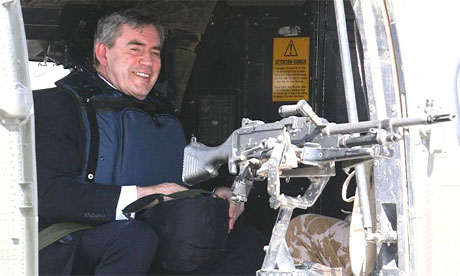
Editor’s Comment — Gordon Brown is to the Labour Party what John Major was to the Conservatives: someone upon whom a shadow has permanently been imprinted. Even so, there’s something perversely intriguiging about a man who can wear a dark suit and tie and flack jacket when it’s 126 degrees Fahrenheit!

Detaining Mr. Marri

The Bush administration has been a waging a fierce battle for the power to lock people up indefinitely simply on the president’s say-so. It scored a disturbing victory last week when a federal appeals court ruled that it could continue to detain Ali al-Marri, who has been held for more than five years as an enemy combatant. The decision gives the president sweeping power to deprive anyone — citizens as well as noncitizens — of their freedom. The Supreme Court should reverse this terrible ruling.

Mr. Marri, a citizen of Qatar legally residing in the United States, was initially arrested in his home in Peoria, Ill., on ordinary criminal charges, then seized and imprisoned by military authorities. The government, which says he has ties to Al Qaeda, designated him an enemy combatant, even though it never alleged that he was in an army or carried arms on a battlefield. He was held on the basis of extremely thin hearsay evidence.

It’s the economic stupidity, stupid

The best thing to happen to John McCain was for the three network anchors to leave him in the dust this week while they chase Barack Obama on his global Lollapalooza tour. Were voters forced to actually focus on Mr. McCain’s response to our spiraling economic crisis at home, the prospect of his ascension to the Oval Office could set off a panic that would make the IndyMac Bank bust in Pasadena look as merry as the Rose Bowl.

“In a time of war,” Mr. McCain said last week, “the commander in chief doesn’t get a learning curve.” Fair enough, but he imparted this wisdom in a speech that was almost a year behind Mr. Obama in recognizing Afghanistan as the central front in the war against Al Qaeda. Given that it took the deadliest Taliban suicide bombing in Kabul since 9/11 to get Mr. McCain’s attention, you have to wonder if even General Custer’s learning curve was faster than his.

Mr. McCain still doesn’t understand that we can’t send troops to Afghanistan unless they’re shifted from Iraq. But simple math, to put it charitably, has never been his forte. When it comes to the central front of American anxiety — the economy — his learning curve has flat-lined.

Leaving Israel a different man

In 1979, at the age of 16, Samir Kuntar led an armed team by boat from Lebanon to the seaside Israeli city of Nahariya to kill and kidnap Israelis. He was in a war against the Zionist state, but he knew almost nothing about the people or the country. The only Hebrew word he knew was shalom – peace – an irony that does not escape him today. That night he made an attack and was caught and convicted of killing a policeman, a second man and his six-year-old daughter.

Thirty years later – spent entirely in Israeli prisons – the 46-year-old man speaks fluent Hebrew without a trace of an accent. He reads Israeli authors, is up-to-date on Israeli pop culture and knows more about the Holocaust and Zionism than many Israelis.

On Wednesday, Israel released Mr. Kuntar as part of a prisoner exchange. It was a tough decision for the government because Mr. Kuntar had become an icon of terror and evil for Israeli society. Yet, before he left Israel for freedom he sent his collection of Israeli books to his home in Lebanon.

None of that would probably have been public were it not for a chance meeting between Mr. Kuntar and Chen Kotas-Bar, a Jewish Israeli journalist, in the prison library in January, 2004. Their short conversation ignited her interest – and his, she says – and the two met often after that. The result was two articles in the Maariv newspaper: one in 2005 and the other published yesterday. The articles reveal a man very different from the teenager who first arrived on Israeli shores.

Putting al Qaeda on the couch

Marc Sageman has charted an unlikely path. The first scholar-in-residence at the New York City Police Department survived the Holocaust to become a psychiatrist, a sociologist and a CIA case officer. Since the publication of “Leaderless Jihad” earlier this year, Sageman has been at the center of a debate about the inner workings of Al Qaeda. Is the organization dispersed and disorganized, as Sageman suggests, or is it resurgent, as CIA analyses have reported? Sageman spoke with Newsweek’s Christopher Dickey in New York.

Facebooktwittermail

NEWS & VIEWS ROUNDUP: July 19

Obama lands in Afghanistan for first tour of war zones

Senator Barack Obama arrived in Afghanistan early Saturday morning, opening his first overseas trip as the presumptive Democratic presidential nominee, to meet with American commanders there and later in Iraq to receive an on-the-ground assessment of military operations in the two major U.S. war zones.

Mr. Obama touched down in Kabul about 11:45 a.m., according to a pool report released by his aides. In addition to attending briefings with military leaders, he hoped to meet with President Hamid Karzai of Afghanistan before flying to Iraq later in the weekend.

Obama going abroad with world watching

Sen. Barack Obama will make his international debut as a Democratic presidential candidate in the coming days with a weeklong tour of the Middle East and Europe designed to deepen his foreign policy credentials, confront questions at home about his readiness to be commander in chief, and signal the possibility of a new era in U.S. relations with the rest of the world.

Obama’s visit is among the most unusual ever undertaken by a presumptive White House nominee, planned with the attention to detail of a trip by a president and as heavily hyped abroad as at home. The senator from Illinois will meet with a succession of foreign leaders, make symbolically important visits and hold at least one large public event — all with an eye to how the trip is playing in the United States.

But the tour is fraught with risks. The large media contingent that will follow Obama means that any misstep or misstatement will be magnified and potentially read as evidence of his inexperience, adding to doubts about him. If he successfully navigates his itinerary, however, the political payoffs could be significant enough to affect the outcome of his race against Republican Sen. John McCain this fall.

Soldiers recount deadly attack on Afghanistan outpost

The first RPG and machine gun fire came at dawn, strategically striking the forward operating base’s mortar pit. The insurgents next sighted their RPGs on the tow truck inside the combat outpost, taking it out. That was around 4:30 a.m.

This was not a haphazard attack. The reportedly 200 insurgents fought from several positions. They aimed to overrun the new base. The U.S. soldiers knew it and fought like hell. They knew their lives were on the line.

“I just hope these guys’ wives and their children understand how courageous their husbands and dads were,” said Sgt. Jacob Walker. “They fought like warriors.”

The next target was the FOB’s observation post, where nine soldiers were positioned on a tiny hill about 50 to 75 meters from the base. Of those nine, five died, and at least three others … were wounded.

Afghanistan hit by record number of bombs

Air Force and allied warplanes are dropping a record number of bombs on Afghanistan targets.

For the first half of 2008, aircraft dropped 1,853 bombs — more than they released during all of 2006 and more than half of 2007’s total — 3,572 bombs.

Driving the increasing use of air power are fights in southern Afghanistan, where the Marine Corps arrived last winter, and battles in eastern Afghanistan, where Taliban and other insurgents use the border region with Pakistan as a safe haven.

For first time, Bush agrees to ‘time horizon’ for Iraq pullout

The United States and Iraq have agreed to a “general time horizon” for further reductions of U.S. combat troops in Iraq, the White House said Friday, the first time the Bush administration has agreed to set any kind of timeline for troop withdrawals.

The agreement appears to be a political favor to Iraqi Prime Minister Nouri al Maliki, but the White House said it wasn’t a reversal of President Bush’s long opposition to any fixed schedule for troop reductions, including the veto of bills that included timetables for withdrawal.

But Democrats — including presumptive presidential nominee Barack Obama — hailed it as belated recognition of the need to hasten the end of the Iraq war.

U.S. position complicates global effort to curb illicit arms

Diplomats from the world’s governments met throughout this week on agreements to cut the global illicit trade in small arms, but their work was curtailed in part by the near-boycott of the meetings by the United States.

The tone of the meetings underscored the political complexities of gaining full support for international small-arms agreements from the United States. The American view has balanced recognition of the dangers of illegal proliferation with the government’s own arms-distribution practices and with the American gun lobby’s resistance to the United Nations’ proposals.

Since 2001, United Nations members have endorsed a broad but loosely defined initiative, called the program of action, for a collective effort against illegal arms circulation. The agreement in part encourages governments to tighten controls on manufacturing, marking, tracing, brokering, exporting and stockpiling small arms and to cooperate to restrict illicit flows, particularly to regions perennially in armed conflict. It addresses hundreds of millions of weapons, ranging from pistols to shoulder-fired rockets, that the United Nations says are in circulation worldwide.

Facebooktwittermail

NEWS & VIEWS ROUNDUP: July 18

Talks signal Mideast shift

After years of escalating tensions and bloodshed, the talk in the Middle East is suddenly about talking. The shift is still relatively subtle, but hints of a new approach in the waning months of the Bush administration are fueling hopes of at least short-term stability for the first time since the invasion of Iraq in 2003.

Much is happening, adding up not to any great diplomatic breakthrough, but to a distinct change in direction. Syria is being welcomed out of isolation by Europe and is holding indirect talks with Israel. Lebanon has formed a new government. Israel has cut deals with Hamas (a cease-fire) and Hezbollah (a prisoner exchange).

On Wednesday, the United States agreed to send a high-ranking diplomat to attend talks with Iran over its nuclear program, and was considering establishing a diplomatic presence in Tehran for the first time since the 1979 revolution and hostage crisis.

“The overall picture is moving in the direction of cooling the political atmosphere,” said Muhammad al-Rumaihi, a former government adviser in Kuwait and the editor of Awan, an independent daily newspaper there.

Many underlying problems, including the Palestinian-Israeli conflict, are not on the verge of resolution. Afghanistan has recently seen a sharp spike in violence. In the Middle East, optimism can fill the void left by even a temporary lull in violence, like the recent — and still fragile — stability gains in Iraq. Nevertheless, not long ago, the fear was that Lebanon would descend into civil war and that either Israel or the United States, or both, would attack Iran. That seems less likely at the moment.

How to save Afghanistan

Many policymakers want to throw more money and troops at the problem. Both Barack Obama and John McCain say that as President, they would send additional combat brigades — from 7,000 to 15,000 troops — to tame the insurgency in Afghanistan. At a June conference in Paris, Western governments committed an additional $20 billion in aid, in the hope that this would finally bring success in counterinsurgency, counternarcotics, rule of law, governance and state-building — and eventually allow us to withdraw from Afghanistan with honor.

But just because Afghanistan has problems that need to be solved does not mean that the West can solve them all. My experience suggests that those pushing for an expansion of our military presence there are wrong. We don’t need bold new plans and billions more in aid. Instead, we need less investment — but a greater focus on what we know how to do.

The Pentagon and the hunt for black gold

For years, “oil” and “Iraq” couldn’t make it into the same sentence in mainstream coverage of the invasion and occupation of that country. Recently, that’s begun to change, but “oil” and “the Pentagon” still seldom make the news together.

Last year, for instance, according to Department of Defense (DoD) documents, the Pentagon paid more than $70 million to Hunt Refining, an oil company whose corporate affiliate, Hunt Oil, undermined U.S. policy in Iraq. Not that anyone would know it. While the hunt for oil in Iraq is now being increasingly well covered in the mainstream, the Pentagon’s hunt for oil remains a subject missing in action. Despite the staggering levels at which the Pentagon guzzles fuel, it’s a chronic blind spot in media energy coverage.

Let’s consider the Hunt Oil story in a little more detail, since it offers a striking example of the larger problem. On July 3, 2008, according to the New York Times, the House Committee on Oversight and Government Reform found that Hunt Oil had pursued “an oil deal with the regional Kurdistan government that ran counter to American policy and undercut Iraq’s central government.” Despite its officially stated policy of warning companies like Hunt Oil “that they incur risks in signing contracts until Iraq passes an oil law,” the State Department in some cases actually encouraged a deal between the “Texas oil company with close ties to President Bush” and Kurdistan that “undercut” Prime Minister Nouri al-Maliki’s government in Baghdad.

Development: US fails to measure up on ‘human index’

Despite spending $230m (£115m) an hour on healthcare, Americans live shorter lives than citizens of almost every other developed country. And while it has the second-highest income per head in the world, the United States ranks 42nd in terms of life expectancy.

These are some of the startling conclusions from a major new report which attempts to explain why the world’s number-one economy has slipped to 12th place – from 2nd in 1990- in terms of human development.

The American Human Development Report, which applies rankings of health, education and income to the US, paints a surprising picture of a country that spends well over $5bn each day on healthcare – more per person than any other country.

Warming is major threat to humans, EPA warns

Climate change will pose “substantial” threats to human health in the coming decades, the Environmental Protection Agency said yesterday — issuing its warnings about heat waves, hurricanes and pathogens just days after the agency declined to regulate the pollutants blamed for warming.

In a new report, the EPA said “it is very likely” that more people will die during extremely hot periods in future years — and that the elderly, the poor and those in inner cities will be most at risk.

Other possible dangers include more powerful hurricanes, shrinking supplies of fresh water in the West, and the increased spread of diseases contracted through food and water, the agency said.

Facebooktwittermail

CAMPAIGN 08 & EDITOR’S COMMENT: Popularity breeds popularity

In Iraq, mixed feelings about Obama and his troop proposal

A tough Iraqi general, a former special operations officer with a baritone voice and a barrel chest, melted into smiles when asked about Senator Barack Obama.

“Everyone in Iraq likes him,” said the general, Nassir al-Hiti. “I like him. He’s young. Very active. We would be very happy if he was elected president.”

But mention Mr. Obama’s plan for withdrawing American soldiers, and the general stiffens.

“Very difficult,” he said, shaking his head. “Any army would love to work without any help, but let me be honest: for now, we don’t have that ability.”

Thus in a few brisk sentences, the general summed up the conflicting emotions about Mr. Obama in Iraq, the place outside America with perhaps the most riding on its relationship with him.

There was, as Mr. Obama prepared to visit here, excitement over a man who is the anti-Bush in almost every way: a Democrat who opposed a war that many Iraqis feel devastated their nation. And many in the political elite recognize that Mr. Obama shares their hope for a more rapid withdrawal of American forces from Iraq.

But his support for troop withdrawal cuts both ways, reflecting a deep internal quandary in Iraq: for many middle-class Iraqis, affection for Mr. Obama is tempered by worry that his proposal could lead to chaos in a nation already devastated by war. Many Iraqis also acknowledge that security gains in recent months were achieved partly by the buildup of American troops, which Mr. Obama opposed and his presumptive Republican opponent, Senator John McCain, supported. [complete article]

Obama faces his overseas audition

Even though the details remain sketchy, it’s clear that Barack Obama’s upcoming trip to the Middle East and Europe is an audition on the world stage. But the most important critics will not be the foreign leaders who will be sizing him up as a potential member of their ranks, or the cheering throngs that are likely to greet him at every stop. The audience that matters most will be the voters back home, where many Americans have yet to be convinced that this young man of relatively little experience is the right person to fill the role of their commander-in-chief. “This,” says Ken Duberstein, who was Ronald Reagan’s White House Chief of Staff, “is an absolute opportunity to get over the acceptability threshold.”

Polling suggests that Obama still has a way to go in that regard. In the latest Washington Post/ABC News survey, only 48% of registered voters said Obama would make a good commander in chief, with an equal percentage saying he wouldn’t. By comparison, 72% said John McCain would be a good one.

The campaign has thus far provided only the barest outline of his itinerary. On Monday, Obama will be in Amman, Jordan; on Tuesday and Wednesday, Israel and the Palestinian territory of the West Bank. Thursday, Friday and Saturday will be a sprint across Europe, with stops planned for Berlin, Paris and London. And somewhere in all this, Obama plans to make a much-anticipated visit to Iraq and Afghanistan with two Senate colleagues, Democrat Jack Reed of Rhode Island and Republican Chuck Hagel of Nebraska. [complete article]

Editor’s Comment — It might sound like the most obvious of truisms, but victory in the presidential election will go to the most popular candidate. Which is to say — and let’s assume it’s Obama — the more popular he appears, the more popular he will become.

Many people who read (as opposed to simply watching) the news, probably already know that Obama is hugely popular outside America, but that’s not something that most Americans know yet. It’s conceivable that nightly news images of Obama receiving effusive greetings and being hailed by cheering crowds of foreigners might fuel the Machuria-candidate suspicions of a few Americans, but I think the more likely deduction that most people will make is that if the rest of the world likes America’s next president, that affection will also extend towards the whole nation.

Barely concealed behind America’s need to elevate itself and be seen as a “shining beacon on the hill”, America has a much simpler and more deeply-rooted need — a need that amounts to a form of national insecurity: the need to be liked.

If Obama is able to channel his own popularity into a broader image of American revival, the effect may snowball in such a way that McCain simply has no way of competing.

Facebooktwittermail

NEWS, ANALYSIS & EDITOR’S COMMENT: A structure for dealing with Iran

Why John Bolton is right on Iran

As usual, John Bolton is absolutely right. His policy prescriptions may be reckless to the point of foolishness (”When in doubt, bomb!”), but his understanding of what is happening in Washington policy (as outlined in his op-ed in the Wall Street Journal yesterday) is unerringly accurate.

While much of the world was hyper-ventilating over the possibility that the United States (and maybe Israel) were getting ready to launch a new war against Iran, Bolton was looking at the realities and concluding that far from bombing the US was preparing to do a deal with Iran. He had noticed that over the past two years the US had completely reversed its position that originally opposed European talks with Iran. [complete article]

A test of US flexibility toward Iran

Last week, when a member of the Senate foreign relations committee repeatedly asked US undersecretary of state for political affairs William Burns if Washington was considering sending a representative to international negotiations with Iran on its nuclear programme this month, the veteran diplomat and newly anointed number-three US state department official took pains to equivocate in his response and not say anything beyond what his cabinet-level superiors had previously stated publicly.

“My question is, has there been any discussion within the administration about having an American representative at the next meeting?” Senator Chuck Hagel, a moderate Republican, asked Burns at the July 9 hearing.

“Senator, as I said, our position remains that secretary [of state Condoleezza] Rice herself is prepared to sit down in negotiations along with the [permanent members of the UN security council plus Germany] along the basis of the ‘suspension for suspension’ proposal,” Burns responded, referring to an international proposal under which if Iran would agree to suspend its uranium enrichment activities, the international community would agree to suspend international sanctions against it. [complete article]

US plans to station diplomats in Iran for first time since 1979

The US plans to establish a diplomatic presence in Tehran for the first time in 30 years as part of a remarkable turnaround in policy by President George Bush.

The Guardian has learned that an announcement will be made in the next month to establish a US interests section – a halfway house to setting up a full embassy. The move will see US diplomats stationed in the country. [complete article]

See also, US will talk to Iran (Paul Woodward, The National).

Editor’s Comment — Back in early May, during his visit to Israel, Bush told the Jerusalem Post that “before leaving office he wants a structure in place for dealing with Iran.” It was one of the clearest indications he had given that in spite of all the pro forma declarations that military action was still on the table, it was not only an option that was firmly bolted down, but Bush had a tangible alternative in mind.

Expressions of his “commitment to a diplomatic solution” have always sounded a bit flimsy — especially coming out of the mouth of a president who seems to find the diplomatic process threatening. But let’s suppose that back in May, Bush had already started toying with an idea that would be as shocking to his critics as it would be to his supporters: that the structure he had in mind to put in place for dealing with Iran was a foundation stone for diplomatic relations.

As Bush contemplated his hopes to salvage some sort of legacy, maybe he took a lesson from Nixon and concluded that his predecessor’s mistake was that he didn’t save his trip to China until close to the end of his presidency. It’s not that I anticipate seeing George Bush shaking Supreme Leader Ayatollah Ali Khamenei’s hand some time in the next few months, but I do think it’s possible that Bush is angling to pull a non-explosive surprise out of his sleeve before he leaves office.

Facebooktwittermail

NEWS & VIEWS ROUNDUP & EDITOR’S COMMENT: July 16

Rule of law

… in the years ahead our country must still come to grips with our national acquiescence to the politics of fear, which has led to the detention and abuse of hundreds of individuals. Among the necessary steps will be restoration of freedom to innocent detainees, accompanied by public apology and some monetary restitution for the years they lost to incarceration. Furthermore, Congress needs to accept responsibility for its complicity with the executive in laws that denied suspects rightful appeal. A national truth commission should be instituted to establish political accountability for the decisions, policies and statutes that placed suspects outside the protection of the law.

Congress might create a bipartisan commission in the style of the Iraq Study Group (members of both parties have criticized the detention system), or, failing Congressional action, a broad association of foundations and human rights groups could organize such an effort. A truth commission should not engage in a witch hunt, but make a serious effort to understand the subversion of the rule of law in the post-9/11 panic and to build a barrier of public opinion and professional responsibility to prevent similar failure in the future. If the nation does not make a collective effort to come to grips with the subversion of liberty in the name of security, we will leave ourselves and generations to come vulnerable to still greater violations and silent coups d’état.

Editor’s Comment — As the pendulum has swung from national support to disenchantment with the war presidency, it’s been all too easy for ordinary Americans to absolve themselves of responsibility for the mess this country is in and the damage it has inflicted on the world. Even to speak of the politics of fear is in some degree evasive.

What far too few have ever been bold enough to say is that America’s response to 9/11 was cowardly. A willingness to indulge in a form of national hysteria was the enabling factor that turned a catastrophic event into the foundation for war. Even now, the promise of a presidency of change is that we can shift our attention away from a war that is a “dangerous distraction” to the one that tackles the “real threat.” If we are at a defining moment, it is apparently not one that opens the political opportunity to challenge the assumptions that war is an effective instrument of counterterrorism or that national security should be uppermost among our concerns.

Collateral damage

With the appearance of this very fine book, Hillary Clinton can claim a belated vindication of sorts: A right-wing conspiracy does indeed exist, although she misapprehended its scope and nature. The conspiracy is not vast and does not consist of Clinton-haters. It is small, secretive and made up chiefly of lawyers contemptuous of the Constitution and the rule of law.

In The Dark Side, Jane Mayer, a staff writer for the New Yorker, documents some of the ugliest allegations of wrongdoing charged against the Bush administration. Her achievement lies less in bringing new revelations to light than in weaving into a comprehensive narrative a story revealed elsewhere in bits and pieces. Recast as a series of indictments, the story Mayer tells goes like this: Since embarking upon its global war on terror, the United States has blatantly disregarded the Geneva Conventions. It has imprisoned suspects, including U.S. citizens, without charge, holding them indefinitely and denying them due process. It has created an American gulag in which thousands of detainees, including many innocent of any wrongdoing, have been subjected to ritual abuse and humiliation. It has delivered suspected terrorists into the hands of foreign torturers.

Under the guise of “enhanced interrogation techniques,” it has succeeded, in Mayer’s words, in “making torture the official law of the land in all but name.” Further, it has done all these things as a direct result of policy decisions made at the highest levels of government.

How the war on terror turned into a war on American ideals,’ by Jane Mayer

“The greatest dangers to liberty lurk in the insidious encroachment by men of zeal, well-meaning but without understanding.”

Justice Louis Brandeis wrote those lines 80 years ago, but as Jane Mayer’s brilliantly reported and deeply disturbing new book, “The Dark Side: The Inside Story of How the War on Terror Turned Into a War on American Ideals,” more than amply illustrates, they’ve never been more relevant.

In fact, if you intend to vote in November and read only one book between now and then, this should be it. By and large, Mayer does not add any strikingly new information to what attentive readers already will know about Bush/Cheney’s adoption of torture as an instrument of American state power and of how the Central Intelligence Agency, its international accomplices and the U.S. military constructed what amounts to an American gulag to further that end. Mayer’s singular accomplishment is to fuse the years of events that have brought us to this pass into a single compelling narrative and to use her own considerable reportorial powers to fill in important connective and contextual events.

Obama’s brave (new?) world

Democratic presidential candidate Senator Barack Obama is the man with the plan for Iraq and Afghanistan. Presidential in tone and delivery, quoting Harry S Truman and Dean Acheson, George Kennan and George Marshall – the greatest generation – Obama, in a major foreign policy speech in Washington on Tuesday, outlined what he calls his “new overarching strategy”.

He said he would “focus this strategy on five goals essential to making America safer: ending the war in Iraq responsibly; finishing the fight against al-Qaeda and the Taliban; securing all nuclear weapons and materials from terrorists and rogue states; achieving true energy security; and rebuilding our alliances to meet the challenges of the 21st century”.

To say that Obama’s plan – sketched earlier in an op-ed piece for The New York Times – is more realistic, thoughtful and sensible than that of rival Republican Senator John McCain’s “road to victory” in Iraq would be an understatement.

Palestinians reluctantly put faith in Obama

Ask many Palestinians or Israelis and they will tell you that US presidential elections are so important for their futures they should be allowed to vote.

Like Israelis, Palestinians see Washington as the most influential third-party player in their conflict. Unlike Israelis, Palestinians see that influence as mostly malign.

Both will carefully watch John McCain and Barack Obama as they try to become the leader of the world’s only superpower. And where polls show Israelis split over which senator they would support, Palestinians overwhelmingly favour Mr Obama.

Yet that support is qualified by cynicism. Palestinians have no illusions when it comes to the US position on the Palestinian-Israeli conflict. “America,” a local restaurateur recently told me, “is irredeemably pro-Israel. I only support Obama because I think he will be good for America and good for black people. For us it will make no difference.”

US troops poised to cross Afghan border for raid on bases

US troops in Afghanistan massed close to the border yesterday for a possible attack on al-Qaeda and Taleban bases in the lawless North Waziristan tribal belt in Pakistan.

Reports from the area said that hundreds of Nato troops were airlifted across the mountains from the village of Lowara Mandi, which has been an important base for cross-border attacks in Afghanistan. Heavy artillery and armoured vehicles were also being moved into position.

The deployment followed a claim by the Afghan Government on Monday that the Pakistani Army and its spy agency had become “the world’s biggest producers of terrorism and extremism”. The Pakistani Foreign Ministry accused Kabul of creating an “artificial crisis to satisfy short-term political expediencies”.

Militants ready for a war without borders

From thinly disguised insinuations against Pakistan following the suicide attack on the Indian Embassy in Kabul this month to outright accusations against Islamabad by the Afghan government over the unrelenting Taliban-led insurgency, the blame game has entered a critical time: a major regional battle could erupt in a matter of days.

Last week, US Joint Chiefs of Staff chairman Admiral Mike Mullen paid a sudden visit to Pakistan during which he revealed to Pakistani leaders and military officials the possibility of surgical strikes on Taliban and al-Qaeda networks operating in the border regions and that coalition forces in Afghanistan would not hesitate to conduct hot-pursuit raids into Pakistan.

Mullen urged Pakistani leaders to play their part from their side. He pin-pointed the North and South Waziristan tribal areas as a focal point, along with the areas of Razmak, Shawal, Ghulam Khan and Angor Ada along the border with Afghanistan. Across the divide, Khost province is considered a likely target for carpet bombing and an offensive by the Afghan National Army.

To Iran or not to Iran

Perhaps because his American “strategic adviser” has told him that this is the way to win the approaching primaries in his Kadima Party, Israel’s former minister of defense, Shaul Mofaz, says that Israel must eliminate the “existential threat” that Iran’s nuclear program represents. Probably because he is afraid, Iran’s president, Mahmoud Ahmadinejad, says that if Israel (or the U.S) attacks his country, the latter will hit back with all its might.

Israel holds maneuvers over the Mediterranean, testing its forces and probably sending a message to Tehran: Back off. Iran also holds maneuvers, testing its forces and sending a very clear message to Washington and Tel Aviv: Back off. “Senior sources” in the Pentagon say that, in view of the progress the Iranians are making, Israel must attack by the end of the year and that it got the yellow light from the U.S administration. “Senior sources” in the State Department say that their opposite numbers in the Pentagon are talking rubbish.

Nobody knows whether Israel and/or the U.S will attack Iran — after all, there are no limits to how crazy some people can be. That neither the U.S nor Israel shouldattack Iran is, to this writer at any rate, very clear indeed. Here is why.

American envoy to join Iran talks

The Bush administration will send a senior envoy this weekend to international talks with Iran about its nuclear program in what U.S. officials described as a “one-time deal” designed to demonstrate a serious desire to negotiate a solution to the impasse over Tehran’s ambitions.

In a significant departure from long-standing policy, Undersecretary of State William J. Burns will join a scheduled meeting in Geneva between European Union foreign policy chief Javier Solana and top Iranian nuclear negotiator Saeed Jalili, according to a senior State Department official.

Burns, State’s third-ranking official, will not negotiate with the Iranians nor hold separate meetings, the official said, speaking on the condition of anonymity because the decision had not yet been announced. Instead, Burns will advance the White House’s position that serious negotiations can begin only after Iran suspends uranium enrichment.

The current oil shock

When will it end, this crushing rise in the price of gasoline, now averaging $4.10 a gallon at the pump? The question is uppermost in the minds of American motorists as they plan vacations or simply review their daily journeys. The short answer is simple as well: “Not soon.”

As yet there is no sign of a reversal in oil’s upward price thrust, which has more than doubled in a year, cresting recently above $146 a barrel. The current oil shock, the fourth of its kind in the past three-and-a-half decades, and the deadliest so far, shows every sign of continuing for a long, long stretch.

The previous oil shocks — in 1973-74, 1980, and 1990-91 — stemmed from specific interruptions of energy supplies from the Middle East due, respectively, to an Arab-Israeli war, the Iranian revolution, and Iraq’s invasion of Kuwait. Once peace was restored, a post-revolutionary order established, or the invader expelled, vital Middle Eastern energy supplies returned to normal. The fourth oil shock, however, belongs in a different category altogether.

Obama says New Yorker insulted Muslim Americans

Democrat Barack Obama said Tuesday that the New Yorker magazine’s satirical cover depicting him and his wife as flag-burning, fist-bumping radicals doesn’t bother him but that it was an insult to Muslim Americans.

“You know, there are wonderful Muslim Americans all across the country who are doing wonderful things,” the presidential candidate told CNN’s Larry King. “And for this to be used as sort of an insult, or to raise suspicions about me, I think is unfortunate. And it’s not what America’s all about.”

Facebooktwittermail

REVIEW: The Dark Side

Answering terror with terror

We can’t say we weren’t warned.

The very first Sunday after the 9/11 attacks, Vice President Dick Cheney descended like a cloud on “Meet the Press” to outline the Bush administration’s response. “We’ll have to work sort of the dark side, if you will. We’ve got to spend time in the shadows in the intelligence world. A lot of what needs to be done here will have to be done quietly, without any discussion, using sources and methods that are available to our intelligence agencies — if we are going to be successful. That’s the world these folks operate in. And, uh, so it’s going to be vital for us to use any means at our disposal basically, to achieve our objectives.”

Around the nation, one presumes, numbed heads were nodding in approval. Whatever it takes to get those bastards. The true nature of our Faustian bargain would not become clear until later, and maybe it needed a journalist as steely and tenacious as Jane Mayer to give us the full picture. “The Dark Side” is about how the war on terror became “a war on American ideals,” and Mayer gives this story all the weight and sorrow it deserves. Many books get tagged with the word “essential”; hers actually is.

Above all, it underscores one of the least remarked aspects of our nation’s counterterrorist policy: the degree to which it has been driven not by spies or generals but by pasty men in ties. “The first thing we do,” goes that crowd-pleasing line from Shakespeare’s “Henry VI,” “let’s kill all the lawyers.” Readers of “The Dark Side” might be moved to add: “Before they kill you.” Almost from the moment America was attacked, Mayer writes, Cheney “saw to it that some of the sharpest and best-trained lawyers in the country, working in secret in the White House and the United States Department of Justice, came up with legal justifications for a vast expansion of the government’s power in waging war on terror. As part of that process, for the first time in history, the United States sanctioned government officials to physically and psychologically torment U.S.-held captives, making torture the official law of the land in all but name.” This “extralegal counterterrorism program,” contends Mayer, “presented the most dramatic, sustained, and radical challenge to the rule of law in American history.” [complete article]

Facebooktwittermail

NEWS & VIEWS ROUNDUP: July 15

Want Obama in a punch line? First, find a joke

What’s so funny about Barack Obama? Apparently not very much, at least not yet.

On Monday, The New Yorker magazine tried dipping its toe into broad satire involving Senator Obama with a cover image depicting the presumptive Democratic presidential nominee and his wife, Michelle, as fist-bumping, flag-burning, bin Laden-loving terrorists in the Oval Office. The response from both Democrats and Republicans was explosive.

Comedy has been no easier for the phalanx of late-night television hosts who depend on skewering political leaders for a healthy quotient of their nightly monologues. Jay Leno, David Letterman, Conan O’Brien and others have delivered a nightly stream of jokes about the Republican running for president — each one a variant on the same theme: John McCain is old.

Editor’s Comment — I guess the comedic opportunities with Obama may have to wait until he names his running mate. If he happens to choose Bill Richardson then we’re in for a treat: a cool Bud Abbot (Obama) alongside his Lou Costello (Richardson) sidekick.

The power of images

For a while, I thought only rightwingers and other Obama haters bought into the lies being spread about him. Then I got a call from Ross Perot, who was trying to plant some dirt about John McCain leaving live POWs behind in Vietnam (untrue, by the way). In the course of the conversation, it became clear that Perot thought Obama was a Muslim. When I informed him that Obama was actually a Christian, Perot was relieved. He didn’t hate Obama; he just had an instinct to believe whatever he happened to see online over what he read in reputable newspapers.

In this, alas, Ross Perot has plenty of company, and among people with a much less conspiratorial bent. Americans have become so distrustful of the mainstream media (MSM) that they instinctively disbelieve much of what they read and hear from us. But if misinformation arrives online from someone they’ve never heard of, they figure it must be true. It’s our newest form of cognitive dissonance.

Six questions for Jane Mayer, author of The Dark Side

In a series of gripping articles, Jane Mayer has chronicled the Bush Administration’s grim and furtive dealings with torture and has exposed both the individuals within the administration who “made it happen” (a group that starts with Vice President Cheney and his chief of staff, David Addington), the team of psychologists who put together the palette of techniques, and the Fox television program “24,” which was developed to help sell it to the American public. In a new book, The Dark Side, Mayer puts together the major conclusions from her articles and fills in a number of important gaps. Most significantly, we learn the details on the torture techniques and the drama behind the fierce and lingering struggle within the administration over torture, and we learn that many within the administration recognized the potential criminal accountability they faced over these torture tactics and moved frantically to protect themselves from possible future prosecution. I put six questions to Jane Mayer on the subject of her book, The Dark Side.

Outpost attack in Afghanistan shows major boost in militant strength

A deadly attack on a remote NATO outpost in the eastern province of Kunar is being viewed as a serious escalation in the fighting between the insurgents and the international forces stationed in Afghanistan – and a possible shift in the insurgents’ tactical capability. The high casualties sustained by international forces in recent attacks have also increased the prospects that international troops could launch cross-border strikes into Pakistan with increasing frequency.

In contrast to their traditional hit-and-run tactics and reliance on use of explosives, bombs, and suicide attacks, militants directly engaged soldiers at the outpost, in the village of Wanat, in a style that had not been seen for more than a year. A wave of insurgents attacked the outpost from multiple sides and some were able to get inside, killing nine US troops and wounding 15. The attack was the worst for US troops since June 2005, when 16 Americans were killed after their helicopter was shot down.

“The attack on Sunday was a carefully planned one, with upward of 200 insurgents, to give it weight of force,” Capt. Michael Finney, acting spokesman for the International Security Assistance Force (ISAF) in Afghanistan, said in an interview. Captain Finney said the attack was ultimately repelled with on-the-ground fighting as well as air power.

Iraqis demand end to ‘occupation’

Iraqi opposition and resistance groups have renewed their demands for an end to all negotiations with the United States while US troops remain on Iraqi soil.

“We reject any kind of agreement that prolongs the occupation for so much as a day,” said Shamil Rassam, chairman of the Iraqi Popular Forces, an anti-occupation group with offices in Syria. “The occupation must be ended immediately and there can be no compromises until the last American soldier has left the country.”

Talks continue between the government in Baghdad and the Bush administration over a controversial status of forces agreement, a treaty that would lay out US military legal rights to remain in Iraq.

Facebooktwittermail

CAMPAIGN 08 & EDITOR’S COMMENT: The New Yorker has its head stuck up its umlaut

‘Scare tactic’ — Obama slams Muslim portrayal

The Obama campaign is condemning as “tasteless and offensive” a New Yorker magazine cover that depicts Sen. Barack Obama (D-Ill.) in a turban, fist-bumping his gun-slinging wife.

An American flag burns in their fireplace.

The New Yorker says it’s satire. It certainly will be candy for cable news. [complete article]

Editor’s Comment — No doubt the editors of a magazine that requires the word “cooperative” to have an umlaut (¨) over the second “o”, have a hard time understanding the everyday truth that a picture is worth a thousand words. The words in The New Yorker are far too precious to be applied to that equation. And when the magazine’s smug editors think about the liberal intelligentsia that populates their intended audience, they choose to ignore that most of the New Yorker‘s readers don’t buy the magazine — they read it with a mix of boredom and anxiety that accompanies the wait in a doctors’ office. There — and across the Internet of course — the message that has much more insidious power is subliminal rather than satirical. It’s conveyed to the person who sees the image and doesn’t even pay attention to the title of the magazine. And it reinforces rather than challenges the misconceptions that it intended to mock.

The mistake was not the artist’s — it was the editors’. What could have been smart on the inside pages was totally dumb for a cover. What the editors of The New Yorker don’t seem to get, but have perfectly demonstrated, is that it’s very easy to be clever and stupid at the same time.

In addition, whether it’s at The New Yorker or NPR or PBS, any time satire has to be labeled (inside the cover of this issue, the magazine explains that the cover is satire), it has failed. The sad truth is that we live in an irony-challenged country and there’s no point pretending otherwise.

Facebooktwittermail

NEWS & VIEWS ROUNDUP & EDITOR’S COMMENTS: July 14

My plan for Iraq

The call by Prime Minister Nuri Kamal al-Maliki for a timetable for the removal of American troops from Iraq presents an enormous opportunity. We should seize this moment to begin the phased redeployment of combat troops that I have long advocated, and that is needed for long-term success in Iraq and the security interests of the United States.

The differences on Iraq in this campaign are deep. Unlike Senator John McCain, I opposed the war in Iraq before it began, and would end it as president. I believed it was a grave mistake to allow ourselves to be distracted from the fight against Al Qaeda and the Taliban by invading a country that posed no imminent threat and had nothing to do with the 9/11 attacks. Since then, more than 4,000 Americans have died and we have spent nearly $1 trillion. Our military is overstretched. Nearly every threat we face — from Afghanistan to Al Qaeda to Iran — has grown.

Editor’s Comment — This seems like a rather jaded statement from a jaded campaign. I don’t know whether Obama had time to read the papers on Sunday, but when the message emerging is that the administration has given up on trying to reach a status-of-forces agreement with the Iraqi government, it’s conceded that a withdrawal date must be set, it’s readying to speed up the pace of withdrawal, and the Iraqis are pushing to reclaim control of the Green Zone — when all of this is happening, then it’s time for Obama to come out with a more nuanced message and less worn-out campaign rhetoric.

Does John McCain’s sick sense of humor matter?

First, he sang ‘bomb, bomb, bomb/ bomb, bomb Iran’ to the tune of the Beach Boys’ ‘Barbara Ann.’

Now, on being told that Iran has increased its importation of American cigarettes, he quipped “Maybe that’s a way of killing them.”

Let us review the things wrong with this statement as a joke.

First of all, it is a standard sentiment that in the United States, we do not wish the people of any country ill, whatever our relations with their government. McCain was hoping Iranians would drop dead from smoking American cigarettes, not the Iranian regime. Coming on top of his ditty about bombing them, I come away with an increasingly sick feeling in my stomach that the man is a sadist who enjoys the idea of killing people.

By the way, for all the propaganda to the contrary, neither Supreme Jurisprudent Ali Khamenei nor President Mahmoud Ahmadinejad has talked about killing Israelis as opposed to causing the regime in Jerusalem to collapse. Can you imagine the outcry if they joked about doing it?

Editor’s Comment — It’s worth repeating that on several occasions, Ahmadinejad has likened the end of Israel to the end of the Soviet Union. He’s talking about the end of an ideology (Zionism); not the annihilation of Jews.

9 Americans die in Afghan attack

Taliban insurgents carried out a bold assault on a remote base near the border with Pakistan on Sunday, NATO reported, and a senior American military official said nine American soldiers were killed.

The attack, the worst against Americans in Afghanistan in three years, illustrated the growing threat of Taliban militants and their associates, who in recent months have made Afghanistan a far deadlier war zone for American-led forces than Iraq.

The assault on the American base in Kunar Province was one of the fiercest by insurgents since the American-led invasion of Afghanistan routed the Taliban and Al Qaeda militants in late 2001.

Collateral ceremonial damage

It was a tribal affair. Against a picture-perfect sunset, before a beige-colored cross and an altar made of the very Texas limestone that was also used to build her family’s “ranch,” veil-less in an Oscar de la Renta gown, the 26 year-old bride said her vows. More than 200 members of her extended family and friends were on hand, as well as the 14 women in her “house party,” who were dressed “in seven different styles of knee-length dresses in seven different colors that match[ed] the palette of… wildflowers — blues, greens, lavenders and pinky reds.” Afterwards, in a white tent set in a grove of trees and illuminated by strings of lights, the father of the bride, George W. Bush, danced with his daughter to the strains of “You Are So Beautiful.” The media was kept at arm’s length and the vows were private, but undoubtedly they included the phrase “till death do us part.”

That was early May of this year. Less than two months later, halfway across the world, another tribal affair was underway. The age of the bride involved is unknown to us, as is her name. No reporters were clamoring to get to her section of the mountainous backcountry of Afghanistan near the Pakistani border. We know almost nothing about her circumstances, except that she was on her way to a nearby village, evidently early in the morning, among a party 70-90 strong, mostly women, “escorting the bride to meet her groom as local tradition dictates.”

It was then that the American plane (or planes) arrived, ensuring that she would never say her vows. “They stopped in a narrow location for rest,” said one witness about her house party, according to the BBC. “The plane came and bombed the area.” The district governor, Haji Amishah Gul, told the British Times, “So far there are 27 people, including women and children, who have been buried. Another 10 have been wounded. The attack happened at 6.30AM. Just two of the dead are men, the rest are women and children. The bride is among the dead.”

State of siege

Each year since the Taliban regime was ended, foreign troop numbers in the country have risen; the single greatest increase has been since early 2007, with 20,000 additional troops arriving to take the overall total to around 66,000 (see the editorial, “Afghan Escalation”, Washington Post, 6 July 2008). Despite this, the intensity of Taliban activity has also increased. Much of it is seasonal, with less fighting during the severe winter months, but even here there has been a change. In recent years, suicide-attacks in cities such as Kabul and Kandahar have increased overall, but they have also continued through the winter months.

For the US forces, the biggest surprise has been the growth in Taliban activity in the eastern part of the country. This region, close to the Pakistan border, has been garrisoned by US forces operating independently of Nato, and there have been frequent claims of progress over the past two years. The US forces and spokespersons have made pointed references to the contrast between their “success” and the difficulties experienced by British troops in Helmand province and the Canadians in Kandahar.

Now, though, the US claims are sounding less assured. The newly-appointed US military commander for eastern Afghanistan, Major-General Jeffrey J Schloesser, has highlighted the increased sophistication of the methods used by the insurgents as a factor in the rising violence. This has led to a near-doubling of the number of US troops killed in the country in the first six months of 2008 compared with the similar period in 2007. What has become particularly noticeable has been the more widespread use of roadside bombs, with tactics developed in Iraq being deployed in Afghanistan.

U.S. and Iraq near a ‘bridge’ deal on status of U.S. troops

By the end of July, US and Iraqi officials hope to finalize a deal that would map out the role and length of stay for US troops in the country.

But this is likely to be a temporary “bridge” agreement, including specific goals for terms of US withdrawal from major cities, followed by further talks on a long-term status of forces agreement (SOFA), says a senior US administration official involved in the talks here.

The US shift to a short-term deal follows comments last week by Iraqi Prime Minister Nouri al-Maliki suggesting for the first time that a timetable be set for the departure of US troops. On Saturday, Democratic presidential hopeful Barack Obama said that “we need a timetable for withdrawal” and that the US should not commit to a long-term occupation of Iraq,

But a key question is whether any deal can be sold to Iraq’s political factions in an election year. The Iraqi government is beset by divisions and conflicting agendas with regard to the status of US forces that are playing out both in the media and in private.

Sarkozy helps to bring Syria out of isolation

Leaders of 43 nations with nearly 800 million inhabitants inaugurated a “Union for the Mediterranean” on Sunday, meant to bring the northern and southern countries that ring the sea closer together through practical projects dealing with the environment, climate, transportation, immigration and policing.

But the meeting was also an opportunity for President Nicolas Sarkozy of France to exercise some highly public Middle East diplomacy by bringing President Bashar al-Assad of Syria out of isolation for an Élysée Palace meeting and by playing host to a session between Prime Minister Ehud Olmert of Israel and the Palestinian president, Mahmoud Abbas.

The Union for the Mediterranean is the brainchild of Mr. Sarkozy, but his original concept was watered down to include all members of the European Union, not just those along the Mediterranean coast. The enlargement of the group to the north made it easier for Mr. Sarkozy to include some southern countries, like Syria and Israel, that remain in a formal state of war with one another, and others, like Jordan, that are only notionally Mediterranean.

Our man in Iran?

Iran’s latest missile tests occurred just as there have been glimmers of progress in nuclear negotiations between Tehran and the Western powers. Whether or not those talks succeed, it’s time for Washington to open a diplomatic post in Tehran.

A high-level official has told me that Secretary of State Condoleezza Rice is seeking President Bush’s approval to establish a United States Interests Section in the Iranian capital. This is a smart idea that Democrats and Republicans should support.

Iran is an anomaly in the Middle East. In Iran, unlike in the Arab world, America is seen as an adversary primarily by the government while most of the Iranian people see it as a country of freedom and moderation.

Facebooktwittermail

NEWS & VIEWS ROUNDUP: July 13

The real-life ‘24’ of summer 2008

We know what a criminal White House looks like from “The Final Days,” Bob Woodward and Carl Bernstein’s classic account of Richard Nixon’s unraveling. The cauldron of lies, paranoia and illegal surveillance boiled over, until it was finally every man for himself as desperate courtiers scrambled to save their reputations and, in a few patriotic instances, their country.

the dark side“The Final Days” was published in 1976, two years after Nixon abdicated in disgrace. With the Bush presidency, no journalist (or turncoat White House memoirist) is waiting for the corpse to be carted away. The latest and perhaps most chilling example arrives this week from Jane Mayer of The New Yorker, long a relentless journalist on the war-on-terror torture beat. Her book “The Dark Side” connects the dots of her own past reporting and that of her top-tier colleagues (including James Risen and Scott Shane of The New York Times) to portray a White House that, like its prototype, savaged its enemies within almost as ferociously as it did the Constitution.

Some of “The Dark Side” seems right out of “The Final Days,” minus Nixon’s operatic boozing and weeping. We learn, for instance, that in 2004 two conservative Republican Justice Department officials had become “so paranoid” that “they actually thought they might be in physical danger.” The fear of being wiretapped by their own peers drove them to speak in code.

A blind eye to Guantanamo?

A CIA analyst warned the Bush administration in 2002 that up to a third of the detainees at Guantanamo Bay may have been imprisoned by mistake, but White House officials ignored the finding and insisted that all were “enemy combatants” subject to indefinite incarceration, according to a new book critical of the administration’s terrorism policies.

The CIA assessment directly challenged the administration’s claim that the detainees were all hardened terrorists — the “worst of the worst,” as then-Defense Secretary Donald H. Rumsfeld said at the time. But a top aide to Vice President Cheney shrugged off the report and squashed proposals for a quick review of the detainees’ cases, author Jane Mayer writes in “The Dark Side,” scheduled for release next week.

“There will be no review,” the book quotes Cheney staff director David Addington as saying. “The president has determined that they are ALL enemy combatants. We are not going to revisit it.”

Overstating our fears

The next commander in chief should base his counterterrorism policies on the following realities:

We do not face a global jihadist “movement” but a series of disparate ethnic and religious conflicts involving Muslim populations, each of which remains fundamentally regional in nature and almost all of which long predate the existence of al-Qaeda.

Osama bin Laden and his disciples are small men and secondary threats whose shadows are made large by our fears. Al-Qaeda is the only global jihadist organization and is the only Islamic terrorist organization that targets the U.S. homeland. Al-Qaeda remains capable of striking here and is plotting from its redoubt in Waziristan, Pakistan. The organization, however, has only a handful of individuals capable of planning, organizing and leading a terrorist operation. Al-Qaeda threatens to use chemical, biological, radiological or nuclear weapons, but its capabilities are far inferior to its desires. Even the “loose nuke” threat, whose consequences would be horrific, has a very low probability. For the medium term, any attack is overwhelmingly likely to consist of creative uses of conventional explosives.

U.S., Iraq scale down negotiations over forces

U.S. and Iraqi negotiators have abandoned efforts to conclude a comprehensive agreement governing the long-term status of U.S troops in Iraq before the end of the Bush presidency, according to senior U.S. officials, effectively leaving talks over an extended U.S. military presence there to the next administration.

In place of the formal status-of-forces agreement negotiators had hoped to complete by July 31, the two governments are now working on a “bridge” document, more limited in both time and scope, that would allow basic U.S. military operations to continue beyond the expiration of a U.N. mandate at the end of the year.

The failure of months of negotiations over the more detailed accord — blamed on both the Iraqi refusal to accept U.S. terms and the complexity of the task — deals a blow to the Bush administration’s plans to leave in place a formal military architecture in Iraq that could last for years.

U.S. considers increasing pace of Iraq pullout

The Bush administration is considering the withdrawal of additional combat forces from Iraq beginning in September, according to administration and military officials, raising the prospect of a far more ambitious plan than expected only months ago.

Such a withdrawal would be a striking reversal from the nadir of the war in 2006 and 2007.

One factor in the consideration is the pressing need for additional American troops in Afghanistan, where the Taliban and other fighters have intensified their insurgency and inflicted a growing number of casualties on Afghans and American-led forces there.

Despite all the sabre-rattling, it looks as if Tehran wants to talk

Despite all the posturing, Israel, for reasons both political and technical, can’t attack Iran without US permission; the US, meanwhile, remains unlikely to give that permission, or do the job itself. Among the reasons:

•Iran’s facilities are too dispersed and hardened to be sure that air strikes – which risk destroying the American project in Iraq, Afghanistan and throughout the region – would do any more than temporarily delay Iran’s nuclear programme.

•The Iranian response would likely imperil tens of thousands of US troops within easy range of Tehran’s missile fleet, and would almost certainly drive oil prices up to levels that would make the US recession a long-term phenomenon.

•Iran has already attained the know-how to create nuclear materiel, the prevention of which Bush has stressed was the primary objective of the campaign against Iran’s enrichment efforts. Military action can’t eliminate that know-how.

•Despite the sabre-rattling, Iran may be moving to engage with the latest US-backed negotiating position offered by the Europeans.

Close examination shows the debate in the US administration may not be between attacking Iran and engaging it, but between those who think diplomacy has a better chance of succeeding if Iran believes it could be attacked, and those who believe that such a belief would likely retard diplomacy.

Support truce with Hamas

Finally, the long-sought truce between Israel and Hamas in the Gaza Strip has become a reality.

Reaching this uneasy state has not been easy. For months, wise and responsible people had exhorted Israel to accept the cease-fire that the Hamas leadership in Gaza had proposed. But Israel’s government, using all kinds of pretexts, stubbornly resisted.

”A truce would weaken Palestinian President Abu Mazen,” officials claimed, as if the construction of new Israeli settlements in East Jerusalem and the refusal to dismantle previous illegal ones had not already weakened him. Or they argued that ”Hamas does not recognize the state of Israel,” as if other cease-fire agreements with the Arab states and the PLO in the last 60 years had been based on recognition of Israel rather than on a simple ethical principle that has guided Israel for many years — namely to gain, for us and our enemies, a pause in hostilities.

In the end, however, logic prevailed over escapism and hesitation. A cease-fire was signed, and we can only regret all the time that was lost and the unnecessary suffering on both sides.

The grim logic of Jerusalem

The little supermarket in the German colony of Jerusalem has a famously good meat counter; the man who has run it for the last 10 years or so is named Abed. He is a Jerusalem-born Arab, a Muslim, about 40 years old, the father of three (or is it now four?) children, whose pictures hang behind the counter. The store is a place residents of the neighborhood wander into several times a week, looking for blueberries or chestnuts. I almost always wound up speaking to Abed about this or that and eventually started coming in to talk, even if I needed nothing. I am more than a customer to him, and he is more than a clerk to me.

Abed has a quick mind, infectious smile and Zhivago-like eyes. He could have been anything he set his mind to becoming. But Jerusalem is not a place where an Arab can go into a bank, borrow money and start a business. He once told me the story of how he and his closest high school friends had hatched a plan to study the law; that a couple of them actually went to Cairo to get their degrees. But Abed had wanted to start making money and missed the boat, you know, for reasons young men later come to regret. But he did go to work — 6 a.m. to 4 p.m., every day for 20 years.

Afghan warlords, formerly backed by the CIA, now turn their guns on U.S. troops

The war in Afghanistan reached a wrenching milestone this summer: For the second month in a row, U.S. and coalition troop deaths in the country surpassed casualties in Iraq. This is driven in large part, U.S. officials point out, by simple cause and effect. Marines flowed into southern Afghanistan earlier this year to rout firmly entrenched Taliban fighters, prompting a spike in combat in territory where NATO forces previously didn’t have the manpower to send troops. “We’re doing something we haven’t done in seven years, which is go after the Taliban where they’re living,” says a U.S. official.

But amid a well-coordinated assassination attempt on Afghan President Hamid Karzai and large-scale bombings last week in the capitals of both Afghanistan and Pakistan, U.S. forces are keenly aware that they are facing an increasingly complex enemy here—what U.S. military officials now call a syndicate—composed not only of Taliban fighters but also powerful warlords who were once on the payroll of the Central Intelligence Agency. “You could almost describe the insurgency as having two branches,” says a senior U.S. military official here. “It’s the Taliban in the south and a ‘rainbow coalition’ in the east.”

A Baghdad bookseller, bound to his country

Upstairs, the blue bedroom door of Nabil al-Hayawi’s only son was locked, sealing in the artifacts of his short life. Downstairs, the frail bookseller’s voice quivered as he recalled the car bombing that killed his son and his brother and razed his family’s bookshop on Baghdad’s storied Mutanabi Street. More than a year later, Hayawi has not entered the bedroom.

He, too, almost died that day. After five operations, he has trouble standing up. His left arm hangs limp. He takes seven pills a day to cope with aches and depression. Shrapnel is still lodged in his body, posing new threats.

But decades of dictatorship, war and international sanctions, followed by five years of occupation, insurgency and sectarian strife, have not defeated the Hayawis. “If you live with fears, how can you live?” said Hayawi, 60, seated at his desk in his spacious, book-lined home on a recent sun-dappled day.

In the long anthology of Iraq’s tragedies, the Hayawis represent the promise of the country’s future. Despite their grief, they tenaciously refuse to surrender to the current turmoil. They belong to the fading but still influential group of middle-class Iraqis who are alarmed by their society’s sectarian fissures and emerging Islamic identity and determined to preserve its cosmopolitan, secular nature.

Suspect soldiers: Did crimes in U.S. foretell violence in Iraq?

Before Army Sgt. 1st Class Randal Ruby was accused in Iraq of beating prisoners and of conspiring to plant rifles on dead civilians, he amassed a 10-year criminal record in Colordao and Washington state for assaulting his wife and in Maine for a drunken high-speed police chase, for which he remains wanted.

Before Lance Cpl. Delano Holmes stabbed an Iraqi private to death, angering the soldier’s unit of coalition soldiers, he was hospitalized after threatening suicide in high school, accused of assault, disorderly conduct and trespassing, and, in the months leading up to deployment, twice linked to drug use.

Before Army Spc. Shane Carl Gonyon was convicted of stealing a pistol at Abu Ghraib prison, he was convicted twice on felony charges and arrested four times, once for allegedly giving a 13-year-old girl marijuana in exchange for oral sex. He enlisted weeks after his release from a federal prison in Oregon.

Obama picks senators as Iraq partners

When Senator Barack Obama travels to Iraq later this summer to get a firsthand look at conditions there, he said he would be accompanied by two colleagues who have “bipartisan wisdom when it comes to foreign policy.”

Senator Chuck Hagel, Republican of Nebraska, and Senator Jack Reed, Democrat of Rhode Island, will join Mr. Obama on his first trip to Iraq as a presidential candidate. All three senators share similar views — critical ones –- of the administration’s Iraq policy.

Obama supporters on the far left cry foul

In the breathless weeks before the Oregon presidential primary in May, Martha Shade did what thousands of other people here did: she registered as a Democrat so she could vote for Senator Barack Obama.

Now, however, after critics have accused Mr. Obama of shifting positions on issues like the war in Iraq, the Bush administration’s program of wiretapping without warrants, gun control and the death penalty — all in what some view as a shameless play to a general election audience — Ms. Shade said she planned to switch back to the Green Party.

“I’m disgusted with him,” said Ms. Shade, an artist. “I can’t even listen to him anymore. He had such an opportunity, but all this ‘audacity of hope’ stuff, it’s blah, blah, blah. For all the independents he’s going to gain, he’s going to lose a lot of progressives.”

Facebooktwittermail

NEWS & VIEWS ROUNDUP: July 11

The migration history of humans: DNA study traces human origins across the continents

A development company controlled by Osama bin Laden’s half brother revealed last year that it wants to build a bridge that will span the Bab el Mandeb, the outlet of the Red Sea to the Indian Ocean. If this ambitious project is ever realized, the throngs of African pilgrims who traverse one of the longest bridges in the world on a journey to Mecca would pass hundreds of feet above the probable route of the most memorable journey in human history. Fifty or sixty thousand years ago a small band of Africans—a few hundred or even several thousand—crossed the strait in tiny boats, never to return.

The reason they left their homeland in eastern Africa is not completely understood. Perhaps the climate changed, or once abundant shellfish stocks vanished. But some things are fairly certain. Those first trekkers out of Africa brought with them the physical and behavioral traits—the large brains and the capacity for language—that characterize fully modern humans. From their bivouac on the Asian continent in what is now Yemen, they set out on a decamillennial journey that spanned continents and land bridges and reached all the way to Tierra del Fuego, at the bottom of South America.

Scientists, of course, have gained insight into these wanderings because of the fossilized bones or spearheads laboriously uncovered and stored in collections. But ancestral hand-me-downs are often too scant to provide a complete picture of this remote history. In the past 20 years population geneticists have begun to fill in gaps in the paleoanthropological record by fashioning a genetic bread-crumb trail of the earliest migrations by modern humans.

Editor’s Comment — In case regular readers here imagine that the only thing that interests me is what’s going on in the Middle East, the truth is, I actually find the story of where we all came from, vastly more interesting.

Afghanistan’s ‘sons of the soil’ rise up

The resilient Taliban have proved unshakeable across Afghanistan over the past few months, making the chances of a coalition military victory against the popular tide of the insurgency in the majority Pashtun belt increasingly slim.

The alternative, though, of negotiating with radical Taliban leaders is not acceptable to the Western political leadership.

This stalemate suits Pakistan perfectly as it gives Islamabad the opportunity to once again step in to take a leading role in shaping the course of events in its neighboring country.

Pakistan’s General Headquarters in Rawalpindi are thrilled with the Taliban’s sweeping military successes which have reduced President Hamid Karzai’s American-backed government to a figurehead decorating the presidential palace of Kabul; he and his functionaries dare not even cross the street to take evening tea at the Serena Hotel.

Book cites secret Red Cross report of CIA torture of Qaeda captives

Red Cross investigators concluded last year in a secret report that the Central Intelligence Agency’s interrogation methods for high-level Qaeda prisoners constituted torture and could make the Bush administration officials who approved them guilty of war crimes, according to a new book on counterterrorism efforts since 2001.

The book says that the International Committee of the Red Cross declared in the report, given to the C.I.A. last year, that the methods used on Abu Zubaydah, the first major Qaeda figure the United States captured, were “categorically” torture, which is illegal under both American and international law.

The book says Abu Zubaydah was confined in a box “so small he said he had to double up his limbs in the fetal position” and was one of several prisoners to be “slammed against the walls,” according to the Red Cross report. The C.I.A. has admitted that Abu Zubaydah and two other prisoners were waterboarded, a practice in which water is poured on the nose and mouth to create the sensation of suffocation and drowning.

47 civilians killed in US-led strikes: investigation

An official investigation has found that US-led air strikes a week ago struck a wedding and killed 47 Afghan civilians, most of them women and children, an official said Friday.

The US-led coalition has steadfastly denied that it killed civilians in the July 6 strikes in the mountains of eastern Nangarhar province, saying only extremist militants had died.

But a nine-member team appointed by President Hamid Karzai to look into the incident found that only civilians were killed in remote Deh Bala district, said the head of the mission, Burhanullah Shinwari.

“We found that 47 civilians, mostly women and children, were killed in the air strikes and another nine were wounded,” said Shinwari, who is also the deputy speaker of Afghanistan’s senate.

Hezbollah and allies get key ministries in Lebanon’s new Cabinet

Two months after fighting in the capital left scores dead, squabbling Lebanese factions on Friday formed a new Cabinet in which the Shiite Muslim militant group Hezbollah and its allies control key ministries and have the power to veto major decisions.

The Cabinet will serve only until the middle of next year, when elections may determine whether Hezbollah and its allies, which are supported by Iran and Syria, or the Western-backed coalition led by Saad Hariri takes control of the country in the coming years.

Hamas arrests Gaza militants for rocket fire: group

Hamas has arrested four members of the Al-Aqsa Martyrs Brigades for firing rockets at Israel or trying to do so, a member of the militant group ruling the Gaza Strip said on Friday.

Four Brigades members “were arrested in Beit Hanun overnight as they prepared to fire rockets in response to Israeli violations” of a three-week-old truce, an official of the group said on condition of anonymity.

Obama’s Iraq withdrawal plan may prove difficult

Whatever nuance Barack Obama is now adding to his Iraq withdrawal strategy, the core plan on his Web site is as plain as day: Obama would “immediately begin to remove our troops from Iraq. He will remove one to two combat brigades each month, and have all of our combat brigades out of Iraq within 16 months.”

It is a plan that, no doubt, helped Obama get his party’s nomination, but one that may prove difficult if he is elected president.

Military personnel in Iraq are following the presidential race closely, especially when it comes to Iraq.

The soldiers and commanders we spoke to will not engage in political conversation or talk about any particular candidate, but they had some strong opinions about the military mission which they are trying to accomplish, and the dramatic security gains they have made in the past few months.

Stop the new FISA

If the sweeping surveillance law signed by President Bush on Thursday — giving the U.S. government nearly unchecked authority to eavesdrop on the phone calls and e-mails of innocent Americans — is allowed to stand, we will have eroded one of the most important bulwarks to a free press and an open society.

The new FISA Amendments Act nearly eviscerates oversight of government surveillance. It allows the Foreign Intelligence Surveillance Court to review only general procedures for spying rather than individual warrants. The court will not be told specifics about who will be wiretapped, which means the law provides woefully inadequate safeguards to protect innocent people whose communications are caught up in the government’s dragnet surveillance program.

The law, passed under the guise of national security, ostensibly targets people outside the country. There is no question, however, that it will ensnare many communications between Americans and those overseas. Those communications can be stored indefinitely and disseminated, not just to the U.S. government but to other governments.

A hint of new life to a McCain birth issue

In the most detailed examination yet of Senator John McCain’s eligibility to be president, a law professor at the University of Arizona has concluded that neither Mr. McCain’s birth in 1936 in the Panama Canal Zone nor the fact that his parents were American citizens is enough to satisfy the constitutional requirement that the president must be a “natural-born citizen.”

The analysis, by Prof. Gabriel J. Chin, focused on a 1937 law that has been largely overlooked in the debate over Mr. McCain’s eligibility to be president. The law conferred citizenship on children of American parents born in the Canal Zone after 1904, and it made John McCain a citizen just before his first birthday. But the law came too late, Professor Chin argued, to make Mr. McCain a natural-born citizen.

“It’s preposterous that a technicality like this can make a difference in an advanced democracy,” Professor Chin said. “But this is the constitutional text that we have.”

Facebooktwittermail

NEWS & VIEWS ROUNDUP: July 10

Iran’s conflicting signals to the West

Last week, various Iranian officials made positive comments about a new diplomatic outreach by the United States and its allies, suggesting negotiations on Iran’s nuclear program might be possible. This week, Iran test-fired medium-range and long-range missiles, bluntly warning that thousands more were ready to be launched.

The conflicting signals are typical of the opaque Islamic republic, with its many competing power centers and complex system of government. But demonstrating strength before negotiations also is a long-tested diplomatic formula, suggesting the missile launches and harsh rhetoric could be a sign that Iran is suddenly open to bargaining.

“The Iranian calculation is they need a show of strength,” said Mehrzad Boroujerdi, director of Middle East studies at Syracuse University’s Maxwell School. “They are ready for diplomacy and willing to talk, but they are also saying you can’t treat us like a weak, third-tier state.”

Why Cheney won’t take down Iran

Yes, there is a powerful faction in this administration, headed by the Vice President, which has, it seems, saved its last rounds of ammunition for a strike against Iran. The question, of course, is: Are they still capable of creating “their own reality” and imposing it, however briefly, on the planet? Every tick upwards in the price of oil says no. Every day that passes makes an attack on Iran harder to pull off.

On this subject, panic may be everywhere in the world of the political Internet, and even in the mainstream, but it’s important not to make the mistake of overestimating these political actors or underestimating the forces arrayed against them. It’s a reasonable proposition today — as it wasn’t perhaps a year ago — that, whatever their desires, they will not, in the end, be able to launch an attack on Iran; that, even where there’s a will, there may not be a way.

Tehran’s definite ‘maybe’

When I pressed Mottaki on how Iran would respond if the next president proposed a broad diplomatic dialogue, he was cautious. He said that as a former Iranian ambassador to Japan, he had come to respect the Japanese approach of navigating unknown waters carefully. There is enormous mistrust between Iran and America, he said, so it is important to be realistic about what diplomacy can accomplish.

Some Iranian moderates have told me they would like to see a broad strategic dialogue between the two countries, similar to Henry Kissinger’s breakthrough conversations with the Chinese in 1971. But Mottaki cautioned that, while it was easy to say “let’s sit down and talk about everything,” this approach might produce a diplomatic version of “tarouf” — an Iranian expression for the ritual politeness in which people say things just to be nice. He seemed to prefer a process in which the two sides would initially discuss one or two pressing issues and, if they made progress, move on to a broader dialogue.

Beware Bush’s preemptive strike on torture

New revelations of the U.S. government’s systematic use of torture in the “global war on terror,” including communist Chinese “brainwashing” methods from the 1950s, have brought renewed calls from lawmakers and human rights advocates for the prosecution of senior Bush administration officials. While the legal and political obstacles to such prosecutions are steep, those implicated will not want to leave the enjoyment of their retirement years to the mercy of the federal judiciary.

So don’t be surprised if some time before Inauguration Day 2009, President George W. Bush issues a blanket presidential pardon to ensure that those who organized and implemented brutal interrogation techniques such as “waterboarding” (a terrifying simulated drowning) are never hauled before the courts. A pardon would prevent future administrations from ever prosecuting those responsible for torture and other mistreatment at Guantánamo Bay and secret CIA detention facilities elsewhere overseas.

The FBI’s plan to “profile” Muslims

The U.S. Justice Department is considering a change in the grounds on which the FBI can investigate citizens and legal residents of the United States. Till now, DOJ guidelines have required the FBI to have some evidence of wrongdoing before it opens an investigation. The impending new rules, which would be implemented later this summer, allow bureau agents to establish a terrorist profile or pattern of behavior and attributes and, on the basis of that profile, start investigating an individual or group. Agents would be permitted to ask “open-ended questions” concerning the activities of Muslim Americans and Arab-Americans. A person’s travel and occupation, as well as race or ethnicity, could be grounds for opening a national security investigation.

The rumored changes have provoked protests from Muslim American and Arab-American groups. The Council on American Islamic Relations, among the more effective lobbies for Muslim Americans’ civil liberties, immediately denounced the plan, as did James Zogby, the president of the Arab-American Institute. Said Zogby, “There are millions of Americans who, under the reported new parameters, could become subject to arbitrary and subjective ethnic and religious profiling.” Zogby, who noted that the Bush administration’s history with profiling is not reassuring, warned that all Americans would suffer from a weakening of civil liberties.

Domestic spying quietly goes on

With Congress on the verge of outlining new parameters for National Security Agency eavesdropping between suspicious foreigners and Americans, lawmakers are leaving largely untouched a host of government programs that critics say involves far more domestic surveillance than the wiretaps they sought to remedy.

These programs – most of them highly classified – are run by an alphabet soup of federal intelligence and law enforcement agencies. They sift, store and analyze the communications, spending habits and travel patterns of U.S. citizens, searching for suspicious activity.

The surveillance includes data-mining programs that allow the NSA and the FBI to sift through large databanks of e-mails, phone calls and other communications, not for selective information, but in search of suspicious patterns.

A more confident Iraq becomes a tougher negotiating partner for the U.S.

The Bush administration’s quest for a deal with Iraq that would formally authorize an unlimited American troop presence there well beyond President Bush’s tenure appears to be unraveling. The irony is that it may be a victim of the administration’s successes in the war.

Prime Minister Nuri Kamal al-Maliki of Iraq and his senior aides are now openly demanding a timetable for the withdrawal of American troops, at least on paper. That is partly a nod to Iraqi political realities, since Iraqi politicians must call for the end of American occupation. No one in Iraq realistically expects to throw out the Americans anytime soon — and few in Iraq believe that it would be safe to do so immediately.

But Mr. Maliki’s once enfeebled government, emboldened by several recent military successes, is eager to assert its sovereignty.

Global warming talks leave few concrete goals

Nearly everyone had something to cheer about on Wednesday after the major industrial powers and a big group of emerging nations pledged to pursue “deep cuts” in emissions of heat-trapping gases in coming decades.

President Bush, who had insisted that any commitment to combat global warming must involve growing economies as well as the rich nations, recruited China and India to the table and received rare accolades from some environmentalists for doing so.

The developing countries received a promise that the rich countries would take the lead in curbing emissions. And environmentalists said the agreements renewed chances of reviving two ailing climate pacts, the 1992 United Nations Framework Convention on Climate Change and the 1997 Kyoto Protocol.

Militant gains in Pakistan said to draw fighters

American military and intelligence officials say there has been an increase in recent months in the number of foreign fighters who have traveled to Pakistan’s tribal areas to join with militants there.

The flow may reflect a change that is making Pakistan, not Iraq, the preferred destination for some Sunni extremists from the Middle East, North Africa and Central Asia who are seeking to take up arms against the West, these officials say.

The American officials say the influx, which could be in the dozens but could also be higher, shows a further strengthening of the position of the forces of Al Qaeda in the tribal areas, increasingly seen as an important base of support for the Taliban, whose forces in Afghanistan have become more aggressive in their campaign against American-led troops.

Facebooktwittermail

NEWS & VIEWS ROUNDUP: July 9

The wrong questions on Iraq – again

I know it’s a summer news doldrum, despite the morbid antics of the presidential candidates, but all this “war on Iran” speculation seems to be missing some key points. Despite Sy Hersch’s recent revelations of stepped up proxy warfare by the Bush Administration against Iran — which mostly reprised previous reporting he’s done, with the only addition I could see being that congressional Democrats have signed off on this fool-headed business — I don’t think there’s any reason to believe that suggests an attack on Iran is imminent — or even likely.

That the Democrats signed off shouldn’t come as any surprise — even the Obama campaign seems ready to embrace the idea that Iranian progress towards the capacity to build a nuclear weapon is “the most dangerous crisis” facing the U.S. in the next decade. And candidate Obama appears to have signed up to the same broad outlook as Bush and McCain, demanding tougher sanctions on Iran in response to its latest missile test. There’s no reason to believe that Obama sanctions would be any more effective than Bush or McCain sanctions in resolving this problem, and it shouldn’t be difficult to understand the Iranian missile test as a response to Israel’s training for air strikes and the stepped up war talk. After all, the Iranians are explicitly saying that they have no intention of attacking any other state, including Israel, but that if they are attacked, they will hit back in a very nasty way. The idea that the appropriate response is to escalate the confrontation seems, to me, to be very much in keeping with the longstanding self-defeating approach to the Iran question we’ve seen up till now.

Olmert wants U.S. to sponsor Israel-Syria talks

Prime Minister Ehud Olmert wants to get the United States involved in the negotiations between Israel and Syria, to persuade President Bashar Assad to advance to direct talks. The U.S. has not been willing until now to become involved, but Olmert said during a Tuesday morning meeting with Italian Foreign minister Franco Frattini that he can persuade President George W. Bush to sponsor the talks.

Frattini recounted conversations with his Syrian counterpart, Walid Moallem, and shared his impression that the Syrians are pleased with the negotiations with Israel. However, Frattini told Olmert he is skeptical that progress is possible in view of Assad’s statements in an interview this week with a French newspaper.

Assad told Le Figaro that he does not think Syria will enter direct talks with Israel before the end of Bush’s term in the White House. “The most important thing in direct negotiations is who sponsors them,” Assad said. “Frankly, we do not think that the current American administration is capable of making peace. It doesn’t have either the will or the vision, and only has a few months left.” Assad added that the next U.S. president will play an important role in peace talks with Israel.

Looking into the Lobby

For three days in the capital in early June, suspense built over the question of how the American Israel Public Affairs Committee conference would greet Barack Obama. There was a lot of grousing about Obama in the hallways of the Washington Convention Center, and AIPAC officials repeatedly warned the faithful to be respectful. “We are not a debate society or a protest movement. … our goal is to have a friend in the White House,” executive director Howard Kohr said in a strict tone. It wasn’t hard to imagine things going poorly: Obama gets booed on national television. He feels insulted. Conservative Jewish donors and voters turn off to Obama. He becomes president without their support. AIPAC has no friend in the Oval Office.

But of course, Obama complied. His speech became the annual example the conference provides of a powerful man truckling. Two years ago, it was Vice President Cheney’s red-meat speech attacking the Palestinians. Last year, it was Pastor John Hagee’s scary speech saying that giving the Arabs any part of Jerusalem was the same as giving it to the Taliban. Obama took a similar line. He suggested that he would use force to stop Iran from getting nuclear weapons, made no mention of Palestinian human rights, and said that Jerusalem “must remain undivided,” a statement so disastrous to the peace process that his staff rescinded it the next day. Big deal. The actual meeting had gone swimmingly.

Eager to tap Iraq’s oil, industry execs suggested military intervention

Two years before the invasion of Iraq, oil executives and foreign policy advisers told the Bush administration that the United States would remain “a prisoner of its energy dilemma” as long as Saddam Hussein was in power.

That April 2001 report, “Strategic Policy Challenges for the 21st Century,” was prepared by the James A. Baker Institute for Public Policy and the U.S. Council on Foreign Relations at the request of Vice President Dick Cheney.

In retrospect, it appears that the report helped focus administration thinking on why it made geopolitical sense to oust Hussein, whose country sat on the world’s second largest oil reserves.

‘It’s like living at the end of the world’

Sufian Odeh used to be able to see his cousin’s house across the street from his apartment window – until Israel built a wall of concrete down the middle of their neighborhood two years ago.

Standing eight metres high and just 13 metres from his building, it overshadows Sufian’s second-floor apartment like the wall of a prison, darkening this once thriving Palestinian district.

“When I look from the window and see the wall, I immediately close the blinds and smoke a cigarette. It’s like living at the end of the world,” says Sufian, who asked to change his name to preserve his family’s privacy.

His neighbours fled long ago, as the West Bank barrier crept down the main street of al-Ram, dividing families, separating children from schools and patients from clinics, and severing the road back to Jerusalem. Stranded outside Jerusalem by the barrier, al-Ram has become a virtual ghost town.

Living alongside the enemy

In the circles of Middle East peacemaking it is called “coexistence”, the often difficult and usually pioneering work that brings together Jews and Arabs, treats them as equals and tries to bridge their differences.

Within Israel it still happens a lot, despite the terrible violence of the second intifada and the flagging political peace process. There are organisations that run bilingual Jewish-Arabic schools, including one in Jerusalem. There are joint business projects, musical ventures and even comedy shows.

In Jaffa, south of Tel Aviv, the small Yaffa cafe and bookshop became the first store in the mixed Jewish and Arab city to sell Arabic books since 1948. It brought a rare, mixed clientele to its wooden tables and won an award for promoting dialogue. Next month, Joe Cocker will perform at a high-profile “coexistence festival” featuring Jewish and Arab musicians in Gilboa, in northern Israel, which will also include a children’s “Bible-Koran quiz”.

Free this detainee

There’s someone I’d like to introduce to President Bush. Also to Chief Justice John Roberts and Sen. John McCain. His name is Huzaifa Parhat, and that get-together might be tricky to arrange. Parhat is also known as ISN (Internment Serial Number) 320 at Guantanamo Bay.

Parhat is Uighur, a Muslim ethnic minority group from western China. He fled China for Afghanistan, and, when the camp he was living in there was bombed by U.S. forces, went to Pakistan. For a bounty, Parhat was turned over to U.S. authorities and shipped to Guantanamo.

He has been held as an enemy combatant for more than six years — even though the government concedes he was never a member of the Taliban or al-Qaeda and never took part in any hostilities against the United States.

Indeed, Parhat’s detention is based on evidence so flimsy that a federal appeals court here told the government it had to free Parhat or come up with something more.

Facebooktwittermail

NEWS & VIEWS ROUNDUP: July 8

Iraqi favors short security pact with U.S.

Prime Minister Nuri Kamal al-Maliki publicly confirmed Monday that his government was leaning toward concluding a short-term security pact with the United States instead of a broader agreement that would last for years.

The legal authority for American troops in Iraq is now provided by a United Nations mandate that expires at the end of the year. Iraq and the United States have been negotiating details of a broad new agreement that would formalize the security relationship, but with elections nearing in both countries and opposition likely from the Iraqi Parliament, Iraqi leaders seemed to be opting for a narrower and short-term pact.

Mr. Maliki’s office said in a statement that the “current trend is toward reaching a memorandum of understanding” that would extend the presence of American troops for a period of time. While the statement used the words “scheduled withdrawal” about American troops, it did not seem to mean that a precise timetable for troops to depart was being negotiated.

Ali al-Adeeb, a prominent leader in Mr. Maliki’s political party, said in a telephone interview that while there were many options for withdrawal and several end points under discussion, “We think that what is suitable for withdrawal is when our soldiers are ready and well armed to take the responsibility.”

The Iraqi oil ministry’s new fave five

On June 19th, the New York Times broke the story in an article headlined “Deals with Iraq Are Set to Bring Oil Giants Back: Rare No-Bid Contracts, A Foothold for Western Companies Seeking Future Rewards.” Finally, after a long five years-plus, there was proof that the occupation of Iraq really did have something or other to do with oil. Quoting unnamed Iraqi Oil Ministry bureaucrats, oil company officials, and an anonymous American diplomat, Andrew Kramer of the Times wrote: “Exxon Mobil, Shell, Total and BP… along with Chevron and a number of smaller oil companies, are in talks with Iraq’s Oil Ministry for no-bid contracts to service Iraq’s largest fields.”

The news caused a minor stir, as other newspapers picked up and advanced the story and the mainstream media, only a few years late, began to seriously consider the significance of oil to the occupation of Iraq.

As always happens when, for whatever reason, you come late to a major story and find yourself playing catch-up on the run, there are a few corrections and blind spots in the current coverage that might be worth addressing before another five years pass. In the spirit of collegiality, I offer the following leads for the mainstream media to consider as they change gears from no-comment to hot-pursuit when it comes to the story of Iraq’s most sought after commodity. I’m talking, of course, about that “sea of oil” on which, as Deputy Secretary of Defense Paul Wolfowitz pointed out way back in May 2003, the month after Baghdad fell, Iraq “floats.”

Disaster capitalism: state of extortion

Once oil passed $140 a barrel, even the most rabidly right-wing media hosts had to prove their populist cred by devoting a portion of every show to bashing Big Oil. Some have gone so far as to invite me on for a friendly chat about an insidious new phenomenon: “disaster capitalism.” It usually goes well–until it doesn’t.

For instance, “independent conservative” radio host Jerry Doyle and I were having a perfectly amiable conversation about sleazy insurance companies and inept politicians when this happened: “I think I have a quick way to bring the prices down,” Doyle announced. “We’ve invested $650 billion to liberate a nation of 25 million people. Shouldn’t we just demand that they give us oil? There should be tankers after tankers backed up like a traffic jam getting into the Lincoln Tunnel, the Stinkin’ Lincoln, at rush hour with thank-you notes from the Iraqi government…. Why don’t we just take the oil? We’ve invested it liberating a country. I can have the problem solved of gas prices coming down in ten days, not ten years.”

There were a couple of problems with Doyle’s plan, of course. The first was that he was describing the biggest stickup in world history. The second, that he was too late: “We” are already heisting Iraq’s oil, or at least are on the cusp of doing so.

GCC urged to reconsider dollar policy

The Government of Abu Dhabi has called for a “rethink” of monetary policy across the GCC, including the US dollar peg, amid rising inflation, record oil prices and fading prospects for a single currency by 2010.

A report released yesterday by Abu Dhabi’s Department of Planning and Economy (DPE), an arm of the emirate that is not part of the Federal Government, urged other Gulf countries to take a “unified stand” and consider de-pegging from the US dollar and adjusting exchange rates to increase the value of their currencies.

“Pegging was adopted when oil prices were low and the greenback still at the height of its strength,” the report said. “Today, the dollar is falling relentlessly and oil prices are skyrocketing. This new reality calls for a rethink of monetary policies.”

Iran won’t go away, the Saudis realize

Saudi Arabia has been a strategic ally of the United States for more than 60 years. Despite occasional differences, Riyadh was a firm – and generous – partner in the implementation of American policy during the Cold War and in conflicts from Afghanistan to Nicaragua. President George W. Bush and King Abdullah reaffirmed the two countries’ ties during Bush’s two visits to the kingdom this year.

However, the Saudis are putting a good deal of distance between themselves and Washington on one of the most important issues of American Middle East policy: Iran. Riyadh does not endorse American efforts to isolate Iran and to put additional pressure on the regime in Tehran. It also firmly opposes any move by the US or Israel to use military force in an effort to shut down the Iranian nuclear program.

The reasons for this Saudi reluctance are not a mystery. There are reportedly some officers in the Saudi armed forces who favor a confrontation with Iran, but most Saudis foresee short-term dangers and long-term strategic damage in any such approach.

In the simplest terms, the Saudis recognize that Iran is a major regional power, a potentially aggressive neighbor that is not going away. Iran is much more capable of making trouble for Saudi Arabia than the other way around, and therefore the kingdom’s security over time requires accommodation with Iran, however difficult it may be to manage the relationship. Americans and other foreigners may come and go, but Iran and its nearly 80 million people – almost four times the population of Saudi Arabia – will remain, a few kilometers across the Gulf.

Pakistan’s deal with the devil

Beheadings, martial law, kidnappings: The Taliban is making its presence felt at the gates of Peshawar. The Pakistani army is trying to fight back, but is doing so only half-heartedly against a committed enemy.

The situation changed overnight in Peshawar. The villas in the posh suburb of Hayatabad, hidden behind acacias, palms and oleander bushes, are now directly on the front line. The Pakistani security forces have declared war on the Muslim fundamentalists who are said to have taken up positions in the immediate vicinity.

Eight armored vehicles belonging to the Pakistani Frontier Corps stand ready to move out in the courtyard of Peshawar’s Beaconhouse School. Riflemen are positioned behind sandbagged emplacements at strategically important intersections. Pakistani anti-terror units and paramilitary forces in black uniforms are on patrol in the area, their submachine guns at the ready.

But where is the enemy? Outside the city, in the direction of the Khyber Pass, the sound of exploding heavy artillery rounds can be heard every few seconds.

‘A regional war that is spreading to Pakistan’

SPIEGEL: Mr. Rashid, currently, there are more American soldiers dying on the battlefield in Afghanistan than in Iraq. Can the Taliban win?

Ahmed Rashid: We are witnessing a major offensive in both countries by the Afghan and the Pakistan Taliban. Previously one of these two groups of Taliban was fighting while the other would rest. This summer they are both on the offensive. This is a strategic decision by the Taliban who see a lame duck American president and also know that it will take until next spring before a new US administration can become effective. They also see a weak and divided Pakistani government and a weak and ineffectual Afghan government.

SPIEGEL: What is their strategic aim in Afghanistan?

Rashid: The Afghan Taliban want to create a strategic debacle, either by taking a town or city and announcing an alternative government or by trying to force one or two of the less committed BATO states to withdraw their troops from Afghanistan. Meanwhile, the Pakistani Taliban are determined to conquer or grab as much territory as possible in the next few months in the North-West Frontier Province (NWFP) in order to extend their influence in the Pakistani population, but also to offer more protection for al-Qaida and the Afghan Taliban leaders in this region.

Facebooktwittermail

NEWS & VIEWS ROUNDUP: July 7

True or false: we need a wartime president

America (and before it, Britain) has felt it was “at war” when the conflict threatened the country’s basic security—not merely its interests or its allies abroad. This is the common-sense way in which we define a wartime leader, and by that definition the politicians in charge during World Wars I and II—Wilson, Lloyd George, Roosevelt, Churchill—are often described as such. It’s not a perfect definition. The United States has been so far removed from most conflicts that even World War I’s effects could be described as indirect (incorrectly in my view). But it conjures up the image of a threat to society as a whole, which then requires a national response.

By any of these criteria, we are not at war. At some level, we all know it. Life in America today is surprisingly normal for a country with troops in two battle zones. The country may be engaged in wars, but it is not at war. Consider as evidence the behavior of our “war president.” Bush recently explained that for the last few years he has given up golf, because “to play the sport in a time of war” would send the wrong signal. Compare Bush’s “sacrifice” to those made by Americans during World War II, when most able-bodied men were drafted, food was rationed and industries were commandeered to produce military equipment. For example, there were no civilian cars manufactured in the United States from 1941 to 1945.

Don’t discount Iran’s internal debates

Iran refused again at the weekend to give a straight answer to the west’s offer of incentives in return for halting its uranium enrichment programme. But its call for a swift resumption of negotiations, and its assertion that a “new environment” conducive to progress now exists, will make it all the more difficult for Israeli and US hawks to press the alternative case for tougher sanctions or military action.

Tehran’s apparent attempt to divide western counsels while counting on Russian and Chinese sympathy at the UN looks familiar. The question of how to maintain a united front and a coherent policy is becoming a hardy perennial as the nuclear dispute drags on. The west’s next move will be discussed at this week’s G8 summit in Japan.

Sceptical western diplomats, convinced Tehran wants to build a nuclear bomb, suggest it is trying to “run out the clock” on George Bush, who leaves office next January and without whose (at least tacit) support Israel is unlikely to act. Foreign minister Manouchehr Mottaki’s welcoming of “new voices in America”, a reference to the less bellicose Democratic presidential candidate, Barack Obama, points in that direction. Meanwhile, diplomats believe, the nuclear programme continues apace.

Secret report: biofuel caused food crisis

Biofuels have forced global food prices up by 75% – far more than previously estimated – according to a confidential World Bank report obtained by the Guardian.

The damning unpublished assessment is based on the most detailed analysis of the crisis so far, carried out by an internationally-respected economist at global financial body.

The figure emphatically contradicts the US government’s claims that plant-derived fuels contribute less than 3% to food-price rises. It will add to pressure on governments in Washington and across Europe, which have turned to plant-derived fuels to reduce emissions of greenhouse gases and reduce their dependence on imported oil.

Obama website riles Muslims

Vanessa Alikhan was at a Democratic ”unity party” when she overheard another guest indignantly refute the rumor that Barack Obama is Muslim, as if it were a racial slur. She later recounted the conversation to a friend.

”She told me that this is politics and that I should just deal with it,” said Alikhan, a Fort Lauderdale graphic artist who converted to Islam about five years ago. “To me this is the same as telling an African American or a Jewish person they should deal with discrimination because people aren’t ready to embrace them as a group.”

She and other American Muslims are speaking out, as the Obama campaign pushes back on widely e-mailed and patently false claims that he is tied to Islamic terrorists. The rumor could be particularly damaging in a must-win state like Florida, which has a large Jewish population.

The stand that Obama can’t fudge

When a candidate calls a second news conference to say the same thing he thought he said at the first one, you know he knows he has a problem.

Thus Barack Obama’s twin news conferences last week in Fargo, N.D. At his first, Obama promised to do a “thorough assessment” of his Iraq policy in his coming visit there and “continue to gather information” to “make sure that our troops are safe and that Iraq is stable.”

You might ask: What’s wrong with that? A commander in chief willing to adjust his view to facts and realities should be a refreshing idea.

But when news reports suggested Obama was backing away from his commitment to withdrawing troops from Iraq in 16 months, Obama’s lieutenants no doubt heard echoes of those cries of “flip-flop” that rocked the 2004 Republican National Convention and proved devastating to John Kerry.

Deconstructing Barry

“Le style, c’est l’homme,” a Frenchman said a long time ago. If style is indeed the man, and the man is on the verge of being nominated for the presidency of the United States, it seems the moment to ask what his style might tell us about his mind and heart.

Many Americans have already decided what they think about this question. Some find in Barack Obama’s eloquence the promise that he will be a leader of insight and inspiration. Others distrust his verbal fluency and feel he is nothing more than a smooth-talking huckster. I know discerning people on both sides of the question. And, since there is no evident correlation between eloquence and executive leadership (Washington was an indifferent writer, Lincoln a great one), it may not be possible to know who’s right except in retrospect.

Even after his breakout into national prominence, Obama has remained a largely unknown politician whose air of destiny can make him seem distant and opaque. Yet, by listening closely to his language, I think we can learn something about who he really is.

Facebooktwittermail