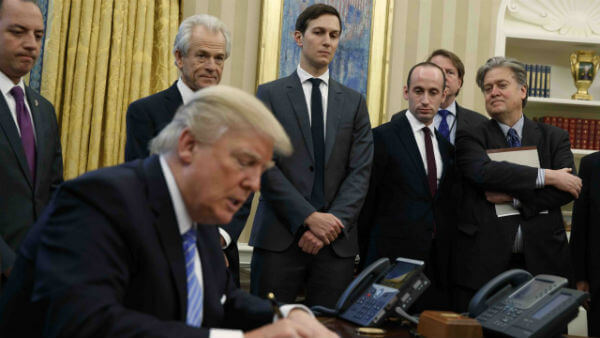
BuzzFeed reports: President Trump resurrected two massive pipeline projects on Tuesday, drawing ire and threats of legal action from the movement that fought to keep them off US land.
“We will see his administration in court,” Trip Van Noppen, president of the non-profit group Earthjustice that represented the Standing Rock Sioux tribe in challenging the Dakota Access Pipeline, said in a statement. “[Trump] should brace himself to contend with the laws he is flouting, and the millions of Americans who are opposed to these dangerous and destructive projects.”
“We are opposed to reckless and politically motivated development projects, like DAPL, that ignore our treaty rights and risk our water,” the chairman of the Standing Rock Sioux Tribe, Dave Archambault II, said in a statement. [Continue reading…]
Trump administration imposes gag order on federal scientists
BuzzFeed reports: The US Department of Agriculture has banned scientists and other employees in its main research division from publicly sharing everything from the summaries of scientific papers to USDA-branded tweets as it starts to adjust to life under the Trump administration, BuzzFeed News has learned.
According to an email sent Monday morning and obtained by BuzzFeed News, the department told staff — including some 2,000 scientists — at the agency’s main in-house research arm, the Agricultural Research Service (ARS), to stop communicating with the public about taxpayer-funded work.
“Starting immediately and until further notice, ARS will not release any public-facing documents,” Sharon Drumm, chief of staff for ARS, wrote in a department-wide email shared with BuzzFeed News.
“This includes, but is not limited to, news releases, photos, fact sheets, news feeds, and social media content,” she added. [Continue reading…]
Huffington Post reports: The Environmental Protection Agency has frozen its grant programs, according to sources there.
EPA staff has been instructed to freeze all its grants ― an extensive program that includes funding for research, redevelopment of former industrial sites, air quality monitoring and education, among other things ― and told not to discuss this order with anyone outside the agency, according to a Hill source with knowledge of the situation.
An EPA staffer provided the information to the congressional office anonymously, fearing retaliation. [Continue reading…]
Mashable reports: The communications ban directly contradicts scientific integrity policies at each agency that highlight the importance of communication between the public and agencies that are spending tax dollars to conduct government research.
The opening paragraph of the EPA’s integrity policy says it is designed to “promote scientific and ethical standards,” including “communications with the public.” It goes on to add that the policy “prohibits all EPA employees, including scientists, managers, and other agency leadership, from suppressing, altering, or otherwise impeding the timely release of scientific findings or conclusions.” [Continue reading…]
Scientific American reports: The administration’s latest actions resemble steps taken in Canada by former Prime Minister Stephen Harper while in office from 2006 to 2015; his administration blocked government scientists from speaking with media and explaining their research. Several weeks before Trump’s inauguration, Canadian scientists interviewed by Scientific American warned their U.S. counterparts about the threat of similar restrictions.
“There was a feeling that the government was not interested in expert opinion, and I think it’s the same kind of thing that you are probably going to see with the new [Trump] administration” in the U.S., David Tarasick, a senior research scientist at Environment and Climate Change Canada (the equivalent of the U.S. Environmental Protection Agency), said last month. Harper’s move drove some Canadian scientists to leave the country to pursue their research. After Harper was voted out Canadian federal scientists last year worked with their union to ensure their contracts would enshrine their ability to speak with the media and the public about their work. [Continue reading…]
Rachel Cleetus at the Union of Concerned Scientists writes: Clean air and clean water are not just “nice to have.”
Pollutants like smog, ozone, and mercury contribute to worsening asthma attacks (especially in young children), heart and lung ailments, and even premature death. What’s more, pollution imposes billions of dollars in costs to the economy in terms of hospital and other health costs, lost work days, lost school days, and other burdens, in addition to pain and suffering.
The EPA was established nearly 50 years ago, under President Nixon, with a mission to protect human health and the environment. Since then, across Republican and Democratic administrations, it has played an important role in responding to environmental disasters, from the 1979 Three Mile Island nuclear accident to the catastrophic 2008 coal ash spill in Kingston, Tennessee.
Equally important, the EPA has worked to implement major environmental laws passed by Congress, including the Clean Air Act and the Clean Water Act, which have helped to significantly to drive down harmful pollution and improve the health of Americans.
We need only look to the air quality in Beijing or New Delhi to understand where our country would be without these fundamental protections. Americans need and depend on the EPA to be our watchdog and guardian. [Continue reading…]
In deference to an FBI chief who is ‘now more famous than me,’ Trump decides to retain Comey’s services
The New York Times reports: The F.B.I. director, James B. Comey, told his top agents from around the country that he had been asked by President Trump to stay on the job running the federal government’s top law enforcement agency, according to people familiar with the matter.
A decision to retain Mr. Comey would spare the president another potentially bruising confirmation battle. It also would keep Mr. Comey at the center of the F.B.I.’s investigation into several Trump associates and their potential ties with the Russian government.
Retaining Mr. Comey could also help calm the bureau’s work force, which has been rattled after a tumultuous few months in which the F.B.I. and the director himself were sharply criticized for moves that many felt influenced the outcome of the presidential election. [Continue reading…]
Politico reports: House Democrats greeted news that FBI Director James Comey will be staying in his job with a mix of disdain and relief Tuesday.
Democratic leaders say they’ve lost confidence in the bureau head to impartially investigate any links between Russia and President Donald Trump’s campaign, given how they think Comey bungled the probe into Hillary Clinton’s email server.
But the alternative, they say, could be much worse. [Continue reading…]
Truth, lies and the Trump administration
Sean Spicer is the new Baghdad Bob @markzohar pic.twitter.com/617Dce4fDv
— Adam Khan (@Khanoisseur) January 22, 2017
Gideon Rachman writes: The man from the BBC was laughing as he reported the White House’s false claims about the size of the crowd at Donald Trump’s inauguration. He should have been crying. What we are witnessing is the destruction of the credibility of the American government.
Sign up By signing up you confirm that you have read and agree to the terms and conditions, cookie policy and privacy policy.
This spectacle of obvious lies being peddled by the White House is a tragedy for US democracy. But the rest of the world — and, in particular, America’s allies — should also be frightened. A Trump administration that is addicted to the “big lie” has very dangerous implications for global security.As Robert Moore, the Washington correspondent for ITN, puts it: “If the White House press secretary says things that we know to be demonstrably false, why will we trust him on North Korea, Russia, Iran [and the] war on Isis?” That is not just a good question — it is a vital one. [Continue reading…]
White House installing ‘senior advisers’ who will shadow each Cabinet secretary and monitor federal agencies
Politico reports: The White House is installing senior aides atop major federal agencies to shadow the administration’s Cabinet secretaries, creating a direct line with loyalists who can monitor and shape White House goals across the federal bureaucracy.
The aides chosen by the White House — given the title of senior adviser in each agency — have already been responsible for hiring at some departments and crafting the blueprint of Trump policy before the Cabinet members win Senate confirmation to take office. They have worked with congressional aides, lobbyists and others seeking influence in the new administration.
The arrangement, described by four people involved in the transition planning, appears designed to help the White House maintain control over its priorities despite pledging to give Cabinet secretaries unusual autonomy. Having senior advisers reporting to both the agency chiefs and the White House could spur early tensions and create conflicts with that pledge of autonomy.
“They want to keep kind of a West Wing-infused attachment to the agencies,” said a person familiar with the arrangement. “There will be tentacles from the White House to these agencies…The effort is to demonstrate that all points lead back to certain people,” such as Trump’s son-in-law, White House senior adviser Jared Kushner, or chief of staff Reince Priebus. [Continue reading…]
NATO has our ‘unshakeable commitment’, U.S. defence secretary Mattis vows
The Guardian reports: James Mattis, the new US defence secretary, has reassured his British counterpart that Washington has an “unshakeable commitment” to Nato, despite Donald Trump previously casting the military alliance as obsolete.
During a phone call with Michael Fallon on his first full day in office, Mattis “emphasized the United States’ unshakeable commitment to Nato”, Pentagon spokesman Captain Jeff Davis said in a statement.
Ahead of his inauguration, Trump told two European newspapers he had long warned that Nato had “problems.” [Continue reading…]
Russia is targetting French, Dutch and German elections with fake news, EU task force warns
The Telegraph reports: Russia is seeking to influence the outcome of several key elections in European countries this year with fake news, a special task force set up by the European Union has warned.
The EU is reportedly allocating more funds to its East StratCom task force to counter the disinformation, amid fears Russia will target elections in France, Germany and the Netherlands
“There is an enormous, far-reaching, at least partly organized, disinformation campaign against the EU, its politicians and its principles,” a source close to the task force told Germany’s Spiegel magazine.
It is “highly likely” Russia will try to influence European elections “as it did in the US”, the source said.
The number one target is Angela Merkel, who has been subjected to a “bombardment” of fake news over her refugee policy and support for economic sanctions against Russia.
Disinformation is “part of state policy” and a “military tool” for the Kremlin”. [Continue reading…]
Obama administration released $221M to Palestinians in final hours
The Associated Press reports: Officials say the Obama administration in its waning hours defied Republican opposition and quietly released $221 million to the Palestinian Authority that GOP members of Congress had been blocking.
A State Department official and several congressional aides said the outgoing administration formally notified Congress it would spend the money Friday morning. The official said former Secretary of State John Kerry had informed some lawmakers of the move shortly before he left the State Department for the last time Thursday. The aides said written notification dated Jan. 20 was sent to Congress just hours before Donald Trump took the oath of office.
In addition to the $221 million for the Palestinians, the Obama administration also told Congress on Friday it was going ahead with the release of another $6 million in foreign affairs spending, including $4 million for climate change programs and $1.25 million for U.N. organizations, the congressional aides said. The aides and the State Department official weren’t authorized to speak publicly on the matter and demanded anonymity. [Continue reading…]
Music: Mario Biondi ft. Al Jarreau — ‘Light To The World’
Misogynist-in-chief: Trump takes swift action to restrict women’s rights globally

Reuters reports: U.S. President Donald Trump on Monday reinstated a global gag rule that bans U.S.-funded groups around the world from discussing abortion, a move that was widely expected but nonetheless dismayed women’s rights advocates.
The rule, which affects American non-governmental organizations working abroad, is one that incoming presidents have used to signal their positions on abortion rights. It was created under U.S. President Ronald Reagan in 1984.
Trump, an abortion opponent, signed the reinstatement directive at a ceremony in the White House on his fourth day in office. Former President Barack Obama had lifted the gag rule in 2009 when he took office.
“Women’s health and rights are now one of the first casualties of the Trump administration,” said Serra Sippel, president of the Center for Health and Gender Equity in Washington. [Continue reading…]
Parliament must vote before UK can trigger Brexit, top court rules
Reuters reports: British Prime Minister Theresa May must give parliament a vote before she can formally start Britain’s exit from the European Union, the UK Supreme Court ruled on Tuesday, giving lawmakers who oppose her Brexit plans a shot at amending them.
By a majority of eight to three, the UK’s highest judicial body decided May could not use executive powers known as “royal prerogative” to invoke Article 50 of the EU’s Lisbon Treaty and so begin two years of divorce talks.
“The referendum is of great political significance, but the Act of Parliament which established it did not say what should happen as a result,” said David Neuberger, President of the Supreme Court.
“So any change in the law to give effect to the referendum must be made in the only way permitted by the UK constitution, namely by an Act of Parliament.”
However, the judges did remove one major potential obstacle for the British government, saying May did not need the approval of the UK’s devolved assemblies in Scotland, Wales and Northern Ireland before triggering Brexit. [Continue reading…]
Fake day: Executive order places all Americans in spirit at Trump’s inauguration
Michael Weiss writes: Well, I suppose a man who derives verbal inspiration from Charles Lindbergh, James Cameron and Bane, a man who celebrates fallen American intelligence operatives by comparing his cover appearances on Time magazine to those of Richard Nixon, can’t really be faulted for naming a holiday after his own resistible rise to power.
But the floridity that strikes the eye and ear in Donald Trump’s first presidential proclamation, heralding the day of his inauguration as a “National Day of Patriotic Devotion,” eerily echoes another insecure authoritarian’s advertisement for himself.
“Today, feelings of patriotism and love for the Motherland are truly invaluable for our vast multiethnic country. These noble qualities and the steadfast civic-mindedness of our people underpin the country’s unity and sovereignty.
“Of course, many factors are essential for the security of the country and its stable development. But they are only effective if people believe in their Fatherland, have respect for it and support it, if they consider our country the best and aspire to live and work for its prosperity.”
Thus spake Vladimir Putin on Russia Day, June 12, 2016.
Now compare. “A new national pride stirs the American soul and inspires the American heart,” the new commander-in-chief informs us, referring to nothing so new as his own state of becoming commander-in-chief. “We are one people, united by a common destiny and a shared purpose.”
I wouldn’t quite put it like that to the millions of women and men who marched in every major American city on Saturday, much eclipsing the headcount at Trump’s rainy Friday anointment. They seemed to declare their destiny and purpose distinctly at odds with how the pussy-grabbing, wall-building executive chooses to define these. And any sensible viewer of White House press secretary Sean Spicer’s first two performances on the size of the crowd at the National Mall, or Kellyanne Conway’s reference to alternative facts on Meet the Press by way of justifying that lie, emblematic of every wobbly despotism, will have been stirred by a feeling other than pride. [Continue reading…]
Pentagon denies claim of a joint U.S.-Russian airstrike on Syria
The Daily Beast reports: No, U.S. and Russian warplanes are not flying combat missions together over Syria. Yet.
That startling claim, which spread across the U.S. news media on the afternoon of Jan. 23, 2017, began with a vague and misleading tweet by the Associated Press that was apparently based in part on a misreading of reports by Russian state media.
“BREAKING: Russian Defense Ministry says its warplanes have flown first combat mission in Syria with U.S.-led coalition aircraft,” the A.P. tweeted at 12:18 P.M. EST.
The Pentagon flatly denied the claim. “The Department of Defense is not coordinating airstrikes with the Russian military in Syria,” department spokesman Eric Pahon told The Daily Beast. “DoD maintains a channel of communication with the Russian military focused solely on ensuring the safety of aircrews and de-confliction of coalition and Russian operations in Syria.”
The A.P.’s report is inaccurate, but the wire service’s confusion is perhaps understandable — and, for Moscow, might even be the whole point. It’s not hard to see how Russia benefits from news reports claiming that the United States and Russia are fighting side-by-side in Syria.
After all, U.S. President Donald Trump seems to be pushing the Pentagon in that direction. [Continue reading…]
Philip Roth: Neither Richard Nixon nor George W Bush was anything like as humanly impoverished as Donald Trump
Judith Thurman writes: In 2004, Philip Roth published “The Plot Against America.” The four main characters of the novel, which takes place between June, 1940, and October, 1942, are a family of American Jews, the Roths, of Newark — Bess, Herman, and their two sons, Philip and Sandy. They are ardent supporters of Franklin Delano Roosevelt, but, in Roth’s reimagining, Roosevelt loses his bid for a third term to a surprise Republican candidate — the aviator Charles Lindbergh — whose victory upends not only politics in America but life itself.
The historical Lindbergh was an isolationist who espoused a catchphrase that Donald Trump borrowed for his Presidential campaign, and for his Inaugural Address: “America First.” The fictional Lindbergh, like the actual Trump, expressed admiration for a murderous European dictator, and his election emboldened xenophobes. In Roth’s novel, a foreign power — Nazi Germany — meddles in an American election, leading to a theory that the President is being blackmailed. In real life, U.S. intelligence agencies are investigating Trump’s ties to Vladimir Putin and the possibility that a dossier of secret information — kompromat — gives Russia leverage with his regime.
Roth wrote in the Times Book Review that “The Plot Against America” was not intended as a political roman à clef. Rather, he wanted to dramatize a series of what-ifs that never came to pass in America but were “somebody else’s reality” — i.e., that of the Jews of Europe. “All I do,” he wrote, “is to defatalize the past — if such a word exists — showing how it might have been different and might have happened here.”
Last week, Roth was asked, via e-mail, if it has happened here. He responded, “It is easier to comprehend the election of an imaginary President like Charles Lindbergh than an actual President like Donald Trump. Lindbergh, despite his Nazi sympathies and racist proclivities, was a great aviation hero who had displayed tremendous physical courage and aeronautical genius in crossing the Atlantic in 1927. He had character and he had substance and, along with Henry Ford, was, worldwide, the most famous American of his day. Trump is just a con artist. The relevant book about Trump’s American forebear is Herman Melville’s ‘The Confidence-Man,’ the darkly pessimistic, daringly inventive novel — Melville’s last — that could just as well have been called ‘The Art of the Scam.’ ”
American reality, the “American berserk,” Roth has noted, makes it harder to write fiction. Does Donald Trump outstrip the novelist’s imagination?
Roth replied, “It isn’t Trump as a character, a human type — the real-estate type, the callow and callous killer capitalist — that outstrips the imagination. It is Trump as President of the United States.
“I was born in 1933,” he continued, “the year that F.D.R. was inaugurated. He was President until I was twelve years old. I’ve been a Roosevelt Democrat ever since. I found much that was alarming about being a citizen during the tenures of Richard Nixon and George W. Bush. But, whatever I may have seen as their limitations of character or intellect, neither was anything like as humanly impoverished as Trump is: ignorant of government, of history, of science, of philosophy, of art, incapable of expressing or recognizing subtlety or nuance, destitute of all decency, and wielding a vocabulary of seventy-seven words that is better called Jerkish than English.” [Continue reading…]
Fake popularity: Trump’s cheering entourage deployed for his CIA appearance; majority of workforce declined invitation to attend
CBS News reports: U.S. government sources tell CBS News that there is a sense of unease in the intelligence community after President Trump’s visit to CIA headquarters on Saturday.
An official said the visit “made relations with the intelligence community worse” and described the visit as “uncomfortable.”
Authorities are also pushing back against the perception that the CIA workforce was cheering for the president. They say the first three rows in front of the president were largely made up of supporters of Mr. Trump’s campaign.
An official with knowledge of the make-up of the crowd says that there were about 40 people who’d been invited by the Trump, Mike Pence and Rep. Mike Pompeo teams. The Trump team originally expected Rep. Pompeo, R-Kansas, to be sworn in during the event as the next CIA director, but the vote to confirm him was delayed on Friday by Senate Democrats. Also sitting in the first several rows in front of the president was the CIA’s senior leadership, which was not cheering the remarks [Continue reading…]
How Donald Trump became a national security threat
John Schindler writes: For the first time, an American president is causing our allies and partners to wonder if Washington can still be trusted.
As I’ve explained, Trump’s aggressive comments about American spies — mocking them and comparing them to Nazis on Twitter, for example — have generated unprecedented enmity in our Intelligence Community. Going to war with the IC is a bad idea for any new administration, particularly given the new commander-in-chief’s rumored links to Vladimir Putin, which are keeping American spies up at night.
It’s not just Washington that’s worried. Throughout the Western spy alliance, intelligence agencies are pondering the previously unthinkable: Is the American president compromised? On several occasions over the decades, the IC had to reduce spy-links, usually only temporarily, to various partners when a new government contained too many cabinet ministers with Moscow linkages. Now the shoe is on the other foot, and it’s the American government that seems to have a Kremlin problem.
Just how alarming things are was revealed by a recent report in The Times of London that British intelligence has asked the IC for reassurances that the new administration — which has several officials with Kremlin ties that aren’t exactly hidden — won’t compromise British spies operating clandestinely inside Russia. When America’s oldest and most intimate intelligence partner is worried that the White House can’t be trusted with secrets, we’re in uncharted and dangerous waters.
The cost of breakdowns in the Western spy alliance won’t be theoretical. If intelligence sharing wanes, the world gets more dangerous and jihadist attacks will increase, perhaps quite quickly. When spy-partners aren’t confident their shared secrets can be protected, they will become reticent to talk to us. As Mike Hayden, the former director of both NSA and CIA explained, “How many foreign intelligence agencies might say, ‘I’m not sure giving this information to the Americans will do any good anyway. So why should we share it in the first place?’ If they come to the conclusion that the decision-makers don’t pay attention to the intelligence and the Intelligence Community is not respected, then why take the risk?” [Continue reading…]
The Trump administration seems poised to further unleash the CIA’s paramilitary branch
Joshua Kurlantzick writes: [T]he Trump administration is poised to accelerate a transformation that has been happening, in fits and starts, since the 1960s, with the CIA becoming less of an outfit focused on spying and more of a paramilitary organization with a central role in violent conflicts.
Further increasing the use of CIA paramilitaries and the Pentagon’s Special Forces in places such as Syria and Afghanistan would have potentially grave consequences for U.S. foreign policy — and for the United States’ leadership in the world. These paramilitaries are almost totally unaccountable, and unaccountability encourages rash, even criminal, behavior, including disdain for civilian lives, torture and other abuses. And, as demonstrated by a secret war in the 1960s and early ’70s — the most important precedent for today’s war on terror — it’s hard to win by using the CIA and Special Forces rather than conventional troops.
Fifty-six years ago, another incoming president decided to empower the CIA’s paramilitaries, relying on covert war rather than conventional fighting.
Before taking the oath of office in 1961, John F. Kennedy had (privately) squabbled with some CIA leaders, who saw him as inexperienced and potentially reckless.
The CIA was only 14 years old then and a relatively small player in the American policymaking apparatus, one with far less power and fewer resources than the Departments of Defense and State. The agency mostly concentrated on traditional intelligence and political work, such as spying and trying to overthrow foreign governments believed unfriendly to the United States. It did a small amount of training of foreign forces, but no battlefield commanding.
Once in office, however, Kennedy approved the expansion of what would become the largest covert U.S. operation in history, in the tiny Southeast Asian nation of Laos. In a shift that could prove familiar in 2017, his decision dramatically empowered the same CIA that had worried about the new president.
The political climate at the time Kennedy took office also was in some ways similar to today’s. After a bloody stalemate in Korea, and the defeat of U.S.-backed French troops in Vietnam in 1954, many Americans were tired of conventional war and interventionism in general. Yet foreign policy elites believed that the United States faced an existential threat: Communism was spreading through Asia, first to China and North Vietnam and then to Laos, and possibly beyond. A secret war, one that used relatively few U.S. combatants and relied on foreign proxy forces and bombing from above, came to be seen as the safest choice, politically, for the Kennedy administration.
The CIA’s involvement in Laos, which expanded in 1961 with a small training program for anti-communist fighters, ramped up quickly. It would grow over the course of the 1960s and into the early 1970s, with few Americans, and not even many members of Congress, knowing anything about it. The CIA recruited tens of thousands of U.S. contractors, paramilitary fighters and local Laotian warriors in an ultimately futile attempt to transform Laotian guerillas into a conventional army capable of stopping Hanoi and its local allies. U.S. bombers, working in concert with CIA paramilitaries, destroyed much of Laos while attacking Laotian and North Vietnamese communists. They dropped more bombs on Laos than on Germany and Japan combined in World War II. The country was left with so much unexploded ordnance that, in the four decades since Laos’s civil war ended in 1975, the leftover bombs have killed 20,000 Laotians.
The war cemented the CIA’s place as an organization with power on par with the Departments of Defense and State — and one increasingly dedicated to activities such as arming and advising foreign forces, managing conflicts and even overseeing targeted killings. CIA operatives went on to play roles in covert wars in Central America and Afghanistan in the 1980s, as well as in conflict zones in the war on terror. As Foreign Policy magazine has characterized it, the CIA is now “pulling the strings of U.S. foreign policy” — overseeing drone strikes and managing many aspects of the fight against the Islamic State. And according to documents released by former National Security Agency contractor Edward Snowden, the CIA’s budget appears to be greater than the State Department’s, a dramatic reversal from the early Cold War. While Brennan is recognized for leading an effort to reduce walls between operatives and analysts and fortify some of the agency’s traditional functions, he also oversaw an increase in the strength of paramilitary operations. In 2015, he promoted a paramilitary operative to head the clandestine branch — reportedly the first time a paramilitary officer took on the top undercover position.
Although Trump’s rhetoric suggests that he could rein in the CIA, the reality, as during Kennedy’s time, will probably be the reverse. The agency’s paramilitary branch, along with the military’s Special Forces — the two have become intertwined in policy and practice — will be further unleashed in a twilight war. [Continue reading…]

Are we entering an era in which ‘truth’ is whatever Trump wants it to be?
Shortly before Trump took office, Ruth Ben-Ghiat wrote: Although we cannot yet know what kind of president he will be, from his June 2015 declaration of candidacy to his January 2017 inauguration, Trump has undertaken two parallel projects aimed at unsettling the mental habits and moral foundations of American democracy. First, he has cultivated a political persona that inspires adulation and unquestioning loyalty that can be mobilized for action on his behalf. Second, he has initiated Americans into a culture of threat that not only desensitizes them to the effects of bigotry but also raises the possibility of violence without consequence.
The founding moment of this era came one year ago, when Trump declared at a rally, “I could stand on Fifth Avenue and shoot someone and not lose any voters.” Trump signaled that rhetorical and actual violence might have a different place in America of the future, perhaps becoming something ordinary or unmemorable. During 2016, public hatred became part of everyday reality for many Americans: those who identify with the white supremacist alt-right like Richard Spencer openly hold rallies; elected officials feel emboldened to call for political opponents to be shot (as did New Hampshire and Oklahoma State Representatives Al Baldasaro and John Bennett, among others); journalists reporting on Trump and hijab-wearing women seek protection protocols and escorts. The bureaucratic-sounding term many use for this, “normalization,” does not fully render the operations of memory that make it possible. Driven by opportunism, pragmatism, or fear, many begin to forget that they used to think certain things were unacceptable.
The risk is that the parameters of thought and action will be nudged to align with those of the leader, easing the retrofitting of history to suit his personalization of the land’s highest office. Trump’s success at this in a country known for individualism, and with no history of living under an authoritarian ruler, shows how susceptible people are to such approaches.
Trump’s bullying charm anchors this culture of threat. From the start he cultivated a relationship with followers founded on an allegiance to his person, and not to a party or principle. He devised campaign rituals (loyalty oaths, “lock her up” chants directed at imprisoning his opponent) that created a bond of charismatic authority and accustomed his constituents to his heavy hand. At his rallies he harangued his crowds, directing them emotionally, urging them to punish protesters as he expressed his own desires to punch offenders in the face. “You were nasty and mean and vicious, you wanted to win, right?” he told his fans after the election.
Twitter has been an excellent training ground for the acceptance of Trump’s cult of personality and the memory politics that undergird it. His skill at orchestrating the news cycle through tweets keeps Americans caught in the web of an “eternal present,” their attention focused on his aggressive outbursts that are dissected by the media and the public with the fervor of Communist-era Kremlinologists. His domination of the media landscape, on Twitter and elsewhere, realizes the authoritarians’ dream: to be everywhere present while remaining in your palace, and able to influence both big policy decisions and small daily habits with a few strokes of your pen. The writer Italo Calvino, who recalled that Mussolini’s face was “always in view” during the first 20 years of his life, would have appreciated how a few critical tweets from the leader-to-be led the storied Ford Motor Company to quickly scrap long-held plans for a $1.6 billion assembly plant in Mexico, and express its “confidence” in his business acumen.
The deference to the leader allows another crucial element of authoritarian rule to fall into place: the discrediting of all alternate sources of information. The confusion sowed by Trump from the start of his campaign (“we’ve got to figure out what’s going on”), which crucially extends to the facts of his personal history (Putin? “I don’t know him”), built to a blanket denunciation of all non-Trump information. “Media is fake!” the president-elect tweeted on January 8, preparing Americans for the onset of a new era in which truth is what Trump wants it to be. [Continue reading…]